Edward Lear, Kom Ombo

Edward Lear, Kom Ombo, Egypt.
Signed with monogram (lower left); stamped with the collector stamp of Earl Spencer (lower right). Watercolour, 17.6 x 37.8cm (6 15/16 x 14 7/8in).

Provenance
Edward John Spencer, 8th Earl Spencer Collection, UK (Frits Lugt L.2341a).
Max Harari Collection, UK (acquired from the above).
Thence by descent.

I strongly long to go to Egypt….I am quite crazy about Memphis and On & Isis & crocodiles… the contemplation of Egypt must fill the mind… with great food for the rumination of long years.
(Edward Lear, letter to Chichester Fortescue, 1848)

Lear’s fascination with Egypt led him to make three visits during his lifetime; the first, in January 1849, was a week-long stay, exploring Cairo and the Pyramids before carrying on towards Sinai. His second visit came at the end of 1853, with his first trip down the Nile in early 1854, travelling as far south as Philae. He returned in December 1866, staying for three months, and making a second trip on the Nile in January 1867, reaching Wadi Halfa.

Lear’s letters reveal his joy in capturing the life and landscape of Egypt: ‘In no place … can the variety & simplicity of colours be so well studied as in Egypt; in no place are the various beauties of shadow more observable, or more interminably numerous. Every mud bank is a picture, every palm- every incident of peasant life’. But Lear was also frustrated in his efforts, critical of his earlier work, noting ‘It seems to me, my former drawings were not severe enough: & certainly I never made enough of the grayness of local colour, nor of the atmosphere’1.

When back in his studio, Lear worked his colour sketches into finished compositions, producing over 40 oils of Egyptian subjects – including Royal Academy submissions in 1856 and 1871 – as well as numerous watercolours. The high finish and lack of annotation and numbering on the present lot and lots 74, 75 and 76 suggests that these works may have been produced in his studio, rather than having been drawn on the spot.

The Temple of Kom Ombo lies 30 miles north of Aswan, its location a crossroads between the caravan route from Nubia and the trails to the gold mines in the eastern desert areas. Constructed during the Ptolemaic dynasty, with later additions made during the Roman period, the temple’s unique double design was intended for the devotion of two sets of gods.

Lear first visited Kom Ombo in 27 January 1854, during his first Nile trip (see Christie’s, London, 12 July 1994, lot 122), stopping again on his return on 10 February: a very similar composition to the present lot is in the collection of Harvard University, Houghton Library, with the interesting colour note ‘The stones are/just like those below Winchelsea & Hastings’.

Lear also visited Kom Ombo on 20 February 1867, during his second Nile trip (see Christie’s, London, 5 July 2016, lot 128); inbetween these visits, he also produced an oil of Kom Ombo in 1856, working from watercolour sketches made in 1854, as was his practice.

See also Christie’s, South Kensington, 1 July 2004, lot 182 and 6 December 2012, lot 276 for further examples.

1 Quoted in Vivien Noakes, The Painter Edward Lear, Newton Abbot, 1991, passim.

Bonhams.

Posted in Edward Lear | Tagged , , , , | Leave a comment

Edward Lear, Auribeau (1868)

Edward Lear, Auribeau.
Signed with monogram l.r., inscribed ‘Abribeau’ and dated ‘1868’ l.l. watercolour 33 x 51.5 cm. (13 x 20 1/4 in.)

Lear was in Cannes until April of 1868. From there he could make expeditions into the hills; he and his servant Giorgio would leave Cannes early in the morning, and he would spend the day drawing.

Lear made several visits to Auribeau- a medieval village between Cannes and Grasse. It is perched on top of a rocky peak above the Siagne gorge and has stunning views of the surrounding mountains.
Lear’s European travels were now coming to an end and with the exception of a few drawings produced in the Italian Alps during the summer months of the 1880s, his depictions of the South of France were the last of his European drawings. Lear, was at the height of his powers as a draughtsman and watercolourist when he painted the present work which is a stunning rendition of this beautiful hilltop town.

Bonhams.

Posted in Edward Lear | Tagged , , , , | Leave a comment

Edward Lear, Italian Peasant (1860)

Edward Lear, An Italian peasant.
Inscribed and dated ‘Rome, April 17. 1860’. Pen and ink and pencil 10.5 x 16 cm. (4 1/4 x 6 1/4 in.)

Bonhams.

Posted in Edward Lear | Tagged , , , | Leave a comment

Edward Lear, An Italian landscape with San Eusebio in the distance (1845)

Edward Lear, An Italian landscape with San Eusebio in the distance.
Inscribed throughout and dated ‘6 January 1845’, brown ink and wash, 18 x 37 cm (7 1/8 x 14 1/2 in.)

Bonhams.

Posted in Edward Lear | Tagged , , , , | Leave a comment

Edward Lear, Italian Lanscape (1840)

Edward Lear, An Italian landscape.
Signed and dated 1840. Pencil 24.1 x 36.9 cm. (9 1/2 x 14 1/2 in.)

Provenance
With Spink, London.

Bonhams.

Posted in Edward Lear | Tagged , , , | 1 Comment

Edward Lear, Honister from near Buttermere (1836)

Edward Lear, Honister from near Buttermere.
Inscribed and dated ’27 Sept 1836′ pencil and black chalk on blue paper. 17.8 x 26 cm. (7 x 10 1/4 in.)

Provenance
With Spink, London.

Lear’s visit to Cumbria in 1836 was one of his first sketching tours, he recorded that: “the counties of Cumberland and Westmoreland are superb indeed, & tho the weather has been miserable, yet I have contrived to walk pretty well over the whole ground, & to sketch a good deal besides”.

Posted in Edward Lear | Tagged , , , , | 1 Comment

Edward Lear, Howara (1849)

Edard Lear, Near Ain Howara, Sinai Peninsula.
Extensively inscribed, dated ’19 January 1849, 4.30 pm’, pen and ink. 19.7 x 40.2 cm. (7 3/4 x 16 in.)

Lear’s first visited Egypt in January 1849, he spent a week in Cairo before setting out for Sinai, he travelled down the west coast of the Sinai peninsula before turning inland towards the mountains.

Bonahms.

Posted in Edward Lear | Tagged , , , , | Leave a comment

Why, How, and When to Write on Edward Lear

Matt Bevis, who has edited Edward Lear and the Play of Poetry with James Williams (now available in paperback), published several essays and posted lectures on Edward Lear (search for his name on the blog) has now published a personal memoir of writing on him for Poetry magazine: you can read “Some Birds” here.

Posted in Edward Lear | Tagged , , | Leave a comment

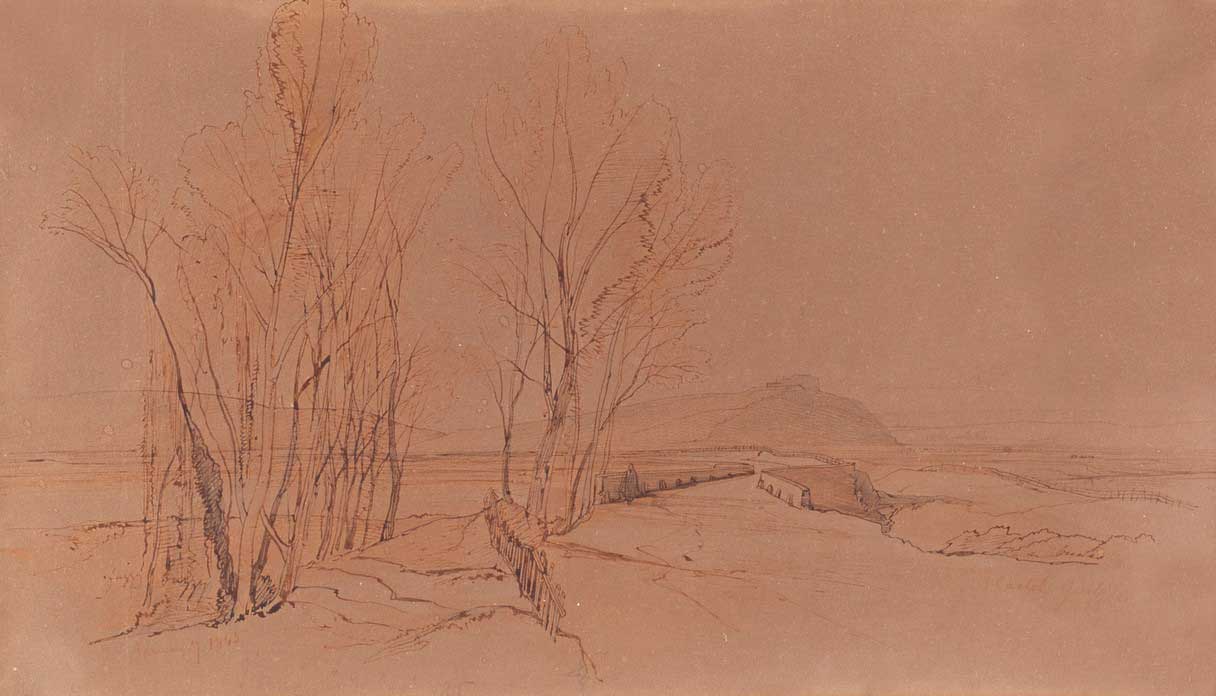
Edward Lear, Castel Giubileo (1845)

Edward Lear, Castel Giubileo.
Jan 7th 1845/brown ink, 21.5cm x 38cm.

“Castel Giulrile”, as it is called in the auction, does not exist as far as I know, while Castel Giubileo, which can be read even though not very clearly as it is written in pencil, is nowadays on the outskirts of Rome, the area where Lear was at the time.

The Saleroom.

Posted in Edward Lear | Tagged , , , | Leave a comment

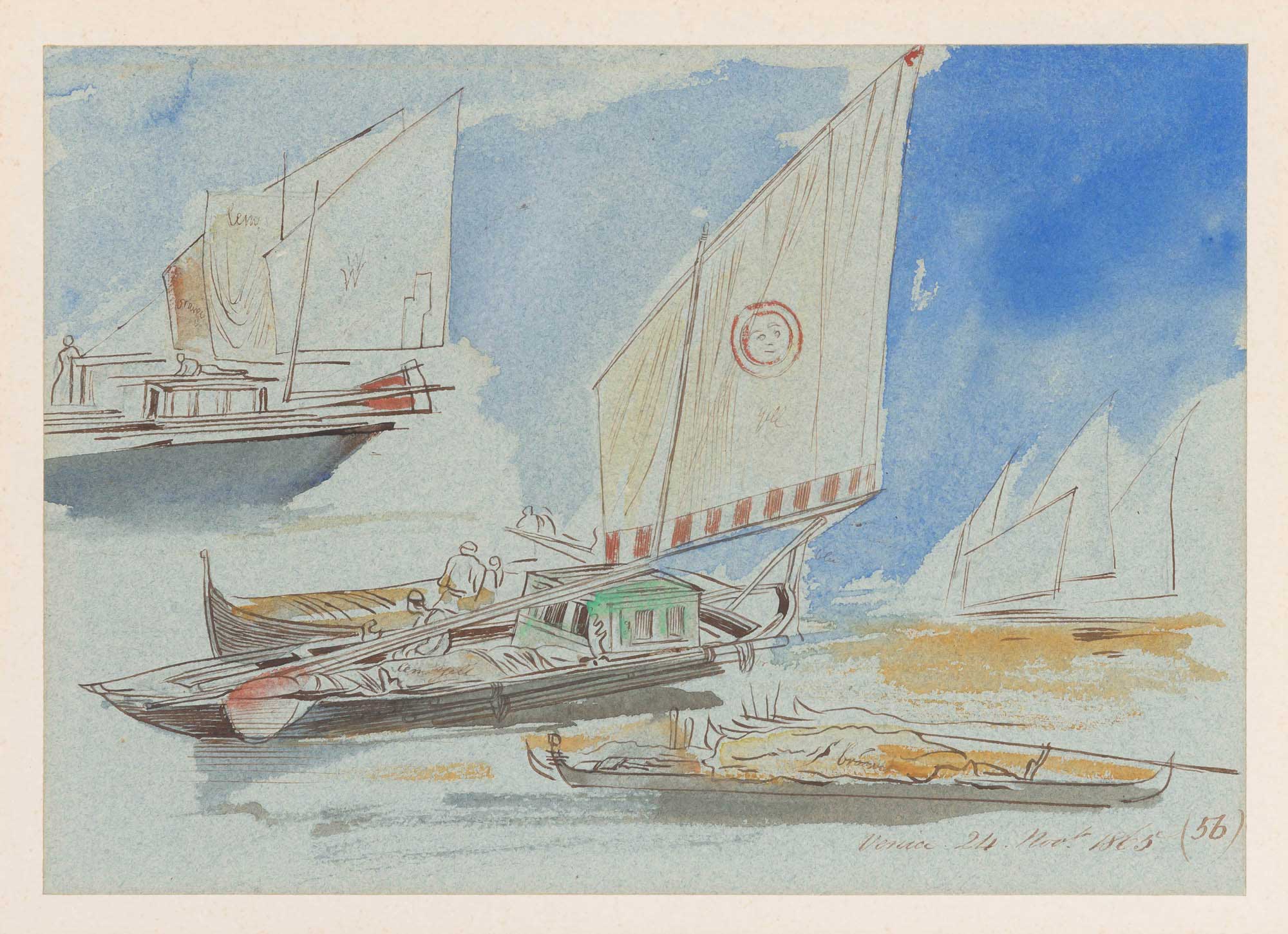
Edward Lear, Sailing Barges, Venice (1865)

Edward Lear, Sailing Berges, Venice, 1865.
Inscribed and dated Venice 24. Nov. 1865 (56) (lr). Ink, watercolor and gouache with traces of pencil on light blue/gray paper. 7 x 10 inches (17.8 x 25.4 cm).

Provenance
Thos. Agnew & Sons, Ltd., London, no. 29431

Doyle.

Posted in Edward Lear | Tagged , , , , | Leave a comment