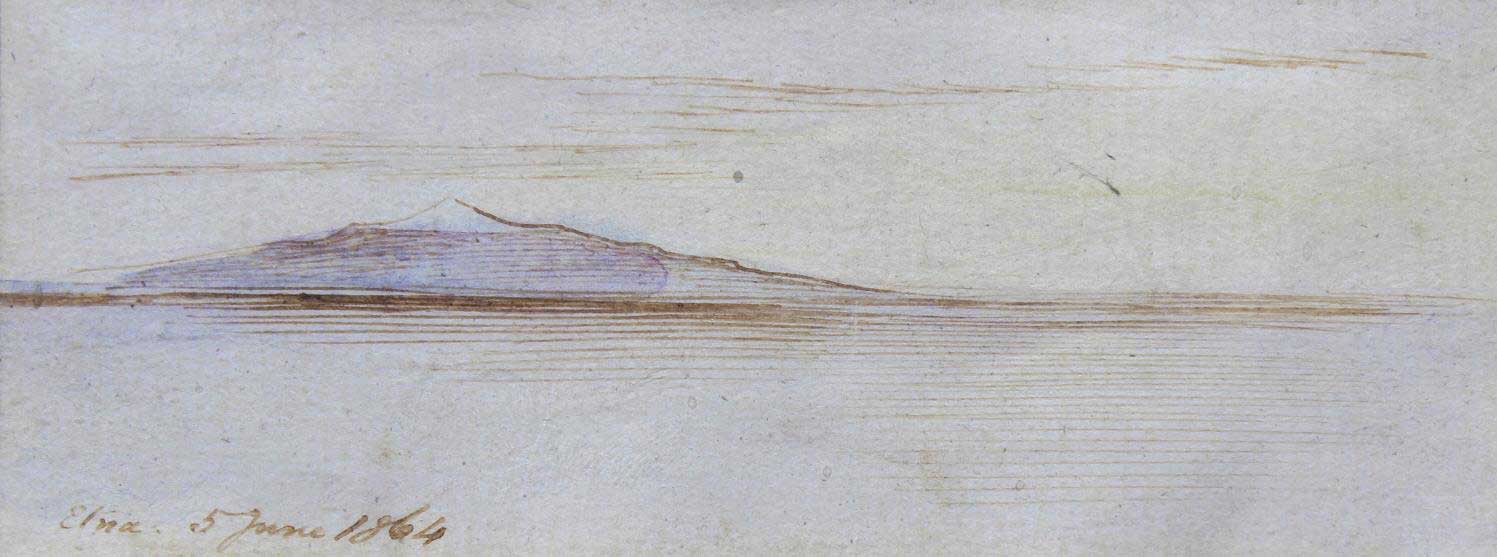
Edward Lear, Etna.
Inscribed Etna 5 June 1864, watercolour with pen and ink
4 x 11cm.
[Drawn while getting back from Crete.]
Edward Lear, Etna.
Inscribed Etna 5 June 1864, watercolour with pen and ink
4 x 11cm.
[Drawn while getting back from Crete.]
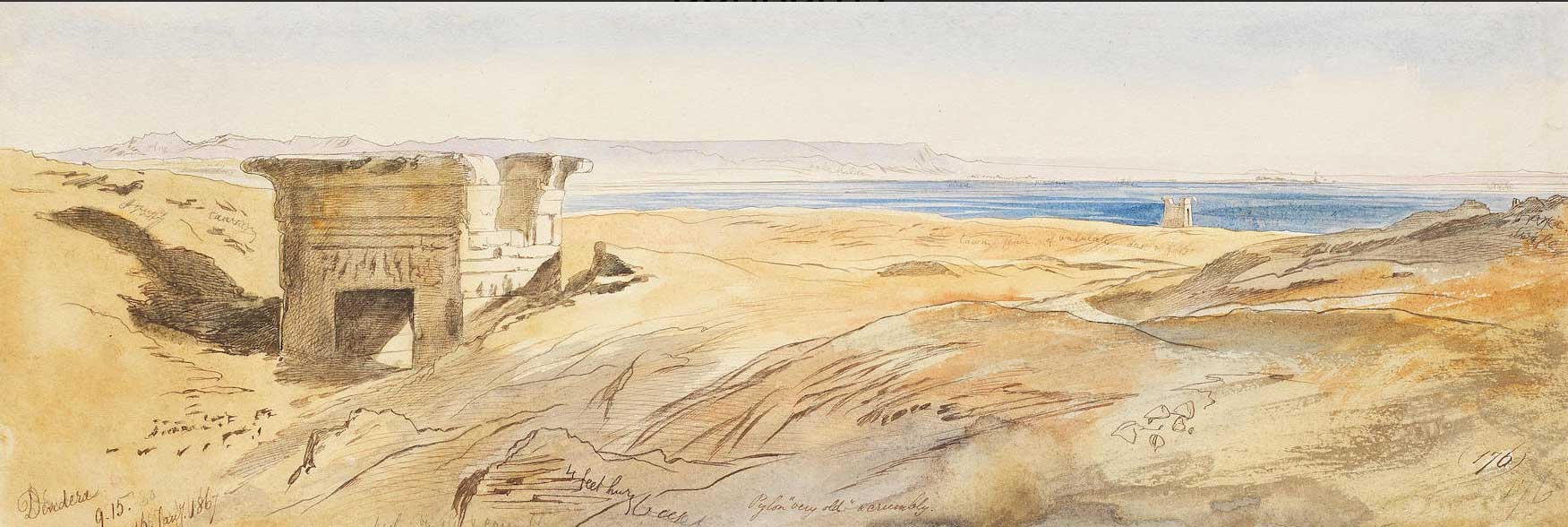
Edward Lear, Dendera, with a View of the Nile.
Inscribed and dated ‘Dendera/9.15./16 Jany.1867′ (lower left); numbered ‘176’ (lower right); variously annotated throughout. Pen, ink and wash. 17 x 50.5cm (6 11/16 x 19 7/8in).
Provenance
Anon. sale, Sotheby’s, London, 17 November 1988, lot 187.
Spink, London.
Private collection, UK.
The present lot was executed during Lear’s third and final visit to Egypt, between December 1866 and March 1867. During January Lear visited Dendera – a Temple 40 miles downriver from Luxor – and produced a series of numbered drawings. For similar examples see a pair of works sold Bonhams, London, 26 September 2019 (numbered 170 & 175); Christie’s, London, 2 April 1996, lot 100 (numbered 169) and Bonhams, London, 6 December 2012, lot 102 (numbered 153).
As common with Lear’s drawings, various inscriptions and colour notes are scattered throughout the present lot (for example ‘tawny’ and ‘sandy’). In the middle foreground is commentary that the ‘Pylon [is] “very old” & crumbly’. Further in the distance, scribbled over an expanse of land is the observation that prior to reaching the Nile, there is a ‘tawny plain of undulating dust’.
2021 marks the 150th anniversary of the publication of Edward Lear’s “The Owl and the Pussy-cat” and St Leonards-on-Sea devotes its A Town Explores a Book festival, 1-18 April 2021, to Nonsense Songs, Stories, Botany and Alphabets, the book in which the poem was first collected.
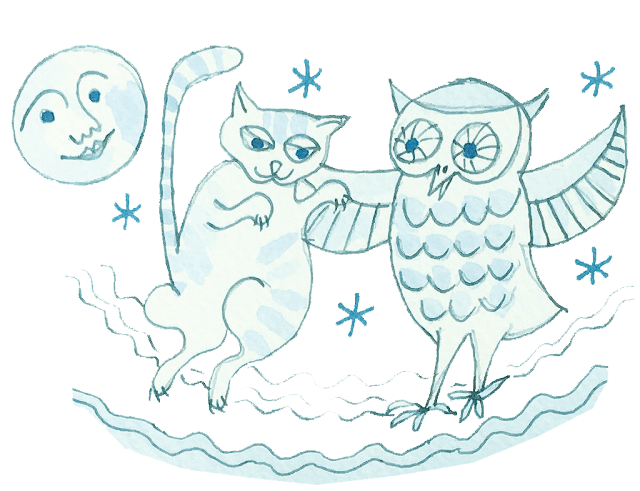
They have launched a Crowdfunder which ends on 1 October (National Poetry Day) and still need to collect about £2,000 in the next two days. So please help them reach their target, and then visit the town, where Lear stayed for long periods to paint.
TED Ed has released a fun animated retelling of Lewis Carroll’s epic nonsense poem, Jabberwocky from his classic novel Through the Looking-Glass, and What Alice Found There.
Poem by Lewis Carroll, directed by Sjaak Rood.
Dive into Lewis Carroll’s epic nonsense poem, “Jabberwocky” from his novel Through the Looking-Glass, and What Alice Found There. — As Alice wanders through the dreamscape of Looking-Glass Land in Lewis Carroll’s “Through the Looking-Glass, and What Alice Found There,” she happens across a book written in an unintelligible language. Inside, she discovers an epic poem filled with nonsense, fearsome creatures, and whimsical language.
Music video for Town of Cats‘s “The Owl’s Song,” by Morgan Twiston Davies.
A celebration of Edward Lear’s “The Owl and the Pussy-cat,” embracing nonsense and following life, love, and joy in all directions. The film was traditionally animated, and digitally coloured and composited. Linework was a technical pen and wax pencils, backgrounds were watercolour, oil pastel, and ink. Most of the film was thoroughly planned, but the end segment was improvisational animation to flow alongside the sax solo.
From Cartoon Brew.

Edward Lear, The Tomb of Cecilia Metella on the Via Appia, Rome.
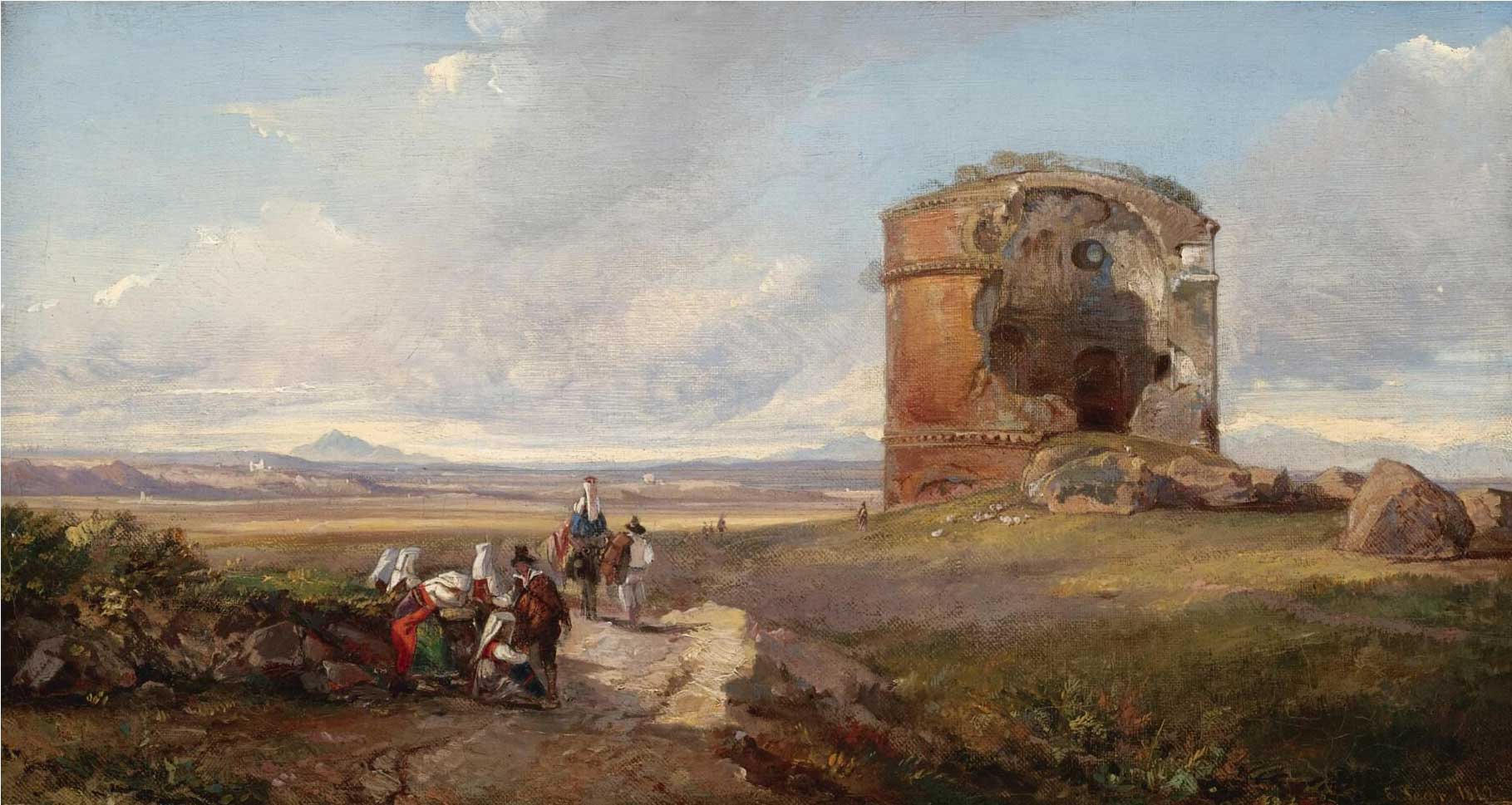
Edward Lear, The Tor di Schiavi on the Via Labicana, Rome.
The former signed l.l.: 1842 / Ed Lear the latter signed l.r.:E.Lear.1842. A pair, both oil on canvas. Each 23 by 44 cm., 9 by 17½ in.
Provenance
Painted for Captain and Miss Phipps Hornby of Shooters Hill, Kent;
Miss Edith Jones, and thence by descent until sold, Sotheby’s, 29th October 1986, lots 308 and 309
The tomb of Cecilia Metella was built circa 50 BC. Cecilia Metella was the daughter of a Roman Consul, Creticus. She married the son of Crassus, a member of the first Roman Triumvirate and one of the richest men in Rome in the first century BC, but little more is know about her. The Via Labicana is an ancient road running south east from Rome.
Lear travelled to Italy in 1837 and, with the exception of two visits to England in 1841 and 1845-6, he stayed there for the next ten years. He was part of an international community of artists, and he maintained his financial independence by teaching drawing, selling his pictures, and writing two illustrated books on Italy.

Rube Goldberg, from Tit-Bits, 15 April 1933. Aventuras de Boborikin ran in the Argentinian magazine Tit-Bits at least from 1932 to 1934.
This collection of invented animals is reminiscent of The Laughable Looloos by Helen Stilwell, Goldberg’s screwball-comics collegue, Gene Carr’s wife.

Edward Lear, A Temple in India.
Signed with the artist’s monogram lower left. Watercolor heightened with white over traces of pencil on paper. 6 1/8 by 10 1/8 in. 15.5 by 25.7 cm.
Long a frequent traveller, Edward Lear’s last extended journey was to India between 1873-1875. Though he was over sixty years old, the aging artist travelled thousands of miles over several months. The tropical vegetation of the area was particularly fascinating to the artist, as suggested by the present work’s long, loosely painted vines and intricately detailed interwoven trunks of the trees, among which monkeys scamper (Vivien Nokes, The Painter Edward Lear, London, 1991, p. 92).

Edward Lear, Philae, Egypt.
Pen and brown ink and watercolour over pencil, on laid paper; inscribed lower left: Philae / 2pm / 30 Jany.1867, numbered lower right: (273) and further inscribed with colour notes. 280 by 530 mm.
Provenance
With Agnew’s, London,
by whom sold to John, Lord D’Ayton (1922-2003);
thence by descent to the present owners
Exhibited
London, Sotheby’s, Edward Lear, An Exhibition of Works by Edward Lear from the D’Ayton International Collection, assembled by John D’Ayton, 2004, no. 22
The present watercolour is dated 30th January 1867. Taken from the rocky banks of the Nile to the west of the island of Philae, Lear appears to delight in his depiction of the dramatic landscape, while the Ptolomaic Temple of Isis and the Kiosk of Trajan are dwarfed by towering cliffs.
When Lear had last visited Philae, thirteen years previously, he spent ten days exploring the island and set up camp in the Temple of Isis. He developed a strong attachment to the area and described it as ‘more like a real fairy island than anything else I can compare it to. It is very small, and was formerly all covered with temples, of which the ruins of five or six now only remain. The great Temple of Isis, on the terrace of which I am now writing, is so extremely wonderful that no words can give the least idea of it. The Nile is divided here into several channels, by other rocky islands, and beyond you see the desert and the great granite hills of Assouan’.1 On his second trip to Philae in January 1867 Lear was even more impressed, describing it as ‘more beautiful than ever.’ 2
Lear executed over twenty oil paintings of Philae. One, which was clearly based on the present sheet, was sold at Sotheby’s, London on the 24th April 2012 (£37,250).
1. V. Noakes, Edward Lear Selected Letter, Oxford 1988, p. 124
2. V. Noakes, Edward Lear Selected Letter, Oxford 1988, p. 216

Edward Lear, Philae, Egypt.
Pen and brown ink and watercolor over pencil; inscribed lower left: Philae / 8. AM. / Feby. [sic] 19. 1867 and further inscribed with artist’s notes . 87 by 251 mm.
This drawing was created on the spot in the early morning of 19thJanuary 1867. Lear shows the island of Philae, with the Ptolemaic Temple of Isis and the Kiosk of Trajan, surrounded by the calm waters of the Nile.
Philae occupied a special place in Lear’s conscience. He first visited the region in 1857, when he spent ten days exploring the ancient site. In a letter home, he affectionately described it as being ‘more like a real fairy island than anything else I can compare it to.’1 When he returned in January 1867, he was equally excited, noting that ‘it is more beautiful than ever!’2
1. V. Noakes, Edward Lear – Selected Letters, Oxford 1988, p. 124
2. ibid., p. 216
 A Blog of Bosh