Edward Lear, Santa Maura (1863)

Edward Lear, Santa Maura.
Inscribed and dated ‘Santa. Maura./Βασιλικῆ/19. April.1863’ (lower right), variously annotated throughout, with collector’s stamp (upper right). Pen and ink and watercolour heightened with white. 36 x 52.5cm (14 3/16 x 20 11/16in).

Provenance
With P & D Colnaghi & Co. Ltd, London.
Anon. sale, Sotheby’s, London, 20 October 1993, lot 119.
Private collection, Greece.

‘This valley we crossed ― & an ascent to Κονδάρινα followed ― no part is anywhere very interesting. 9 A.M. thence, by particularly vile paths & a steep descent to the shore of Βασιλικῆ. The morning was hot ― & I not very well ― headache & tired. I wish I could reckon on getting back to Sta. Maura on Thursday! However, the plain of Βασιλικῆ & the mountain of Σταυροτὰ are more respectable than anything I have yet seen.’
Edward Lear, diary entry for 19 April 1863.

Bonhams.

Posted in Edward Lear | Tagged , , , , , | Leave a comment

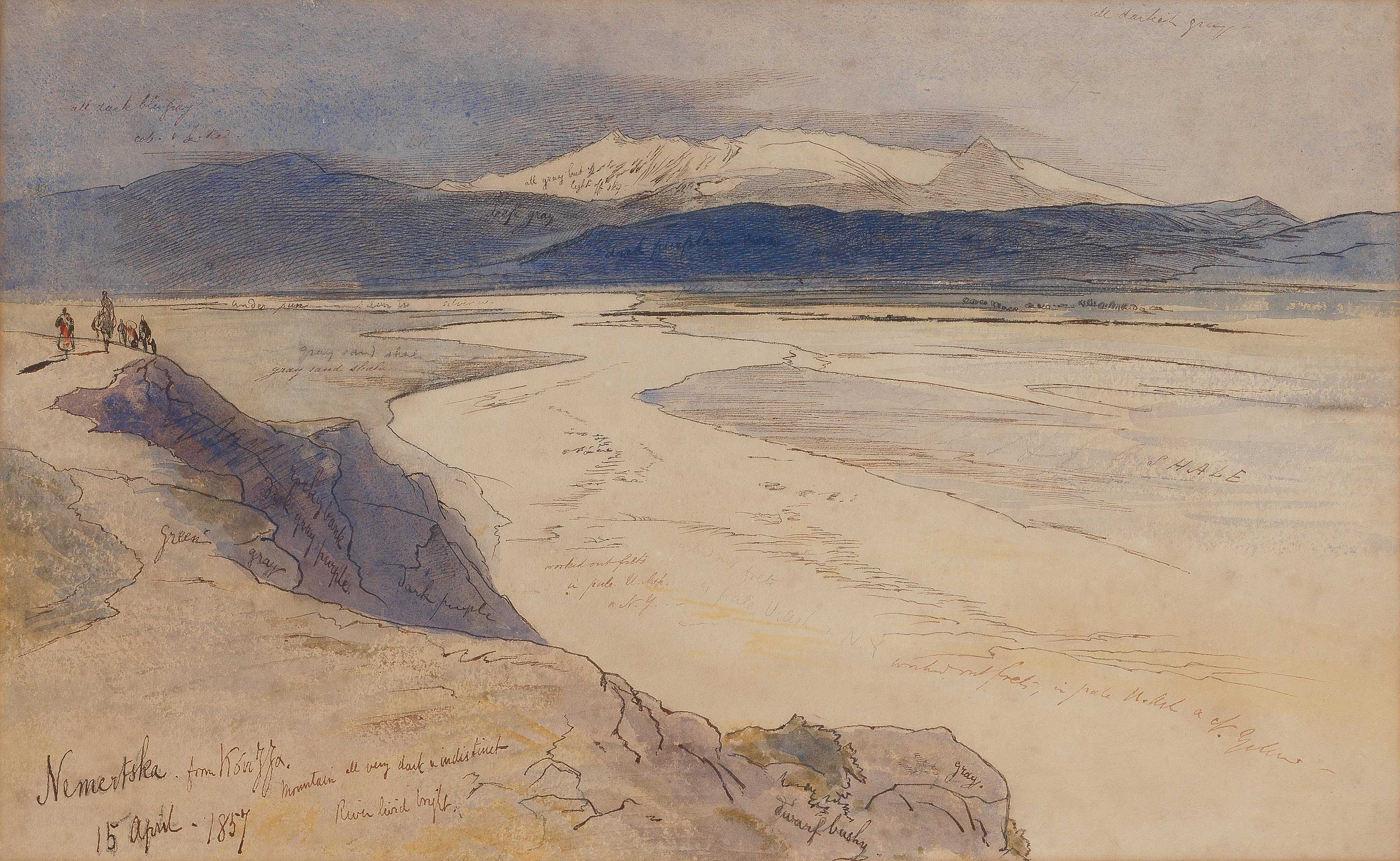
Edward Lear, Nemertska from Kouzza, Albania (1857)

Edward Lear, Nemertska from Kouzza, Albania.
Inscribed and dated ‘Nemertska from Kouzza/15 April 1857’ (lower left), variously annotated throughout. Pen, ink and watercolour. 32.5 x 52cm (12 13/16 x 20 1/2in).

Provenance
Lady Shaw.
Thence by descent.
Anon. sale, Bonhams, London, 23 May 2007, lot 154.
Private collection, Greece.

Lady Shaw met Lear in Corfu and later acquired this watercolour in London.
Lear first visited Albania in 1848 and recorded his visit in Journals of a Landscape painter in Greece and Albania (1951). He returned in April 1857 to visit the Greek mountain region of Epirus and the villages above the River Vikos, a place he missed on his first trip.

Bonhams.

Posted in Edward Lear | Tagged , , , , | Leave a comment

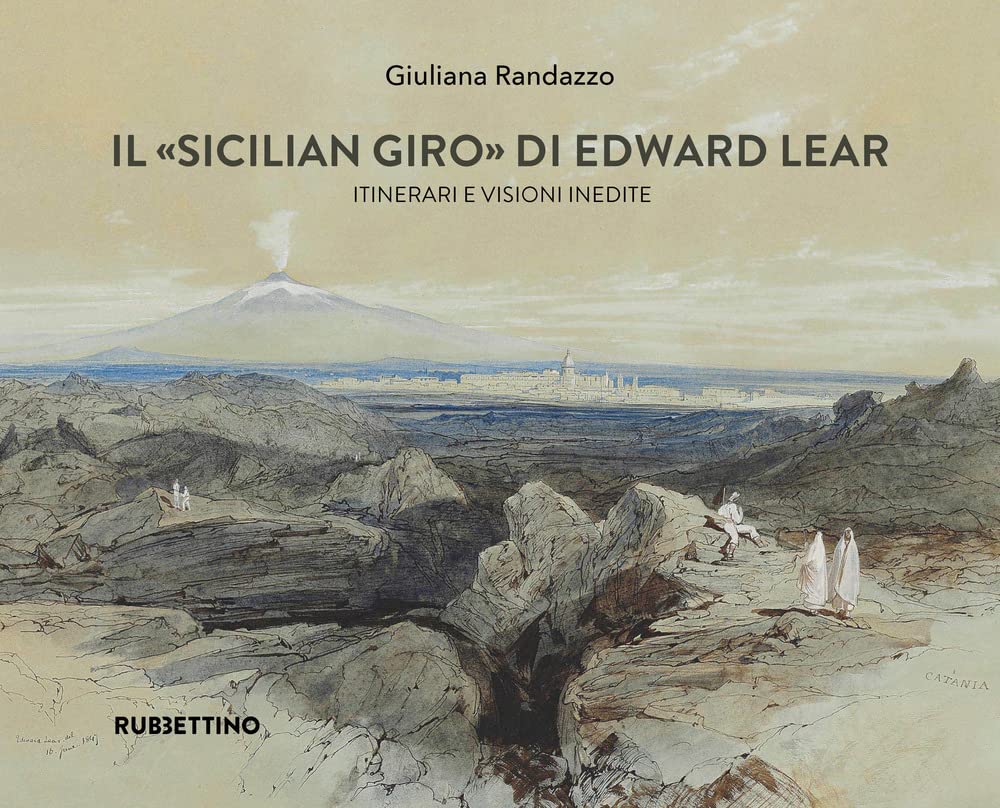
Edward Lear’s “Sicilian Giro”

Giuliana Randazzo’s book contains a large collection of landscape pictures, often never before published, drawn by Edward Lear during his two Sicilian trips in 1842 and 1847.

As far as I can see it is only available from amazon.it.

Posted in Edward Lear | Tagged , , , | 2 Comments

Letters to the Caetani Family (5)

[This is part of a series of previously-unpublished letters to Margaret Knight, who was married to Michelangelo Caetani, Duke of Sermoneta, and to Ada Bootle-Wilbraham, married to Onorato Caetani, Michelangelo’s son, Prince of Teano and then Duke of Sermoneta.
The letters are in the Caetani Archive, Palazzo Caetani, via delle Botteghe Oscure 32, Roma.
An Italian version will appear as an Appendix to my essay “Prima di Gregorovius: Edward Lear, i Caetani, e Ninfa” in a forthcoming volume: Michael Matheus (ed.) Ninfa: Percezioni nella scienza, letteratura e belle arti nel XIX e all’inizio del XX secolo. Regensburg: Schnell & Steiner.]
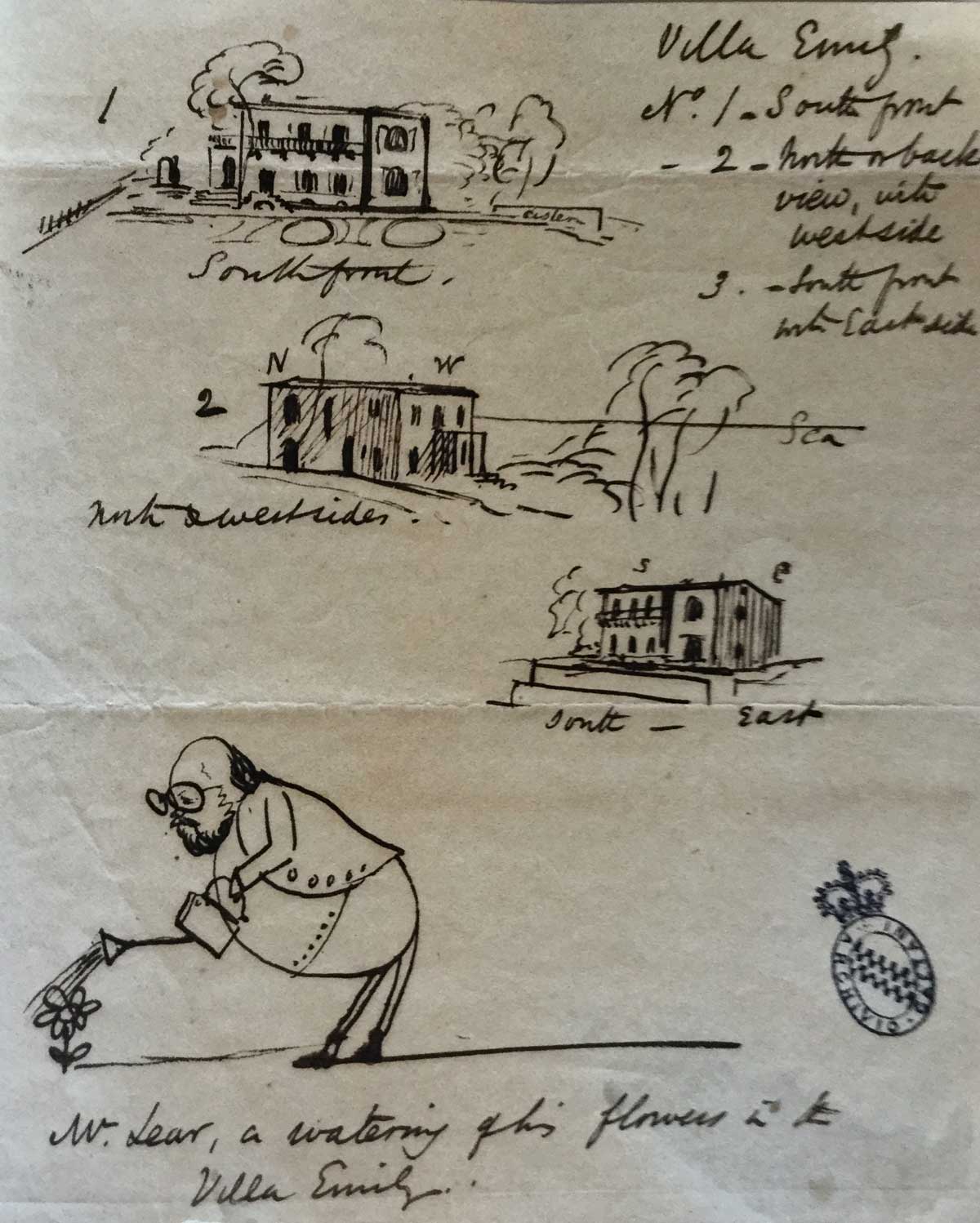
Villa Emily. Sanremo.
December. 1872.

Dear Princess Teano,
I wrote a letter to the dear Duchess on the 21st of last month, ― to thank her for sending me your photograph, & to tell her why I had not answered her letter earlier, ――― little thinking that she was no longer in our world.
The sad news of her loss I only have heard from Charles Knight & Mrs. C.K. ― but they mention the fact of her death & nothing more: ― & if you could be kind enough to let me have a line to say when & how this occurred, I should be so much obliged to you! ― I am sure you must have loved her as all who ever knew her did, & I know you ^[& the Prince] must feel her loss greatly: but perhaps you would not mind the trouble of telling so old a friend as myself something of her last illness & death. The reason I have never heard of this till now, is that I was on my way to India for a year, to stay with Lord Northbrook, but fate did not allow me to get farther than Suez, whence I only returned here early in November.
I am so glad now that I went to Rome last year ― at least to have seen her once more.
Please tell me how the Duke is ――― it is so very very sad to think of him now. And yet it would be far more so were not you & his son, & Mme Lovatelli & her husband all with him as I hope you are.
Please give my kindest remembrances to the Duke, ― & to all who remember me; if I am offering sympathy of little value, it must be recollected that I ask as I feel, & as it would please me if others acted towards myself.
I have written also to Prince Teano, as someone said you were not at Rome, & I thought that his being a Deputato would ensure letters arriving.
I am in hopes Charley will come here: his wife writes that he is so grieved & sad, ― & I think a change would be good for him. As he don’t care for luxury, I could put him up comfortably here, where, (with due respect a Vossignoria Romana,) we have a better winter climate than ― any place in all Italy: ― vero, ― (unless perhaps it be Taranto.)
I hope your little ones are well: & that Col. & Mrs. Wilbraham are so. They will hardly remember me ― or I would ask you to give them my Xmas good wishes, as I do to yourself & all the Duke’s family.

Believe me,
Dear Princess Teano
Your’s sincerely,
Edward Lear.

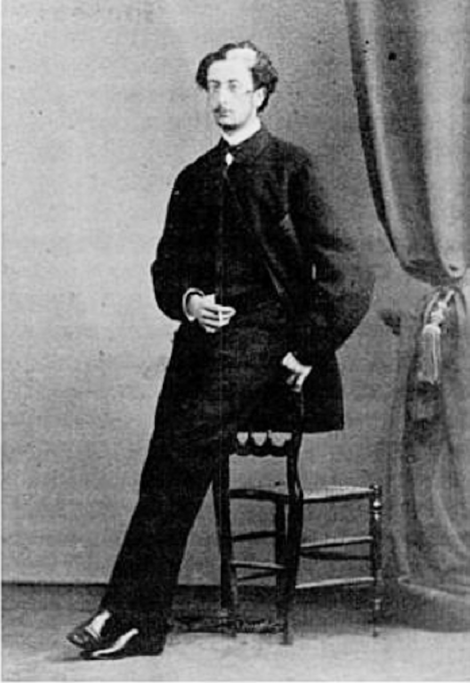
Onorato Caetani, Prince of Teano.

Posted in Edward Lear | Tagged , , , | Leave a comment

Letters to the Caetani Family (4)

[This is part of a series of previously-unpublished letters to Margaret Knight, who was married to Michelangelo Caetani, Duke of Sermoneta, and to Ada Bootle-Wilbraham, married to Onorato Caetani, Michelangelo’s son, Prince of Teano and then Duke of Sermoneta.
The letters are in the Caetani Archive, Palazzo Caetani, via delle Botteghe Oscure 32, Roma.
An Italian version will appear as an Appendix to my essay “Prima di Gregorovius: Edward Lear, i Caetani, e Ninfa” in a forthcoming volume: Michael Matheus (ed.) Ninfa: Percezioni nella scienza, letteratura e belle arti nel XIX e all’inizio del XX secolo. Regensburg: Schnell & Steiner.]

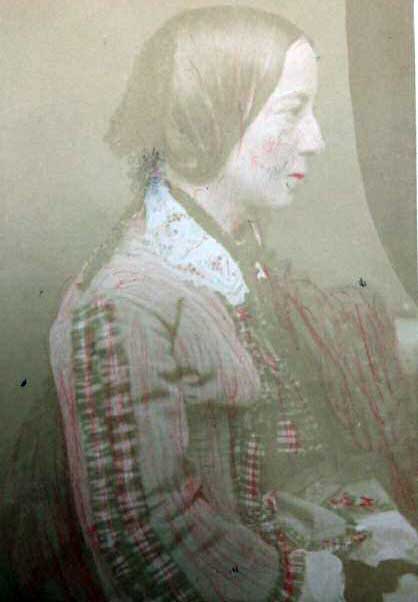
Photo of Margaret Knight Caetani in the 1860s.

Villa Emily.
Sanremo.
Nov.r. 21. 1872

Dear Duchess of Sermoneta,
Your letter of last August ― written after I had told you of my stay with Charley, should have been answered long ago, but I was never able to get a moment while in London, & afterwards I was constantly preparing to go to India ― (I told you Lord Northbrook had asked me there,) or hurrying about paying visits &c. (Bye the bye I just missed the Bertie M.’s at Guy’s Cliffe ―― how we should have sympathized! ―) Then I left in Sept.r to put things in order here for an 18 month’s absence ― & then set off to Egypt ― picking up my old servant at Corfu. But at Suez it appeared to be decreed that I was not to go ― two steamers were full ― (at that season every place is crowded,) & I missed a third: & then, the effects of a bad blow from a fall which received in England weighed also in the balance, ― & finally I believed I had better return ― in spite of the trouble I had given in having introductions written for me, & in spite of the time & money I had lost. I got back here on Nov.r 6 ― after a journey much put out by inundations &c.: & I suppose am now here for the winter. At 60 years of age ― it is almost silly to regret anything ― so I endeavor to think as little about the whole matter as possible.
I hope you will be able to write before long, or cause someone to write, as I should like to hear how you & the Duke & all of you are. I was delighted at the Photograph of Princess Teano, & thank you very much for it. Her face is really lively, & I have set it up on the Chimney-piece here so that I can look at it at any time. ― I should be glad to hear how Charley is, & must write to him soon. Had it not been for the broken railways, & the difficulty of getting on I should have come back here by Naples & Rome & so might have seen you. The other day Glennie & Mrs. G. passed through here, but thought I was in India & “passed by on the other side.” If you will let me know a safe way of sending the Books from here to Rome, I will forward the Corsica,[1] & the 2 Nonsenses.[2] The former is 30 fr. & the 2 latter 15 fr. each ― so that you could easily repay me by a P.O. order on the Post office here. Had I but known Glennie was going through! Gio. Batt: Fornari is the man who has all books here, & I will ask him to forward them. The Corsica will please you, & the other books will delight the small people.
I have just received letters from Lord Northbrooks Children, from Brindisi, so vexed at my non=coming, that I am grieved I ever thought of going, since go I did not, & now shall be able to think of nothing else for the rest of today.
I wish we were a little more settled in our Italy. I found it the opinion of many eminent & thinking men in England that if your V.[3] neighbour & his atrocious goings on are not finally stopped, calamities will one day ensue. While we have so open an enemy in the Centre of our existence & one who would scruple at nothing to regain power, ― we are far from safe. And the worst is that belief in him & his satellites is carried on by all or most Italian mothers & taught to their children, ― so that there will be plenty of material for a bad reaction whenever opportunity occurs. And that party think so too ― we are only ousted for a time ― say they: ― the foundations of our power have never been uprooted ― only the walls shaken down. Naturally the difficulty of an opposite course is immense ― but unless it is courageously taken, I fear bitterly for the future of this country.
Give my kindest remembrances to the Duke ― & to Prince & Princess Teano, & believe me, Dear Duchess of Sermoneta,
Your’s sincerely,
Edward Lear.

_____

[1] Journal of a Landscape Painter in Corsica, 1870.
[2] Nonsense Songs, Stories, Botany and Alphabets, London, 1871, e More Nonsense,
ictures, Rhymes, Botany, etc., London 1872.

[3] Vatican.

Posted in Edward Lear | Tagged , , , | 1 Comment

Letters to the Caetani Family (3)

[This is part of a series of previously-unpublished letters to Margaret Knight, who was married to Michelangelo Caetani, Duke of Sermoneta, and to Ada Bootle-Wilbraham, married to Onorato Caetani, Michelangelo’s son, Prince of Teano and then Duke of Sermoneta.
The letters are in the Caetani Archive, Palazzo Caetani, via delle Botteghe Oscure 32, Roma.
An Italian version will appear as an Appendix to my essay “Prima di Gregorovius: Edward Lear, i Caetani, e Ninfa” in a forthcoming volume: Michael Matheus (ed.) Ninfa: Percezioni nella scienza, letteratura e belle arti nel XIX e all’inizio del XX secolo. Regensburg: Schnell & Steiner.]

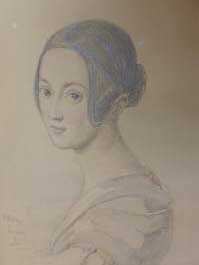
Ada Constance Bootle-Wilbraham, Princess of Teano and later Duchess of Sermoneta.

Villa Emily. San Remo.
                        March 1. 1872

Dear Princess Teano,
Mr. & Mrs. Miles, who are going from here to Rome in a few days, have kindly offered to take my little drawing of Sermoneta Castle to you. It is rather late in the day for a wedding present to you & Prince Teano, but the proverb says, better late than never. The sketch is merely a rough & shabby one, but as it may recall the situation of Sermoneta, & of Ninfa & Norba, I trust you may think it worth accepting & perhaps of putting it into a plain gilt frame with a glass, so as to hang it up somewhere.
I hope Prince Teano & yourself are well: your little ones also: & that the Duke & Duchess with Count & Countess Lovatelli are also in good health: ― I should like to see you all in Rome, but do not think I shall this year.
I think you have met Mr. & Mrs. Miles in England somewhere: ― perhaps at Colonel Northey’s? ― whom I know Mr. Miles is acquainted with. Mrs. Miles is a daughter of Sir William Napier, & sister of Mrs. Henry Bruce, & Lady Arran. She is certainly additional testimony to the probality [sic] of Prince Teano’s theory ― i.e. ― that English women are the handsomest in the world.
Please give my kind remembrances to the Prince ― & believe me

Your’s sincerely,
     Edward Lear.

Posted in Edward Lear | Tagged , , , | Leave a comment

Edward Lear, View of the Castello Caetani and the hill-town of Sermoneta (1872)

Edward Lear, View of the Castello Caetani and the hill-town of Sermoneta, Lazio, Italy.
Signed and dated ‘Edward Lear. del. 1872./(Feb 3. 1840)’ (lower left). Pencil, pen and brown ink and watercolour, heightened with touches of bodycolour. 6 1⁄2 x 10 1⁄8 in. (16.5 x 25.7 cm.)

Provenance
Anonymous sale; Bonhams, London, 7 June 2005, lot 75.
Anonymous sale; Christie’s, London, 5 June 2007, lot 133, where purchased by the present owner.

This view through the olive groves shows the 13th century castle which was built by the Caetani family to cement their hold over the surrounding countryside. Dominating the medieval hill-town of Sermoneta, the castle was taken from the Caetani in 1500 by Pope Alexander VI, who had it fortified by his son Cesare Borgia, and gave it to his daughter Lucrezia. The composition of a fortified building seen through trees from afar, with figures in the foreground, was also used by Lear for his depiction of the Citadel of Corfu.
With financial backing from Lord Derby, Lear set out for Italy in the summer of 1837. For most of the next ten years Lear wintered in Rome and toured other parts of Italy in the summer.

Christie’s.

Posted in Edward Lear | Tagged , , , , , | 1 Comment

Letters to the Caetani Family (2)

[This is part of a series of previously-unpublished letters to Margaret Knight, who was married to Michelangelo Caetani, Duke of Sermoneta, and to Ada Bootle-Wilbraham, married to Onorato Caetani, Michelangelo’s son, Prince of Teano and then Duke of Sermoneta.
The letters are in the Caetani Archive, Palazzo Caetani, via delle Botteghe Oscure 32, Roma.
An Italian version will appear as an Appendix to my essay “Prima di Gregorovius: Edward Lear, i Caetani, e Ninfa” in a forthcoming volume: Michael Matheus (ed.) Ninfa: Percezioni nella scienza, letteratura e belle arti nel XIX e all’inizio del XX secolo. Regensburg: Schnell & Steiner.]

Villa Emily.     San Remo

12. May.1871
(which I am 59 years old today.)


Dear Duchess of Sermoneta,
I meant to have written more than I now can do in answer to your’s of the 30 April ― but I have just now heard from Guidi the Photographer here that he is sending a Copy fo his very beautiful Photograph Flora of San Remo to some public Institution at Florence, & that he will kindly get my little book Conveyed to you.
So I sent it, addressed to the Duke; & beg you will write to poor Charley, ― or send it to him when you can. As this opportunity has occurred suddenly, I have thought it best to avail myself of it at once, ― rather than wait till you send me Charley’s address. I shall be very glad to hear where he is: what sad trouble they have ―― all besides his dreadful state of health. I trust his little girl is better, & shall be much obliged by your letting me know.
Thank you for Miss Helen’s address.
I dare say you were quite right about Mrs. Caldwell. If one had to live over again, (let me be thankful ― one hasn’t!) one would try to see into more amiable eyes.
Don Michele is of very great use to his country. Blind, & no longer young, he sets an example to those who have youth & all their faculties, who may learn that position in social life is not without its duties, nor can they be put aside without damage occurring to the whole machinery.
I suppose the little boy you speak of is son of P. Teano & Miss Wilbraham that used to be ― or you mean Mme Lovatelli’s son.[1]
I delight in the [the] R.C. deputation’s disappointment at no stones being thrown at them![2] Why didn’t they hire some gamins to pelt them right & left & then say it was our sods did it?
We (we agriculturists!) here discuss what you are to plant all over the Campagna.

Pepper trees ―

Castor oil ―

Wheat ―

beans ―

Tobacco ―

Rice ―

(& for ought I know gooseberries.)

Please let me know, where do you pass the summer? Have you rooms at the V. Taverna now? I wish Charles could come & join you.
I write in gt. hurry: & must go & work at Lord Derby’s picture.
Besides, the door has been opened, & a blue-bottle-fly has come in, which obliges me to sign myself,

Your’s sincerely
Edward Lear.

Please read all my book: & read what you like of it to the Duke if he has time to hear nonsense.
Please let me know (as the Irishman said,) if you don’t get the book or this letter.

(exact proportions of blue-bottle-flies at San Remo.)

_____

[1] Mme Lovatelli was Michelangelo Caetani’s daughter, Ersilia Caetani, married to Count Giacomo Lovatelli.
[2] Probably a deputation sent by the Curia Romana to discuss the “legge delle garentigie” (Law of Guarantees: https://en.wikipedia.org/wiki/Law_of_Guarantees regulating the relations between State and Church) that would be passed by the Italian State on 13 May 1871.

Helen Knight drawn by Franz Nadorp (on p. 55 of Isabella Knight’s commonplace book, British Museum, Prints and Drawings, 1938,0514.1.1– 41).

Posted in Edward Lear | Tagged , , , , | Leave a comment

Letters to the Caetani Family (1)

[This is part of a series of previously-unpublished letters to Margaret Knight, who was married to Michelangelo Caetani, Duke of Sermoneta, and to Ada Bootle-Wilbraham, married to Onorato Caetani, Michelangelo’s son, Prince of Teano and then Duke of Sermoneta.
The letters are in the Caetani Archive, Palazzo Caetani, via delle Botteghe Oscure 32, Roma.
An Italian version will appear as an Appendix to my essay “Prima di Gregorovius: Edward Lear, i Caetani, e Ninfa” in a forthcoming volume: Michael Matheus (ed.) Ninfa: Percezioni nella scienza, letteratura e belle arti nel XIX e all’inizio del XX secolo. Regensburg: Schnell & Steiner.]

Margaret Knight drawn by Franz Nadorp (on p. 55 of Isabella Knight’s commonplace book, British Museum, Prints and Drawings, 1938,0514.1.1– 41).

Answered.[1]
Villa Emily.     San Remo.
[The “Emily” is my sister Sarah’s grand-daughter ― my grand=niece.]

16. April. 1871.

Dear Duchess of Sermoneta,
Your letter of January 13 ought, I well know, to have been answered before now, but I don’t think it is worth making a lot of apologies to one who maybe saw my not writing I am sure would not attribute my non-writing to neglect. Yet I may say that ― (as people say ― of the season at Watering places,) “this has been an exceptional year” ― & I seem to have ^[had] nothing to do but to write letters, 408 of wh. I actually stamped with Italian Franco-bolli last year, ― whereby am I not a good Italian subject? (Bye the bye a German Lady or Gerwoman came into the Tobacconist’s where I buy mine yesterday & said, “Datemi un Franco bollito e subito!” ―) Then, the constant going to & fro from S. Remo lodgings to my new house here, & 3dly my waiting for a book I want to send to Charley[2] ―― all this, added to hard work in painting to keep my head above water, ― makes a sufficient bunch of apology, even if you needed any. (And I have left out the move up into & “fixing” in my new house.)
Charles wrote me a letter, dated January 2, which was a great pleasure to me: ― I had no idea till I received it how terribly ill he still was. And now I want you kindly to write & tell me if he is still at Geneva, & also his exact address ― for, bless the boy, he hasn’t put it in his letter at all. The copy of my “Nonsense Prose, poetry, & Alphabets”[3] has only just come out, & I want his children to have it. But I do not feel sure that he is still at Geneva; nor, if I learn he is, am I at all sure of how I can send it. I wish I could send you a copy, but I have none, nor does the book bring me any profit, so that I should have copies of my own ― for although it has gone to a sale of 3000 in 3 months, & has been reviewed in all sorts of ways, the expense of getting it up, woodcuts &c., swallows all the profit, & I am lucky in not having any debt over & above. (One reviewer calls me, “a pure benefactor of the human race,” another says ― “for true fun, Mr. Lear stands at the summit of humanity.” ― (Appropriate proverb, ― “fine words butter no parsnips.”) ― Will you, if you write to Charley, say that I have not answered his letter for these 2 reasons; first, it contained no address & I had lost or mislaid that you gave me: 2dly I waited for the book. And give my kind regards to him & Mrs. Charles. I will write to him, directly I hear from you. ― Another old Roman friend I see is gone: Mrs. Caldwell. I believe you & Isabella liked her ― & possibly she was a kind-hearted person: but she always seemed cold & antipatica to me. I pity poor Col. Caldwell: & after all, I could hardly judge much of Mrs. C., & moreover was always a crotchety cross-grained brute myself, so I don’t see why she should have been pleasant to me if she could have avoided being so. I suppose they are very Papaline: but I cannot fancy your not seeing much of them if they are still there, for they were always fond of you all, & particularly of Miss Isabella, whose death even now I cannot thoroughly realize, ― so vivid an impression did her character leave on the minds of those who knew her. When I begin to write to you, so much “crops up” as to memory (to use a geological expression,) that I go on without stopping, & possibly leave out all I most want to say. I should like to see you & Don Michele again. His exertions ― at his age, & afflicted as he is, will endear his memory to Italians: I suppose his ^[general] health generally is pretty good, or he could not do so much. I am sorry to know from your letter that your own health is always so comfortless. It has however this bright side, that such constitutions live frequently to gt. old age ― which if you do, it will be all the better for those who are around you, ― always ^[supposing] if you suffer less rather than more in years to come. I should like to know where Mme Kanitz is ― wh. was Miss Helen.[4] It’s odious to think how lonely & scattered the friends of earlier days become ―: you, I think are among the happiest, ― having so many you care for. I hope Charley’s children will be a comfort to him. As for me I am like a Pelican in the wilderness or an Owl in the desert,[5] ― or, as I really once heard a Devonshire parish clerk say, ― “I am become as a Pilgrim in the wilderness, with Oil for his Dessert.” ―― Have you met with a Mr. Montrith at Rome? He came to me here from Professor Lushington, & is a friend of many of mine, A. Tennyson &c. &c. But he is pro=papal to an indefinite amount, so tho’ well known in certain circles in Rome, you may know him not after all. I cannot but hope that all this downfall of French power will work well for Italy in the long run. And anyhow, even their enemies must (or should) allow that the Italians have acted well & wisely throughout this wretched year, or half year past. I am much more sensible than I was, of the difficulties of Italo=Roman politics, & confess that I rushed in where angels &c. I have left little space for myself or my doings ― the less the better. I have moved into my new house, wh. is beautiful to behold, & really well built, though large for what I want, ― but I had to think of what would sell if I couldn’t manage to live in it. My painting room is perfect & I suppose unique, & painting is really fun in it, so good the light ― so large the space. Besides doing a painting of Corfù for Lord Derby, & one smaller for Lushington, I am at work on one of the Campagna from Cervara, & am daily carried away to those places; ― on the hill sides I make the Villas of Poli ― the heights of Guadagnolo, the slopes & incidents of Tivoli; ― on the plain, the towers by the Anio, Lunghezza &c. &c. I must really try & do a small work on the Campagna before I exit ― for none living or dead have collected such material. I am also going on with 112 (!!!) illustrations of A. Tennyson’s poems ― all landscapes descriptive & poetical. So you see at nearly 59 I have a deal of energy if not of common sense, left me.
Meanwhile, the old servant who has come with me going on 16 years makes me very decently comfortable, & as yet I have not begun to eat the mice & snails. Later I trust to get somewhere southward in Italy ― but all is more or less uncertain. Please give my best remembrances to the Duke, ― and hoping to hear from you very soon with Charley’s address, ― believe me,

Dear Duchess of Sermoneta,
Your’s sincerely,
Edward Lear.

One would like to live in Rome if the climate weren’t so beastly. Yes I say, Beastly: for it is so. Here, except 2 months bad weather, we have been always fine.
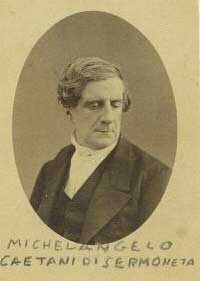
Michelangelo Caetani, Duke of Sermoneta, Margaret’s husband from 1854.

_____

[1] In a different handwriting, probably by Margaret Knight.
[2] Charles Knight, brother of Margaret. He travelled with Lear in the Abruzzi in 1842.
[3] Nonsense Songs, Stories, Botany and Alphabets, 1871.
[4] The youngest of the Knight sisters, who in 1860 had married Karl Friederich Ernst von Canitz und Dallwitz, Prussian envoy in Naples.
[5] Psalm 102.6: “I am like a pelican of the wilderness: I am like an owl of the desert” (KJV).
Posted in Edward Lear | Tagged , , | Leave a comment

Edward Lear, Philae (1854)

Edward Lear, Philae, Egypt, 1854.
Pen and brown ink and watercolour. 294 by 492 mm.

Mutualart.

Posted in Edward Lear | Tagged , , , , | Leave a comment