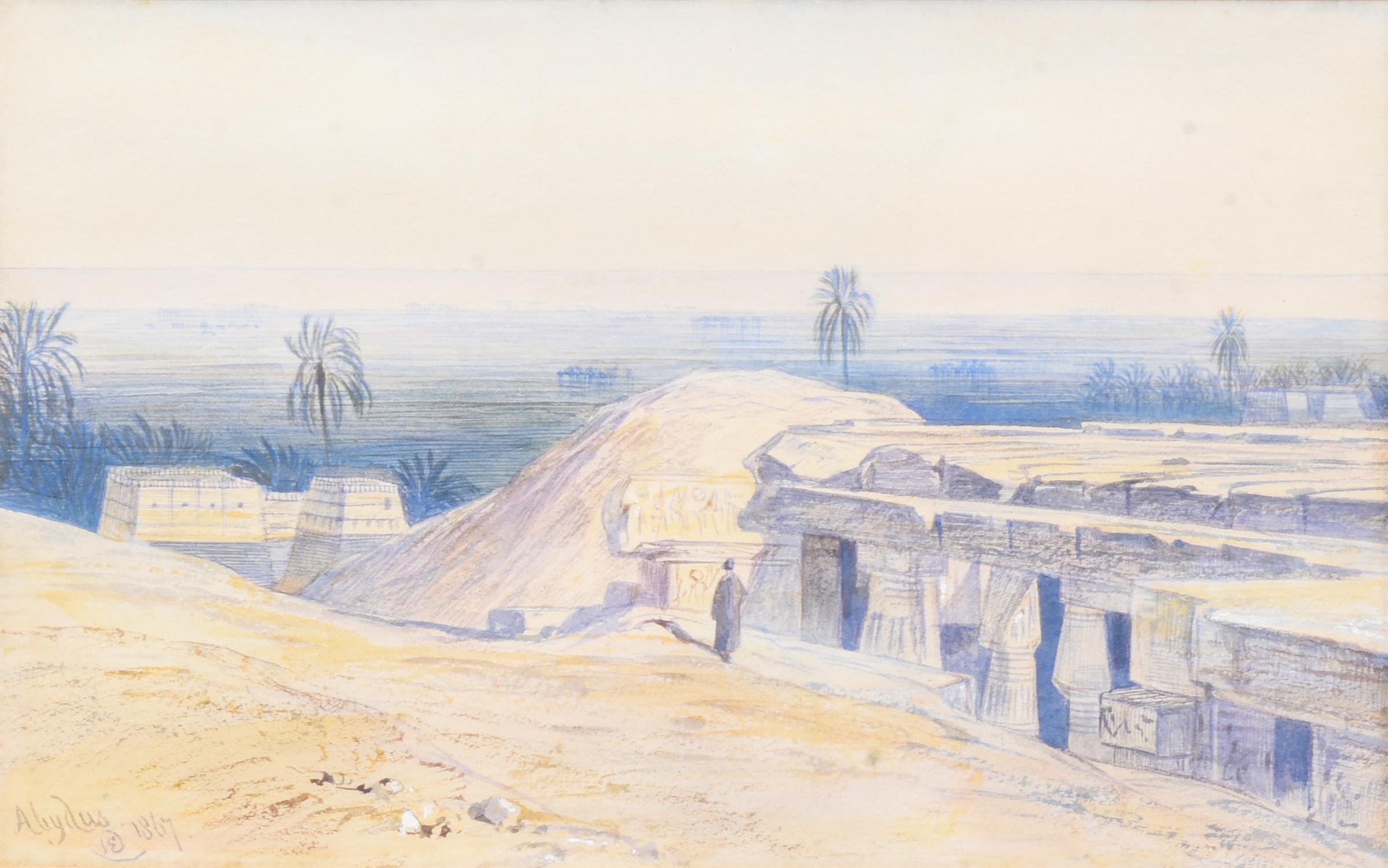
Edward Lear, Abydus, Egypt (1867)

Edward Lear, Abydus, Egypt.
Watercolour heightened with white. Signed with monogram, titled and dated ‘1867’ (lower left). 16 x 25.5cm (6¼ x 10 in.)

Provenance
Ruskin Gallery, Stratford Upon Avon 1964
Property from the Estate of William W. Appleton
His sale, Christie’s, New York, 29 January 2015, lot 108, where purchased by Robert Kime

Abydos is one of the oldest of the sacred cities of Ancient Egypt and was the site of a number of important tombs and temples including the Temple of Seti I. Lear visited Abydos during his third visit to Egypt in 1867. His earlier trips had taken place much earlier, in 1849 and 1853-4. He travelled up the Nile as far as the Second Cataract, and into what was then Nubia before returning to Cairo.

Dreweatts.

Posted in Edward Lear | Tagged , , , , | Leave a comment

Edward Lear, View at Fatehpur. Sikri, India (1874)

Edward Lear, View at Fatehpur. Sikri, India.
Pen, ink, and watercolour. Inscribed and dated ‘Fattehpore. Sikree. Feby.28.1874’ (lower left), signed (lower right). 8.5 x 17.5cm (3¼ x 6¾ in.)

Provenance
Elizabeth Wintgens Gallery, Bucks.
Christie’s, South Kensington, Travel and Natural History, 25 September 2007, lot 306, where purchased by Robert Kime

Dreweatts.

Posted in Edward Lear | Tagged , , , , | Leave a comment

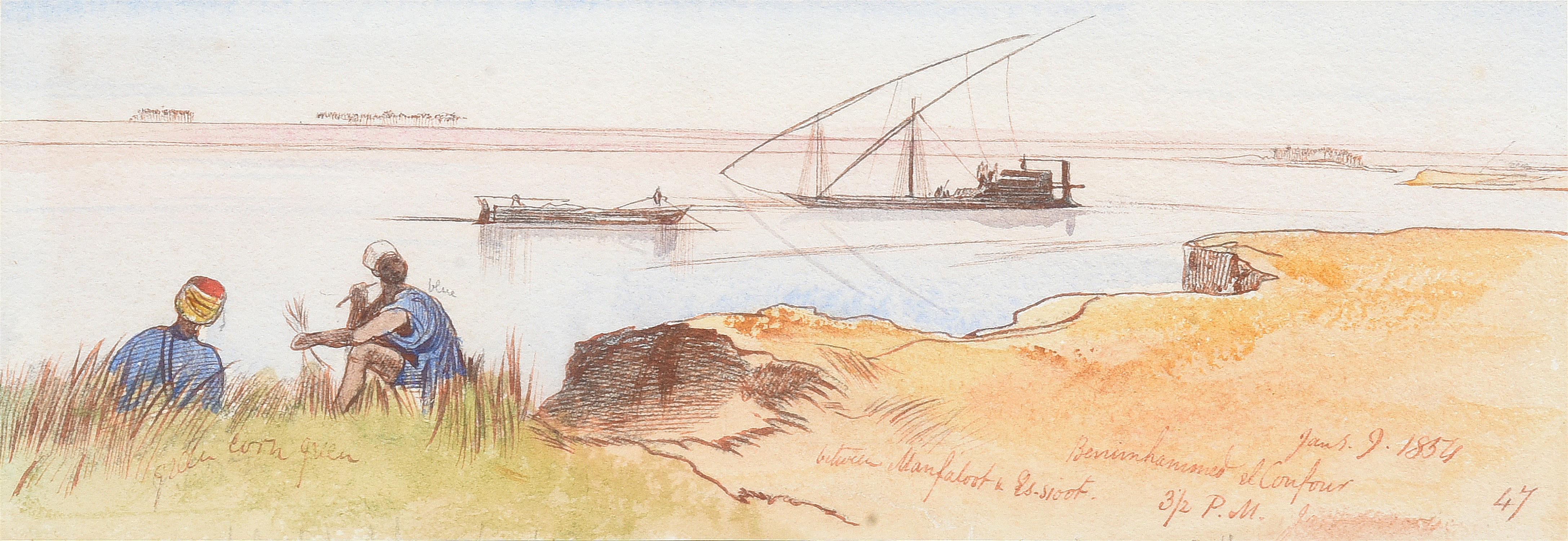
Edward Lear, Feluccas on a Stretch of the Nile between Manfalut and Assiut (1854)

Edward Lear, Feluccas on a Stretch of the Nile between Manfalut and Assiut.
Pencil, pen and brown ink and watercolour. Inscribed, dated and numbered  ‘Jany.9.1854/Benimhammed el Confour/between Manfaloot & Es-sioot./3/2PM / 47’  (lower right), colour notes throughout. 8 x 23cm (3 x 9 in.)

Provenance
Anthony Reed, London.
Christie’s, London, 10 December 2008, lot 53, where purchased by Robert Kime

Dreweatts.

Posted in Edward Lear | Tagged , , , , | Leave a comment

Edward Lear, Opposite Benihabra Looking South (1867)

Edward Lear, Opposite Benihabra Looking South.
Watercolour, ink and wash. Inscribed and titled ‘4.40 jany 5 1867’ (lower left) numbered 79 (lower right). 7.5 x 26cm (2¾ x 10 in.)

Dreweatts.

Posted in Edward Lear | Tagged , , , , | Leave a comment

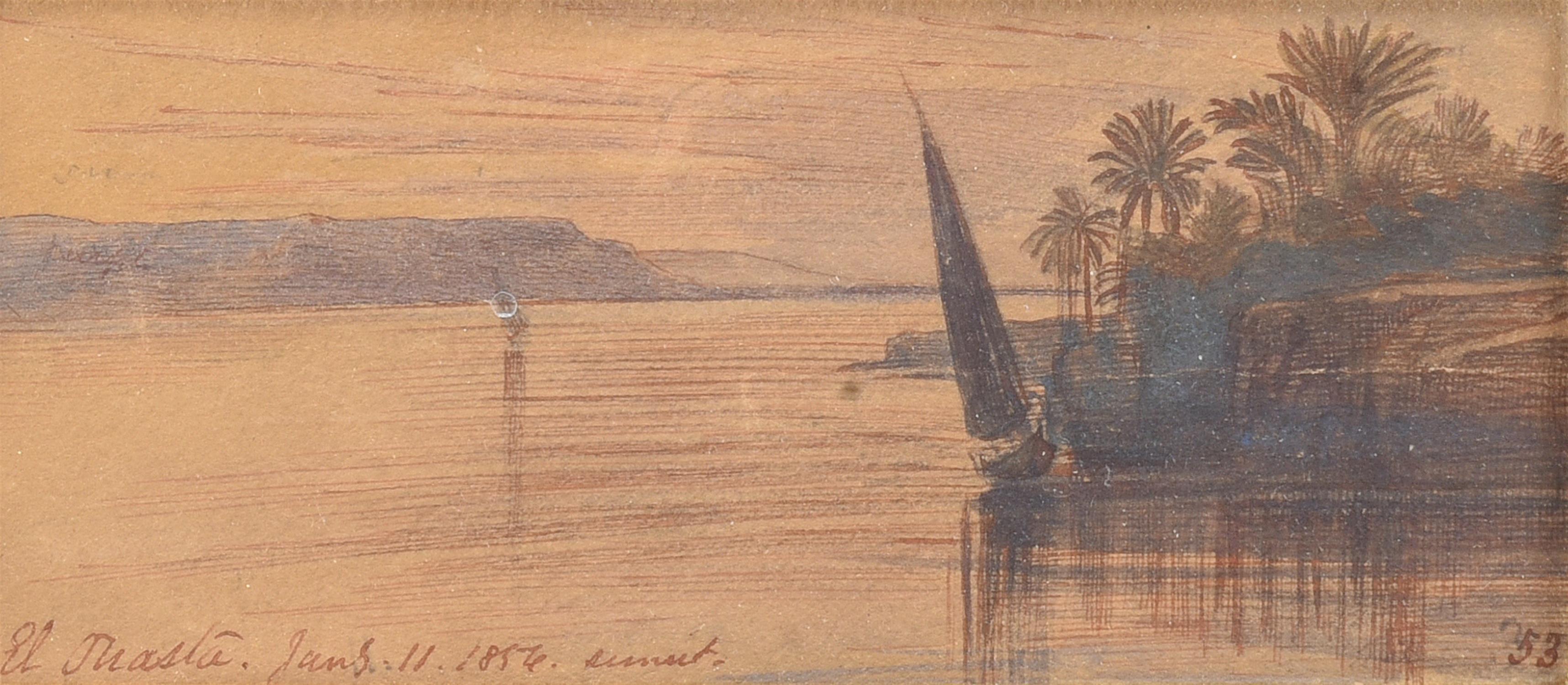
Edward Lear, Sunset on the Nile (1854)

Edward Lear, Sunset on the Nile.
Watercolour. Indistinctly inscribed and dated ‘Jany 11 1854, sunset’ (lower left), numbered ’53’ (lower right). 6.5 x 15cm (2½ x 5¾ in.)

Dreaweatts.

Posted in Edward Lear | Tagged , , , , | Leave a comment

Edward Lear, Isola Pescatore, Lake Maggiore (1837?)

Edward Lear, Isola Pescatore, Lake Maggiore.
Pencil with White chalk on blue paper. 9 3/4″ x 13 1/4″ sheet, 21 1/2″ x 25 1/2″ framed.

After 1837, Lear lived mainly in Italy and Corfu. On 31 October 1836 he wrote to Gould “my eyes are so sadly worse, that no bird under an ostrich shall I soon be able to do”. When he felt himself no longer able to cope with the detailed work of bird illustration, he turned his talents to landscape. Lear travelled extensively in Italy and as can be seen from this drawing enjoyed the tranquility of the Italian Lakes.

Invaluable.

Posted in Edward Lear | Tagged , , , , | Leave a comment

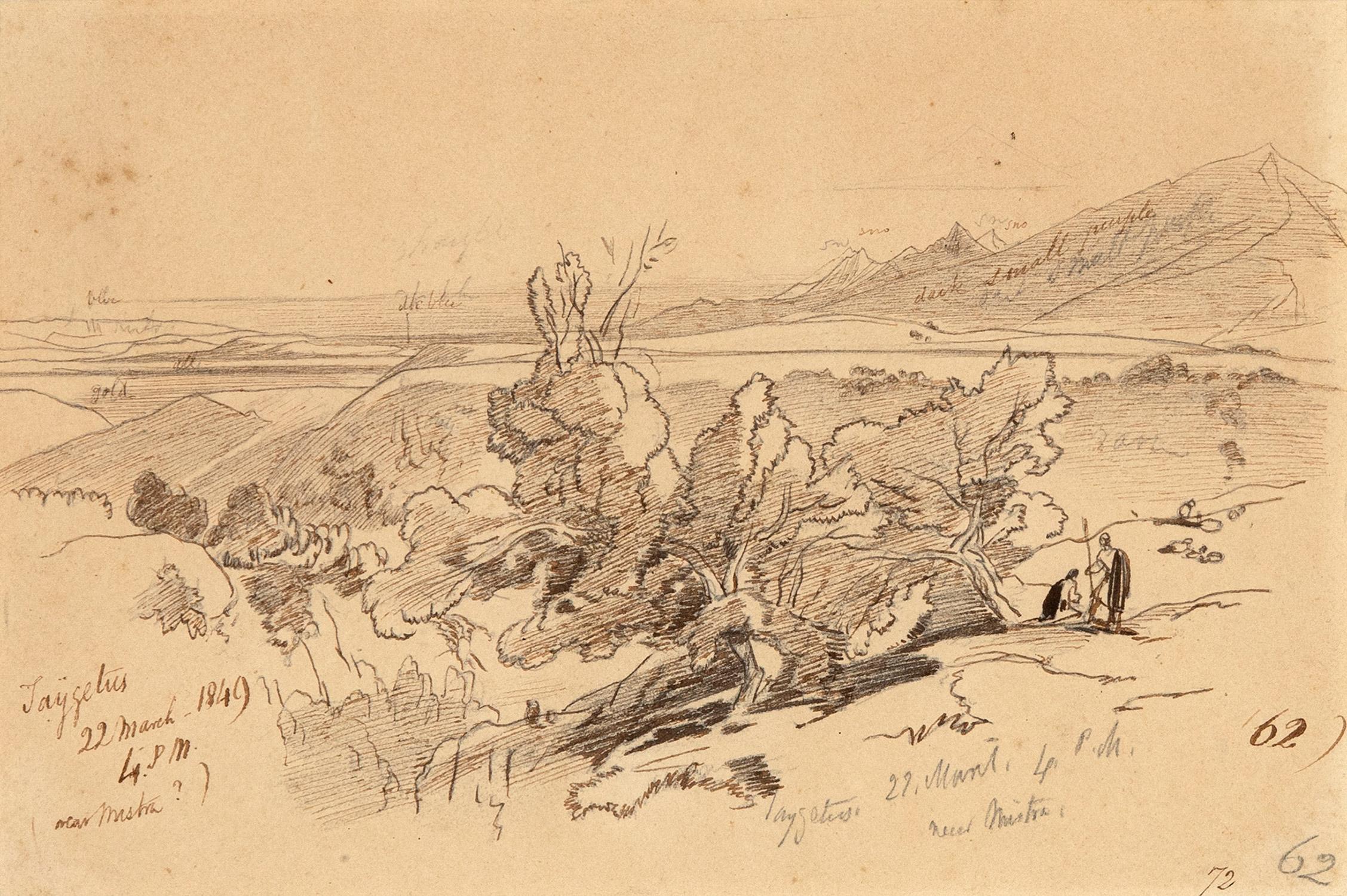
Edward Lear, Taygetus, near Mystras (1849)

Edward Lear,  Taygetus (near Mystras).
Dated lower left and right: 22 March 1849, title lower left (in ink) and right (in pencil).  15 x 22,5 cm. Ink and pencil on paper.

Invaluable.

Posted in Edward Lear | Tagged , , , , , | Leave a comment

A Touching Appeal: A Parody of “The Yonghy-Bonghy-Bò”

Punch, Vol. 107 (17 November 1894), pp. 234-235.

From Amy Matthewson’s Cartooning China: Punch, Power, & Politics in the Victorian Era. London and new York: Routledge, 2022, pp. 114-116.

John Tenniel’s “A Touching Appeal” depicts an overgrown childlike Chinese man named Younghy-Bung-Boo-Hoo who starts a fight but then loses to a much smaller Japanese man . The Japanese figure stands strong an ready for action; both hands are clenched into fists and he leans threateningly towards the defeated Younghy-Bung-Boo-Hoo who sits on the ground, his nose red as a result from the fight. Edwin Milliken’s accompanying “poem” explains the cartoon. The “proud” Younghy-Bung-Boo-Hoo was “jealous of Jappy,” who, although small, was a “plucky chappie/[and] Made big Younghy feel unhappy.” The animosity resulted in a physical confrontation where Younghy “the big boy pale and yellow,” was quickly defeated and “began to bleat and bellow.” Being “fearful for his life,” he cried out, “Though you welly lilly body, Jap, you strikee biggy blow! Welly much hurtee – me no play!!” His Japanese opponent shows no mercy “And he cried ‘Fight on, man, do!’” and tells his Chinese rival, “Yah! In fighting I’m your mate. /You cave in a bit too late, /I will whop you – if you’ll wait.” The poem ends with Younghy-Bung-Boo-Hoo whinging that the foreigners, who are standing watch in the background, do nothing to help.

This cartoon and accompanying “poem” was published in November 1894, during the First Sino-Japanese war, a conflict between China and Japan over supremacy in Korea. It was a short but decisive war and the consequences were paramount in shifting the balance of world power. Western powers were astounded by China’s rapid defeat and theorised that this was the result of China’s extensive corruption, stubborn resistance to Western technology, and the nation’s backwardness Japan emerged as a new imperial player on the international arena and “A Touching Appeal” reflected this shift in power. The message in the cartoon declared that China may be great in size but it is not great in strength. Japan, on the other hand, is represented in relatable terms; not only is it an island nation like Britain, but also the Japanese are characterised as people with plucky spirits, a trait easily identifable as it is found in the emblematic John Bull, who embodies pugnacity, independence, and courage.

Milliken’s “poem” is equally significant as it is within this textual representation that China and Japan are categorised and understood within the British popular imagination. Younghy speaks in broken pidgin English and his rival, the Japanese man, communicates in standard, grammatically correct English. For the Chinese, the use of “pidgin,” a derivative of the English word for “business,” was taken seriously as it was considered a valuable tool needed in order to engage in the lucrative trade sector. Europeans and Americans, however, viewed pidgin English as something laughable and it was associated with non-Caucasians with low social status. This perception combined with the difficulty the Chinese have in pronouncing some consonants resulted in pidgin being frequently employed for comedic effect and this had a “profound impact on popular perception.” The Japanese were also subjected to ridicule in their use of Yokohama Pidgin. For example, Hoffman Atkinson poked fun of its use in his humorous pamphlet, Exercises in the Yokohama Dialect published in Yokohama and then reviewed by C.G. Leland in London’s New Quarterly Magazine in 1879. “A Touching Appeal” is notable in focusing linguistic humour solely on the Chinese figure and this is significant.

In a review in the Bulletin of the School of Oriental and African Studies (2023), pp. 1-2, T.H. Barrett observes that “the subtext for these verses is clearly Edward Lear’s 1877 poem “The Courtship of the Yonghy-Bonghy-Bò”, but in that work Lear’s humour is gentle — it is, after all, in some measure a self-portrait –whereas here the treatment is vicious and insulting throughout.”
Posted in Edward Lear, Nonsense Lyrics, Punch | Tagged , , , , | Leave a comment

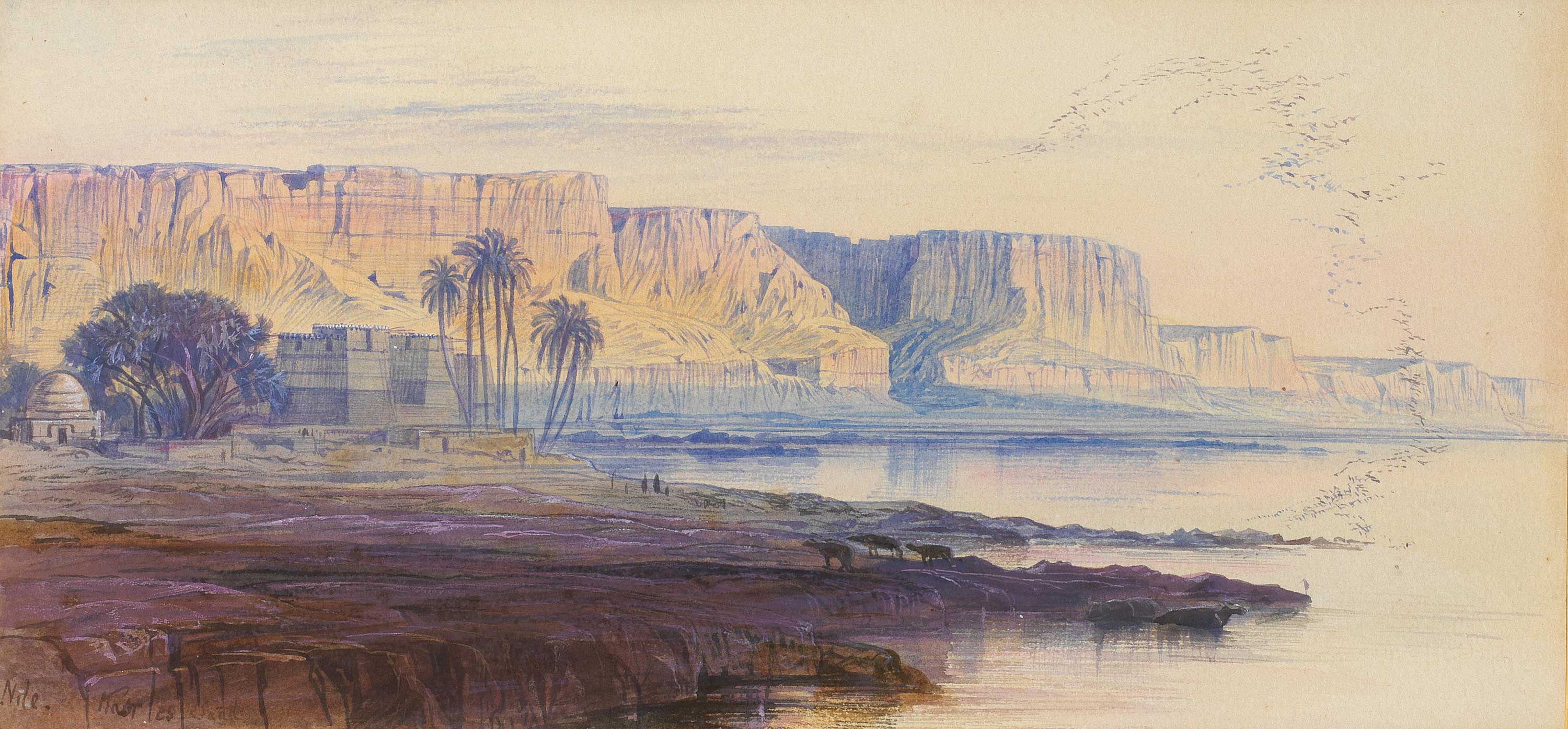
Edward Lear, The Nile at Kasr-es-Saad

Edward Lear, The Nile at Kasr-es-Saad.
Inscribed ‘Nile. Kasr es Saad’ (lower left). Watercolour and bodycolour. 17.5 x 37.5cm (6 7/8 x 14 3/4in).

Provenance
The Honourable Eustace Henry Dawnay, 8 Belgrave Square, London.
Thence by family descent to the present owner.
Private collection, UK.

‘Last night, we arrived at one of the most beautiful places I ever saw – Casr el Saadd. I am quite bewildered when I think how little people talk of the scenery of the Nile – because they pass it while sleeping I believe. Imagine immense cliffs, quite perpendicular, about as high as St Paul’s & of yellow stone – rising from the most exquisite meadows all along the river! While below them are villages almost hidden in palms… it is one of the most beautiful spots in the world’.
(Edward Lear, letter to his sister Ann, 18 January, 1854)

Lear encountered the subject of the present work (now known as Kasr-es-Saiyyad) early into his first journey down the Nile in 1854. He produced a number of pencil and watercolour studies on the spot (see for example Christie’s, London, 21 November 2002, lot 66, and 2 July 208, lot 52.). As was his working practice, Lear later worked up his drawings into a series of large oils of the subject, one of which was shown at the Royal Academy in 1870.

See previous post.

Bonhams.

Posted in Edward Lear | Tagged , , , , | 1 Comment

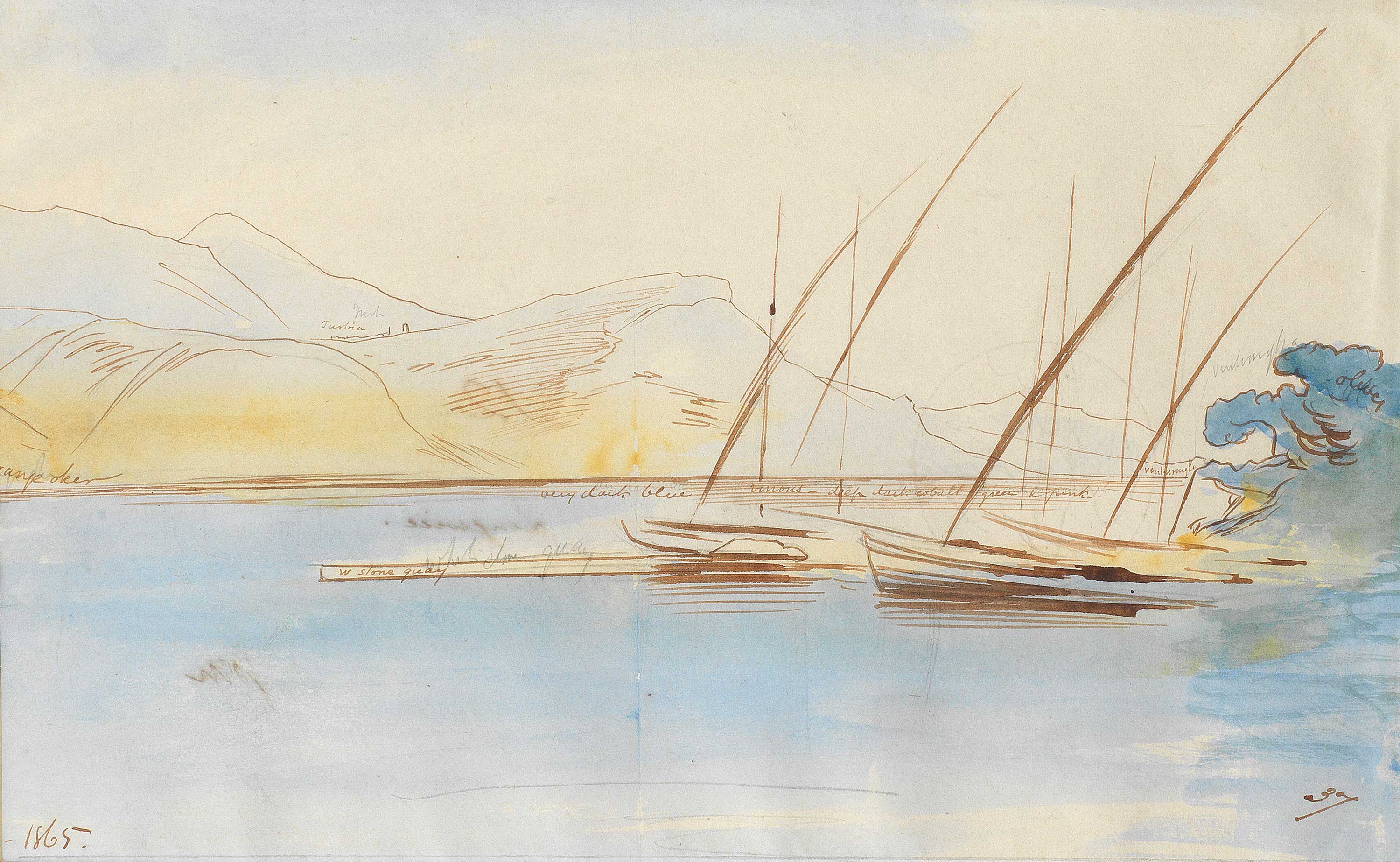
Edward Lear, View from St. Jean towards Villefranche (1865

Edward Lear, View from St. Jean towards Villefranche.
Dated ‘1865’ (lower left); numbered ’37’ (lower right); inscribed ‘from/Ville St.  Jean/(Villefranche) 15. February 1.PM.’ (on a fragment of paper attached beneath the  mount); extensively inscribed with colour notes throughout. Watercolour and pencil 21.5 x 35cm (8 7/16 x 13 3/4in).

Provenance
With Thomas Agnew & Sons, Ltd.
With Squire Gallery, London.
Private collection, UK (acquired by the grandfather of the present owner).

Lear travelled to the south of France in November 1864, first lodging in Nice before embarking on a walking tour as far along the coast as Genoa. During this winter he executed a huge volume of sketches and watercolours. Writing to Holman Hunt, Lear noted ‘One of my aims this winter was to ‘get’ all the Corniche or Riviera di Ponente; .. that I have done both ways – with 145 sketches & better health than before – also less abdomen’

Bonhams.

Posted in Edward Lear | Tagged , , , , | Leave a comment