Edward Lear Album to be Auctioned

A previously unknown, at least to me, album of early Edward Lear drawings has emerged and will be auctioned on 23 June.

The description is not clear on how many of the drawings are Lear’s, it simply states that it is “probably by more than one hand,” which might include Lear’s sisters as well as other unidentified authors.

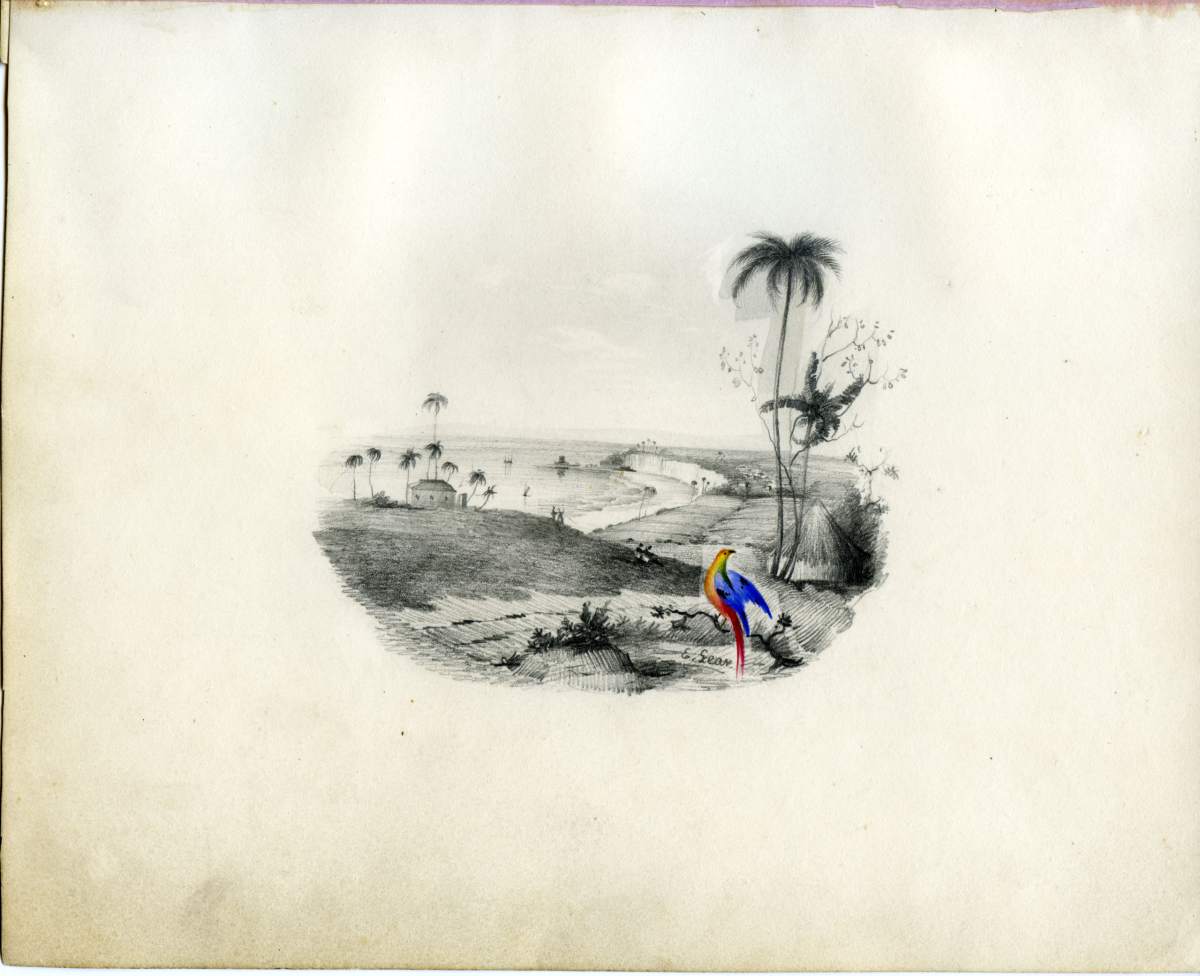
Among the pictures available online, the following one appears to be signed E. Lear, and might be part of the series of coloured birds in b/w landscapes I mentioned a few days ago. In this case, however, the landscape is limited to the immediate background.
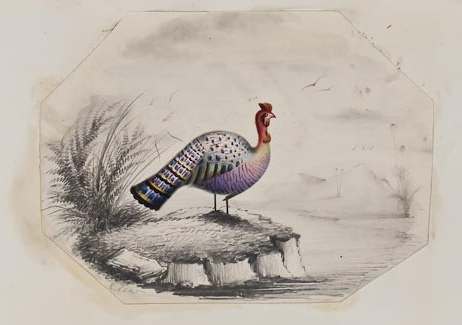
At least another one of the images seems to belong to Lear, though I cannot read the date:
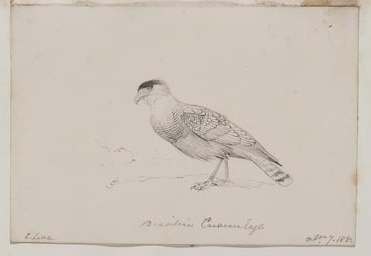
Below is the lot description, in case it disappears from the Liveauctioneers site:

Edward Lear (1812-1888) An album of early drawings and watercolours,
mostly botanical and natural history subjects, a few topographical views and figure studies, on rectos only of 62 leaves of Whatman wove paper watermarked 1827, probably by more than one hand, totalling over 80 images, some drawn or painted directly onto the leaf, others mounted on, including onto the front and back pastedowns, these mostly cut around in outline, also including 17 small engravings similarly mounted, several studies headed with its scientific classification, others more decoratively composed or placed under headings of other subjects, many inscriptions overmounted with the engravings and some later drawings, 1 botanical study signed with initials, 4 (1 flower piece, 3 birds) signed in full, of which the 2 more serious pencil bird studies dated October 1831, numerous other birds, flowers, butterflies, fish and animals, many in a closely comparable hand in both decorative and scientific styles, a pencil study of a small rodent inscribed Portrait of Mrs Gould’s Pet, the album in red half roan over marbled boards, 4to, c.1828-c.1832.

Provenance: from the natural history library of Pamela McKenna, née Jekyll (1889-1943), wife of the politician and banker, Reginald McKenna, and niece of Gertrude Jekyll, and thence by descent. The late Vivien Noakes, writing on Lear in the Royal Academy exhibition catalogue of 1985, states that the ‘earliest known of his work to have survived, dated c.1828, is an album of birds, butterflies and flowers (Houghton Library, Harvard University). The drawings follow the amateur conventions of the day’, (p.77). This album bears such remarkably close comparison to that album, in content, composition and binding, that it cannot but be from the same origin. Lear began drawing birds and animals in his teens, encouraged initially by his sisters, who may well have contributed to this album (the Houghton Library album is attributed to both Edward and Ann Lear), and then by his patron Mrs Godfrey Wentworth. She introduced Lear to Prideaux Selby who, in 1828, employed him on his Illustrations of British Ornithology, before he went on to work as an ornithological draughtsman for John Gould in the early 1830s. In the interim, Lear had also produced that extraordinarily precocious work, Illustrations of the Family of Psittacidae, or Parrots, in 1831 at the age of 19. This album comes from those formative years and, perhaps most fascinatingly of all, seems to have been revisited with later, more mature and scientific studies, however small, overlaying earlier juvenile work. Our thanks to Hope Mayo, Philip Hofer Curator of Printing and Graphic Arts, Houghton Library, Harvard University.

Posted in Edward Lear | Tagged , , , | 1 Comment

Near Khan, Lebanon

Edward Lear, Near Khan, Lebanon.

Inscribed and dated ‘Lebanon./17.May.1858./near Khan’ (lower left) and numbered ‘(173)’ (lower right) and inscribed ‘vines and millions of/black pines’ (centre) and further inscribed with colour notes.
Pencil, pen and brown ink and watercolour, 13¾ x 19¾ in. (34.9 x 50.2 cm.) .

Lear kept separate journals when travelling, in view of possible publication. As far as I know the diary for the Lebanon trip of 1858 has not survived. The diary‘s last entry is for 16 May, then it resumes on 6 June with a terse “Left Beirut.” However, we have a letter to Lady Waldegrave from Damascus, written on 27 May.


Posted in Edward Lear | Tagged , , , | Leave a comment

An Unpublished Early Picture by Edward Lear

I am by nature a collector, but I can’t say I really care about having originals or first editions: I like having everything produced by Edward Lear, for example, but late editions of his books are all right with me, provided they are faithful to the originals. While I have first editions of the three later nonsense books, for instance, I have never thought of investing a small capital to obtain an early edition of the Book of Nonsense: these are things for libraries, and getting to see the 1855 edition at the National Art Library last March was instructive and a pleasure, but I really feel no drive to acquire a copy.

So I never owned a Lear original … until about a year ago when, unexpectedly, I won the picture above on eBay at an incredibly low price. Not fully convinced of my luck, I sent a scan to Vivien Noakes and she confirmed it was by Edward Lear: she had shown me a similar one in a scrapbook when I visited her. Hers was published in The Painter Edward Lear, p. 35, as part of “Miss Fraser’s Album.”

The two pictures are extremely similar, the cliffs in the background even appear to be the same, and they were probably part of a series featuring gaily-coloured birds against a tropical-island background. Lear probably drew them in the early 1830s According to Vivien, the pictures show the influence of Thomas Stothard’s illustrations for The Life and Adventures of Robinson Crusoe, but I think a stronger influence might have been George Cruikshank’s illustrations for the same book. Stothard’s wonderful engravings always foreground Robinson and set him in a rather indefinite environment, while Cruikshank tends to emphasize the landscape and his figures are much less defined and slightly caricatural. Lear, who never felt sure of his figures, only suggests their presence and does not really manage to integrate them in their surroundings. The birds, however, though very small, are gorgeous and jump out of the picture

Posted in Edward Lear | Tagged , , , | 4 Comments

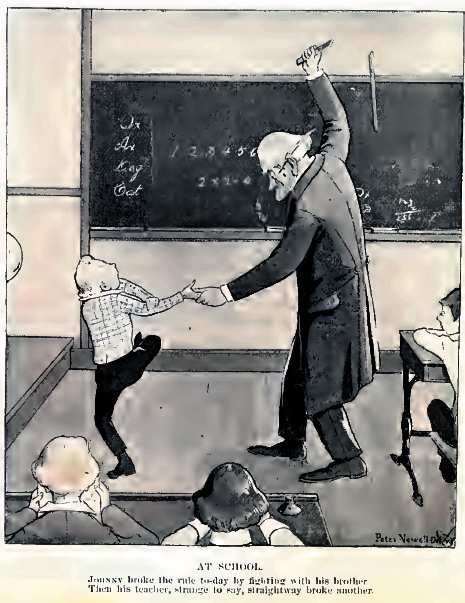
Peter Newell: At School

Johnny broke the rule to-day by fighting with his brother
Then his teacher, strange to say, straightway broke another.

Harper’s Young People, vol 15, issue 735, 28 November 1893, p. 72.

Posted in Peter Newell | Tagged , | Leave a comment

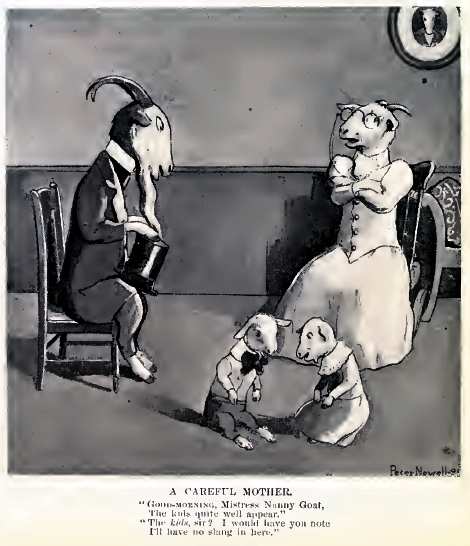
Peter Newell: A Careful Mother

“Good -morning, Mistress Nanny Goat,
The kids quite well appear.”
“The kids, sit? I would have you note
I’ll have no slang in here.”

Harper’s Young People, vol 15, issue 742, 16 January 1894, p. 208.

Posted in Peter Newell | Tagged , | Leave a comment

Gustave Verbeek: The Chicken Girl

Hartmann, Sadakichi. A History of American Art. Boston: L.C. Page, vol. 2, p. 129.

Posted in Gustave Verbeek | Tagged , | Leave a comment

Gustave Verbeek: The Boy, the Snowball, and the Cat

Harper’s Magazine, vol. 94, issue 562, March 1897, p. 655.

Posted in Gustave Verbeek | Tagged , | Leave a comment

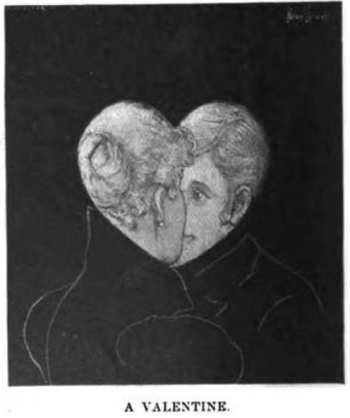
Peter Newell: A Valentine

Harper’s Magazine, vol. 94, issue 562, March 1897, p. 654.

Posted in Peter Newell | Tagged , | Leave a comment

Peter Newell: Cupid’s Top

Harper’s Magazine, vol. 94, issue 562, March 1897, p. 653.

Posted in Peter Newell | Tagged , | Leave a comment

Peter Newell: A Rebuff

Harper’s Magazine, vol. 94, issue 561, February 1897, p. 493.

Posted in Peter Newell | Tagged , | 1 Comment