Phos, ye cat

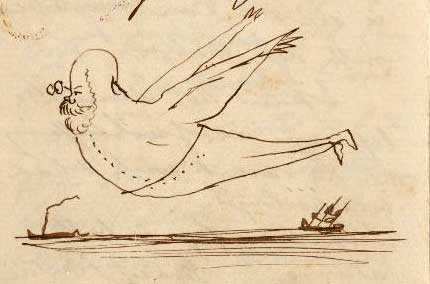
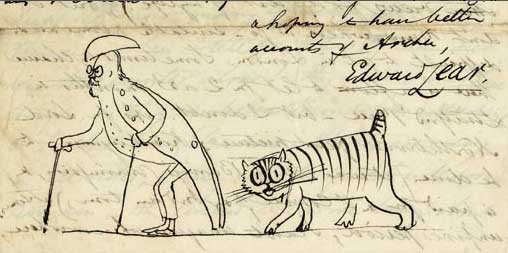
From a letter to Mrs. G. Clive of 25 March 1875 after coming back from the Indian tour.

The letter complains of the changes in San Remo since the Franco-Prussian War (‘You may suppose how many Germen & Gerwomen there are, when I tell you that 37 have died here this winter alone!’), mentioning his falling income from the sale of his pictures, referring to his Indian tour (the country has ‘so fascinated me that I hardly fancy I can make any other views for the rest of my life’) and ‘Lord Northbrook’s great picture of Kinchinjunga’, and concluding with mournful description of his ‘semi-demoralized’ condition: ‘I am become like a periwinkle in the wilderness, with an owl for his dessert. It ain’t pleasant at 63 … I shall have recourse to the society of my Cat, & walk up & down the terrace.’

Christie’s, 6 June 2001.
Posted in Edward Lear | Tagged | 2 Comments

Edward Lear and the Ionian Islands

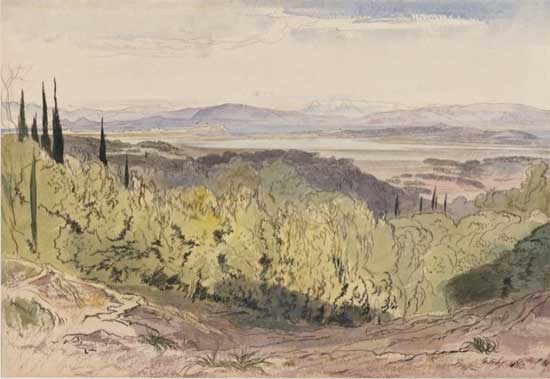
E. Lear, Corfu - Viros, 1863

The Corfu Museum of Asian Art has officially announced the dates for the bicentenary exhibition, Edward Lear & the Ionian Islands, at the Palace of St. Michael and St. George, from 25 May to 31 August 2012.

The exhibition also has an informative official page.

Posted in Edward Lear | Tagged , , , , | Leave a comment

Edward Lear Conference

Harvard University - Houghton Library MS Typ 55.23

As you know if you follow the list of Bicentenary Events, there will be an Edward Lear Bicententennial Conference at Jesus College, Oxford, on 21-22 September.

The page announcing it now lets you pre-register to be notified as soon as registration opens. Still here? What are you waiting for?

Posted in Edward Lear | Tagged , | Leave a comment

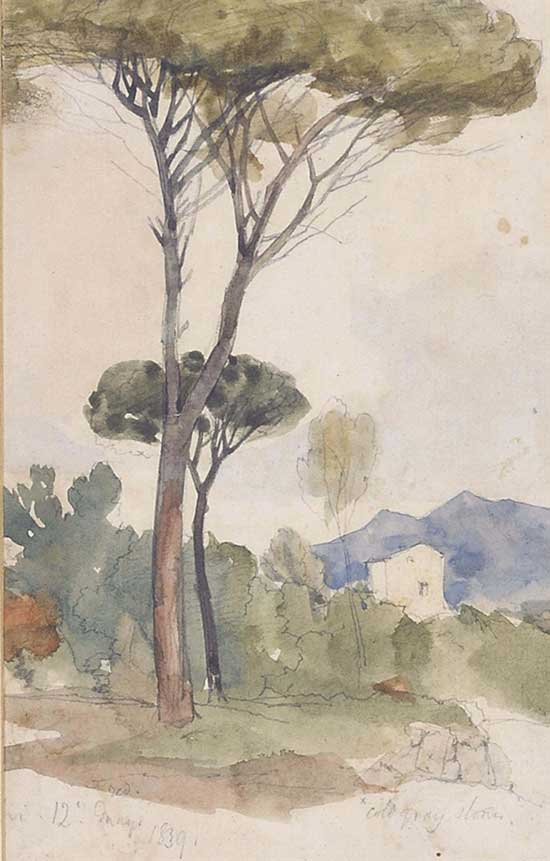
Edward Lear, Cypress Trees (1839)

Cypress trees. Inscribed and dated ‘..vi 12 th May 1839.’ (lower left) and variously inscribed with colour notes. Pencil and watercolour. 5¾ x 3½ in. (14.7 x 8.9 cm.).

Christie’s.

Posted in Edward Lear | Tagged , , | Leave a comment

Two Talks on Edward Lear in One Day

Tomorrow, 30 January, two separate events will mark the beginning of Edward Lear’s bicentenary celebrations. You will have to choose, if you are in London, don’t miss

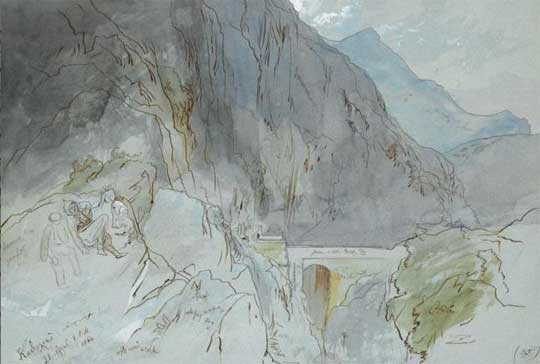
Edward Lear, Katholikó Akrotiri, Crete (1864)

Edward Lear and His Cretan Drawings, a lecture by Stephen Duckworth. Modern Greek Seminars, King’s College, London. 5.30 pm.

If you are in Oxford:

Edward Lear’s Origins, a lecture by James Williams, of Brasenose and Jesus Colleges. Oxford Children’s Literature and Youth Culture Colloquium, Seminar Room A, English Faculty Building. 5.15 pm. Directions & map.

More details in the home page, or on Facebook.

When Edward Lear drew the picture above, in April 1864, he had just completed a three-month stay on Corfu. From that island he had travelled to Athens and then on to Crete, where he was to stay until June. In this on-the-spot drawing, the artist has depicted the so-called Katholiko Monastery, which lies in the dramatic but barren Akrotiri peninsula in northern Crete. Built in the tenth and eleventh centuries the monastery had been abandoned by the date Lear visited the region.
Pen and brown ink and watercolour over pencil heightened with white on blue paper,

Inscribed l.l.: Katholikó (Akrotiri)/ 21 April 1. pm/ 1864, numbered l.r: (25), and further inscribed with colour notes.
Posted in Edward Lear | Tagged , , , , | Leave a comment

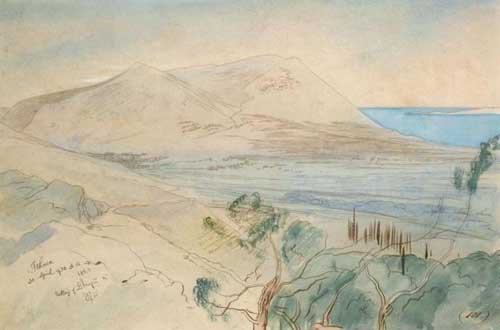
Edward Lear, Ithaca (1863)

Ithaca, Ionian Islands. Inscribed and dated l.l.: Ithaca/ 30. April. 9.30.A.M. 1863/ Valley of Elaupio/ OE…, numbered l.r.: 101, further inscribed with notes. Pen and brown ink and watercolour over pencil heightened with bodycolour.

In 1863, the date of the present work, Lear was 51 years old. Between 1862 and early 1864 he had largely divided his time between Corfu and England. However, from April to May he conducted a brief tour of the other Ionian islands. Ithaca lies to the north-east of Kefalonia and Lear described it as ‘Ulysses’ Kingdom’. He was clearly inspired by the island for in letter to Ann, his wife, he wrote: ‘[Ithaca] is a little island and charmingly quiet. I delight in it,’ (see Angus Davidson, Edward Lear, 1968, p.50).

Posted in Edward Lear | Tagged , , , | Leave a comment

Edward Lear, Gozo, Malta

Edward Lear, Gozo, Malta. Watercolour and bodycolour, (25 x 16 cm). Private collection.

Posted in Edward Lear | Tagged , , , | 1 Comment

Two More Looloos

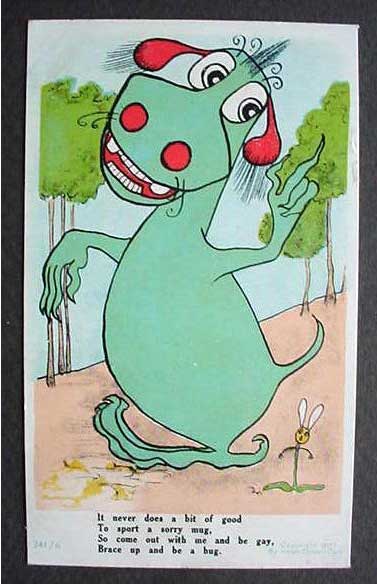
I found these two pictures on my hard disk; which I probably saved them from eBay auctions. They are from a set of six postcards from Helen Stilwell’s Laughable Looloos, a series of cartoon that was published in the New York World from 13 May to 25 November 1906, I have posted most of the newspaper strips here.

Helen Stilwell, I have found out, married comic strip artist Gene Carr on 22 August 1906 (they divorced in 1937), and was “a school teacher of Red Bank, and has since been living at Red Bank. Mrs. Carr is generally supposed to be the writer who signs her name Betty Vincent to many stories which are published by the same newspaper for which Carr works” (The New York Times, 28 July 1908, reporting on Carr being suspected of murder, but being “proved not the man”).

Posted in Comics | Tagged , , , | 1 Comment

Edward Lear, A View of the Valley of the Nera, Near Rome

A view of the Valley of the Nera, near Rome.
Signed with monogram, inscribed and indistinctly dated ‘Valley of the Nera/18…’ (lower right) and with the artist’s notation ‘River’.
Pencil heightened with white on buff paper. 10 1/8 x 13¾ in. (25.9 x 35 cm.).

Lear most likely made this drawing during his first few years in Italy, circa 1838-39, when he would often travel through the Campagna.

Christie’s.

Posted in Edward Lear | Tagged , , | Leave a comment

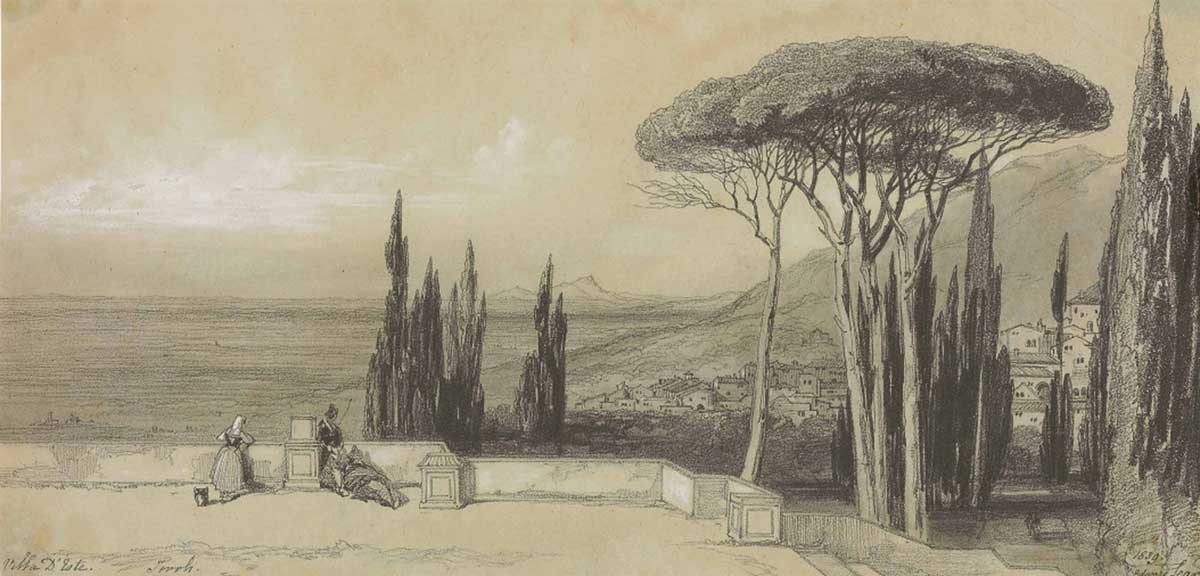
Edward Lear, Tivoli (1839)

Tivoli, a view from the Villa d’Este looking across the Campagna.
Inscribed ‘Villa D’Este. Tivoli’ (lower left) and signed and dated ‘1839./Edward Lear’ (lower right).
Pencil heightened with white on grey-green paper. 6 5/8 x 13 1/8 in. (16 x 33.4 cm.).

This highly finished pencil drawing is typical of the artist’s early style. The technique and composition of such works shows the influence of James Duffield Harding with a vigorous use of soft dark lines, white chalk highlights and tinted paper.

Christie’s.

Posted in Edward Lear | Tagged , , | 1 Comment