My transcript:
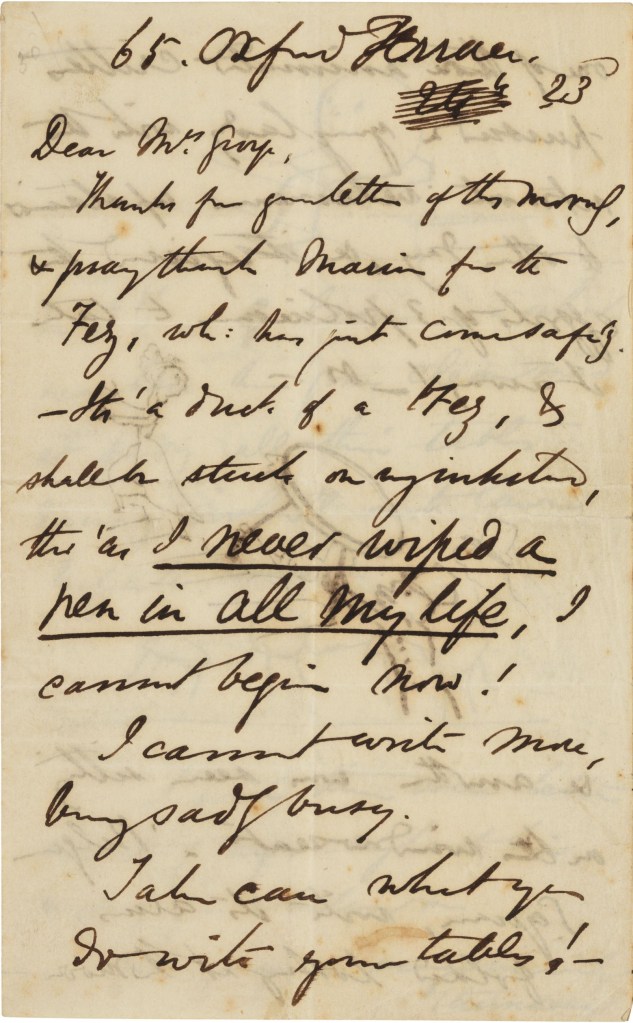
65. Oxford Terrace.
24th 23d
Dear Mrs George,
Thanks for your letter of this morning, & pray thank Maria for the Fez, wh: has just come safely. — It’s a duck of a Fez, & shall be stuck on my inkstand, tho’ as I never wiped a pen in all my life, I cannot begin now!
I cannot write more, being sadly busy.
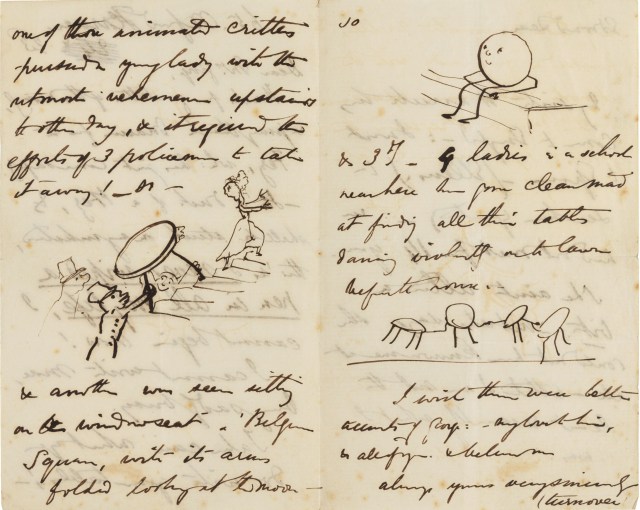
Take care what you write with your tables! — one of those animated critters pursued a young lady with the utmost vehemence upstairs the other day, & it required the efforts of 3 policemen to take it away! — so —
<picture>
& another was seen sitting on the window-seat at Belgrave Square, with its arms folded looking at the moon — so
<picture>
& 3dly — 4 ladies in a school near here have gone clean mad at finding all their tables dancing violently on the lawn before the houe. —
<picture>
I wish there were better accounts of George: — my love to him, & all of you. & believe me
always yours very sincerely (turn over
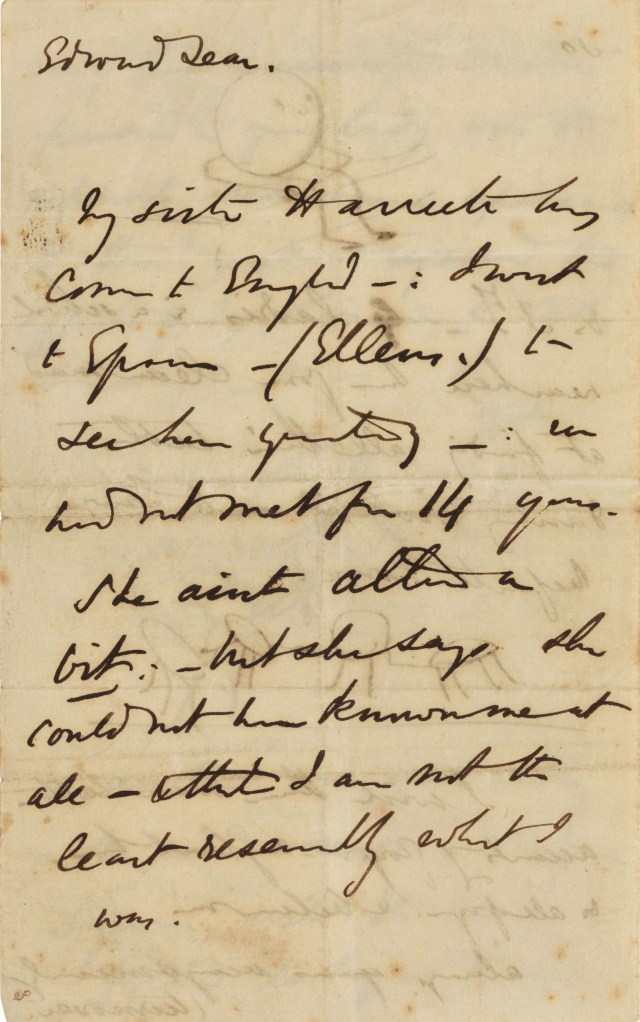
Edward Lear
My sister Harriet has come to England –: I went to Epsom — (Ellen’s) to see her yesterday) –: we had not met for 14 years.
She aint altered a _bit_: — but she says she could not have known me at all — & that I am not the least resembling what I was.
The post-scriptum asllows us to date the letter exactly, Lear mentions vsiting his sister Harriet in his diary for 23rd August 1858 when he finds her “looking ill,” so this letter was written on 24th. She would die less than a year later, as he mentions in his diary entry for 25 July 1859.
The Bonhams description quoted below also incorrectly states that it is addressed to “a close family friend… with the moniker of Charles Dickens’s famous comedic creation—Mrs. Gamp,” while actually it begins “Dear Mrs. George,” probably George Scrivens’s wife, so no reference to Dickens is present in the text. In addition they write that the meeting with Harriet took place in “Strowan” while, as the diary entry makes clear, he saw her in Epsom.
Edward Lear illustrated autograph letter.
LEAR, EDWARD. 1812–1888. Autograph Letter written under a playful Dickensian pseudonym (“Dear Mrs. Gamp”), profusely illustrated with three original pen-and-ink nonsense drawings by Lear satirizing the Victorian “table-turning” spiritualism craze. 65 Oxford Terrace, London, Wednesday 23rd [c. 1853] 4 pages, written across a single folded bifolium of cream wove paper, 8vo (180 x 113 mm). Featuring a famous personal declaration regarding his writing process and three highly characteristic nonsense illustrations integrated into the text body, light vertical and horizontal folding creases.
A PREMIER EXEMPLAR OF VICTORIAN NONSENSE LITERATURE: AN ILLUSTRATED AUTOGRAPH LETTER BY EDWARD LEAR CAPTURING THE ARTIST AT HIS SATIRICAL AND VISUAL BEST.
While Edward Lear’s illustrated correspondence to close confidants like Chichester Fortescue and the Tennyson family is celebrated in institutional collections, privately held letters containing multiple, fully developed narrative sketches are scarce on the market. This complete four-page letter captures the “King of Nonsense” using both his literary wit and his distinct graphic line to savage the massive spiritualist craze of “table-turning” that captivated London drawing rooms during the 1850s.
Writing to a close family friend whom he addresses with the moniker of Charles Dickens’s famous comedic creation—Mrs. Gamp—Lear begins by acknowledging a miniature gift sent by a mutual acquaintance named Maria. The gift, a novelty fabric “Fez” designed to serve as a Victorian pen-wiper, prompts an heavily underlined declaration that serves as a cornerstone piece of personal trivia regarding Lear’s chaotic artistic process:”…[it] shall be stuck on my inkstand, tho’ as I never wiped a pen in all my life, I cannot begin now!” The letter swiftly transitions into a tour de force of Lear’s signature surrealism as he turns his sights on the contemporary fad of séances and moving furniture, detailing a series of fictional accounts where local tables have become sentient, wild “animated critters.”
To complement his narrative, Lear executes three pen-and-ink doodles directly into the text layout:
The Fleeing Lady: A dramatic sketch illustrating a narrative report where a rogue parlor table “pursued a young lady with the utmost vehemence upstairs… and it required the efforts of 3 policemen to take it away!
“The Lunar Spectator: A charming, anthropomorphized drawing of a three-legged circular table with a fully realized, smiling human face resting contentedly on a bench (“sitting on the window-seat in Belgrave Square, with its arms folded looking at the moon”).
The Dancing Academy: A kinetic chorus line of four stick-legged tables dynamically kicking their limbs into the air, illustrating a local rumor of a ladies’ school gone “clean mad at finding all their tables dancing violently on the lawn before noon.”
On the final page, Lear rounds out the correspondence by shifting to an intimate biographical update. He writes from “Strowan” to report an emotional family reunion with his beloved sister Harriet after a fourteen-year separation, noting with moving self-deprecation that while she had not altered at all, “she says she could not have known me at all — & that I am not the least resembling what I was.”

