[In 2012, the King’s School in Canterbury held a bicentenary exhibition of its holdings of Edward Lear watercolours, part of an album of drawings donated by Hugh Walpole in 1938. Most of these works had already been presented by Charles Nugent in the two publications cited in the “Further Reading” section below.
Here is the short catalogue that was printed for the occasion; it was given to me by Peter Henderson, Walpole Librarian at the King’s School, Canterbury, when I visited the library in March of 2014. Marco.]
EDWARD LEAR DRAWINGS
A Bicentenary Exhibition
Edward Lear was born in Holloway on 12 May 1812. A largely self-taught artist, he began his career drawing animals and birds. His Illustrations of the Family of Psittacidae or Parrots was published in 1830-32. He also did illustrations for The Zoology of the Voyage of HMS Beagle and for John Gould’s The Birds of Europe.
Lear probably first went to the Lake District in around 1830, when he was invited by Edward Stanley, later 13th Earl of Derby, to draw the animals in the menagerie at Knowsley Hall, Lancashire. In 1835, 1836 and 1837 he went on tours of the Lakes and began drawing landscapes. These journeys were the subject of an exhibition ‒ Edward Lear the Landscape Artist ‒ curated by Charles Nugent at the Wordsworth Trust, Grasmere in 2009. The School’s seven Lake District drawings were exhibited there. Lear drawings of English scenes are rare.
In 1837 Lear left England for Italy and for the next dozen years he was largely based in Rome. He particularly appreciated the beauty of the Campagna, but he also visited much of central and southern Italy as well as Sicily. The School’s four Italian drawings probably date from this period. He returned to England twice, taking the opportunity to publish Views in Rome and its Environs in 1841 and Illustrated Excursions in Italy in 1846. His first Book of Nonsense appeared pseudonymously in 1846. He also gave drawing lessons to Queen Victoria.
From 1849 to 1853 Lear was in England. He enrolled as a student at the Royal Academy, and also had painting lessons from Holman Hunt. He then returned to Italy and for the rest of his life he lived abroad with just the occasional summer visit to England. He travelled extensively in the Mediterranean, with one trip to India. He was a prolific artist, leaving nearly 10,000 drawings and watercolours as well as some 300 oil paintings. He published several more books illustrating his travels, and set some of Tennyson’s poems to music. He died at San Remo in 1888.
The School’s Lear drawings came in an album presented by Hugh Walpole in 1938 as part of the Walpole Collection. There are nineteen landscape sketches in pencil and watercolour, dated between 1835 and 1845, though some of the pictures are not by Lear, but probably by his pupils. This is the first time these twelve pictures by Lear have been displayed in Canterbury.
KING’S WEEK 2012
Admissions Office, Lardergate
Exhibition open during office hours
THE LAKE DISTRICT 1835-37:
LATHOM 1835:
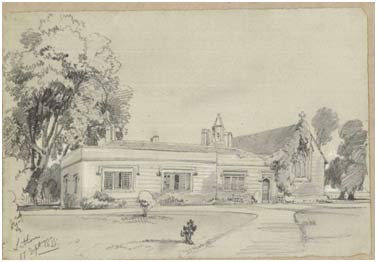
1. THE CHAPEL AND SCHOOL, LATHOM, LANCASHIRE.
Inscribed: ‘Lathom 17 Sept. 1835’. Pencil and black chalk with touches of white heightening, on blue-grey paper. The Chantry Chapel had been founded by the Earl of Derby in 1500 and consecrated in 1509. The priest’s house was demolished in the eighteenth century and was replaced by a school. Nugent (2009), no. 31.
2. LATHOM HOUSE, LANCASHIRE.
Inscribed: ‘Lathom. Sept 18. 1835.’ Pencil and black chalk on blue-grey paper. Lathom was the property of Lord Skelmersdale, father-in-law of Edward Stanley, later 14th Earl of Derby. The house was built in Palladian style by Giacomo Leoni for Sir Thomas Bootle c1740. The main house was demolished in 1925. Nugent (2009), no. 30.

LEVENS HALL AND KENDAL 1836:
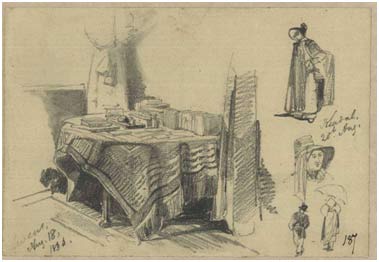
3. STUDY OF AN INTERIOR AT LEVENS HALL AND STUDIES OF FIGURES.
Inscribed: ‘Levens Aug 18 1836’, and ‘Kendal 20th Aug’. Pencil. Lear drew very few interiors, though there is another drawing of a Levens interior in the British Museum. Nugent (2009), no. 35.
4. THE NORTH FRONT, LEVENS HALL, CUMBRIA.
Inscribed ‘Levens. Aug. 19. 1836’. Pencil and black chalk with touches of white heightening, on blue-grey paper. Levens was the largest Elizabethan house in Cumbria. It was the home of Col. the Hon. Fulke Greville Howard and his wife Mary. Lear described it as “perhaps the finest existing specimen of an antique house”. Nugent (2009), no. 36.

ALDERLEY 1837:
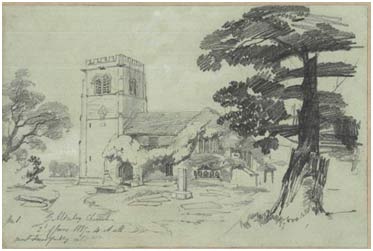
5. ST MARY’S CHURCH, NETHER ALDERLEY, CHESHIRE.
Inscribed: ‘Alderley Church 2d of June 1837 4 A.M. most dreadfully cold’, and ‘No. 1’. Pencil and black chalk with touches of white heightening, on blue-grey paper. Lear stayed at Knowsley in May on his final visit before departing for Italy. Nugent (2009), no. 96.
6. THE SKELETON OAK, ALDERLEY PARK, CHESHIRE.
Inscribed ‘Alderley June 3. 1837.’; ‘5 A.M. Cold – drizzly.’; ‘The Skeleton Oak’; and signed ‘Edward Lear del.’ Pencil and black chalk with touches of white heightening, on blue-grey paper. The finished drawing is in the Whitworth Art Gallery, University of Manchester. Lear made several studies of trees in Alderley Park for the Stanley family. Nugent (2009), no. 97.

7. NINE LAKE DISTRICT VIEWS.
Pencil and black chalk. The views are from West Cumberland and include Pikes Crag, Wasdale Hall and Wastwater. Versions of four of the scenes in the thumbnails have survived and were exhibited at Dove Cottage (nos. 42, 43, 44 and 47). These original drawings date from September 1836, so this composition was probably produced soon afterwards. This type of image is unique in Lear’s work. Nugent (2009), no. 45.

SCOTLAND 1841:
8. A DISTANT VIEW OF TAYMOUTH CASTLE, PERTHSHIRE.
Pencil and black chalk, on buff paper. This preliminary sketch is annotated, in characteristic Lear fashion, ‘stream’, ‘beech’, ‘ash’, ‘wood’, etc. Lear visited Scotland in September 1841 with Phipps Hornby and this view was presumably drawn on that occasion.

ITALY 1837-1845:
9. HOUSE IN ITALY.
Inscribed: ‘E Lear del. 1837’. Pencil and black chalk with white heightening on orange paper. Lear left England in July 1837 and after a journey through Germany arrived in Italy in September. From Milan he went on a walking tour of Como and Lugano, visited Florence, and arrived in Rome in December. This view has not been identified.

10. SANT’ IONA.
Inscribed ‘Sant’ Iona’ and ‘E. Lear 1845’. Pencil and black chalk on grey paper. Sant’ Iona is in the Abruzzi, a mountainous region to the East of Rome. In early 1845 Lear went on a sketching tour in the Campagna with Chichester Fortescue, later Lord Carlingford. He then left Rome in April to return to England.

ITALIAN SCENE.
Inscribed: ‘E.L.’ Pencil and black chalk with touches of white heightening on blue paper. This view is probably in the Campagna, where Lear found “the beauty and the grandeur that he most wanted to paint… [with] gnarled olive trees and rhythmical lines of hills disappearing into wide, distant horizons” (Vivien Noakes). It may well be from the same period as no. 12.

12. ITALIAN SCENE.
Pencil and black chalk on blue paper. In one of his earliest letters from Rome in December 1837, Lear commented on “the long lines of aqueducts and tombs on the desolate and beautiful Campagna”. Several Lear drawings and watercolours of Roman aqueducts survive. This is probably from the same period as no. 11.

Further Reading
Vivien Noakes, Edward Lear: The Life of a Wanderer (1968; revised and enlarged 2004)
Vivien Noakes, Edward Lear 1812-1888 (1985). Royal Academy exhibition catalogue.
Vivien Noakes, Edward Lear: Selected Letters (1988)
Charles Nugent, ‘Some unpublished drawings by Edward Lear of British subjects’, British Art Journal, Vol. VIII, no. 1 (2007), pp. 24-9
Charles Nugent, Edward Lear: the Landscape Artist (2009): nos. 30, 31, 35, 36, 45, 96 and 97.
Previous King’s Week exhibitions
1972 Prints and Drawings of the School
1974 Somerset Maugham’s Schooldays
1975-77 Prints and Drawings of the School
1978 William Harvey 1578-1978
1985 Michael Powell, Carol Reed and Charles Frend: OKS Film Directors
1993 Marlowe and his Successors
1994 Walter Pater’s Schooldays
1996 William Morris
1997 A King’s School Tapestry: 597-1997
1998 Hugh Walpole and the Walpole Collection
1999 Fin de Siècle
2000 Passing Tales: Some Literary Pilgrims
2001 Fifty Years of King’s Week
2002 The School Library: A Tercentenary Exhibition
2005 Michael Powell: A Life in Movies
2008 Jocelyn Brooke Centenary
2010 Jimmy James: the Great Escaper
Acknowledgements
Many thanks to Bev Skilton, Kate Harrison and Claudia Upton of the Admissions Office for hosting the exhibition; to Peter Whitehead and Sarah Stanley for mounting the drawings; to Hawkswells for the picture frames; and to Charles Nugent, who first recognised the importance of the album.
[The following is a list of the drawings in the album, including those that cannot be attributed to Edward Lear; this was also given to me by Peter Henderson. Marco.]
EDWARD LEAR: drawings and watercolours.
The items are listed in the order in which they are bound in this volume.
- Nine Lake District views. 14 × 23 cm. Pencil and black chalk. The views include Pikes Crag, Wasdale Hall and Wastwater. Nugent (2009) no. 45.
- [not EL] Tower. 23 × 15.3 cm
- Study of an interior at Levens Hall and studies of figures. 15.5 × 23 cm. Inscribed: ‘Levens Aug 18 1836’, and ‘Kendal 20th Aug’. Pencil and black chalk. Nugent (2009) no. 35.
- The Chapel and School, Lathom, Lancashire. 17.3 × 26 cm. Inscribed: ‘Lathom 17 Sept. 1835’. Pencil and black chalk with touches of white heightening, on blue-grey paper. Nugent (2009) no. 31.
- St Mary’s Church, Nether Alderley, Cheshire. 16.7 × 25.3 cm. Inscribed: ‘Alderley Church 2d of June 1837 4 A.M. most dreadfully cold’, and ‘No. 1’. Pencil and black chalk with touches of white heightening, on blue-grey paper. Nugent (2009) no. 96.
- Sant’ Iona. 8.3 × 13.7 cm. Inscribed ‘Sant’ Iona’, and signed ‘E. Lear 1845’.
- The Skeleton Oak, Alderley Park, Cheshire. 25.3 × 16.7 cm. Inscribed Alderley June 3. 1837.’; ‘5 A.M. Cold – drizzly.’; ‘The Skeleton Oak’; and signed ‘Edward Lear del.’. Pencil and black chalk with touches of white heightening, on blue-grey paper. The finished drawing is in the Whitworth Art Gallery, University of Manchester, D.1981.1. Nugent (2009) no. 97.
- Lathom House, Lancashire. 17.5 × 25.8 cm. Inscribed: ‘Lathom. Sept 18. 1835.’ Pencil and black chalk on blue-grey paper. Nugent (2009) no. 30.
- [not EL] 20.5 × 25.8 cm. Inscribed ‘from the Wimberry above pen-ma..’
- [not EL] Tree. 25.5 × 20.8 cm.
- House in Italy. 20 × 28.8 cm. Inscribed: ‘E Lear del. 1837’.
- [not EL] Tivoli. 27 × 21.5 cm. (Image 19 × 13.2 cm.)
- [not EL] Trees. 28.5 × 22 cm. Inscribed: ‘Gozzinni del.’ (or ‘Gorzini, or ‘Gornissi’??)
- [possibly EL] Rhine scene. 22.7 × 30 cm. (Image 16.7 × 25.5 cm.)
- Campagna scene. 24.5 × 29.8 cm. × (Image 17 × 25.4 cm.)
- Italian scene. 24.2 × 30 cm. (Image 17 × 26 cm.) Inscribed: ‘E.L.’
- [not EL] Unknown view. 25.7 × 27.2 cm.
- A distant view of Taymouth Castle, Perthshire. 25.5 × 35.2 cm. Pencil and black chalk, on buff paper.
- The North Front, Levens Hall, Cumbria. 25.5 × 36 cm. Inscribed ‘8’, and ‘Levens. Aug. 19. 1836’. Pencil and black chalk with touches of white heightening, on blue-grey paper. Nugent (2009) no. 36.
Charles Nugent, ‘Some unpublished drawings by Edward Lear of British subjects’, British Art Journal Vol. VIII, no. 1, pp. 24-28, describes and illustrates nos. 1, 3, 4, 5, 7, 8, 18 and 19.
Nos. 1, 3, 4, 5, 7, 8 and 19 were exhibited at Dove Cottage in 2009; see Charles Nugent, Edward Lear: the Landscape Artist (2009): nos. 30, 31, 35, 36, 45, 96 and 97.