Edward Lear, View of Sorrento (1839)

el_sorrento-s

Edward Lear, View of Sorrento.
Signed and dated ‘Edward Lear del./1839’ (lower right) and inscribed ‘Sorrento’ (lower left)
pencil and black chalk heightened with white. 9 7/8 x 16 ½ in. (25 x 42 cm.)

Lear spent the summer of 1838 travelling through the area around the Bay of Naples with the artist Thomas Uwins (1782-1857). For much of the time they were based in the small village of Capo di Cava and from there made excursions either inland or around the Bay. There is another view of Sorrento and the Bay executed in the same careful technique and on a sheet of similar size, in Boston, Museum of Fine Arts.

Christie’s.

Posted in Edward Lear | Tagged , , , | Leave a comment

Georgiana Peel’s Recollections of Edward Lear

Lady Georgiana Peel, née Lady Georgiana Adelaide Russell, (1836-1922) was Archibald Peel’s second wife; he was a friend Edward Lear frequently mentioned in the diaries. A book of her memoirs was published in 1920 by her daughter; unfortunately, the editing is far from perfect, and the “recollections” do not always correspond to what we would expect of Lear, e.g. the “story” she reports does not sound like him at all. Also, when Lear had his adventure in revolutionary Reggio Calabria he ws travelling with John Proby, not Peel.

georgiana-peel

Recollections of Lady Georgiana Peel. Compiled by Her Daughter Ethel Peel. London: John Lane, The Bodley Head, 1920, pp. 251-253:

Two very interesting men with whom he [Georgiana’s husband Archibal Peel] travelled, in Italy and Corsica, were Mr. Chichester Fortescue, Chief Secretary for Ireland in my father’s administration, and Mr. Edward Lear, the landscape painter, and writer of nonsense stories and verses, also books of travel, which have a charm about them, given by the writer’s very original ideas, coupled with sketches which render to the reader exactly what he wished to describe.
While in company with Edward Lear, they stayed at a small inn, in a town in Italy, which was much agitated by a local revolution, a frequent occurrence in that country. The two visitors, wishing to go out at once to inspect the beauties of the town, gave the keys of their boxes to the waiter, and asked him to unpack, and put out their clothes, as they wished to change at once on coming in. They were somewhat taken aback, when the excited little Italian threw the keys in the air, shouting, “Non c’è roba! Non c’è chiave! Tutto è amora e libertà!” — “There are no clothes, there are no keys, all is love and liberty!” They were quite relieved when the luggage and keys remained in sight, and did not disappear!
A story told A. by Edward Lear always struck him as a lesson in worldly wisdom. Though published afterwards by the well-known landscape painter in one of his books, it may perhaps be repeated. The fable, which though not Aesop’s is worthy of that ancient sage, run [sic] as follows:
“Once upon a time, three poor students, all very near-sighted, and each possessing a single pair of horn-rimmed spectacles, set out to walk to a remote university for the purpose of competing for a professorship. On the way, while sleeping by the wayside, a thief stole their three pairs of spectacles. Waking, their distress was great: they stumbled, they fell, they lost their way, and night was at hand when they met a pedlar.
“‘Have you any spectacles?’ said the three miserable students,
“‘Yes,* said the pedlar,’ exactly three pairs, but they are set in gold, and are of magnificent workmanship; in fact, they were made for the King, and the cost is £15 each pair.’
“‘Such a sum,’ said one student, ‘is absurd; it is surely as much as we possess.’
“‘I cannot,’ the pedlar replied, ‘take less, but here is an ivory-handled frying-pan which I can let you have for a trifling sum, an astonishing bargain; you may never again chance to meet with such a singularly joyful opportunity.’
“Said the eldest of the three students, ‘I will grope my way on as I can. It is ridiculous to buy a pair of this man’s spectacles at such a price.’
“‘And I,’ said the second student, ‘am determined to purchase the ivory-handled frying-pan; it costs little, and may be useful, and I may never again meet with such an extraordinary bargain.’
“But the youngest of the three, in spite of the laughter of his two companions, bought the sumptuous spectacles, and walking quickly on, no longer hindered by his bad sight, soon disappeared in the distance.
“Thereon, No. 1 set off slowly, but falling into a ditch by reason of his blindness, broke his leg, and was carried back by a passing cart to his native town.
“No. 2 wandered on, but lost his way, and after much anxiety and loss of time, was forced to sell his valuable frying-pan at a great loss, to enable him to return home.
“No. 3 reached the university, gained the prize, was made a professor, with a fixed home and a fixed salary, and lived happily ever after.
“Moral. To pay much for what is most useful is wiser than to pay little for what is not!”
Edward Lear, as can be guessed from his books, was the most inspiring of companions, nothing could be uninteresting when viewing it in his company.

archie-peel

Of greater interest are two letters she publishes from John Peel, Archibald’s elder brother, mentioning Lear and his stays in Malta:

Edward Lear has been often here, he has a house the other side of the harbour; I generally dine him and put him up about once a week. Though excellent friends, when talking to him I feel like a bad skater; any minute may bring me to grief. Artists and naval men are so cursedly vain, they are always thinking of their own dignity, and that is why one is perpetually treading on their toes.
(From Malta, February 1865, but must be 1866. Recollections p. 236.)

The other one is of 23 February 1867, ibid. p. 239, and provides a Dickensian portrait of Lear:

Edwin [sic] Lear, when he passed through, dined with me; he was as usual somewhat melancholy, and foretold the death of his remaining relatives, several in number and his own total blindness and impecuniosity like Micawber; however he brightened up, and concealed a good deal of liquor about his person, he is now up the Nile, and I owe him a letter.

Posted in Edward Lear | Tagged , , | 1 Comment

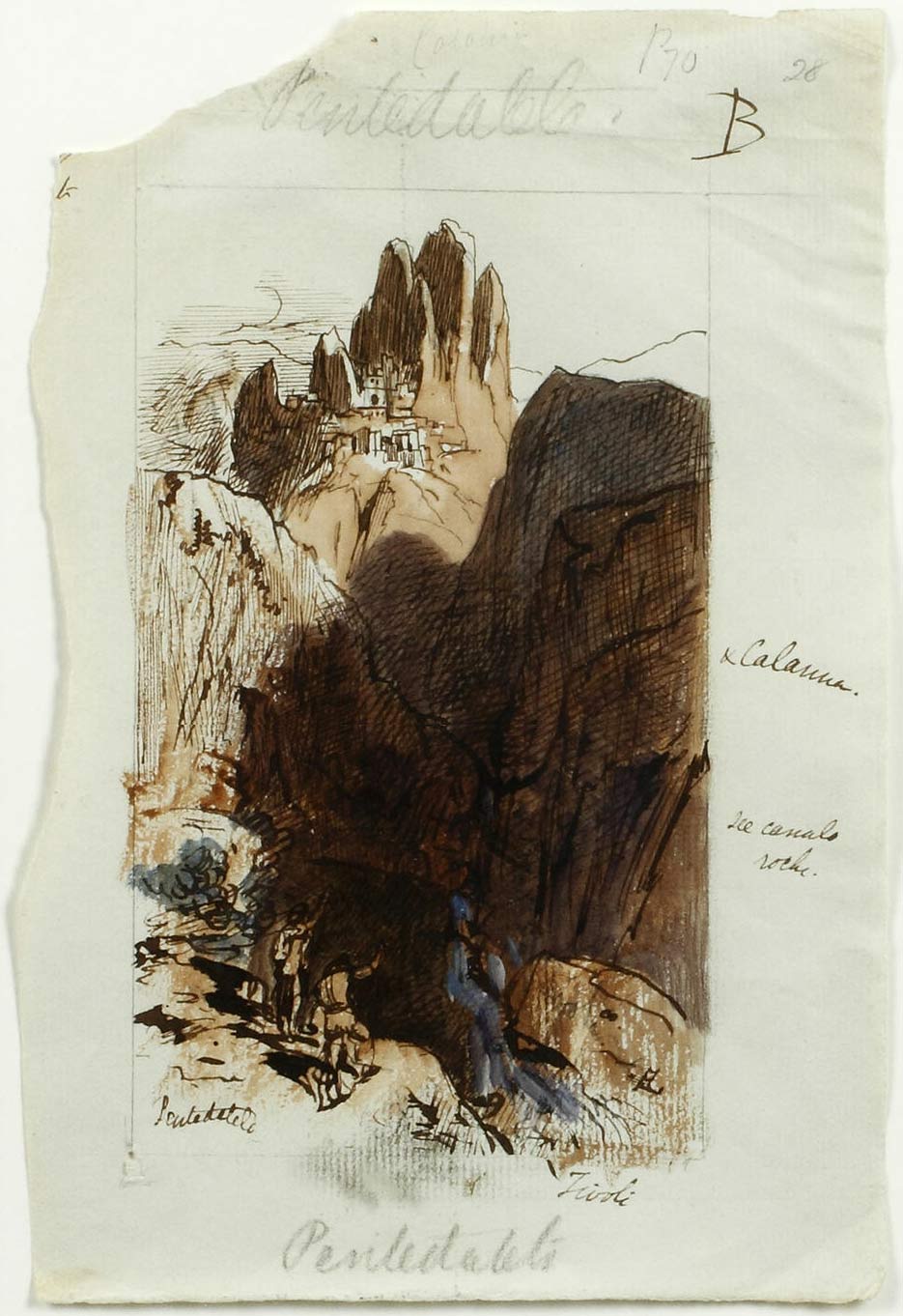
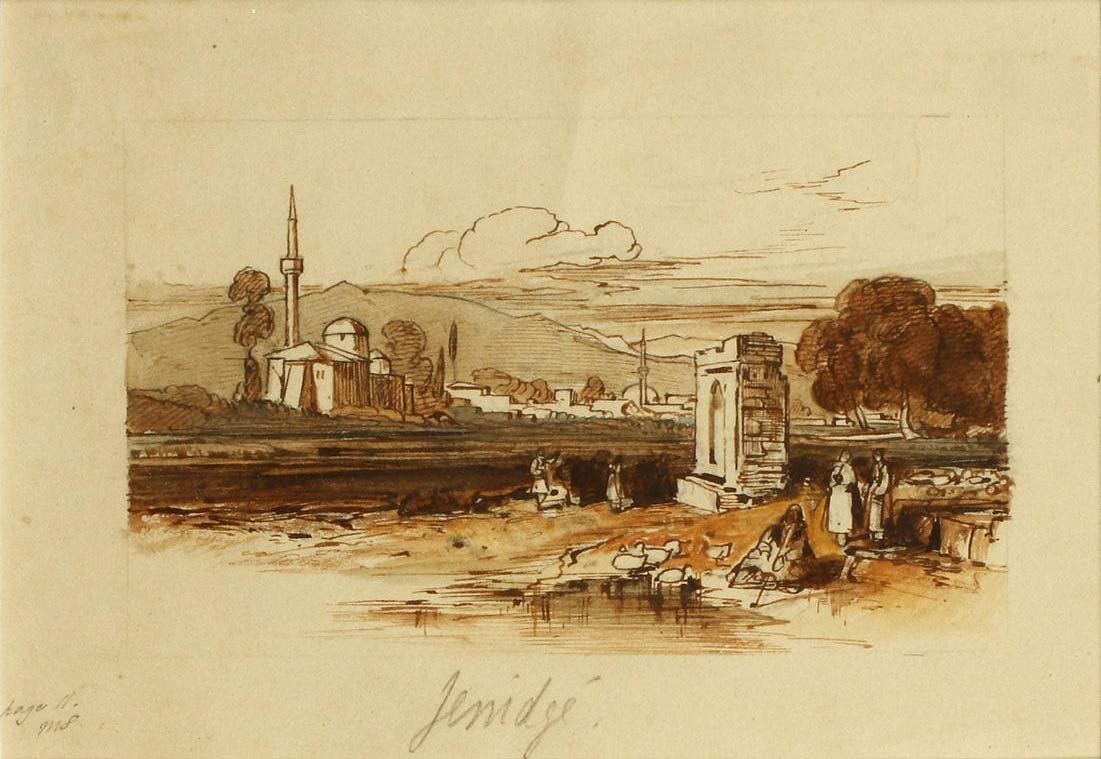
Edward Lear, Pentedatelo and Jenidgé

Two undated watercolours to be auctioned at Bonhams:

el_pentedatilo-s

Pentedatelo (Pentedattilo, Calabria, Italy), signed with monogram.

el_jenidge-s

Jenidgé (Macedonia).

Posted in Edward Lear | Tagged , , , , | Leave a comment

Edward Lear’s First Impressions of Malta (an unpublished letter)

[This previously unpublished letter to his elder sister Ann tells of Edward Lear’s leaving Italy because of the 1848 insurrections; he was on his way to Corfu, where he had been invited by G.F. Bowen. It also contains Lear’s first impressions of Malta and, as it is not used by John Varriano in his recent book, may serve to complete the picture of Lear’s attitude to an island he was never able to like.

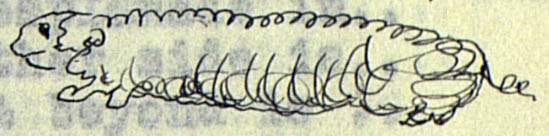
I transcribe the letter from the surviving typescript, so the caricature of the Maltese poodle below was traced from Lear’s original.]

Dumford’s Hotel, Valletta, Malta

April 9th., 1848.

My Dear Ann,

You see by my beginning so high on the paper that I prepare to write you a rather longer letter than of late you have had. I am sure I hope you will not have been uneasy about me ― though the complete stoppage of all posts through Lombardy makes me rather apt to suppose you have not received my last 2 letters. I wrote from Rome, on the 18th. & 28th. of last month, & more than that I could not do. However, I trust you will get this, & learn that I am quite safe & sound & meanwhile I will tell you all I can of my doings since the 28th., & of my journey hither, ― & also of this place itself. Please be so kind as to keep these letters I now write, as they may be useful in after journalising; do not forget to tell me of the dates of all you receive; above all, never fret in the least at not hearing from me, as the last occurrences will have only convinced you how possible it is I should be perfectly well, & yet that you should not hear a word from me for ever so long ― through the stoppage of letters by unexpected events. I was truly glad to leave Rome at the last; every time poor old Giovanina came in to the room she said she was bringing this, or doing that, for the last time, & went out in tears; poor old lady ― she is a kind hearted creature & very sorry to loose [sic] me ― which after 10 years is not wonderful. On the Friday morning (march 31st.) I left very early ― & such a sobbing & crying never was! ― I sold her all my furniture at a mere nominal price, as she had been so good a landlady & did not like to take much money from her. My journey down to Naples by diligence was most extremely pleasant, ― though naturally most unlike any previous one I had ever made. It would be quite impossible to make you understand how a few short months have changed all things & persons in Italy ― for indeed I can hardly believe what passes before my own eyes. Restraint & espionage has given universal place to open speaking & triumphant liberal opinions. One of my fellow passengers was a Neapolitan noble, exiled for 16 years; when he saw Vesuvius first, he sobbed so that I thought he would break his heart. Naples, I found yet more unsettled & excited than I had left Rome. No one could tell what would happen from one hour to the next. The King still reigns, but I cannot think he will long do so. All the English were running away & the resident bankers etc. etc. frightfully harassed & uneasy as to the future. As usual, I found numbers of friends at Naples & had 11 dinner invitations for the 6 days I was o stay. Lord Minto[,] the Miss Tullons, Lord Napier, Lady Carmichael, Baring, Horton, Iggulden, Webbs, Roscoes ^[etc. etc.] The English fleet being there made a deal of gaiety. I was ready to leave by the French steamer on the 5th ― but it did not appear, ― & on the 6th only it came in sight, having been detained by bad weather. We left the harbour at noon on the 6th. & truly glad was I to be out of Italy ― I assure you ― not from any fear of danger, but because the whole tone of the place is worry, worry, worry ― & I am sick of it, having lived in it so long in quieter times. On board we had the Webbs, Ramsays, Sykes etc. etc. ― the Maronite Bishop of Laodicea, 2 of the late Neapolitan ministers, who, secluded for 2 weeks in one of our ships were smuggled on board ― flying for life to Malta etc. etc. The first day was truly delightful, & we were so merry a party that all things were charming ― but in the night an ugly breeze got up, & although we were off Stromboli by 5 a.m. on the 7th, yet we were all day long ― 14 hours namely accomplishing 12 miles ― & only got to Messina by twilight. The sea was very rough, & I confess to being most miserable. However I kept mostly in bed, where also passed all the night of Friday, & all Sat. the 8th on the evening of which we at last reached Malta. It is very unusual to have such bad weather at this time of the year, & you may suppose I was ill enough all the way ― & most heartily glad to land. And now I must tell you something of this place. First ― I have found (as usual) a multitude of friends; having letters to some, & discovering ancient acquaintances in others; so that, as it were, half Malta rushed to receive me with open arms. There is the good ^[natured] Lady Duncan & Mr. & Mrs. Webb who are in the same hotel ― & Col. Sykes & Col. Lockyer, & Mr. Bouchier ―whose family are particularly good natured. Yesterday I went to church twice ― & was much pleased with both the building & the service. You know Queen Adelaide built the church ― & it is a large & handsome one; the bishop resides here ― but his sister is ill, & he was not officiating. Malta itself, is an island all over rock & sand & a little soil, & crammed in every crevice with people & houses. Valetta [sic] is the city ― but somehow one never thinks of any other name than Malta. Such a strange place as Valetta I certainly never did see ― & as a town it is perhaps as beautiful as any existing. The houses all look as if built yesterday ― of a beautiful cream coloured stone, with green or white or painted balconies stuck about in every possible corner. The streets have all capital trottoirs, & there is no dirt to be seen. But the odd part of the character of the place is the mixture of nations; you see all the soldiers English ― English officers driving etc. etc. ― English policemen just as in Cheapside ― but all the bulk of the people are queer, bare footed Maltese ― mingled with blanketed, black faced Africans[,] turbaned Turks, Greeks etc. etc. etc. ― & the bable [sic] of tongues! Most however understand English, though they jabber Maltese which no one but themselves knows anything of. All round the town & two harbours the lines of fortifications are most surprising ― you walk in labyrinths, & when you have got outside, it begins all over & over & over again. ― Zig zag ― zig zag ― up stairs & down stairs ― sharp corners & half moons, moats, drawbridges, bastions & towers till you feel as if built up in Valetta for life. As for the country, there is none; stone walls & stone houses & stone terraces for miles, & villages as far as you can see ― so that you may say that all Malta is a great heap of stone in the Mediterranean with a little ground here & there for cultivation. Food ― pretty cheap fruit abounds. Oranges you know are famous here, & there is good fruit called Japan Medlar which I never before tasted ― Fish not much ― Goats numerous & fine ― milk excellent ― Cows live in cellars. About 18 or 12 trees on all the island I should think [―] yet the varying outline of the angles of forts contrasted with the vast harbours spotted with craft, ― the busy quays, ― & the long lines of public buildings make many an interesting picture. It is impossible to tell you how kind the people are to me; every day I have at least one invitation to dinner, & for some days ― 3 & 4.

April, 12th., Wed.

You see I snatch a bit of every day to fill up this sheet, & indeed ^[it] is no easy matter to find time, though I get up at 5 or 6. Yesterday, I went over early to Sheina, & sketched & walked about till 12 when I had to return here to arrange for money matters. After that, I had several calls to make ― & I drew, & walked round the ramparts till it was time to dress for dinner at the 97th. mess officers ―, a very large & fine dinner. Then came the opera, & a ball at the General’s, ― so I did not get to bed till 2. Of course I should not like this life long, ― but it is impossible not to be pleased with the continual kindness I meet with. I hope to start on Sat. the 15th. for Corfu ― & when there hope to find letters from you ― & I will answer them directly. I look to feeling quite quiet & at home there ― having some intimate friends with whom I hope to stay some time. The weather here is already tremendously hot; it is like India. I never saw such a pretty town as this; it has all the picturesqueness of southern places combined with the cleanness of England. Such beautiful goats are all about the quays & streets; ― I must try to get something Maltese for you. Here comes an invitation to dine with the Governor ―& 2 other dinners! ― which though I can’t eat, I must nevertheless reply to. I cannot read over this letter when written ― so you must excuse all blunders.

April 13th.

I must now wind up & post this today. I hope to send you a pair of lace mittens & something else truly Maltese ― some little ornament if I can find one. Perhaps you would like a Maltese poodle? ― But for fear you should not, I will not send it. I should like to send Eleanor one. They are very like hairy caterpillars to look at ― 2 feet long ― & 3 inches high about.
picture1

This morning with an old friend, Kirkpatrick, whom I unexpectedly find here, I walked to the English buying ground ― it is on the ramparts ― but is not so nicely kept as ours in Rome. The weather is most brilliant always. Yesterday the fleet came in from Naples, & no such magnificent naval spectacle did I ever see. They came close to the houses ― all the largest men of war, for the harbour is in the centre of the town. All the part of Valetta where I am reminds me of Brighton ― only it is so perfectly white & gay. But it will not do to look beyond the town ― as the “country” is too ugly. A whole crew of Arabs in blankets & scarlet turbans are just going by the window; one of them with a very long beard & leading a little blanketed boy ― might be Abraham with Isaac. I have a very nice little bedroom with a balcony ― paying 2 [] a night, which, with my breakfast is all the expense I am at. At Corfu I hope to stay with Bowen. I long to see Corfu & the mountains of Albania. The Webbs, who brought me letters in Rome, & who live over me are most kind; indeed I have too many friends, & wish I were more thankful for them. Pray name dates of all the letters you get, & write c/o G.F. Bowen Esq., University. Corfu, & believe me dear Ann,

Ever affect. yours,

Edward Lear
 

Posted in Edward Lear | Tagged , , , , , | 3 Comments

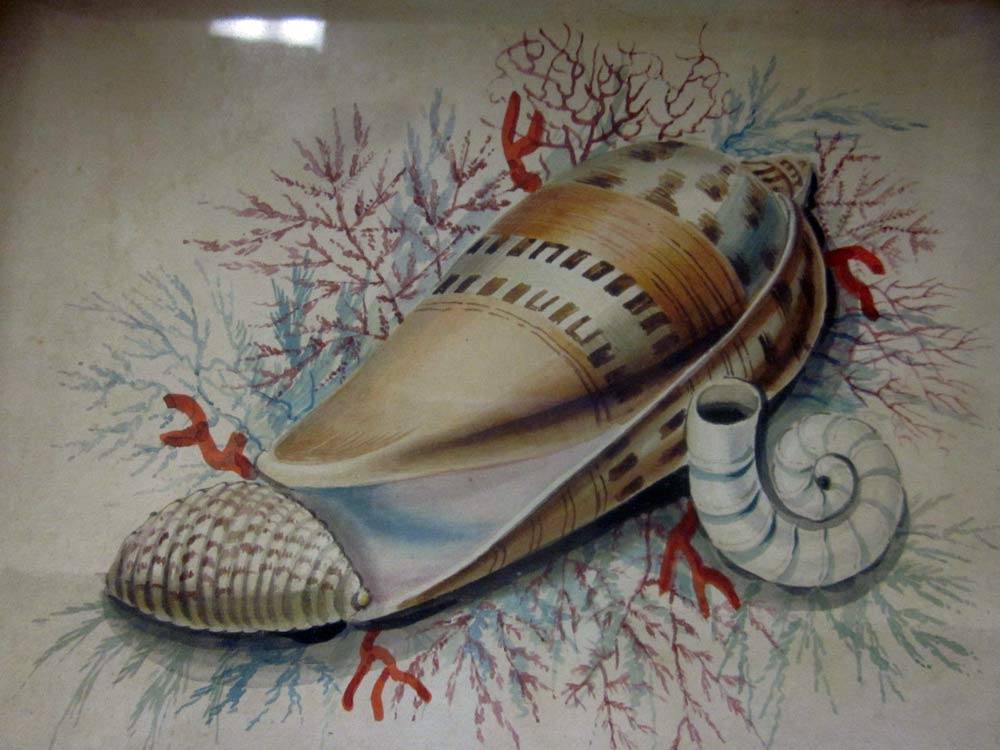
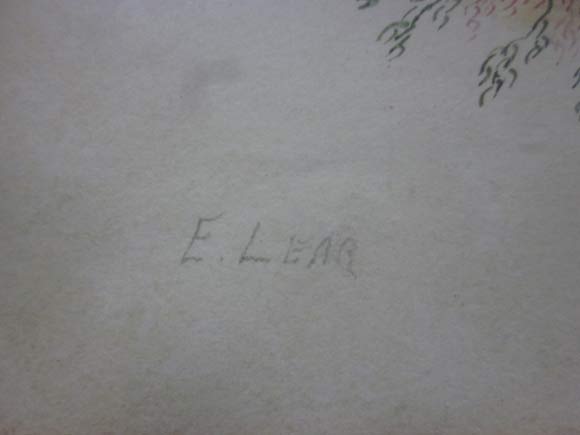
Two Watercolours of Shells by Edward Lear

The two watercolours below were on sale on eBay a few weeks ago; according to the label, they were made as “watercolour samples for Gould’s Natural History.”

el_shell1-s

eBay.

el_shell2-s

eBay.

el_shells-signature

el_shells-label

Posted in Uncategorized | Leave a comment

An 1852 Review of “Journals of a Landscape Painter in Southern Calabria”

Journals of a Landscape Painter in Southern Calabria, &c. By Edward Lear, Author of “Journals of a Lnadscape Painter in Albania,” &c. ―London: Bentley, 1852.

This splendidly got up volume contains a simple but lively and graphic narrative of a tour undertaken by the author through Southern Calabria and through the Basilicata and the adjoining provinces of the kingdom of Naples. Travelling as he did with no other object than to enrich his sketchbook and portfolio, for which purpose he sought out places lying completely out of the track of the ordinary tourist, and being furnished with excellent introductions, he came into constant and close contact with all classes of society, and was thus enabled to give in his journal many details of the social life and manners of the countries he visited, which would probably escape the common traveller. His account fo the state of society in Calabria is peculiarly interesting, from the comparative seclusion in which its injabitants live, and from its being ground untrodden hitherto by English tourists. The ignorance, however, is abundantly reciprocated, at least if we may judge by the various commentaries upon England and English life to which our traveller was doomed to listen, and of which we shall transcribe, by way of specimen; and, for the entertainment of our readers, to that of the Superior of Sta-Maria di Polsi, with all its attendant circumstances: ―

It was nine o’clock eere we arrived before the gate of this remote and singular retreat. It was a long while before we gained admittance; and the Superiore, a most affable old man, having read our letter, offered us all the accomodation in his power, which, as he said, we must needs see was small. Wonder and curiosity overwhelmed the ancient man and his brethren, who were few in number, and clad in black serge dresses. “Why had we come to such a solitary place? No foreigner had ever done so before?” The hospitable father asked a world of questions, and made many comments upon us and upon England in general, for the benefit of his fellow-recluses. “England,” said he, “is a very small place, although thickly inhabited. It is altogether about the third part of the size of the city of Rome. The people are a sort of Christians, though not exactly so. Their priests, and even their Bishops marry, which is incomprehensible, and most ridiculous. The whole place is divided into two equal parts by an arm of the sea, under which there is a great tunnel, so that it is all like one piece of dry land. Ah ― che celebre tunnel!” A supper of hard eggs, salad, and fruit followed in the refectory of the convent, and we were attended by two monstrous watch-dogs, named Assassino and Saraceno, throughout the rest of the evening, when the silence of the long hall, broken only by the whispers of the gliding monk, was very striking. Our bed-rooms were two cells, very high up in the tower of the Convent, with shutters to the unghlazed windows, as a protection against the cold and wind, which were by no means pleasant at this great elevation. Very forlorn, indeed, were the sleeping apartments of Sta. Maria di Polsi, and fearful was the howling of the wind and the roaring of a thunder-storm throughout the night! ― but it was solemn and suggestive, and the very antithesis of life in our own civilized and distant home.

The author’s tour of Calabria was unhappily cut short by the revolutionary movements consequent upon Pio Nono’s sudden and shorlived fir of Liberalism. The tour of the Basilicata has since acquired an additional interest from the desolation caused in the very districts which he visited four years before, by the terrible earthquake of August 14th, 1851, a brief account fo which, from the pen of one of his former hosts, Mr. Lear has appended to his volume. The landscape sketches which accompany the text in rich abundance are of the most striking character and create a great longing to have a further peep at the collection from which they are derived.

[From John Bull, 1663, Saturday, 23 October 1852; pp. 683-684.]

macri

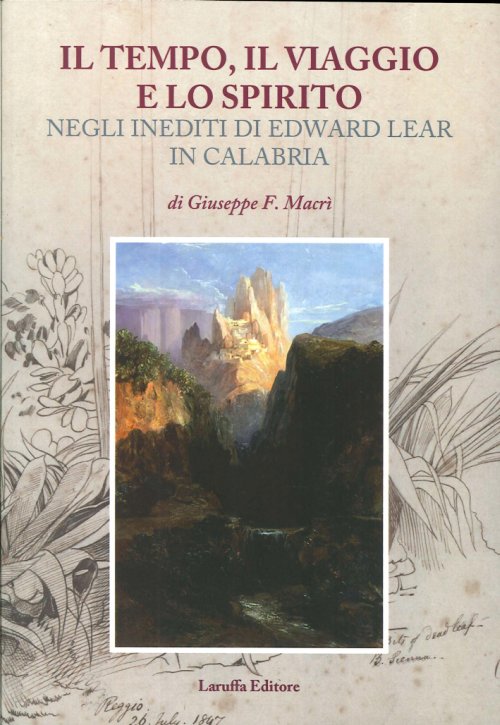
For more information on the history and condition of Calabria and Basilicata at the time of Edward Lear’s tour, see Il tempo, il viaggio e lo spirito negli inediti di Edward Lear in Calabria by Giuseppe Macrì, Reggio Calabria: Laruffa, 2012: it does not really have much to say about Lear, but its overview of the history of the area is of great interest.

Posted in Edward Lear | Tagged , , , , | Leave a comment

2014 in review

The WordPress.com stats helper monkeys prepared a 2014 annual report for this blog.

Here’s an excerpt:

The concert hall at the Sydney Opera House holds 2,700 people. This blog was viewed about 27,000 times in 2014. If it were a concert at Sydney Opera House, it would take about 10 sold-out performances for that many people to see it.

Click here to see the complete report.

Posted in Uncategorized | Leave a comment

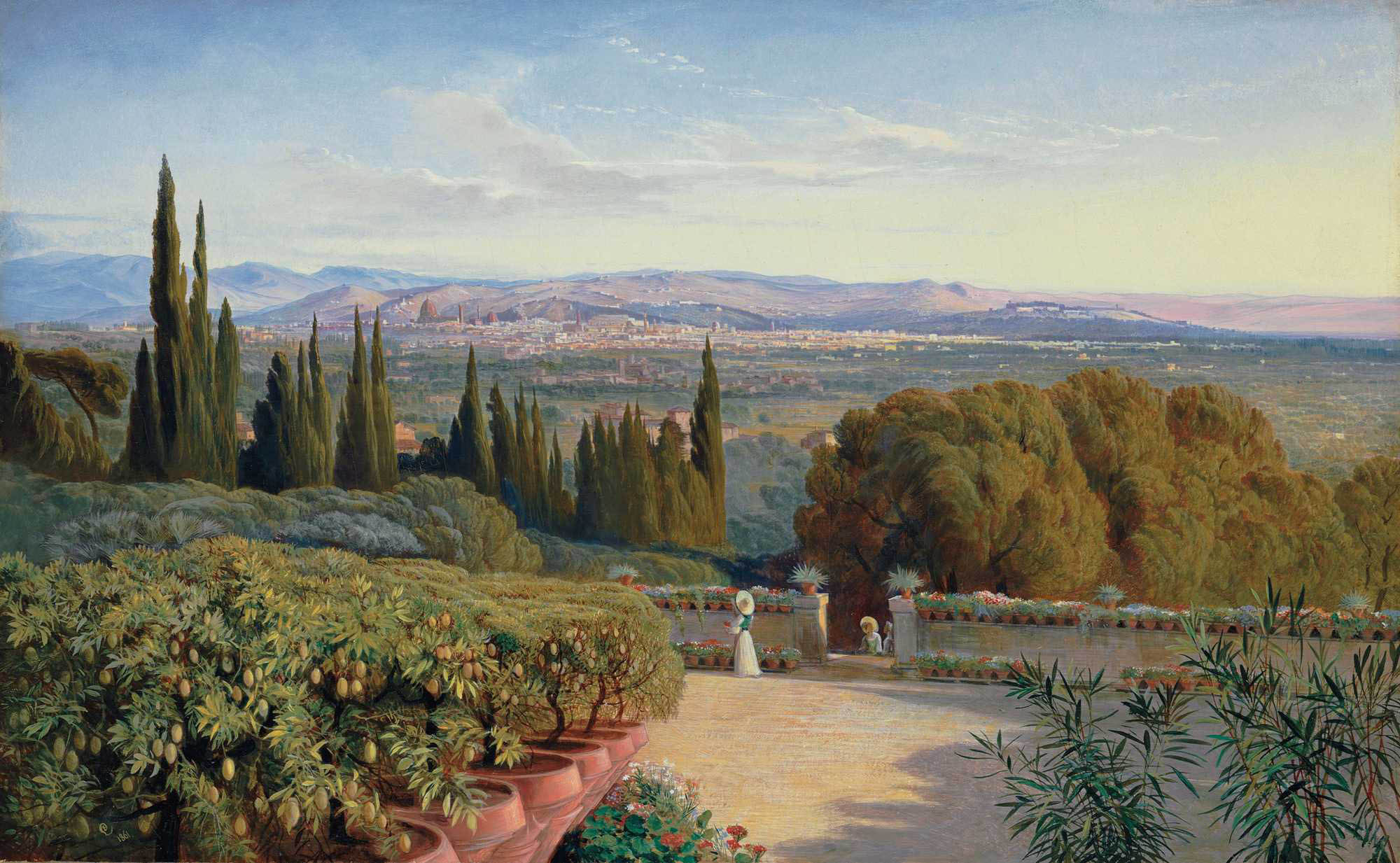
Edward Lear, View of Florence from Villa Petraja (1861)

el_florence-s

Edward Lear, View of Florence from Villa Petraja.
Signed with monogram and dated EL /1861 at lower left. Oil on canvas. 
47 x 75.5 cm (18 ½ x 29 ¾ in.).

‘At present I am at work ferociously on the Petraja & I must say it promises well. I worked on the large lemon trees in pots all yesterday, & to-day must fidget over the houses all the long hours. No life is more shocking to me than the sitting motionless like a petrified gorilla as to my body & limbs hour after hour – my hand meanwhile, reck peck pecking at billions of little dots & lines, while my mind is fretting & fuming, through every moment of the weary days work.’ Lear’s letter to his friend Chichester Fortescue, written on 29 August 1861, reports on his progress with his painting of Florence from Villa Petraja. It expresses, with the typically quirky humour for which he is widely known, the painstaking efforts with which he strove to complete his oil paintings to the satisfaction of his clients. By late September he had ‘made the view from Villa Petraja all but a reality’ and by 12 October it was finished (L.E.L., 1907, pp. 189, 196, 199).

The painting of Florence from the gardens of the celebrated Medici Villa La Petraja had been commissioned by the prominent whig-Liberal political hostess Frances, Countess Waldegrave (1821-1879), a staunch supporter of Lear’s and for whom he made six other paintings. Then married to the elderly but well-connected George Harcourt, she was surrounded by younger admirers and the particular focus of the affections of Chichester Fortescue, who had introduced her to Lear.
Lear was in need of change after the death of his beloved eldest sister Ann, who had been a substitute mother to him since his early childhood, and he welcomed the opportunity to travel to Italy.

Reaching Florence in June 1861, he spent that month making sketches, writing in colourful terms to William Holman Hunt: ‘Plumpudding – treacle, weddingcake, sugar, barleysugar, sugar candy, raisins & peppermint drops would not make a more luscious mixture in the culinary world, than Florence & its Val d’Arno does as Landscape’ (cited in V. Noakes, 1979, p. 184). Evidently he had a sweet tooth, as his diary records ‘the usual four ices’ eaten on his way home (cited in P. Levi, 2013, p. 183). Lear had long admired Holman Hunt and had spent a summer in 1852 at Clive Vale Farm near Hastings watching him paint. Although Lear was no longer painting in the open air by the early 1860s, his Villa Petraja has Pre-Raphaelite resonances, particularly in the attention to naturalistic detail in the foreground. This emphasis on local colour often presented him with a problem of transition between near and far in his landscapes, but Lear resolves it here with a weighty bank of trees in the middle ground, providing a magnificent foil to the campaniles and domes of the distant city. Lady Waldegrave was pleased with the painting and when Lear wrote to her with his condolences after the death of her husband he expressed his pleasure that she now had the picture ‘of Petraja where you so lately were together…. It seems to me that in converting memories into tangible facts, recollections & past time as it were into pictures, lies the chief use & charm of a painter’s life’ (5 January 1862, L.E.L., 1907, p. 21).

Daniel Katz Ltd.

Posted in Edward Lear | Tagged , , , , | 1 Comment

Christmas Holiday Reading Online

05

Several new books by Edward Lear are now available in full online; of particular interest:

Lear, Edward. A Book of Nonsense. First Edition. London: T. McLean, 1846. [Florida State University Digital Library]

Lear, Edward. A Book of Nonsense. Third Edition. London: Routledge, Warne, and Routledge, 1862. [Hathi Trust Digital Library]

Edward Lear’s Journals: A Selection. Edited by Herbert van Thal. New York: Coward-MdCann Inc, 1952 [Hathi Trust Digital Library]

Edward Lear’s Flora Nonsensica. Cambridge, Mass.: Harvard College Library, Department of Printing and Graphic Arts, 1963. [Hathi Trust Digital Library]

Lear’s Shilling Book of Nonsense. London: Frederick Warne, [ca.1870] [Hathi Trust Digital Library]

13

On Edward Lear and / or Nonsense:

Byrne, Peter. “Il Nonsense tra logica e arte.” Segni e comprensione 2.4 (1988): 18-23. [Università di Salerno]

Ciornei, Ileana-Silvia. “The Nonsense World of Edward Lear.” Language and Literature: European Landmarks of Identity. 10 (2012): 64-68. [Agence Universitaire de la Francophonie]

Sellick, Rob. “The Birds of Edward Lear.” Kunapipi, 34.2 (2012): 113-122. [University of Wollongong]

Carrington, Dorothy. “En 1868, un paysagiste anglais découvre la Corse.” Etudes Corses. Revue trimestrielle. 80.25, 1er trimestre 1960: 38-43. [Gallica]

Also of interest on Gallica: Chauvet, Paul. “L’Angleterre et la Corse.” Revue Anglo-Américaine. 7 (1929): 418-431.

Distaso, Leonardo.”On Satzklang: on the Sense and on the Nonsense.” Aisthesis: Pratiche, linguaggi e saperi dell’estetico. 6.1 (2013): 263-273.

Sze, Gillian. “Sense & Nonsense: Thinking Poetry.” LEARNing Landscapes, 4.1, Autumn 2010.

49

Of possible interest:

Woods, David L., E. William Yund and T.J. Herron.”Measuring consonant identification in nonsense syllables, words, and sentences.” Journal of Rehabilitation Research & Development. 47.3 (2010): 243–260.

Posted in Edward Lear, General | Tagged , , , , , | Leave a comment

Review of an Edward Lear Exhibition, from The Tablet (1958)

Edward Lear

IT is not only since the advent of Punch that Englishmen have claimed a sense of humour as their monopoly. As long ago as 1673 the Earl of Peterborough wrote of the Duchess of  Modena: “She is really an extraordinary woman, has a great deal of witt and sperritt, and I believe wants not humour if she were in a place where it was the custome.” But the form of humour which depends largely on a combination of puns, phonetic spelling, portmanteau words, cockneyisms, superfluous aspirates and verbal distortions such as “aperiently” for “apparently” was a Victorian phenomenon which dies hard in certain secluded patrician circles.

Edward Lear was not impervious to the fashions of his time nor, perhaps, to the echoes of Rabelais and Swift but the collection of his paintings, drawings, books, prints and manuscripts (which the Arts Council has brought from the Aldeburgh Festival to St. James’s Square) reminds us that his nonsense drawings must have been the prototype of Mr. James Thurber’s and that some of his sentences could easily get lost in Finnegans Wake. As a coiner of words he was more prolific and inventive than Lewis Carroll, and many of his verbal aberrations have a surrealist logic which is exclusively his own. Nonsense was officially a sideline to his chosen occupations of book illustration and landscape painting, in the pursuit of which he travelled extensively. His journeys were no doubt an escape from a form of agoraphobia (though he was not unsociable and had many friends) and a justification for his restless temperament: just as his nonsense was a safety-valve through which escaped much of his irritation with his rather ludicrous appearance (long or large noses and beards are always appearing in the rhymes) his chronic ill-health (he was an asthmatic and suffered from mild epilepsy) and his lack of funds. He was never really poor but, in spite of the friendship of rich patrons, he was continually worried by the insecurity of having no fixed income. Brought up by women, he was conscious of a certain lack of virility. He never married, though after the death of the sister who was largely responsible for his upbringing he often brooded about taking a wife. He refers in middle age to a “nice fat Greek girl” and it is difficult not to identify him with the Yonghy Bonghy Bó and Augusta Bethell, Lord Westbury’s daughter, with the Lady Jingly Jones. Like Lewis Carroll, he seems to have been only on friendly terms with women.

The longer poems seem to me his most memorable works. They often have a lyrical pathos that sets them apart from the limericks which I have never liked, partly because of their hint of childish cruelty (so many of his characters come to sticky ends) and partly because the last line invariably provides an anticlimax. Exceptions may be made for the Old Man of Thermopylae who never did anything properly and for the Young Person of Crete whose toilette (a sack) was far from complete. The illustrations to the limericks are on another level, and I was sorry not to find in the exhibition the Old Man of Blackheath and the Young Person of Bantry. Several of the more celebrated poems may, however, be examined in manuscript, including the “Owl and the Pussy-cat” (differing slightly from the published version) and “The Pobble who has no toes” (also with variations). I would have liked to see more of the nonsense receipts and botany (though Manypeeplia Upsidownia is there) but room had to be found for the journals, landscapes and illustrations of birds and animals.
The oil paintings are not impressive, though some of the drawings and water-colours are of unusual interest. Queer shapes, whether real or invented, fascinated Lear, and in this respect he occasionally looks forward to Wyndham Lewis. More often (as in No. 25) he derives from Towne and other eighteenth century votaries of the picturesque. An original note can be detected in such exhibits as Nos. 18, 19, 21, 42 and 59. In the lithograph numbered 97 he has suggested the markings on a tortoiseshell by scraping black paint off the stone—a technique which was not commonplace in the 1830’s. The zoological illustrations are careful and sensitive and loving and competent but not unique of their kind.

Perhaps it is as a personality that we should remember him — the Compleat Eccentric in an age of eccentrics, everybody’s uncle and the most cheerful of grumblers. We can forgive him his exasperation at the number of conversions to Rome and at Cardinal Manning’s “atrocious sermons . . . to which nevertheless, all heaps of fools go.”

WINEFRIDE WILSON.

The Tablet. The International Catholic News Weekly. Vol. 212, No. 6164. 12 July 1958, p. 8. [Available online here.]

[The exhibition reviewed here had originally been at The Eleventh Aldeburgh Festival of Music and the Arts, 12-22 June 1958; a Complete Programme Book. 95[3]pp., was printed by Benham and Company in Colchester, 1958.

The number cited at the end of the article presumably refer to the catalogue: Edward Lear, 1812-1888; an exhibition of oil paintings, water-colours and drawings, books and prints, manuscripts, photographs and records. 64pp. London: Arts Council of Great Britain, 1958. Marco.]

Posted in Edward Lear | Tagged , , , | Leave a comment