Edward Lear, Views of Sta. Maura and Corfu

el-amaxichi-s


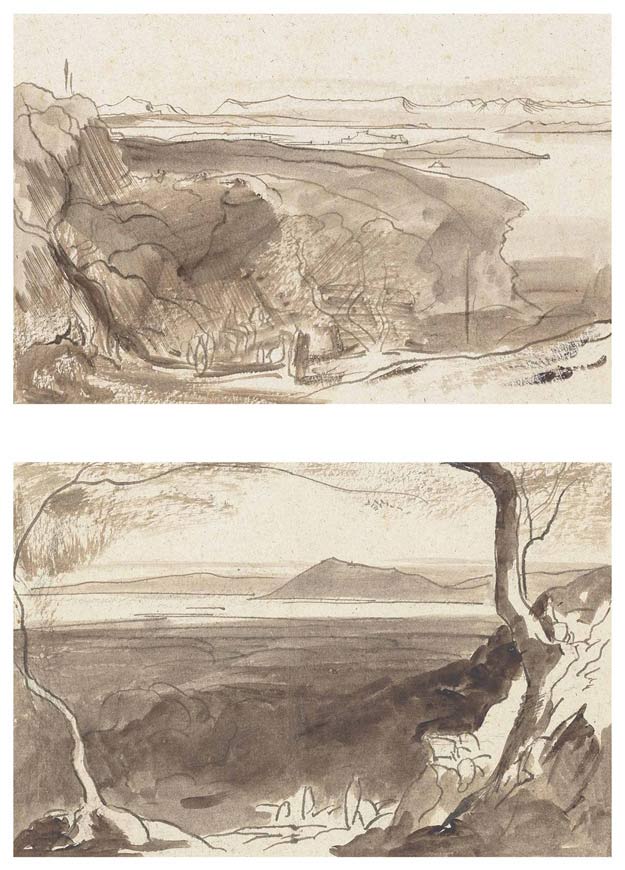
Edward Lear, View of Amaxichi and the Fort, Santa Maura; and View of Corfu from the Benitza Road, near Gastouri.
The first inscribed ‘Santa Maura’ (lower centre, in the margin), the second inscribed ‘Corfu’ (on a fragment attached to the mount). Pencil, one pen and brown ink, both brown wash, on oatmeal paper. 9¼ x 14½ in. (23.5 x 36.8 cm.).

Lear’s sixth book recording his travels was Views of the Seven Ionian Islands, published in 1863. The format echoed his Views in Rome and its Environs: the lithographic illustrations had a brief explanatory text with each one, rather than a personal journal. The illustrations resulted from a two month tour of the islands that Lear made in the Spring of 1863. He executed numerous pencil drawings, which he later penned out and overlaid with washes. The schematic style of the present drawings, which relate to plates 10 and 4 of Seven Ionian Islands, suggest they may have been part of the overall planning of the work rather than drawings intended for reproduction.

The island of Santa Maura is now known as Lefkada.

Christie’s.

Posted in Edward Lear | Tagged , , , , | Leave a comment

Edward Lear, Near Massa, 1838

el-massa-s


Edward Lear, Near Massa, Capri in the distance.
Inscribed and dated ‘Near Massa, 22 August/1838’ (lower left) and with extensive colour notes throughout. Pencil on buff paper. 10 x 14 in. (25.4 x 25.5 cm.)

Christie’s.

Posted in Edward Lear | Tagged , , , | Leave a comment

Small Potatoes

s-potatoes-s

Small Potatoes, by Mary G. Jones, ran in the New York Herald from 10 July to 6 September 1903; it was one of several nonsense-rhyme cartoons in the Sunday supplements of the early years of the 20th century. The strip above, from 9 August, was posted by P. Maresca in his Origins of Sunday Comics series.

Posted in Comics, Nonsense Lyrics | Tagged , , | Leave a comment

WS Gilbert’s Nonsense Poems

W.S. Gilbert never really wrote Nonsense; his Bab Ballads and other collections, while obviously influenced by Edward Lear ― especially in the strongly caricatural style of the pictures accompanying his poems in the early editions – are rather in the humorous narrative tradition of William Cowper’s “Diverting History of John Gilpin” and Thomas Hood’s “Miss Kilmansegg and Her Precious Leg.”

Early in his career, however, he produced imitations of Nonsense, the most famous ― owing to its publication history ― being perhaps “The Advent of Spring.” It first appeared anonymously in Fun in 1862:

THE ADVENT OF SPRING.

By a Devout Admirer of Mr. T―――――n.

Under the beechful eye,
When causeless brandlings bring,
Let the froddering crooner cry,
And the braddled sapster sing.
For never and never again
Will the tottering bauble bray,
For bratticed wrackers are singing aloud,
And the throngers croon in May!

The wracking globe unstrung,
Unstrung in the frittering light
Of a moon that knows no day!
Of a day that knows no night!
Diving away in the crowd
Of sparkling frets of spray,
The bratticed wrackers are singing aloud,
And the throngers croon in May!

Hasten, O hapful blue,
Blue of the thimmering brow,
Hasten to meet your crew,
They’ll clamour to pelt thee now!
For never again shall a cloud
Out-thribble the babbling day,
When bratticed wrackers are singing aloud,
And the throngers croon in May!

[WS Gilbert.] “The Advent of Spring.” Fun 1 February 1862, vol.1, p. 200.

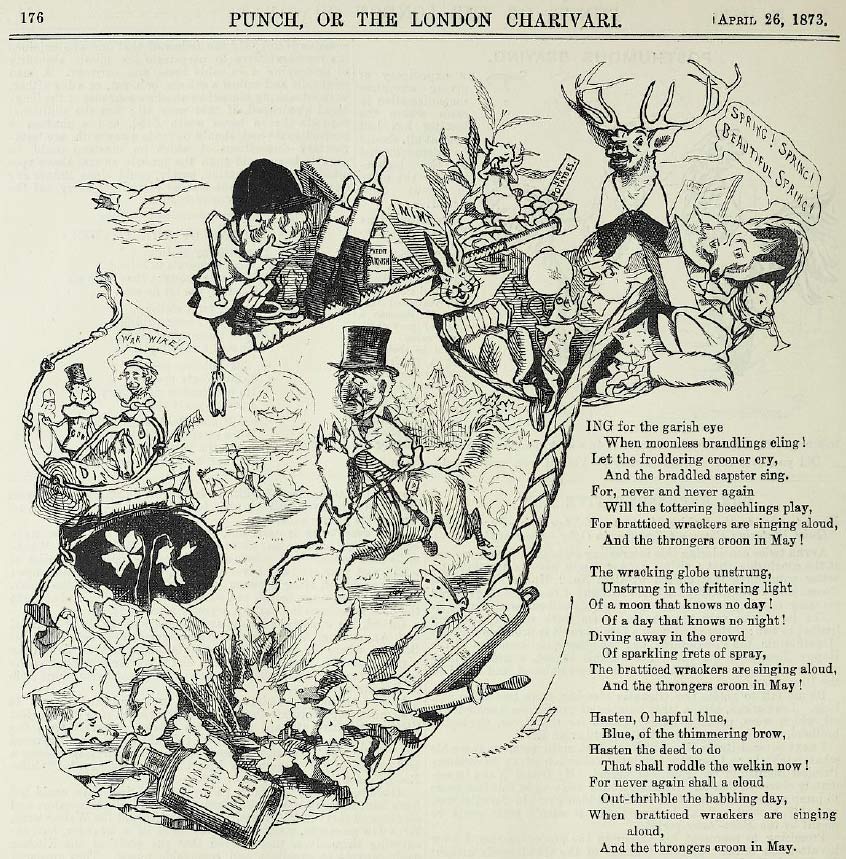
The poem was then reprinted, apparently by mistake and with some variants, in Punch on 23 April 1873:

gilbert-punch-s

Shirley Brooks, editor of Punch at the time, wrote in his diary:

Miss Emily Leith has helped me into a mull. She sent me some things of her own some time back, and with them some very good nonsense verses in MS., which I also took to be hers, but which she says she told me were copied. If she did, I overlooked the statement, and having touched them up, used them this week, as they fitted a cut of Sambourne’s. Such things will happen, but I don’t do them often, usually eschewing outsiders.

And a few days later:

I inserted some verse sent me by Emily Leith, overlooking her distinct statement that she had copied them. So down come letters from Gilbert, who wrote them in Fun 10 years ago, Tom Hood and Burnand. Made the amende and wrote Gilbert. Mea culoa, and nobody else’s. (George Somes Layard, A Great Punch Editor. London: Sir Isaac Pitman & Sons, 1907. 542.)

“The Advent of Spring” is a parody of Tennyson’s notorious haziness of meaning, with particular reference perhaps to the poet laureate’s “The Progress of Spring” or “Early Spring.” The poem, with its profusion of invented words, sounds a lot like Lewis Carroll’s “Jabberwocky,” which would only appear ten years after the first Fun publication.

Tennyson is also mentioned in a second experiment with nonsense, which was published in Fun in two installments in 1865:

SOMETHING LIKE NONSENSE VERSES

1.―The Highland Jew.

I saw a red-haired Jew from Aberdeen,
In a gabardine,
At the Tabard Inn,
He wore a sword which was its scabbard in,
On a Wednesday!

  1. ―The Pious Q.C.
    I saw Mr. Big Ben Denison,
    Ask a benison
    On some venison,
    Which he bought of Alfred Tennyson,
    On a Wednesday.
  2. ―The Greek Maiden.
    I beg to state I love a yaller miss,
    Born at Salamis,
    And this gal, or miss,
    Bound to meet me down at Balham is,
    Every Wenesday!
  3. ― The Worthy Independent Minister.
    A worthy Independent minister,
    Born at Finisterre,
    Turning sinister,
    Smothered his wife with fumes of kinaster
    On a Wednesday!
  4. ―The Unhappy Marriage.
    Once I married a cook from charity,
    But disparity,
    And hair carroty,
    Made me treat her with barbarity
    Every Wednesday!
  5. ―The Sensation Opera Troupe
    I know a man who’s going to offer Gye
    Anthropophagi
    (Or androphagi),
    Who will sing with French hippophagi
    Every Wednesday!

[WS Gilbert.] “Something Like Nonsense Verses.” Fun 10 June 1865, p. 31.

Something like Nonsense Verses.

No. II.

  1. ―The Unfortunate Revellers.
    Tipsy gents, the type of snobbery,
    Drunk and slobbery,
    Make a bobbery,
    And the victims are of robbery

Every Wednesday.

  1. ―The Jealous Dancer.
    As I Waltzed with Jane deliciously,
    Jones officiously,
    Injudiciously,
    Bumped against us both most viciously,
    On a Wednesday.
  2. ―The Polite Student.
    A civil student at my college (he
    Learns horology
    And conchology)
    Offers me a full apology
    Every Wednesday.
  3. ―The Undignified Nobleman.
    I know a nobleman whose publicity
    And complicity
    In mendacity
    Is a fact of authenticity
    Every Wednesday.
  4. ―The Absurd Chancellor.
    Once a chancellor of acidity
    And timidity,
    With rapidity
    Used to sing “Run ti iddy ti!”
    Every Wednesday.

[WS Gilbert.] “Something like Nonsense Verses. No. II.” Fun 24 June 1865, p. 51.

The model for these short monorhyme five liners seems might have been Edward Lear’s A Book of Nonsense, whose third edition, the first one to be widely distributed, had been published to great acclaim in 1861.

For more on Gilbert’s little-known poems see: Ellis, James. “The Unsung W.S. Gilbert.” Harvard Library Bulletin 18.2 (1970): 109-40.
Posted in Edward Lear, Lewis Carroll, Nonsense Lyrics, WS Gilbert | Tagged , , , , , | Leave a comment

A Wheelbarrow to Hell

In a previous post, The natural History of the Wheelbarrow, I published a series of images in which a woman was carried around in a wheelbarrow, usually by a loving husband or servants.

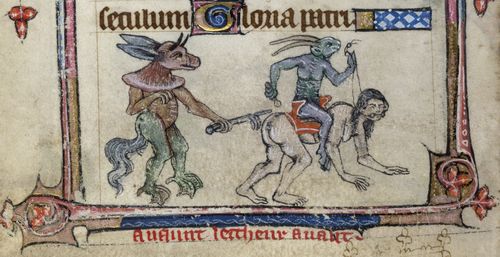
The first image, however, showed a devil carrying souls to hell in a wheelbarrow; the same MS ― ‘Taymouth Hours’, England (London?), second quarter of the 14th century, Yates Thompson MS 13, f. 139v ― has a similar image in which a “lecherous woman” is pictured so that she herself looks like a wheelbarrow while she is led to hell by demons:

woman-wheel

Detail of a bas-de-page scene showing a lecherous woman, from the ‘Taymouth Hours’, Yates Thompson MS 13, f. 141v.

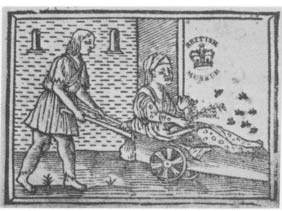
The wheelbarrow as a means of transport to a place of punishment was still well alive in the 16th century, when this print was published:

purgatorio-cortigiane

The small woodcut was prefixed to an early 16th century edition of an often-reprinted pamphlet by Maestro Andrea, Purgatorio delle Cortigiane, in which harlots lament their fate and describe their premature descent into hell on earth owing to the French disease, here represented by the sores and ulcers covering the woman’s body. I take the picture from Kurz, Hilde. “Italian Models of Hogarth’s Picture Stories.” Journal of the Warburg and Courtauld Institutes 15.3/4 (1952): 136-68.

As Arturo Graf observed (Attraverso il cinquecento. Torino: Loescher, 1888. 272): “The Purgatorio delle cortigiane […] is not the ordinary purgatory, but the hospital of San Giacomo, known as the Incurables’ hospital, in Rome,”

In cui si vede paurosi mostri,
Qui è di Franza il dilettevol male,
E di San Lazer la lebbra gioconda,
Cancheri e malattie universale.

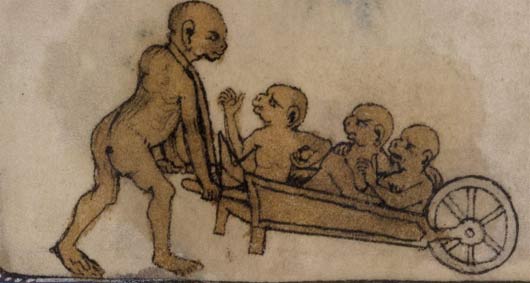
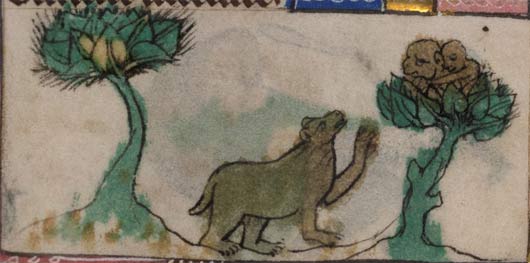
The wheelbarrow also appears in the same manuscript, Yates Thompson MS 13, on f. 184r, where a mother-ape is pushing her three children, presumably to escape from a big bear which appears in the facing f. 183v:

ape-wheelbarrow

bear-apes

On f. 184v the ape has abandoned the wheelbarrow, and lost one of her children:

bear-apes-2

The short story comes to an end in the next page (f. 185r) when the mother finally finds a tree to climb, much to the bear’s chagrin:

bear-apes-3

The mother now seems to hold one child only, however.

Posted in Comics | Tagged , , , , | 4 Comments

The Gook

lll_1910-08-14-s

Gustave Verbeek‘s Loony Lyrics of Lulu, 17 July – 23 October 1910, presented an adventure of Lulu and her “papa” with a fantastic animal described in the last panel in a limerick composed by Lulu, a real tour de force, as all Verbeek’s strips.

The above is from Peter Maresca’s series Origins of Sunday Comics.

Posted in Comics, Gustave Verbeek | Tagged , , , , | Leave a comment

JP Benson’s Woozlebeasts

wb_1904-09-11-col-s

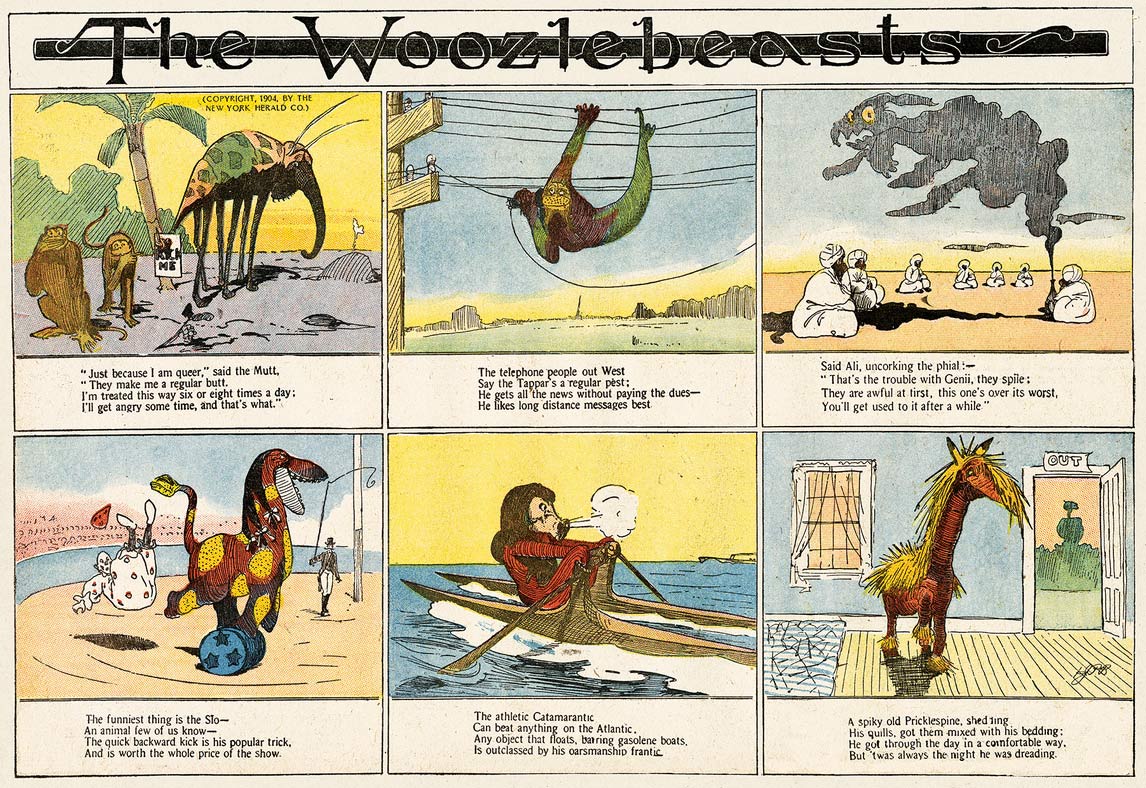
A rare example of a coloured Woozlebeasts strip by John Prentiss Benson (11 September 1904). On nonsenselit.org you will find the full run of the newspaper strips, in black and white, as well as the 1905 book published by Moffat, Yard & Co.

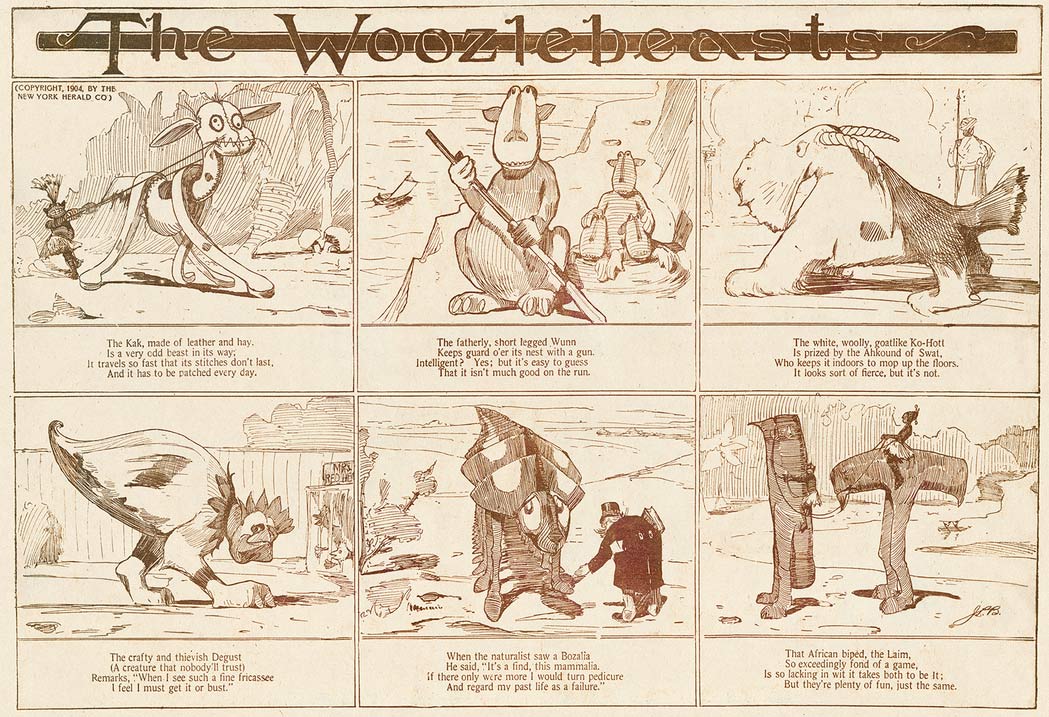
Below is another instalment (18 September 1904), as posted by Peter Maresca at Origins of the Sunday Comics: a blog presenting a new strip from the early days of newspaper comics every day.

wb_1904-09-18-s

Posted in Comics, Limerick | Tagged , , , | Leave a comment

Limericks!

A quick note on a few studies on the limerick I have read or re-read recently.

Scheepers, Christoph, et al. “Listening to Limericks: A Pupillometry Investigation of Perceivers’ Expectancy.” PLoS ONE 8.9 (2013): e74986.

The abstract appears to confirm what limerick lovers, at least those who appreciate the Nonsense kind, already know, i.e. that rhyme is the dominating parameter, but of course the essay says much more and deserves to be read in full:

What features of a poem make it captivating, and which cognitive mechanisms are sensitive to these features? We addressed these questions experimentally by measuring pupillary responses of 40 participants who listened to a series of Limericks. The Limericks ended with either a semantic, syntactic, rhyme or metric violation. Compared to a control condition without violations, only the rhyme violation condition induced a reliable pupillary response. An anomaly-rating study on the same stimuli showed that all violations were reliably detectable relative to the control condition, but the anomaly induced by rhyme violations was perceived as most severe. Together, our data suggest that rhyme violations in Limericks may induce an emotional response beyond mere anomaly detection.

In a similarly scientific perspective, limericks are mathematically analysed by Kevin Jones in “Self-similar syncopations: Fibonacci, L-systems, limericks and ragtime” (2000), and you can read comments on the essay here. Do you want to know what a real Fibonacci poem (or Fib) looks (or sounds) like? Read this short description.

“How Come the Translation of a Limerick Can Have Four Lines (Or Can It?)” is the captivating title of Gideon Toury’s 1999 article from Word, Text, Translation: Liber Amicorum for Peter Newmark, eds Gunilla Anderman & Margaret Rogers. Clevedon etc.: Multilingual Matters, 1999, 163-174.

Bob Turvey has published two interesting articles on the fortune of the form:

“Kipling and the Limerick.” Kipling Journal 77 (2003): 8-20.

“The Limericks of Algernon Swinburne.” The Journal of Pre-Raphaelite Studies 20 (2011): 63-72.

If you enjoy this kind of thing, here is the umpteenth rewriting of Lear’s “nonsense rhymes;” one advantage is that much of it can be read on Google BooksEdward Lear and My Father. Compiled by Barbara Whitehead. Bloomington: Author’s House, 2014.

More original is Jim Puder’s attempt to rewrite some of Lewis Carroll’s poems as limericks in “The Forgone Limericks of Lewis Carroll.” Word Ways 44.1 (2011). I posted the four original Carroll limericks and a short note here. Puder’s article asks, but does not answer, the right questions:

Why did Carroll publish no limericks as an adult? Did he fear that if he did, he might be seen as trying to emulate Lear? Or had he simply come to regard the limerick as being too hackneyed a verse form to have any artistic currency? The question is an intriguing one, but the focus of this article is upon another speculation of likely interest to limerick devotees, namely this: supposing that the adult Carroll had produced limericks for publication, what might they have looked like?

Another Carroll limerick I had never seen is also presented:

Happily for posterity, Carroll did inadvertently bequeath to it one limerick penned in adulthood. In books and other items given by him as gifts, he was in the habit of inscribing short poems to the recipient, among which may be found this undated verse addressed to a Miss Vera Beringer:

THERE was a young lady of station,
‘I love man’ was her sole exclamation;
But when men cried, ‘You flatter,’
She replied, ‘Oh! no matter,
Isle of Man is the true explanation.’

Posted in Limerick | Tagged , | 1 Comment

Tolkien’s Nevbosh Limerick

From Joan Acocella’s “Slaying Monsters,” in The New Yorker for 2 June 2014, a review of the recently published translation of Beowulf by J.R.R. Tolkien:

Tolkien was a serious philologist from the time he was a child. He and his cousin Mary had a private language, Nevbosh, and wrote limericks in it. One of their efforts went:

Dar fys ma vel gom co palt “Hoc
Pys go iskili far maino woc?
Pro si go fys do roc de
Do cat ym maino bocte
De volt fact soc ma taimful gyroc!”

(“There was an old man who said ‘How / Can I possibly carry my cow? / For if I were to ask it /To get in my basket / It would make such a terrible row!’ ”)

According to Michael D.C. Drout’s J.R.R. Tolkien Encyclopedia: Scholarship and Critical Assessment, New York: Routledge, 2007 p. 222:

Tolkien, with his cousin Mary Incledon, disguised French, English and Latin to create Nevbosh, or the New Nonsense, in which they wrote limericks.

It seems that this was not the first invented language Tolkien used since, according to this page which also provides a “Nevbosh Wordlist,” it came after Mary and Majorie Incledon’s Animalic, which he learnt.

The full story is told by Arne Zettersten in J.R.R. Tolkien’s Double Worlds and Creative Process: Language and Life. New York: Palgrave Macmillan, 2011, pp. 70-71:

The two cousins [Mary and Marjory Incledon] had already begun to construct a simple private language, which they called Animalic. Mary and Ronald continued to work on new inventions of words and the result was a completely new language, which was more advanced, and which they calle Nevbosh, or New Nonsense. Unfortunately, there is not much left of Nevbosh except a limerick, which is recorded in Tolkien’s essay, “A Secret Vice,” from 1931.

Tolkien points out in his essay that Nevbosh is mainly based on English, but that many words are changed or distorted. The creators of Nevbosh, Mary and Ronald, were children, without any conscious knowledge of the relations between sounds and concepts in language…
Tolkien also states in his essay that the dominance of English in Nevbosh might give the impression of being a “code.” He does not find this type of language interesting, but languages that are unrelated to traditional languages or school languages stimulate a deeper interest in him.

And on page 72 of the same book, in the context of a discussion of a picture letter, another Tolkien limerick is presented:

Tolkien also engaged in constructed alphabets during his school period. These had code symbols that corresponded to every letter in the english alphabet. A code letter from August 8, 1904 from Ronald to Father Francis survives in the Tolkien Collection at the Bodleian Library…
The letter ends with the following limerick to Father Francis:

There was an old priest named Francis
Who was fond of “cheefongy” dances
That he sat up too late
And worried his pate
Arranging these Frenchified Prances.

Posted in Limerick, Nonsense Lyrics | Tagged , , , | Leave a comment

Edward Lear, Philae

EL_Philae-s

Edward Lear, Philae.
Signed with monogram (lower right). Oil on paper laid down on canvas. 13 3/8 x 21 ¼ in. (34 x 54 cm.)

Lear visited Philae twice, in late January and early February 1854 and in January 1867.

Christie’s.

Posted in Edward Lear | Tagged , , , , | 1 Comment