Edward Lear, Jericho (1865)

EL_Jericho-s

Edward Lear, Jericho.
Signed with monogram, inscribed ‘JCS’ and dated ‘1865’ l.r. Watercolour and bodycolour. 17.7 x 25.2 cm. (7 x 10 in.)

Catherine Symonds, a gift from the artist;
By descent to H.J. Vaughan;
Christie’s London, 26 April 1963, lot 52.

This is a version, with minor variations, for instance the height of the trees on the right, of the finished work of the same size and medium on buff paper, formerly in the collections of John Addington Symonds, Dame Janet Vaughan and Miss W.W. Vaughan (sold at Sotheby’s London, 13 November 1980, lot 175), which is signed with Lear’s monogram and dated both ‘1858’ and ‘1862’. The first date presumably refers to the year of Lear’s visit to the Holy Land; he was at Jericho on 7 May 1858 after stopping in Jerusalem following his stay at Petra in late April (see V. Noakes, Edward Lear, 1812-1888, ex. cat., London, Royal Academy, 1985, p. 110, no. 25e).
We are not certain of the meaning of the inscription and date ‘JCS 1865’ on the present drawing. There is no evidence of Lear collaborating nor can there be any doubt that the watercolour is by Lear. The most plausible explanation is that Lear added the initials and date when he gave the watercolour to the Symonds, the initials are those of Mrs Symond’s whose first names were Janet Catherine, and the date, ‘1865’ is the year in which she gave birth to her daughter Janet. Lear had known Mrs Symonds since she herself had been a child and had been a regular visitor at her father’s house (Mr. Frederick North, MP for Hastings), so it is quite possible that he gave her this watercolour to mark the occasion of the birth of her first child. Catherine married the poet and author John Addington Symonds on 10 November 1864 and Janet was born on 22 October 1865. Why the family possessed two versions of the subject remains a matter for speculation, it is possible that the two watercolours were kept in different houses; due to the ill health of both Mr Symonds and his daughter Janet, the family lived abroad a great deal including a period when they rented Lear’s house the Villa Emily in San Remo, Italy. Lear remained a close friend of the Symonds family and his first and perhaps most famous nonsense song The Owl and the Pussycat, was written for Janet Symonds. For further information regarding Lear and Symonds, see P. Grosskurth, John Addington Symonds, London, 1964, pp.124, 126-7 and 199.
We are grateful to Vivien Noakes for her assistance in the preparation of this catalogue entry.
Bonhams.

Posted in Edward Lear | Tagged , , , , | Leave a comment

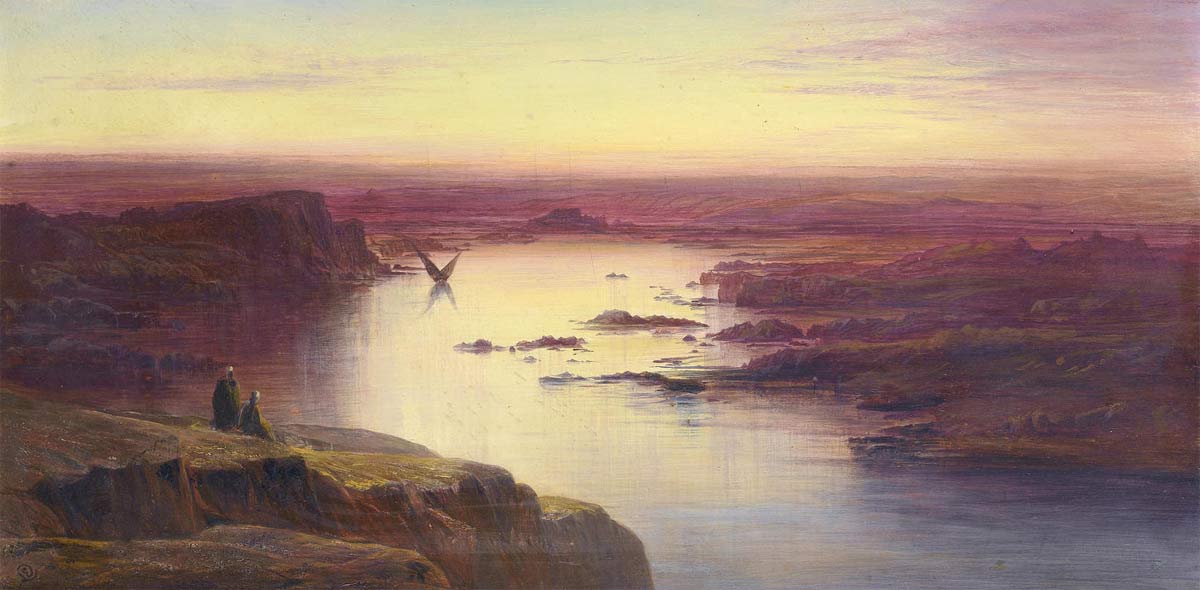
Edward Lear, Sunset on the Nile, above Aswan (1871)

EL_Aswan-s

Edward Lear, Sunset on the Nile, above Aswan.
Signed with monogram (lower left); bears exhibition label and inscribed, signed and dated ‘On the Nile/Edward Lear/1871’ (verso). Oil on canvas. 24 x 47cm (9 7/16 x 18 1/2in).

Purchased directly from the artist in 1871 by Ernest Noel (1831-1931), M.P. for Dumfries Burghs 1874 to 1886.
Audrey Baillie Theron (neé Noel).
Jacqueline Marie Malcolm (neé Theron).
Thence by direct descent to the current owner.

Ernest Noel befriended Edward Lear when they were both passengers on a journey down the Nile in Egypt. It is thought Noel commissioned the current lot on the basis of sketches he had watched Lear execute during the voyage.
Lear made his first trip to Egypt in 1849. He expressed his excitement about the upcoming trip in a letter to another close friend, Lord Fortescue:
“the contemplation of Egypt must fill the mind, the artistic mind I mean, with great food for the rumination of long years” (12 February 1848 quoted in ed. Lady Strachey, The Letters of Edward Lear, 1907, pp.8-9).
The trip did not disappoint, and Lear was deeply struck by the powerful colours and light of Egypt. Indeed, he enjoyed the country so much that he made another trip during the winter of 1853-4, arriving in Cairo on the 18th December 1853. He had planned to travel around Egypt with the Pre-Raphaelite artist William Holman Hunt and initially intended to wait for his friend in the capital city before commencing his travels. However, he developed a fever and as Cairo was damp he decided that he would leave at once for Upper Egypt and the Nile.
Lear’s letters from this trip to his sister Ann are full of delight about his travels up the Nile; he described the river as “magnificent…with endless villages – hundreds & hundreds on its banks, all fringed with palms, & reflected in the water; – the usual accompaniments of buffaloes, camels etc. abound, but the multitude of birds it is utterly impossible to describe, – geese, pelicans, plovers, eagles, hawks, cranes, herons, hoopoes, doves, pigeons, king fishers & many others. The most beautiful feature is the number of boats which look like giant moths, – & sometimes there is a fleet of 20 or 30 in sight at once.” (Lear to Ann, 4th January 1854, as quoted in Noakes, 1968, p.122).
As with all his travels, he captured his impressions in detailed annotated drawings and watercolours, drawn en plein air, which he used as reference for his larger scale studio oils on canvas, such as the present lot, upon his return to England:
“I have done very little in oils, as the colours dry fast, & the sand injures them; watercolours are also difficult to use. But I have made a great many outlines.” (the artist, as quoted in Noakes 1991, p.65).
Thirteen years later, Lear made his second trip up the Nile and his third and last visit to Egypt in December 1866 until March 1867. Once again it was Egypt’s rich colours that Lear found most remarkable, consequently filling his diary with details of their extraordinary brilliance and variety. The present painting is most likely worked up from sketches made during that final visit, demonstrating the extent to which Lear was captivated by the Nile’s astonishing scenery. He realised that his watercolour sketches from his previous trips had, by their very nature, failed to capture the intensity of colour: “It seems to me, my former drawings were not severe enough…” (the artist, as quoted in Noakes 1991, p.65).
“It will be difficult to work out anything like the sentiment – of the infinite detail of rocks!…the upper side light, the lower so dark. In the foreground – the pale rock & gritty sand is blazing bright – while all below is a dark depth. The farthest range of hills is sandy pale, with grey from crowds of rocks.”
However, Lear seemed to relish these challenges: “In no place – it seems to me, can the variety & simplicity of colours be so well studied as in Egypt; in no place are the various beauties of shadow more observable, or more interminably numerous. Every mud bank is a picture, every palm – every incident of peasant life” (Edward Lear, Diary, 25th February 1867).
The present lot demonstrates Lear’s master use of glazes to capture the brilliant light he described in his journal and letters. Three of Lear’s works titled On the Nile were exhibited at the Royal Academy in 1871.

Bonhams.

Posted in Edward Lear | Tagged , , , , , | 1 Comment

Edward Lear Drops Holman Hunt’s Letters (An Unpublished Letter)

The following is a note Edward Lear sent to William Holman Hunt explaining what happened to two of Hunt’s letters Lear was supposed to post from London. There is a short reference to the accident in today’s diary entry (19.ix.64):

3 PM. 19. Sept. /64
Stratford Place.

My dear Daddy,

I was miserably vexed this morning at what happened to your letters ― tho’ as no harm has come of my mishap you may forgive me. In taking out a letter from my jacket ^[front] pocket, I took out 2 of yours by mistake, & replaced them inadvertently in the similar pocket of my overcoat. This latter, finding myself too warm in walking, I took off, not supposing there was anything in the pockets, but unfortunately the 2 letters fell out, & were ― luckily, ― picked up by the man who brought down my luggage ― who posted them at the station. The 3 letters I posted myself. Thus, you see, your letters will not reach their destination sooner than they would have done from Burton. I was immensely disgusted, & shall remember a double pocket in future. I do not remember any such accident ever happened to me before.

Take care not to do too much with your lame leg.

Your affly. E. Lear.

I found a letter from F. Lushington: Mrs. F. is better, & they are going[.]

Posted in Edward Lear | Tagged , , | 4 Comments

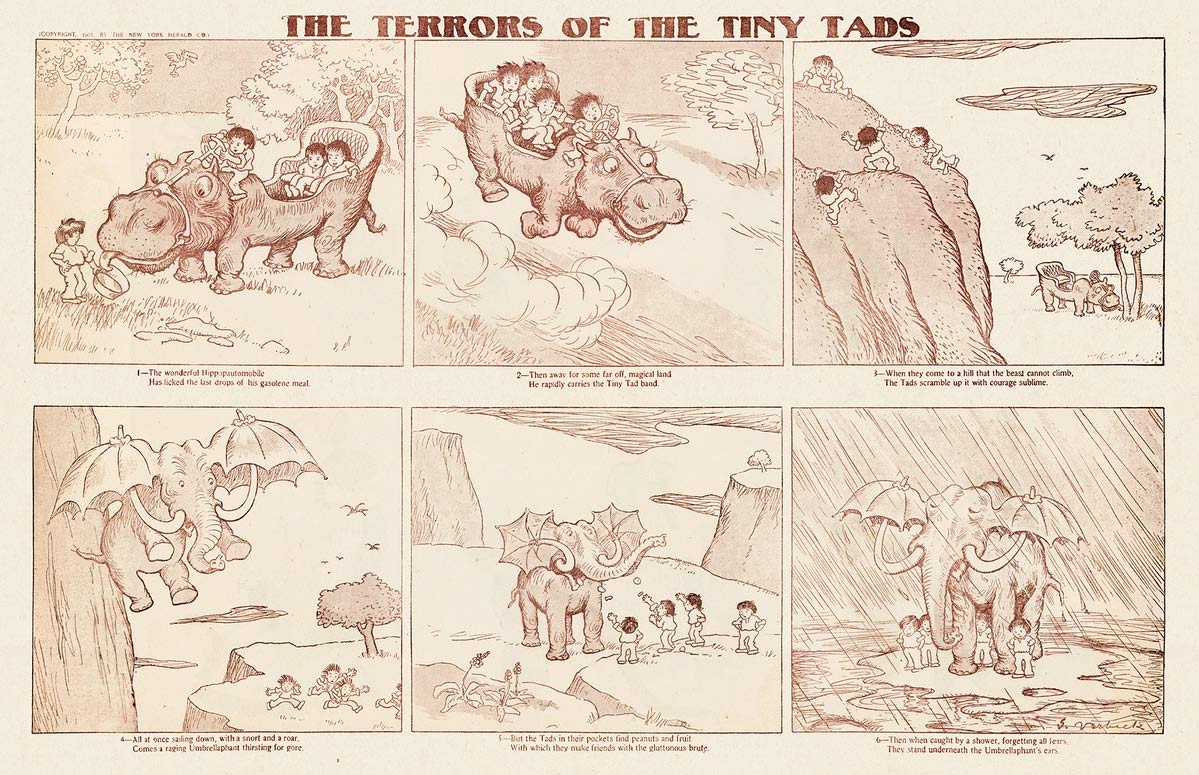
The First Terror of the Tiny Tads

ttt-1-s

First instalment of Gustave Verbeek’s Terrors of the Tiny Tads, May 28, 1905.

On Verbeek here and at nonsenselit.org.

From Peter Maresca’s Origin of Sunday Comics series.

Posted in Gustave Verbeek | Tagged , , | 1 Comment

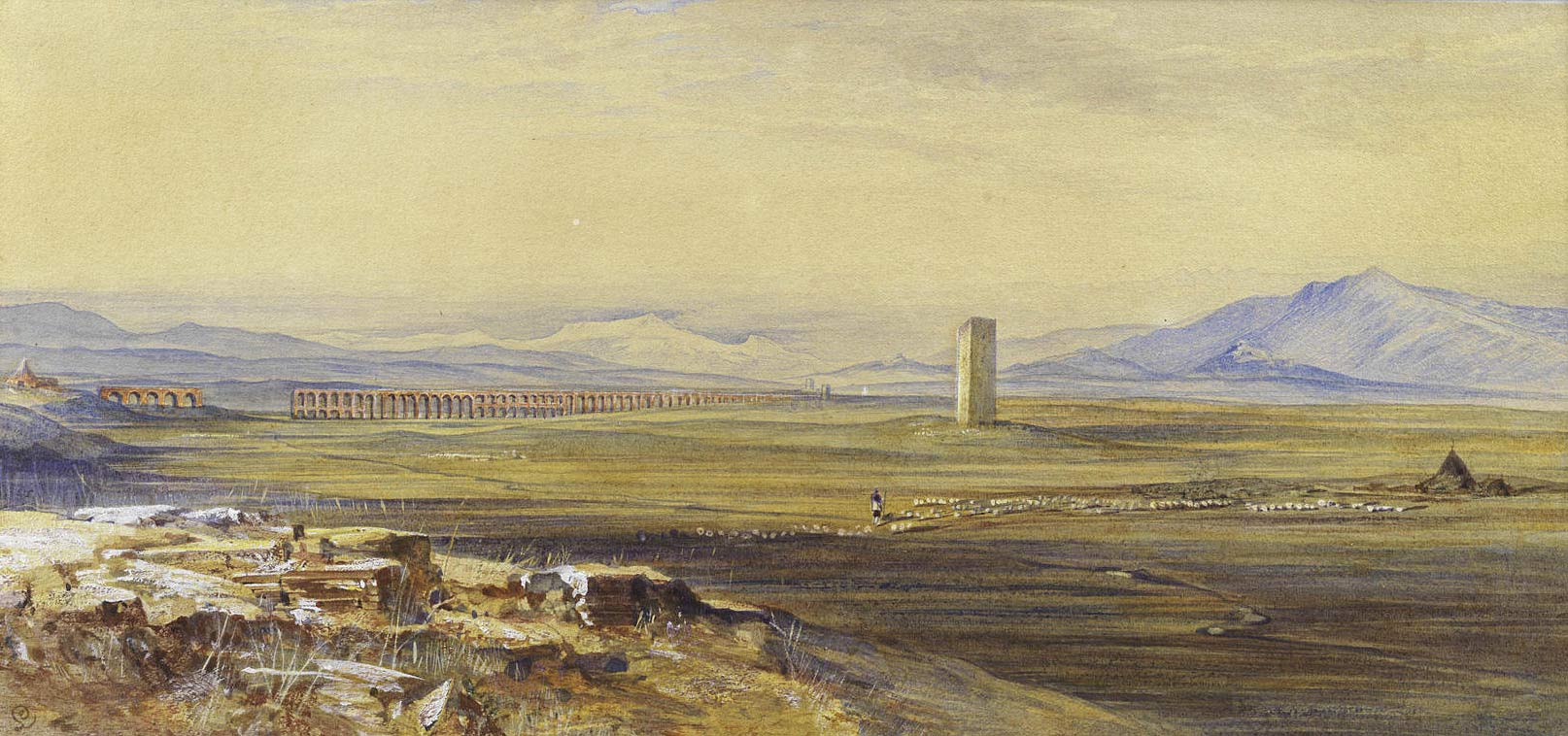
Edward Lear, View of the Roman Campagna

alex-s

Edward Lear, View of the Roman Campagna and the Alexandrine Aqueduct.
Signed with monogram (lower left). Watercolour heightened with white. 17.8 x 38.1cm (7 x 15in).

Bonhams.

Posted in Edward Lear | Tagged , , , , | Leave a comment

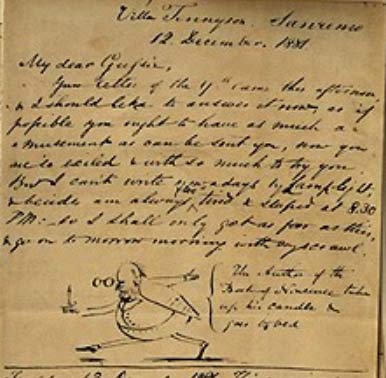
Edward Lear Picks up a Candle and Goes to Bed

I found this on my hard disk; can anyone say where this letter to Gussie Bethell can be found?

bed

“The Author of the Book of Nonsense takes up his candle & goes to bed.” Edward Lear, letter to Augusta Bethell of 12 December 1881.

Posted in Edward Lear | Tagged , , , | Leave a comment

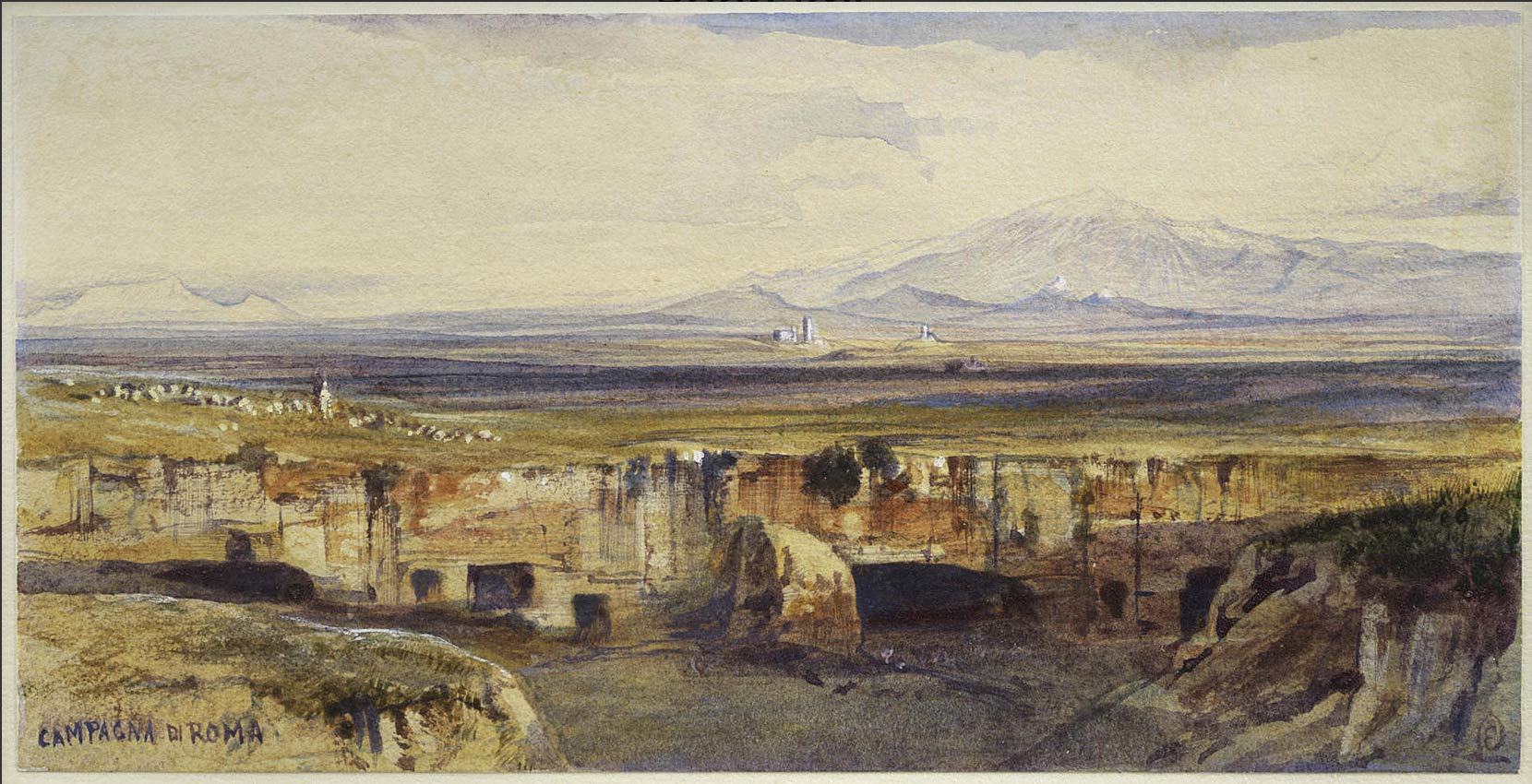
Edward Lear, Campagna di Roma

campagna-s

Edward Lear, Cervera, on the Roman Campagna.
Signed with monogram (lower right) and inscribed ‘CAMPAGNA DI ROMA’ (lower left). Pencil and watercolour, heightened with white and gum arabic. 10.1 x 20.3cm (4 x 8in).

Bonhams.

Posted in Edward Lear | Tagged , , , , , | Leave a comment

Edward Lear, Anadoluhisari, 1848

el-anadoluhisari-s

Edward Lear, Anadoluhisari, Istanbul, on the Bosphorus.
Inscribed and dated ‘Bosphorus./1. Sept. 1848′ (lower left) and again in pencil (lower right) and numbered ’17’ (lower right) and further inscribed with colour notes. Pencil, pen and brown ink and brown wash on paper. 10 ¾ x 14 in. (27.4 x 35.4 cm.).

Lear visited Constantinople in 1848 as the guest of Lady Canning, the wife of the British Ambassador in Turkey, setting off from Corfu with the Cannings on 30 May 1848 and travelling by way of Athens where he fell ill. Anadoluhisari is the fortress on the Anatolian side of the Bosphorus and gives its name to the Quarter around it. It was built between 1393 and 1394 by Ottoman Sultan Bayezid as part of the preparations for the 2nd Ottoman Seige of Constantinople which took place in 1395. It is the oldest architectural structure in Istanbul.

Christie’s.

Posted in Edward Lear | Tagged , , , , | Leave a comment

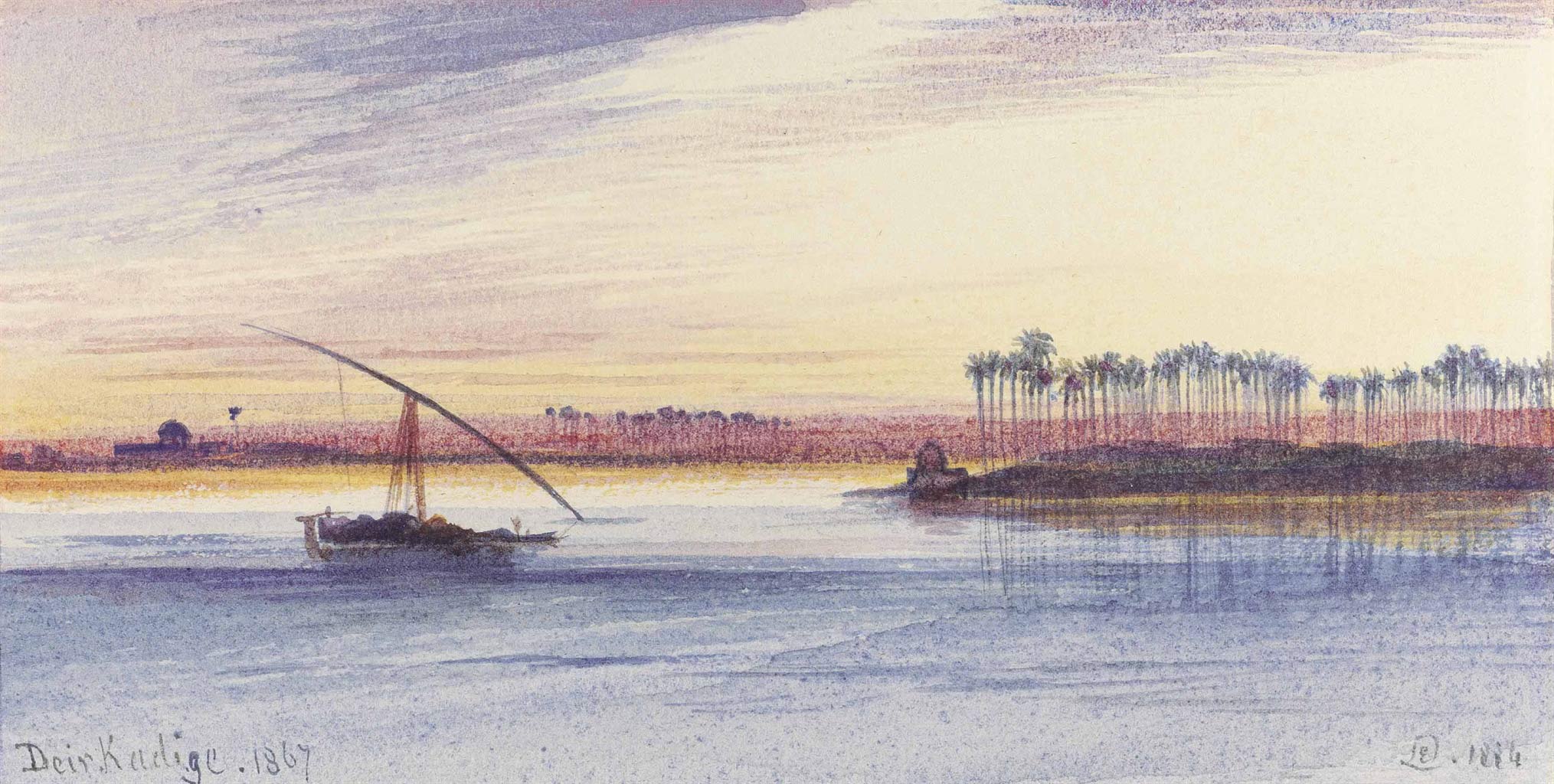
Edward Lear, View of Deir Kadige, 1867 (1884)

el-deirkadige-s

Edward Lear, View of Deir Kadige, on the Nile, Egypt.
Signed with monogram and dated ‘.1884’ (lower right) and inscribed and dated ‘Deir Kadige. 1867′ (lower right) and numbered and inscribed ’67. Deir Kadige’ (verso). Pencil and watercolour. 3 ¾ x 7 ¼ in. (9.5 x 18.5 cm.).

Lear visited Egypt four times, firstly in 1848, then again in 1853 and 1854. The present watercolour dates to his final trip which was from the winter of 1866 to the spring of 1867. Lear often executed ‘on the spot’ sketches complete with colour notes that were then revisited years later and worked into more finished watercolours such as the present view, hence the second date of 1884. Another view of Deir Kadige by Lear is in the National Maritime Museum.

Lear met Thomas Baring, later the Earl of Northbrook, in February 1848, and described him as ‘an extremely luminous & amiable brick, & I like him very much…& I suppose he likes me or he wouldn’t take the trouble of knocking me up as he does considering the lot of people he might take to instead’ (Letter to Chichester Fortescue, 12 February 1848, in V. Noakes, Edward Lear: The Life of a Wanderer, London, 2006, p. 71). They became close friends and when Northbrook became Viceroy of India in 1871, Lear was invited to stay and spent over a year travelling through the country and staying in Vice-Regal houses.

Christie’s.

Posted in Edward Lear | Tagged , , , , | Leave a comment

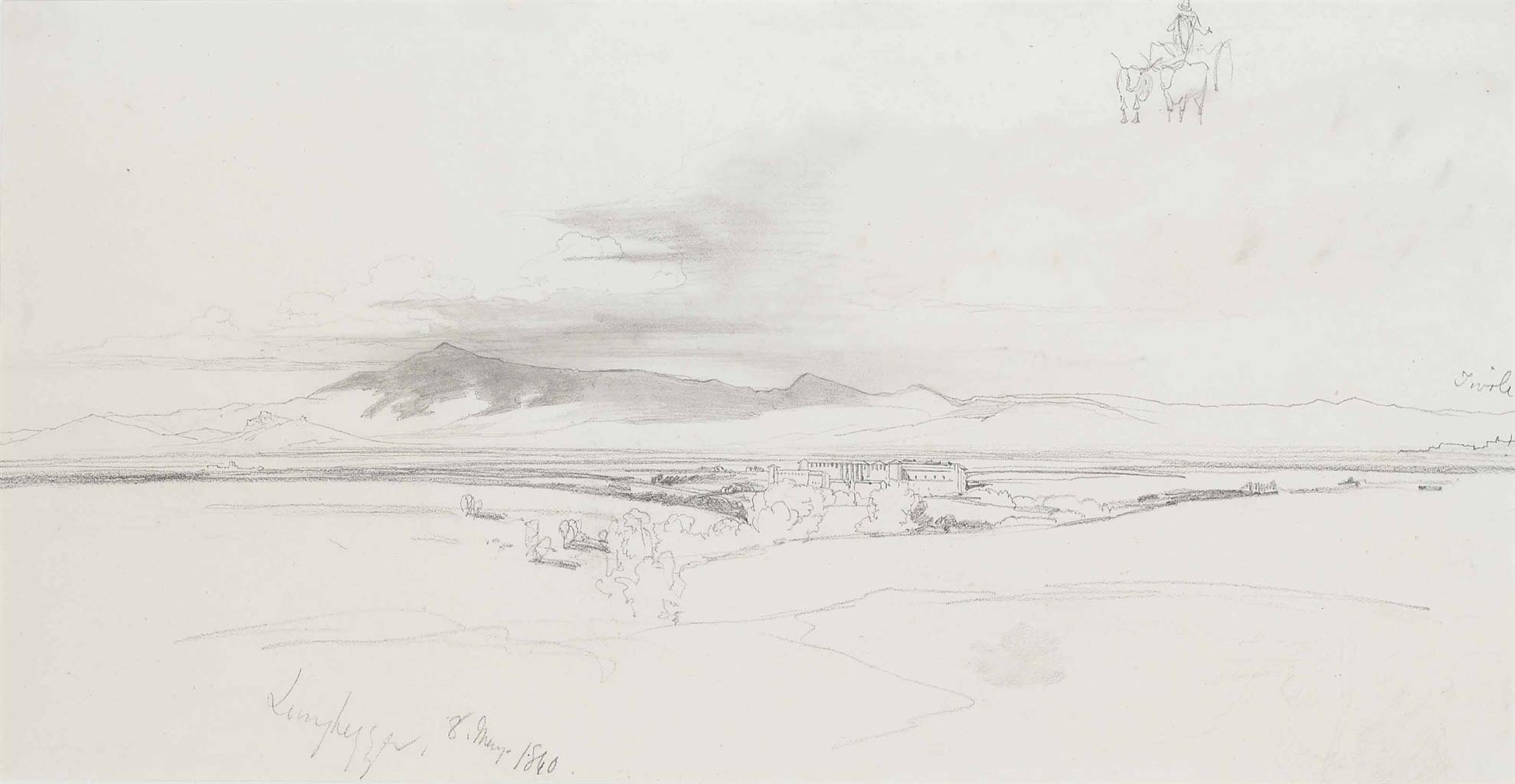
Edward Lear, Val Montone, Near Tivoli, 1840

el-valmontone-s

Edward Lear, Val Montone, near Tivoli.
Inscribed and dated ‘8th May, 1840’ (lower left). Pencil. 8 ½ x 16 ¼ in. (21.6 x 41.3 cm.).

Christie’s.

Posted in Edward Lear | Tagged , , , , | Leave a comment