Christmas Holiday Reading Online

05

Several new books by Edward Lear are now available in full online; of particular interest:

Lear, Edward. A Book of Nonsense. First Edition. London: T. McLean, 1846. [Florida State University Digital Library]

Lear, Edward. A Book of Nonsense. Third Edition. London: Routledge, Warne, and Routledge, 1862. [Hathi Trust Digital Library]

Edward Lear’s Journals: A Selection. Edited by Herbert van Thal. New York: Coward-MdCann Inc, 1952 [Hathi Trust Digital Library]

Edward Lear’s Flora Nonsensica. Cambridge, Mass.: Harvard College Library, Department of Printing and Graphic Arts, 1963. [Hathi Trust Digital Library]

Lear’s Shilling Book of Nonsense. London: Frederick Warne, [ca.1870] [Hathi Trust Digital Library]

13

On Edward Lear and / or Nonsense:

Byrne, Peter. “Il Nonsense tra logica e arte.” Segni e comprensione 2.4 (1988): 18-23. [Università di Salerno]

Ciornei, Ileana-Silvia. “The Nonsense World of Edward Lear.” Language and Literature: European Landmarks of Identity. 10 (2012): 64-68. [Agence Universitaire de la Francophonie]

Sellick, Rob. “The Birds of Edward Lear.” Kunapipi, 34.2 (2012): 113-122. [University of Wollongong]

Carrington, Dorothy. “En 1868, un paysagiste anglais découvre la Corse.” Etudes Corses. Revue trimestrielle. 80.25, 1er trimestre 1960: 38-43. [Gallica]

Also of interest on Gallica: Chauvet, Paul. “L’Angleterre et la Corse.” Revue Anglo-Américaine. 7 (1929): 418-431.

Distaso, Leonardo.”On Satzklang: on the Sense and on the Nonsense.” Aisthesis: Pratiche, linguaggi e saperi dell’estetico. 6.1 (2013): 263-273.

Sze, Gillian. “Sense & Nonsense: Thinking Poetry.” LEARNing Landscapes, 4.1, Autumn 2010.

49

Of possible interest:

Woods, David L., E. William Yund and T.J. Herron.”Measuring consonant identification in nonsense syllables, words, and sentences.” Journal of Rehabilitation Research & Development. 47.3 (2010): 243–260.

Posted in Edward Lear, General | Tagged , , , , , | Leave a comment

Review of an Edward Lear Exhibition, from The Tablet (1958)

Edward Lear

IT is not only since the advent of Punch that Englishmen have claimed a sense of humour as their monopoly. As long ago as 1673 the Earl of Peterborough wrote of the Duchess of  Modena: “She is really an extraordinary woman, has a great deal of witt and sperritt, and I believe wants not humour if she were in a place where it was the custome.” But the form of humour which depends largely on a combination of puns, phonetic spelling, portmanteau words, cockneyisms, superfluous aspirates and verbal distortions such as “aperiently” for “apparently” was a Victorian phenomenon which dies hard in certain secluded patrician circles.

Edward Lear was not impervious to the fashions of his time nor, perhaps, to the echoes of Rabelais and Swift but the collection of his paintings, drawings, books, prints and manuscripts (which the Arts Council has brought from the Aldeburgh Festival to St. James’s Square) reminds us that his nonsense drawings must have been the prototype of Mr. James Thurber’s and that some of his sentences could easily get lost in Finnegans Wake. As a coiner of words he was more prolific and inventive than Lewis Carroll, and many of his verbal aberrations have a surrealist logic which is exclusively his own. Nonsense was officially a sideline to his chosen occupations of book illustration and landscape painting, in the pursuit of which he travelled extensively. His journeys were no doubt an escape from a form of agoraphobia (though he was not unsociable and had many friends) and a justification for his restless temperament: just as his nonsense was a safety-valve through which escaped much of his irritation with his rather ludicrous appearance (long or large noses and beards are always appearing in the rhymes) his chronic ill-health (he was an asthmatic and suffered from mild epilepsy) and his lack of funds. He was never really poor but, in spite of the friendship of rich patrons, he was continually worried by the insecurity of having no fixed income. Brought up by women, he was conscious of a certain lack of virility. He never married, though after the death of the sister who was largely responsible for his upbringing he often brooded about taking a wife. He refers in middle age to a “nice fat Greek girl” and it is difficult not to identify him with the Yonghy Bonghy Bó and Augusta Bethell, Lord Westbury’s daughter, with the Lady Jingly Jones. Like Lewis Carroll, he seems to have been only on friendly terms with women.

The longer poems seem to me his most memorable works. They often have a lyrical pathos that sets them apart from the limericks which I have never liked, partly because of their hint of childish cruelty (so many of his characters come to sticky ends) and partly because the last line invariably provides an anticlimax. Exceptions may be made for the Old Man of Thermopylae who never did anything properly and for the Young Person of Crete whose toilette (a sack) was far from complete. The illustrations to the limericks are on another level, and I was sorry not to find in the exhibition the Old Man of Blackheath and the Young Person of Bantry. Several of the more celebrated poems may, however, be examined in manuscript, including the “Owl and the Pussy-cat” (differing slightly from the published version) and “The Pobble who has no toes” (also with variations). I would have liked to see more of the nonsense receipts and botany (though Manypeeplia Upsidownia is there) but room had to be found for the journals, landscapes and illustrations of birds and animals.
The oil paintings are not impressive, though some of the drawings and water-colours are of unusual interest. Queer shapes, whether real or invented, fascinated Lear, and in this respect he occasionally looks forward to Wyndham Lewis. More often (as in No. 25) he derives from Towne and other eighteenth century votaries of the picturesque. An original note can be detected in such exhibits as Nos. 18, 19, 21, 42 and 59. In the lithograph numbered 97 he has suggested the markings on a tortoiseshell by scraping black paint off the stone—a technique which was not commonplace in the 1830’s. The zoological illustrations are careful and sensitive and loving and competent but not unique of their kind.

Perhaps it is as a personality that we should remember him — the Compleat Eccentric in an age of eccentrics, everybody’s uncle and the most cheerful of grumblers. We can forgive him his exasperation at the number of conversions to Rome and at Cardinal Manning’s “atrocious sermons . . . to which nevertheless, all heaps of fools go.”

WINEFRIDE WILSON.

The Tablet. The International Catholic News Weekly. Vol. 212, No. 6164. 12 July 1958, p. 8. [Available online here.]

[The exhibition reviewed here had originally been at The Eleventh Aldeburgh Festival of Music and the Arts, 12-22 June 1958; a Complete Programme Book. 95[3]pp., was printed by Benham and Company in Colchester, 1958.

The number cited at the end of the article presumably refer to the catalogue: Edward Lear, 1812-1888; an exhibition of oil paintings, water-colours and drawings, books and prints, manuscripts, photographs and records. 64pp. London: Arts Council of Great Britain, 1958. Marco.]

Posted in Edward Lear | Tagged , , , | Leave a comment

Lear Drawings at King’s School, Canterbury

[In 2012, the King’s School in Canterbury held a bicentenary exhibition of its holdings of Edward Lear watercolours, part of an album of drawings donated by Hugh Walpole in 1938. Most of these works had already been presented by Charles Nugent in the two publications cited in the “Further Reading” section below.

Here is the short catalogue that was printed for the occasion; it was given to me by Peter Henderson, Walpole Librarian at the King’s School, Canterbury, when I visited the library in March of 2014. Marco.]

EDWARD LEAR DRAWINGS

A Bicentenary Exhibition

Edward Lear was born in Holloway on 12 May 1812. A largely self-taught artist, he began his career drawing animals and birds. His Illustrations of the Family of Psittacidae or Parrots was published in 1830-32. He also did illustrations for The Zoology of the Voyage of HMS Beagle and for John Gould’s The Birds of Europe.

Lear probably first went to the Lake District in around 1830, when he was invited by Edward Stanley, later 13th Earl of Derby, to draw the animals in the menagerie at Knowsley Hall, Lancashire. In 1835, 1836 and 1837 he went on tours of the Lakes and began drawing landscapes. These journeys were the subject of an exhibition ‒ Edward Lear the Landscape Artist ‒ curated by Charles Nugent at the Wordsworth Trust, Grasmere in 2009. The School’s seven Lake District drawings were exhibited there. Lear drawings of English scenes are rare.

In 1837 Lear left England for Italy and for the next dozen years he was largely based in Rome. He particularly appreciated the beauty of the Campagna, but he also visited much of central and southern Italy as well as Sicily. The School’s four Italian drawings probably date from this period. He returned to England twice, taking the opportunity to publish Views in Rome and its Environs in 1841 and Illustrated Excursions in Italy in 1846. His first Book of Nonsense appeared pseudonymously in 1846. He also gave drawing lessons to Queen Victoria.

From 1849 to 1853 Lear was in England. He enrolled as a student at the Royal Academy, and also had painting lessons from Holman Hunt. He then returned to Italy and for the rest of his life he lived abroad with just the occasional summer visit to England. He travelled extensively in the Mediterranean, with one trip to India. He was a prolific artist, leaving nearly 10,000 drawings and watercolours as well as some 300 oil paintings. He published several more books illustrating his travels, and set some of Tennyson’s poems to music. He died at San Remo in 1888.

The School’s Lear drawings came in an album presented by Hugh Walpole in 1938 as part of the Walpole Collection. There are nineteen landscape sketches in pencil and watercolour, dated between 1835 and 1845, though some of the pictures are not by Lear, but probably by his pupils. This is the first time these twelve pictures by Lear have been displayed in Canterbury.

KING’S WEEK 2012
Admissions Office, Lardergate
Exhibition open during office hours

THE LAKE DISTRICT 1835-37:

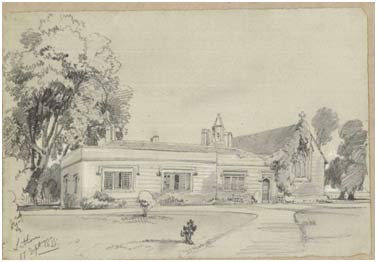
LATHOM 1835:

1. THE CHAPEL AND SCHOOL, LATHOM, LANCASHIRE.

Inscribed: ‘Lathom 17 Sept. 1835’. Pencil and black chalk with touches of white heightening, on blue-grey paper. The Chantry Chapel had been founded by the Earl of Derby in 1500 and consecrated in 1509. The priest’s house was demolished in the eighteenth century and was replaced by a school. Nugent (2009), no. 31.
walpole01

2.  LATHOM HOUSE, LANCASHIRE.

Inscribed: ‘Lathom. Sept 18. 1835.’ Pencil and black chalk on blue-grey paper. Lathom was the property of Lord Skelmersdale, father-in-law of Edward Stanley, later 14th Earl of Derby. The house was built in Palladian style by Giacomo Leoni for Sir Thomas Bootle c1740. The main house was demolished in 1925. Nugent (2009), no. 30.

walpole02

LEVENS HALL AND KENDAL 1836:

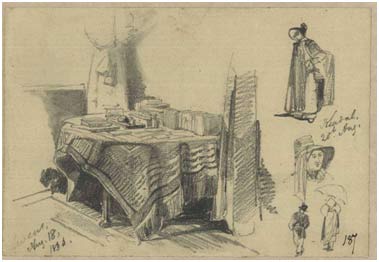
3. STUDY OF AN INTERIOR AT LEVENS HALL AND STUDIES OF FIGURES.

Inscribed: ‘Levens Aug 18 1836’, and ‘Kendal 20th Aug’. Pencil. Lear drew very few interiors, though there is another drawing of a Levens interior in the British Museum. Nugent (2009), no. 35.
walpole03

4. THE NORTH FRONT, LEVENS HALL, CUMBRIA.

Inscribed ‘Levens. Aug. 19. 1836’. Pencil and black chalk with touches of white heightening, on blue-grey paper. Levens was the largest Elizabethan house in Cumbria. It was the home of Col. the Hon. Fulke Greville Howard and his wife Mary. Lear described it as “perhaps the finest existing specimen of an antique house”. Nugent (2009), no. 36.

walpole04

ALDERLEY 1837:

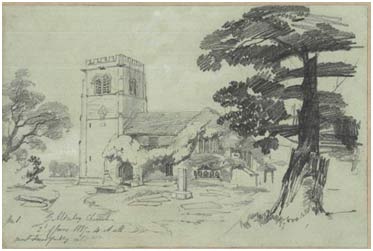
5. ST MARY’S CHURCH, NETHER ALDERLEY, CHESHIRE.

Inscribed: ‘Alderley Church 2d of June 1837 4 A.M. most dreadfully cold’, and ‘No. 1’. Pencil and black chalk with touches of white heightening, on blue-grey paper. Lear stayed at Knowsley in May on his final visit before departing for Italy. Nugent (2009), no. 96.
walpole05

6. THE SKELETON OAK, ALDERLEY PARK, CHESHIRE.

Inscribed ‘Alderley June 3. 1837.’; ‘5 A.M. Cold – drizzly.’; ‘The Skeleton Oak’; and signed ‘Edward Lear del.’ Pencil and black chalk with touches of white heightening, on blue-grey paper. The finished drawing is in the Whitworth Art Gallery, University of Manchester. Lear made several studies of trees in Alderley Park for the Stanley family. Nugent (2009), no. 97.

walpole06

7. NINE LAKE DISTRICT VIEWS.

Pencil and black chalk. The views are from West Cumberland and include Pikes Crag, Wasdale Hall and Wastwater. Versions of four of the scenes in the thumbnails have survived and were exhibited at Dove Cottage (nos. 42, 43, 44 and 47). These original drawings date from September 1836, so this composition was probably produced soon afterwards. This type of image is unique in Lear’s work. Nugent (2009), no. 45.

walpole07

SCOTLAND 1841:

8. A DISTANT VIEW OF TAYMOUTH CASTLE, PERTHSHIRE.

Pencil and black chalk, on buff paper. This preliminary sketch is annotated, in characteristic Lear fashion, ‘stream’, ‘beech’, ‘ash’, ‘wood’, etc. Lear visited Scotland in September 1841 with Phipps Hornby and this view was presumably drawn on that occasion.

walpole08

ITALY 1837-1845:

9. HOUSE IN ITALY.

Inscribed: ‘E Lear del. 1837’. Pencil and black chalk with white heightening on orange paper. Lear left England in July 1837 and after a journey through Germany arrived in Italy in September. From Milan he went on a walking tour of Como and Lugano, visited Florence, and arrived in Rome in December. This view has not been identified.

walpole09

10. SANT’ IONA.

Inscribed ‘Sant’ Iona’ and ‘E. Lear 1845’. Pencil and black chalk on grey paper. Sant’ Iona is in the Abruzzi, a mountainous region to the East of Rome. In early 1845 Lear went on a sketching tour in the Campagna with Chichester Fortescue, later Lord Carlingford. He then left Rome in April to return to England.

walpole10

ITALIAN SCENE.

Inscribed: ‘E.L.’ Pencil and black chalk with touches of white heightening on blue paper. This view is probably in the Campagna, where Lear found “the beauty and the grandeur that he most wanted to paint… [with] gnarled olive trees and rhythmical lines of hills disappearing into wide, distant horizons” (Vivien Noakes). It may well be from the same period as no. 12.

walpole11

12. ITALIAN SCENE.

Pencil and black chalk on blue paper. In one of his earliest letters from Rome in December 1837, Lear commented on “the long lines of aqueducts and tombs on the desolate and beautiful Campagna”. Several Lear drawings and watercolours of Roman aqueducts survive. This is probably from the same period as no. 11.

walpole12

Further Reading

Vivien Noakes, Edward Lear: The Life of a Wanderer (1968; revised and enlarged 2004)

Vivien Noakes, Edward Lear 1812-1888 (1985). Royal Academy exhibition catalogue.

Vivien Noakes, Edward Lear: Selected Letters (1988)

Charles Nugent, ‘Some unpublished drawings by Edward Lear of British subjects’, British Art Journal, Vol. VIII, no. 1 (2007), pp. 24-9

Charles Nugent, Edward Lear: the Landscape Artist (2009): nos. 30, 31, 35, 36, 45, 96 and 97.

Previous King’s Week exhibitions

1972                Prints and Drawings of the School

1974                Somerset Maugham’s Schooldays

1975-77          Prints and Drawings of the School

1978                William Harvey 1578-1978

1985                Michael Powell, Carol Reed and Charles Frend: OKS Film Directors

1993                Marlowe and his Successors

1994                Walter Pater’s Schooldays

1996                William Morris

1997                A King’s School Tapestry: 597-1997

1998                Hugh Walpole and the Walpole Collection

1999                Fin de Siècle

2000                Passing Tales: Some Literary Pilgrims

2001                Fifty Years of King’s Week

2002                The School Library: A Tercentenary Exhibition

2005                Michael Powell: A Life in Movies

2008                Jocelyn Brooke Centenary

2010                Jimmy James: the Great Escaper

Acknowledgements

Many thanks to Bev Skilton, Kate Harrison and Claudia Upton of the Admissions Office for hosting the exhibition; to Peter Whitehead and Sarah Stanley for mounting the drawings; to Hawkswells for the picture frames; and to Charles Nugent, who first recognised the importance of the album.

[The following is a list of the drawings in the album, including those that cannot be attributed to Edward Lear; this was also given to me by Peter Henderson. Marco.]

EDWARD LEAR: drawings and watercolours.

 The items are listed in the order in which they are bound in this volume.


  1. Nine Lake District views. 14 × 23 cm. Pencil and black chalk. The views include Pikes Crag, Wasdale Hall and Wastwater. Nugent (2009) no. 45.
  2. [not EL] Tower. 23 × 15.3 cm
  3. Study of an interior at Levens Hall and studies of figures. 15.5 × 23 cm. Inscribed: ‘Levens Aug 18 1836’, and ‘Kendal 20th Aug’. Pencil and black chalk. Nugent (2009) no. 35.
  4. The Chapel and School, Lathom, Lancashire. 17.3 × 26 cm. Inscribed: ‘Lathom 17 Sept. 1835’. Pencil and black chalk with touches of white heightening, on blue-grey paper. Nugent (2009) no. 31.
  5. St Mary’s Church, Nether Alderley, Cheshire. 16.7 × 25.3 cm. Inscribed: ‘Alderley Church 2d of June 1837 4 A.M. most dreadfully cold’, and ‘No. 1’. Pencil and black chalk with touches of white heightening, on blue-grey paper. Nugent (2009) no. 96.
  6. Sant’ Iona. 8.3 × 13.7 cm. Inscribed ‘Sant’ Iona’, and signed ‘E. Lear 1845’.
  7. The Skeleton Oak, Alderley Park, Cheshire. 25.3 × 16.7 cm. Inscribed Alderley June 3. 1837.’; ‘5 A.M. Cold – drizzly.’; ‘The Skeleton Oak’; and signed ‘Edward Lear del.’. Pencil and black chalk with touches of white heightening, on blue-grey paper. The finished drawing is in the Whitworth Art Gallery, University of Manchester, D.1981.1. Nugent (2009) no. 97.
  8. Lathom House, Lancashire. 17.5 × 25.8 cm. Inscribed: ‘Lathom. Sept 18. 1835.’ Pencil and black chalk on blue-grey paper. Nugent (2009) no. 30.
  9. [not EL] 20.5 × 25.8 cm. Inscribed ‘from the Wimberry above pen-ma..’
  10. [not EL] Tree. 25.5 × 20.8 cm.
  11. House in Italy. 20 × 28.8 cm. Inscribed: ‘E Lear del. 1837’.
  12. [not EL] Tivoli. 27 × 21.5 cm. (Image 19 × 13.2 cm.)
  13. [not EL] Trees. 28.5 × 22 cm. Inscribed: ‘Gozzinni del.’ (or ‘Gorzini, or ‘Gornissi’??)
  14. [possibly EL] Rhine scene. 22.7 × 30 cm. (Image 16.7 × 25.5 cm.)
  15. Campagna scene. 24.5 × 29.8 cm. × (Image 17 × 25.4 cm.)
  16. Italian scene. 24.2 × 30 cm. (Image 17 × 26 cm.) Inscribed: ‘E.L.’
  17. [not EL] Unknown view. 25.7 × 27.2 cm.
  18. A distant view of Taymouth Castle, Perthshire. 25.5 × 35.2 cm. Pencil and black chalk, on buff paper.
  19. The North Front, Levens Hall, Cumbria. 25.5 × 36 cm. Inscribed ‘8’, and ‘Levens. Aug. 19. 1836’. Pencil and black chalk with touches of white heightening, on blue-grey paper. Nugent (2009) no. 36.

Charles Nugent, ‘Some unpublished drawings by Edward Lear of British subjects’, British Art Journal Vol. VIII, no. 1, pp. 24-28, describes and illustrates nos. 1, 3, 4, 5, 7, 8, 18 and 19.

Nos. 1, 3, 4, 5, 7, 8 and 19 were exhibited at Dove Cottage in 2009; see Charles Nugent, Edward Lear: the Landscape Artist (2009): nos. 30, 31, 35, 36, 45, 96 and 97.
Posted in Edward Lear | Tagged , , , , , , | Leave a comment

Edward Lear, A View of Menton from across the Bay

el_menton1-s

Edward Lear, A view of Menton from across the bay.
Signed with monogram (lower right). Pencil, watercolour and bodycolour. 16.5 x 26cm (6 1/2 x 10 1/4in).

Lear had moved to Nice in November 1864 where he began work on 240 of what he termed his ‘Tyrants’. These were systematically worked up watercolours, taken from sketches and painted simultaneously in a production line method. They were sold relatively cheaply at around 10 guineas and although they are an achievement in terms of workload and inventiveness their varying quality and formulaic approach have been criticised.

After this herculean effort, Lear set out on foot and painted around the coast of the Corniche for a month, capturing the beautiful scenery of the coast from Nice to Menton. The present and following lot would seem to date from this time and show his focus on the detail in the middle distance with the rocky foregrounds left understated and the dramatic hills plunging into the Mediterranean.

Bonhams.

Posted in Edward Lear | Tagged , , , | 1 Comment

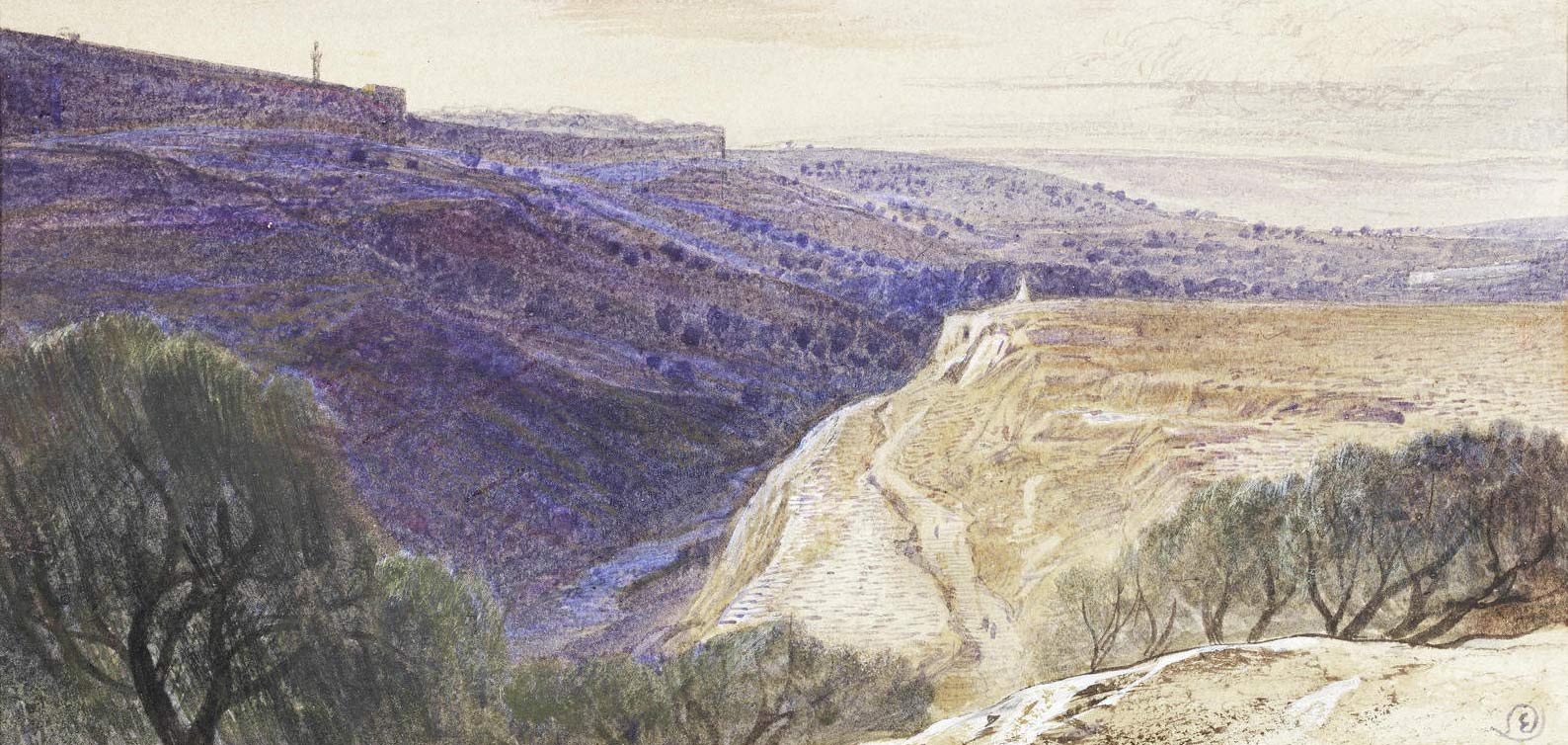
Edward Lear, The Valley of Jehosaphat with Jerusalem Beyond

el_jehosaphat-s

Edward Lear, The Valley of Jehosaphat with Jerusalem beyond.
Signed with monogram (lower right). Watercolour and bodycolour. 9.5 x 19.5cm (3 3/4 x 7 11/16in).

Edward Lear travelled to Jerusalem from Corfu and arrived on 27 March 1858. His diary records his travels outside the walls of the city, ‘We crossed the Kidron and went up the Mount of Olives – every step bringing fresh beauty to the city uprising behind’ (Vivien Noakes, Edward Lear 1812-1888, Royal Academy of Arts, London, 1985, p.149).

Lear went on to camp for a week on the Mount of Olives making studies and preparatory drawings of the view of Jerusalem in April/May 1858 for a commission from Lady Waldegrave. He worked these up into many successful compositions such as View of Jerusalem, 1858 (Tate Britain). The present lot shows a view of the Valley of Jehosaphat, with Jerusalem on the left with Temple Mount just visible and Absolom’s Pillar in the central middle distance. Lear was particularly interested in the light at dawn and evening, the simple colour scheme of gold, green and purple working to excellent effect. He wrote, ‘just at sunrise the view of the city is most lovely…all gold and white beyond the dark fig and olive trees’. (Vivien Noakes, The Painter Edward Lear, David & Charles, London, 1991, p.72).

Bonhams.

Posted in Edward Lear | Tagged , , , | Leave a comment

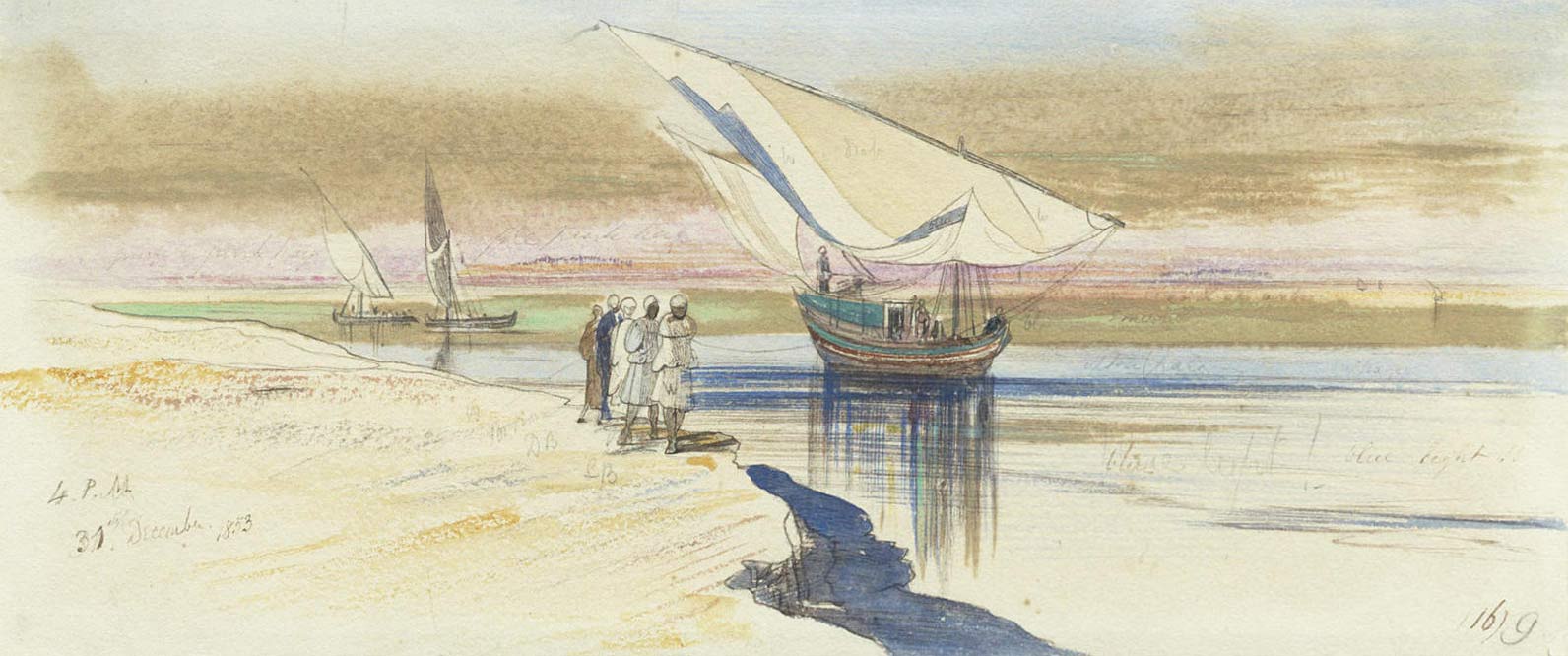
Edward Lear, Dhows on the Nile at Sunset (1853)

el_dhows-s

Edward Lear, Dhows on the Nile at sunset.
Inscribed and dated ‘4pm 31 December 1853’ (lower left). Watercolour, pen and ink. 9.5 x 23cm (3 3/4 x 9 1/16i.

Bonhams.

Posted in Edward Lear | Tagged , , , | Leave a comment

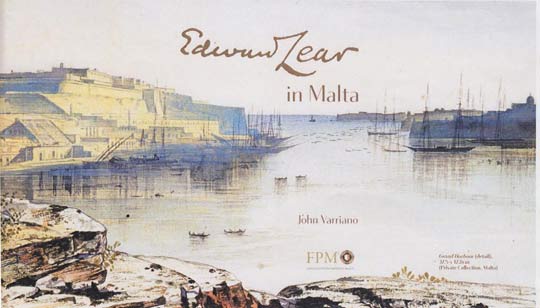
Edward Lear in Malta, Corfu, and Lake Maggiore

varriano-book

I have received John Varriano’s new book on Edward Lear in Malta, a gorgeous addition to the recent fashion of books and / or exhibitions on Lear’s travels to different parts of the world. This beautiful oblong volume contains a detailed discussion of the painter’s visits to the island and in particular the last one in 1865-1866, lists all known landscape paintings he did of the island — most of those that can still be traced are illustrated — and prints transcripts of the diaries and letters written in the period he stayed there. Highly recommended.

You may remember there was an exhibition in Corfu a couple of years ago on Edward Lear and the Ionian Islands; one of the events connected with this was a lecture on Edward Lear by psychiatrist Anthony Stevens, which I have found is available in its entirety on YouTube: Dr Stevens states that Lear suffered from “a severe body dysmorphic disorder,” i.e. was obsessed with his physical appearance.

Finally, if you read Italian you should not miss Paola Vozza’s long post on Il paesaggio secondo Lear, which also has a gallery with several of the landscapes Lear painted of the Italian alpine lakes.

Isola San Giulio. Lago di Orta. 1842.

Isola San Giulio. Lago di Orta. 1842.

Posted in Edward Lear | Tagged , , , , , | 2 Comments

Edward Lear in Malta

malta-leaflet

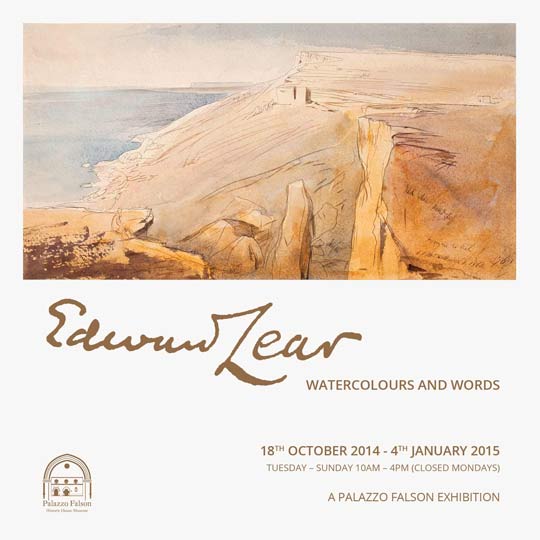
The exhibition curated by John Varriano on Edward Lear’s Malta watercolours, Edward Lear: Watercolours and Words, has opened at Palazzo Falson, Mdina, and will be on until 4 January 2015 (here is an article from The Malta Independent).

varriano-book

Professor Varriano, who also gave a lecture on 18 October, has a new book on Edward Lear in Malta published by Fondazzjoni Patrimonju Malti in Valletta. It can be ordered from the Book Distributors Limited website.

More events  connected with the exhibition include an Artists’ Workshop with John Martin Borg and a Gallery talk by Catherine Galea.

Previously on Lear in Malta.

Posted in Edward Lear | Tagged , , , | 1 Comment

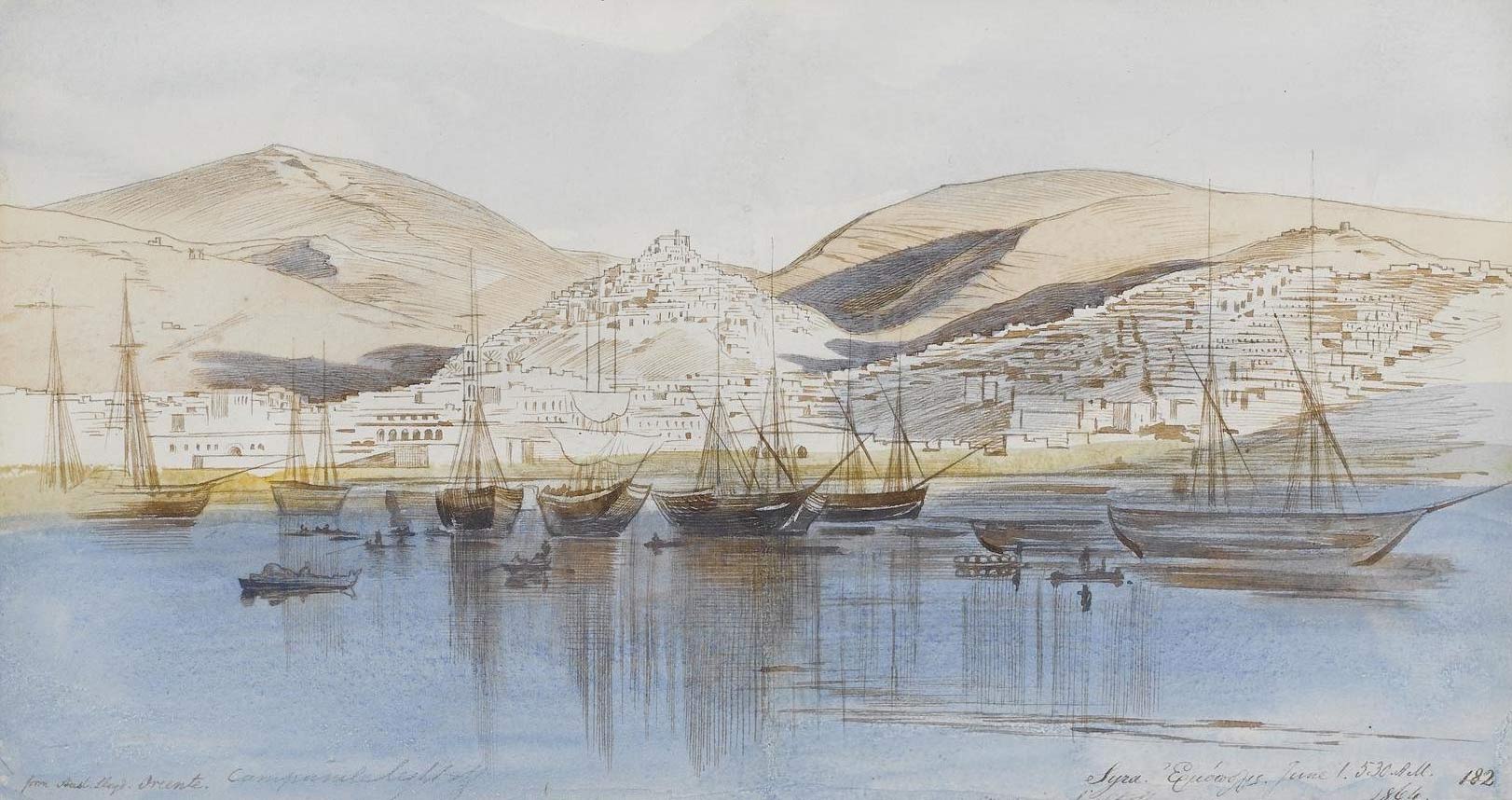
Edward Lear, Syra, Ermoupoli (1864)

EL_Ermoupoli-s

Edward Lear, View of Ermoupoli, Syros.
Inscribed ‘Syra. Ermoupoli. June 1. 5.30 AM/ 182’ and dated ‘1864’ l.r. Watercolour. 17 x 32 cm. (6¾ x 12½ in.)

Lear visited Syra on his way back to Athens at the end of a two month exploration of Crete during which he made nearly two hundred drawings. He had sailed from Khanià early in the morning of 31 May, and sat on deck as the boat sailed north through the Cyclades. “The multitude of ‘Isles of Greece’ is quite uncommon and lovely”, he wrote in his diary, “About eight we reached Syra. A wonderful voyage!”.

Bonhams.

Posted in Edward Lear | Tagged , , , , | Leave a comment

A Day in the Studio with Edward Lear

Another previously unpublished letter Edward Lear sent to William Holman Hunt exactly 150 years ago (see Diary 6.x.64). This one contains a humorous description of a day in Lear’s London studio while he is trying to do some work.

15 Stratford Place. Oxford St. W.
October. 1864

My dear Daddy,

I was glad to hear from you just now, & as you much want some amusement, even if ever so small, I will write a bit, trusting the chance that people won’t call before I have got two or 3 hour’s work at my brambles & bricks & lizards. A heap of callers have been here of late ― & nearly all oldish personal friends, so I am a good deal behind-hand as to work, & believe, after all that I must give up going on Monday to Faringford, ― for ― if I leave this picture very much unfinished, the foreboding of fogs & other interruptions ― keeping me in England ―― would destroy all my fun if I left town. Some good scenes might be drawn out of Studio life ― as for instance.


(4 ladies ― having staid for 2 hours ― rise to go.)

1st Lady “What a treat my dear Mr Lear! but how wrong it is of you to stay so much in doors! You should take more care of your health ― work is all very well but if your health fails you know you will not be able to work at all, & what could [would?] you do then! Now pray go out & only see your friends before 12 or 1. in the morning.
2nd Lady ― But how dreadful these interruptions must be! I cannot think how you ever do anything! ― Why do you allow people to break in on you. So? It quite shocks me to think we have taken up so much time.
3d Lady. Yes, indeed: these are the best hours of the day. You should never see any one after 2 o’clock.
4th Lady. You should walk early, & then you could see your friends all the rest of the day. Interruptions must be so dreadful!

(Enter 4 more ladies. The first 4 rush to them.)

All 8 Ladies ― How charming! how fortunate! dear Mary! Dear Jane! dear Emily! dear Sophia! &c.

5th Lady ― How wrong of you dear Mr. Lear to be indoors this fine day!
6th Lady. ― How you can ever work I cannot think! you really should not admit visitors at all hours!
7th Lady ― But do let us only sit & look at these beautiful sketches!
8th Lady. O how charming! & we will not go to Lady O’s.

The other 4 Ladies. O then we also will all sit down again ― it is so dreadful.

Chorus of 8 Ladies. What a charming life an artist’s is! ―

Artist. ――――― D ―――n!

&c. &c. &c.


I can now understand Mrs. N’s feelings about the Dr.’s picture. I did not take to Mrs. N― it is difficult to do so now a days to most clergy. (The Bishops are getting it right & left from the Times, & justly enough. Gloucester & Lincoln must wish they had said less, for they surely cannot seriously believe their order will gain in the end, by setting the intellectual element of the Community dead against their own.          I find people like the Jánina picture immensely: the brambles &c. ― & a great deal more I owe to you.

I am sorry F. has not bought the Selborne estate: ― the property is in a most delightful part of England ― & he may never again have such a chance. ― Your stay at Burton must have a good many tough drawbacks: ―[some words have been blotted] In the South, where servants

There must have been a second sheet, but I have not been able to find it.

Posted in Edward Lear | Tagged , , , | 1 Comment