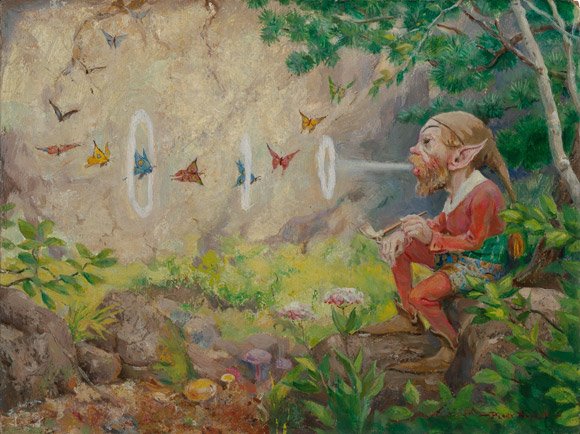
Peter Newell, Fairyland.
Oil on panel. 12 x 16 in. Signed lower right
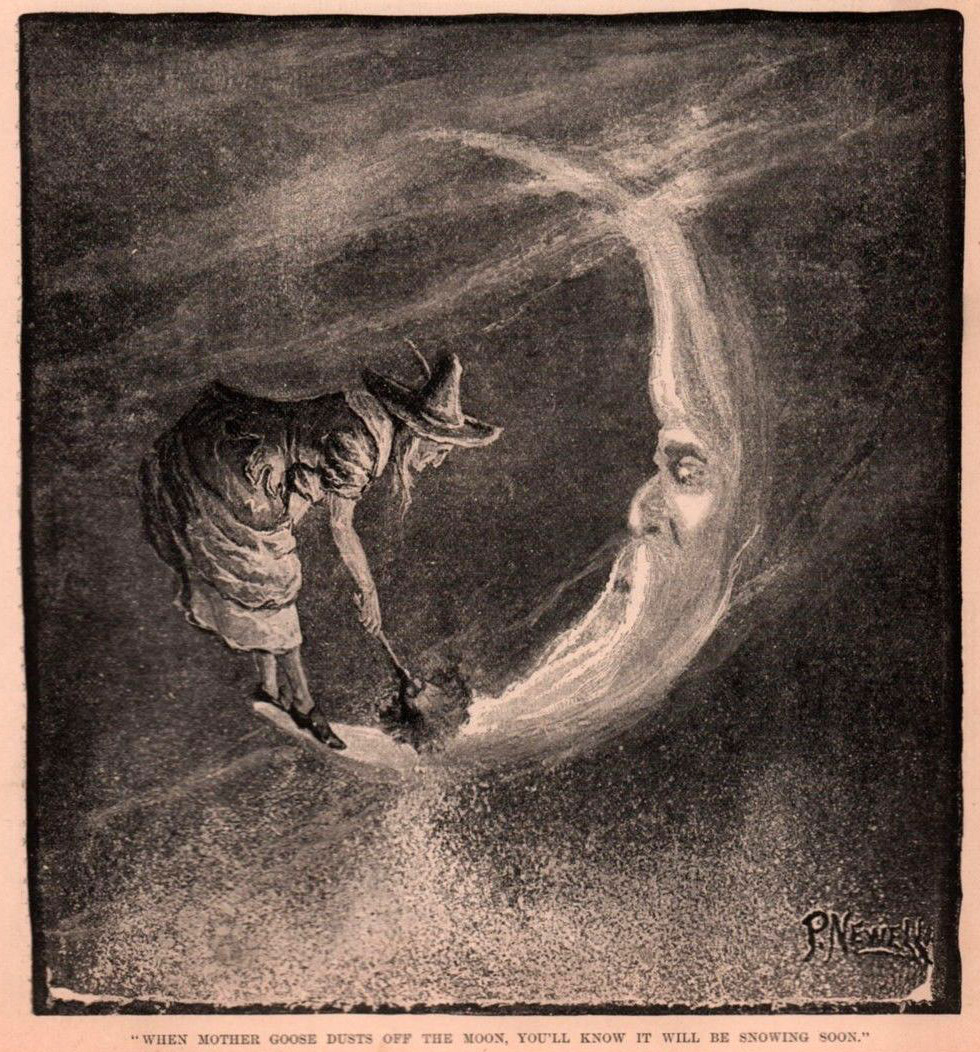
Peter Newell, cover for Harper’s Young People: An Illustrated Weekly, vol. VL No. 279, 3 March 1885.
For more moon dusting see Aliquis’s The Flight of the Old Woman Who was Tossed Up in a Basket.
Haughton, Hugh. “Just Letters: Corresponding Poets.” In Letter Writing Among Poets: From William Wordsworth to Elizabeth Bishop. Ed. Jonathan Ellis. Edinburgh: Edinburgh University Press, 2015. 57-80. [Google Books]:
Thinking of ‘snail mail’ brings to mind two pictorial letters from the great Victorian nonsense poet and illustrator Edward Lear, who was as idiosyncratic a letter writer as his American contemporary Emily Dickinson.
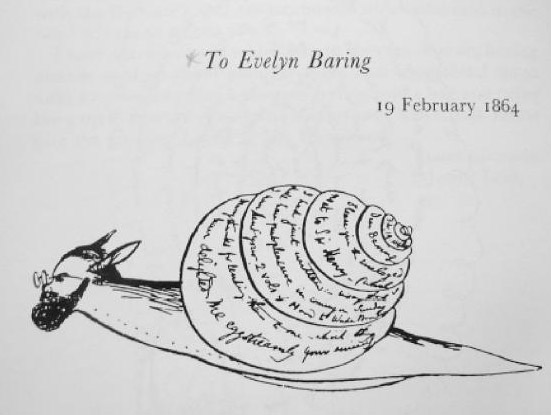
The first of these is a brilliant epitome of snail mail. The text of this note to Evelyn Baring of 19 February 1864 winds itself around the shell of a snail that bears not only the words but the bearded features of its author (Noakes 194). Lear was a traveller, topographical painter and travel writer and this letter is both a traveller’s text and a travelling one. Snails may be slow but they travel, and this bearded and bespectacled snail bears not only the name of its addressee — someone actually called Baring — but a portrait of the letter writer as middle-aged snail. As stamps bear the head of the monarch, the letter bears the head of its author. This comic self-portrait in letter form tells us something about the form of the letter, about its materiality, its mimetic relationship to its author and its essential mobility (however slow).
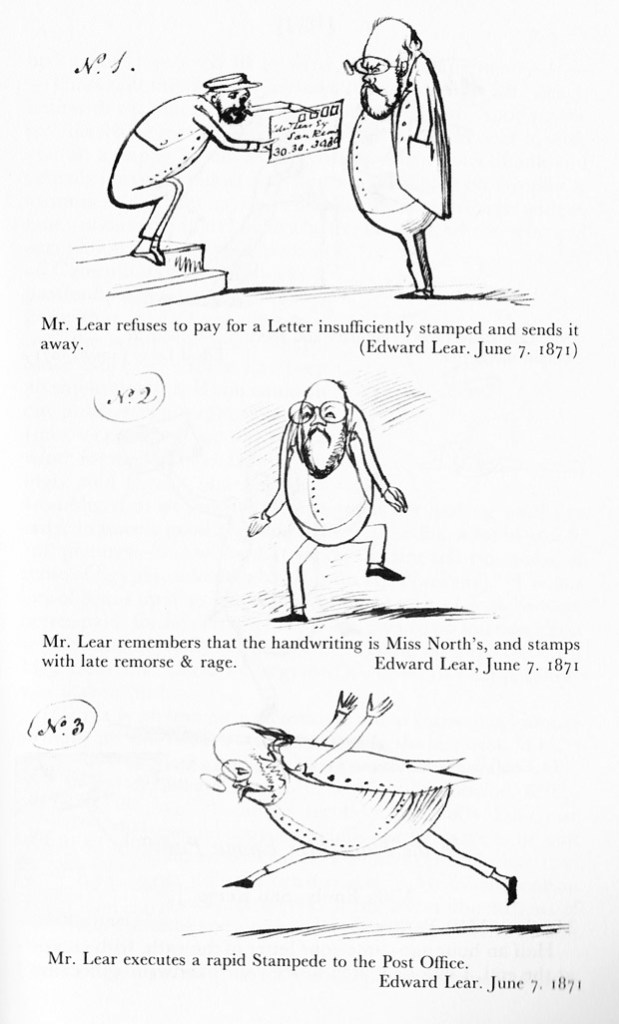
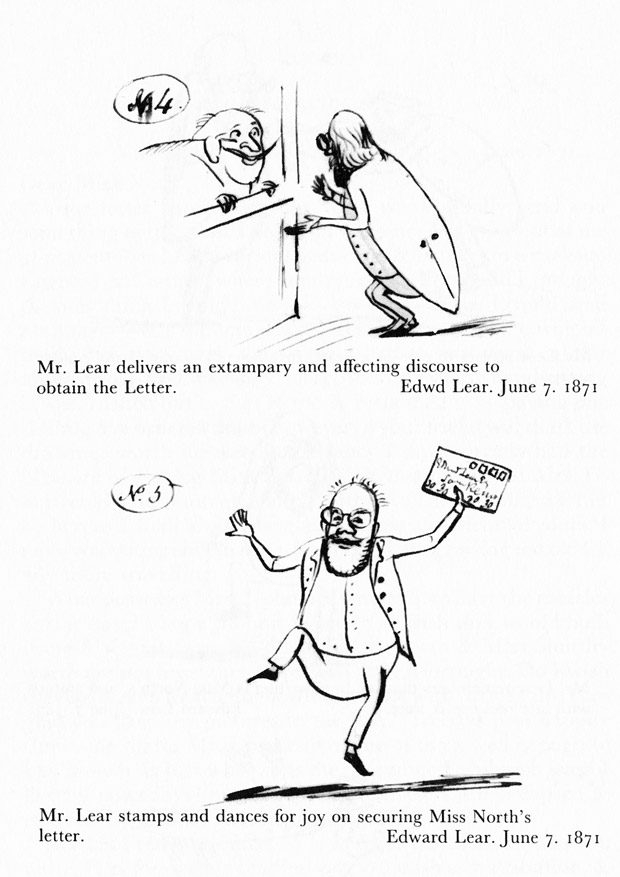
Lear was an often dazzling letter writer and his correspondence shimmers with the playfulness that went into his verse. ‘Letters are the only solace of my life at present, except sardines and omelettes,’ he told Lady Wyatt in December 1870, while in 1861 he said his letters ‘would be quite as fit to read 100 years hence as any body else’s naughty biography’ (Noakes 226). Another letter to Marianne North of June 1871 includes a series of images illustrating his reception of one of her letters (230-2). They show him finding it ‘insufficiently stamped’, then executing ‘a rapid Stampede to the Post Office’, delivering ‘an extampary and affecting discourse’, and concluding with a triumphant image, in which ‘Mr Lear stamps and dances for joy in securing Miss North’s letter’. Each illustration includes a different kind of ‘stamp’ and the sequence dramatises a complex dance of relatioships that is both ritualised and ‘extampary’, a word that suggests both ‘extempore’, officially franked, and bearing the author’s energetic personal stamp. It turns the receiving of the letter into a tour de force of writing and illustrates the crucial interdependence in all correspondence of writing and receiving, posting and reading. Like Keats and Dickinson, Lear often enclosed poems with his letters, circulating them among friends prior to publication. Indeed his letters with their blend of nonsensical play, travel writing and biography, are the best guide to the world of the Dong with the Luminous Nose, the Pobble who has no toes and his other nonsensical protagonists. Lear wrote a poem entitled ‘How pleasant to know Mr. Lear!’, and the letters give his readers a pleasurable sense of the displaced poet within his far-flung social worlds, transforming our sense of his dancing, unhappy and ‘extampary’ poems.
Unlike ‘How pleasant to know Mr. Lear!’, the late poem ‘My Agèd Uncle Arly’ doesn’t purport to be autobiographical. Nonetheless it is quoted in a letter of 4 June 1884 to a Lear’s friend Lord Carlingford with the following introduction:
Having a notion you have a little more leisure while you are at Balmoral (as I see by the papers you are about to be) … I shall send you a few lines just to let you know how your aged friend goes on
O my agèd Uncle Arly!
Sitting on a heap of Barley
Through the silent hours of night!
On his nose there sate a cricket;
In his hat a railway ticket —
But his shoes were far too tight!
Too! Too!
far too tight! (Strachey 212)
As John Byrom [Thomas Byrom?] has pointed out, the name ‘UncLE ARly’ includes (albeit ‘unclearly’) the letters of the author’s name, ‘Lear’, but this letter explicitly equates the author and his avuncular protagonist as well as relating the tight shoes to the letter writer’s feet (the letter also includes a drawing of a swollen footed Lear hobbling on ski-like crutches). In March 1886, Lear sent a copy of the completed poem to Ruskin, prefaced with an allusion to Gray’s ‘Elegy’, ‘E’en in our ashes’ (echoing ‘E’en in our ashes live their wonted fires’), and saying he esteems it ‘a thing to be thankful for that I remain as great a fool as ever I was’. Two days later, sending it to the wife of a doctor, he describes it as ‘the last Nonsense poem I shall write’, calling it ‘stuff begun years ago for Lady E Baring’. According to his editor Vivien Noakes (who doesn’t quote the letter to Carlingford), on 5 March he made twelve copies to send to friends, as well as referring to ‘another poem about the same ingividgual’, recorded as an ‘Incomplete MSS — found in the brain of Mr Edward Lear on dissection of the same — in a post-mortem examination’ (Noakes 546). Such letters confirm the live role of the epistolary audience in the composition and distribution of his nonsense poems, whose primary audience was a network of friends. However, they also anticipate our post-mortem sense of this most ‘ingividgual’ of artists and poets, as he reframes the poem autobiographically for different correspondents.
Taken together, Lear’s images — with letters like these — remind us that every letter is part and parcel (rather like a parcel) of a larger social network, a textual response that is designed to provoke a response. In any exchange of letters the writer is always a reader and the reader a writer, and I want to suggest this is true in a different sense of poems, which are also never private and always circulate within a larger system of exchange which gives them meaning in their own time, and then after the death of the author in ‘post-mortem examination’. James Wright wrote in a letter to Donald Hall that ‘friendship is everything. It may not be entirely why we write our poems. But it is certainly why we have the courage to give those poems to each other’ (455). Manuscripts aren’t found in any brain, of course, but the manuscripts of letters like Lear’s are taken up into Derrida’s archive where they will inevitably be read in relation to the mind of the dead author and his friends, forming a crucial archival embodiment of his mental and corporeal life.
This is an interesting reading of a few of Edward Lear’s letters, but some references are inaccurate, i.e. those to Noakes are to Vivien Noakes’s edition of Lear’s Selected Letters, except (Noakes 546) which clearly refers to her edition of The Complete Verse and Other Nonsense, which does not appear in the bibliography; moreover, Haughton does not clearly state that the letter on “the same ingividgual” is to the Reverend E. Carus Selwyn (from Selected Letters 280) and does not read exactly as he quotes it:
Villa Tennyson | Sanremo | 19. May or might | would | could or | should be 19th. | 1886
After I sent your letter to the preconcerted predacious Poast — I remembered your wish to know about ‘Uncle Arly’ ——— of which Wilkie Collins writes to me that he thinks it the best of all ‘my poetry!’ ——
There is another pome about the same ingividgual begun — but shunted —
‘Accidental on his hat, ——
‘Once my Uncle Arly sat:
‘Which he squeezed it wholly flat.’(Incomplete MSS — found in the brain of Mr. Edward Lear on dissection of the same — in a post mortification examination)
Della Dora, Veronica. “Ways of Seeing: The Making of a Holy Landscape of Rocks.” In Avril Maddrell, Veronica della Dora, Alessandro Scafi, Heather Walton. Christian Pilgrimage, Landscape and Heritage: Journeying to the Sacred. New York: Routledge, 2014. 45-66. [Google Books] pp. 57-60:

Unlike Byzantine accounts, whereby landscape is essentially a collage of symbolic topoi, or Parthenios’ post-Byzantine engravings, likewise organised according to topological principles, in these descriptions landscape is articulated through a tension between proximity and distance, unexpected irregular forms and normalizing frames, wonder and spatial control. Landscape surprises and at the same time acquires geometrical depth as the eye moves from the immediate detail to the horizon, Objects are arranged through a receding view: human figures, shadowy trees and rocks stand in the foreground; further away are the strange pinnacles and pyramids of rock; and finally, mountain landmarks fade in the distance. ‘As the day wore on, and the river opened out into a wider valley, the eastern horizon suddenly exhibited a strange form in the distance, which at once I felt to be one of the rocks of the Meteora’, writes Edward Lear, one of the most celebrated nineteenth-century painters of Greek landscapes.
This object combines with a thousand beautiful pictures, united with the white-trunked plane-trees and the rolling Peneius, ere, escaping from the woods, the route reaches the wider plain; and the inconceivably extraordinary rocks of kalambaka, and the Meteora convents, are fully unfolded to the eye… I do not think I ever saw any scene so startling and incredible; such vast and perpendicular pyramids, standing out of the earth, with the tiny houses of the village clustering at the roots (Lear 1851, 395).
As with Leake, Wordsworth and Curzon, Lear’s views of the Meteora are ‘fully unfolded to the eye’ — and framed. In the village of Kastraki, the majestic pinnacles are sighted through the windows of his room, conveniently located on the upper floor of a tower-like dwelling (ibid., 296). As the British painter ventures up towards the monasteries, the rocks appear to him as
a most wonderful spectacle; and are infinitely more picturesque than I had expected them to be. The magnificent foreground of fine oak and detached fragments of rock, struck me as one of the peculiar features of the scene. The detached and massive pillars of stone crowned with the retreat of monks, rise perpendicularly from the sea of foliage, which at this early hour, six a.m. is wrapped in the deepest shade, while the bright eastern light strikes the upper part of the magic heights with brilliant force and breadth (ibid., 396-7).
Further up,
on a level with the summit of the great rocks of Meteora and Varlaam, the solitary and quiet tone of these most wonderful haunts appeared to me inexpressibly delightful. Silvery white goats were peeping from the edge of the rocks into the deep, black abyss below; the simple forms of the rocks rise high in the air, crowned with church and convent, while the eye reaches the plains of Thessaly to the far-away hills of Agrafa (ibid., 397).
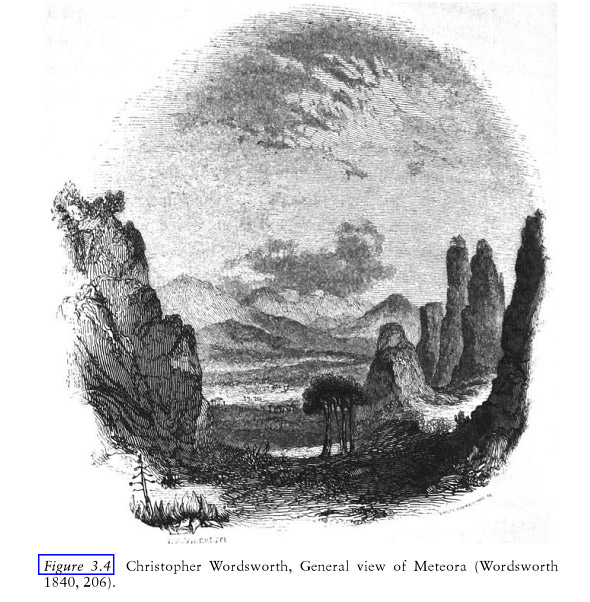

Figure 3.5. Edward Lear
The engravings illustrating Wordsworth’s book (see Figure 3.4) and the paintings produced by Lear (see Figure 3.5) feature vistas of monastery-topped pinnacles respectively framed by other pinnacles and the thick foliage of trees underneath. Unlike Orthodox representations, they do not provide a simultaneous God’s-eye view from multiple angles; they rather offer tiny windows on a reality captured from a single vantage point. Unlike in Orthodox engravings (see Figure 3.3) and proskynētaria centred on the monasteries and their relics, in these representations the presence of the monasteries and their inhabitants almost vanishes in the landscape. Why is this the case?
Scenic appreciation and ‘objective’ representation require visual distancing. Yet, distancing can in turn produce alienation. Unlike Orthodox proskynētes, nineteenth-century Western travellers were essentially oursiders. For some of them, the monasteries were nothing but picturesque curiosities; for others, they were metonymies of a system of beliefs they utterly despised. In 1814 Charles Robert Cockerell, one of the most famous early antiquarians that visited the region, ascended Megalo Meteoron to produce landscape drawings. He praised the view from the Monastery of the Transfiguration as ‘magnificent’, but scorned its inhabitants as ‘wretched’ and ‘as ignorant as possible’ (Cockerell 1903, 249). During his vist, Lear, a notorious anti-Orthodox, did not even bother to pay a visit to ‘these monkish habitations… regretting that I did so the less, as every moment of the short time Iingered among these scenes, was too little to carry away even imperfect representations of their marvels’ (1851, 398). Meteora was less of a (sacred) place than a collection of landscapes to be enframed by the artist and ‘taken away’ in pictorial form.
Unlike Lear, Curzon ventured to the monasteries and requested to see icons and relics, but certainly not to venerate them. While relics constituted, we have seen, the main focus for Orthodox pilgrims to Meteora, Curzon did not find them ‘of very great antiquity or interest: the shrines are only sufficient in size to contain two skulls and a few bones; the style and execution of the ornaments are also much inferior to many works of the same kind which are met in ecclesiastical houses’ (1851, 253). …
References to:
Leake, Martin William. Travels in Northern Greece. 4 vols. London: J. Rodwell, 1835.
Wordsworth, Christopher. Greece: Pictorial, Descriptive, and Historical. London: William S. Orr and Co., 1840.
Curzon, Robert. Visits to Monasteries in the Levant. London: John Murray, 1851.
Lear, Edward. Journals of a Landscape Painter in Albania &c. London: Richard Bentley, 1851.
All available on Google Books.
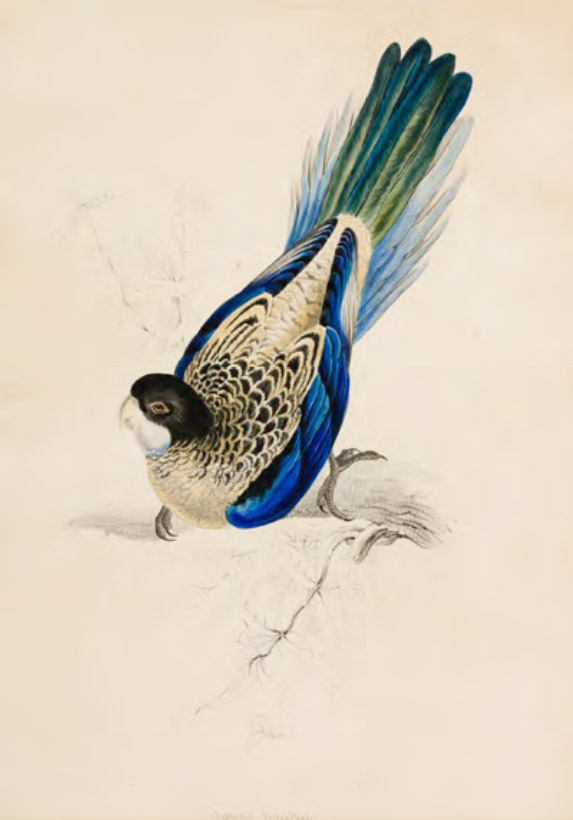
Edward Lear, Brown’s Parrakeet (c. 1831).
Watercolour and pencil on paper. 40 x 29 cm.
Plate 20 of Lear’s Illustrations of the Family of Psittacidae.
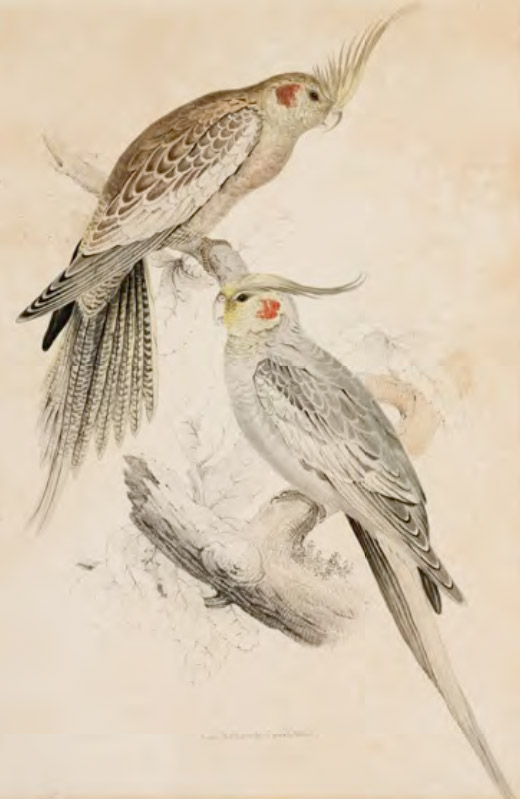
Edward Lear, New Holland Parrakeet (c. 1831).
Watercolour and pencil on paper. 45.3 x 29 cm.
Plate 27 of Lear’s Illustrations of the Family of Psittacidae.
Justin Miller Art winter 2015 Catalogue.
I have just received a copy of the special issue of RSV: Rivista di Studi Vittoriani devoted to “Edward Lear in the Third Millenium: Explorations into his Art and Writing” edited by Raffaella Antinucci and Anna Enrichetta Soccio; here is a list of the essays that have now been added to the bibliography:
Colley, Ann C. “Edward Lear and Victorian Animal Portraiture.” RSV: Rivista di Studi Vittoriani 34-35 (2013): 11-26.
Marroni, Francesco. “Edward Lear and Albania.” RSV: Rivista di Studi Vittoriani 34-35 (2013): 27-49. [Academia.edu]
Dilworth, Thomas. “Lear’s Italian Limericks.” RSV: Rivista di Studi Vittoriani 34-35 (2013): 51-78.
Lodge, Sara. “My Dear DAddy: Edward Lear and William Holman Hunt.” RSV: Rivista di Studi Vittoriani 34-35 (2013): 79-99.
Bruni Roccia, Gioiella. “Edward Lear’s Metaphorical Mind: A Cognitive Approach to A Book of Nonsense.” RSV: Rivista di Studi Vittoriani 34-35 (2013): 101-18.
Tigges, Wim. “Edward lear’s Limericks and the Aesthetics of Nonsense.” RSV: Rivista di Studi Vittoriani 34-35 (2013): 119-38.
Williams, James. “Edward Lear’s Luminous Prose.” RSV: Rivista di Studi Vittoriani 34-35 (2013): 139-58.
Antinucci, Raffaella. “‘… in those few bright (Abruzzi) days’: Edward Lear’s Landscaping Gaze and the Discovery of Abruzzo.” RSV: Rivista di Studi Vittoriani 34-35 (2013): 159-88.
Soccio, Anna Enrichetta. “Struggling with Genres: Edward Lear’s Short Stories.” RSV: Rivista di Studi Vittoriani 34-35 (2013): 189-201.
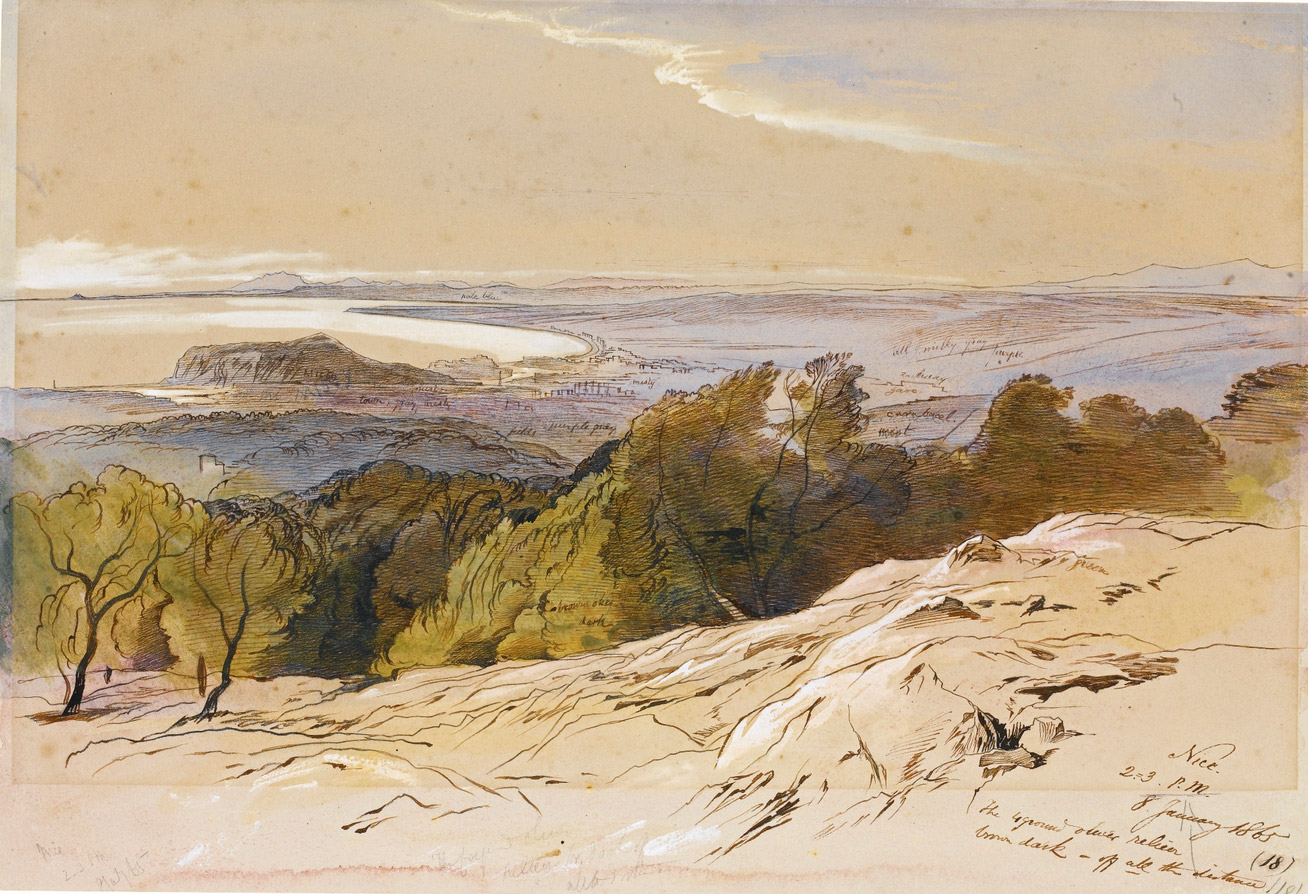
Edward Lear, Nice, France.
Pen and brown ink and watercolour over pencil heightened with white;
inscribed in ink lower right: Nice. / 2.= 3. P.M. / 8 January 1865 / (18) the 4ground olive section / brown dark – off all the distance; further inscribed with the artist’s colour notes
370 by 543 mm.
Lear drew this landscape from life in the early afternoon of 8th January 1865. He had arrived in the French Riviera in November of the previous year and had decided to spend the winter there, before returning to London in April.
This drawing belongs to Lady Evans, in whose family it has been since the early 20th Century. Lady Evans was married to the late Sir Charles Evans (1918-1995), who was the deputy-leader of the triumphant Everest expedition of 1953.
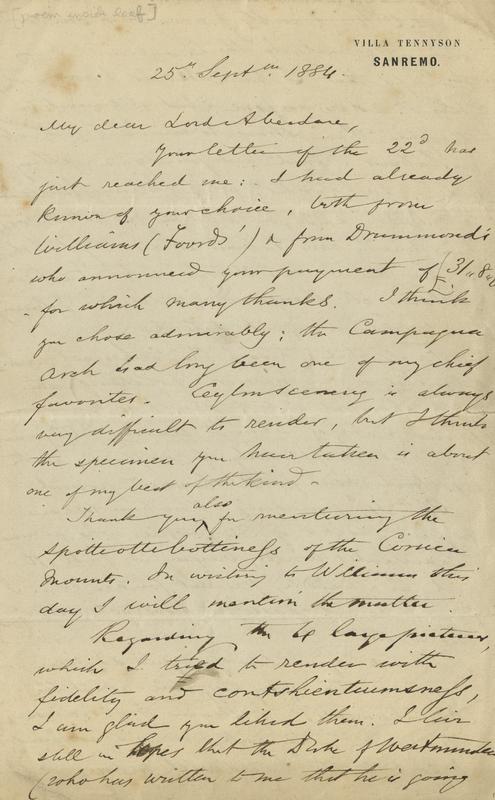
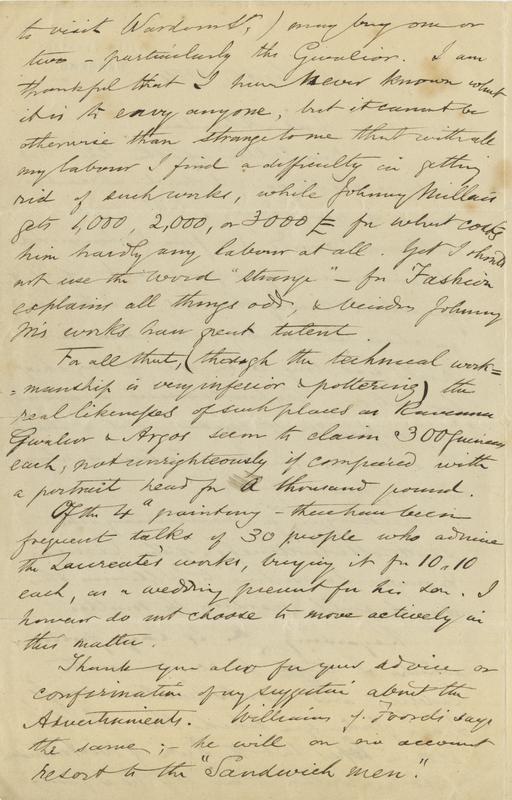
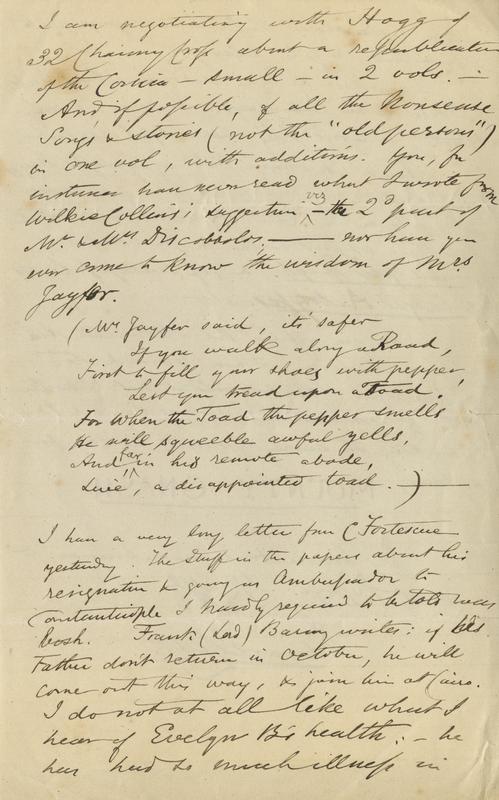
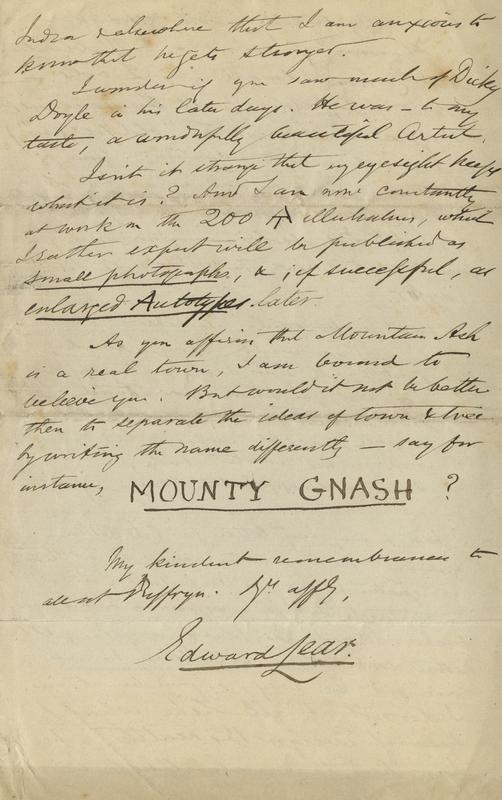
Among the many subjects touched in the letter to Henry Bruce, Lord Aberdare transcribed below from the scans available on the Florida State University website, is Edward Lear’s statement that the second part of “Mr and Mrs Discobbolos” was suggested by Wilkie Collins (see previous post), and that he was thinking of publishing a new collection of his nonsense songs with additions; he also mentions Richard Doyle as a “wonderfully beautiful artist,” and complains of the difficulty he has in “getting rid” of some of his paintings:
Villa Tennyson
Sanremo
25th. Septer. 1884.
My dear Lord Aberdare,
Your letter of the 22nd has just reached me: I had already known of your choice, both from Williams (Foord’s) & from Drummond’s who announced your payment of £31.8.0 ― for which many thanks. I think you chose admirably; the Campagna Arch had long been one of my chief favorites. Ceylon scenery is always very difficult to render, but I think the specimen you have taken is about one of my best of the kind.
Thank you ^[also] for mentioning the spottiottibottiness of the Corsica Mounts. In writing to Williams this day I will mention the matter.
Regarding the 4 large pictures, which I tried to render with fidelity and contshientiumsness, I am glad you like them. I live still in hopes that the Duke of Westminster (who has written to me that he is going to visit Wardour St.,) may buy one or two ― particularly the Gwalior. I am thankful that I have never known what it is to envy anyone, but it cannot be otherwise than strange to me that with all my labour I find a difficulty in getting rid of such works, while Johnny Millais gets 1,000, 2,000, or 3,000£ for what costs him hardly any labour at all. Yet I should not use the word “strange” ― for Fashion explains all things odd, & besides Johnny M.’s works have great talent.
For all that, (though the technical workmanship is very inferior & pottering) the real likenesses of such places as Ravenna Gwalior & Argos seem to claim 300 guineas each, not unrighteaously if compared with a portrait head for a thousand pound.
Of the 4th painting ― there have been frequent talks of 30 people who admire the Laureate’s works, buying it for 10.10 each, as a wedding present for his son. I however do not choose to move actively in this matter.
Thank you also for your advice or confirmation of my suggestion about the Advertisements. Williams of Foord’s says the same; ― he will on no account resort to the “Sandwich men.”
I am negotiating with Hogg of 32 Charing Cross about a republication of the Corsica ― small ― in 2 vols. ― And, if possible, of all the Nonsense Songs & stories (not the “old persons”) in one vol., with additions. You, for instance have never read what I wrote from Wilkie Collins’s suggestion ^[viz.] ― the 2nd part of Mr. & Mrs. Discobbolos. ――― nor have you ever come to know the wisdom of Mrs. Jayfer.
(Mrs. Jayfer said, it’s safer
If you walk along a Road,
First to fill your shoes with pepper,
Lest you tread upon a toad.
For when the Toad the pepper smells
He will squeeble awful yells,
And ^[far] in his remote abode,
Live, a disappointed toad.) ――
I have a very long letter from C. Fortescue yesterday [sic]. The stuff in the papers about his resignation & going as Ambassador to Constantinople I hardly required to be told was bosh. Frank (Lord) Baring writes: if his Father don’t return in October, he will come out this way, & join him at Cairo. I do not at all like what I hear of Evelyn B.’s health: ― he has had so much illness in India & elsewhere that I am anxious to know that he gets stronger.
I wonder if you saw much of Dicky Doyle in his later days. He was ― to my taste, a wonderfully beautiful Artist.
Isn’t it strange that my eyesight keeps what it is? And I am now constantly at work on the 200 AT illustrations, which I rather expect will be published as small photographs, &, if successful, as enlarged Autotypes later.
As you affirm that Mountain Ash is a real town, I am bound to believe you. But would it not be better then to separate the ideas of town & tree by writing the name differently ― say for instance, MOUNTY GNASH?
My kindest remembrances to all at Duffryn. Yrs affly,
Edward Lear.
The friendship between Edward Lear, the Victorian poet of nonsense verses, and Wilkie Collins, the novelist, has long been well-known. Yet, strangely enough, it was a friendship of which, as Collins’ biographer tells us, “hardly a trace remains.”{1} We know that Lear, ill and depressed, wrote at the end of 1881 to Hubert Congreve that he would continue to correspond in the future only with those “I have been in the habit of writing to since 1850 ― 32 years.” Among those he named was Wilkie Collins.{2} That Collins had written at least once to Lear is seen in a single reference in a letter written by Lear to Lord Carlingford on January 7, 1884, in which he said he had received a “long and very nice letter from Wilkie Collins. . . .”{3} We are told that Lear sent to Collins a copy of John Ruskin’s letter to the Pall Mall Gazette praising the nonsense poet,{4} and that Lear sent to Collins a manuscript copy of his last nonsense-poem ” Uncle Arly.”{5} In view of all this, it is extremely odd that in the two volumes of Lear’s published letters not one to Collins appears. In the J. Pierpont Morgan Library there has been for some years an autograph letter from Lear to Collins; so far as I can ascertain this letter has never been published. For some unaccountable reason those who have written on Lear and on Collins have seemingly been unaware of its existence. If it is, as seems very probable, the only letter from Lear to Collins in existence, it should be of interest not only to students of both Lear and Collins but also, because of a reference in it, to those of Ruskin. This letter of two and one-half pages may very well be the one in which Lear enclosed the copy of ” Uncle Arly,” for that poem may be the “absurdity ” which he mentions in the first paragraph. An exact transcription of the letter follows:
7. March 1886
Villa Tennyson
Sanremo.
My dear Wilkie,
“Ee’n in our ashes live” &c &c ― so, ― though I have been in bed some 14 weeks, I have nonetheless written an absurdity which I fancy you may like ― whereby I send it.
The acute Bronchitis which I began with, Dr Hassall I am grateful to say has pretty well abolished. Not so the congestion, which with its dreadful cough ― is trying enough. Yet many thousands suffer more, & I may be very thankful that only increasing weakness is my greatest drawback.
One of my oldest friends, Fortescue, (now Ld Carlingford) was here for two months & with me almost all day daily. And other friends come & are coming from Cannes, Hyères ― &c. & I have lots of books, (many by one Wilkie Collins,) & most attentive & able servants ― to feed me or lift me in or out of bed. Of what is called the “Colony” here I know ― I am happy to say nothing. Neither perpetual church services ― (high or low ― candlestix or cursings ―) are to my taste, nor are balls & Lawn Tennis among my weaknesses.
Mr Ruskin (vide Pall Mall Gazette Febr 15 ―) has of late greatly exalted me, & he is now taking much interest, he writes most kind letters, ― about yeverlasting & never terminated AT or Alfred Tennyson illustrations ― still let us hope ― to come out in Autotype ― about the year 4810. Meanwhile, if I go off in one of these terrible phitz of coughing, this may be the last note you will ever be bothered by from, Your’s affly,
Edward Lear{6}
David Shusterman
University of Kansas
{1} Kenneth Robinson, Wilkie Collins (New York, 1952), p. 93.
{2} Later Letters of Edward Lear, ed. Lady Strachey (London, 1911), p. 34.
{3} Ibid., pp. 296-297.
{4} Angus Davidson, Edward Lear Landscape Painter and Nonsense Poet (London, 1938), p. 265.
{5} Robinson, p. 93. [See a MS of the poem]
{6} Quoted by permission of the J. Pierpont Morgan Library
Modern Language Notes 71.4, April 1956, pp. 262-264.
Catalogue entry for this letter at the Pierpont Morgan Library. They have another Lear letter to Collins, of 25 May 1887 “concerning his poor health, and the sale of his large ‘Argos picture’ to Trinity college, Cambridge― ‘a matter of high honour & pleasure to me’.”
The text set as No. XXII in Michael East’s Second Set of Madrigals 1606 is an almost perfect limerick (East, xii and 115-20; Fellowes, 91{1}); a fact which I believe has not been noted before.
The piece runs:
O metaphysical tobacco,
Fetched as far as from Morocco,
Thy searching fume
Exhales the rheum,
O metaphysical tobacco.
and it can be seen that it conforms in every respect to the ‘rules’ of the limerick, except that it changes to an iambic rhythm for lines 3 and 4, Like Edward Lear’s limericks, but unlike most modern examples, it uses the first line as the concluding line.
The tone and diction of the piece are at odds with the other, more courtly lyrics used in East’s collection and this, taken in consideration with the more homophonic and chordal music to which it is set, seems to anticipate the fashions of the late seventeenth and early eighteenth centuries, the era of ‘Wit and Drollery’. Indeed it is surprising that a precurson to the limerick-form has not already been discovered amongst the glees, catches, and ‘Pills to Purge Melancholy’ of that period. Now with this example of the form in front of us the absence of any proto-limericks from the eighteenth century is even more unaccountable.
John Leonard
University of Queensland.
Notes and Queries, n.s. 40.2 [Volume 238], June 1993, pp. 207-208.
As you may have realised, I’m throwing away tons of paper and scanning and ocr-ing my Lear-related photocopies: publishing some of this material here is a good way to make the material easy to find. Bonus: you can listen to Michael East’s ‘limerick’ here, or get a glimpse of the score and listen to a MIDI version here.
 A Blog of Bosh