Edward Lear, A Venetian Sail Barge (1865)

el_venice-s

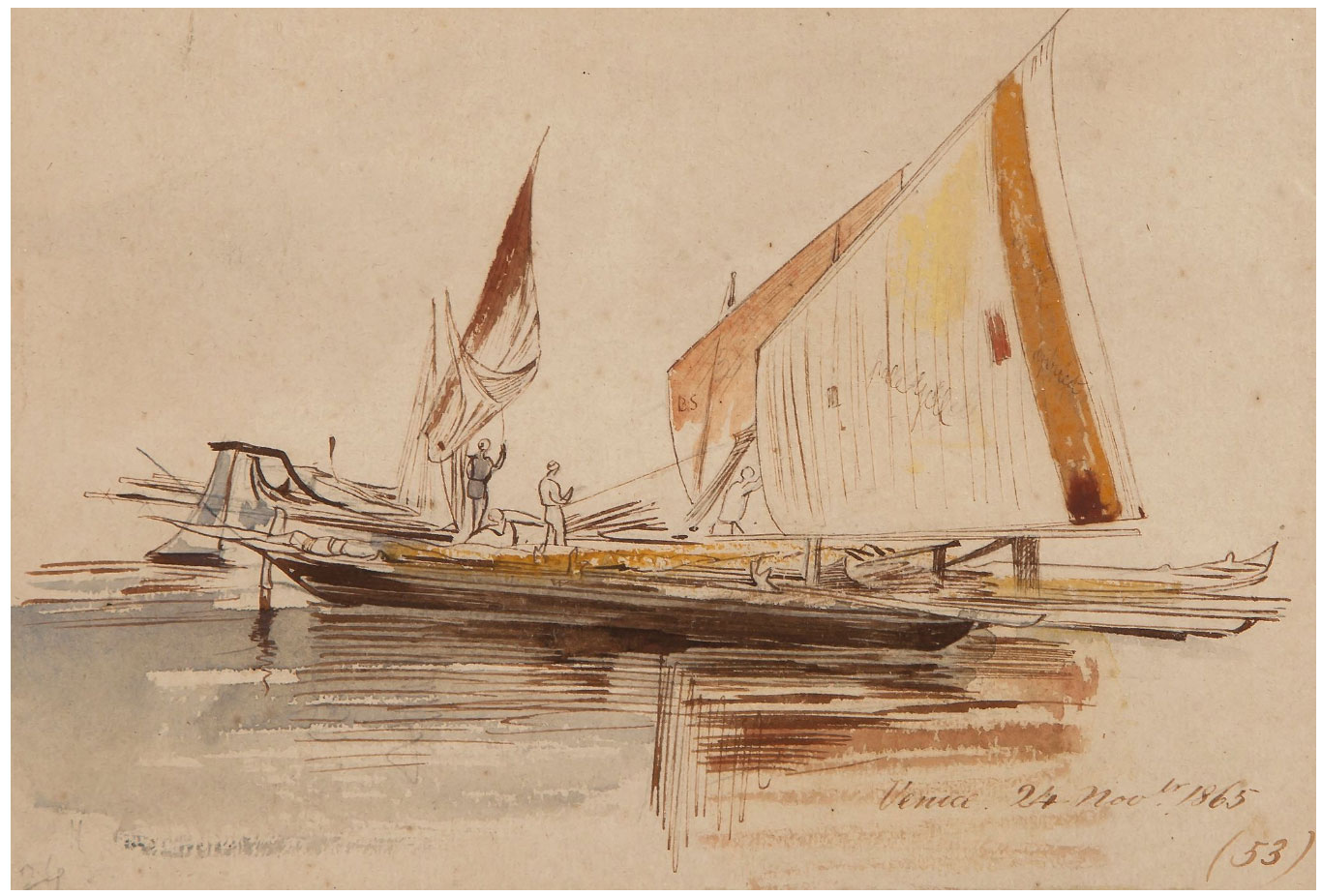
Edward Lear, A Venetian sail barge.

Brush and red ink, watercolour, touches of body colour, traces of graphite. Inscribed ‘Venice 24 Nov, b’r 1865 (53)’ lower right. 11.5 x 17 cm. (4 1/2 x 6 3/4 in)

Provenance:
Thomas Agnew & Sons, London (label on reverse, no. 29064)

Bloomsbury.

Posted in Edward Lear | Tagged , , , | Leave a comment

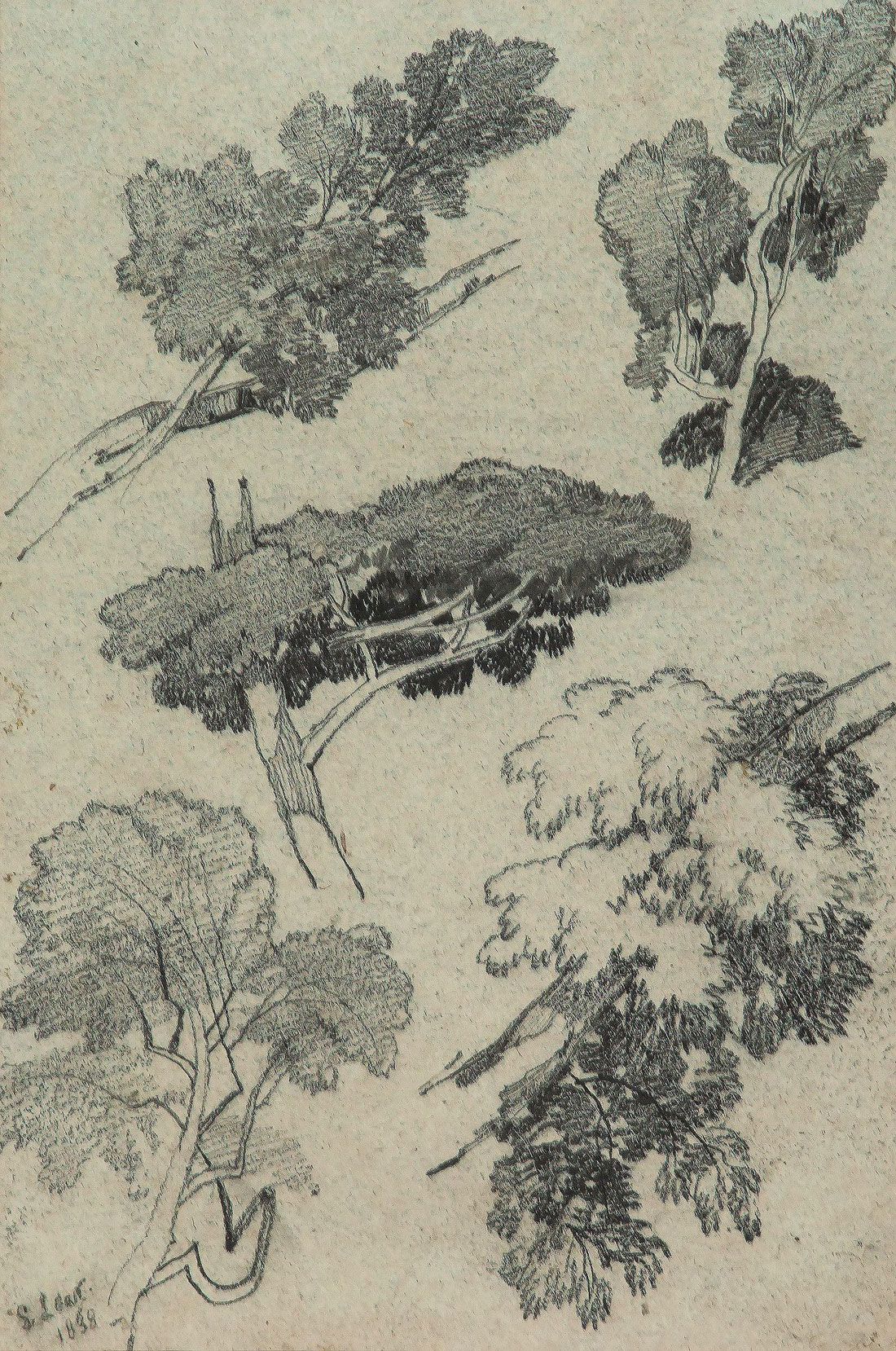
Edward Lear, Sketches of Trees (1838)

el_trees-s

Edward Lear, Sketches of trees.

Graphite on blue wove paper. Signed and dated 1838 lower left. 26 x 18 cm.(10 1/4 x 7 1/8 in).

Provenance:
Spink, London (label on reverse, no. K3/4388);
Thomas Agnew & Sons, London, 1970s.

Bloomsbury.

Posted in Edward Lear | Tagged , , | Leave a comment

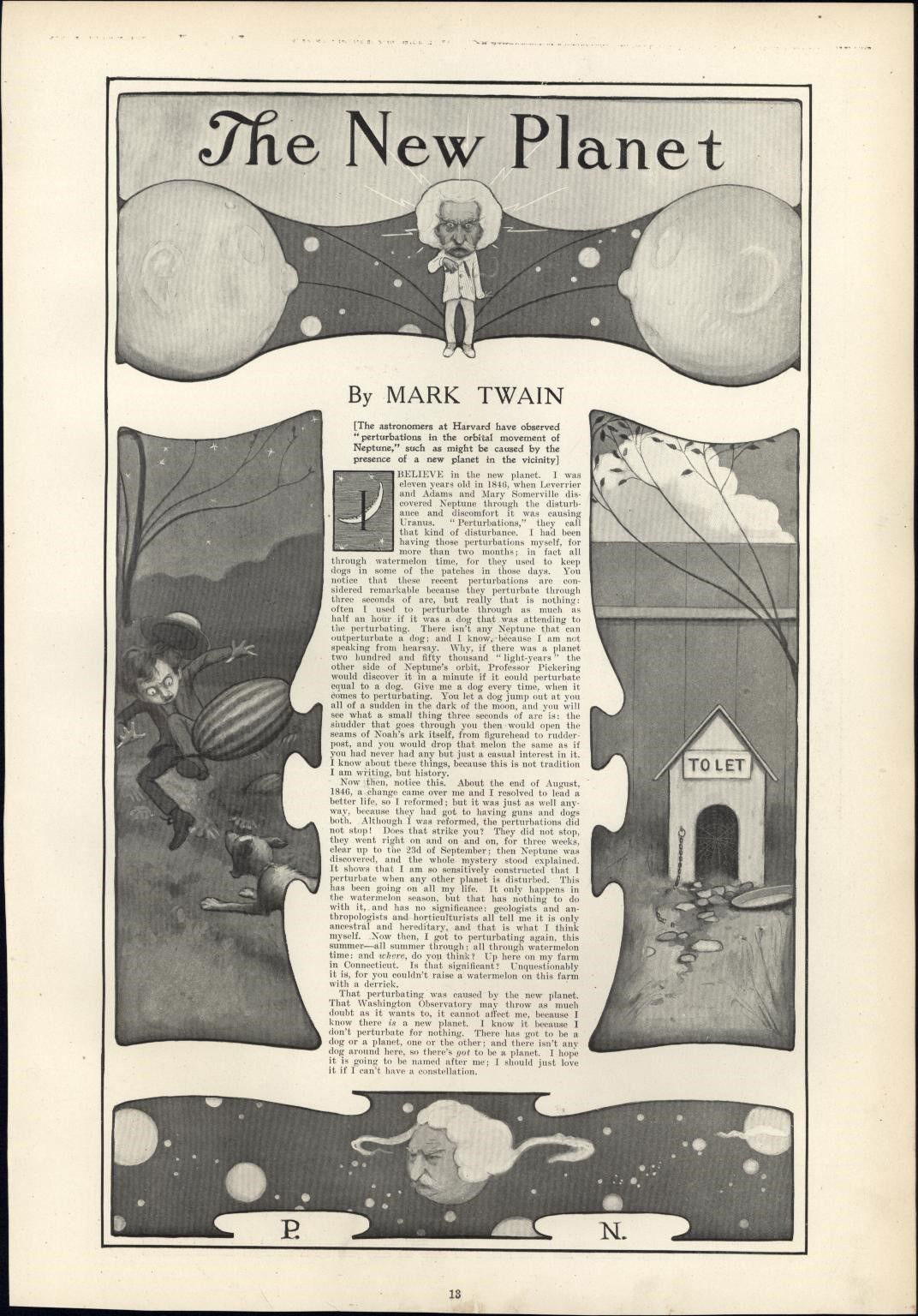
Mark Twain, The New Planet, Illustrated by Peter Newell

pn_new-planet-s

THE NEW PLANET

(The astronomers at Hanard have observed “perturbations In the orbital movement of Neptune,” such as might be caused by the presence of a new planet in the vicinity.)

I BELIEVE in the new planet. I was eleven years old in 1846, when Leverrier and Adams and Mary Somerville discovered Neptune through the disturbance and discomfort it was causing Uranus. “Perturbations,” they call that kind of disturbance. I had been having those perturbations myself, for more than two months; in fact, all through watermelon time, for they used to keep dogs in some of the patches in those days. You notice that these recent perturbations are considered remarkable because they perturbate through three seconds of arc, but really that is nothing: often I used to perturbate through as much as half an hour if it was a dog that was attending to the pertur-bating. There isn’t any Neptune that can outper-turbate a dog; and I know, because I am not speak-ing from hearsay. Why, if there was a planet two hundred and fifty thousand “Hght-years” the other side of Neptune’s orbit. Professor Pickering would discover it in a minute if it could perturbate equal to a dog. Give me a dog every time, when it comes to perturbating. You let a dog jump out at you all of a sudden in the dark of the moon, and you will see what a small thing three seconds of arc is : the shudder that goes through you then would open the seams of Noah’s Ark itself, from figurehead to rudder post, and you would drop that melon the same as if you had never had any but just a casual interest in it. I know about these things, because this is not tradition I am writing, but history.

Now then, notice this. About the end of August, 1846, a change came over me and I resolved to lead a better life, so I reformed; but it was just as well, anyway, because they had got to having guns and dogs both. Although I was reformed, the pertur-bations did not stop! Does that strike you? They did not stop, they went right on and on and on, for three weeks, clear up to the 23d of September; then Neptune was discovered and the whole myster>’ stood explained. It shows that I am so sensitively constructed that I perturbate when any other planet is disturbed. This has been going on all my life. It only happens in the watermelon season, but that has nothing to do with it, and has no significance: geologists and anthropologists and horticulturists all tell me it is only ancestral and hereditary, and that is what I think myself. Now then, I got to p)ertur-bating again, this summer — all summer through; all through watermelon time : and where, do you think ? Up here on my farm in Connecticut. Is that signifi-cant? Unquestionably it is, for you couldn’t raise a watermelon on this farm with a derrick.

That perturbating was caused by the new planet. That Washington Observatory may throw as much doubt as it wants to, it cannot affect me, because I know there is a new planet. I know it because I don’t perturbate for nothing. There has got to be a dog or a planet, one or the other; and there isn’t any dog around here, so there’s got to be a planet. I hope it is going to be named after me; I should just love it if I can’t have a constellation.

Text from The Complete Works of Mark Twain. Authorized Edition. New York: Harper and Brothers, 1923. 355-357.

Illustrated page from Harper’s Weekly, 30 January 1909.

Posted in Peter Newell | Tagged , , | Leave a comment

Edward Lear, Hajar Kim, Malta (1866)

el_hajar-kim-s

Edward Lear, Hajar Kim, Krendy, Malta, 4 March 1866.
Annotated sketch at the archaeoligical site of the prehistorical temple complex at Hagar Qim, near Qrendi in southern Malta, pen and sepia ink over pencil on buff paper, 360 x 525mm., annotated in the lower half with location and colour references in the same ink, evenly browned, 1866.

This is a companion drawing in respect of exact date, subject location, paper type and annotation, to no. 973 in the catalogue of the collection of Edward Lear landscape drawings in the Houghton Library of Harvard University. Edward Lear (1812-1888) visited Malta for the penultimate time between December, 1865, and April, 1866, the longest of eight spells on the island, stopping there again only very briefly in December 1866, on his way to Egypt. Despite these numerous returns to Malta, Lear was ambivalent towards the place, as expressed in a letter to his sister, in 1848, “I cannot remember to have left any place with so much regret after so short a stay in it. But I could not live at Malta ― there is hardly a bit of green in the whole island ― a hot sandstone, wall, & bright white houses are all you can see from the highest places”.

The megalithic temple complex of Hagar Qim, in the south of the island, dates from 3600-3200 BC, and is considered to be one of the oldest religious sites on Earth. It was first excavated in 1839, and is now a World Heritage Site.

Provenance: with Antoine Xuereb, London.

Bloomsbury.

Posted in Edward Lear | Tagged , , , | Leave a comment

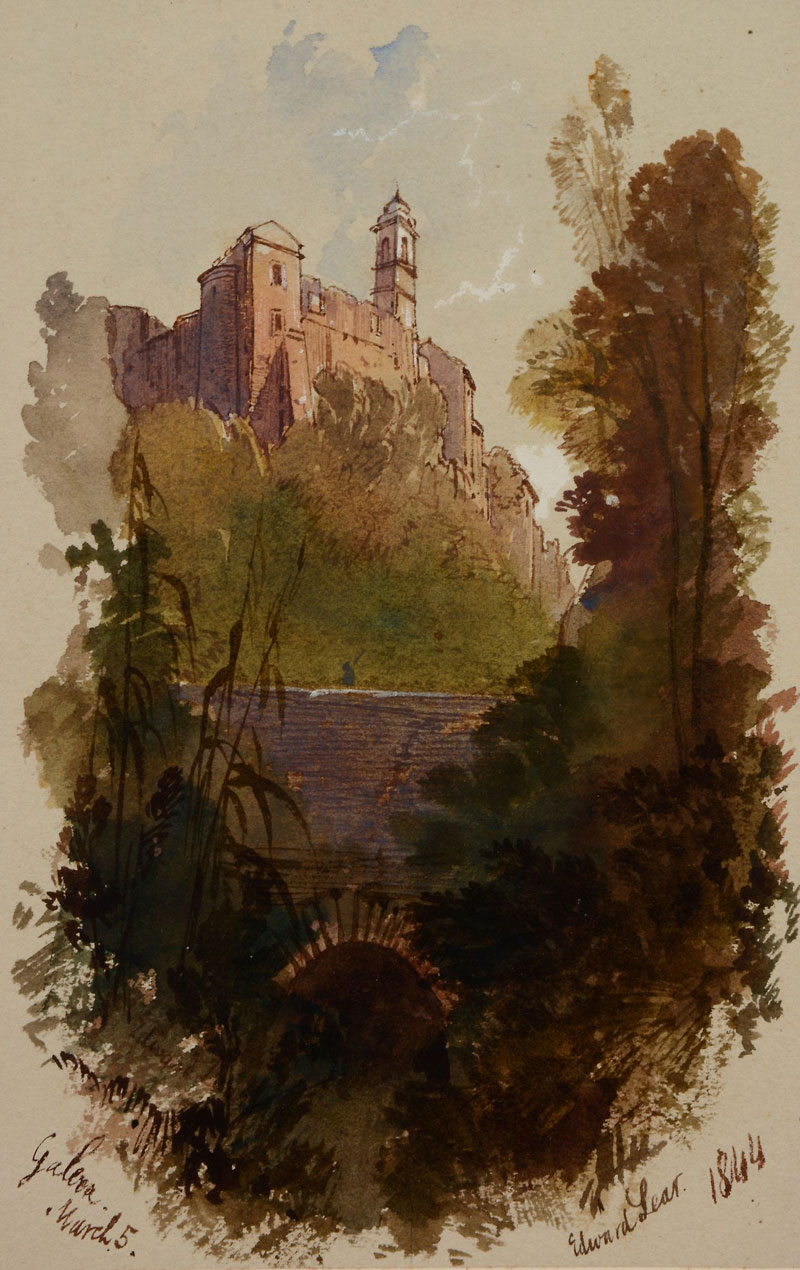
Edward Lear, Galera (1844)

el_falera-s

Edward Lear, Galera, 1844.

Watercolour, heightened with white, on light grey paper. Signed and dated 1844 lower right, inscribed Galera , March 5 lower left. 17.5 x 11 cm. (6 7/8 x 4 1/4 in).

Provenance:
John Scandrett Harford (1787-1866); thence by descent to the present owner

For a similar watercolour of Galera by Lear, executed two years earlier than the present work, see Tate, London (ref.: N02749).

Bloomsbury.

Posted in Edward Lear | Tagged , , , , | Leave a comment

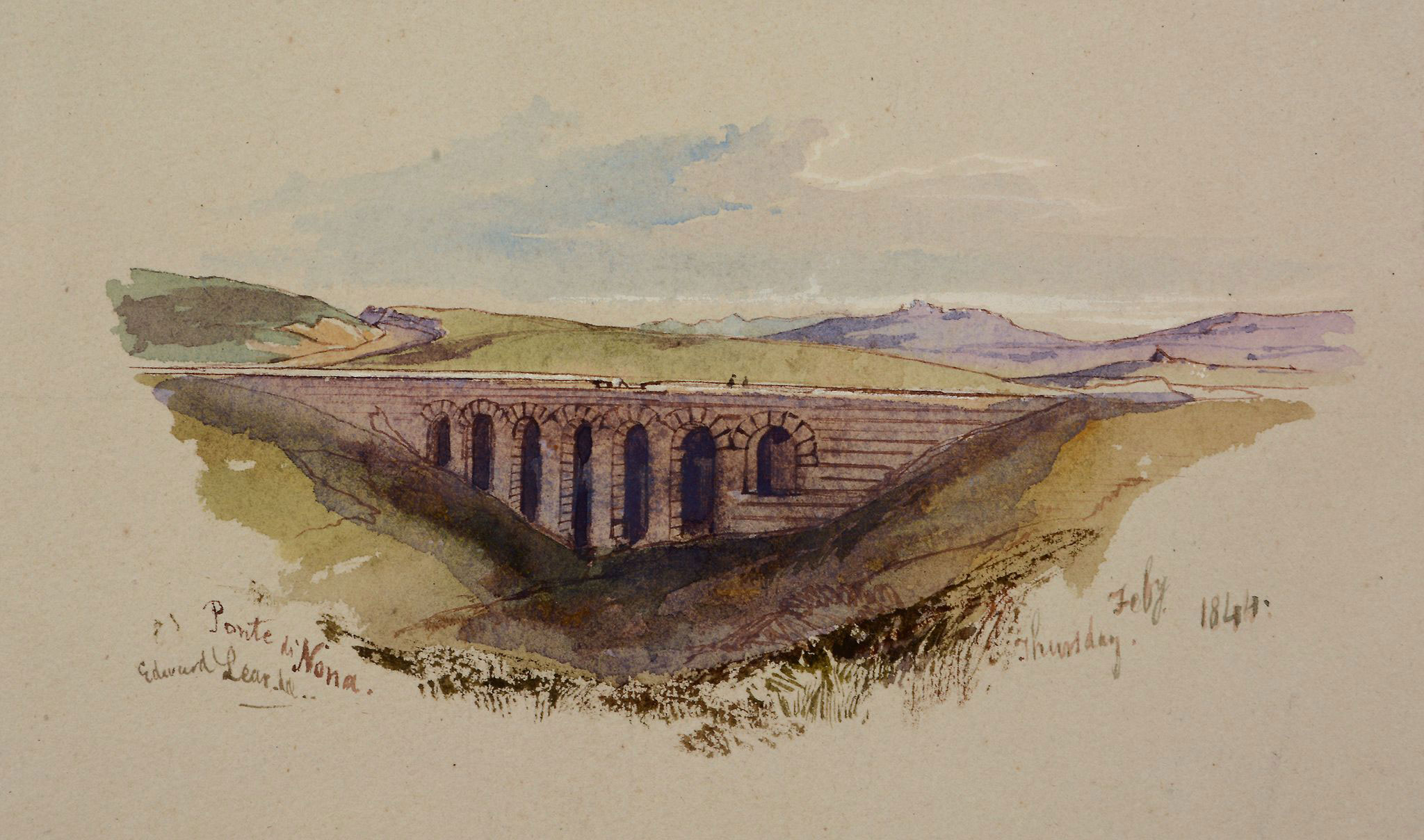
Edward Lear, Ponte di Nona (1844)

el_ponte-nona-s

Edward Lear, Ponte di Nona, 1844.

Watercolour, over pencil, heightened with white, on light blue grey paper. Signed and inscribed Ponte di Nona lower left, dated Thursday. Feby. 1844 lower right. 11 x 18.5 cm. (4 1/4 x 7 1/4 in).

Provenance:
John Scandrett Harford (1787-1866); thence by descent to the present owner.

For two further drawings of Ponte di Nona by Lear, painted one year later than the present work, see Houghton Library, Harvard University, Edward Lear Landscape Drawings , 1834-1884 (MS Typ 55.11, MS Typ 55.26, TypDr 805.L513), nos. 377 and 378.

Bloomsbury.

Posted in Edward Lear | Tagged , , , , | Leave a comment

Two Bird Drawings by Edward Lear

Bonhams have added two drawings, both dated April 1846, to the lot in the previous post:

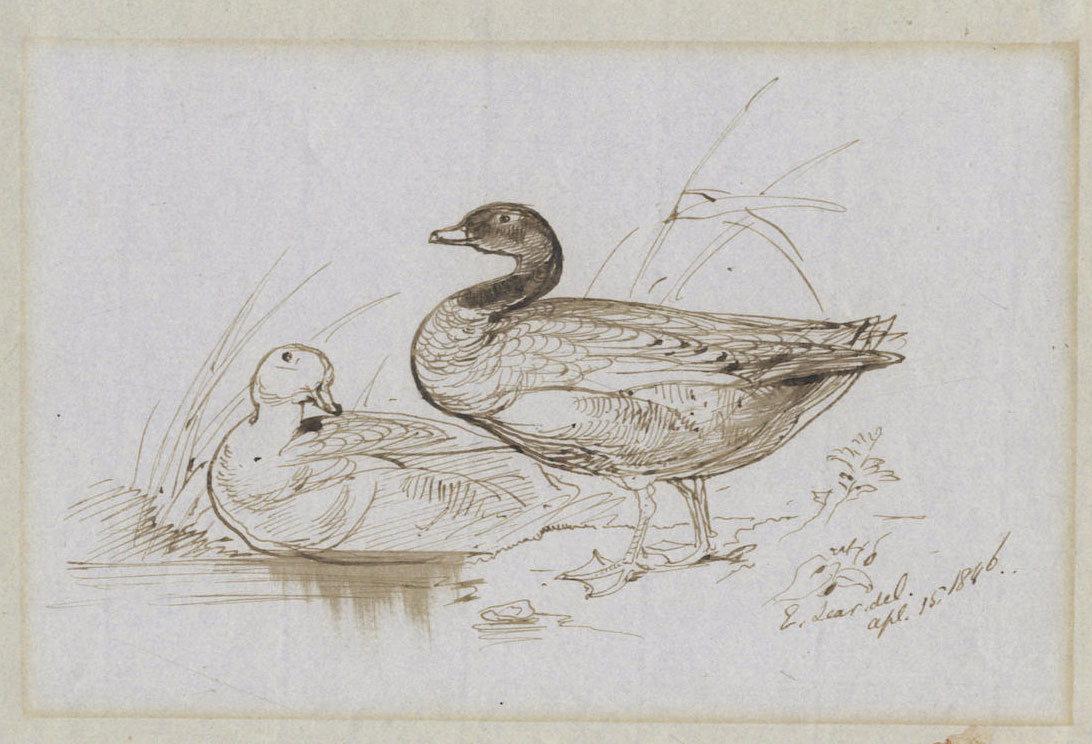
el_two-mallards-s

[Two Mallards.] E. Lear. del. apl. 15. 1846.

el_black-swan-s

[A Black Swan.] E. Lear. del. April. 17. 1846.

Posted in Edward Lear | Tagged , , , | Leave a comment

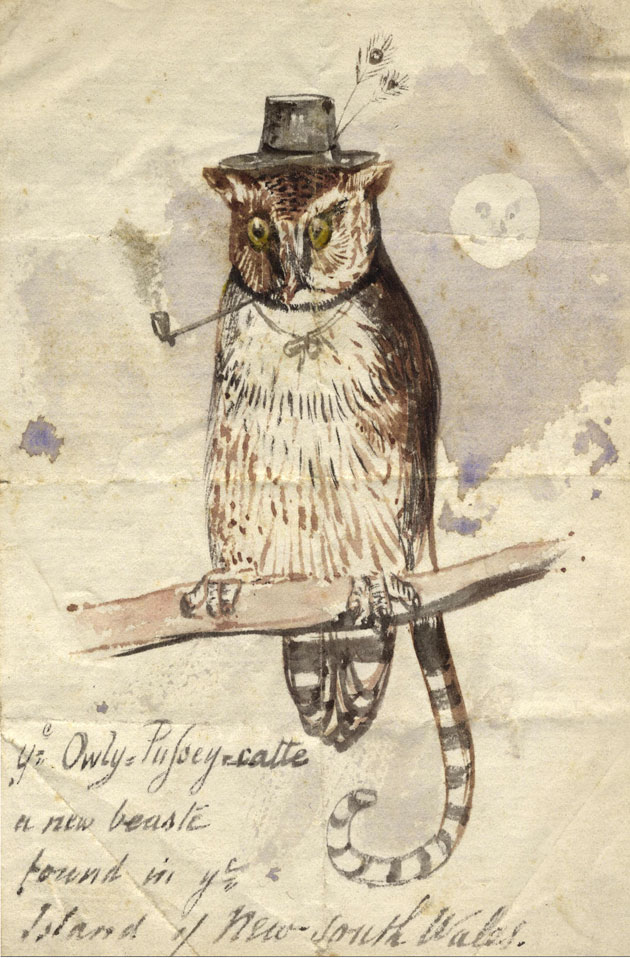
Ye Owly=Pussey=catte

The items below are for sale at Bonhams at impossible prices (as usual). I find it highly unlikely that the picture of the Owly=Pussey=catte can be dated 1846 like some of the others in the lot: for one thing Edward Lear never got to Egypt before January 1849, and he was there in 1867, when he probablydrew the other picture reproduced below. The description however is very interesting.
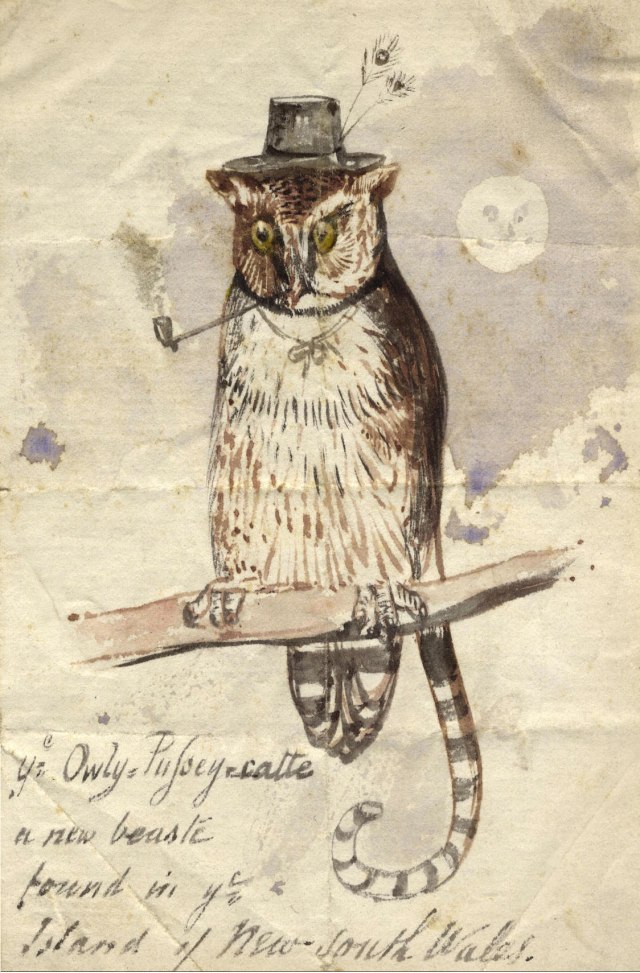
ye-owly-pussey-catte

Bonhams’ description:

Group of four autograph drawings by Lear, drawn for the family of his childhood friend Fanny Drewitt of Peppering House, Dorset, and her husband George Coombe, comprising:

(i) a watercolour of “Ye Owly Pussey-catte a new beast found in ye Island of New South Wales”, showing him perched on a branch, puffing a churchwarden pipe and wearing a settlers’ wide-awake hat with two peacock feathers in the brim, with a smiling moon looking on; captioned by Lear in grey wash (as quoted), paper originally folded for delivery, pasted down at the corners, 134 x 89mm.;
(ii) pen-and-ink study of a (naturalistic) owl upon a branch, signed “E. Lear del. 1846”, time-stained where formerly framed and left-hand margin frayed, other light dust-staining, 228 x 178mm.;
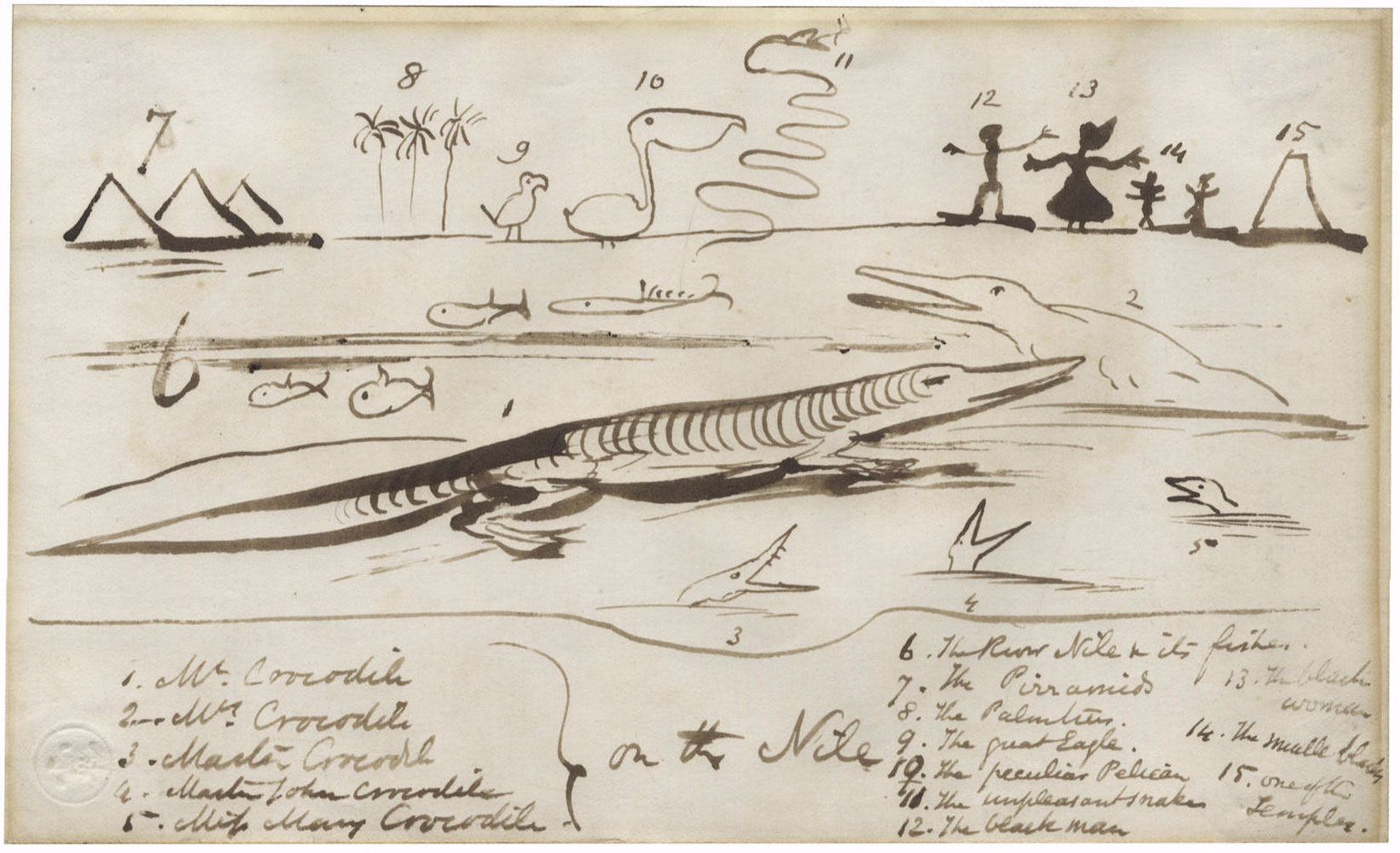
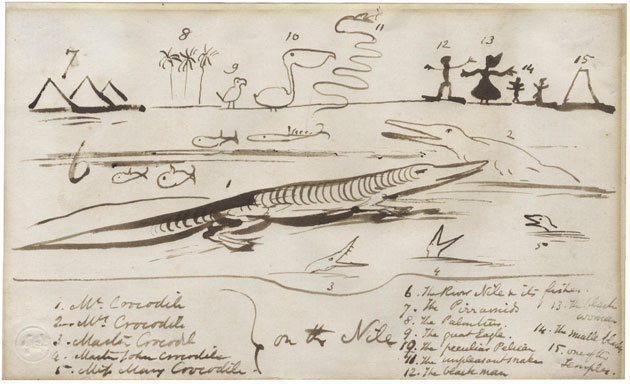
(iii) pen-and-ink nonsense drawing of the River Nile and its inhabitants, showing Mr and Mrs Crocodile, Master Crocodile, Master John Crocodile and Miss Mary Crocodile on the Nile; with “the River Nile and its fishes” , “The Pirramids”, “The Palmtrees”,”The Great Eagle”, “The Peculiar Pelican”, “The unpleasant Snake”, “The black Man”, “The black Woman”, “The smalle blacks”, “One of the Temples” (each keyed with a number), slight discoloration at the edges where formerly framed, mounted onto part of an album leaf, 111 x 185mm.;
(iv) pen ink and brown wash view [of Peppering House], signed “Edward Lear. del.” and dated “…1846”, discoloured at edges where formerly framed, tear at bottom right-hand corner (obscuring part of the date), tapes on reverse, 143 x 207mm.;
(v) near matching view of Peppering House by George Coombe, taken from slightly further away, in watercolour over pencil, signed and dated “G.C./ Oct 6th 1843”, laid down, slight dust-staining, 136 x 218mm.;
(vi) together with a partly-dismembered album, comprising watercolours and other drawings, one of a lady seated beneath an old oak tree probably by Lear, watercolours by Coombe (including a distant view of the Acropolis in the style of Lear, 6 April 1859) and two Lear lithographs of Knowsley, partially disbound, boards detached, 4to
on-the-nile-s

‘YE OWLY PUSSEY-CATTE’ OF NEW SOUTH WALES

Lear drawings from the collection of his childhood friend Fanny Coombe (née Drewitt) and her husband George. Although undated, the striking drawing of the Owly Pussycat could well date from the same period as the two dated drawings in the group, both executed in 1846; in which case it would long predate his famous poem ‘The Owl and the Pussy Cat’, which was not composed until the Christmas of 1867 (for Janet, the sick daughter of his friend Arthur Symonds with whom he was staying at Cannes), and first published in 1871, as part of the Nonsense Songs. A possible antecedent can be found in Lear’s study of the Owl or Night Monkey, a monkey with owl-like face and long cat-like tail, lithographed in John Edward Gray’s Gleanings from the Menagerie and Aviary at Knowsley Hall (1846), plate 1. Our drawing is unusual in that it is executed with stylistic care more usually to be found in his ‘serious’ drawings, such as the Knowsley studies, rather than in the more rough-and-ready style of the line drawing illustrating his ‘nonsense’ verse. It could have well been intended for the Coombes’ daughter, Fanny Jane Dolly, born in the summer of 1832 (see the letter to his ‘Niece – par adoption’ dated 15 July 1832, in The Complete Verse and Other Nonsense, edited by Vivien Noakes, 2001).

A drawing by Lear of the Drewitt family seat, Peppering House, taken from much the same angle as ours (although dating from much earlier in his career) is illustrated by Charles Nugent, Edward Lear the Landscape Artist, catalogue of the Wordsworth Trust Grasmere exhibition, 2009, p.3; where Lear’s letters to the Coombe family from the Frederick Warne Archive (ex Christie’s, 29 June 1995) are also printed and illustrated. A small group of illustrated letters to Fanny Drewitt Coombe can also be found in the Beinecke Library, Yale (ex Frederick Koch Collection).
Posted in Edward Lear | Tagged , , , , , | 2 Comments

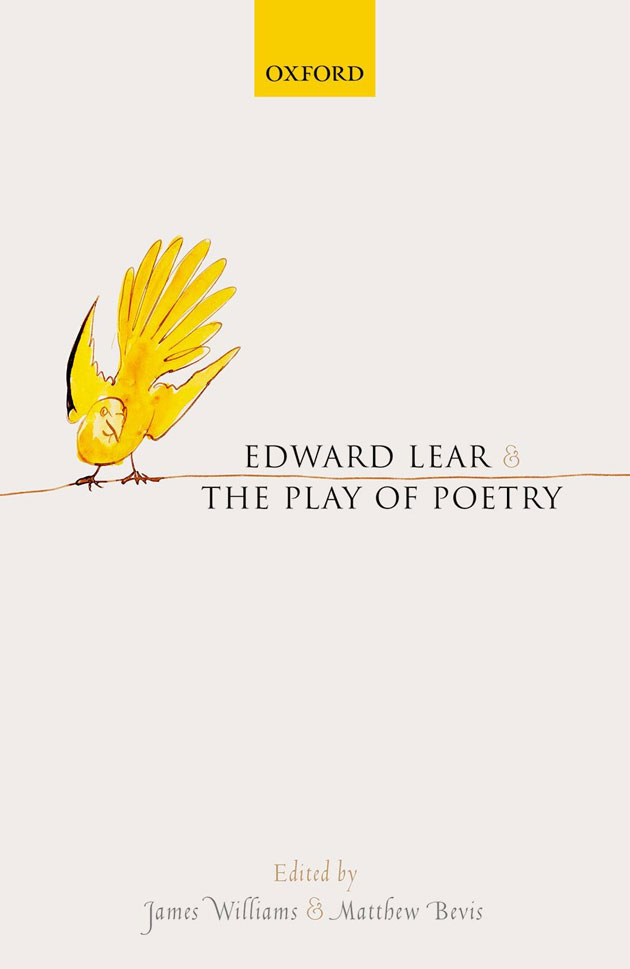
Edward Lear & the Play of Poetry

edward-lear-and-the-play-of-poetry-bc

At long last it’s out!

Williams, James, and Matthew Bevis, eds. Edward Lear & the Play of Poetry. Oxford: Oxford University Press, 2016.

Here is the table of contents:

James Williams and Matthew Bevis,Introduction: Edward Lear and the Play of Poetry, 1-15
James Williams, Lear and the Fool,16-50
Michael O’Neill, One of the Dumms: Edward Lear and Romanticism, 51-69
Sara Lodge, Edward Lear and Dissent, 70-88
Peter Swaab, Some Think Him… Queer: Loners and Love in Edward Lear, 89-114
Peter Robinson, Edward Lear: Celebrity Chef, 115-133
Matthew Bevis, Falling for Edward Lear, 134-161
Daniel Brown, Being and Naughtiness, 162-182
Anna Henchman, Fragments Out of Place: Homology and the Logic of Nonsense in Edward Lear, 183-201
Daniel Karlin, ‘The Owl and the Pussy-Cat’, and other Poems of Love and Marriage, 202-222
Hugh Haughton, Playing with Letters: Lears Episthilarity, 223-242
Anna Barton, The Sense and Nonsense of Weariness: Edward Lear and Gertrude Stein read Tennyson, 243-259
Anne Stillman, T.S. Eliot Plays Edward Lear, 260-280
Adam Piette, ‘Now Listen, Mr Leer!’: Joyces Lear, 281-299
Seamus Perry, Auden’s Lear, 300-315
Will May, Drawing Away from Lear: Stevie Smiths Deceitful Echo, 316-338
Adam Phillips, Edward Lear’s Contribution to British Psychoanalysis, 339-346
Philip Ross, Edward Lear, John Ashbery, and the Pleasant Surprise, 347-365
Select Bibliography, 367-372

There are several essays which were not presented at the 2012 bicentennial conference, so it was worth waiting for it. There is a preview on Google Books, and an official OUP page.

On 8 December next, there will be a book launch at the Institute of Advanced Studies with the editors, Peter Swaab, Barbare Everett, Adam Phillips and jenny Uglow.

The book and the single essays have been added to the bibliography.

Posted in Edward Lear | Tagged , , | Leave a comment

Dear Edward Lear I Love Your Birds

Dear Edward Lear
I Love Your Birds
by Jeredith Merrin

The Red and Yellow Macaw resplendent,
And clearly your puff-chested model,
Arching head over the arc of half-extended
Red yellow blue wing, intended us to look.

My first was in kindergarten in Oregon,
A Robin in profile and colored correctly,
But with four four-toed feet. Teacher
Pinned it on the wall, and I was
Humiliated by Open House laughter.
A child who felt, can still often feel wrong.
Hundreds of ornithological lithographs
Beautifully right, but you felt wrong.

Also I love your Salmon Crested
Cockatoo so Parisian-chic,
And your backward-S-necked elegant
But clearly low-IQ Flamingo on one
Foot. Your Toco Toucans and gold-eyed,
Spectacled Owl. All earning scientific,
Artistic respect, polite patronage,
Uppercrust meals, but little money. All
Made before the age of twenty-five.

Birds of course are phallic, though without
Apparent sexual organs, and beaks also,
Like the large noses in your Nonsense books.
Great travelers birds are as you were,
Darting everywhere and making sketches
For imitative formal landscape
Paintings for which you’re not remembered,
Following your odd-shaped nose to
Rome Corsica Corfu Malta Egypt.
In Albania you were pelted, but
In Petra your pockets were rifled. In India
More seizures, in Salonika counting Kestrels.

Is it merely coincidental your name
Rhymes with fear fleer tear queer?
I don’t think so. Bless you because
You “Never,” a biographer tells us,
“Showed any capacity for flattery.”
Sad single man who gladdened children,
The young Charles Pirouet for instance,
Dashing off for his amusement The Light
Green Bird The Pink Bird The Yellow
Bird and thirteen others in your hotel
In northern Italy in eighteen-eighty,
Though nearly blind at sixty-eight.

Are you comfortably nested now in what
You referred to as “the next eggzi stens?”
I don’t think so. But thank god when
You were dying in San Remo, rheumatic
And feeble, one servant for company,
On good days you could be moved to
The little villa’s terrace. It was dim
Spring, with ten new Pigeons trying
To fly from the railing: “a great diversion.”

Agni 44 (1996), pp. 57-58.

Posted in Edward Lear | Tagged , , | Leave a comment