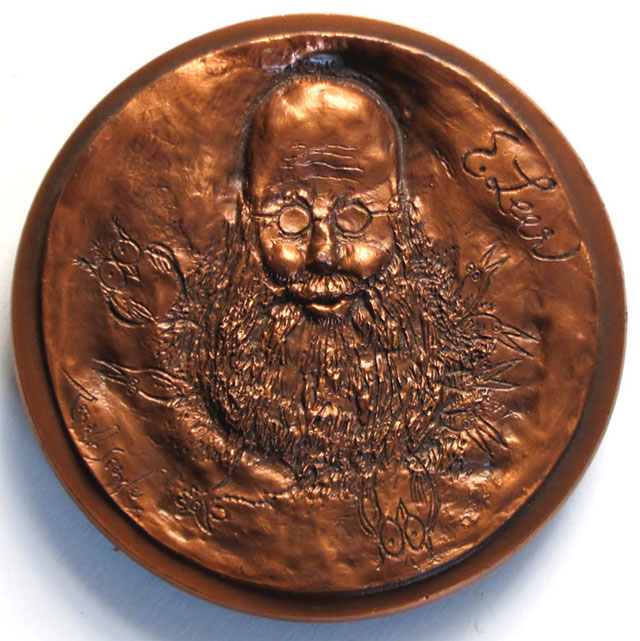
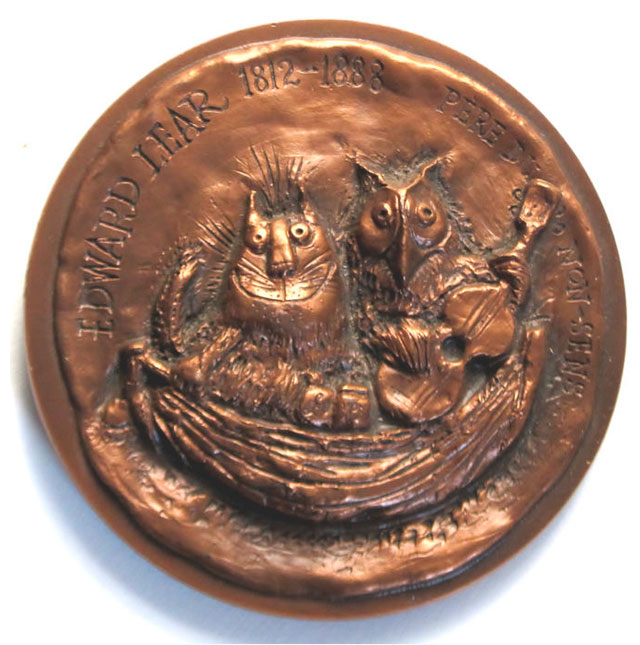
Ronald Searle‘s medal of Edward Lear [Père du non-sens], modelled in 1975 and issued by the Monnaie de Paris.
Ronald Searle‘s medal of Edward Lear [Père du non-sens], modelled in 1975 and issued by the Monnaie de Paris.
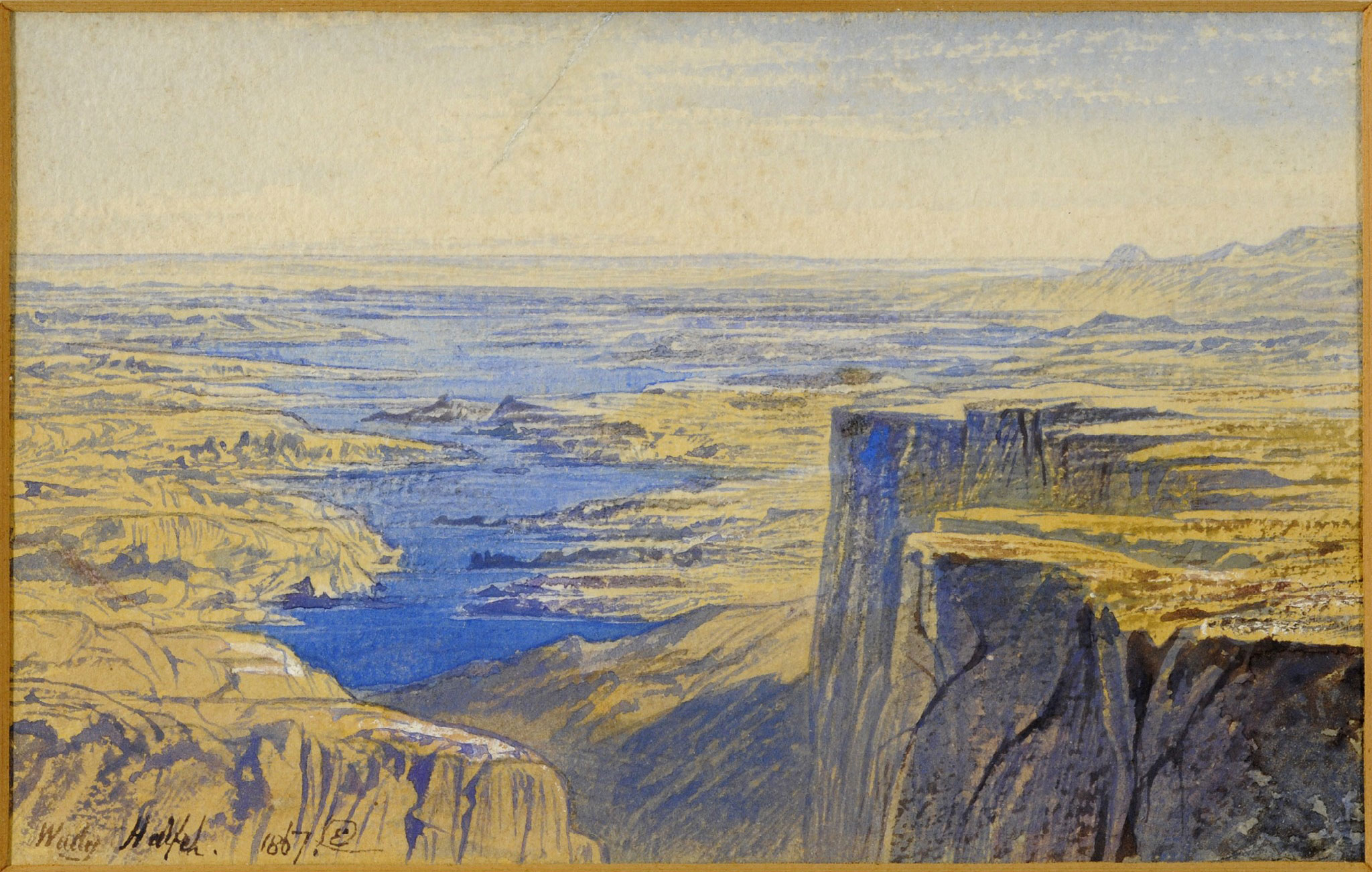
Edward Lear, Wady Halfeh.
Signed with monogram, dated 1867 and inscribed with title, watercolour 11 x 17.5cm.
Wadi Halfa is in the Northern State of Sudan on the shore of Lake Nubia (Lake Nasser). Lear visited Egypt in 1866 and travelled down the Nile as far as Wadi Halfa from December 1866 to March 1867. In a letter to Chichester Fortescue in March 1867, Lear remarked upon the “sad, stern, uncompromising landscape” of Nubia with its “piles of granite rocks.”
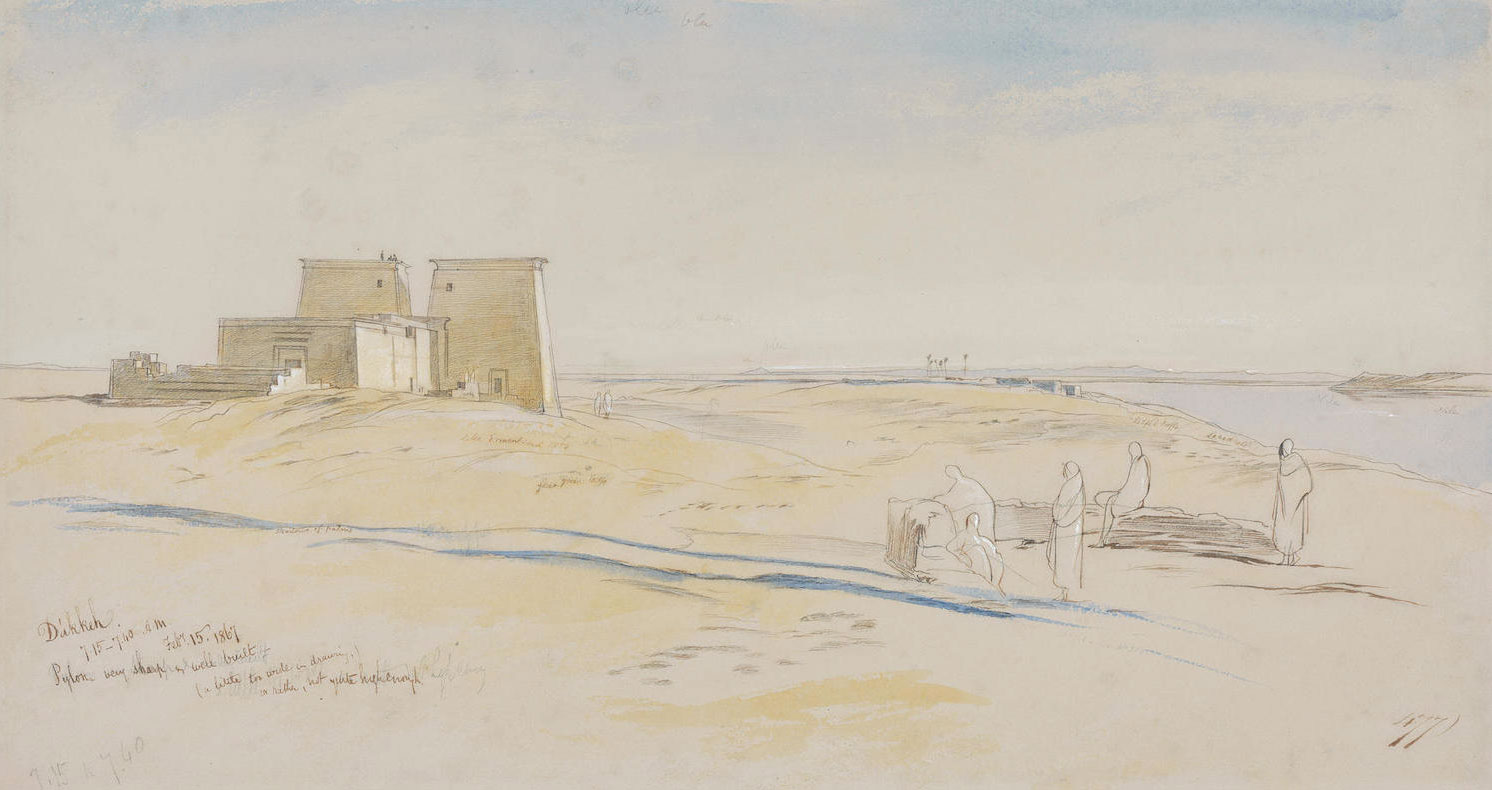
Edward Lear, Dakkeh.
Inscribed and dated ‘Dakkeh./7.15 – 7.40 AM./Feb. 15. 1867./Pylon very sharp & well built/(a little too wide in drawing,)/or rather, not quite high enough’ (lower left); numbered ‘(477)’ (lower right); variously annotated throughout. Watercolour and ink heightened with white over traces of pencil. 28.9 x 54.4cm (11 3/8 x 21 7/16in).
Provenance
Thos Agnew & Sons Ltd., London.
Anon. sale, Christie’s, London, 11 July 1995, lot 105.
Private collection, UK (acquired from the above sale).
Edward Lear visited Egypt and the Nile in 1849, in late 1853 and in early 1867. He was delighted with Egypt’s intense colours and richness of scenery.
On the day the present lot was executed (rising at 5.40am, drawing at 7am) Lear wrote in his diary ‘…long flat lines of sandy distance, the few isolated lilac hills – the scant green of the Nile Garden, the silver river itself all form a beautiful Nubian scene ‘. (Edward Lear, Diary, 15 February 1867.)

Edward Lear, Bethany.
Signed bottom left and titled bottom right, watercolor with brown ink on paper laid down to mat at edges. Image: 6 1/8 x 9 1/8 in. (15.6 x 23.2cm), sheet: 10 1/2 x 14 1/16 in. (26.7 x 35.7cm).
Provenance:
George Clive Esq., Herefordshire, England, United Kingdom.
By descent in the family.
Private Collection.
Spink & Son Limited, London, United Kingdom.
Patricia & John Roche, New York, New York.
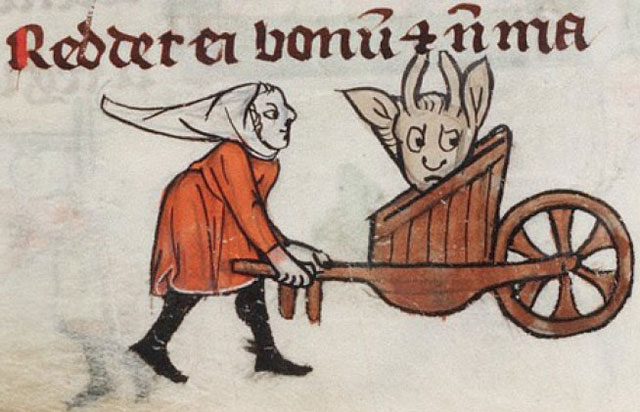
From Yale University, Beinecke Library MS 404, Rothschild Canticles, 169v (thanks to Francois Soyer).
Previous instalments: The Natural History of the Wheelbarrow, A Wheelbarrow to Hell.
Rather than devils carrying souls to hell, the scene seems to represent a (good?) soul driving back a devil; or perhaps the weight of sin all people must carry?
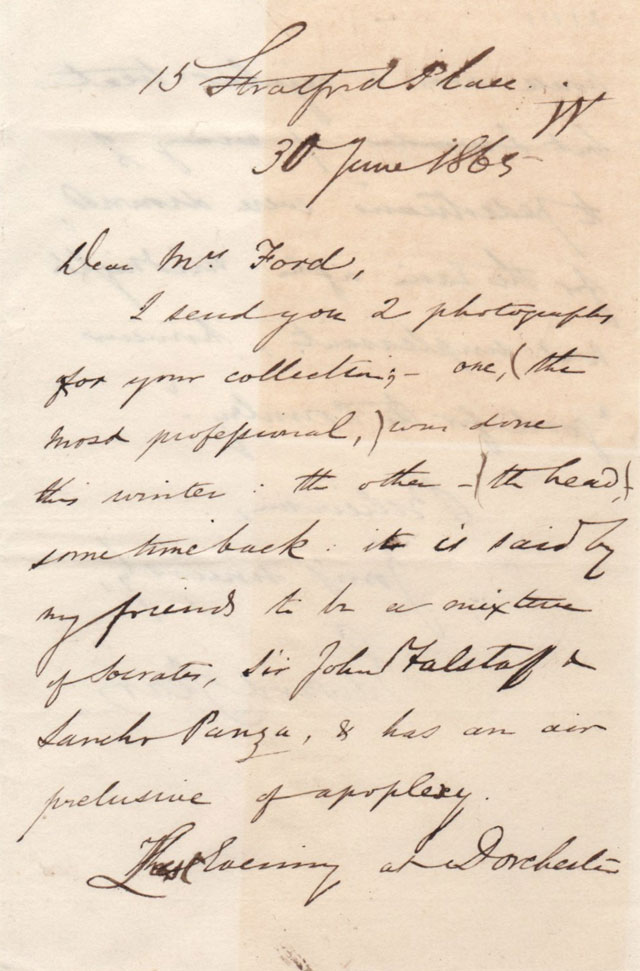
5 Stratford Place.
30 June 1865
Dear Mrs. Ford,
I send you 2 photographs for your collection; — one, (the most professional,) was done this winter: the other — (the head,) — some time back: it is said by my friends to be a mixture of Socrates, Sir John Falstaff & Sancho Panza, & has an air preclusive of apoplexy.
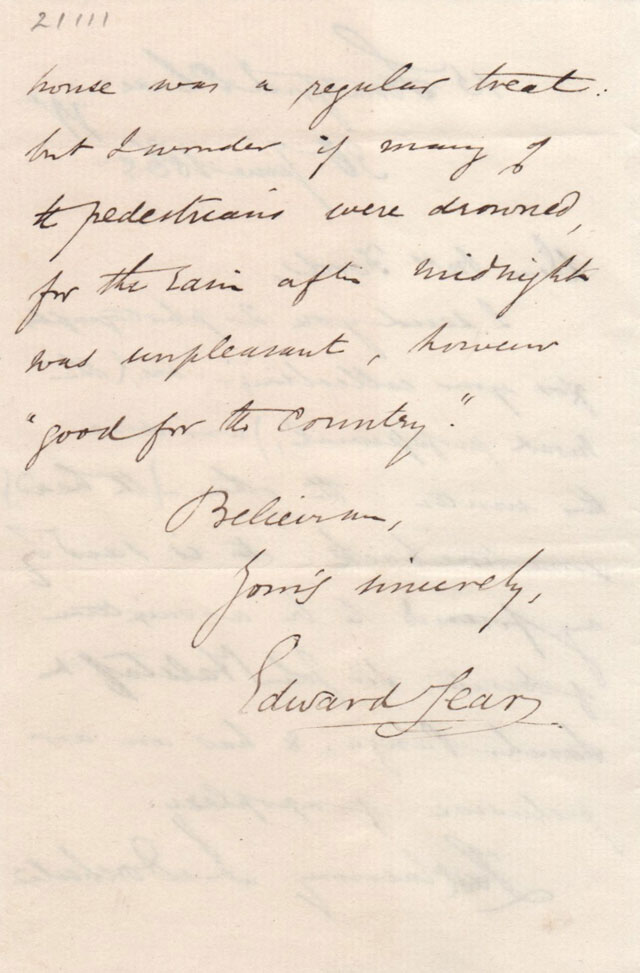
Last evening at Dorchester House was a regular treat but I wonder if many of the pedestrians were drowned, for the rain after midnight was unpleasant, however “good for the country.”
Believe me,
Your’s sicerely,
Edward Lear.
Diary 29 June 1865:
… Cab to Dorchester House at 10.30, Magnificenza. Saw many people, & passed a pleasant time till 1. When the Digby Wyatts took me home in pouring rain. …
LEAR EDWARD: (1812-1888) English Artist, Illustrator and writer, remembered for his nonsensical poetry and limericks. A.L.S., Edward Lear, two pages, 8vo, Stratford Place, 30th June 1865, to Mrs. Ford. Lear sends his correspondent two photographs (no longer present), evidently of himself, for her collection, remarking ‘it is said by my friends to be a mixture of Socrates, Sir John Falstaff & Sancho Panza, & has an air preclusive of apoplexy.’ He further remarks on the previous evening at Dorchester House being ‘a regular treat’ although comments ‘I wonder if many pedestrians were drowned, for the rain after midnight was unpleasant, however “good for the country”‘. A small area of discolouration only lightly affects part of the text of the first page, otherwise VG
Thanks to St4ephen Duckworth.

Harvard University, Houghton Library MS Typ 55.14, item 93:
Once I had a Mucous Membrane
And I kept him in a box ―
Which the lid I fastened down with
3 of Brahmah’s patent locks.
So ― said I ― my little darling ―
From [this time] there is no doubt
From this box so well securely
You will never more get out!
But my mucous membrane’s mind
Was of a lively wary kind ―
And in spite of Brahmah’s locks
He did evade that safety box.
What was my intense surprise ―
I could scarce believe my eyes ―
Walking like a placid Demon
Arm in arm with Mrs. Freeman
Up & down the Passeggiata
[Eating] bread & buttered Tomata?
Nothing could be more suprising.
But the voice of angry demon
Dr. F. & Mrs. Freeman ―
In a quarrel soon were heard
Why we’ve had no lunch at all!
luncheon yet!
Its too late for luncheon now ―
But we must have food anyhow (though its too late
All the restaurants are closed
Ha the Doctor interposed ―
Let us, rather than be starved
Cook & eat the Mucous Membrane ―
Which accordingly they did ―
Out from Castellani’s Inn,
Saucepans & all of tin
Salt & pepper [too] of course
And a lot of Worcester sauce.
Then they dined & both declared
Better they had never fared.
& eaten hot from a little
silver pot. What was
left was wrapped in silk ―
& sent to Mrs. Crawford Dilke.
Half the mucous membrane
roast [as] & Sandwich [or] a
toast. Half was fried &
Half I painted
――――
Of a bright celestial blue,
Half I painted emerald green
So that such a mucous membrane
half so lovely neer was seen.
“Once I had a Mucous Membrane” was probably inspired by something that happened to Lear and some acquaintances (Dr. and Mrs. Freeman) and written for this particular audience that knew what the “mucous membrane” was, much like in the “Scene from the New Drama of the ‘Middle Ravine’” at the Morgan Library (Dept. of Drawings and Prints):
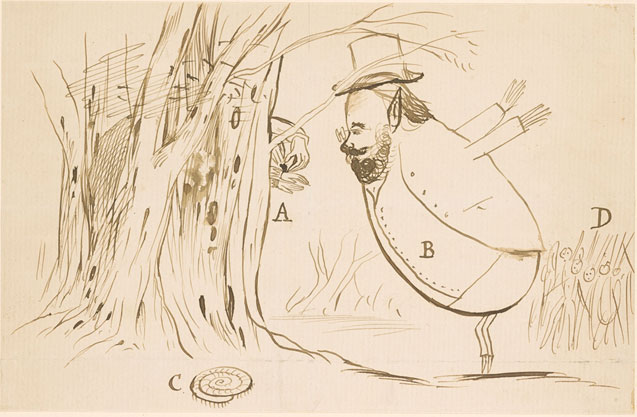
In this case we have Lear’s own explanation, which while it does not clear everything at least gives an idea of what happened:

“Scene from the New Drama of the “Middle Ravine”
Place, Corfu. Time.5. P.M.March 13th 1864
Scene, a Nollive Wood: – 4 hands discovered from
behind a Nollive tree – persons belonging to the hands
unseen. An aged and obese Landscape painter observing
the 4 hands. A vast Multitewd looking on. A Julus on the ground.
A. The 4 hands.
B the aged & obese Landscape painter.
C. The domestic and tranquil Julus D The Multitewd.
Curtain rises to Sloe and Blackthorn melody: voices
heard singing, Flee-flee to the mountains – flee!
Chorus. FLEE!!!”
This poem does not appear in The Complete Verse and Other Nonsense; Vivien Noakes mentioned it in a note to “The Uncareful Cow, who walked about” on p. 515, but obviously considered this sketch too rough to be published, and she was probably right, as the story is not brought to a satisfactory conclusion. “The Little Mouse” was probably to have a sad sentimental ending similar to that of other songs:

The little mouse lived quite close to the oven,
His nose was pink & his coat was gray
He said, “I’ll be neat ― I won’t be a sloven ―
I’ll comb my whiskers day by day.
I will brush my fur & I will never will fail
To … & smooth every hair
―――― take ^[most] particular care
Of the elegant tip of my beautiful tail[.]
& when I can find any crumbs to eat,
I’ll sit upright on my hinder feet
And nibble it slowly [illegible] genteel
Like high ^[well] bred people a eating a meal.
―――
The large ^[soft] white ^[Pussey] cat lived close by the fire
And she said one day to the mouse ― O Sir!
It’s quite impossible not to admire
Your charming nose & your smoothy fur!
I shall have such pleasure, Sir she said
If you’ll make what use you please of my head
If gentle For my head is as soft as a velvet chair
And you’d find it pleasant a sitting there!
―――
The little mouse said ― In all my life
I never had offer so kind as this is{1}
My darling ^[O] pussey I’ll come ―――
& I’ll give you 50 ^[20] thousand kisses!
Long long ago in happier times
―――――――――― chimes
My grandmother taught me to play on a straw
Some lovely melodies{2} ―10 or more ―
I will sit on your head & play it slowly ―
―――――――――― wholly ―
――――――――――――――
――――――――――――――
{1} Or “I never had offer / In all my life so kind as this is.”
{2} Corrects “A lovely melody.”
The Houghton Library “finding aid” entry for MS Typ 55.14, item 154 reads:
Lear, Edward, 1812-1888. The little mouse lived quite close to the oven: autograph manuscript (unsigned); [Italy, undated]. 1s. (1p.)
A nonsense poem.
The sheet is part of a series of manuscript versions of famous nonsense poems; specifically it is between “The Duck and the Kangaroo” (no. 153) and “The Owl and the Pussy-cat” (no. 155) and so was perhaps written in the same period (1867). With the former “The Little Mouse” shares the invitation to take advantage of a part of one of the protagonists’ body, with the latter the Pussy-cat as well as the singing of “lovely melodies.”
The poem should presumably have been part of the series devoted to more-or-less incongruous couples, like the duck and the kangaroo or the daddy-long-legs and the fly: as in some other poems of the group the protagonists are animals traditionally considered totally-incompatible enemies who find a way to be of use to each other and end up living together in harmony (but on the final happiness of these couples, see Daniel Karlin’s essay on Lear’s “Poems of Love and Marriage” in Edward Lear and the Play of Poetry). While the second stanza might be read as containing an equivocal invitation on the part of the cat, the picture clearly indicates that there should have been a relatively happy ending, remarkably similar to the one in the “Duck and the Kangaroo.”
Lear evidently did not find the poem interesting enough to complete it, or perhaps he realized it was little more than a repetition of themes already developed in the other Nonsense songs. However, it is useful as it allows us to see Lear’s modus operandi in writing a poem: he clearly starts from the end of the lines defining the rhyme, but also pays attention to the rhythmical cadence of the verse.
The 18th son Charles had an interesting story, he became medical Missionary and went to the West coast of Africa, was a great favourite of the Chiefs, and when he nearly died of malaria, was put on board a ship for England. The Captain would not take him without a nurse, so Adjouah the native girl who nursed him went too, Charles insisting upon marrying her first. He took her to his sister Eleanor Newsome who had no children, and lived with her husband at Leatherhead, Surrey. The story goes that the first day after her arrival she poured the hug of water in her bedroom over her head. They became very fond of Adjouah, she was sent to school for three years, and Charles returned to the Mission filed, where he died. Afterwards she became a Missionary and returned to work amongst her own people, the only relics we had of her were a high comb, made in fine basked work, and a long handled ivory had to scratch a troublesome back.
These few lines written by Lilly Bowen in 1835 for Angus Davidson, who was working on Edward Lear’s first full-length biography. I have already expressed my doubts on Ms Bowen’s reliability in the previous posts on the Lear family (Part 1, part 2, part 3). What she says is certainly reliable in this case though one would like to have some time frame in which to place the events. Most biographers of Edward assume that Charles disappeared soon after going back to Africa, probably in the 1840s.
However, a few years ago, Harlon V. Wells, a descendant of Frederick Lear, sent me an e-mail which might throw some light on the events. In it he mentioned a letter
written on 2 July 1888, from Dublin, Erath Co., Texas, by Francis Frederick Lear, (son of Frederic Lear), to his wife, back home, in Blanket, Brown Co., Texas. This being only two days since his father, Frederick, had died of cancer, there in Dublin, at the home owned by Frederick’s wife’s half sister, Frances “Fannie” Elizabeth Boyd. He was explaining to his wife about the manner in which he thought the inheritance from his father was to be distributed. Coincidentally, at about the same time, he was expecting an inheritance distribution from his grandmother Skerritt’s estate. (This is curious because her will was proven on 20 January 1834, so why was it just being distributed in 1888?? I haven’t a clue!) At this point, Frederick and Aunt “Fannie” were living together after the death of his wife, in 1880. Here is an excerpt from my[Mr. Wells’s] transcription of that lengthy letter:
It has been a hard matter to make Aunt understand it but I believe it is all right – I think from what she says she will take a childs part ie – 1/4 part – so that when Pa’s share com [sic], and I don’t think it will be less than $4000 clear – it will be $1000 apiece – and when it is legally Settled that Uncle Charles is dead – His share will Come – It will not be less that [sic] $4000 unless they spend a good deal hunting for him. I am anxiously waiting to hear from England to Know what they have done and what they are going to do – I hear the train Come in, so I must go and see if there is any mail I must close for the present.
I Remain your affectionate Husband,
Fras F. Lear
It seems then that in 1888 not even the family knew what had happened to Charles; he was presumed dead, but this could not yet be legally asserted.
According to an article by R.M. Jarvis and M.F. Chaney (“‘The Living, the Dead, the Undecided’ – An Annotated Bibliography of Law Review Articles Dealing with the Law of Absentees and Returnees.” International Journal of Legal Information 44.2 (2016) 182):
In antiquity, the presumption of “continuing life” required proof that an absentee was dead. In the 17th century, the English Parliament by statute reversed this presumption with respect to missing spouses and, later, missing life tenants. As a result, such persons could be declared legally dead after being absent for seven years. In 1805, Lord Ellenborough relied on these statutes to hold that any person who had been missing for seven years could be declared legally dead.
We can imagine that no one tried to determine Charles’s status before at least 1881.
Notice that Aunt Fannie seems to accept a “child’s part,” i.e. a quarter, as Frederick had three children, here is a registry report for Frederick Lear provided by Mr. Harlon V. Wells:
Frederick5 Lear (Jeremiah4, Henry3, George2, George1), born 1 Mar 1805 in Pentonville, Middlesex, England; died 25 Jun 1888 in Dublin, Erath, Texas; buried in Live Oak Cem, Dublin, Erath, Texas. He married on 17 May 1830 in Shoreditch, Middlesex, England, Rosa Annie Smyth , born 1813 in , England; died 17 Jul 1880 in St Louis, St Louis, Missouri; buried 18 Jul 1880 in Bellefountaine C, St Louis, St Louis, Missouri.

Frederick Lear, the only one of Edward’s brothers for whom we have a photograph. Photo provided by Harlon V. Wells.
Notes for Frederick LEAR
Occupation: Mining Engineer, CSA Captain, & Plantation Owner?
Married in the Parish of St Leonard
Buried in The New Dublin Liveoak Cemetery
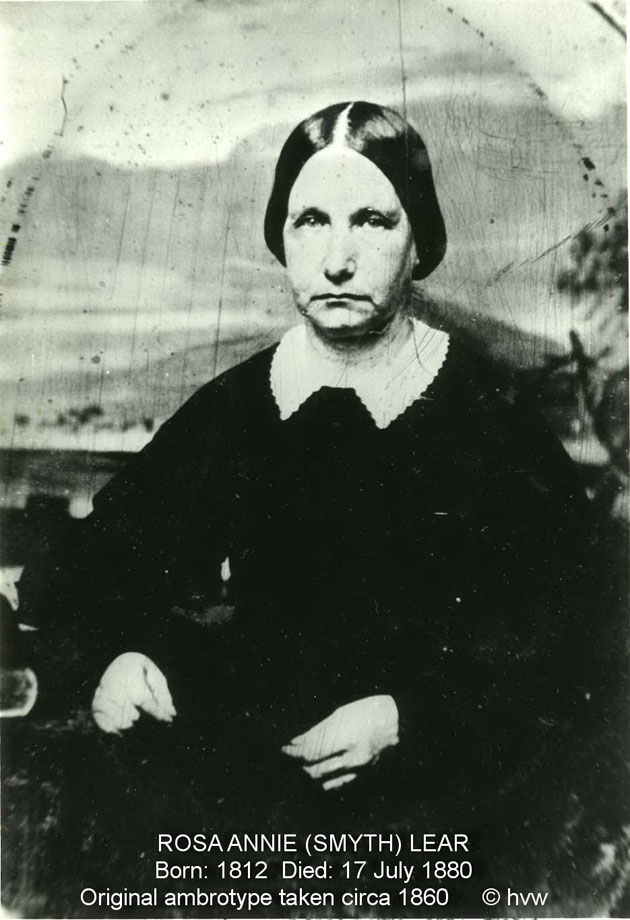
Frederick’s wife Rosa Anna Smyth. Photo supplied by Harlon V. Wells. Photo provided by Harlon V. Wells.
Notes for Rosa Annie SMYTH:
Buried in Bellefountaine Cemetery N, 4947 W Flourissant, block 205, lot 01, grave 116, no gravestone
Children of Frederick LEAR and Rosa Annie SMYTH were as follows:
Francis Frederick6 Lear , born 28 May 1832 in , Jamaica, West Indies; died 1 Jul 1889 in Blanket, Brown, Texas; buried in Eureka Cemetery, Blanket, Brown, Texas.
Rosa Frances Ann6 Lear , born 1840 in , Cuba, West Indies; died 1910/19 in Fullerton, Orange, California.
Mary Ellen Anastasia6 Lear , born 1842 in Havana Harbor, Cuba, West Indies. Born aboard ship in Havana Harbor bound for United States.
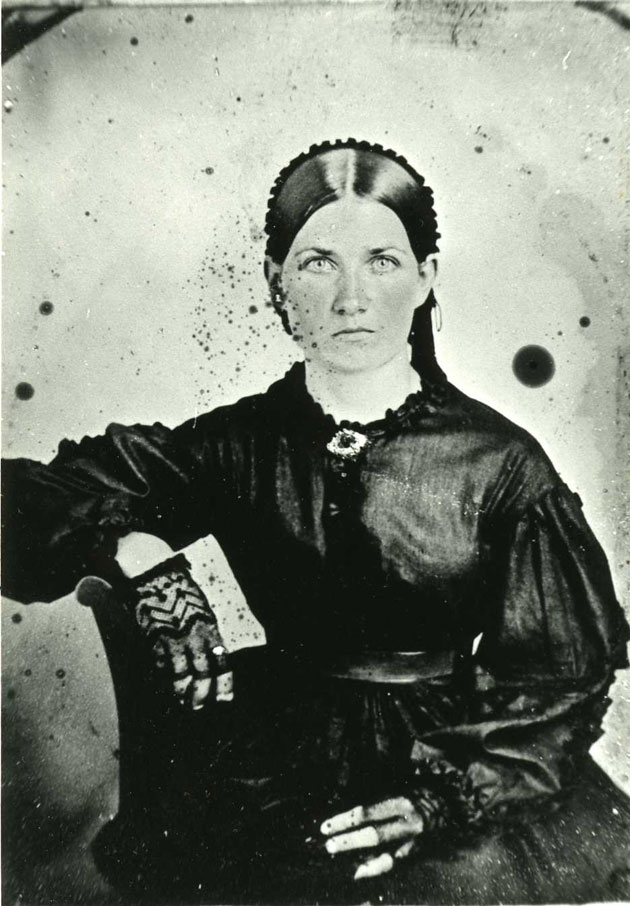
Mary Ellen Anastasia Lear, Frederick’s daughter. Photo provided by Harlon V. Wells.
Mr. Wells has provided further information in this page, where he maintains that Charles died before 1859 and is buried in Sierra Leone. Following the links provides additional details on some of the other Lear siblings.