Edward Lear, An Unpublished Letter

The letter below was probably addressed to Charles Marcus Church‘s brother when Edward Lear got back to England after a long period abroad. Lear and Church had travelled in Greece in 1848 (see Edward Lear’s Grecian Travels) and Church had taken care of Lear when he had been seriously ill.

Blaine Castle. Bristol.
22.Aug.t 1849.

My dear Sir –

Have you not heard anything yet of Charles?

I cannot help writing to ask you & to beg that you will send me a line saying where he was last heard of, & how he is. Pray excuse my troubling you again, but your brother will tell you I am a fidget by nature, tho’ in this case my anxiety is natural enough as he was so very kind to me when I was ill.

A note addressed to me at
17. Duke St.
St. James’s
London
will always reach me.

After October I trust to be settled in my new lodgings –
Stratford Place – & there some time I shall hope to make your acquaintance & shew you some of my drawings.

Believe me,
Dear Sir,
Your’s very truly,
                        Edward Lear

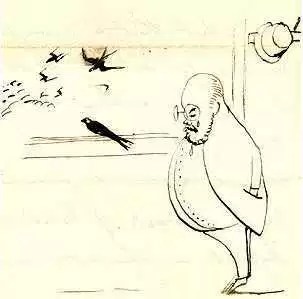
The scans from the seller’s page:

Posted in Edward Lear | Tagged , , , | 1 Comment

More to Read on Edward Lear

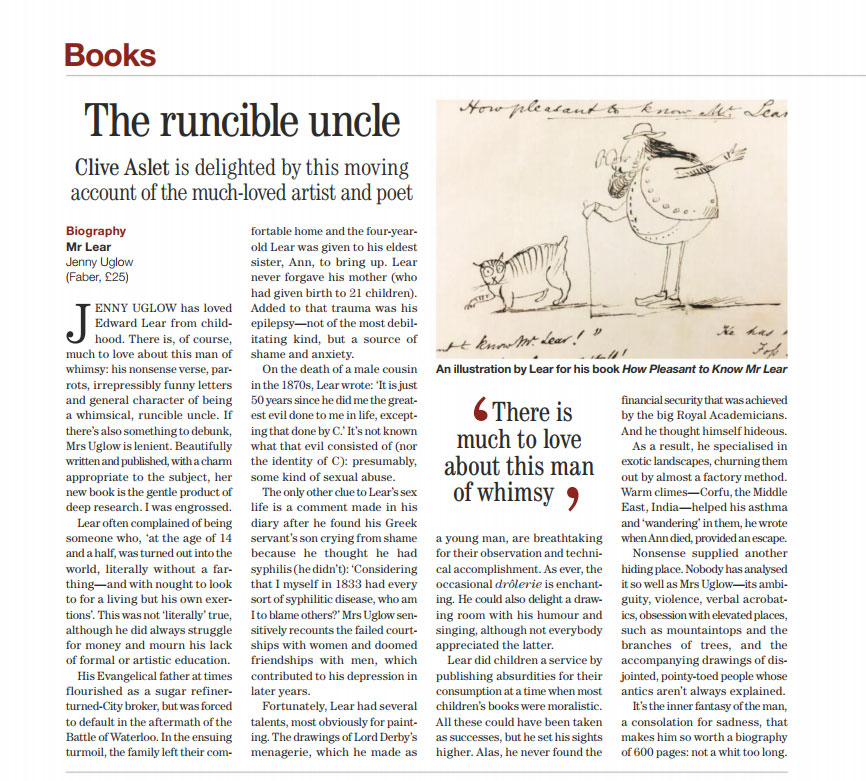
Here is a review of Jenny Uglow’s biography from Country Life, 11 October 2017, p. 180:

Barry Dicdcock’s review of the same book in the Herald Scotland. And Suzi Feay’s in the Financial Times.

Anthony Madrid’s “On Edward Lear’s ‘The Scroobious Pip’,” from the paris Review website, which also has these on Lear.

Posted in Edward Lear | Tagged , , , | Leave a comment

Edward Lear’s Landscape Drawings: How Many Were There?

by Stephen Duckworth (the 2017 version is below, the latest 2019 version, which includes a few changes, can be downloaded as a pdf).

The project’s objective is to make an estimate of the number of original dated landscape drawings (as opposed to worked up watercolours) which Lear undertook in a career of over fifty years.

No reliable estimate has previously been made of Lear’s work output as a topographical artist. Hope Mayo of the Houghton Library, Harvard, acknowledges this in her paper The Edward Lear Collection at Harvard University, published in the Harvard Library Bulletin, Summer-Fall 2011, Volume 22: Number 2-3 (p.95).

The majority of Lear’s drawings appeared on the London market in 1929, over forty years after his death. Three significant sales at auction took place that year, as well as a private sale of many drawings by Mildred Lushington to the Tunbridge Wells dealers, Craddock and Barnard. Two of the auction sales as well as the private sale derived from the drawings and diaries left by Lear with his executor Franklin Lushington, Mildred’s father. The third auction sale, coincidentally in the same year, was of Lord Northbrook’s collection of some 3,000 of Lear’s drawings, primarily from his long visit to Indian and Ceylon from 1873 to 1875. These were contained in two cabinets, acquired by 1935 by W.B.O. Field, and are now at the Houghton Library (Mayo, p.87).

A detailed account of these transactions and their outcomes is given in Hope Mayo’s paper referred to above, and the background to one significant transaction on Greek drawings is described in my own paper, Edward Lear’s Cretan Drawings, in The Gennadius Library’s The New Griffon -12, published in Athens 2011 (p.103ff).

Public holdings

The Houghton Library has by far the largest collection of Lear drawings, some 3,600 in all, principally as the result of gifts of their collections by two Americans, W.B.O. Field and Philip Hofer, who realised the potential soon after the 1929 outpouring of works onto the market. Other significant public collections are those of the Yale Centre for British Art (approximately 490), the Liverpool Libraries (300) and the Gennadius Library in Athens (200). But no other public collections to my knowledge hold more than 100 of his drawings. Only some nine other institutions in Britain, the United States and Greece hold more than 25 each. This research has been able to tabulate hopefully all of the more significant such holdings and many of the much smaller ones, and incidentally to show which of Lear’s many journeys are represented at each.

The methodology has been to search collection websites of over 200 art galleries and museums in the UK plus Oxford and Cambridge University Colleges, 40 in the United States and 30 in Australia, New Zealand, Canada, South Africa, Greece, Turkey, France, Israel, and Malta. These searches have been followed up with email or personal enquiries where necessary.

Approximately 5,000 drawings are currently available for study, the large majority of them dated. Publication of the database has yet to be decided, but it is hoped it will be placed on the website of the Edward Lear Society and the Blog of Bosh – Edward Lear Homepage – as well as being made available more widely.

Private holdings

In 1967 Philip Hofer published Edward Lear as a Landscape Draughtsman (the Belknap Press of Harvard University Press, Cambridge, MA). Unimaginable today, Chapter VIII of his book describes the then status of Lear collections, naming over 80 individuals or families in the United States, United Kingdom and Greece who held between one and fifty Lear drawings each ! Probably altogether these held at least four to five hundred drawings at the time, and he notes that a further 300 were destroyed in a fire in 1937.

No such information is readily available today, but through the Louis Blouin Art Sales website, I have established that almost 1,300 dated Lear landscape drawings were auctioned between 1958 and the end of 2014. (There will be a limited amount of duplication within that figure, because some works will have come to auction more than once over this period in excess of half a century and some will have been bought at auction by public collections and so already on record.) Most of the auction sales will have been of privately owned holdings transferring to other private hands. The number of sales of all Lear works on paper (including finished watercolours, undated landscapes, small figure drawings and nonsense verse drawings) in that period exceeds 2,000.

Numbered drawings

The aim of the research has been to put an estimated number on the total of Lear’s dated topographical landscape drawings from his first travels in England and Ireland from 1834, until his very last travels in the 1880s.

For most artists with works on paper running into many thousands, this might seem a very difficult if not impossible task. Lear however helps us greatly because for some 36 journeys he not only dated (and often timed) his drawings but gave a consecutive numeric sequence to them. He kept his drawings once penned out in cabinets in his London studio as source material for the oils and watercolours for which he hoped he would be commissioned for sale. From the mid 1840s onwards he usually, though not invariably, undertook this numbering, reflecting his methodical nature but probably also as a helpful reference source both for his paid for work and for his published books and those he hoped to write.

The numbered drawings did not cover all his output on such journeys. For example when he spent seven weeks in Crete in 1864, he completed 185 numbered and dated drawings but also ‘a vast number of small bits’ which were quick sketches of Cretans at work and rest, animals and bits of landscape often on very small scraps of paper. In my research on the Cretan drawings I have identified a further 52 ‘small bits’ – see www.edwardlearandcrete.weebly.com

To compute the number of drawings Lear made on each ‘numbered’ journey, the attempt has been made to find the highest numeral on a drawing with a date close to the end of the journey. This will slightly underestimate the final number for the journey unless there is a known record of his very last drawing (as there is on the Cretan journey referred to above). Lear was also prone to occasionally adding an A and even a B and C to a digit to add in extra drawings, probably because he had already used the next consecutive numeral, forgetting he had one or two more drawings in time sequence to interpose. It will also omit the ‘small bits’, some of which do appear in the holdings of public institutions and which in the Cretan example above formed a significant but minor part of his output.

The database includes over 4,300 numbered Lear drawings with public institutions, for most of which it is now possible to reference numbers, dates and other details on museum websites. From this a fair assessment can be reached on the total of numbered and dated drawings he made on all such journeys. The total of all drawings using the method described on the 36 journeys where Lear appears to have consistently numbered drawings is a minimum of 7,081. An unknown number of these may no longer exist.

Estimating the remainder

In order to arrive at a broad estimate of the total number of dated drawings Lear made on his travels, there remains the question of 63 journeys or places where he stayed for a period where at least one unnumbered drawing has been identified. We may have the date of the drawings but no number sequence and so no guide to the total number. Sixteen of these journeys were made early in his career, up to 1843. But a further 36 were in the next 30 years before his final major travels to India and Ceylon in 1873-75. Late in his life he continued to draw on a further eleven journeys / places stayed.

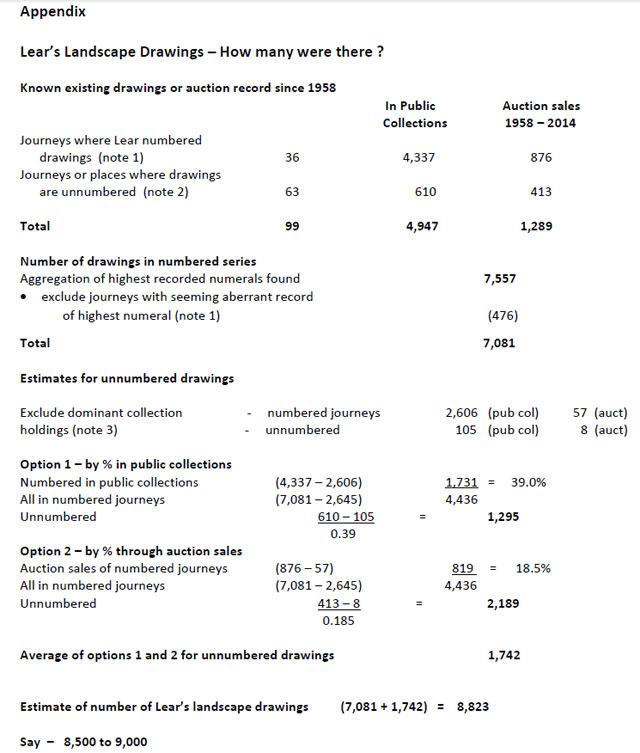
I consider below two approaches which will provide a clue to this gap in our knowledge. Both of these are only guides and very broad estimates to the numbers involved. The fact that they provide different results demonstrates the caution which must be attached. One method draws on the known number of Lear drawings held in public collections. The other draws on the auction sale data over a more than 50 year period. The detailed calculations are in the Appendix.

First, research to date indicates over 4,300 dated drawings in public collections which are from ‘numbered’ journeys. We have established above the total drawings in numbered series as a minimum of 7,081. Therefore some 61% of all numbered drawings are currently held publicly. There seems no inherent reason why the unnumbered Lear drawings held by public collections should not represent a roughly similar percentage of the total sum of unnumbered drawings as they do of numbered drawings. Thus a simple calculation of the potential unnumbered drawings total can be made.

However this would ignore the fact that for a few journeys a particularly high percentage of the total output may have been acquired by one institution, for historic reasons. A good and major example is the very large number of drawings of India and Ceylon which were acquired possibly in Lear’s lifetime by Lord Northbrook, and which were subsequently sold and passed into the collection of the Houghton Library at Harvard. 1999 numbered drawings (in two sequences, one labelled ‘scraps’) were made. The Houghton has 2012 India and Ceylon drawings, some of which will be unnumbered. Other public collections hold a mere 9, and only 38 are recorded as sold at auction between 1958 and 2014. These must clearly be excluded from the calculations.

There are three other cases of numbered drawings (Northern Greece and Albania September 1848 and May 1849 and Corsica 1868, all again with Houghton) and one case of unnumbered drawings (Abruzzi July 1843, with Liverpool Libraries) where there is a similar dominance (see Appendix, note 3). I have excluded these from all the calculations below, but retained a handful of other cases where one collection may have more than 50% of known drawings, but there are also good proportions of other public holdings and auction sales.

Taking these exclusions into account the proportion of numbered drawings held publicly to all numbered drawings reduces to 39%. If that percentage is applied to the number of unnumbered dated drawings in public collections (610 found to date, but 505 after the exclusion of the Abruzzi 1843 journey), a total of unnumbered but dated drawings of approximately 1,295 results.

A second method is to use auction results to make a similar calculation. In some cases auction records have also helped to establish a high/late number for a particular journey. The Blouin Art Sales website has been used to examine just under 1,300 dated landscape drawings, as described under Private holdings above.

By tabulating these by journey, there is an interesting comparison of the distribution for individual journeys of holdings by institutions and the frequency of auction sales over half a century. Where the bulk of the drawings, for example of Lear’s India and Ceylon travels as mentioned above, remained together with the Earl of Northbrook and then ultimately with the Houghton Library, there are relatively very few auction sales because few drawings are in private hands. But there are examples where the reverse appears to be true and most works are probably with collectors.

By separately totalling the auction sales of dated drawings for the numbered journeys and those for journeys/places which Lear did not number, it becomes possible to make another broad estimate of the drawings made on these unnumbered journeys. The same exclusions are made for where there is a dominant public collection as in the first method above. Since 1958, approximately 18.5% of the numbered journey drawings were sold at auction (the same drawing might appear over this long period more than once at auction but this would probably account for only a small percentage of these sales).

405 of the adjusted auction sales however related to unnumbered journeys, and if these, as for the numbered journey sales, represented 18.5% of the total, the unnumbered drawings would amount to approximately 2,189.

The total of Lear’s dated landscape drawings output therefore seems likely to have been a minimum of 7,081 numbered drawings plus perhaps between 1,295 and 2,189 unnumbered drawings. It may be reasonable to suggest that he made between 8,500 and 9,000 dated drawings of landscapes over his fifty years of constant travels.

I am most grateful for the comments and advice I received from Dr Rowena Fowler and Bernard Silverman in preparing this paper.

© Stephen Duckworth
August 2017
Posted in Edward Lear | Tagged , , | 3 Comments

New about Edward Lear

Daniel Karlin reviews Jenny Uglow’s Mr. Lear in this week’s TLS; while his final opinion is largely positive,

Uglow has something interesting to say on almost every facet of Lear’s life and work, taken individually. When she gets off the chronological treadmill her gift as a storyteller is evident, and her assessments of character and motive are almost always sensible and convincing. As a critic she is lucid, clever, conversable; she doesn’t talk down, and her readings are excellent, the heart of the book.

he seems to consider Uglow’s chronological approach “wearisome,” in large part because of a redundant focus on Lear’s travels, an impression I did not have while reading the book, which on the contrary I think managed to avoid this pitfall of many other biographical sketches. On the other hand, a little contradictorily, he complains that the book “would need to be three, four, ten times as long to do this [i.e. provide an ‘immersive experience of such a life’] propertly.”

In the same issue Thomas Dilworth launches in one of his readings of an Edward Lear limerick, “There was an Old Man of the Hague,” which is fun to read but does not really say much about Lear himself.

Peter Parker reviews Mr. Lear for The Spectator.

I have added to the critical bibliography the following items:

Uglow, Jenny. Mr. Lear: A Life of Art and Nonsense. London: Faber and Faber, 2017.

Westwood, Benjamin. “Edward Lear’s Dancing Lines.” Essays in Criticism 67.4 (2017): 367-91.

Posted in Edward Lear | Tagged , , | Leave a comment

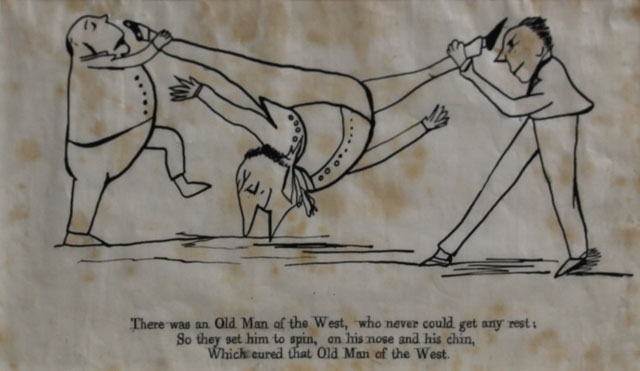
Three Limerick Drawings by Edward Lear

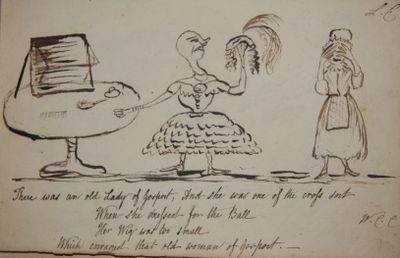
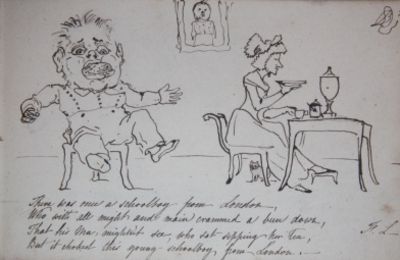
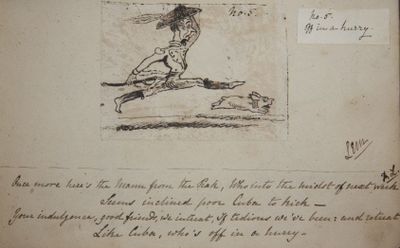
Three original pen & ink drawings by Edward Lear, taken from ‘A Book of Nonsense,’ first published in 1846. The drawings have been examined and fully authenticated as Lear’s work by the late Vivien Noakes, the world expert on Edward Lear. They are drawn on silk, or possibly fine rag paper, and then laid on paper for support. They were drawn, almost certainly for presentation to friends, and would originally have been part of a group of drawings bound in book form, probably at the time of its making in the early 1860’s. There is some staining and browning, but otherwise the drawings are in excellent condition. The drawings are mounted on acid free card and are supplied with a copy of the letter of authentication from Vivien Noakes. Mount sixe: 24.7 x 30.5 cm. Original ‘Nonsense’ drawings by Lear are exceedingly rare.

David Miles Books: 1, 2, 3.

Posted in Edward Lear | Tagged , , , , | Leave a comment

The Animal World of Edward Lear

In her new biography of Edward Lear Jenny Uglow observes that “when he was low Lear always felt closer to the animals than to the smart people around him” (p. 229) and she has now expanded on the idea in an article in The Guardian, “From ging-e-jonga to the Quangle Wangle Quee.”

Speaking of Lear and animals, Christine Jackson has reviewed Robert Peck’s The Natural History of Edward Lear in the Archives of Natural History, 44.2, October 2017. 385-386.

Posted in Edward Lear | Tagged , , | Leave a comment

Edward Lear and Food

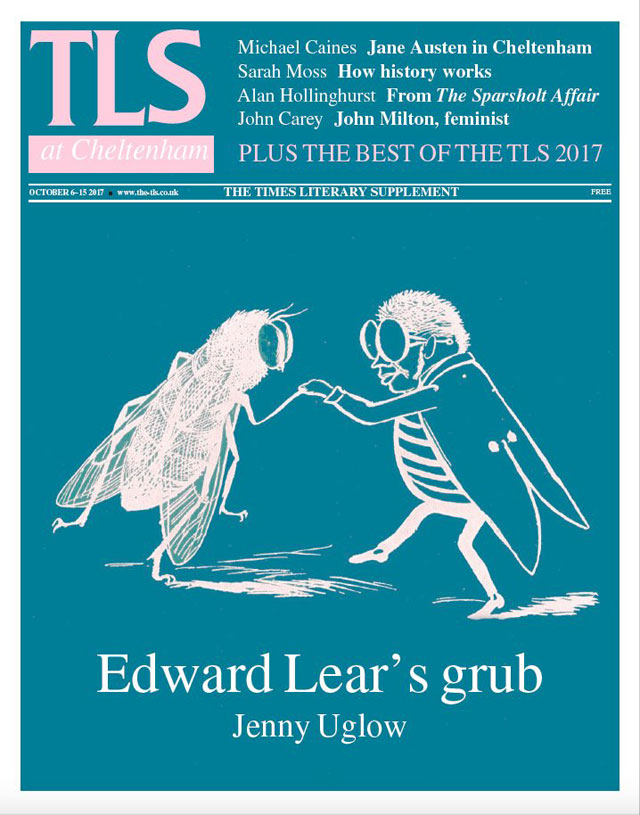
You would think that writing over 500 essential pages on Edward Lear should have been enough for Jenny Uglow who, not thinking so, has a long article on food in Lear on the Times Literary Supplement website entitled “Full of Veal-Cutlets and Chocolate-Drops.” I sincerely hope this is an outline for her lecture at the Cheltenham Literature Festival on 13 October; or, considering she also has a long review of a book on Hans Sloane in the current New York Review of Books, she could tell the rest of us how she manages to get 8-day weeks.

More reviews of Edward Lear: A Life of Art and Nonsense:

Christopher Hart in The Australian.

Posted in Edward Lear | Tagged , , | Leave a comment

Jenny Uglow’s Edward Lear: A Life of Art and Nonsense

Another biography of Edward Lear!

One could be excused for reacting like this at the news of Jenny Uglow’s new book, after all there are at least five other easily available. Even though I had enjoyed all the books by Uglow that I had read, I was also a bit sceptical about the possibility of improving on the late Vivien Noakes’s Edward Lear: The Life of a Wanderer, first published in 1968 and last updated in 2004.

Let me state straight away that there was no reason for concern; this is a wonderful book providing what will presumably be the definitive story of Lear’s life and one of the best interpretations of his works for many years to come. All my worries were dissipated from the very beginning, Lear’s infancy and youth are explored in great depth, adding details not in the previous biographies or presenting them in a clearer way, while at the same time dispelling a number of recurrent myths, often propagated by Edward himself, about the Lear household, such as the number of children and the nature and consequences of Jeremiah Lear’s bankruptcy.

Uglow’s Edward Lear: A Life of Art and Nonsense, a very traditional biography starting with Lear’s birth and proceeding chronologically to his last years and death, does not try to impress the reader with picturesque descriptions or entertaining episodes, though there are lots of course. The historical, political and social context is less in evidence than in her previous books, probably a consequence of Lear’s limited interest and non-existent participation in the great events of the age, unless they concerned his acquaintances or family. Also, as his friend Evelyn Baring wrote, Lear was “too warm-hearted to be satirical” and his nonsense, especially the later, longer poems, were concerned with his feelings rather than with the external world. The existence of a daily diary, starting in 1858, also leaves very little to be inferred about his opinions, though Uglow perceptively observes that it is not necessarily always a reliable guide:

He recorded moods, health, toothache, itchy skin, constipation; work and travel; people met, letters received, gossip heard; walks taken, books read, meals eaten.
What did he not record? Dreams, lusts, his feeling about words, his creative process – all these lie deep beneath the diary-words (p. 415).

These latter are the things we really want to know and that Uglow tries, convincingly I think, to extract from Lear’s limericks, poems and stories, as well as paintings and travel journals. What mostly distinguishes the volume from the other biographies is the attention devoted to the nonsense works, with chapters discussing each of the four canonical volumes and others on specific genres; I was particularly fascinated by the one about Lear’s early poem caricatures and picture stories (“Make ’em laugh”) and the one on the alphabets (“A was an Ass”), a kind of composition I have never fully appreciated: after reading Uglow’s observation that they “let us hear how Lear spoke” (p. 265) I will have to go back and reconsider them. Uglow’s readings are always convincing and often original and enlightening.

The book is also strong on the connections of Lear’s work with the ideas of other great Victorians, such as Alfred Tennyson, Charles Darwin and John Stuart Mill, as well as on his position on the theological debates of the age, in particular those following the publication of Essays and Reviews in 1860. Lear’s debt to other painters is also discussed and the book contains the best analysis I have read of his brief affair with the Pre-Raphaelite Brotherhood and his life-long friendship and admiration for William Holman Hunt.

Praise is also due to Faber & Faber, as the volume itself is wonderfully produced and for once the large number of well-chosen colour and black and white illustrations, often pictures only rarely seen, instead of being grouped in one or two blocks are evenly interspersed in the text and placed in relevant positions; I suppose this is no easy feat for a publisher.

Reviews so far:

Ysenda Maxtone Graham in The Sunday Times.

Robert McCrum in The Guardian.

Robert Douglas-Fairhurst also in The Guardian.

Lybdall Gordon in the New Statesman.

Eileen Batterby in The Irish Times.

Craig Bown Event in the MailOnline.

Jenny Uglow will talk about Edward Lear at The Times and The Sunday Times Cheltenham Literature Festival on Friday, October 13 cheltenhamfestivals.com,

Posted in Edward Lear | Tagged , , | 1 Comment

Mary Crawford Fraser on Edward Lear

For some reason we were drawn to choose quite a new spot for our villegglatura in the summer of 1870, a retreat in the Maritime Alps, of which till then I had seen very little. I think the train took us as far as Cour Mayeur, and from there we journeyed by carriage to the Certosa di Pesio, a huge monastery in the most lonely part of the hills, which had been converted into a summer hotel. The road ascended all the way through an almost unbroken forest of chestnut trees, their cool, deep verdure striking very pleasantly on the senses after the two days of hot, dusty railway travelling. Towards evening we skirted a torrent, rushing far below us, and finally crossed it by an ancient stone bridge to drive under the archway of the Certosa itself, a huge gray building with vast cloisters surrounding flowery courtyards. The bedrooms, wonderfully large and airy, all opened out of these cloisters, and of course the general dining-room was the former refectory. It was a particularly cheerful apartment, and when I came in to the midday breakfast on the day after our arrival, I was dazzled by the floods of light and rather confused by the noise of sixty or seventy persons talking the ear splitting Lombard dialect in the shrill Lombard voice. The language had no relation to any Italian I had ever heard, and carried as many “ngs” and “oüs” as Portuguese, together with sibilant “c’s” and “s’s” that emulated what foreigners call the hiss of English. Nothing gives me the blues like finding myself among people who speak a tongue I do not understand, and I slipped into my place beside my mother in deep dejection, which must have shown itself in my face, for when I looked up to take stock of our neighbours I became aware that a dear old gentleman on the opposite side of the long narrow table was regarding me with benevolent if amused pity. He had a long white beard and very bright eyes that seemed to be watching a pleasant comedy all the time. After a few minutes he found occasion to offer me some small table d’hôte civility, remarking at the same time, “It is rather confusing at first, but you will soon get accustomed to it!”
I never knew how musical an English voice could sound, till that moment. Before the meal was over we were the best of friends, and my new acquaintance, remarking that my small sister Daisy, who sat beside me, was in trouble with her big knife and fork, produced a bit of paper and a pencil, and a few seconds later pushed across to her a delightfully funny drawing with one of Edward Lear’s immortal nonsense rhymes written below! That moment betrayed him to us. We knew all the “First Nonsense Book” by heart already, and that summer saw almost all that went to make the “Second Nonsense Book” written and illustrated for my fortunate little sister. Never was there a man who could so live into the feelings of a child. Daisy was a turbulent little creature, always getting into trouble of some kind, and from that first day she learnt to take her disasters to “Uncle Lear,” as he taught her to call him, to have them turned into joys by his rhymes and pictures. A frightful bump on her forehead was the origin of the “Uncareful Cow” who got a similar one and was horrified to find It growing into a third horn which had to be rubbed away with camphor. The strange meats and unmanageable cutlery of the table d’hôte inspired the marvellous botanical specimen, “Manyforkia Spoonfolla” as well as most of the recipes for “Nonsense Cookery.” But Uncle Lear did not always wait to be asked for his rhymes. Day after day Daisy would find on her plate some enchanting, highly coloured sketch with an appropriate poem. We all felt enriched when “The owl and the pussy cat went to sea in a beautiful pea green boat,” and the mystery of the disappearance of “The Jumblles,” who “Never came back to me!” had an alluring gloom even for us grown ups.
All through that summer, which grew sadder and sadder as the storm of war broke over France and crept down across the Alps to prepare the Roman tragedy, dear Mr. Lear was an unfailing source of comfort and cheer to us all. He was one of the few Englishmen not spoilt by almost life-long residence in Italy, one who gave the lie to the Italian proverb, “un Inglese italianato è il Diavolo incarnato.” And he knew his part of the world well, having travelled far enough from his home in San Remo to paint many delightful pictures of other places with pen and pencil. His big book on Corsica which he sent me later, was one of my most treasured possessions. For all his bubbling love of fun he had a fine sense of the stern and dramatic, and I have seldom seen anything grimmer than his picture of a Corsican funeral — the stark corpse in everyday clothes tied in an upright sitting posture to a kind of gibbet strapped to the saddle of a mountain pony, the animal shivering with fright as it was led by two men over the tumbled rocks and boulders of a pass so steep that they could hardly keep their footing, down to where it was possible to dig a grave and bring a priest to bless it.
But it was not for his serious work that we and the world loved Mr. Lear, not by that will he be remembered, but by the inexhaustible sweetness and spontaneousness of his fun, the blessed innocent delight which he brought into thousands of lives. One day he said to me confidentially, “My dear child, I’m sure we shall be allowed to laugh in Heaven!” He came to see us in Rome in succeeding years and grew to be so much our own that after his death I sometimes fancied his spirit crept in among us and added a note of gentle, ghostly mirth to our little gatherings. He had had heavy private sorrows, but they were never allowed to cloud the sunshine he so generously shed upon all who came near him.

Mrs. Hugh Fraser [Mary Crawford Fraser]. A Diplomatist’s Wife in Many Lands. New York: Dodd, Mead and Company, 1913. Volume II. 24-27

Posted in Edward Lear | Tagged , , , | Leave a comment

More Wheelbarrows!

There was a young woman of Harrow
Who always rode in a wheelbarrow
Her weight was so great
She came out of it straight
That jolly young woman of Harrow.

See here, here, and here.

This one is from:

The Book of Folly: A Volume of Original Caricatures in Pen-and-Ink from the Library of Viscount Long
Oblong, 15 by 23 cm. Unpaginated, with 42 pages containing ink illustrations and/or verse, most of which are outlandish and nonsense often in the spirit of Edward Lear.
The album had a few contributors, each of whom initialed his contribution. One poem is signed William Colquhoun. Otherwise, the contributions are initialed and their precise identities are unknown. It is probable that a number of the limericks and/or ink illustrations were done by children of the Walter Long, created the First Viscount Long, and their friends. The book carries the bookplate of Long on its FEP, and many of the items are initialed with an L. Long, known as a Irish Unionist, was a leading politician during World War One and the period directly prior and after, serving as First Lord of the Admiralty from 1919 to 1921. The level of artistic proficiency is various, the very best of the artwork has the unforced fluency of a cartoon by a Rococo master, when it is elaborate, or sure-handed and crisp, when a more minimalist sketchy line drawing. And at the lower end, even the most unskilled illustrations do not fail to amuse. (Nowadays, when no longer is artistic self-expression widely cultivated, it is inconceivable that such an album could be created.) The verse has a similar range but also should never fail to bring at least a smile of appreciation. Subject-wise, there is a generous dose of mayhem, cruelty, slapstick, and freakish traits and perverse tics — after all, limericks predominate! There is one narrative set of five limericks about a dog who drank tea; otherwise, the works are all free-standing. There are burlesques of cats, horses, bald ladies, the fat, the skinny — but telling you that this poem is about the “Soldier from Naples” or that one, “the old man on the moon”, really doesn’t relate much about their humor and warpness. Most of the entries are directly into the album, with a handful of illustrations pasted instead.

White Fox Rare Books and Antiques.

Posted in Limerick | Tagged , , | Leave a comment