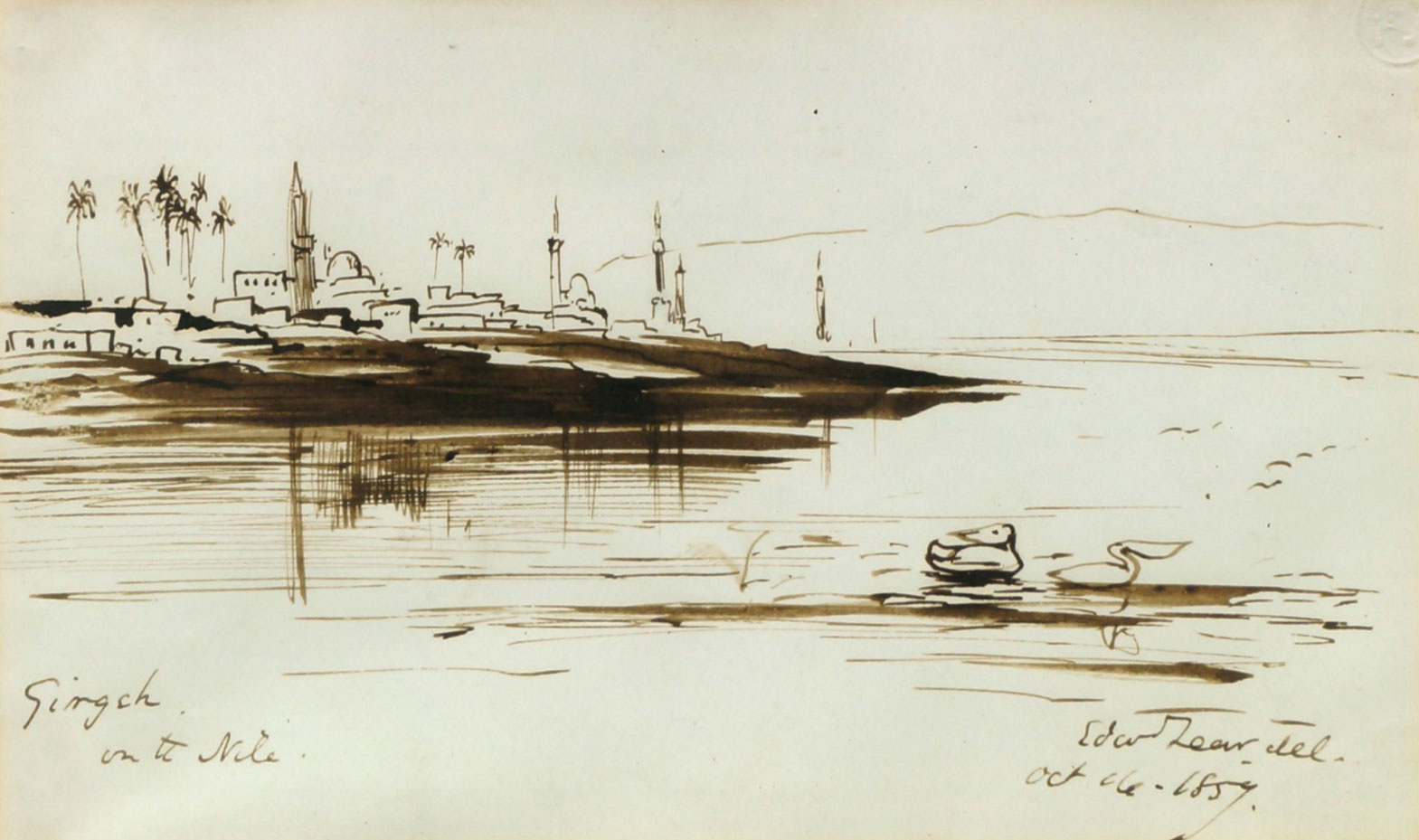
Edward Lear, Girgeh on the Nile.
October 1857 (not 1859 as in the auction post, not sure on the day either)
Sold with:
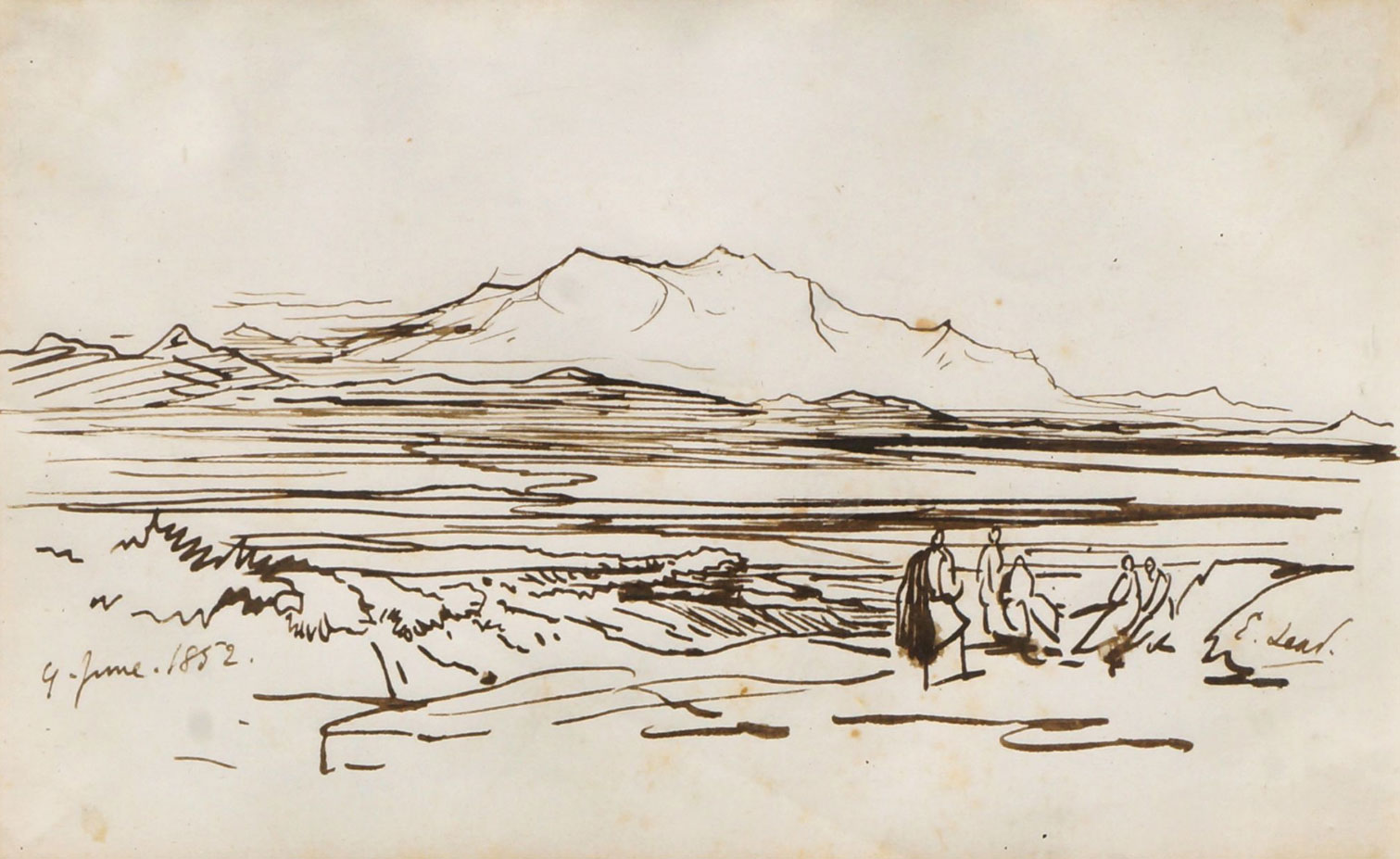
Edward Lear, Figures in a Mountain Landscape.
4 June 1852.
Edward Lear, Girgeh on the Nile.
October 1857 (not 1859 as in the auction post, not sure on the day either)
Sold with:
Edward Lear, Figures in a Mountain Landscape.
4 June 1852.

Lear, Edward; Valentine; Glasgow Museums; http://www.artuk.org/artworks/valentine-84944
If, like me, you sometimes visit ArtUK to see if there is anything new by Edward Lear, you might have noticed that there are two paintings which look completely different from his other ones. A few days ago Matt Bevis wrote to ask my opinion and I confirmed that they did not look like Lear’s to me; he then contacted Stephen Duckworth who remembered that Charles Lewsen had actually identified the author of the two painting, not Edward but Charles Hutton Lear (1818-1903).

Lear, Edward; Launce and His Dog; Glasgow Museums; http://www.artuk.org/artworks/launce-and-his-dog-84943
CH Lear appears to have drawn several pencil portrait now at the National Portrait Gallery; not much information is available on him. Here is another picture in the same style:
ArtUK, by the way, has another picture by Charles Hutton Lear, which is correctly attributed, though it looks a bit more learian than the others:

Lear, Charles Hutton; Beech Trees; Walker Art Gallery;http://www.artuk.org/artworks/beech-trees-9
This is vaguely reminiscent of Edward Lear’s two landscapes which also portray the Congreve children with their cat, posted here and here.
I have already discussed Edward Lear’s Irish sources here, here and here. Another fine instance is the parody in four pictures that Lear drew of Thomas Moore’s “Rich and rare were the gems she wore” from the first volume of Moore’s Irish Melodies (1807):
RICH and rare were the gems she wore,
And a bright gold ring on her wand she bore;
But, O, her beauty was far beyond
Her sparkling gems or snow-white wand.

“Lady! dost thou not fear to stray,
So lone and lovely, through this bleak way?
Are Erin’s sons so good or so cold
As not to be tempted by woman or gold?”

“Sir Knight! I feel not the least alarm,
No son of Erin will offer me harm;
For though they love woman and golden store,
Sir Knight! they love honor and virtue more!”

On she went, and her maiden smile
In safety lighted her round the green isle;
And blest forever is she who relied
Upon Erin’s honor and Erin’s pride!
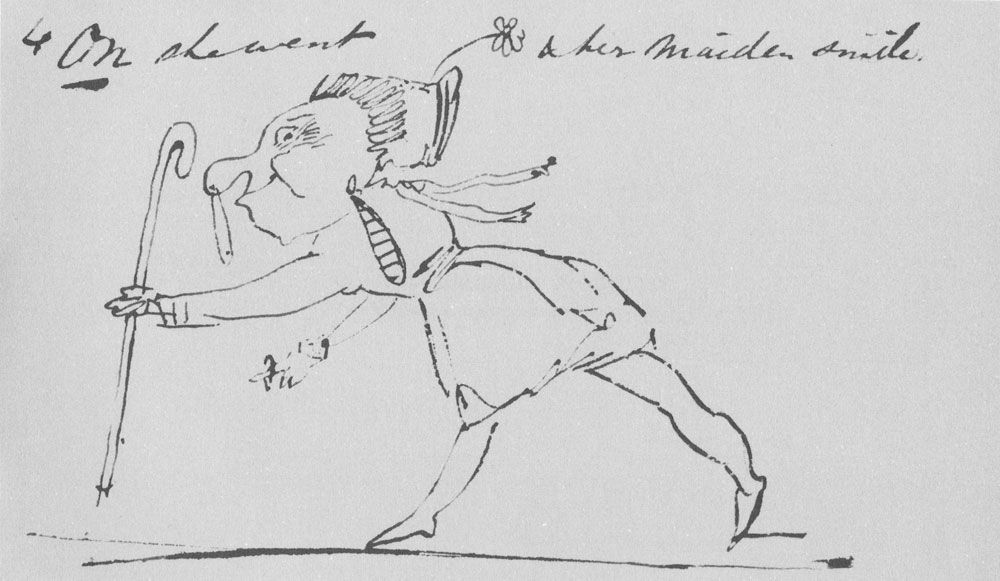
What makes these illustrations (from Lear in the Original pp. 169-173) particularly interesting is that they are clearly no more than an expansion of a caricature by Thomas Hood and show that much of Lear’s early work was inspired by his punning humourous work; here is Hood’s illustration for the poem from his Whims and Oddities, in Prose and Verse (London: Lupton Relfe, 1826), facing page 13:

This was first noted by Michael Heyman, Isles of Boshen: Edward Lear’s Literary Nonsense in Context (Thesis submitted for the Degree of PhD, University of Glasgow, Faculty of Arts, Department of English Literature, 1999), pp. 32-33.
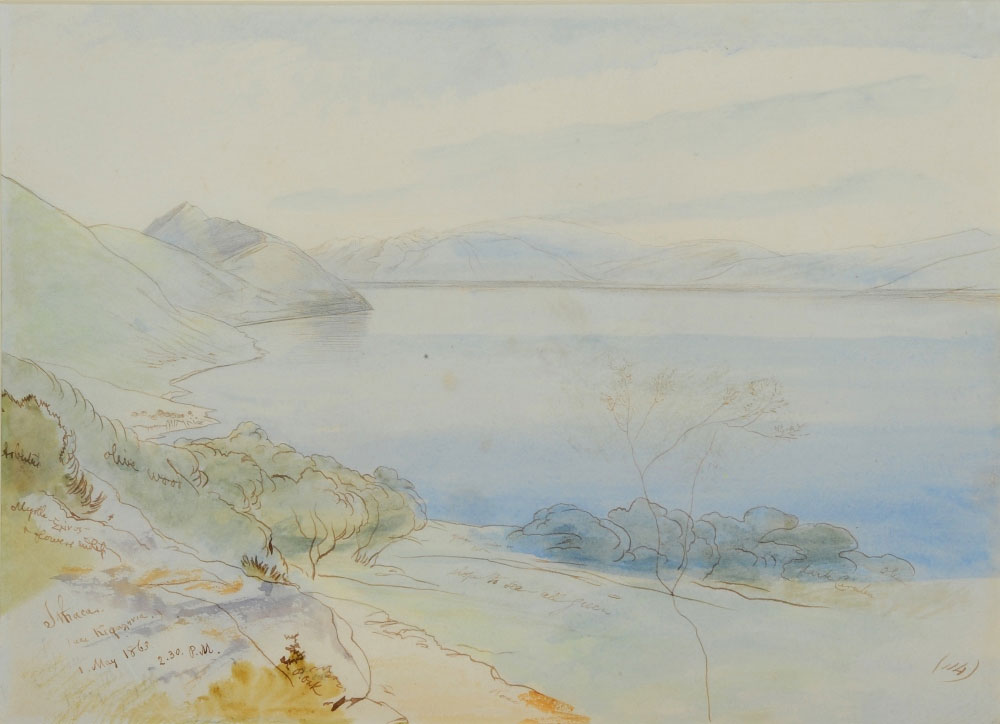
Edward Lear, Ithaca.
Inscribed with title and dated 1 May 1863 2.30pm, numbered ‘114’, pen, ink and watercolour and inscribed with notes, 33 x 49cm. The Department of Western Art, Ashmolean Museum Oxford label verso.

Little Egret.
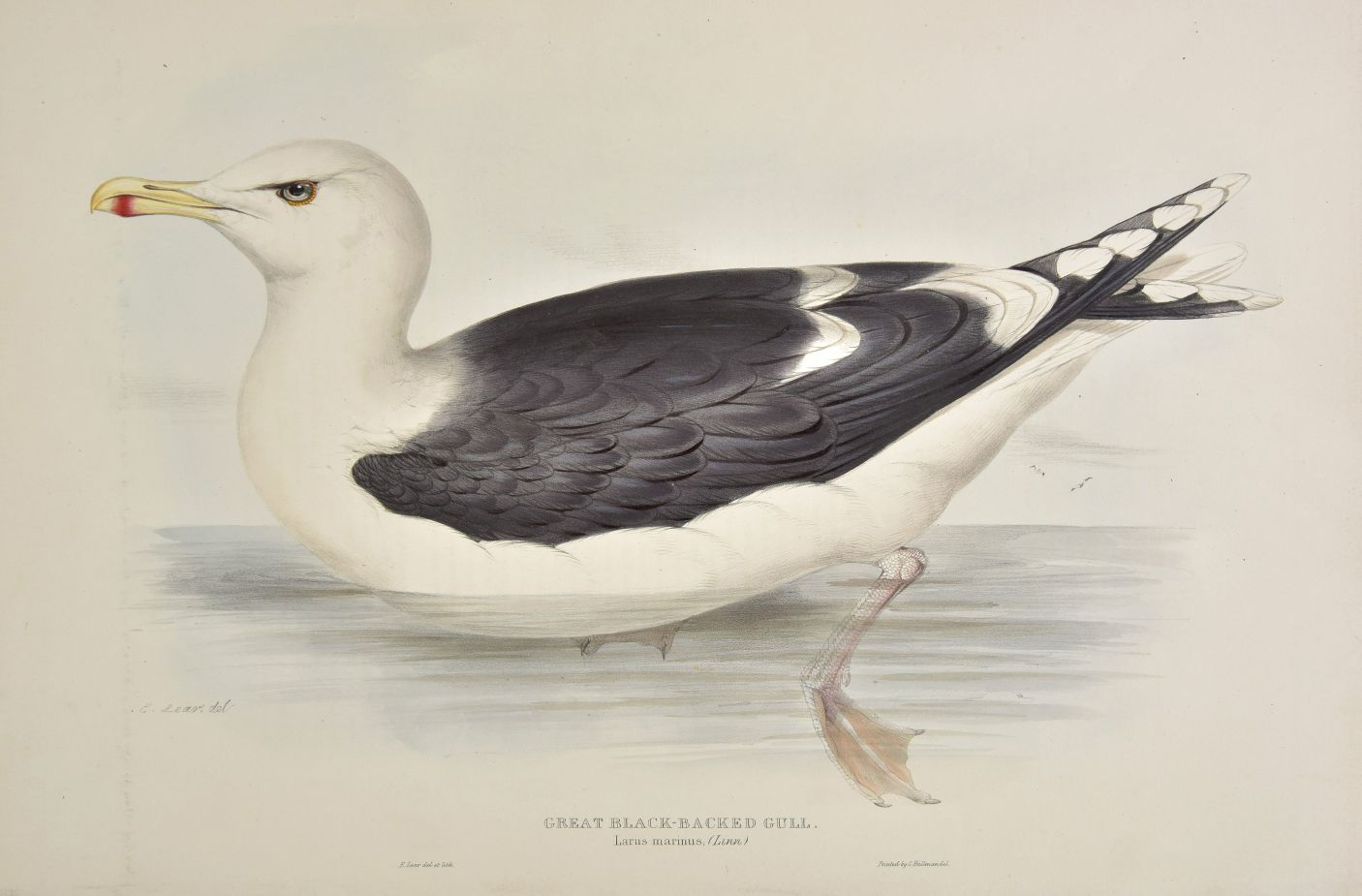
Great Black-Backed Gull, Audouin’s Gull [and] Glaucous Gull.
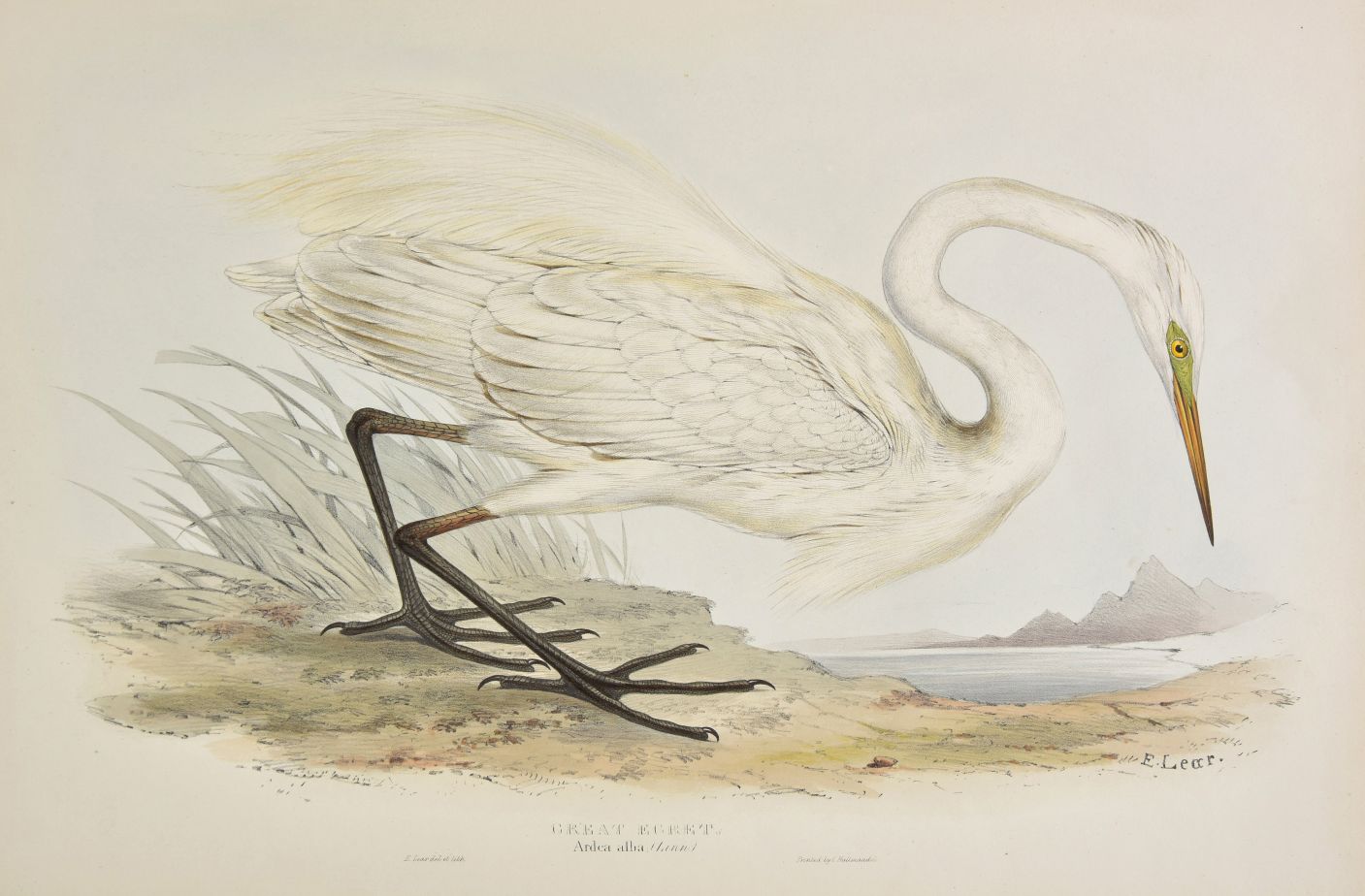
Great Egret.

Great Bustard.
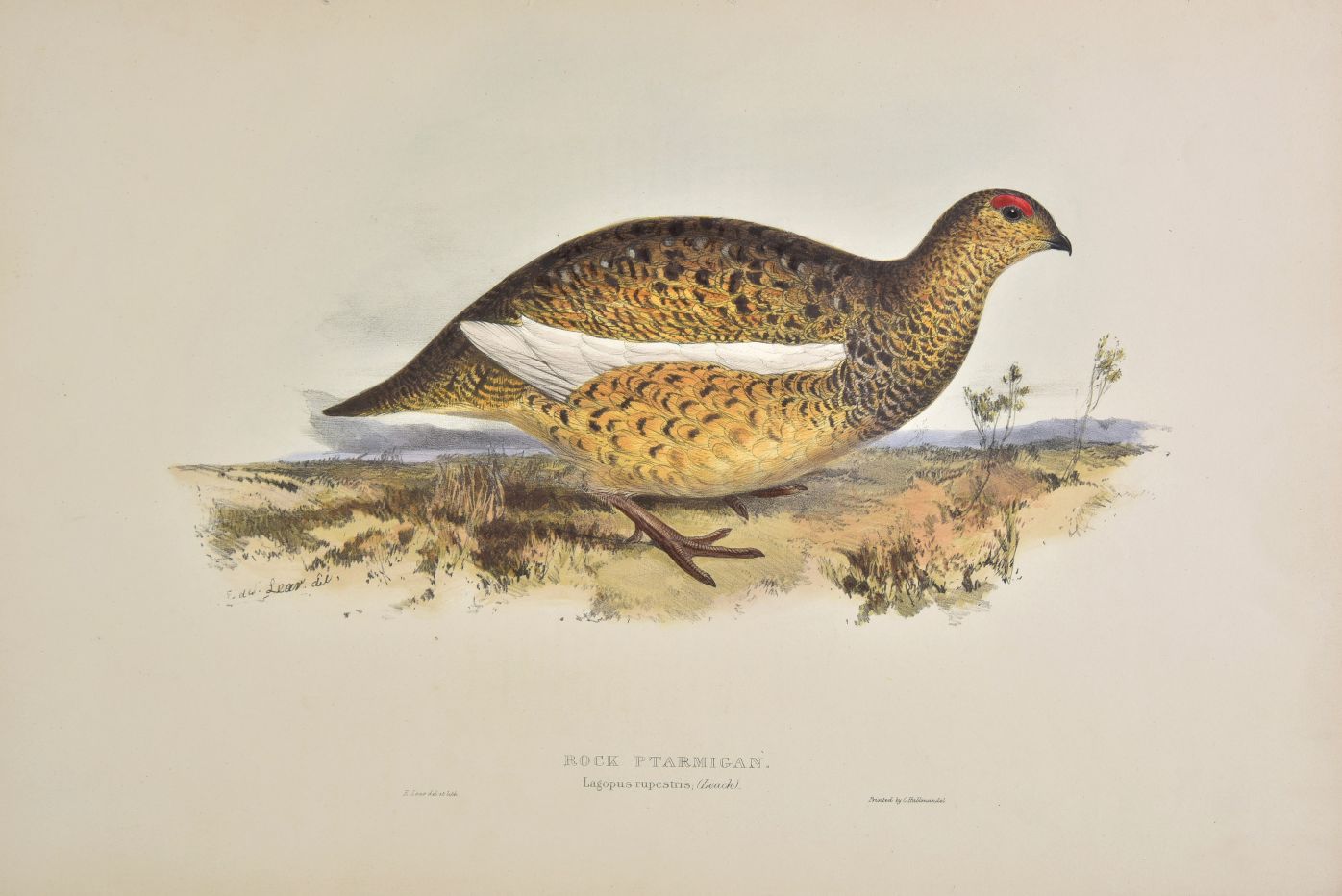
Rock Ptarmigan.
Edward Lear’s lithographs with contemporary hand colouring, old ‘punch holes’ to upper margin, 340 x 520 mm. Originally published in John Gould’s ‘Birds of Europe’.
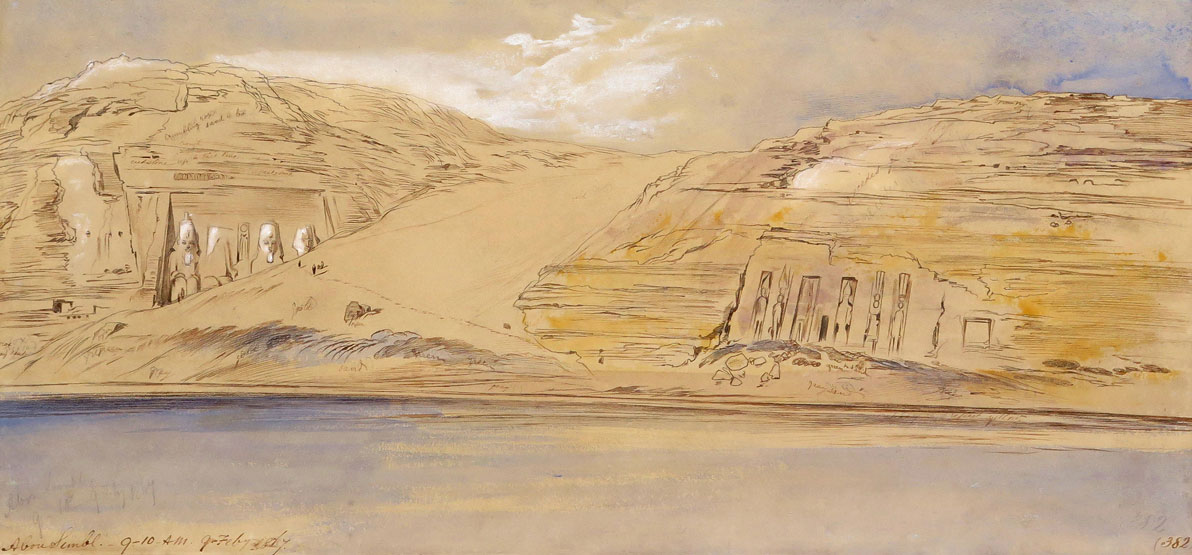
Edward Lear, Abu Simbel, Nubia, Egypt.
Titled Abu Simbl, dated 9-10AM, 9 Feby 1867, and numbered 382 once in pencil and once in ink, also inscribed with artist’s notes. Pen, brown ink, pencil and watercolour 25.5 x 54cm; 10 x 21¼in.
Provenance
Agnews Mid 1960s The collection of Captain R. Gordon Canning Ian Cook, Exeter Christie’s, London, 10th December 2008, Lot 49.
Edward Lear arrived at Abu Simbel on 8th February 1867 on his 2nd tour of Egypt. This view is of the large Temple of Abu Simbel on the left and to the right the Facade of the small temple dedicated to Nefertari with Lake Nasser in the foreground
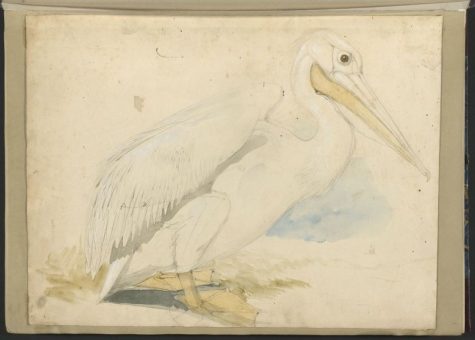
The third part of Matthew Bevis’s series on Edward Lear for the Houghton Library Blog is now online and discusses Lear’s relationship with birds, pelicans in particular. Please note there are TWO pages, the main text is in the sefcond one!
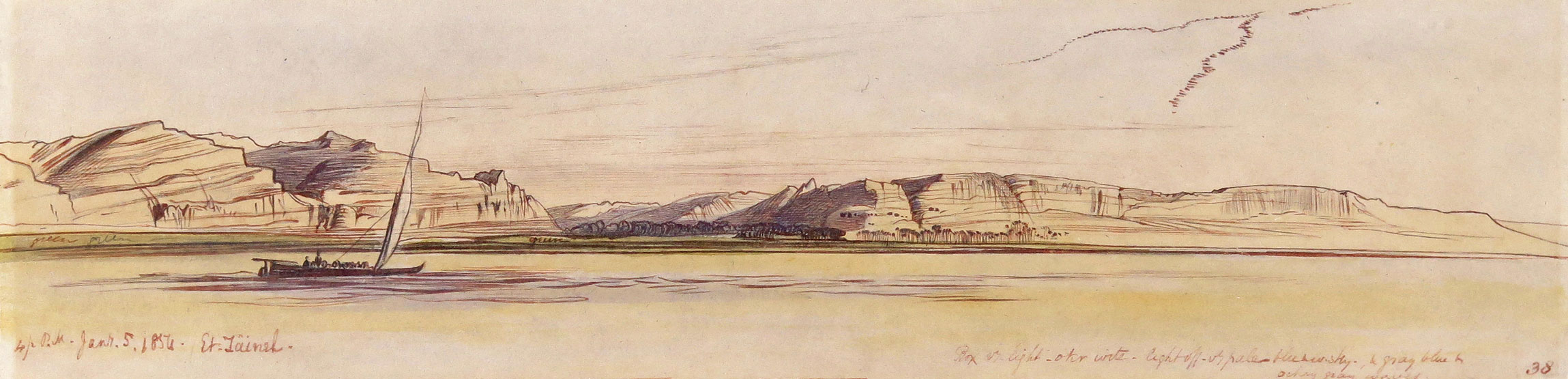
Edward Lear, El Tainel, a view on the Lower Nile.
Dated 4 p.m. Janr. 5. 1854, numbered 38 and inscribed with colour notes. Pencil, pen and brown ink with watercolour on buff paper 9 x 35.5cm; 3½ x 14in.
Lear left Cairo after Christmas 1853 with a large party of English, some twelve boats in all. They travelled up the Nile at a leisurely pace, dropping anchor every night. They started their return journey from Philae on February 8th, 1854 (see Edward Lear, Vivian Noakes, London 1985, p.97)
The British Museum’s curator comments for no. 1970,0411 reads:
The following text is from the label for the display at the British Museum ‘Watercolours and Drawings by Edward Lear: a Bicentennial Celebration’:
In 1842 Lear made a tour of the Abruzzi, a region of central Italy, with his friend Charles Knight. Knight had given Lear riding lessons ‘round the walls of Rome’, and lent the artist one of his horses for the journey. In these drawings the artist makes fun of his poor horsemanship, with typical self-deprecating humour. They are part of a larger series that records the pair’s adventures in comic form.
The Museum’s acquisition note adds:
This item has an uncertain or incomplete provenance for the years 1933-45. The British Museum welcomes information and assistance in the investigation and clarification of the provenance of all works during that era. From an album from the Hornby family sold at Christie’s, and subsequently broken up. The Department purchased 21 drawings.
So the missing pictures were perhaps still around in the 1930s and 1940s and may be in a private collection. This would have probably been the longest of Edward Lear’s picture stories recording a journey, though rather than on the journey, it concentrates on Lear’s own misadventures while learning to ride. The picture story has first been published in full in The Complete Verse and Other Nonsense, edited by Vivien Noakes, pp. 63-70; also see the note at pp. 479-480.

1. L. & K. leave Frascati — July 28.. 1842. — Villa Taverna
L. contemplates a ferocious horse with feelings of distrust
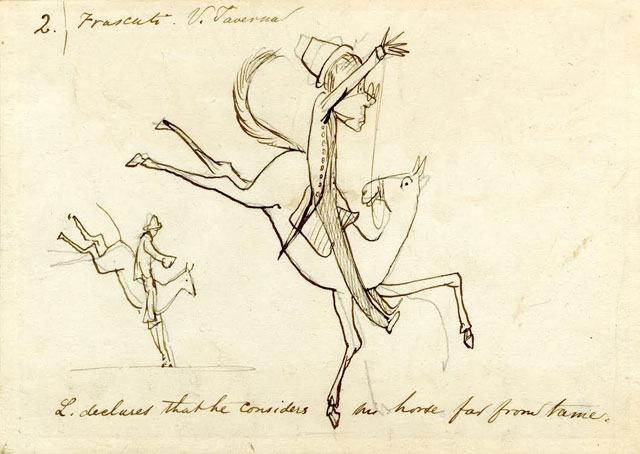
2. Frascati. V. Taverna.
L. declares that he considers his horse far from tame.

3. Frascati. V. Taverna.
L. casually seats himself on the wrong side of his saddle.

4. V. Taverna. Frascati.
L. changes position for the sake of variety.

5. — V. Mondragone. Frascati.
L. perceives he has not seated himself properly
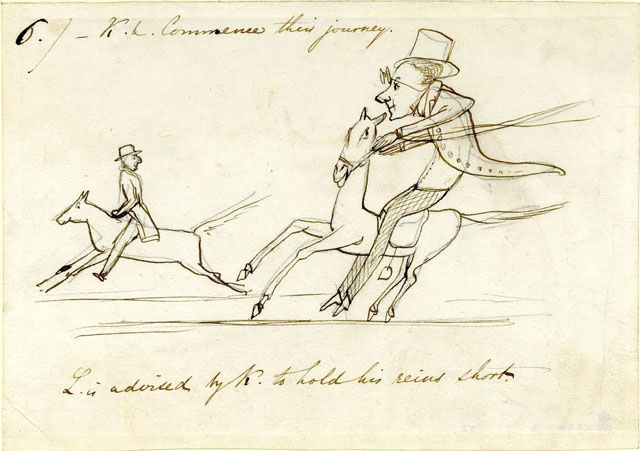
6. — K. & L. Comence their journey.
L. is advised by K. to hold the reins short.

7. Frascati.Villa Mondragone.
L. is politely requested by K. to stop his horse.

8. M. Porzio.
K. enquires amiably of L. if his stirrups are sufficiently short.

9. — M. Porzio.
K. & L are pusued by6 an irascible ox. —
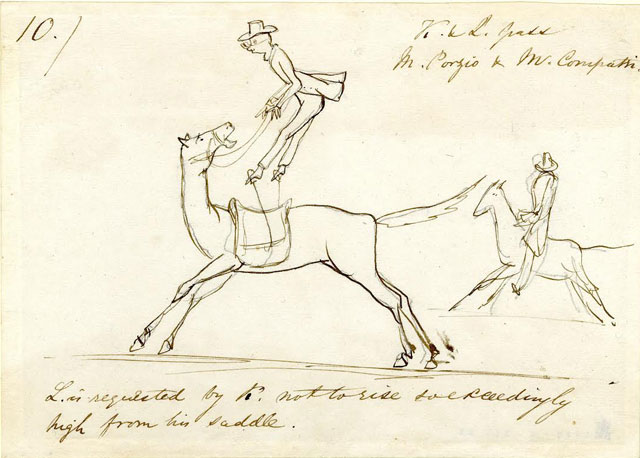
10. K. & L. pass M. Porzio & M. Compatri.
L. is requested by K. not to rise so exceedingly high from the saddle.
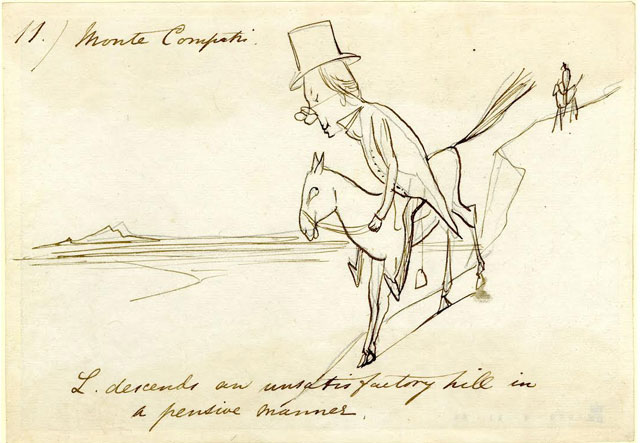
11. Monte Compatri.
L. descends an unsatisfactory hill in a pensive manner.

12. K. & L. pass Colonna.
L. is besought by K. to sit back on his saddle.

13. — Near Gallicano.
L. is immersed in an indefinite quigmire.
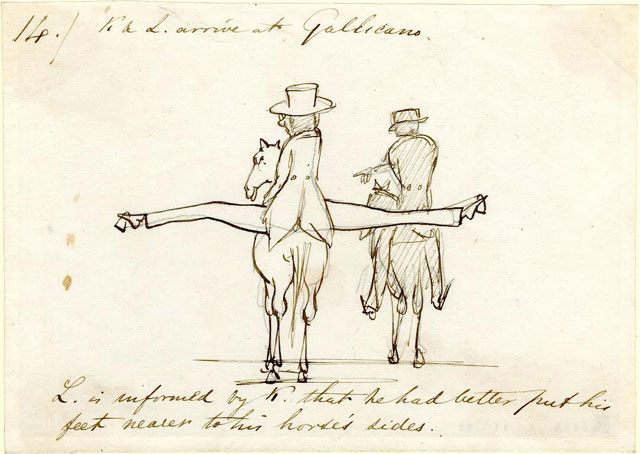
14. K. & L. arrive at Gallicano.
L. is informed by K that he had better put his feet nearer to his horse’s sides.

15. Ponte Lups: — near Gallicano.
K. entreats L. to observe a large vridge called Ponte Loophole.
[I read “Lups” but it must be “Ponte Lupo,” the most massive Roman aqueduct in the world (18m thick).]
[Five pictures missing.]
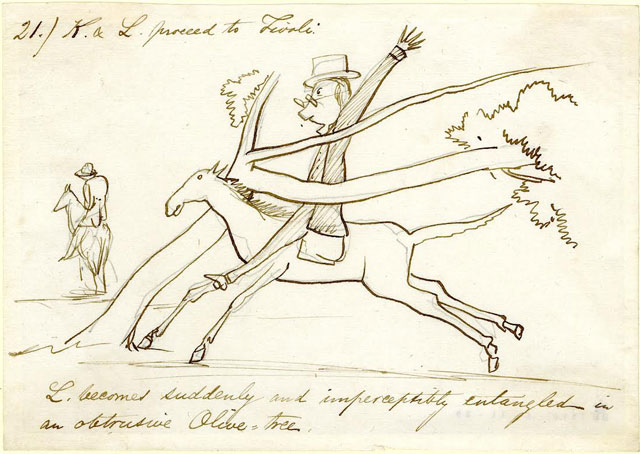
21. K. & L. proceed to Tivoli.
L. become suddenlyand imperceptibly entangled in an obtrusive Olive=tree.
[One picture missing.]

23. K. & L. visit the temple by Moonlight.
K. & L. discern a predominant Ghost.
[One picture missing.]
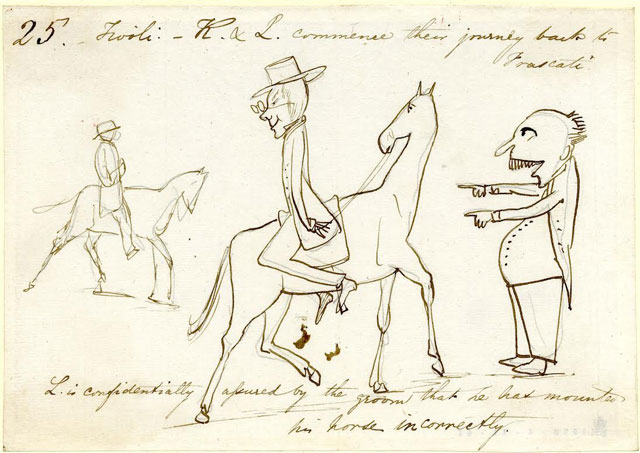
25. — Tivoli. — K. & L. commence their journey back to Frascati.
L. is confidentially assured by by the groom that he has mounted his horse incorrectly.
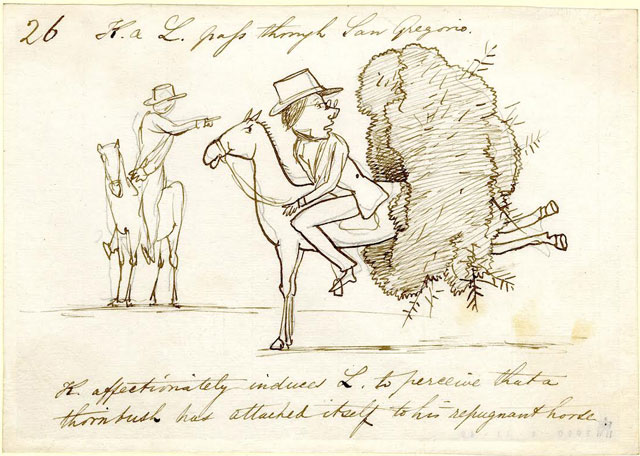
26. K. & L- pass through San Gregorio.
K. affectionately induces L. to perceive that a thorn-bush has attached itself to his repugnant horse.

27. K. & L. pass Casape & Poli returning by Gallicano to Zagarolo.
L. is much disturbed by several large flies.
[Five pictures missing.]

33. K. & L. proceed from Zagarolo to Frascati.
K. & L. are attacked by several very venomous Dogs in the vicinity of Colonna.
[More pictures missing?]
All images are ©Trustees of the British Museum and can be dowloaded at higher resolution from the Museum’s Online Collection.
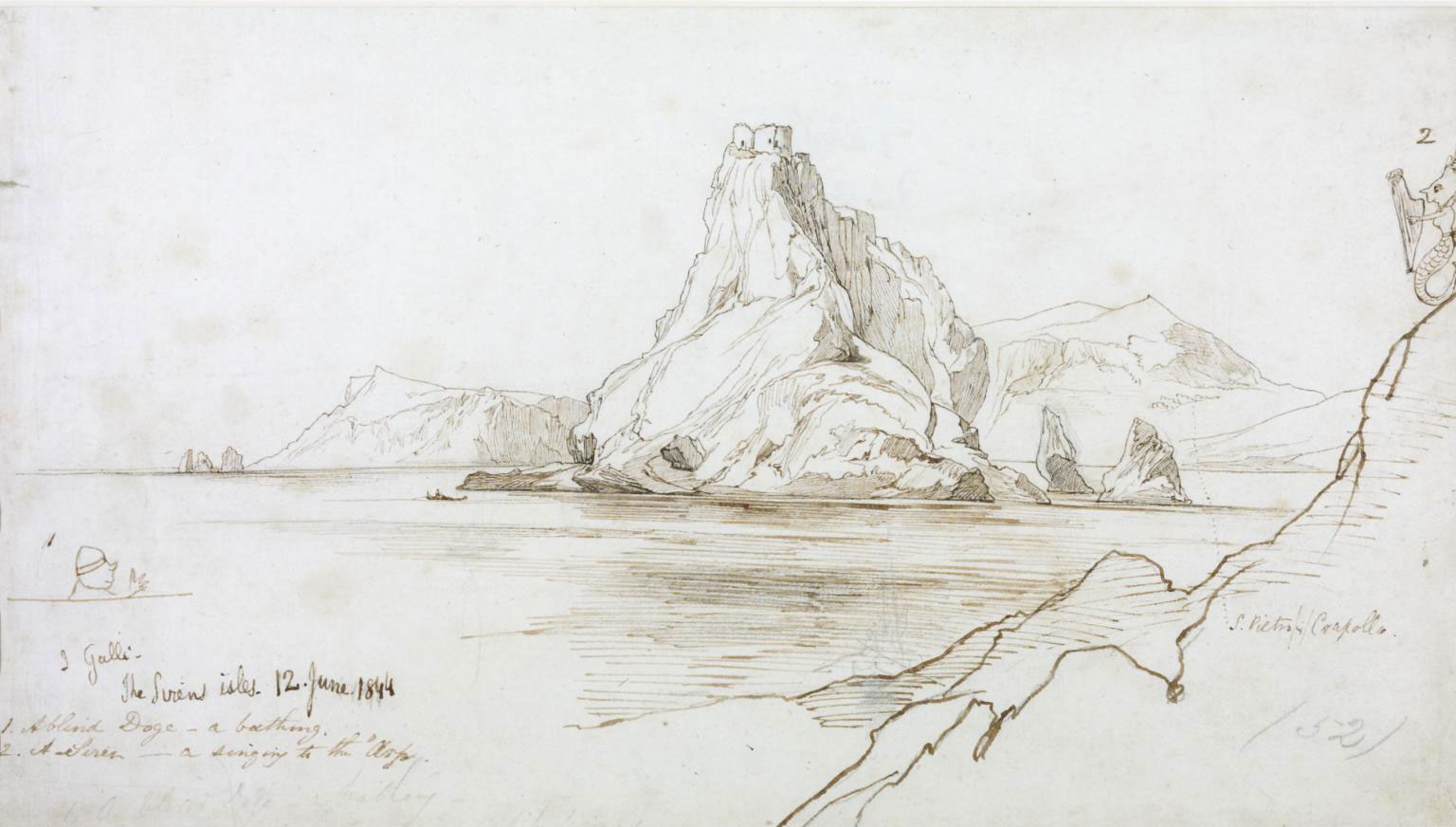
Matt Bevis has recently brought to my attention the above drawing by Edward Lear in which landscape and nonsense get in some way mixed. The picture is at Tate and the text reads:
I Galli
The Sirens isles. 12. June. 1844
1. [Referring to the swimming figure] A blind Doge — a bathing
2. [The mermaid at the top left] A Siren —- a singing to the ‘Arp.
The painting is numbered 42 and was drawin in S. Pietro in Crapolla (where now there is a place called “Il covo delle Sirene” – “The Mermaids’ den”), near Positano, presumably one of the supposed locations of Ulysses’s Sirens.
This reminded me of another watercolour containing nonsense elements that was part of Stephen Duckworth’s presentation I saw in 2012 and is mentioned in his article on Edward Lear’s Cretan Drawings (in New Griffon 12, 2011, website):
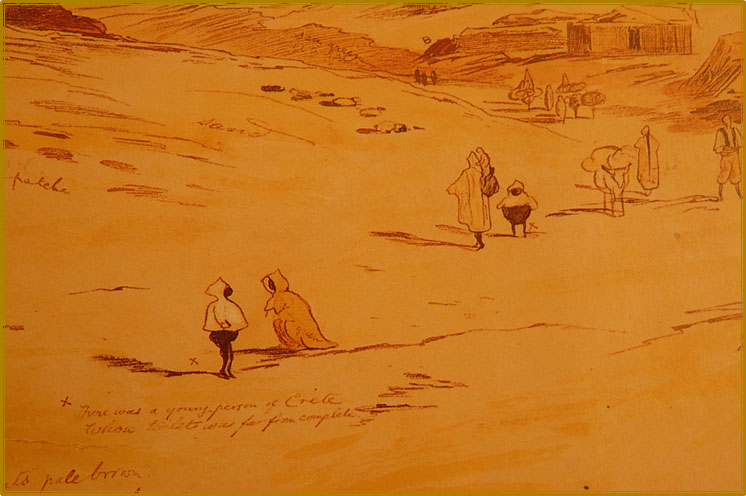
This drawing was made “outside Hania,” the detail above contains the beginning of a famous limerick: “The was a young person of Crete | Whose toilet was far from complete,” which I suppose refers to the “young person” marked with an “x.” The limerick had appeared in the 1861 edition of the Book of Nonsense (the picture is dated 1864, I think):
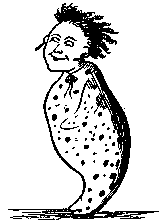
There was a Young Person of Crete,
Whose toilette was far from complete;
She dressed in a sack,
Spickle-speckled with black,
That ombliferous person of Crete.
 A Blog of Bosh