
Edward Lear, Plain of Damascus coming from Hermon.
Inscribed with title lower left, signed with initials lower right, 28th May 1855. Watercolour, 14.5cm x 21.5cm.
Edward Lear, Plain of Damascus coming from Hermon.
Inscribed with title lower left, signed with initials lower right, 28th May 1855. Watercolour, 14.5cm x 21.5cm.
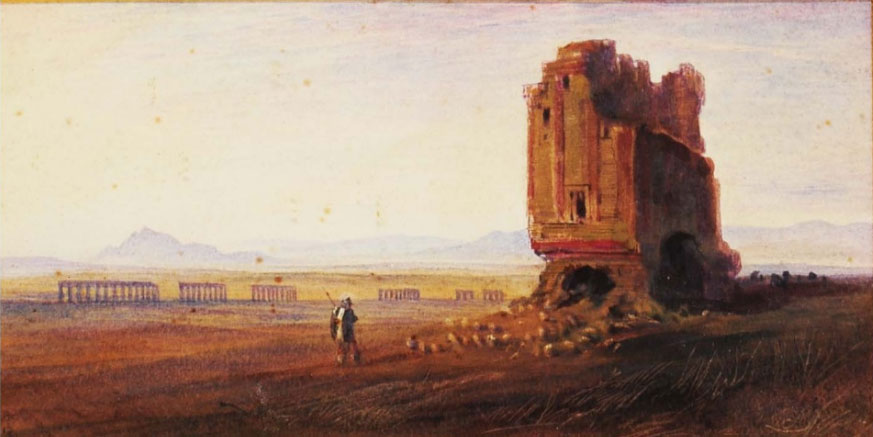
Edward Lear, Middle Eastern landscape with figure approaching a ruined tower and classical columns in the distance, signed with monogram, and dated 1873, watercolour with scratching out, 10 x 20cm; and companion, a pair (2).
[This one might well be a view of the Roman Campagna, in my opinion.]
Prov: With Foord & Dickinson, 90 Wardour St, London.
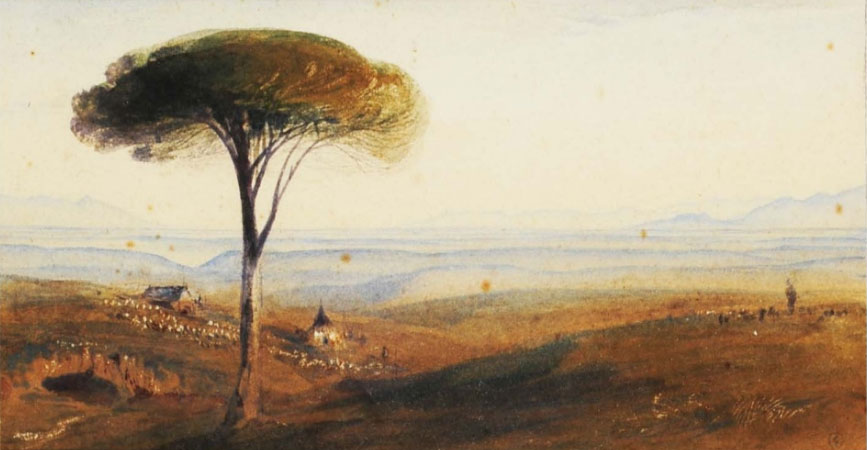
[This also looks like it might be a picture of the Campagna.]
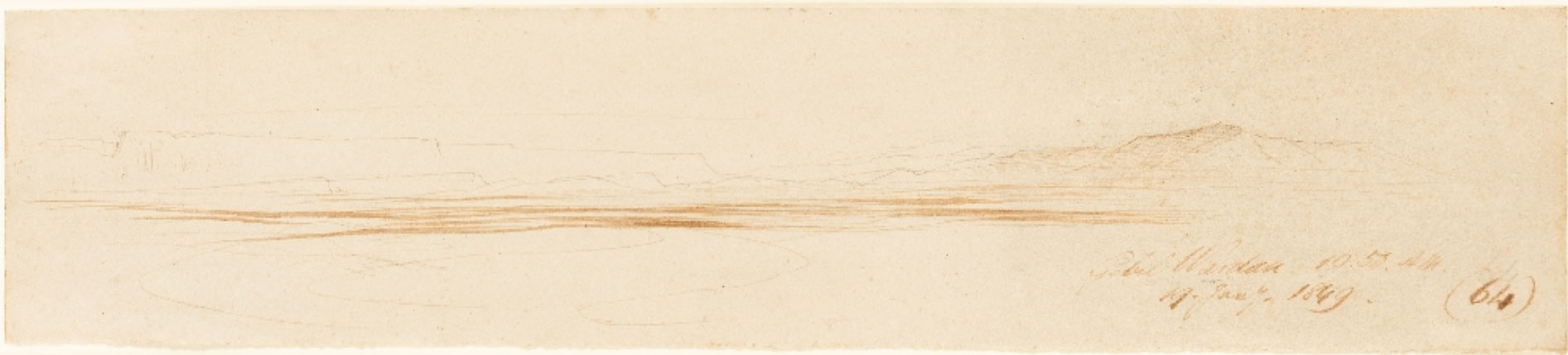
Edward Lear, Gebel Wardan, Sinai.
Inscribed and dated l.r.: Gebel Wardan 10.50.AM. / 19.Jany. 1849 (64). Brown ink and pencil. 7.5 x 35.5cm / 2.9 x 14.0in.
Provenance:
Mr and Mrs Godfrey Pilkington of the Piccadilly Gallery
Lear drew a large number of sketches on his travels through Egypt and the Sinai desert, having left Malta for Alexandria at the start of 1849. We know that later on this day in 1849, he was close to Hawara, the site of a complex Roman subterranean necropolis and the pyramid of Amenemhat III (No. 70 in the series depicts an Encampent Near Hawara, sold Christie’s, South Kensington, Old Master and Early British Drawings and Watercolours, 6th December 2012, Lot 277)

I missed this review of Jenny Uglow’s Mr Lear, you can read it here.
Listen to three Edward Lear arrangements, in Hungarian Translatio, by György Kósa:
The music comes from Kósa György: Home Concert – Songs and Chamber Works; Bokor Jutta, Judit Kiss-Domonos, Korondi Anna, Kósa Gábor. Hungaroton, 2007. HGR 32486.

The translations are taken from Edward Lear’s Boldog bolondságok, translated by Hajnal Anna, Illustrated by Gyulai Líviusz. Budapest, 1978. 64 p., ill.

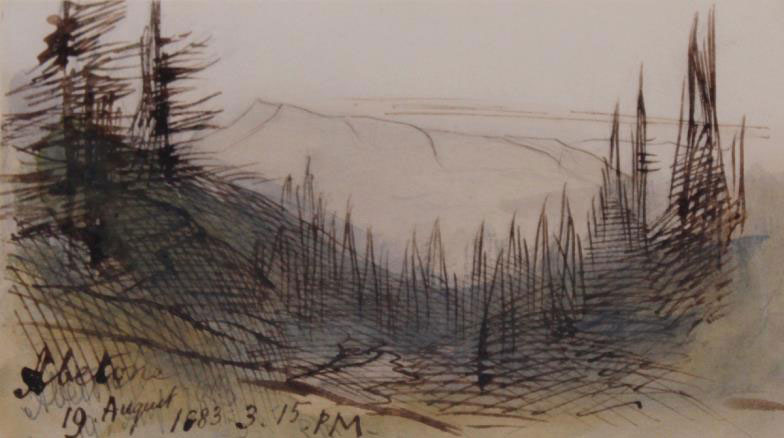
Edward Lear, Abetone.
Inscribed Abetone/ 19. August/ 1883 3.15pm in pencil and in ink. Watercolour with pen and ink 9.2 x 16.5cm. Abetone lies 80km north west of Florence, in Tuscany.

Edward Lear, Alderly, 1837, figures walking in a park.
Charcoal with white heightening on gray paper under Plexiglas. Signed lower left: Edward Lear, dated and titled lower right: June, 1837 . Sheet: 9.75″ H x 14″ W. Condition: Generally good condition. Framed floating and mounted to the back mat. Not examined out of the frame. Frame: 19″ H x 22.75″ W x 1″ D.


This Book, Marie Duval, edited by Simon Grennan, Roger Sabin and Julian Waite, has been available for some time: it has been a bit of a disappointment as the critical apparatus is almost non-existent. However, this is the only way to get some of Duval’s material in print. Much more is available online t the Marie Duval Archive. I discussed Marie Duval, whom I consider strongly influenced by Edward Lear’s nonsense, and her book A Choice Collection of Queens and Kings, and Other Things here.

James Williams’s long-awaited book on Edward Lear will be published at the end of the month, but on the publisher’s website you can find a lot of information, including an intriguing table of content.

They also tell me that the catalogue on Edward Lear in Amalfi has been printed and will be available soon (I haven’t seen a paper copy yet!). Tonight at 21:00 CET, RTC QuartaRete, a local channel will broadcast a long interview with Federico Guida discussing the book (in Italian of course). The program will be broadcast also on Wednesday 19 at 14:25, Thursday 20 at 23:25, Saturday 22 at 17:25 and Sunday 23 at 18:00.
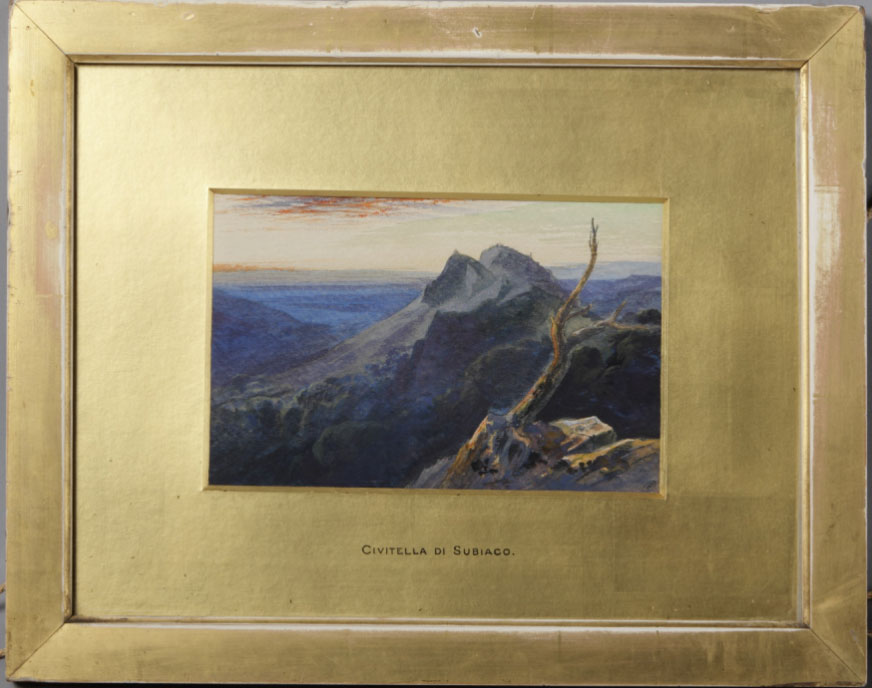
Another picture from Edward Lear’s projected set of Tennyson illustrations which was also realized as a watercolour:
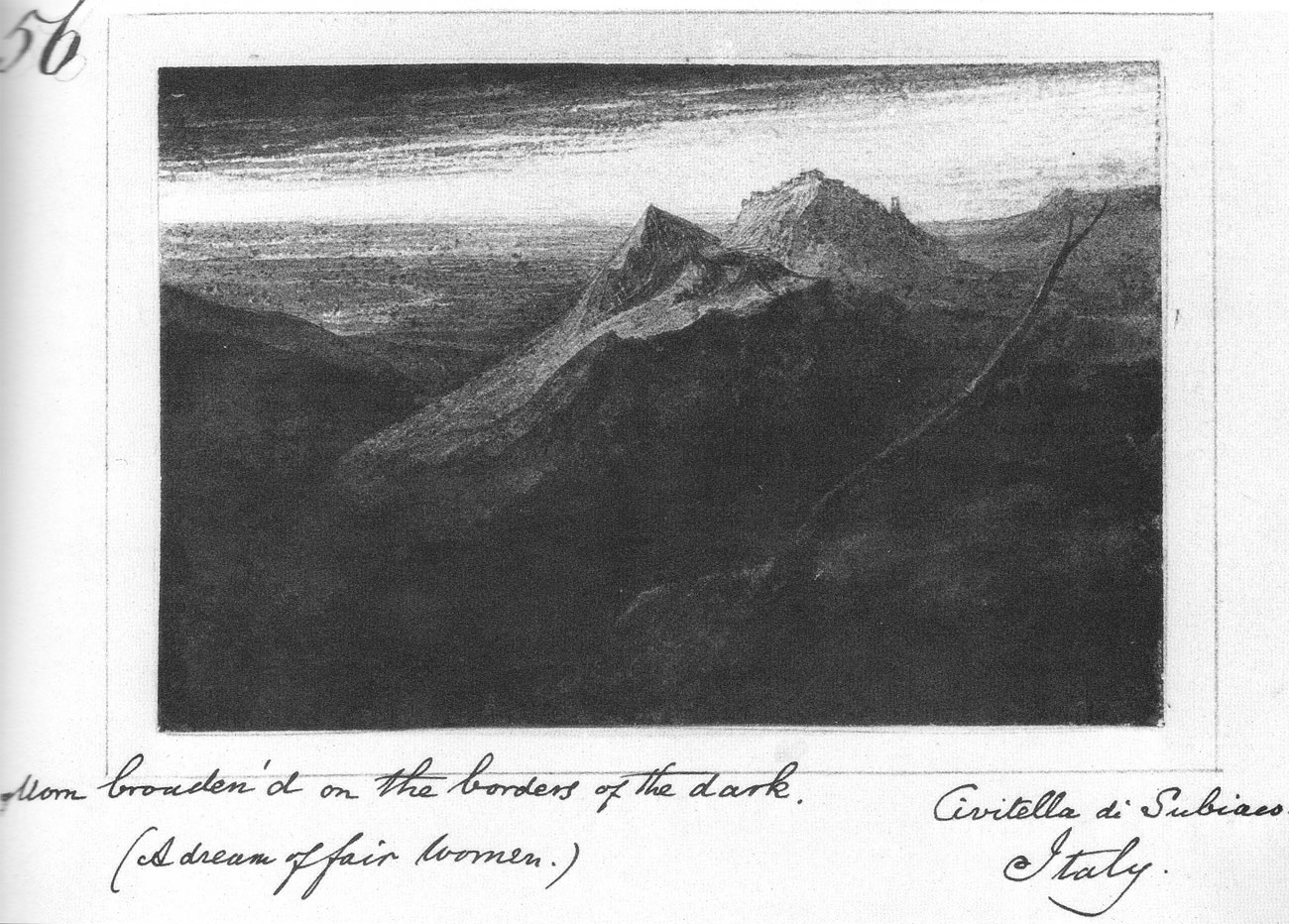
“Morn broaden’d on the borders of the dark,” from Tennyson’s A Dream of Fair Women (from Ruth Pitman’s Edwawrd lear’s Tennyson, p. 101). A colour version is now at Gumby Hall, Lincolnshire:
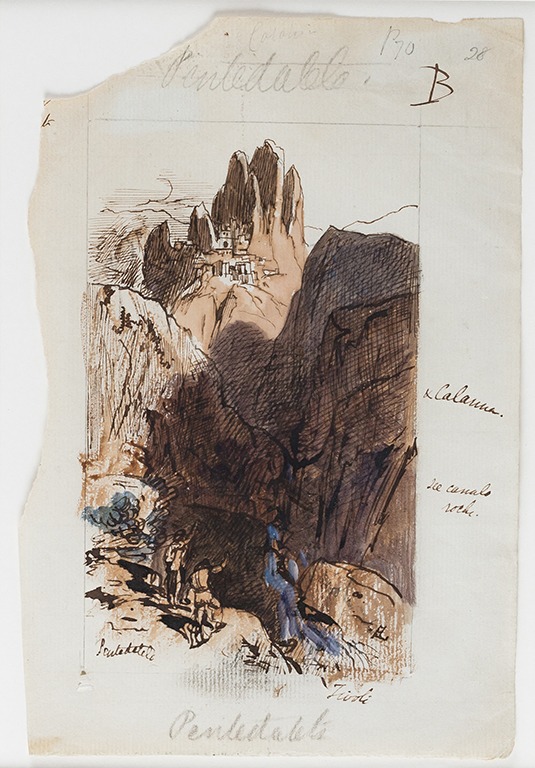
LEAR Edward,‘Pentedatelo’ (sic. Pentedattilo), Calabria.
Ink and watercolour. Signed and inscribed.
Lear’s Diary (30th July 1847) ‘ … the wild crags of Pentedatelo particularly arrested our attention…’
A sketch for the ill.opp.p.190, ‘Pentedatilo’, ‘Journals of a landscape painter in Southern Calabria’, publ. 1852. 8.25×5.5 inches the paper irregular. 6×3.25 inches the image. 16.5×13.5 inches.
Lear used a different picture of Pentedattilo, in which the “five fingers” are seen from afar, as an image for Tennyson’s The Palace of Art:

We know that he also produced an oil version of this and presented it to Hallam Tennyson and his wife, froma letter of 24 February 1886:
You (& Audrey) are to have the large picture of Pentedatelo or ‘someone pacing there alone’ — wh. indeed was a matter settled long ago — but my omcreasing ill health broke off an arrangement wh. was then being carried out, i.e. — of the picture being presented to you by 30 individual parties.
This I knocked up, & you must now kindly accept the picture as a sort of pro=legacy, & I hope you can place it well.
(Selected Letters, ed. Vivien Noakes, p. 277.)
According to Jasmine Jagger, the picture was received by Hallam and Audrey Tennyson on 11 March 1886 — this is the date used by Hallam when he writes to Lear:
We have just opened the picture case – and both my Father and myself exclaimed “How magnificent!” It is an extraordinarily fine realisation of the stanza. … We shall put Pentedaleto at Aldworth – and I shall always count it as one of my most precious possessions.
We learn from Ruth Pitman (Edward Lear’s Tennyson, p. 29) that “one version — with a ‘red man’ — of ‘someone pacing there alone’ ended up, after Lear’s death, in Tennyson’s last home at Aldworth.”
Jasmine is trying to trace that colour version, does anyone know where it is?
I posted colour image very like the one above last June, but it is missing the ‘someone pacing there alone.’

The watercolour is now with Karen Taylor.
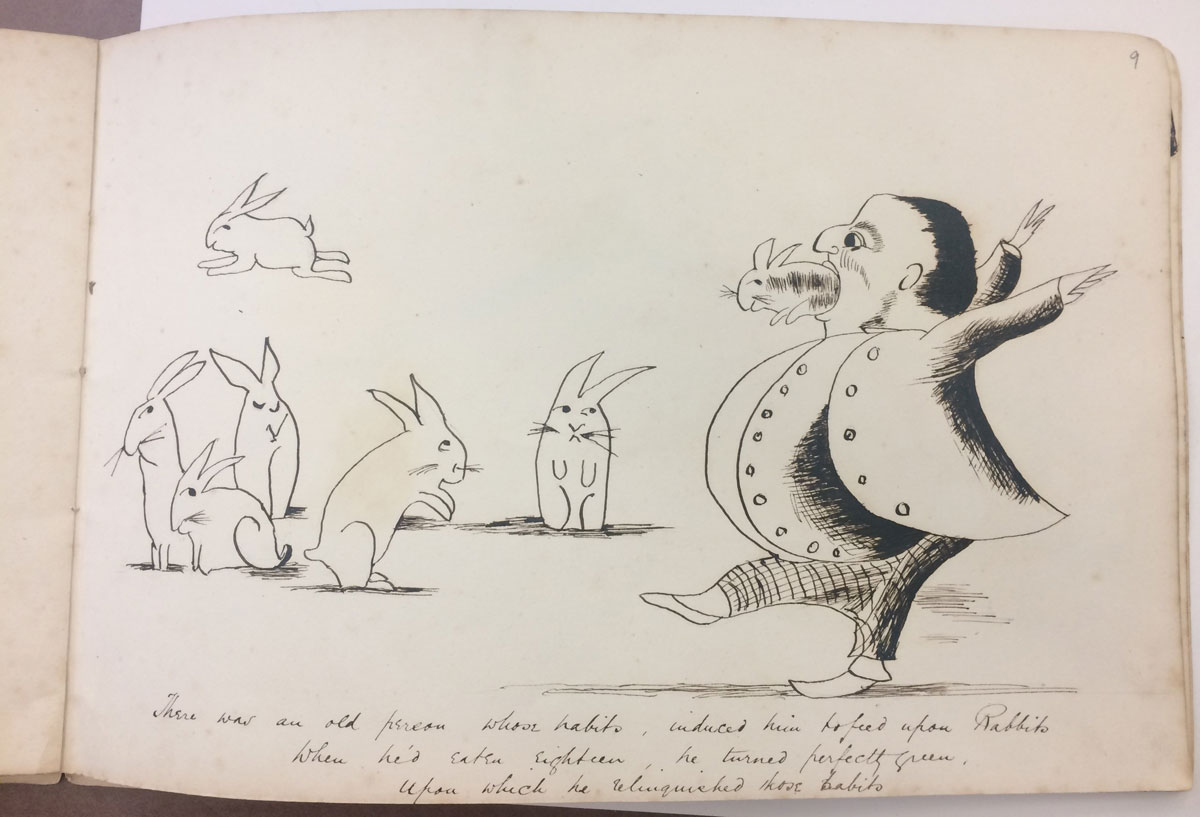
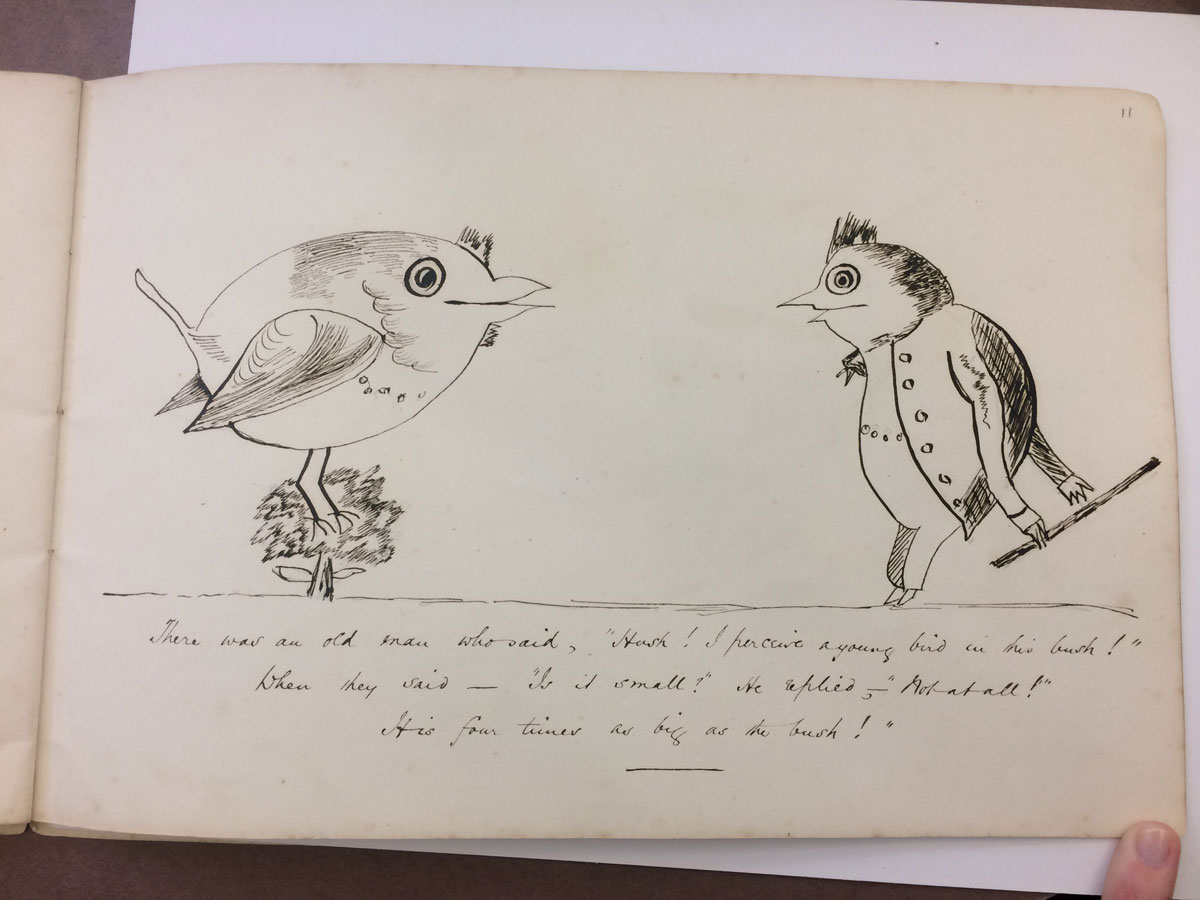
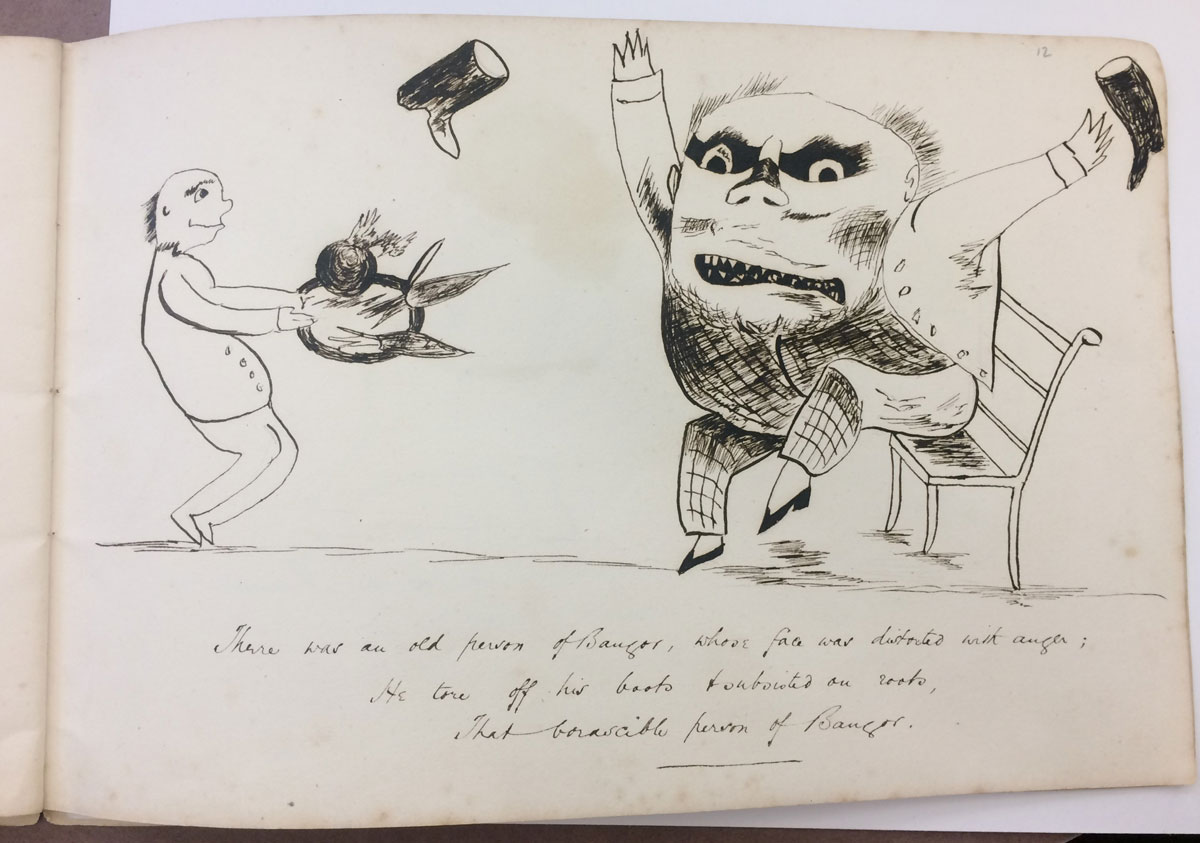
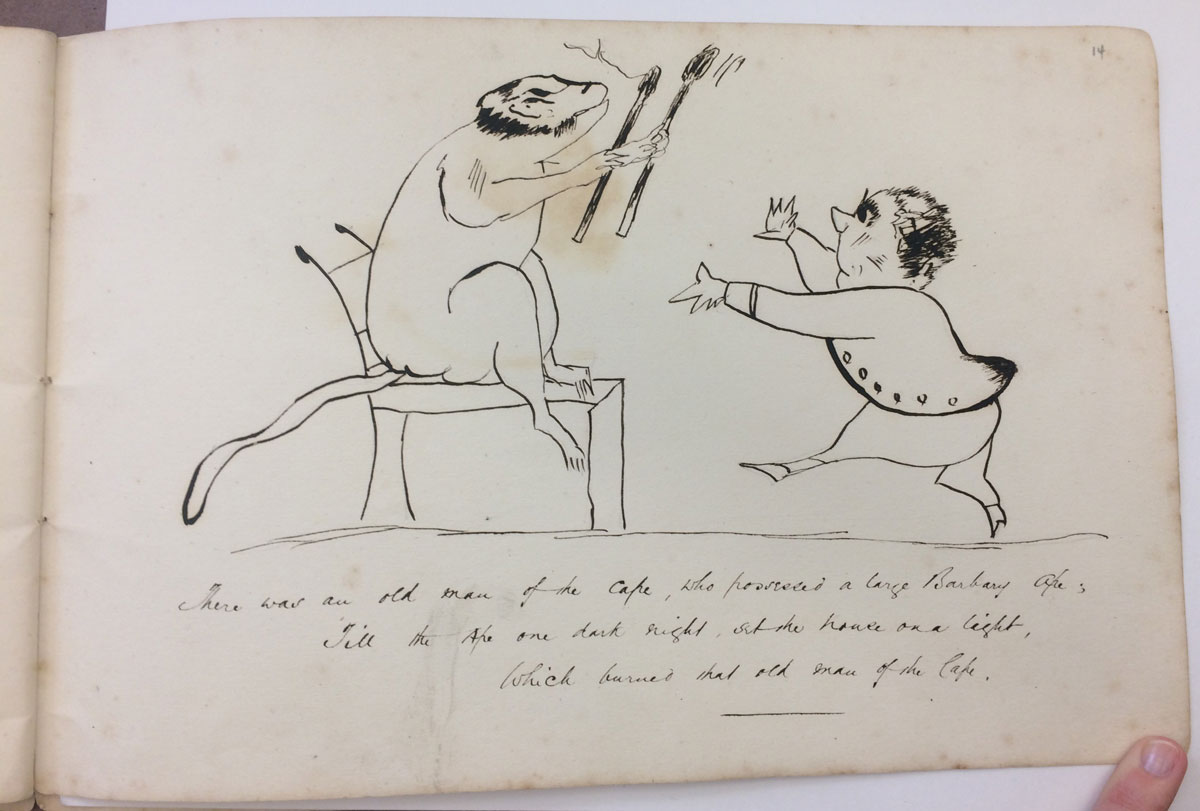
Ekaterina Shatalova (see here) sends the description of a manuscript copying several of Edward Lear’s limericks together with pictures; here they are:
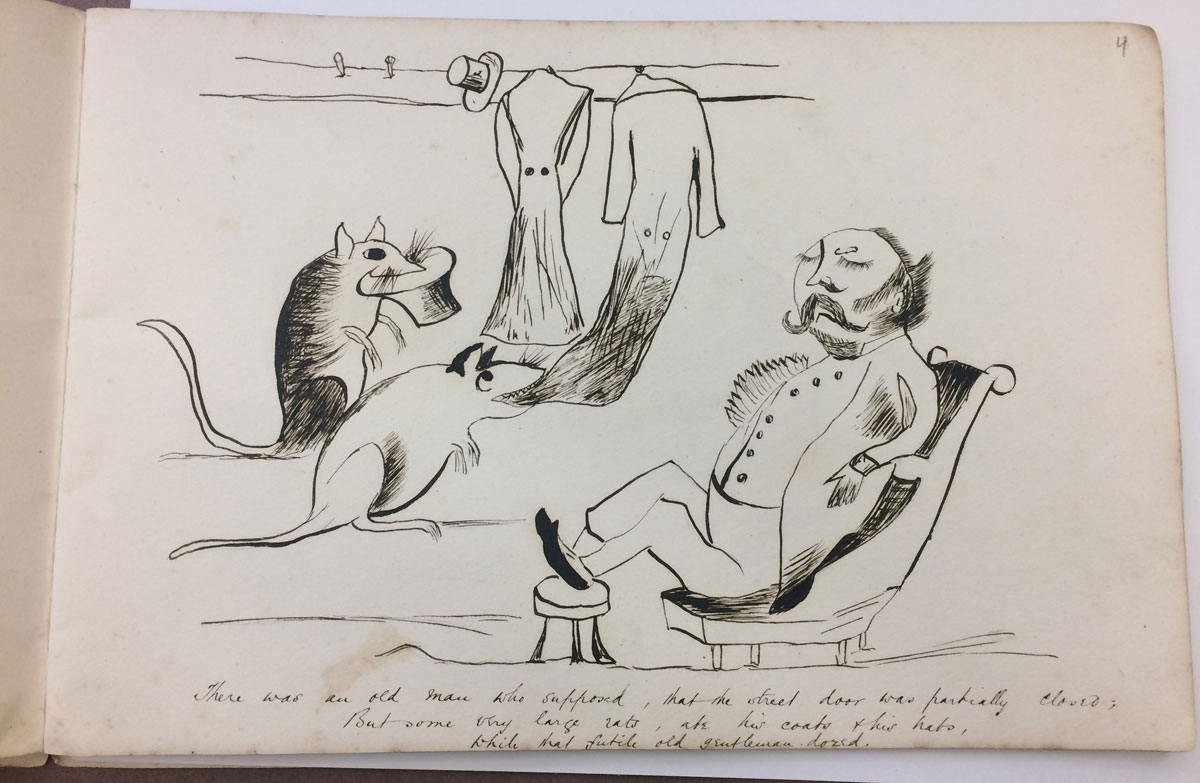
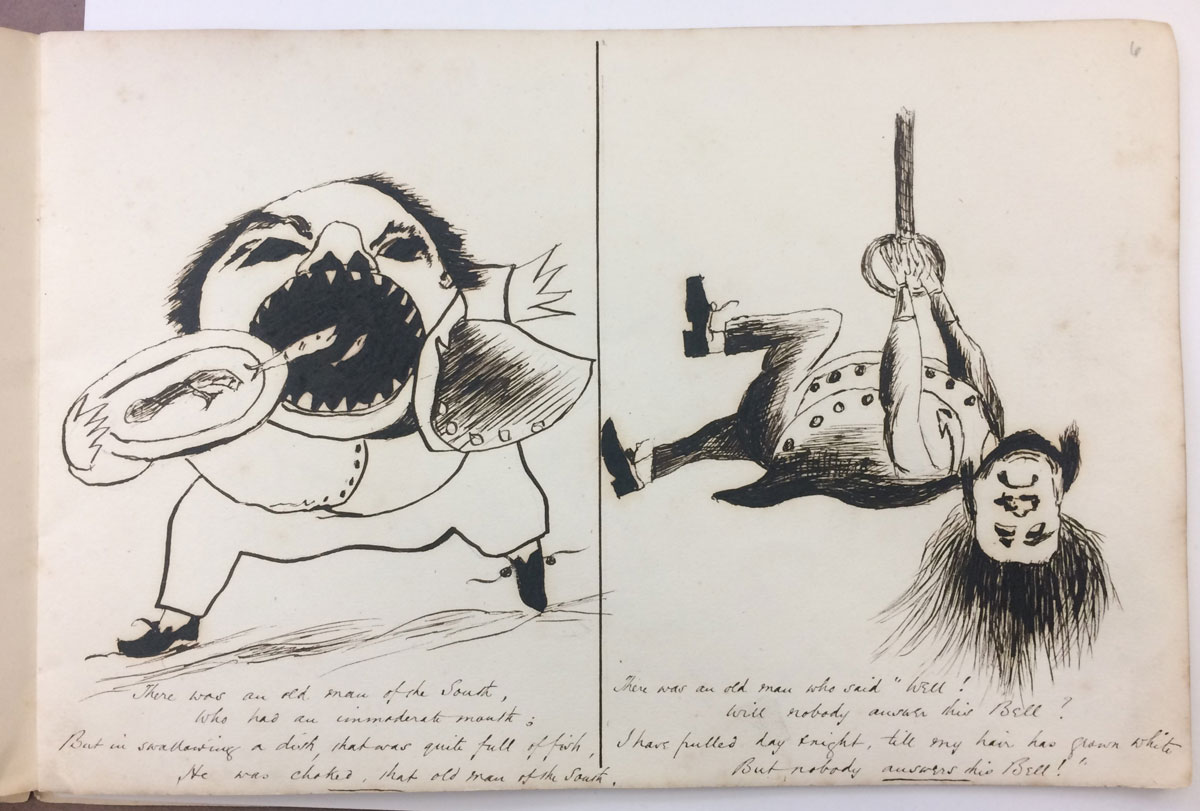
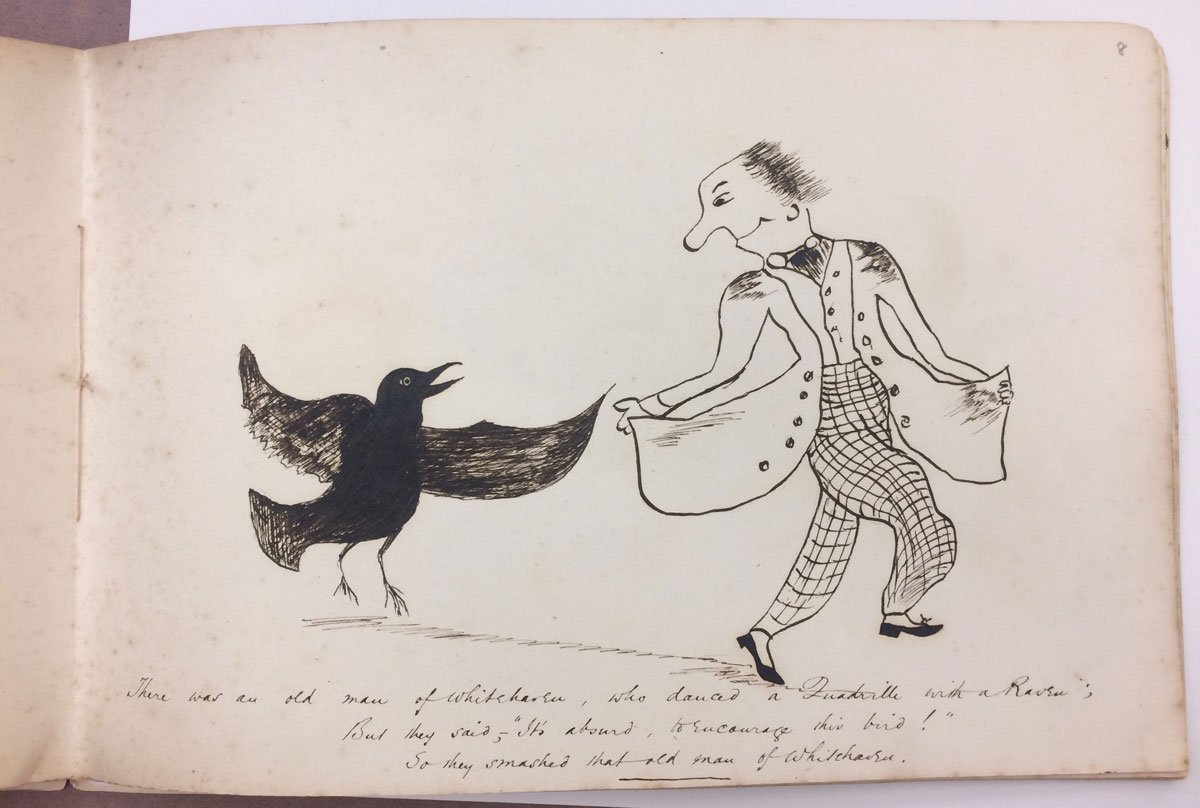
A rather delightful album of 15 original ink drawings repeating some of Lear’s limericks from Book of Nonsense. Late 19th century. Oblong 8vo, plain stiff paper wrappers; varying wear, drawings on rectos only, some ink bleeding to versos of leaves. The artist has copied Lear’s drawings to the best of his or her rude ability, copying the verses out faithfully by hand with the occasional omission of some punctuation marks. The compiler shared the limericist’s appreciation for old men, and includes here specimens from Bangor, the Cape, Coblenz, Jamaica, Kilkenny, Philae, Whitehaven, and the South, as well as men characterized by bovinophobia, hirsute aviaries, patient bell ringing, ornithological observation, erroneous supposition, and leporine diets. The one member of the fair sex included here, possessed of eyes of unique colour and size, testifies to the transgressive power of the female gaze in the Victorian age.
The seller’s advertisement of the album was accompanied by a lovely limerick:
An anonymous lover of Lear
Found the piece of nonsense too dear
So he made his own book
By aping the look
And the verse of that man without peer.
The whole list of the selected limericks:
There was an Old Man with a beard

There was a Young Lady whose eyes

There was an Old Man of Kilkenny

There was an Old Man who supposed
There was an Old Person of Philae

There was an Old Man of the South
There was an Old Man who said, “Well!”
There was an Old Man who said, “How”

There was an Old Man of Whitehaven
There was an Old Person whose habits
There was an Old Man of Coblenz

There was an Old Man who said, “Hush!”
There was an Old Person of Bangor
There was an Old Man of Jamaica

There was an Old Man of the Cape
 A Blog of Bosh