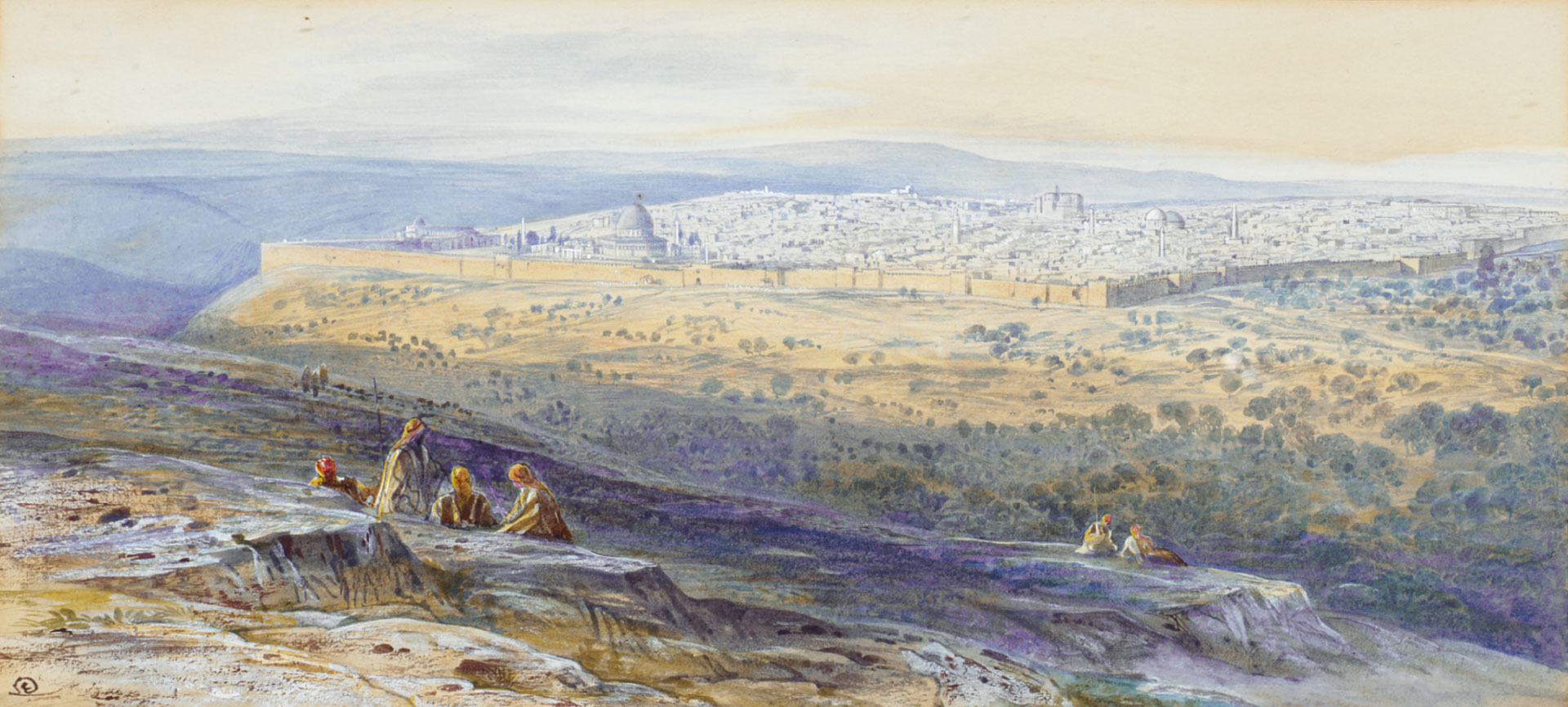
Edward Lear, Jerusalem from the Mount of Olives

Edward Lear, Jerusalem from the Mount of Olives.
Signed with monogram l.l. Pencil and watercolour heightened with white. 17 by 37cm., 6¾ by 14½in.

After leaving Corfu by the spring of 1858, Lear visited Jerusalem. He arrived during Holy Week and immediately began exploring the countryside outside the city walls: ‘We crossed the Kidron & went up the Mount of Olives – every step bringing fresh beauty to the city uprising behind. At the top, by the Church of Ascension the view is wonderfully beautiful indeed’ (see Vivien Noakes, Edward Lear 1812-1888, 1985, p.149). He was, however, reluctant to stay for long because of the Easter crowds, and soon left for Petra. He returned to the city on 20 April, and began working on a painting of Jerusalem at sunset from the Mount of Olives which Lady Waldegrave had commissioned. He also painted an oil of an almost identical viewpoint, but at sunrise. Lear spent almost a fortnight studying the view from the Mount of Olives and making a number of drawings which he used as the basis for later watercolours such as the present work. From his vantage point could be seen ‘the site of the temple & the 2 domes – and it shows the ravine of the valley of Jahosaphat, over which the city looks: -and Absalom’s pillar – (if so be it is his pillar – ), the village of Silouam, part of Aceldama, & Gethsemane are all included in the landscape. And besides this the sun, at sunset, catches the sides of the larger Eastern buildings, while all the upper part of the city is in shadow; – added to all which there is an unlimited foreground of figs, olives, & pomegranates, not to speak of goats, sheep, & human beings’ (see Lady Waldegrave, 27.V.58, manuscript, Somerset Record Office, Taunton). In 1865 Lear painted one of his most accomplished landscapes of the Holy Land, an oil of Jerusalem (Ashmolean Museum, Oxford) depicting a similar vista from the north-east side of the Mount of Olives, with shepherds and their flock in the foreground.

The first owner of this watercolour was Alfred Manners Drummond (1829-1921), son of Andrew Robert Drummond and brother of the banker Edgar Atheling Drummond (1825-1893). Edgar Drummond and Lear became friends after they met in Rome in the winter of 1858. Lear often mentioned Edgar’s younger brother Captain Alfred Manners Drummond, in his correspondence, and as he was an adventurous traveller and art collector, he also became one of Lear’s patrons. The picture remained in his collection until his death when it passed to his niece Dorothy, the first wife of Sir David Scott. For more information on Lear’s friendship with the Drummonds, see Maldwin Drummond’s book After You, My Lear – In the Wake of Edward Lear in Italy.

Provenance
Given by the artist to Alfred Manners Drummond (1829-1921) and thence by descent to his niece Dorothy Scott (née Drummond), first wife of Sir David Scott.

Sotheby’s.

Posted in Edward Lear | Tagged , , , , | Leave a comment

New Bibliography

Edward Lear, Amalfi (1839)

Dubois, Martin. “Edward Lear’s India and the Colonial Production of Nonsense.” Victorian Studies 61.1 (2018): 35-59.

Williams, James. “The Whole Situation.” Cambridge Quarterly 47.4 (2018). 387-394. (A review of Uglow’s Mr Lear).

Rizal, Sarif Syamsu. “Actantial Models in the owl and the Pussy-cat (A Narrative Scheme on Poem).” LITE: Jurnal Bahasa, Sastra, dan Budaya 15.1 (2019): 17-30.

Swaab, Peter. “Romantic Poetry and Victorian Nonsense Poetry: Some Directions of Travel.” Romanticism 25.1 (2019): 90-102.

Tillinghast, Richard. Edward Lear’s pilgrimage. New Criterion 37.6 (2019). 63-66. (A review of Uglow’s Mr Lear).

White, Donna R. “Nonsense Elements in Jane Austen’s Juvenilia.” Persuasions: The Jane Austen Journal On-Line 39.1 (2018).

Edward Lear, La Cava (20 July 1838)

Plus:

I have uploaded my contributions to last year’s book Edward Lear: Visioni inedite della Costa di Amalfi as well as my presentation in Amalfi last month at Academia.edu.

By the end of the year my article on “Edward Lear: A Life in Pictures” should appear in European Comic Art.

Edward Lear, Amalfi (8 June 1844)

Posted in Edward Lear | Tagged , , , , , , | Leave a comment

Meeting Edward Lear in Heaven

She wears a retro dress,
the waist nipped small
now that the tumors
don’t bulge, a skirt that swirls,
and dangling red earrings.

Time’s different there
and just this second
she’s spotted the tall man
excusing himself from Auden
and coming toward her, shy,
his hands outstretched.

Susan Blackwell Ramsay, “Meeting Edward Lear in Heaven,” in A Mind Like This, University of Nebraska Press, 2012, p. 83.

Posted in Edward Lear | Tagged , , , | Leave a comment

Northrop Frye on Edward Lear’s Last Lines

July 23, 1932

I read in a book on the limerick the other day by some supercilious ass who
talked about Edward Lear as a pioneer but a childish and inane primitive because his first and last lines ended with the same word, venturing to “improve”
some by rewriting their final lines. This latter method is all right for sillycleverness or obscenity,—or anything which makes the limerick do slave-labor
for some non-literary purpose,—but the gentle echolalic of Lear, the last line as a
reflective comment, establishes the limerick as art, modern smartness ruining its
delicacy by rushing the meter and clinching and compressing the theme. Lear is
the unchallenged and supreme master of the limerick, and almost the only one
who brought it definitely within the pale of literature. This person is an ass, as I
said before.

Northrop Frye’s Uncollected Prose. ed. Robert D. Denham. University of Toronto Press (2015). 39.

Posted in Edward Lear | Tagged , , , | 2 Comments

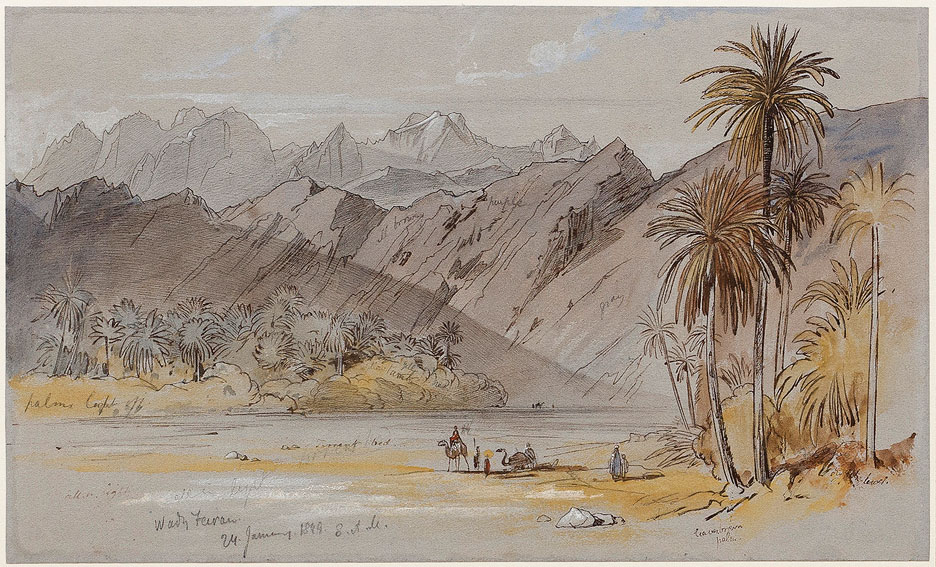
Edward Lear, Wadi Feiran (1849)

Edward Lear, Wady Feiran, Sinai Peninsula.
Ink, watercolour and gouache on blue/grey paper. Inscribed and dated by the artist ‘ Wady Feiran / 24 January 1849 / 8 A.M.’ and with artist’s note ‘Palms (?cut) off’, ‘Torrent bed’, ‘all in light’, ‘leaves brown / palm’, ‘dry palm leaves’. 7×11.5 inches.

Exhibited: Spink (No. K35871).

Posted in Edward Lear | Tagged , , , , | 1 Comment

Edward Lear, Hey, Diddle, Diddle (a New Version)

Edward Lear, “The little dog laughed to see such sport.”
Pen and brown ink on laid paper watermarked with Britannia. 16.2 by 20.3 cm., 6 1/4 by 8 in.

Provenance
With Gooden and Fox, London (pre-1973);
Yehudi Menuhin (1916-1999)

Lear is working on an illustration to the nursery rhyme `Hey Diddle Diddle’ in the
present drawing:
`Hey, diddle, diddle, The cat and the fiddle, The cow jumped over the moon; The
little dog laughed To see such sport…’ Lear illustrated this, as well as other well known traditional nursery rhymes, like ‘Sing a Song of Sixpence’ and ‘Goosy Goosy Gander’.

The present drawing is typical of the sort of drawing that Lear would produce to illustrate his own and other’s nursery rhymes and nonsense poems, characterised by a rapid pen line and simplified forms, often with exaggerated features. Lear was an accomplished poet who was passionate about the play of words and sounds and took great pleasure in inventing nonsense poems and limericks. It was apparently whilst staying with the 14th Earl of Derby at Knowsley between 1832 and 1837 that Lear began to make up nonsense rhymes and stories, accompanied by amusing cartoons and caricatures for the Earl’s grandchildren.

This drawing belonged to Yehudi Menuhin. His wife, Diana, was a fan of Edward Lear and the family chalet in Gstaad was named ‘Chankley Bore’ a reference to his poem, The Jumblies.

Guy Peppiatt Fine Art, British Drawings and Watercolours: 2019, auction catalogue.

Another version.

Posted in Edward Lear | Tagged , , , , | Leave a comment

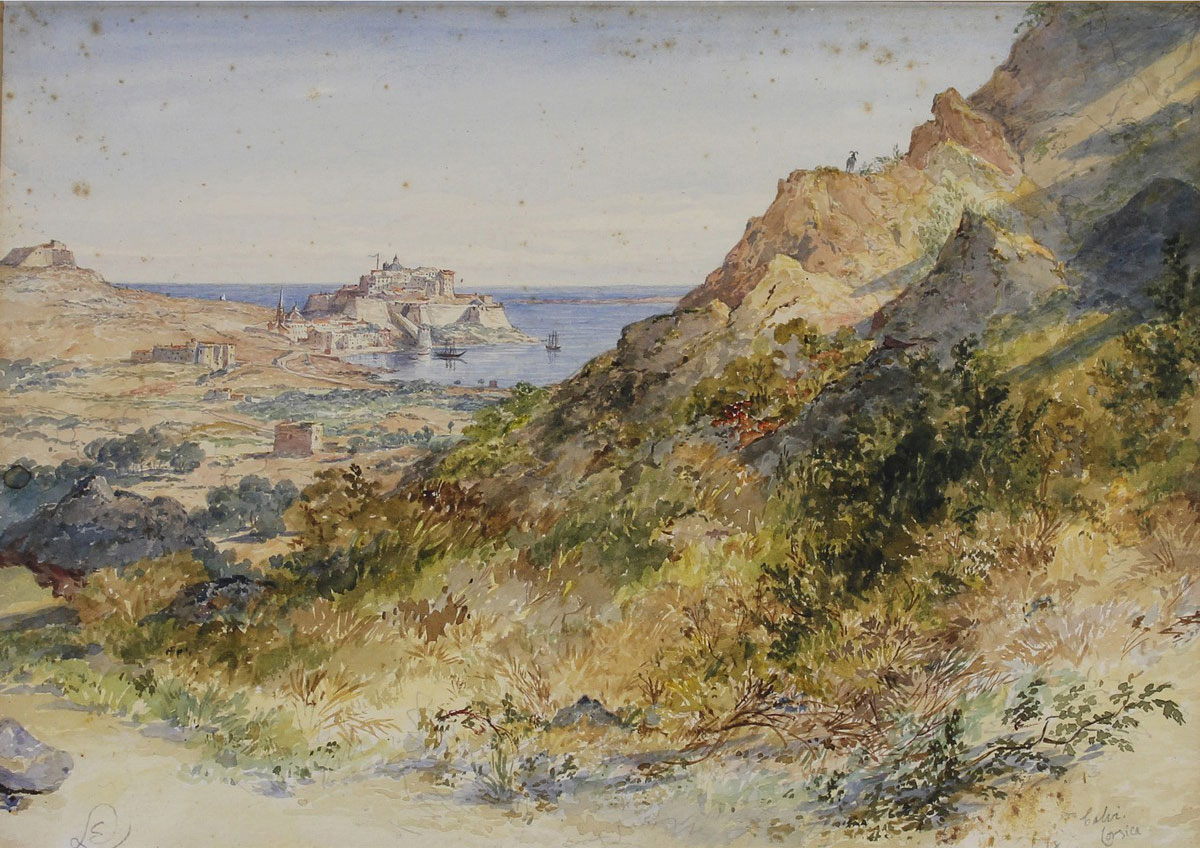
Edward Lear, Calvi, Corsica

Edward Lear, Calvi Corsica.
8. 9.5 x 13.25 ins., (24 x 34 cms.). Watercolour. Signed with monograph.

The Saleroom.

Posted in Edward Lear | Tagged , , , , | Leave a comment

Edward Lear [?], Adjutant Bird

Edward Lear, Adjutant Bird .
Watercolour. Partial signature. Inscription and date 17.8.86 17 x 12.5cm.

[I think the date unlikely, and I’ve never seen a date written this way by Lear, and the handwriting is not Lear’s; maybe the date refers to the acquisition of the picture?]

The Saleroom.

Posted in Edward Lear | Tagged , , | Leave a comment

Presentazione del libro Edward Lear: Visioni inedite della Costa di Amalfi

A post in Italian, once in a while.

Se siete dalle parti di Amalfi non prdetevi la presentazione del libro sui dipinti di Edward Lear realizzati nella zona: organizzato dal Centro di Cultura e Storia Amalfintana, saranno presenti il prof. Giovanni Camelia, Federico Guida e il sottoscritto:

Presswo le Bibliioteca comunale di Amalfi, sopportico Sant’Andrea 3, mercoledì 24 aprile 2019, alle ore 17:00.

Posted in Edward Lear | Tagged , , , | 2 Comments

Edward Lear and the Classics

It is well know that Edward Lear did not have a formal education, a fact that he apparently did not consider a limitation as he thought that it had left him with a curiosity to know new things that lacked in many people educated at the best universities. He certainly did not have a university-level education in the classical languages, but he very probably read a number of classical works in translation or, as a child, summaries of many. The theme has been extensively treated by Marian W. Makins in a recent essay, “Latin, Greek, and Other Classical ‘Nonsense’ in the Work of Edward Lear.” Classical Reception and Children’s Literature: Greece, Rome and Childhood Transformation. Eds. Hodkinson, Owen and Helen Lovatt. London and New York: I.B. Tauris, 2018. 203-25.

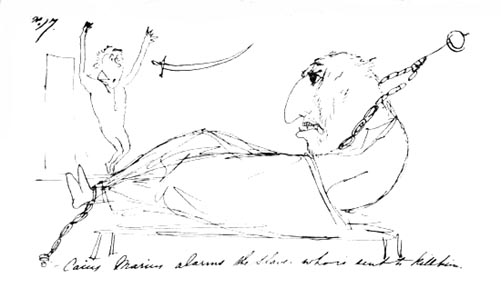
While discussing “The Tragical Life and Death of Caius Marius,” probably in large part based on Plutarch, Makins, p. 222 note 12, notices  that pictures 15 to 18 appear to be based on Oliver Goldsmith’s The Roman History, from the Foundation of the City of Rome to the Destruction of the Western Empire. Abridged for the Use of Schools, London: J. Williams, 1781, pp. 117-118. A book Lear had perhaps read as a young boy, or was reading with the child of a friend. After checking the text here is what I think she found corresponding to Goldsmith’s version:

Goldsmith writes, p. 117: “In this distress he was obliged to conceal himself in the marshes of Minturnum, where he spent the night up to his chin a quagmire.” The part which does not appear in Plutarch is “up to his chin.”

Goldsmith, p. 117: “being known and discovered by some of the inhabitants, he was conducted to a neighbouring town with an halter round his neck, without cloaths, and, covered with mud, was sent to prison,” and “The Governor of the place… soon after sent a Cimbrian slave to dispatch him; but the barbarian no sooner entered the dungeon for this purpose, but he stopt short intimidated by the dreadful visage and awful voice of the fallen general, …” The “halter” is not mentioned in Plutarch, nor is the man going to kill Marius defined as a “slave” and he offers to go, is not “sent.”

Goldsmith, p. 118: “”He afterwards landed in Africa, near Carthage, and went, in a melancholy manner, to place himself amongst the ruins of that desolated place”

Makins, however, misses, or chooses not to discuss another interesting classical reference by Lear in one of the two sequels to “The Owl and the Pussy-cat” he wrote. Published in the Complete Verse edited by Vivien Noakes, pp. 450-541, in “The Later History of the Owl and the Pussy-cat”, the cat dies after swallowing, “in a rage,” a document that “if found upon them the discovery would insuredly lead to acrostic results,” after her husband, the owl, refused to do so. Before falling off a tree and “perspiring,” the Pussy-cat manages to say: “My Pœtus! it is not painful.” This is an obvious reference to the story –  told by Pliny, Tacitus, Cassius Dio and Martial –  of Aulus Caecina Paetus, condemned to death for his participation in the revolt of Lucius Camillus Scribonianus; given the opportunity to kill himself, he wavered, but his wife Arria stabbed herself and then gave him the dagger saying: “Non dolet, Paete!” the exact words Lear reports in the letter and in the accompanying picuture.

Posted in Edward Lear | Tagged , , , , , | Leave a comment