Edward Lear, The Temple of Olympian Zeus, Athens (1848)

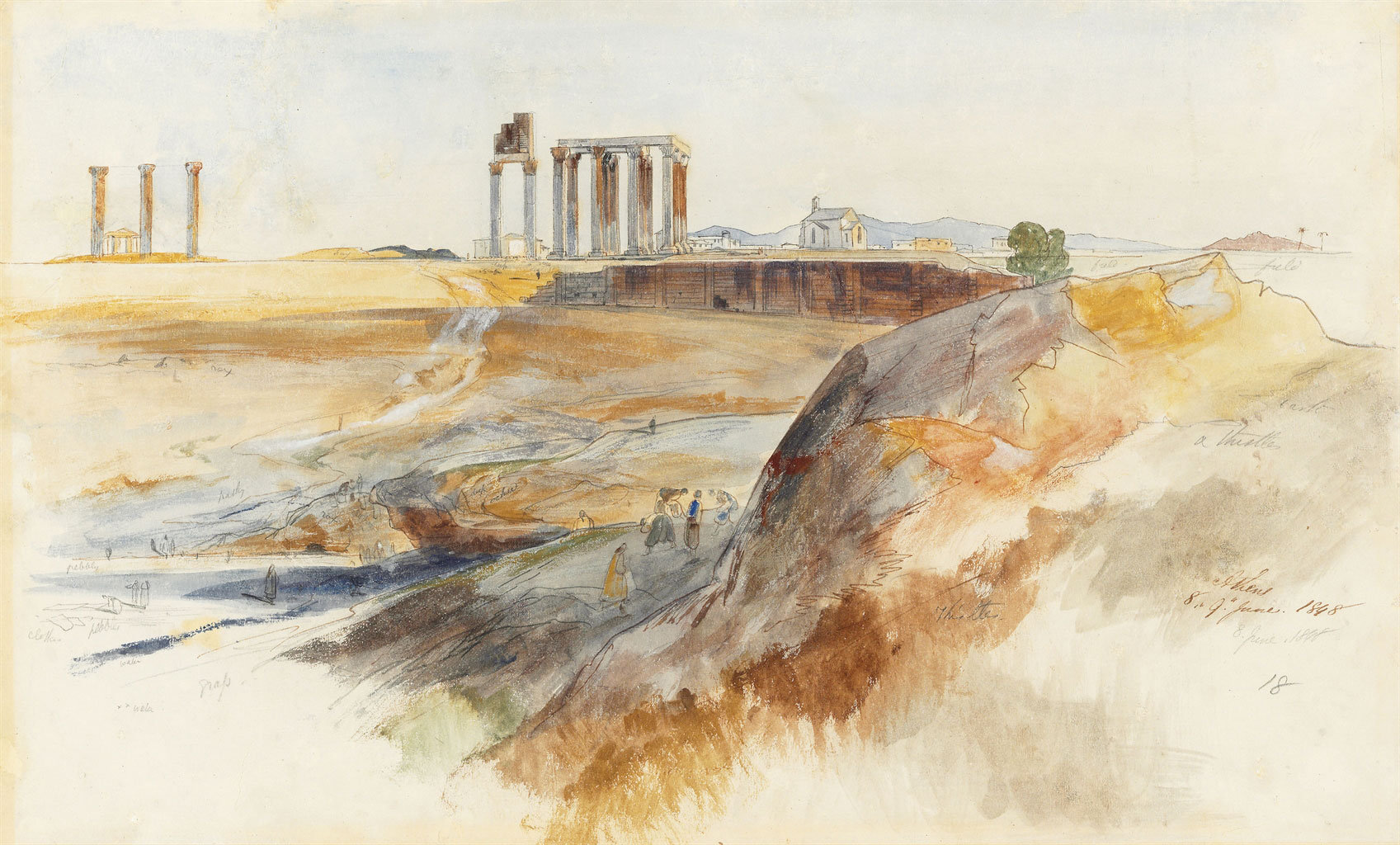
Edward Lear, The Temple of Olympian Zeus, Athens.
Inscribed and dated ‘Athens / 8. 9th June. 1848′, numbered ’18’ (lower right), and extensively inscribed with artist’s notes throughout. Pencil, pen and brown ink and watercolour, heightened with bodycolour. 11 1/8 x 18 3/8 in. (28.2 x 46.7 cm.)

Provenance
Charles Church, a gift from the artist, and by descent to the present owners.

Christie’s.

Posted in Edward Lear | Tagged , , , , | 3 Comments

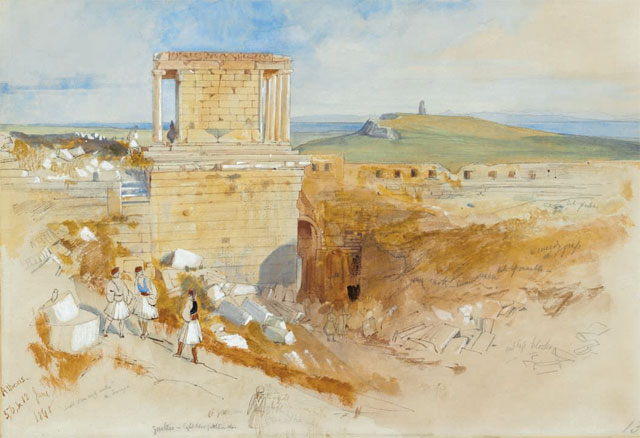
After Edward Lear, The Acropolis from the southwest

After Edward Lear, The Acropolis from the southwest, with the Temple of Athena Niké.
Inscribed and dated ‘Athens. / 5. 6. 7. June / 1848’ (lower left), and inscribed and numbered ‘(6) / a copy, made June 1866; the original belongs to / F.L.’ (Penned & traced in Edward Lear’s hand (?) by F. Underhill)’ (lower right). Pencil, pen and brown ink and watercolour, heightened with bodycolour. 12 7/8 x 20 3/8 in. (32.7 x 51.8 cm.)

Provenance
Charles Church, and by descent to the present owners.

Exhibited
Sheffield, Graves Art Gallery, Edward Lear, Drawings from a Greek Tour, July 1964.

The ‘F.L.’ mentioned in the inscription must be Franklin Lushington (1823-1901), Lear’s great friend who he met in Malta in 1849. Lear would later live with Lushington in Corfu, where the latter was a judge. Frederick Thomas Underhill (1846-1897) was best known as a copyist for the Guild of St George. Lear employed Underhill to prepare his illustrations of Tennyson’s poems for reproduction, but seemingly also employed him to copy other drawings: a diary entry from 31 October 1864 reads ‘Paid young Underhill £2.10.0 for his work: a good Lad’.

Christie’s.

Posted in Edward Lear | Tagged , , , , | Leave a comment

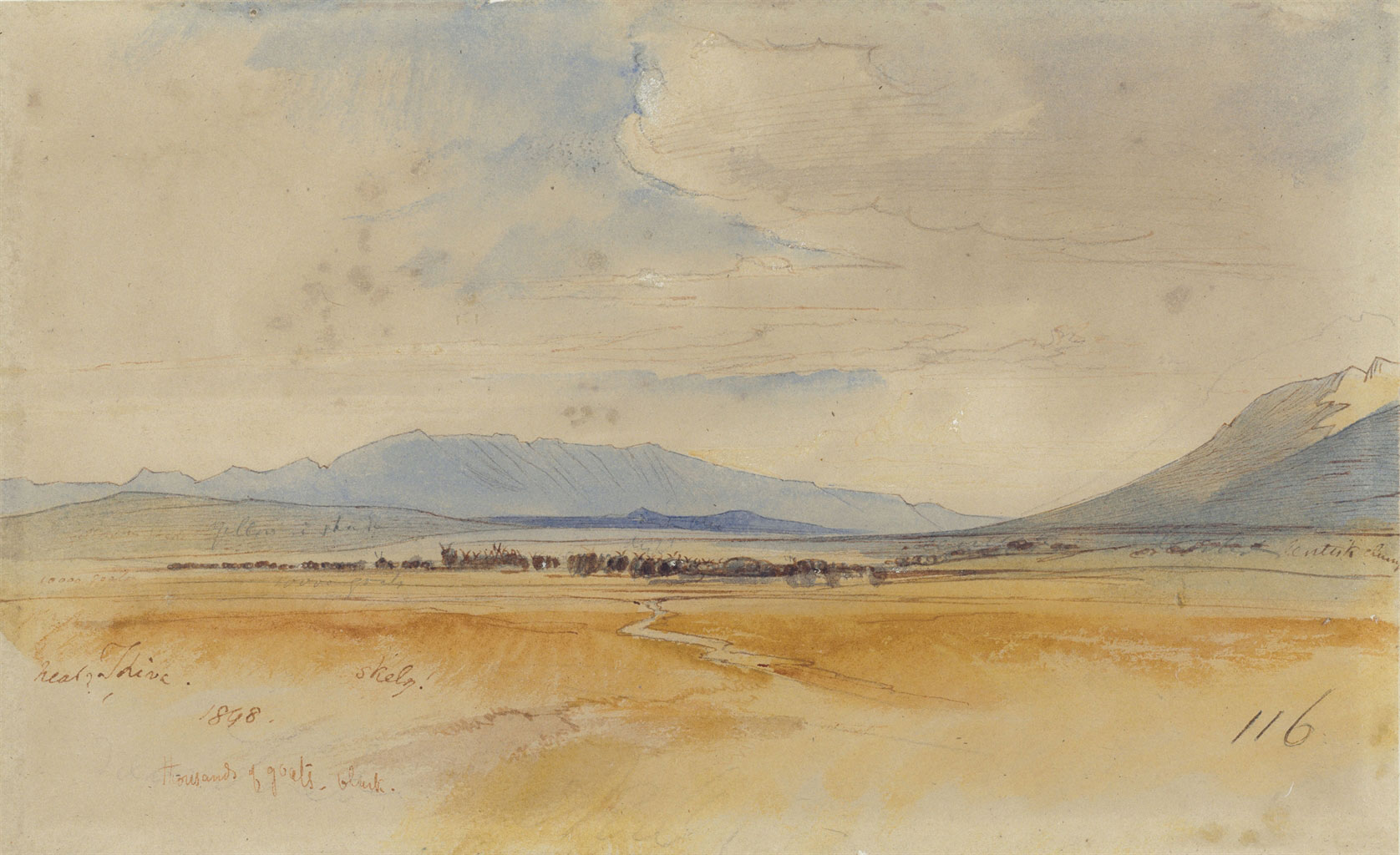
Edward Lear, Thousands of Goats, near Thebes (1848)

Edward Lear, Thousands of goats, near Thebes.
Inscribed and dated ‘near Thiva. / 1848./ thousands of goats black’ (lower left), numbered ‘116’ (lower right), and inscribed with colour notes throughout. Pencil, pen and brown ink and watercolour. 6 ¼ x 10 ¼ in. (15.9 x 26 cm.)

Provenance
Charles Church, a gift from the artist, and by descent to the present owners.

Christie’s.

Posted in Edward Lear | Tagged , , , , | Leave a comment

Edward Lear, The Temple of Nike Apteros, Athens (1848)

Edward Lear, The Temple of Nike Apteros, Athens.
Inscribed and dated ‘Athens../ 5, 6 & 12 June / 1848/ “and it was windy weather”/ A. Tennyson’ (lower left), numbered ’13’ (lower right), and inscribed ‘earth – innumerable bits of marble/ & weedy grass’ (centre left) and extensively inscribed with colour notes throughout. Pencil, pen and brown ink and watercolour, heightened with bodycolour on duck-egg blue paper. 13¾ x 20 in. (34.9 x 50.8 cm.)

Provenance
Charles Church, a gift from the artist, and by descent to the present owners.

Exhibited
Shefield, Graves Art Gallery, Edward Lear, Drawings from a Greek Tour, July 1964, no. 6.

Charles Church (1823-1915) frst met Lear in Rome in 1847, while he was travelling through Europe on his way to stay with his uncle Sir Richard Church (1784-1873), who had commanded the Greek forces in the War of Independence against Turkey. The two met up again in Athens in 1848, and made plans to travel around Greece together. Church had a great interest in the antique, and spoke modern Greek, which Lear had very little grasp of. The trip was the genesis of a lifelong friendship, and Church amassed a large collection of Lear’s work, both from this and later tours, with over one hundred 1848 sketches bequeathed to him by Lear at his death. Of the present group of seventeen drawings, ffteen date from the 1848 tour. Church later became Dean of Wells, and later in life wrote a manuscript which was never published, entitled WITH EDWARD LEAR IN GREECE: Being recollections of travel in Hellenic lands two generations ago, with extracts from his Journals and Letters, and illustrated by his sketches, recording their 1848 travels, and largely based on Lear’s now lost diary.

Church records that with the exception of the two Greek tours of 1848 and 1849, all Lear’s travels were undertaken alone, giving a sense of the importance of their relationship. Lear arrived in Athens on 2 June, and met Church the next day. Church records, ‘For the next ten days his journals describe him as giving himself up to the study of the scenes and art around,… “Doing nothing but draw, draw, draw”. Meanwhile I saw him most days on his sketching ground and was with him while he drew, and gradually our plans of travel grew.’ In those ten days, Lear made more than twenty sketches of the city, including four of this group (lots 229-232). From Athens they travelled to Chalcis, where their plans changed due to fghting in Thebes. A week’s tour of Euboea was added, and they arrived in Cumi on 20 June (lot 233). From there they went to Castella, and then arrived in Achmet Aga on 23 June (lot 234), the pass to which Lear described as ‘one of the most beautiful I ever saw — so stufed with vegetation. First, the running river, then Oleander endless; above, huge planes, hung with clematis or creepers, or oaks, or taller abeles. Above all this, infnite tall or branchy pine, some dead and glittering’. By 25 June, the two were in Kokkinomelia, where Lear noted, ‘Astonishing Swiss-like pinewoods! Magnifcent view of Gulf of Volo, which we stopped to draw.’ (lot 235). They travelled by boat to Lamia, where they found unrest but stayed anyway (lot 237), and spent a day visiting Patragik, where Lear depicted the soldiers gathered around ‘a sort of church’ (lot 236). From here, the route changed again, and the travellers set out for Thebes, with Lear drawing furiously on the way (lot 238). By the time they arrived in Thebes, Lear had a high fever, and the drawings made at Thebes and Plataea between 3 and 5 July (lots 238-241) were the last before they returned to Athens for him to recover.

The fnal two drawings (lots 242 and 243) date from September 1856, when Lear travelled from his home in Corfu to make a tour of the monasteries of Mount Athos. He travelled throughout the peninsular and succeeded in visiting all twenty principal monasteries and many of their dependencies. He produced a series of ffty drawings of the monasteries and landscapes, apparently intended to be published although this was never fulflled. On his return to Corfu he wrote at length to Church, telling him of his servant’s illness during the journey and recalling his own fever of 1848, as well as asking ‘Should you like any one of the Convents of Athos…or a general view of the mountain, or any other? or anything of Troy?’. Church noted on the foot of the letter that he had a drawing of the Monastery of St Paul, and these two were perhaps part of Lear’s later bequest.
Posted in Edward Lear | Tagged , , , , | Leave a comment

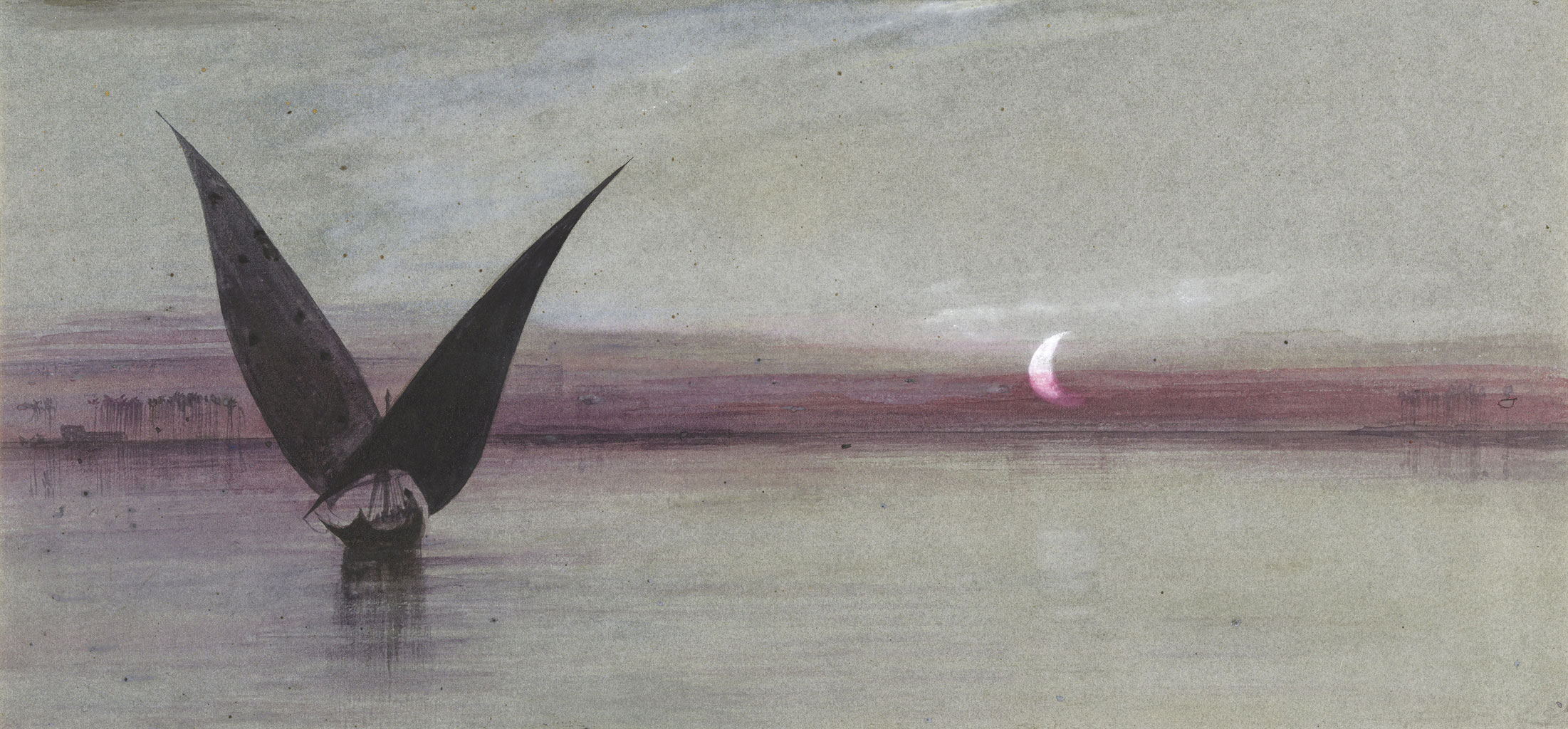
Edward Lear, On the Nile, moon setting

Edward Lear, On the Nile, moon setting.
Numbered and inscribed ‘No. 6/ ON THE NILE. MOON SETTING.’ (on the verso of the mount). Watercolour heightened with bodycolour and gum arabic on blue paper
7 1/8 x 14 7/8 in. (18 x 37.5 cm.)

Lear visited Egypt four times, firstly in 1848, then again in 1853 and 1854. He was captivated by the form of the Egyptian boats; writing to his sister Ann on 4 January 1854, ‘the most beautiful feature is the number of boats, which look like giant moths, -& sometimes there is a fleet of 20 or 30 in sight at once’. After a gap of thirteen years Lear set off on his final trip to Egypt in December 1866 writing ‘It seems a dream that I am about to see the blinding brightness of the south once more’. (V. Noakes, Edward Lear, The Life of a Wanderer, London, 1979, p. 174).

Christie’s.

Posted in Edward Lear | Tagged , , , , | Leave a comment

Edward Lear, Premeti, Albania (1858)

Edward Lear, Premeti, Albania.
Inscribed ‘Premeti’ (in Greek) and dated ’17. April. 1857.’ (lower left) and extensively inscribed with color notes. Pencil, pen and brown ink and watercolor. 11 7/8 x 20 ½ in. (30.5 x 51 cm).

In 1857 Lear was living and working on the Greek island of Crete. In April he undertook a journey to the mainland, spending three weeks exploring northern Greece and southern Albania. He spent three days following the River Viosje from Konitsa to Tepelene, reaching Premeti, or Përmet, just over the Albanian border on 17 April. Lear wrote to his sister Ann on 23 April: ‘The walk of the 17th by the side of the Viosa was magnificent…’, and he made several drawings of the area.
In the mid-19th Century Albania was a territory relatively unexplored by Englishmen, and Lear found it provided a wealth of subject matter: ‘You have that which is found neither in Greece nor in Italy, a profusion everywhere of the most magnificent foliage recalling the greenness of our own island…You have majestic cliff-girt shores; castle-crowned heights, and gloomy forests; palaces glittering with gilding and paint; mountain passes such as you encounter in the snowy regions in Switzerland…and with all this a crowded variety of costume and pictorial incident such as bewilders and delights an artist at each step he takes’ (V. Noakes, The Painter Edward Lear, London, 1991, p. 52). The present drawing depicts the famous stone of the city, and the arched bridge across the river which has now been demolished.

Christie’s.

Posted in Edward Lear | Tagged , , , , | Leave a comment

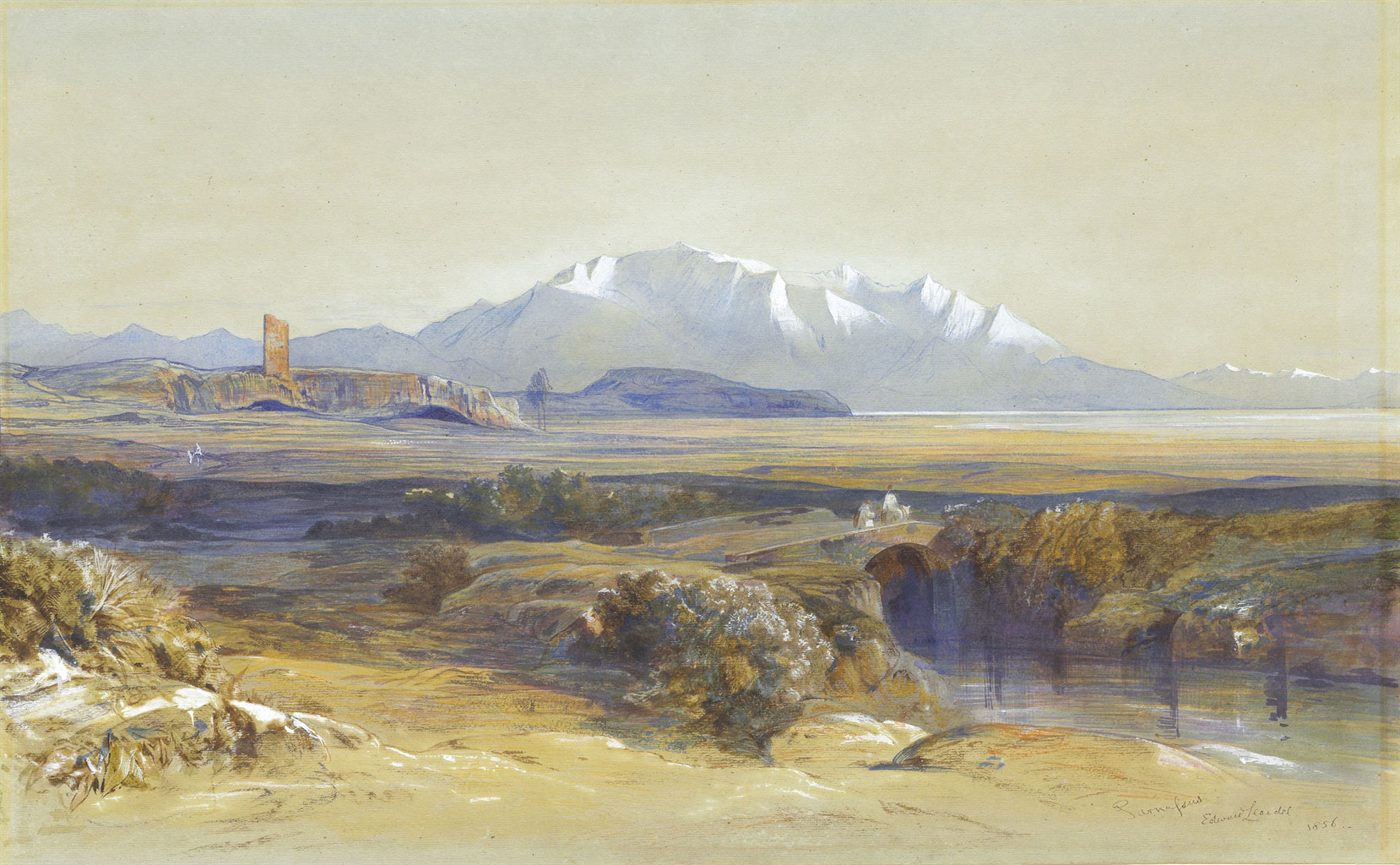
Edward Lear, Parnassus (1856)

Edward Lear, Parnassus, Greece.
Signed, inscribed and dated ‘Parnassus/ Edward Lear del./ 1856.’ (lower right). Pencil, pen and brown ink and watercolour, heightened with white on duck-egg blue paper. 12 ½ x 20 in. (31.8 x 50.8 cm.)

Provenance
Charles Church, a gift from the artist, and by descent to the present owners.

Exhibited
Sheffield, Graves Art Gallery, Edward Lear, Drawings from a Greek Tour, July 1964, no. 46.

Christie’s.

Posted in Edward Lear | Tagged , , , , | 1 Comment

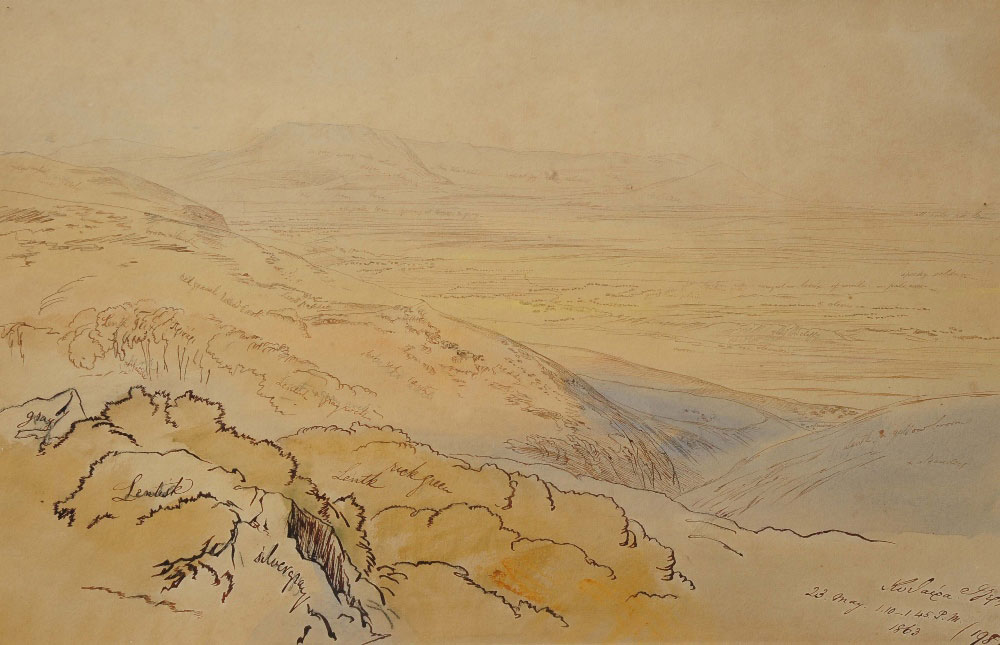
Edward Lear, Kythira (1863)

Edward Lear, The Island of Cerigo (Kythira), Greece.
Inscribed and dated ’23 May 1.10-1.45pm 1863′ and numbered ‘198’, pen, ink and watercolour with annotations, 32 x 48.5cm.

With Thomas Agnew & Sons Ltd.

The Saleroom.

Posted in Edward Lear | Tagged , , , , | 1 Comment

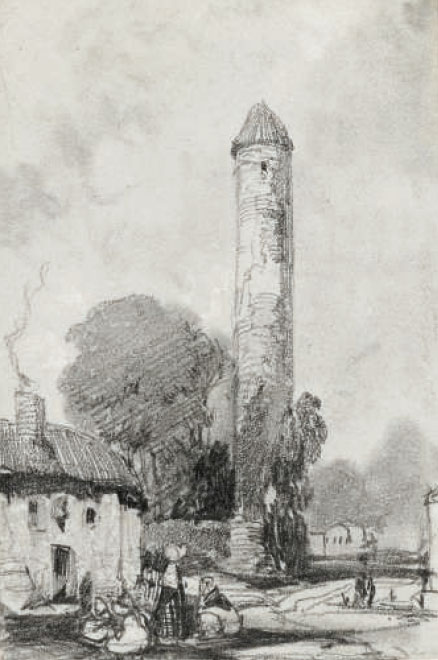
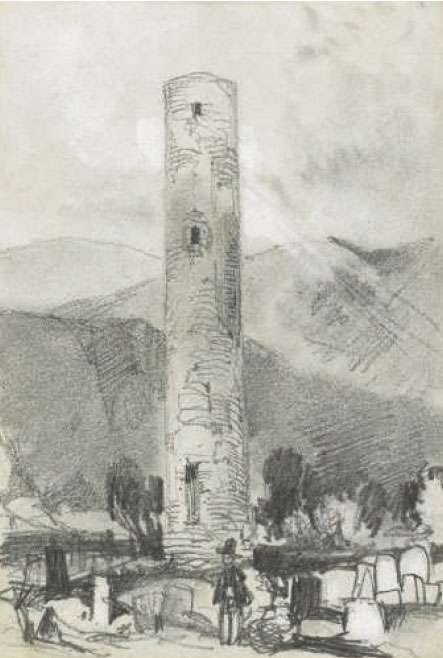
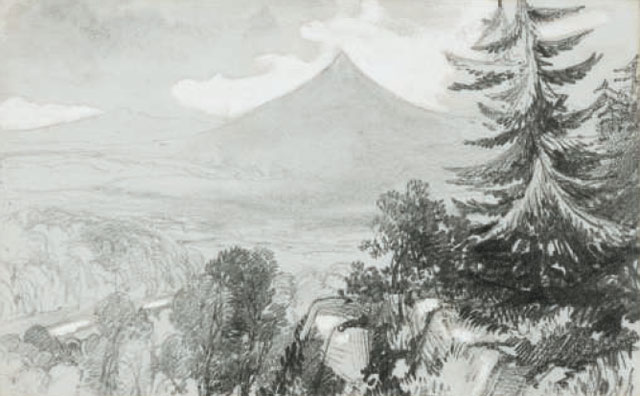
Edward Lear, More Views in Ireland (1835)

Edward Lear, Two views of towers at Clondalkin Tower, Co. Dublin; one of Glendalough tower, Co. Wicklow; and The Banqueting-room in the Demesne of Bellevue, with a view of Wicklow Head.
The fourth signed and inscribed ‘Wicklow Head/ ELear’ (lower centre and left). Pencil, heightened with white, on grey paper. 4 ¼ x 6 ½ in. (10.8 x 16 ½ cm.); and smaller (4).

Provenance
i and iii) Mary F. Shaw.
with Agnew’s, London, 1989.
ii) Mary F. Shaw.
with Agnew’s, London, 1989, where purchased by
Vivien Noakes.
iv) Robert A. Hornby.
Anonymous sale; Sotheby’s, London, 18 March 1982, lot 9 (part).

Exhibited
Grasmere, The Wordsworth Museum, Lear the Landscape Artist: tours of Ireland and the English Lakes 1835 and 1836, 2nd July – 4th October 2009, no’s 18, 19, 24 and 25.
iv) London, Royal Academy, Edward Lear 1812-1888, 1985, no. 13d.

Clondalkin tower may be identified by its expanded base, the only one of its kind in Ireland, and the only such tower to have a ‘cap’ in the 19th Century. Standing to the West of Dublin, it is not on the way to Wicklow, and would have been a day trip from the city. The tower at Glendalough has no cap, and is part of a monastery dating from the time of St Kevin in the 6th Century. Although it has been defunct as a monastery since the 14th Century, it remains a popular site of pilgrimage, as well as a tourist site. It seems likely that Lear made further drawings of the site which are not known to have survived.
Stanley recorded that after visiting Glendalough, the group stayed at Bellevue, the country house of the Dublin banking family the La Touches near Bray. The Banqueting-Room was a rustic masonry building in the grounds, built in a Gothic style, with views across the estate to Wicklow Head.

Christie’s.

See previous post.

Posted in Edward Lear | Tagged , , , , | 1 Comment

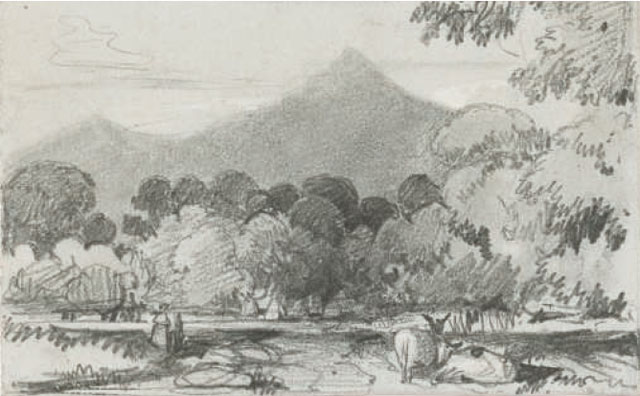
Edward Lear, Five Views in County Wicklow (1835)

Edward Lear, Five views in County Wicklow: The Great and Little Sugarloafs; The Great and Little Sugarloafs, from The Scalp; Figures beside trees, probably in the Powerscourt Demesne; Loch Tay looking north; and Bray, with the Little Sugarloaf in the distance.
The first signed and inscribed ‘Sugar Loaf/ ELear’ (lower centre and left). Pencil, some heightened with white, on grey paper. 4 ¼ x 6 ½ in. (10.8 x 16 ½ cm.); and smaller (5).

Provenance
i) Robert A. Hornby.
Anonymous sale; Sotheby’s, London 18 March 1982, lot 9 (part).
ii, iii, iv and v) Mary F. Shaw.
with Agnew’s, London, 1989, where purchased by
Vivien Noakes.
iv) Mary F. Shaw.
with Agnew’s, London, 1989

Exhibited
Grasmere, The Wordsworth Museum, Lear the Landscape Artist: tours of Ireland and the English Lakes 1835 and 1836, 2nd July – 4th October 2009, no’s 20, 21, 22, 23 and 26.

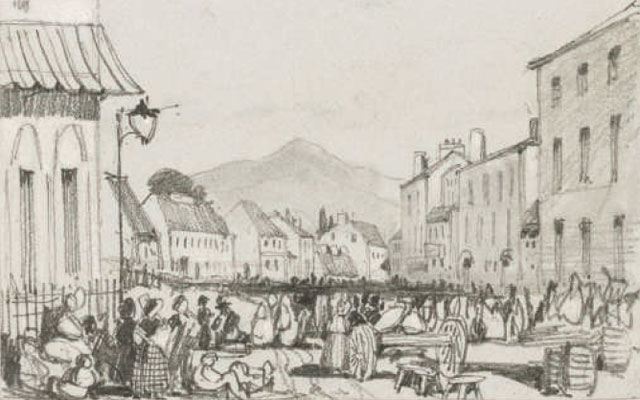
Lear went to Ireland in 1835 with his friend Arthur Stanley (later Dean of Westminster), as well as Stanley’s brother, father and uncle, for the annual meeting of the British Association for the Advancement of Science (BAAS) in Dublin from 10 to 15 August. When the meeting finished, part of the group set off to walk through Wicklow, and Lear made a sketchbook of drawings, of which this and the following lot are the largest group known to remain. Arthur Stanley’s diaries were later published, and give some idea of how the journey might have looked.
The first three of these drawings were probably taken in or near Lord Powerscourt’s deerpark. The view of Loch Tay shows the rocky scarp of Luggala on the left. The view of Bray is an important record of the appearance of the town before the arrival of the railway in 1854. Taken from outside the Market House on market day, it must date from either Saturday 22 or Tuesday 25 August, on Lear’s return journey to Dublin.

Christie’s.

Posted in Edward Lear, Uncategorized | Tagged , , , , | 1 Comment