Edward Lear, Argostoli and the Black Mountain, Cephalonia (1863)

Edward Lear, Argostoli and the Black Mountain, Cephalonia.
Inscribed, numbered and dated ‘Argostoli [in Greek]. (129)/May 5. 1863.’ (lower right) and extensively inscribed with colour notes. Pencil, pen and brown ink and watercolour. 12 7/8 x 19 ¾ in. (32.8 x 50.3 cm.)

Provenance
Gilbert Davis (L. 757a).
William Cavendish Bentinck, 9th Duke of Portland and by descent to
Anonymous sale; Christie’s, New York, 30 January 2014, lot 72.

Christie’s.

Posted in Edward Lear | Tagged , , , , | 1 Comment

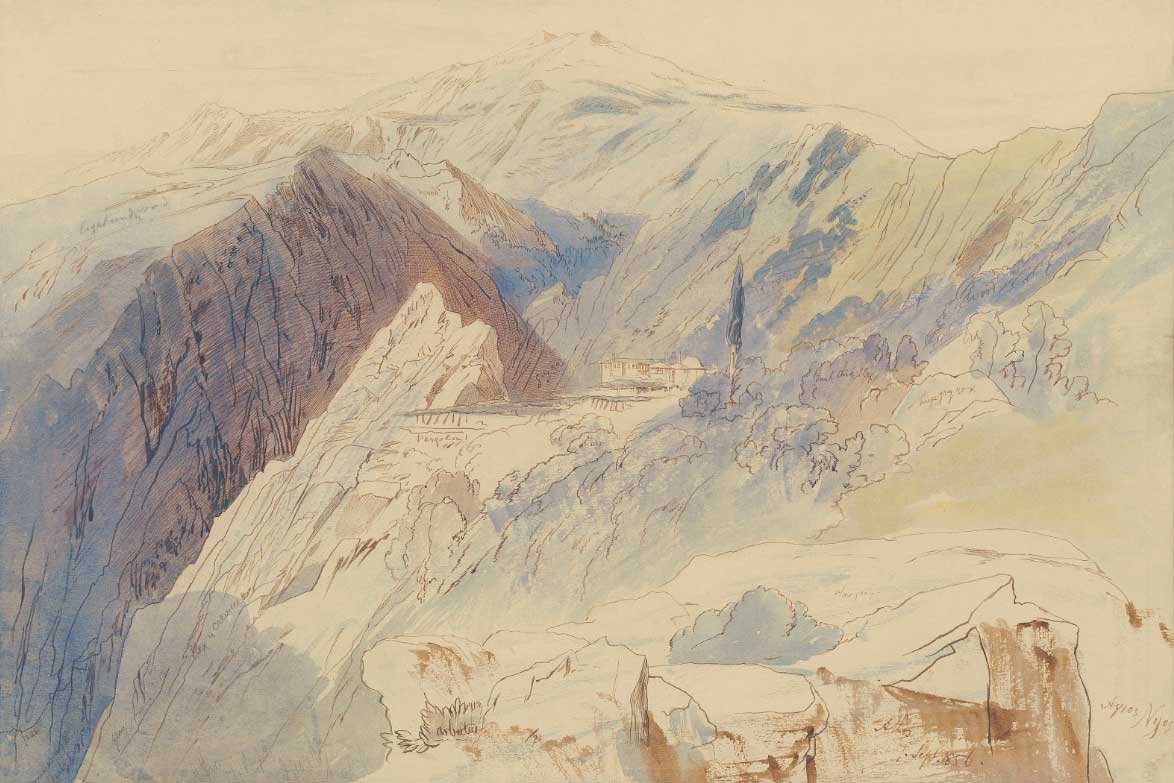
Edward Lear, The Monastery of St Nilus, Mount Athos (1856)

Edward Lear, The Monastery of St Nilus, Mount Athos.
Inscribed in Greek ‘Ayios Nilos’ and inscribed and dated ‘Athos./ 7.Sept.1856.’ (lower right) and further inscribed with colour notes. Pencil, pen and brown ink and watercolour. 14 x 20 ¾ in. (35.6 x 52.7 cm.)

Provenance
Anonymous sale; Sotheby’s, London,13 July 1989, lot 217.
with Agnew’s, London, where purchased for the present collection.

Christie’s.

Posted in Edward Lear | Tagged , , , , | Leave a comment

The Darwins and Edward Lear’s “scroobious”

Edward Lear was always in contact with naturalists, especially as a young ornithological illustrator. He certainly provided illustrations for  The Zoology of Captain Beechey’s Voyage (1839) and may have had a part in the production of Charles Darwin’s Zoology of the Voyage of HMS Beagle; Robert Peck (The Natural History of Edward Lear, p. 15) writes: “Whether or not he helped Gould, and his wife, Elizabeth, create some of the illustrations for Charles Darwin’s report on the birds seen during the voyage of HMS Beagle, is unclear, but he was certainly close at hand during that exciting time…”

The Darwin family very probably was familiar with Lear’s nonsensical works, as a letter 28 September 1874 from one of Charles’s sons, Leonard Darwin (1850-1943), to his mother Emma demonstrates:

The preparations for lunch now necessitate another turn on deck   At lunch the general wish is to eat as little as possible, as dinner at four comes so soon after it. —an arrangement of meals which the captain says kills the day   I think it kills it too much. Crawford is the wit of the party, and generally keeps us laughing; I expect it does not take a big joke to kill here but I think he is really very amusing. Between lunch and dinner I read my Mill which is progressing slowly. After dinner some light book, a pipe, and about the 50th. turn on decks does away with the time till tea, at 7. After tea I never attempt to read, it is so delightfully cool on deck. and rather the reverse below. At 8 o’clock we begin a religious game of whist; then a final turn on deck and so to bed. Yesterday I went aloft for the first time it is rather a scrubious sensation at first; not that I felt giddy actually but only a trifle unhappy   What strikes one most is how little the ship below looks, and what a wonder it is that it is not blown flat over. I went on the top gallant yard to look for Madeira, but it was too soon to see it. It is quite beautiful to see the ship cutting through the waves from above; there was not a cloud in the sky and the water was most wonderfully blue.

The word “scrubious” is of course a variant on Lear’s invention of “scroobious” and the way Leonard uses it makes clear that he expected his mother, and probably the whole family, would understand what he was referring to.

Here is the whole annotated text of the letter.

Posted in Edward Lear | Tagged , , , | Leave a comment

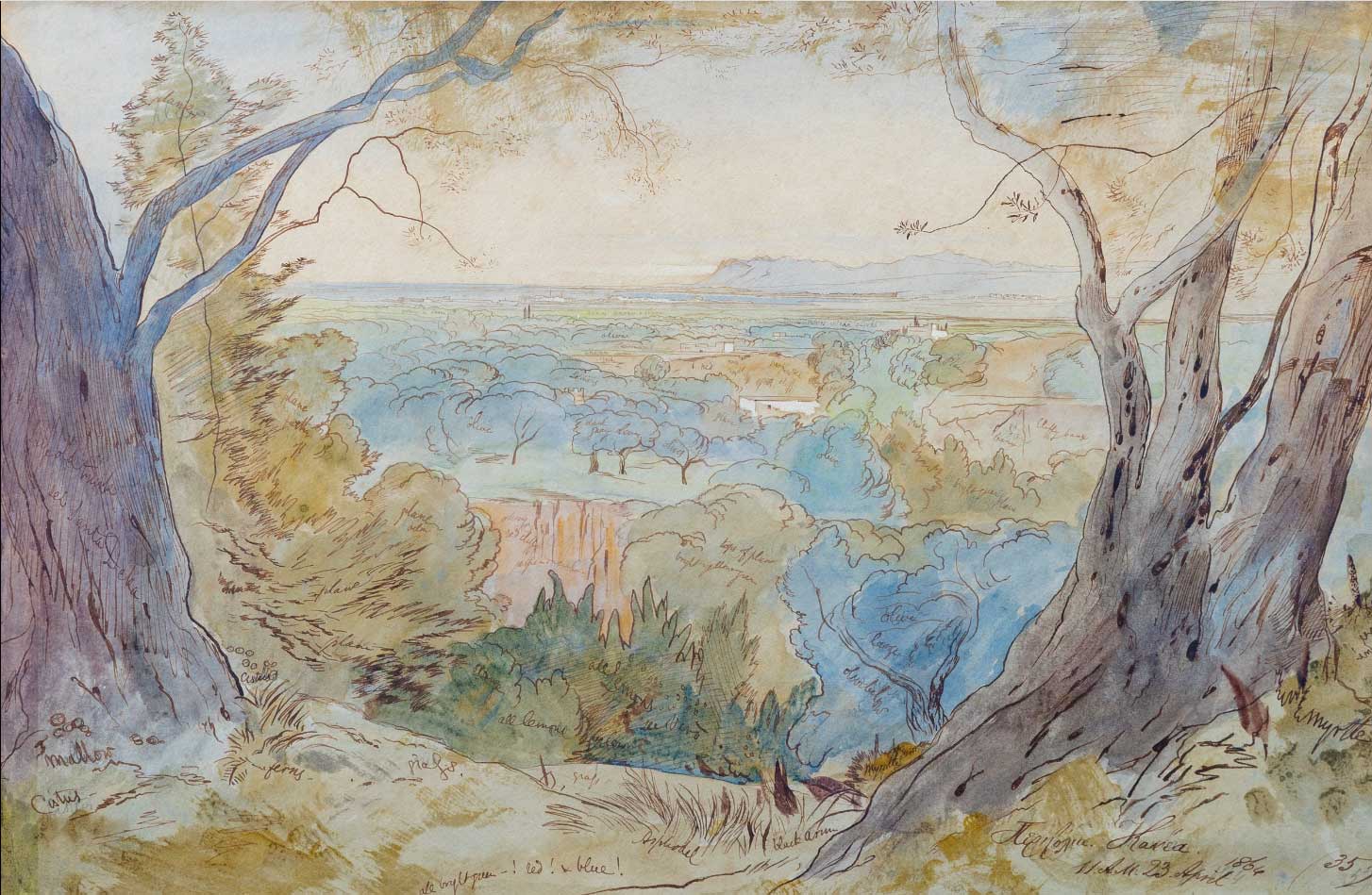
Edward Lear, Near Perivolia, Chania, Crete (1864)

Edward Lear, Near Perivolia, Chania, Crete.
Pencil, pen, ink and watercolour heightened with white. 370 × 540 mm. (14 ⅝ × 21 ¼ in.). Inscribed (in Greek) Perivolia. Chania and dated 11 A.M. 23 April 1864 and numbered (35).

The location of this remarkable watercolour had been unknown until its recent rediscovery. It is recorded as no. 30 – Near Perivolia – 11 a.m. in the list of Cretan drawings made by Lear’s friend and executor, Frank Lushington, now held by the Yale Center for British Art at Yale n the Edward Lear archive.

Lear reached Crete on 11th April 1864, a week after leaving Corfu, his final departure from his island home for the past nine years, brought by the end of British rule and the cession of the Ionian islands to Greece. The voyage via Athens to Crete was uncomfortable which cannot have helped his state of mind, already somewhat depressed by the change of circumstances. Lear recorded each day’s events in his journal, now in the Houghton Library, Harvard.

On 23rd April Lear wrote: “Rose at five. Very lovely and George and I off at six; I in great pain from some unknown cause in left foot – left wrist also very painful. Out of spirits. Hobbled to the streets by the gate and drew a little, so that now I can make a drawing of it. Then by the paved Turkish road, drawing a picturesque tomb, towards the Perivolia villages. Drew below a large olive – at this part of the plain there are really fine trees – the beautiful scene I had marked on the [18th]: foreground a great waving pale green corn meadow, then large olives deep gray beneath the green down-like hills, topped by the snow range. Beyond this, at nine, we threaded through ruined villages – what a state they are in! – hardly seeing a soul, to the west of the plain; but then, missing our way, had to work back till we reached the huge olive boles, whence all the plain is seen, a blaze of colour; the yellow-green of the plain and the frittery bright lemon groves, the darker orange, gray olive, red cliffs, lilac hills and blue sea! Nightingales delighted by singing, orioles and hoopoes by showing themselves…….. Certainly this corner of the plain of Hanià is wonderfully lovely and the lemon groves are positively amazing.”

The present watercolour is of the scene described above, reflecting the bright colouring Lear records. His travels through Crete covered the centre and west of the island, visiting the relatively few known classical sites, which did not at that time include Knossos and Phaestos, yet to be rediscovered. He finally departed Chania on 31st May. Alive to the political problems posed by the Turkish rule and of a population divided between a Greek majority and a mixture of other races, he kept himself at a distance from this as he had in earlier excursions, for instance in Calabria in 1847.

James Mackinnon.

Posted in Edward Lear | Tagged , , , , | Leave a comment

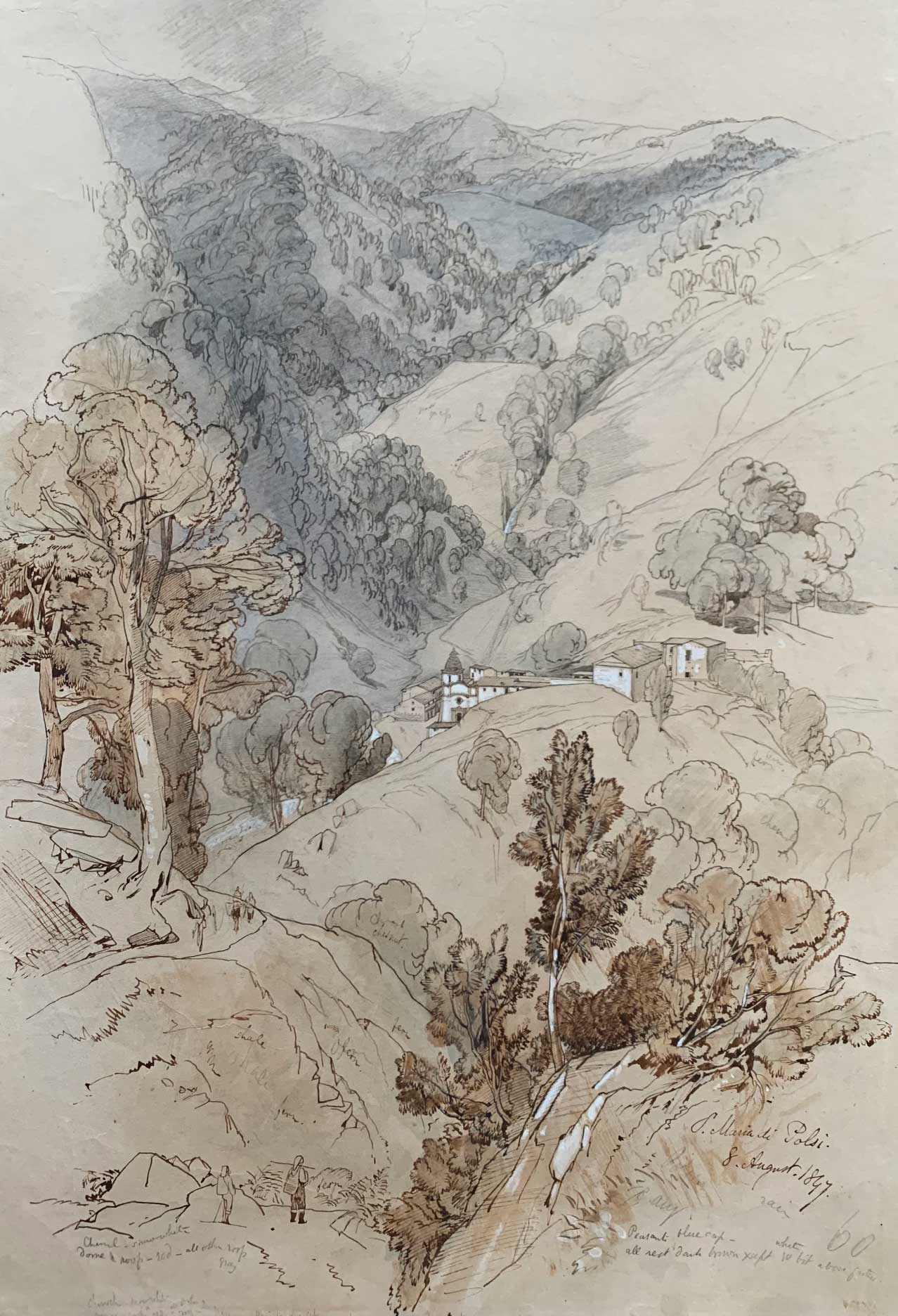
Edward Lear, Santa Maria di Polsi (1847)

Edward Lear, Santa Maria di Polsi.
Pencil, pen and ink with wash, heightened with white. 497 × 343 mm. (19 ⅝ × 13 ½ in.). Signed, inscribed and dated: “8 August 1847”.

Lear travelled in Calabria in 1847. The lithograph of Santa Maria di Polsi in his Journals of a Landscape Painter in Southern Calabria and the Kingdom of Naples, London, 1852, is based on this drawing.

James Mackinnon.

Posted in Edward Lear | Tagged , , , | Leave a comment

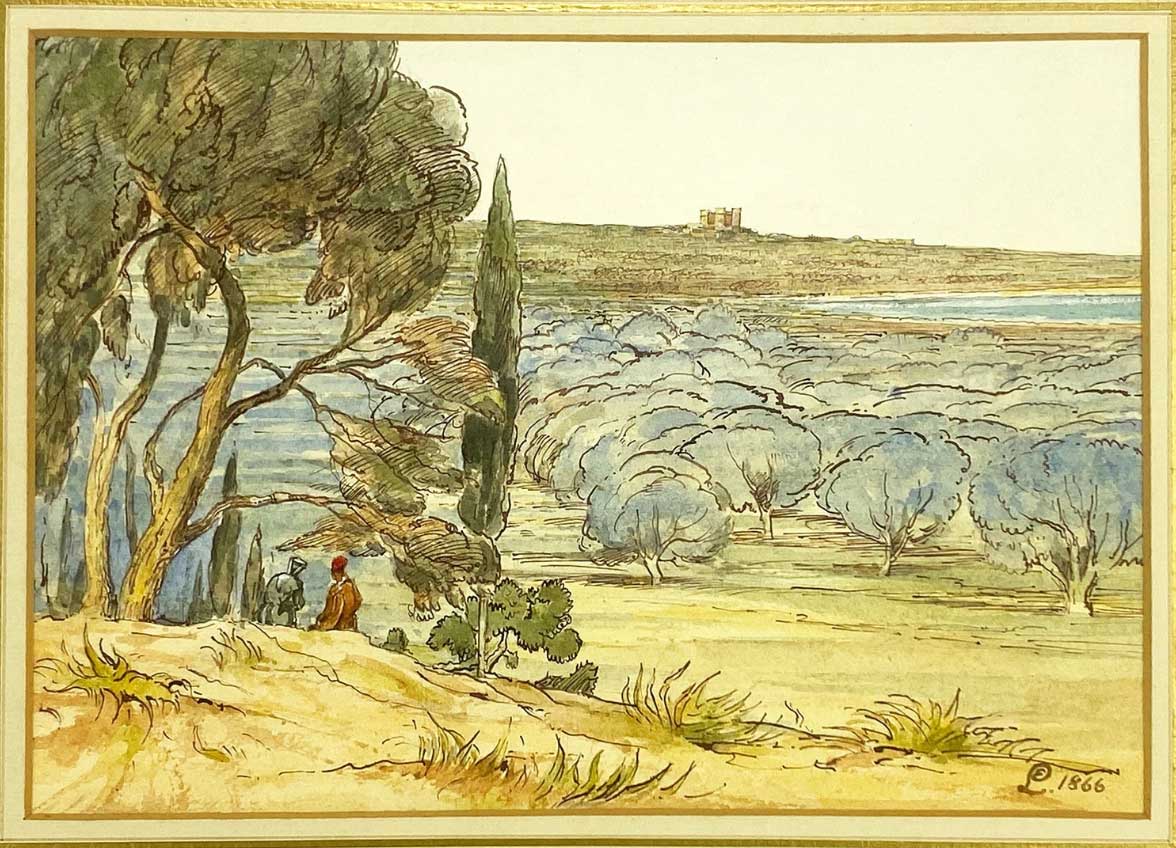
Edward Lear, The Red Tower or St. Agatha’s Tower, Malta (1866)

Edward Lear, The Red Tower or St. Agatha’s Tower, Malta.
1866. Watercolor and ink on paper. 7.5 by 10.75.

MutualArt.

Posted in Edward Lear | Tagged , , , , | Leave a comment

Variant Versions of Edward Lear’s Limericks

‘There was an old person of Skye,/ Who was nearly a hundred feet high;/ He seemed to the people/ As tall as a steeple,/ And served as a lighthouse on Skye.’ (upper left)
pen and brown ink, partial watermark ’18…’
4 7/8 x 7 7/8 in. (12.5 x 20 cm.)

NONSENSE DRAWINGS BY EDWARD LEAR, FROM THE COLLECTION OF NINA R. AND ARTHUR A. HOUGHTON, JR. (LOTS 121-129)Although rarely seen on the market, Lear’s Nonsense poems and limericks, with their accompanying drawings, are perhaps his best known works, familiar across the world. They come from the time Lear spent at Knowsley between 1831 and 1837, when he was commissioned to produce drawings of the menagerie of Lord Stanley, later the 13th Earl of Derby. Lear entertained the many children who visited Knowsley with poem and songs, and with a series of illustrated limericks. These were not gathered together and published until 1846, when they were published anonymously by Thomas McLean as Book of Nonsense. Several drawings exist for each published limerick, as he often gave them as gifts to children, and 48 Nonsense drawings remain in an album at Knowsley. He continued to produce Nonsense drawings and limericks throughout his life, and A Book of Nonsense was republished several times, alongside 3 further books of Nonsense drawings and limericks. Lear wrote to Norah Bruce in 1870, ‘Nonsense is the breath of my nostrils’, and his joy in the absurd and ridiculous is immediately obvious in these drawings. The present group of drawings relate to a variety of his Nonsense books, and indeed some were never published in Lear’s lifetime and are fairly recent discoveries.

Christie’s.

‘There was an old person of Calais/ Who lived in a blue marble palace./ But in coming downstairs,/ He encountered some bears/ Who devoured that old person of Calais.’ (upper left)
pen and brown ink
4 7/8 x 7 7/8 in. (12.5 x 20 cm.)

Christie’s.

‘There was an old man of the Rhine, who thought it was going to be fine,/ So he walked for six hours through wind and through showers/ that resolute man of the Rhine.’ (upper centre)
pen and brown ink, partial watermark ‘…37’
4 7/8 x 7 7/8 in. (12.5 x 20 cm.)

Christie’s.

‘There was an old person whose wish/ Was to swallow a very large fish -/ So he asked his 7 daughters/ To cut it in quarters,/ And boil it for tea in a dish.’ (lower left)
pen and brown ink, partial watermark ‘…37’
4 7/8 x 7 7/8 in. (12.5 x 20 cm.)

Christie’s.

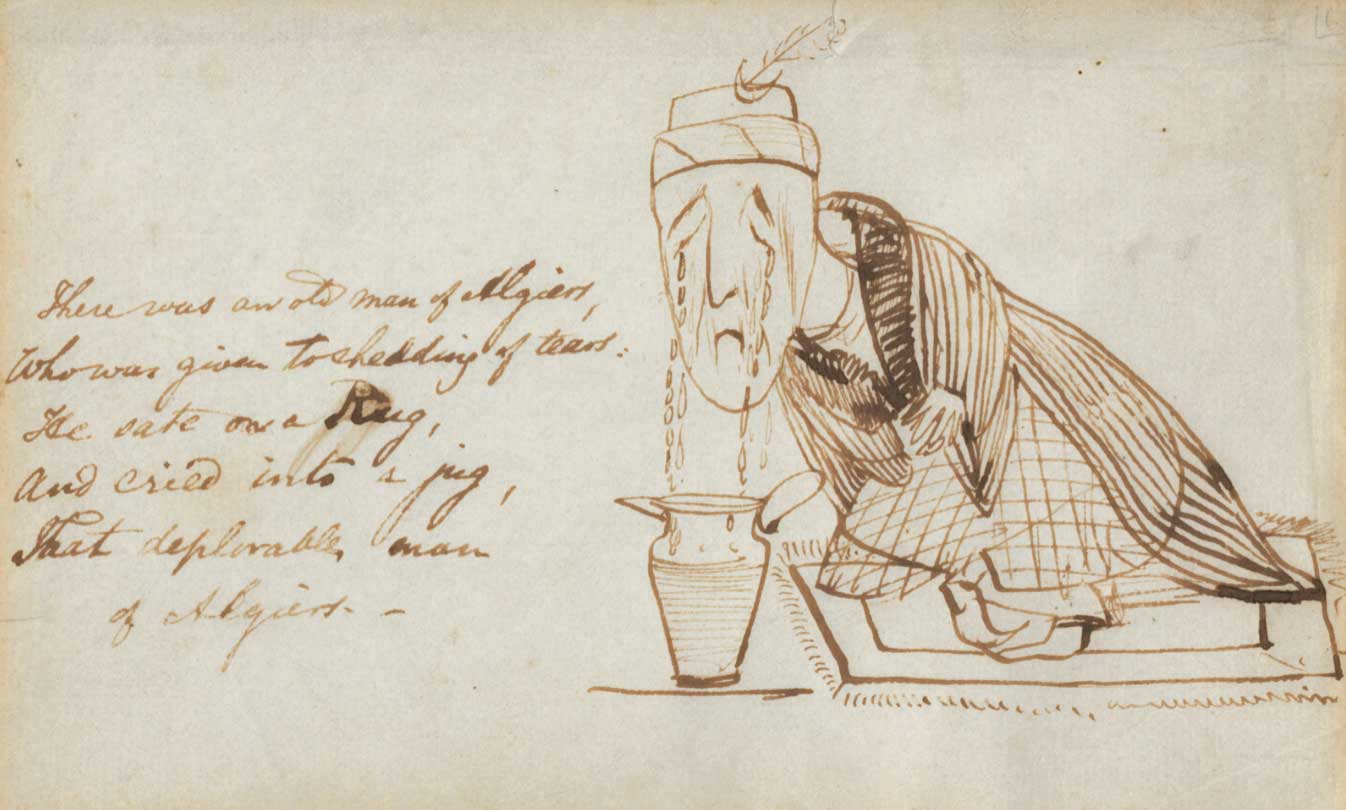
‘There was an old man of Algiers,/ Who was given to shedding of tears./ He sat on a Rug,/ And cried into a jug,/ That deplorable man/ of Algiers’ (centre left)
pen and brown ink
4 7/8 x 7 7/8 in. (12.4 x 20 cm.)

Christie’s.

‘There was an old man of Toulouse/ who purchased a new pair of shoes;/ When they asked, “Are they pleasant?” He said, “Not at present.”/ That turbid old man of Toulouse.’ (lower centre)
pen and brown ink
5 ½ x 6 1/8 in. (14 x 15.6 cm.)

Christie’s.
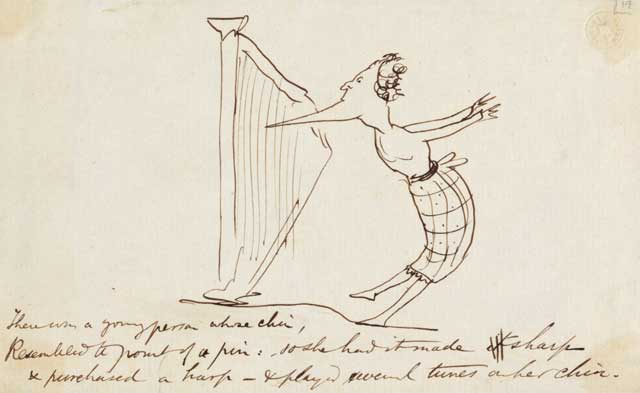
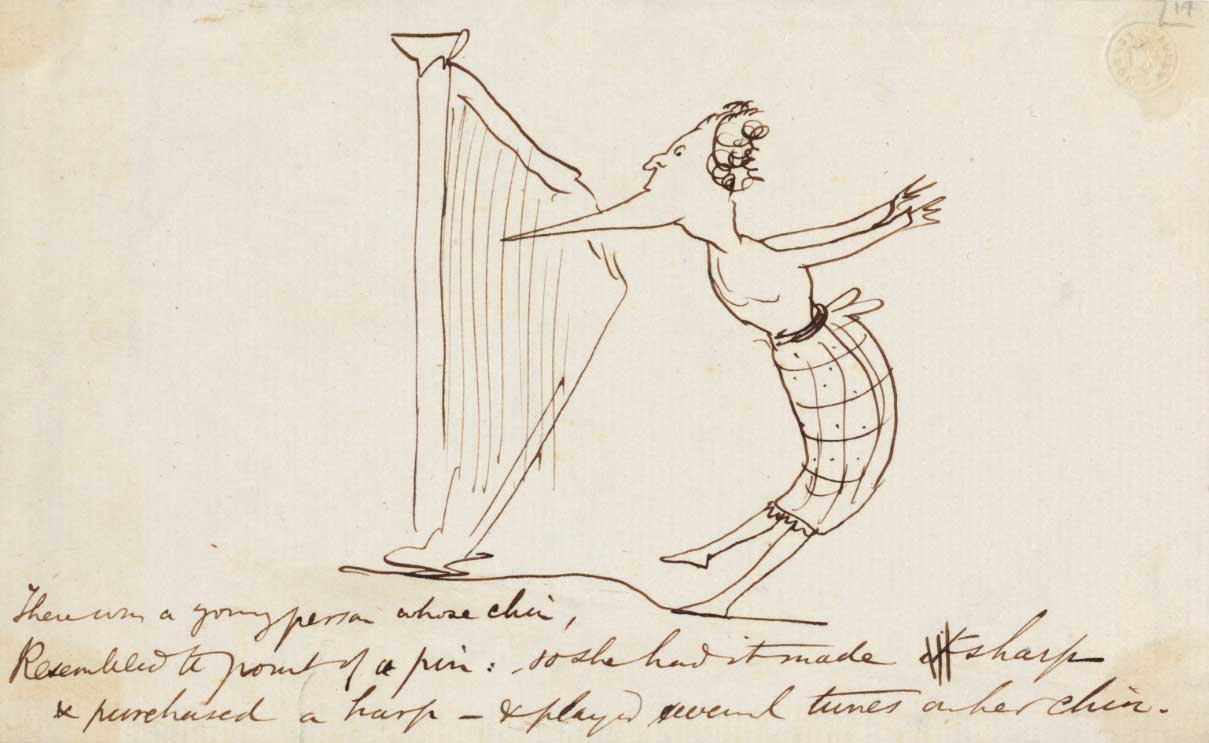
‘There was a young person whose chin,/ Resembled the point of a pin: so she had it made sharp/ & purchased a harp – & played several tunes on her chin’ (lower centre)
pen and brown ink on paper blindstamped ‘SUPER LONDON’
4 3/8 x 7 1/8 in. (11.1 x 18.1 cm.)

Christie’s.

‘There was an old person of Oude/ Who fled when was he was not pursued,/ When called back by his mother/ He answered “Oh! bother!”/ That naughty old person of Oude.’ (lower centre)
pen and brown ink, blindstamped ‘… LONDON’ (lower left)
4 7/8 x 7 7/8 in. (12.5 x 20 cm.)

Christie’s.

‘There was an old man with an Owl/ Who continued to bother & howl:/ He sat on a rail & imbibed bitter ale/ Which appeased that old man and his owl.’ (lower left)
pen and brown ink
4 3/8 x 7 in. (11.1 x 17.8 cm.)

Christie’s.
Posted in Edward Lear | Tagged , , , , | 1 Comment

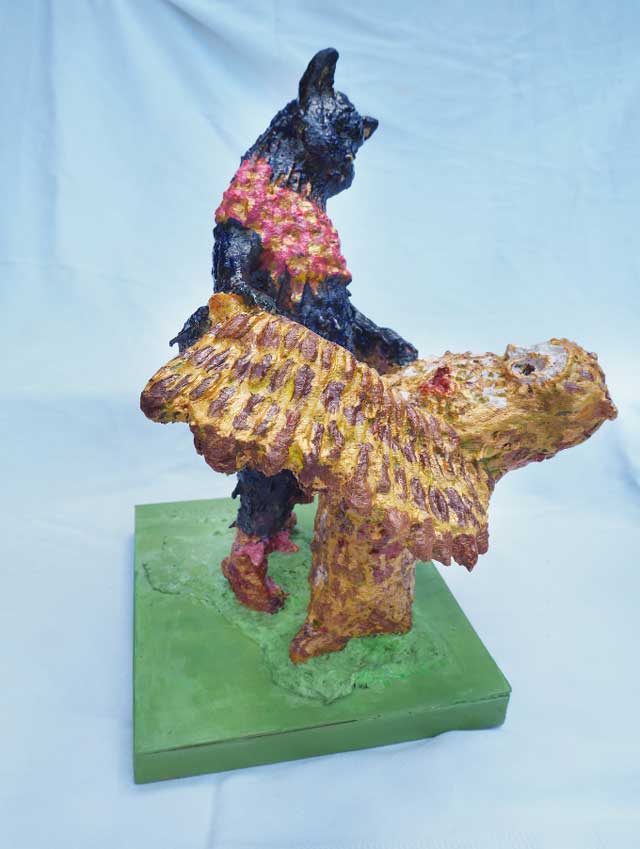
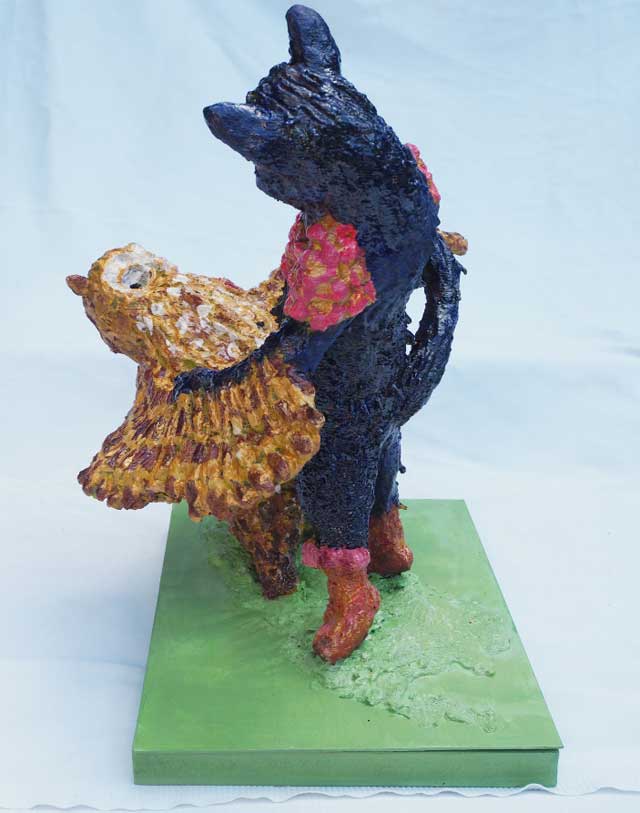
Lydia Karpinska, The owl and the Pussy-cat Dancing

Lydia Karpinska, The Owl and the Pussy-cat.

Capturing joy and movement from every angle, this charming intrepretation entitled They danced by the light of the moon, is of course the unmistakable owl and pussy cat of Edward Lear. This piece is the work of sculptor Lydia Karpinska BA, M.R.B.S. This study in mixed media resin, patinated and hand finished by the artist, is 20cm x 37cm x 27cm A wonderful addition to an existing collection, or equally as a charming accent stand alone piece. Lydia is an artist whose public sculptures include Windsor Lady (HM Queen Elizabeth ll) complete with Corgis at Batchelors Acre Park, Windsor, Sir Nicholas Winton whose seated figure partially occupies a bench at Maidenhead Station. Vintage Boys and The Boy & Boat, Maidenhead. Green Man, Woburn Square, London. Swing, Skate, Star, Elms Park, Bracknell and Water Babies, Wokingham.

The Saleroom.

Posted in Edward Lear | Tagged , , , , | Leave a comment

Edward Lear, Kandy (1874)

Edward Lear, Kandy.
Dec 2. 1894 [but actually 1874], 7.45AM,:- pencil, watercolour, pen and brown ink drawing inscribed as titled, further annotated, ‘bamboo’, ‘green for misty’, ‘cabbidge palm’, ’12ft high’ …. 16 x 34.5cm.

Provenance
With Thos. Agnew & Sons Ltd.

Exhibition label
‘2. E.Lear. Kandy, Ceylon’.

The Saleroom.

Posted in Edward Lear | Tagged , , , , | Leave a comment

Edward Lear, Garf Hoseyn (1867)

Edward Lear, Garf Hoseyn.
Inscribed Garf Hoseyn/ 2.15. PM. 1867./ Feby.15.1867 in ink (over a similar inscription in pencil), numbered (483) lower right, with artist’s colour notes, pen and brown ink with coloured washes, heightened with white. 30.5 x 53cm.

A slightly earlier drawing of the same subject (near Lake Nasser, Nubia, Egypt), timed at 12.30pm on the same day (and numbered 480) is in the collection of The Yale Center for British Art (Gift of Donald C. Gallup), New Haven, Connecticut

The Saleroom.

Posted in Edward Lear | Tagged , , , , | Leave a comment