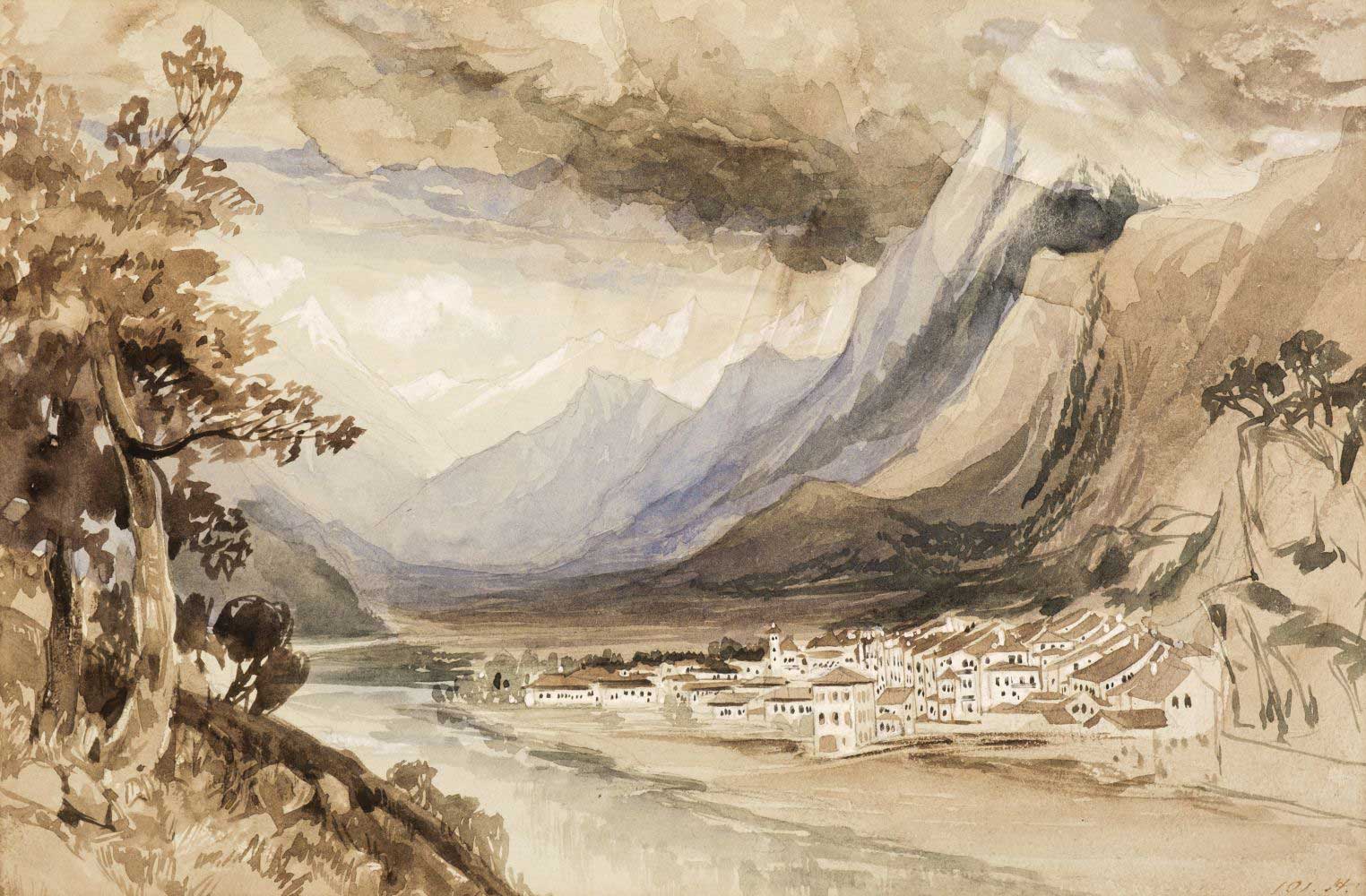
Edward Lear, Saint Moritz, Switzerland

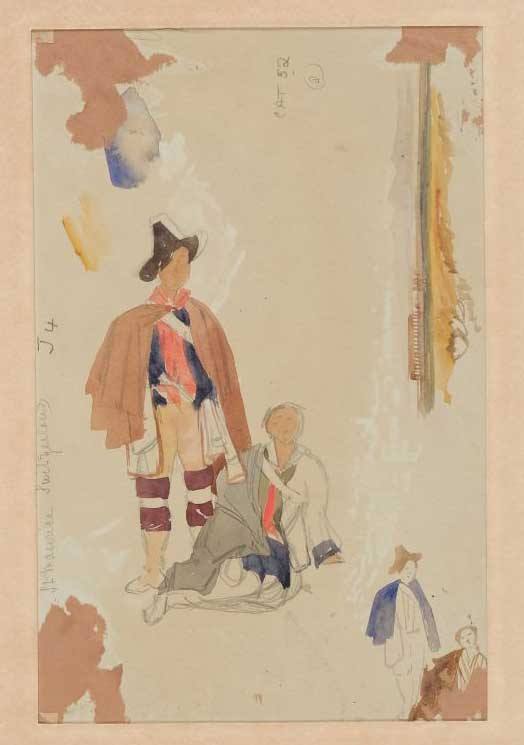
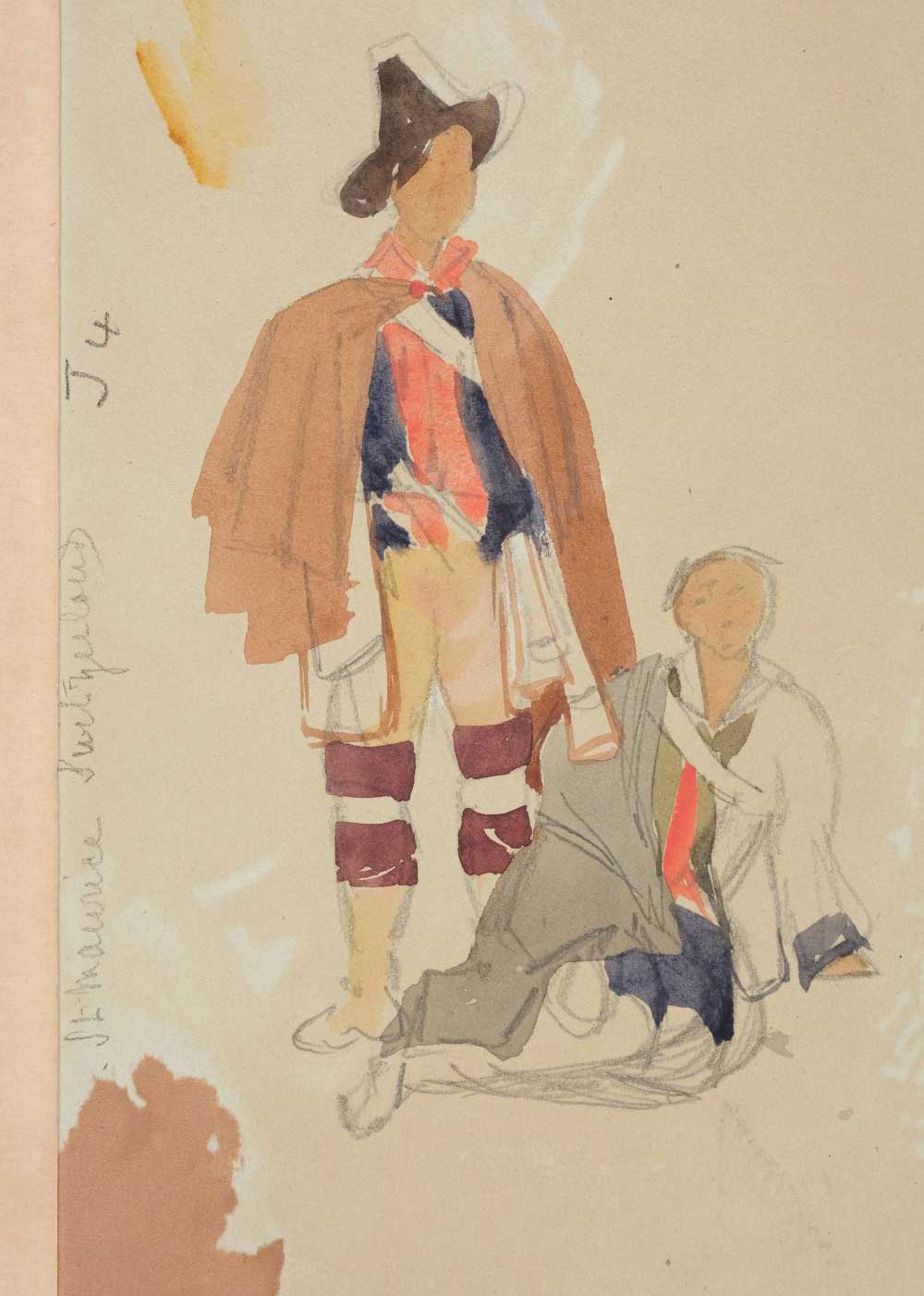
Edward Lear, Saint Moritz, Switzerland, watercolour on grey paper, depicting a panoramic landscape, with a village nestling at the foot of a range of snow-topped mountains, trees in the foreground to the left, and clouds gathering overhead, annotated in brown ink by the artist lower right ‘101.H.’, with pencilled title ‘St. Maurice’ to verso also in the artist’s hand, and additional sketches by the artist to verso of a standing man and seated woman in Swiss costume, as well as a small sketch of a panoramic landscape, 15.5 x 23.9cm (6 1/8 x 9 3/8ins), mounted, framed and glazed (33.4 x 41.7cm), backboard with typed label detailing Sotheby’s provenance and printed label of The Rowley Gallery, London

Provenance: Sotheby’s, July 29th, 1971.

This drawing is almost certainly one of a number dating from Edward Lear’s tour of Europe in the summer of 1837. On July 10th that year the artist boarded the Antwerp packet, accompanied by his sister, Ann, who travelled with him as far as Brussels. On leaving Belgium Lear travelled through Luxembourg, Germany and Switzerland, reaching the Italian lakes by the autumn, arriving in Florence in November and Rome in December. In 2012 Christie’s sold a drawing of Sion in Switzerland by Lear, dated 17th September 1837, which, like the present work, was annotated with an ‘H’ to the lower right corner (Christie’s, London, Old Master & Early British Drawings and Watercolours, 3rd July 2012, lot 156).

We are grateful to Charles Nugent, former curator of British Drawings at the Whitworth Art Gallery, Manchester, and author of Edward Lear the Landscape Artist: Tours of Ireland and the English Lakes, 1835 & 1836, for assistance with this catalogue description.
Dominic Winter.

Posted in Edward Lear | Tagged , , , , | 1 Comment

Edward Lear, On the Nile

Edward Lear, On the Nile.
Pen and brown ink on laid paper. Watermarked: 1836 and embosed with a fleur de lys. 4 1/4″ x 7 1/4″ sheet; 11″ x 13 1/4″.

Provenance
George and Fanny Coombe (nee Drewitt), Peppering House, Sussex.

Arader.

Posted in Edward Lear | Tagged , , | Leave a comment

Edward Lear: Moment to Moment

The exhibition, Edward Lear: Moment to Moment, opening on 9 September, now has a web page where you can find more information.

Co-curated by Matt Bevis and Jonathan Watkins at Ikon in Birmingham.

Posted in Edward Lear | Tagged , , , | Leave a comment

Per la Calabria selvaggia: 109 previously unpublished drawings by Edward Lear

Raffaele Gaetano, author of another interesting booklet on Edward Lear, Senza ombre di cerimonie. Sull’ospitalità nei «Diari di viaggio in Calabria» di Edward Lear, which by the way contains some of the recipes of the peculiar dishes offered to Lear during his Calabrian tour, kindly sent me an impressive volume entitled Per la Calabria selvaggia: 109 disegni inediti di Edward Lear. Dalla Collezione della Central Library di Liverpool. As the title states the imposing volume contain all the pictures which were bound with the print edition of Journals of a Landscape Painter in Southern Calabria (1852) thanks to Thomas George Baring, Lord Northbrook, whom Lear had given a great number of the originals drawn during the tour.

The pictures are preceded by a long essay telling the story of the collection, by extensive comments on the pictures themselves and containing a lot of information on the families that gave Lear hospitality. A very nice tome and well worth having: unfortunately, it is not for sale (yet). It is a numbered signed edition published with the contribution of Regione Calabria and Comune di Motta San Giovanni, though Raffaele hopes to have an edition published for the general public shortly; he also promises a further book on Lear’s visit to Calabria, treating in greater detail the history of the people Lear met during the tour.

Here is the new entry in the Edward Lear Criticism bibliography:
Gaetano, Raffaele. Per la Calabria selvaggia: 109 disegni inediti di Edward Lear. Reggio Calabria: iiriti editore, 2021.

While we are at it, here is a new, very interesting article:
Masud, Noreen. “Edward Lear: Sudden and Surprising.” Modern Philology 119.3 (2022): 421-41.

Posted in Edward Lear | Tagged , , , , , , | 1 Comment

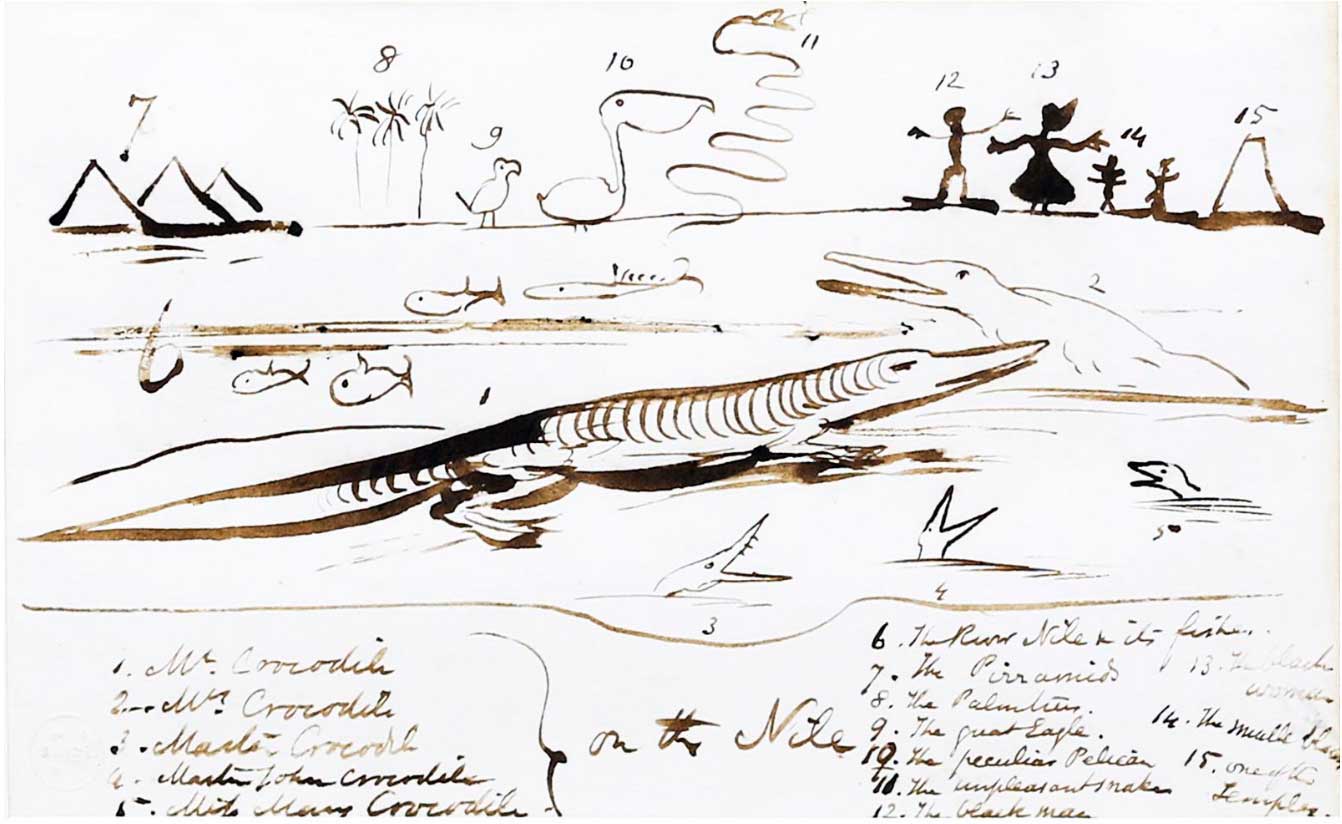
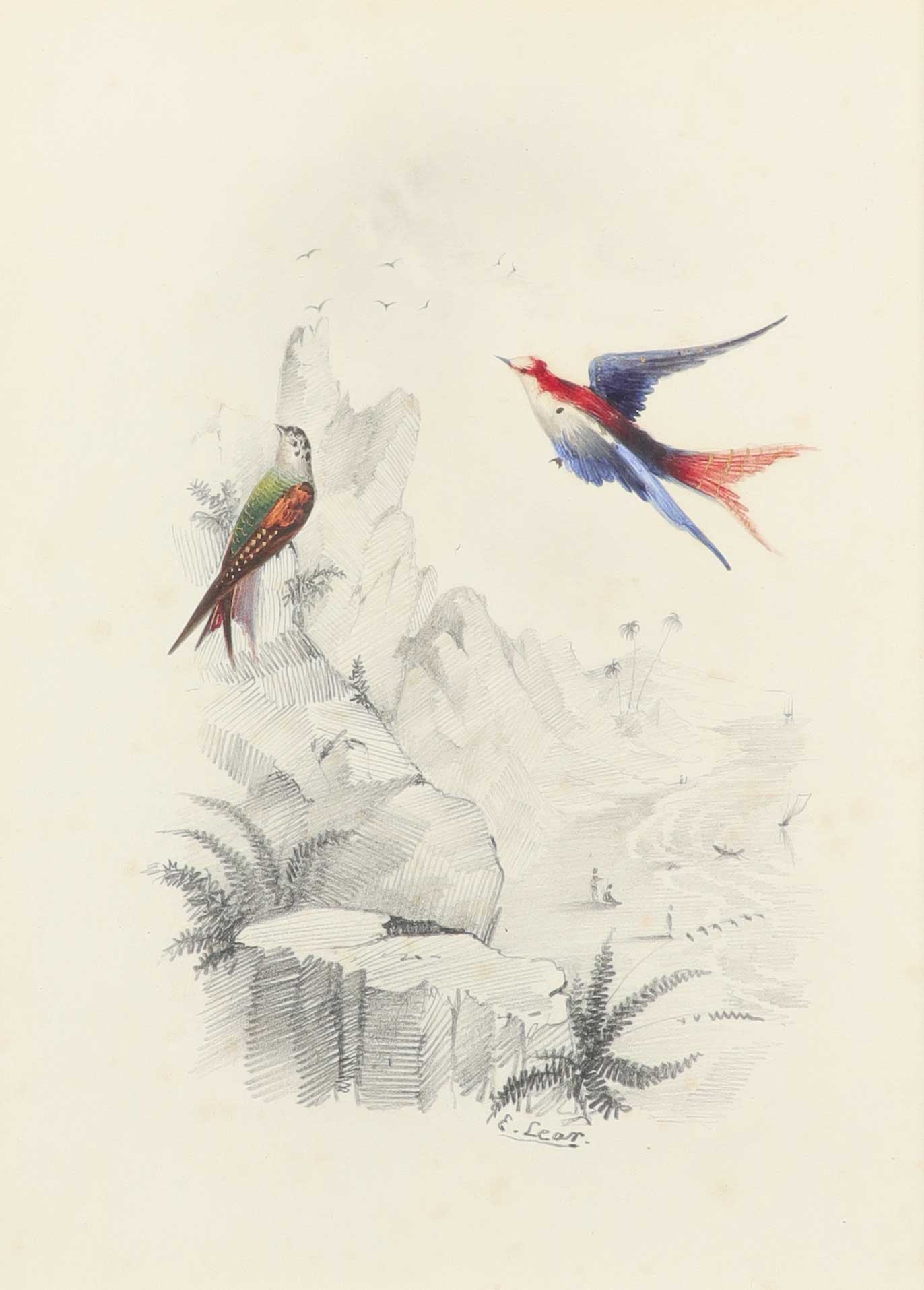
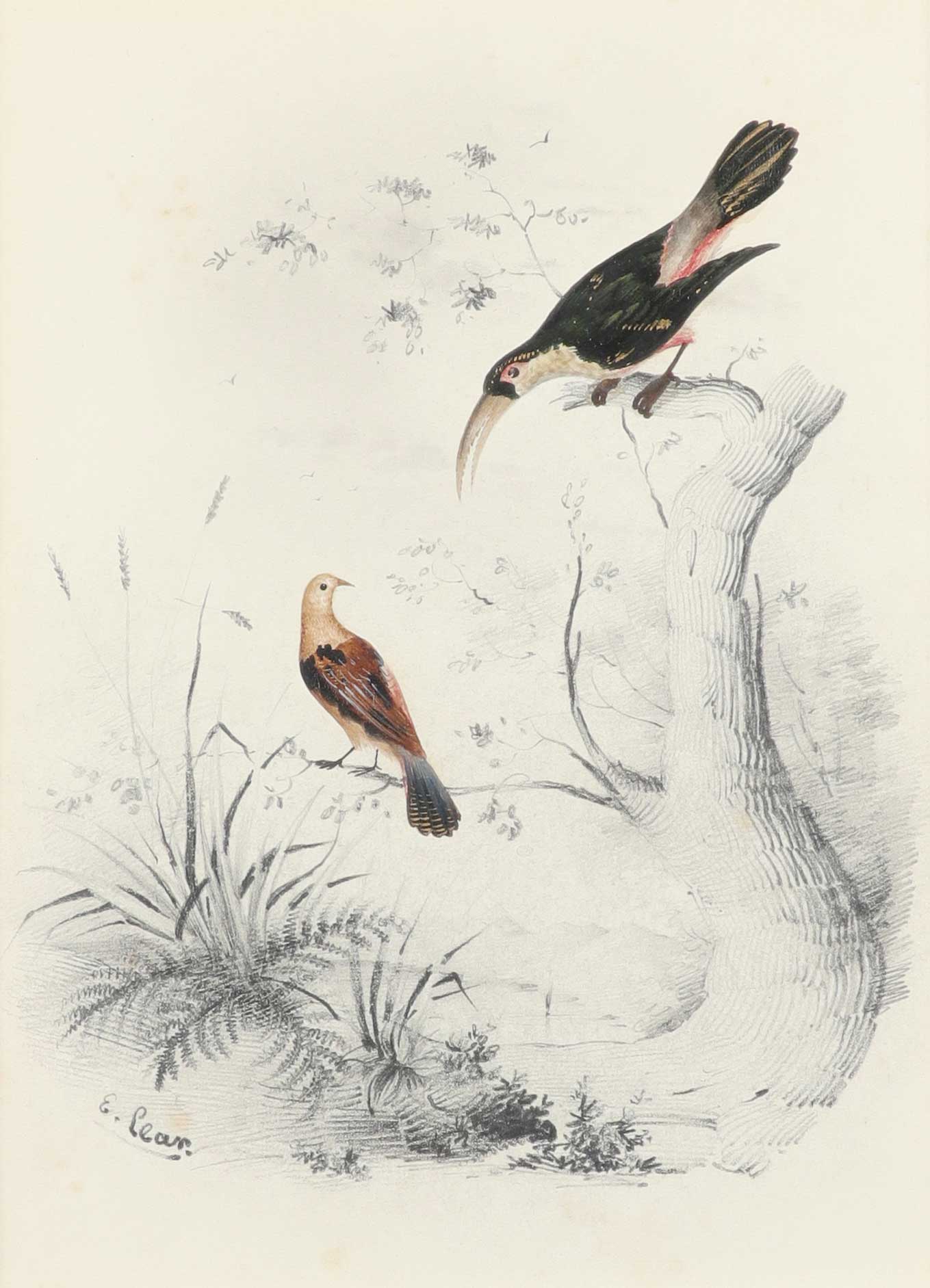
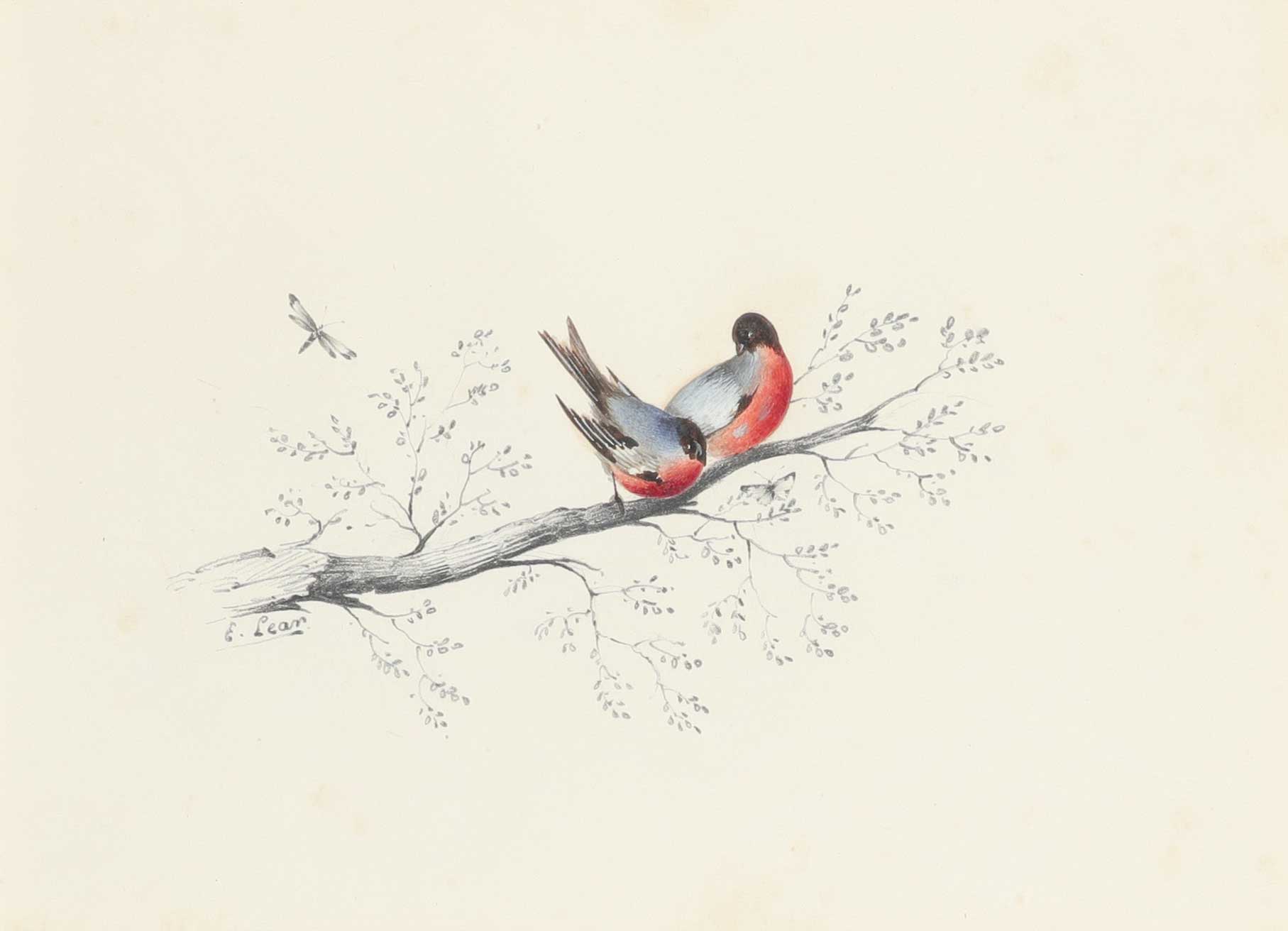
Five Early Imaginary Birds by Edward Lear

The five examples of Edward Lear’s imaginary bird pictures in this sale (lots 245-249) are early instances of his work, which Robert McCracken Peck has dated to 1827-1830. They are typical of the Lear’s work during this period, in which his subjects are based on familiar species, such as the hoopoe, toucan and swallow, but are then enhanced by his imaginative take on aspects such as colours, feather patterns and habitats.
The Strachey family were deeply influential in helping shape and preserve Lear’s legacy. They were close friends and published various publications on the artist between 1888 and 1911.
We are grateful to Robert McCracken Peck for his help cataloguing this work. For further information, see Robert McCracken Peck, The Natural History of Edward Lear (Princeton University Press, 2021).

Provenance
Lady Strachey, Sutton Court;
And by descent

The Saleroom: 1, 2, 3, 4, 5.

Also see.

Posted in Edward Lear | Tagged , , , , | 1 Comment

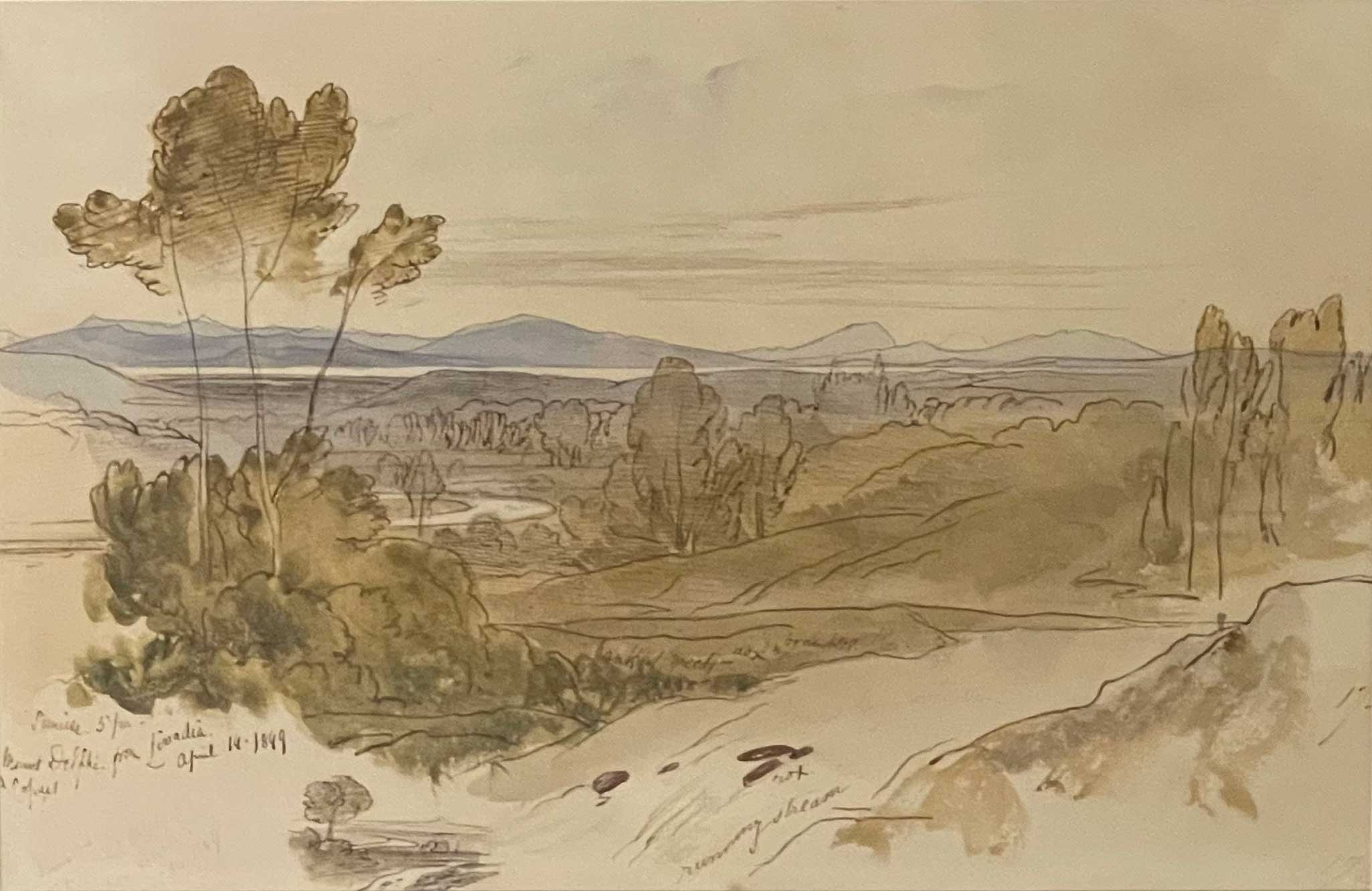
Edward Lear, Mount Delphi (1849)

Edward Lear, Mount Delphi.
Signed and dated with multiple inscriptions: (bottom left) “Sunset 5. / 20. am. Mount Delphi from Livadia –  & Copias (an important former lake, drained in the late 19th century; it features in other Lear drawings, not ACOFUIS) April 14 . 1849.”

Provenance
Condylis Collection.

The Saleroom.

Again thanks to Rowena Fowler for correcting the transcript.

Posted in Edward Lear | Tagged , , , , | Leave a comment

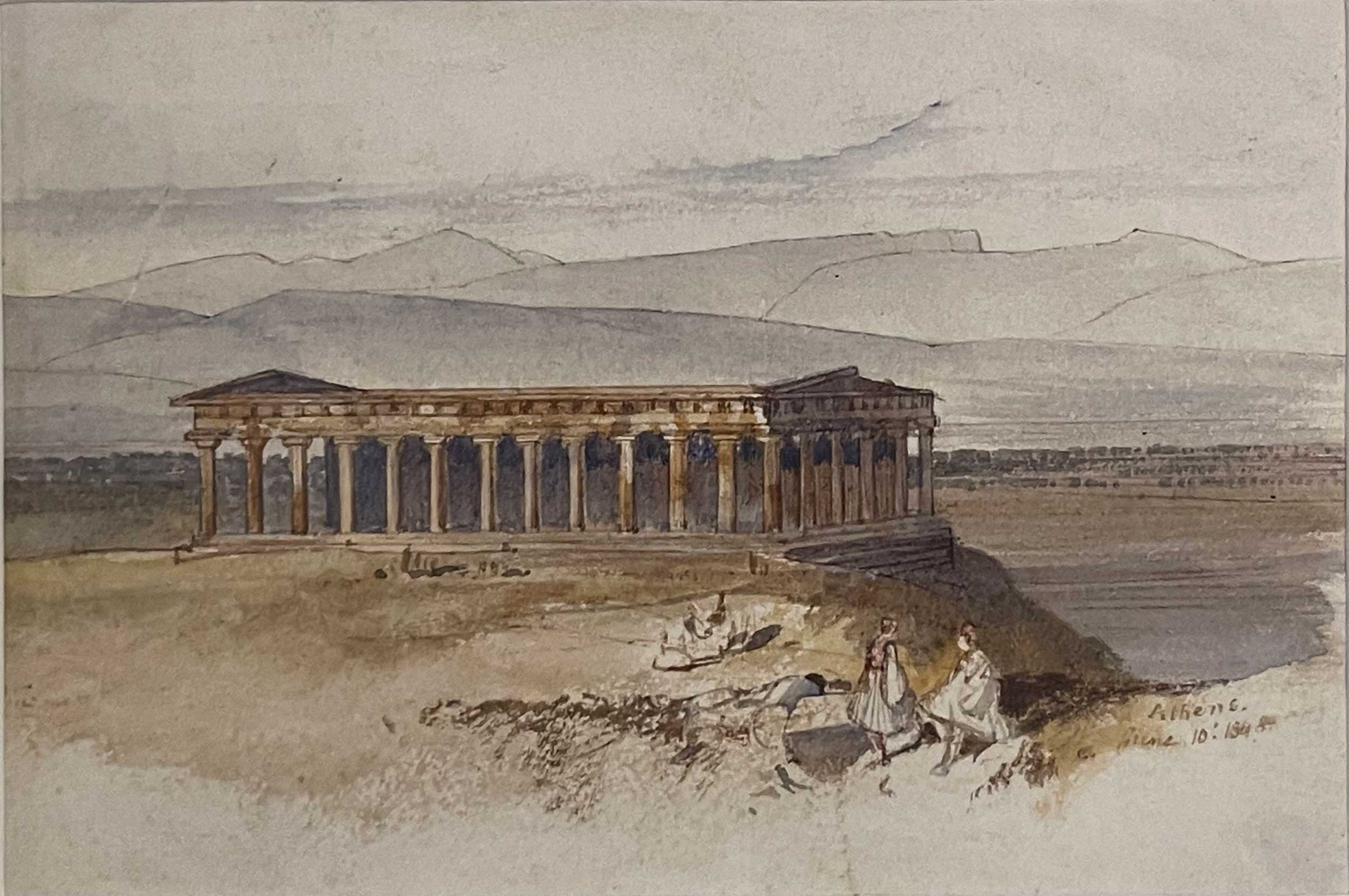
Edward Lear, Hephaistion (1848)

Edward Lear, Hephaistion (incorrectly described as “The Acropolis” in the Auction web page).
With seated figures in the foreground. On paper. Signed and dated. Inscribed: “Athens / June 10th 1848”. (reverse) Thomas Agnew & Sons label: “no 36717”; “no 75 E. Lear Athens”. 3.75 in x 5.75 in.

Provenance
Condylis Collection

The Saleroom.

With thanks to Rowena Fowler for correcting the description.


Posted in Edward Lear | Tagged , , , , | Leave a comment

The Limerick Man: Lear in Ireland

This Sunday, at 6 pm and free thereafter to listen to online, on the Lyric Feature on RTÉ lyric fm, Sara Lodge, author of the recent Inventing Edward Lear, presents The Limerick Man – the story of Edward Lear, and the influence of his visits to Ireland on his life and work.

Here is a short presentation.

You can now download the programme from this page. Or download it here.

Posted in Edward Lear | Tagged , , , | Leave a comment

Edward Lear, View of the Acropolis and the temple of Hephaistos, Athens (1848)

Edward Lear, View of the Acropolis and the temple of Hephaistos, Athens.

Pen and brown ink and watercolor over pencil, heightened with white; inscribed lower right: Athens – from the West / June 5-6-7- 1848 / 5; further inscribed with extensive color  notes. 319 by 495 mm; 12¾ by 19½ in.

Literature
R. Fowler and E. Well, Edward Lear’s Grecian Travels, on-line edition, unnumbered.

Lear made this on-the-spot drawing over three successive days (between 5 and 7 July 1848) shortly after arriving in Athens on his inaugural tour of Greece. The previous month, in Corfu, he had met Sir Stratford and Lady Canning who had asked him to accompany them to Constantinople, where Sir Stratford had recently been appointed British Ambassador to the Ottoman Empire.
In Athens, the Cannings organized for Lear to stay at the British embassy and Lear also met up with his friend, Charles Church (1825-1915), with whom he explored the city and traveled more widely in northern Greece.
Understandably, Lear could not wait to begin exploring and he wrote to his sister Ann the following day: ‘I have risen as early as I could this morning, & surely never was anything so magnificent as Athens!…. The beauty of the temples I know well from endless drawings – but the immense sweep of plain with exquisitely formed mountains down to the sea – & the manner in which that high mass of rock – the Acropolis – stands above the modern town with its glistening white marble ruins against the deep blue sky is quite beyond expectations.’1
A comparable drawing by Lear, showing this scene from a slightly different viewpoint, was sold at Christie’s in 2008.2

1. V. Noakes, Edward Lear: Selected Letters, Oxford 1988, p. 76*
2. Sale, London, Christie’s, 4 June 2008, lot 30 ($77,790)

Posted in Edward Lear | Tagged , , , , | Leave a comment

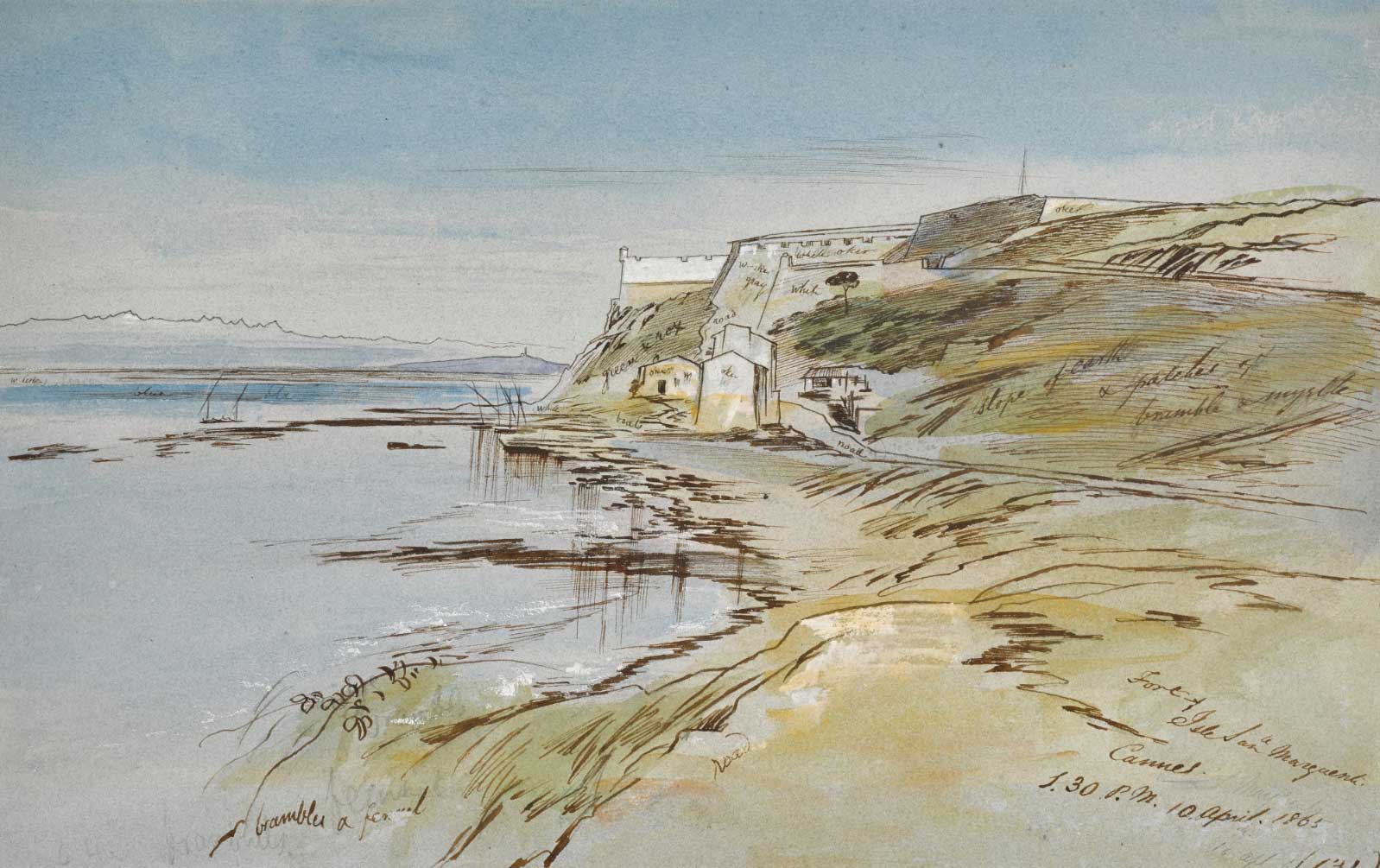
Edward Lear, Fort of Ile Sainte Marguerite, Cannes (1865)

Edward Lear, Fort of Ile Sainte Marguerite, Cannes.
Pen and brown ink and watercolor, heightened with white; inscribed and dated lower  right: Fort of Isle Sante Marguerite / Cannes. 1.30 P.M. 10 april. 1865 / (131), and  elsewhere with extensive color notes. 315 by 505 mm; 12½ by 12⅜ in.

Provenance
With Agnew’s, London;
with Chris Beetles Gallery, London

Exhibited
London, Chris Beetles Gallery, Summer Show, 2018, no. 21

Between November 1864 and April 1865, Edward Lear stayed on the French Riviera, in order to produce work for an exhibition that he planned to hold later in the year. Basing himself in Nice, he visited towns along the coast, including Antibes and Cannes. At the end of his sojourn, he spent a week in Cannes and, on his return to London, wrote to his friend Chichester Fortescue, Lord Carlingford, that he was ‘absolutely delighted’ with the town, finding it ‘different’ and preferable to Nice. In a postscript to the letter, he added, that he had produced 125 sketches ‘at Nice, Antibes and Cannes’.1
Thanks to Lear’s habit of dating and numbering his drawings, the pattern and prolificacy of his work can be charted in some detail. On 10 April 1865, he spent the day on the Lérin Islands, just off the coast of Cannes, first visiting Saint-Honorat, where he made at least nine drawings, and then Sainte-Marguerite, where he made the present one, and probably others.
Ile Sainte-Marguerite is the largest of the Lérin Islands, and is home to the Fort Royal, which was built in the early seventeenth century, and became a barracks and state prison a few decades later. The fort is most famous for holding the unidentified prisoner known as ‘Man in the Iron Mask’, who died there in 1703.

1. Ed. Lady Strachey, Later Letters of Edward Lear, (21 April 1865), London 1911, p. 61

Sotheby’s.

Posted in Edward Lear | Tagged , , , , | Leave a comment