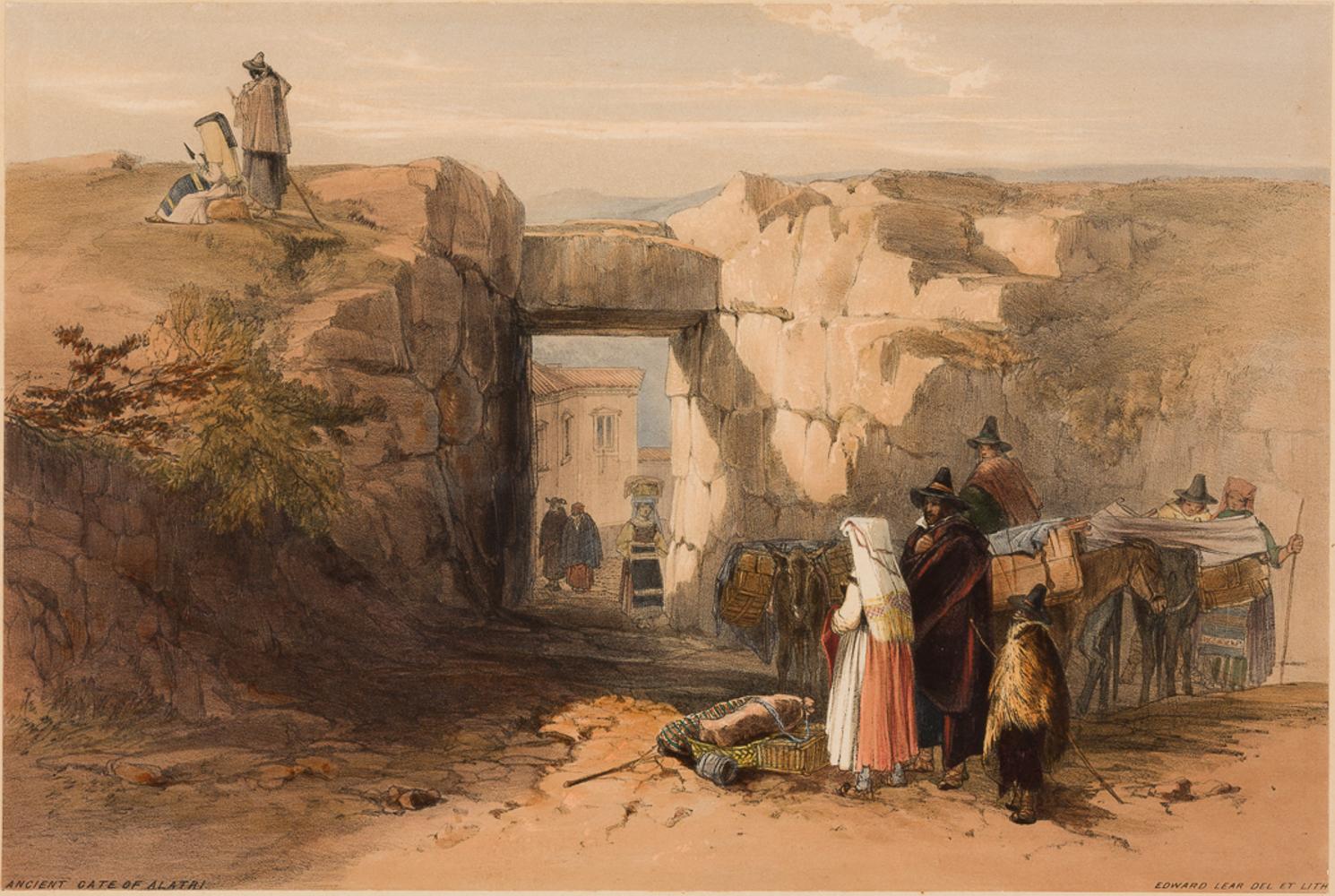
Edward Lear, Ancient Gate of Alatri

Edward Lear’s lithograph of the Ancient Gate of Alatri from Views in Rome and Its Environs. In a coloured version, under Lear’s supervision? I’m finding more and more of these lithographs in colour, so perhaps the book was sold in different versions.

For sale, with a watercolour by Samuel Prout through Invaluable. If I lived in the US I’d be sure to bid on this, the starting bid is quite interesting.

Posted in Edward Lear | Tagged , , , , | Leave a comment

A Batch of Irish Learics

In a previous post, like this one inspired by Doug Harris, I showed a page of “Irish Literary Learics” from   Idyls of Killowen: A Soggarth’s Secular Verses (London: James Bowden, 1899), by Matthew Russell, S.J.

The same limericks, however had already been published in 1898 in The Irish Monthly, vol. 26, pp. 87-89, so the use of the term “learic” was even earlier than I thought.

Here is a transcript of the text:

A BATCH OF IRISH LEARICS.

FIRST of all, what is a Learic? A Learic is not a lyric as pronounced by one of that nation who joke with deefficulty; but it is the name we have invented for a single-stanza poem modelled on tho form of “The Book of Nonsense” for which Mr. Edward Lear has got perhaps more fame than he deserved. His funny pictures helped his funny rhymes very cleverly. We have not seen it noticed that these nonsense-verses copy the metre of Lady Morgan’s “Kate Kearney.” It is a very amphibrachian metre, to coin an epithet for the occasion; namely, the “foot” that predominates is an amphibrach, consisting of a long syllable between two short ones, like eternal. The whole stanza is made up, first, of two lines consisting of three amphibrachs, then two short lines consisting each of an amphibrach and an iambus, ending with a fifth line the same as the first two. Mr. Lear’s verses are largely geographical. Here is his nonsense-verse about almost the only Irish town that he has thus honoured:—

There was an Old Person of Newry,
Whose manners were tinctured with fury:
He tore all the rugs
And broke all the jugs
Within twenty miles’ distance of Newry.

The following will fix on the youthful mind that the spot which determines our first meridian is pronounced Grinnttch.

There was a Young Lady of Greenwich
Whose garments were bordered with spinach;
But a large spotty calf
Bit her shawl quite in half,
Which alarmed that Young Lady of Greenwich.

It will be perceived that Mr. Lear uses one rhyme twice. It seems a more skilful feat to find three distinct rhymes; and the more ‘difficult the rhyme the better, if the difficulty be fairly overcome. “Winchelsea” is hard enough; but we see no special force in the concluding line.

There was an Old Lady of Winchelsea,
Who said, “If you needle or pin shall see
On the floor of my room,
Sweep it up with a broom,”
That exhaustive Old Lady of Winchelsea.

With this explanation we venture to print an original batch of Learics on Irish men, and women of letters. The reader is supposed to know that Mrs. Cowden Clarke wrote a Concordance of Shakspere, and that Mrs. Gaskell’s “Cranford” is the closest parallel for Miss Barlow’s Lisconnell.

I.
The Author of “The History of Dublin.”

Thy marvellous lore, Sir John Gilbert,
Can crack the most obdurate filbert,
And many a mystery
In Erin’s dark history
Has been by thy critical skill bared.

II.
The Author of “Vagrant Verses.”

Lady Gilbert, once Rosa Mulholland,
Weaves stories most deftly of all, and
Her “Verses,” though “Vagrant,”
Are pure, fresh, and fragrant—
Oft drawn from the Acta of Bolland.*

III.
The Author of “Irish Idylls.”

The Gaskell of Erin, Jane Barlow,
Dwells nearer to Dublin than Carlow.
Irish life with its side ills
Shines out in her “Idylls”
With much of the pathos of Marlowe.

IV.
The Author of “A Fairy Changeling and Other Poems.”

Thy name, Dora Sigerson Shorter,
(Not always pronounced as it ort ter, +
Matrimonially rounded,
Can now be compounded
In this amphibrachian mortar,

V

The “Author of “The Art of Conversation.”

A Greek (not a Turk) is Mahaffy;
Of his Hellenist lore more than half he
Has amassed on the plan
Of that muscular man
In Cymric song famous as Taffy.

VI.
The Author of “Hurrish.”

I wish that Miss Emily Lawless
In her studies of Ireland saw less
Of dark ugly shade—
The sketch she has made
Is surely not truthful or flawless.

VII.
The Author of “A Cluster of Nuts.”

Katherine Tynan is now Mrs, Hinkson,
But her maiden name pleasantly links on
To that wonderful throng
Of story and song
Which amazes the more that one thinks on,

VIII.
The Author of “The Mystery of Killard.”

I knew you a boy, Richard Dowling,
And, though there’s a good deal of howling
In your thrilling romances,
Most gentle your glance is,
And your face always smiling, not scowling.

IX.
The Author of “Shakspeare, his Mind and Art.”

In matters Shakespearian Dowden
Is a glorified Mrs. Clarke (Cowden).
He has mixed in the melée
That rages around Shelley,
But he cares not for Lingard or Plowden.

X.
The Author of “Maime o’ the Corner.”

Mrs. Blundell, self-called “ M. E. Francis,”
As bright and as keen as a lance is.
Her plots are well knit,
And a delicate wit
The charm of her stories enhances.

* St. Barbara, St. Brigid, etc , in the Acta Sanctorum of the Bollandists
+ The g “ought to’’ have its hard sound.

The introductory note mentions “the metre of  Lady Morgan’s “Kate Kearney” as the inspiration for the form. Of course Doug dug out the song on YouTube:

Doug adds: “it is interesting to note that it does indeed fit the limerick lilt rather neatly. It’s also interesting that the ballad of Kate Kearney, first heard as the tune “The Beardless Boy” by Edward Bunting in 1796 and perhaps then first seen in print as Kate Kearney in 1807 as shown here … is in limerick form:”

… and in 1810 in both ‘The Shamrock’ and ‘The Hibernian Songster and ‘The Emperor’s Wedding’) … although laid out in print quite differently:

Oh did you not hear of Kate Kearney?
She lives on the banks of Killarney;
From the glance of her eye,
Shun danger and fly,
For fatal’s the glance of Kate Kearney. etc etc.”

Here is the score of the song, published in 1829 in The New-York Mirror, and Ladies’ Literary Gazette.

Posted in Edward Lear, Limerick | Tagged , , , | Leave a comment

Edward Lear: A Commemorative Medal

British / French Commemorative Medal, bronze d.80mm: Edward Lear 1812-1888 Père du Non-Sens (medal) by Ronald Searle – famous satirist and illustrator, from his series The Fathers of Caricatures, 1970s, struck by the Monnaie de Paris (Paris Mint). A heavy high-relief art medal, GEF, with box.

The Saleroom.

Posted in Edward Lear | Tagged , , | 1 Comment

A Hierarchy of Nonsense, By John Kropf

[I receive from John Kropf, and publish.]

For a couple of semesters in college I worked at the on-campus student coffee house, The Bandersnatch, named after the creature in Lewis Carroll’s famous nonsensical poem, Jabberwocky. When you work inside a Lewis Carroll nonsense poem, you start to take nonsense seriously. While toasting bagels and brewing coffee, and listening to the songs playing on the house stereo, I created what I classified as a nonsense hierarchy.

Understandable Nonsense.“Colorless green ideas sleep furiously,” is a Frankenstein monster of a sentence composed by the MIT Professor of Linguistics, Noam Chomsky to test his theories of language and the best example I can think of as nonsense where the words are all understandable but whose meaning is nonsensical. This category is not a lot of fun, mostly because it seems to be the playground for academics to make linguistic arguments.

The pop songs I heard were much more entertaining nonsense. John Lennon, a life-long lover of nonsense words, filled some of The Beatles most memorable songs with Understandable Nonsense like Come Together:

He wear no shoeshine
He got toe jam football
He’s got monkey finger
He shoot Coca-Cola

Mixed-Up Nonsense. Second level of nonsense is a mix of the understandable and made up. Carroll’s 1855 poem Jabberwocky is what I think of — writing that is grammatically correct and partially understandable but filled with lots of made-up, fun words.

’Twas brillig, and the slithy toves
Did gyre and gimble in the wabe:
All mimsy were the borogoves,
And the mome raths outgrabe.

I don’t know what a slithy tove is but the sound of the words along send me in a direction where I conjure up an image of something amphibian-like.

Carroll’s contemporary, Edward Lear, wrote a whole book of nonsense including poems, short stories, songs, drawings, alphabets, and even botanical drawings.

Over a century later, this was fertile ground for writers of pop-songs.  The 1960’s vocal group, The Crystals, had a Top Ten Billboard it with The Da Doo Ron Ron:

I knew what he was doing when he caught my eye
Da do ron-ron-ron, da do ron-ron
He looked so quiet but my oh my
Da do ron-ron-ron, da do ron-ron

In 1967, John Lennon was working with three different song ideas when the result turned out to be one of the most memorable songs from The Magical Mystery Tour album with Mixed-Up Nonsense of I am the Walrus

They are the egg men
I am the walrus
Goo goo g’joob, goo goo goo g’joob
Goo goo g’joob, goo goo goo g’joob, goo goo

The torch of mixed-up nonsense was picked up in the late 1970s by The Police with their Billboard Top Ten hit, De Do Do Do, De Da Da Da. The lyrics are credited to Sting who said he was interested in the success of the Crystals Da Ron Ron and Do Wah Diddy by Manfred Man. He was self-aware enough to expressly call out the nonsense of the words:

De do do do, de da da da
Is all I want to say to you
De do do do, de da da da
They’re meaningless and all that’s true

As early as The Police’s first album, Sting had been playing with mixed nonsense in the track Masako Tango, from their first album:
Key wo wa di com la day wa da
Co wa da zu ma pu wa all day
See po wa ta na po ba ba
Zoe ka mo wa I’ve been sleepin’ all day

Total Nonsense.This is the top of the nonsense pyramid where there are no recognizable words and, while it might feel grammatically correct, it’s not like a foreign language where you can find a translation because there are no translations. A prime example is the Dada poet, Hugo Ball, who in 1916 wrote a poem, Karawane, consisting of nonsensical words. Some commentators called it a “sound poem.” Here’s the opening verse:

Gadji beri bimba clandridi
Lauli lonni cadori gadjam
A bim beri glassala glandride
E glassala tuffm I zimbra

The Talking Heads revived the poem in their 1979 song I Zimbra, from their album Fear of Music. Ball received a writing credit for the song on the track listing. And if you want to say you have seen everything on the internet, you can watch a YouTube video of Marie Osmond reciting Karawane.

On the final Beatles album to be recorded, Abbey Road, John Lennon took his fondness for wordplay into pure nonsense with the song Sun King and the lyrics:

Quando para mucho mi amore de felice corazón
Mundo paparazzi mi amore chicka ferdy parasol
Cuesto obrigado tanta mucho que canite carousel

The lyrics sound like a romance language just out of reach but were in fact totally made-up. Leaving John Lennon at the top of the nonsense hierarchy would likely please him.

There’s a lot more nonsense out there for another day but for now I’ve got to Gimble in the wabe.

Posted in Edward Lear, Lewis Carroll, Nonsense Lyrics | Tagged , , , , , | 1 Comment

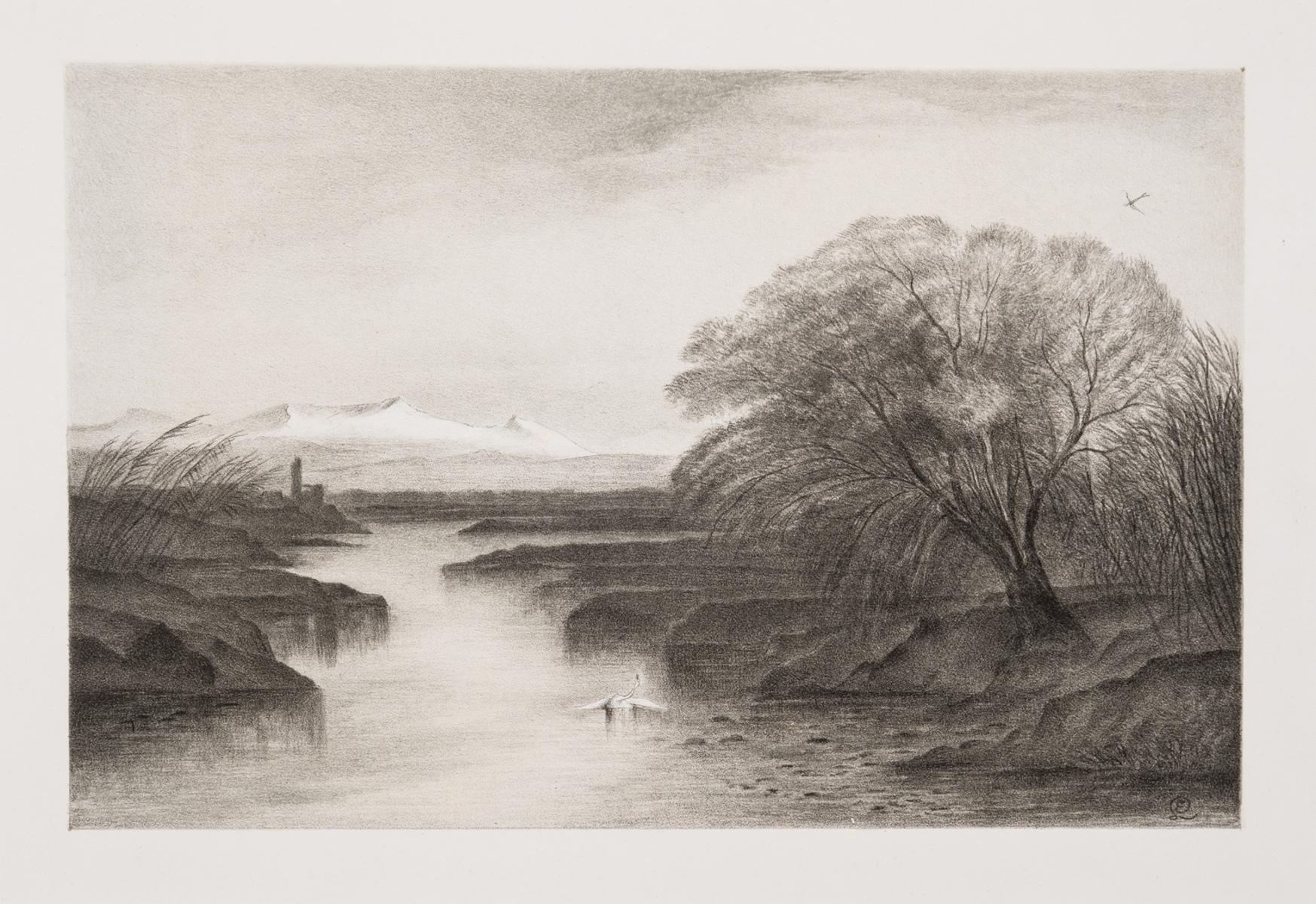
Edward Lear, One Willow over the river hung

Tennyson (Alfred, Lord).- Lear (Edward) “One willow over the river hung… River Anio, Campagna di Roma”, lithograph on fine wove paper, image 165 x 255 mm (6 1/2 x 10 in), sheet 280 x 335 mm (11 x 13 1/4 in), hinged into mount, some minor pin holes carefully restored, unframed, [circa 1885]

Provenance
Sotheran’s, London;
Private collection, London

Rare working proof of an apparently unpublished lithograph illustrating Tennyson’s poem The Dying Swan. Houghton Library hold the original drawing for the print in their collection ‘Edward Lear drawings for illustrations to the poems of Tennyson’ [see item 17].

Invaluable.

Posted in Edward Lear | Tagged , , , , | Leave a comment

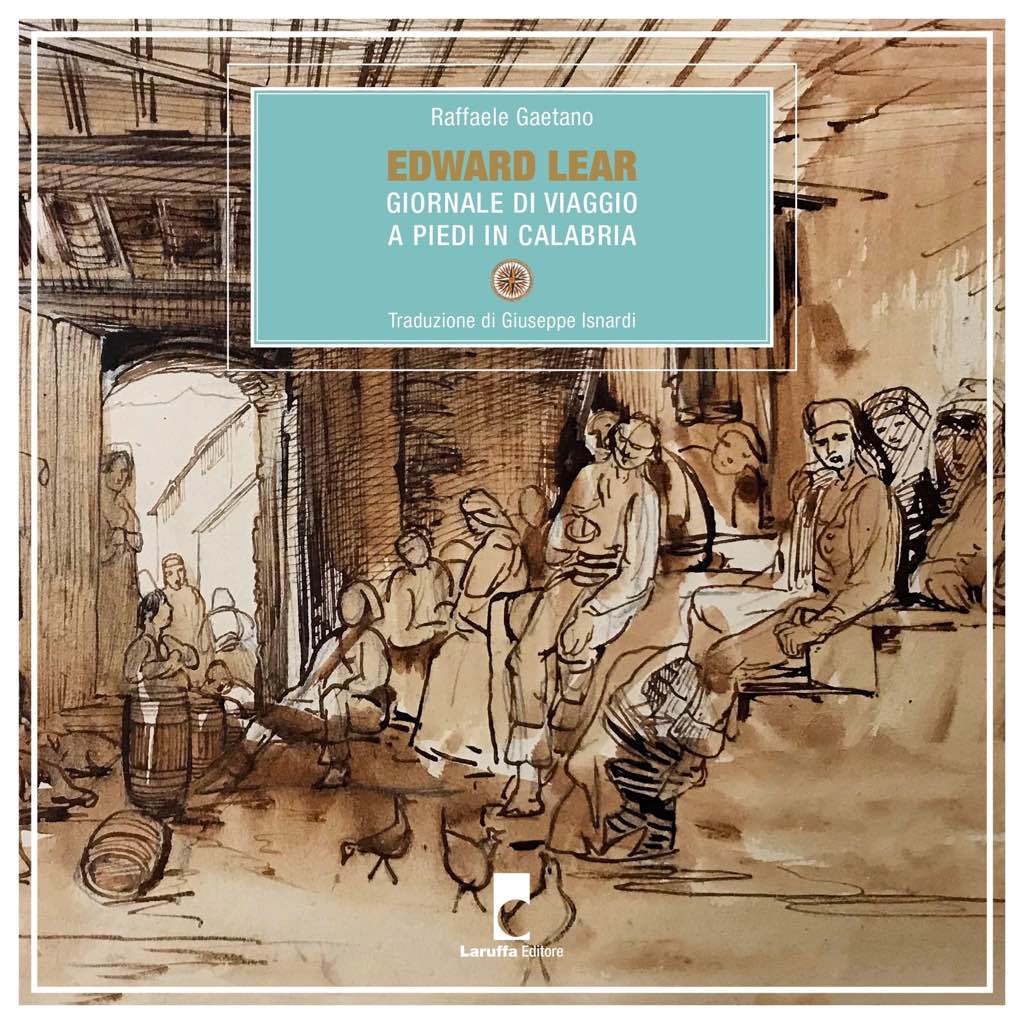
Edward Lear’s Calabria Journal edited by Raffaele Gaetano

Raffaele Gaetano has published a new edition of Giuseppe Isnardi’s historic translation of  Edward Lear’s Journals of a Landscape Painter in Southern Calabria, & c.

The book contains a long introduction by Gaetano and is richly illustrated with photographs showing the present state of the places mentioned by Lear.

Here are Gaetano’s other books on Edward Lear.

Posted in Edward Lear | Tagged , , , | Leave a comment

Wallace Stevens’s “playful, eroticized elaboration of Edward Lear”

Floral Decorations for Bananas
by Wallace Stevens

Well, nuncle, this plainly won’t do.
These insolent, linear peels
And sullen, hurricane shapes
Won’t do with your eglantine.
They require something serpentine.
Blunt yellow in such a room!

You should have had plums tonight,
In an eighteenth-century dish,
And pettifogging buds,
For the women of primrose and purl
Each one in her decent curl.
Good God! What a precious light!

But bananas hacked and hunched….
The table was set by an ogre,
His eye on an outdoor gloom
And a stiff and noxious place.
Pile the bananas on planks.
The women will be all shanks
And bangles and slatted eyes.

And deck the bananas in leaves
Plucked from the Carib trees
Fibrous and dangling down,
Oozing cantankerous gum
Out of their purple maws,
Darting out of their purple craws
Their musky and tingling tongues.

It was first published Measure 26 (Apr. 1923) and then in Stevens’s first book of poetry, Harmonium (1923), according to Wikipedia.

That it is  a “playful, eroticized elaboration of Edward Lear” is stated on p. 92 of Alec Marsh’s essay “Wallace Stevens, Stanley Burnshaw, and the Defense of Poetry,” in The Cambridge Companion to American Poetry and Politics since 1900, edited by Daniel Morris (2023). Marsh goes on to state that this was what “persuaded contemporary critics in the 1920s to ‘market the thesis of Stevens’s aestheticism, his verbal acuteness and emotional lassitude.'”

Posted in Edward Lear | Tagged , , , | 2 Comments

On Bawdy Limericks and Edward Lear (again)

From the Vaughan Williams Foundation website:


Letter from Ralph Vaughan Williams to Ursula Wood

Letter No.: VWL1485


From R. Vaughan Williams,
The White Gates,
Westcott Road,
Dorking.

[3 February 1940]

My Dear

I went and got a Lear1 at once – it is a good book – but I wish he2 wd not call them “Limericks” – I feel sure he wd have hated the word – a Limerick is an indecent poem in the same metre as the Lear nonsense rhymes.
I’d often thought of setting the Pobble3 to music – its one of the most mysteriously romantic poems I know.
Have you read the prose nonsense story4 – its superb – I did not know it before.5
The wedding6 is next Sat. (10th) – I am told the bridegroom has a pretty sister so I am all agog.
Love from

RVW


1. According to R.V.W.:a biography, p.233, this was a paperback edition of some of Edward Lear’s writings. it was possibly Edward Lear’s Nonsense Songs, with the Author’s Own Illustrations, an edition published by Chatto & Windus in 1938.
2. i.e. the editor, not the author
3. The Pobble who has no toes, one of the Lear poems.
4. The story of the four little children who went round the world  by Lear.
5. The letter up to this point is quoted in R.V.W.: a biography, p.233.
6. Probably that of Honorine Williamson (see R.V.W.: a biography, p.232 and VWL686 footnote 3, etc.). She had lived with the VWs ever since the move to Dorking and was to marry the trumpeter Bernard Brown.


I have been unable to find any setting of Lear’s poems by Vaughan Williams.

Posted in Edward Lear | Tagged , , , | Leave a comment

Cylinder Nasties and Some T.S. Eliot Limericks

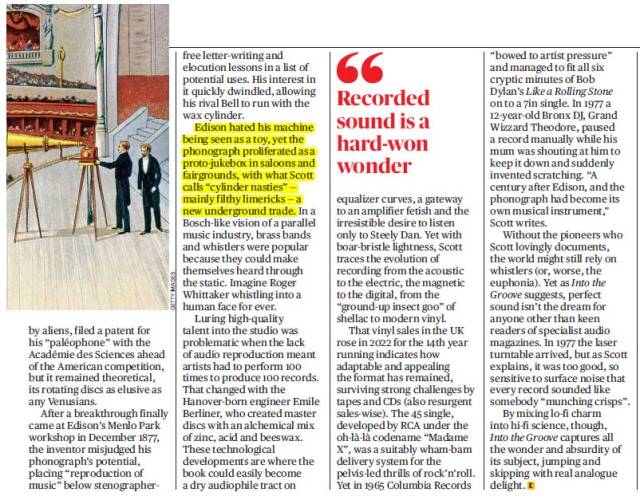
One of the “Limerick Company” I occasionally hear from, Bob Turvey, mentioned the following article from the 5 March 2023 Sunday Times “Culture” supplement, pp. 24-25:

Here is the passage of interest from the book being reviewed:

Another star, and arguably the most popular of all pre-mass production artists in America, was Russell Hunting, whose rapid-fire skits involving the Irish character Michael Casey were so popular they sparked an entire army of imitators. Hunting was an actor with the Boston Theatre Company who had leased a phonograph for his own use, just to experiment. Certain kinds of voice might come out as garbled scratchings, but while experimenting he realised he sounded particularly good on recond.
Hios debut record, with the New England Phonograph Company, came out in 1891. Soon, he was recording for Columbia and many others. Versions of his 1892 skits ‘Casey at the Telephone? and ?Casey Taking the Census? became his most famour works, as did the baseball poem ?Casey at the Bat’. Casey was so popylar that Hunting lost control as more and more recording artists imitated Casey themselves, in poor knock-offs of the origina. In a bid to stam out this annoying practice, he launched his own magazine, The Phonoscope, in 1896. …
Although he didn’t mention them in The Phonoscope, Hunting also put out a series of indecent recordings for saloons and amusement arcades on Coney Island and was briefly imprisoned for violating obscenity laws. He wasn’t alone either, and lots of cylinder nasties appeared in the 1890s, until legislation caught up and outlawed them. While most of these lewd recordings were destroyed, you can listen to examples that survived in the 2007 compilation Actionable Offenses: Indecent Phonograph Recordings from the 1890s. I’ve listened to them, so you don’t have to – it’s mainly profanity-laden skits and limericks.
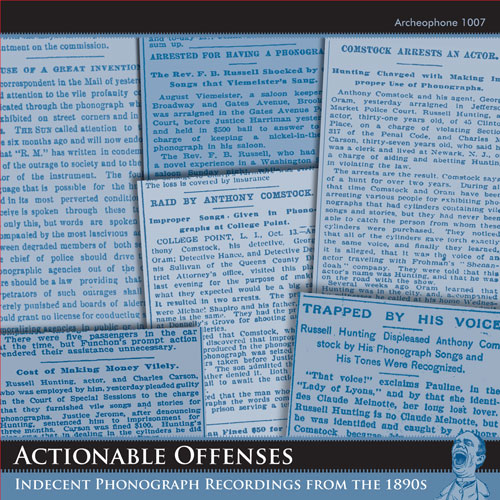
You can read more on the CD on Wikipedia, and more on dirty recordings (of limericks) in There Once Was a Record of Smut by Jody Rosen from the New York Times website, which states:

His [an anonymous contributor to the CD] repertory includes “He’ll Win in a Walk, B’Jesus,” a scatological ballad about a day at the horse track; several dirty variations on “Mary Had a Little Lamb”; and off-color limericks like the one that begins “There was a young lady from Alaska.” (Let’s just say the punch line involves John Jacob Astor.)

Doug Harris, never one to miss an opportunity to discuss limericks, can’t seem to be able to find his copy of the CD, however he reports:

Interesting stuff… though it may be that only a single limerick (Alaska / Astor) has been recorded here and this might sadly make the claim; “mainly profanity-laden skits and limericks” to mean more of the former and less of the latter, perchance not even in the plural.

Unfortunately, I don’t know the whole “Alaska” limerick; however, more or less at the same time, I found the following in Lyndall Gordon’s The Hyacinth Girl: T.S. Eliot’s Hidden Muse:

Eliot once remarked that however intimate a love poem may be, it is meant to be overheard. An addition to his marital poems is a teasing limerick (in ‘Valerie’s Own Book’): ‘The Blameless Sister of Publicola’, dated 16 September 1959 and alluding to ‘The noble sister of Publicola’, Valeria, who is reported as icicle-pure in Coriolanus:

I know a nice girl named Valeria
Who has a delicious posterior
And beautiful thighs
Where her true lover lies
While his penis explores her interior.

Before their marriage, Eliot resisted – so he told Conrad Aiken – Valerie’s appeals to him to ‘burst into Bolovian song’. But afterwards he copied out assorted stanzas, previously reserved for men, in ‘Valerie’s Own Book’: twelve stanzas in one exercise book and two in the other.

The poem also appears in volume II of The Poems of T.S. Eliot, with other “Improper Rhymes.” The editors, Christopher Ricks an d Jim McCue, comment:

Valerie’s Own Book: fair copy, one page, dated “16. ix. 59”.

Coriolanus V iii, VOLUMNIA: “Do you know this lady?” CORIOLANUS: “The noble sister of Publicola; | The moon of Rome: chaste as the icicle | That’s curdied by the frost, from purest snow, | And hangs on Dian’s Temple: dear Valeria!”

While “his ‘King Bolo’ limericks” are not real five-line limericks, we find:

There was a young lady named Ransome
Who surrendered 5 times in a hansom,
When she said to her swain
He must do it again
He replied: “My name’s Simpson, not Samson”.

To Frank Morley, from Harvard, “St. Stephen Protomartyr [26 Dec] 1932”.

TSE had written to Morley, 20 Dec 1932: “I have an undeserved reputation for limericks which I must live down”, but less than a week later, enclosing this, he admitted “I know several good Limericks now.”

And:

There was a young girl of Siberia
Who had such a tempting posterior
That the Lapps and the Finns
Kept inventing new sins
As the recognised types were too stereo–.

Published in The Faber Book of Blue Verse from ms in Valerie’s Own Book. Date of composition unknown. C. L. Sulzberger recalled TSE at Harvard in 1933: “Timid and withdrawn as Eliot was in class, he had a talent for banging the piano and singing a huge number of limericks, some of which I suspect he had written himself”, A Long Row of Candles (1969) 4 (James Loucks, personal communication).

The introduction to the section also mentions the Eliots receiving Konrad Aiken’s collection of limericks:

Valerie Eliot to Aiken, 23 Nov 1964, acknowledging a copy of A Seizure of Limericks (1964): “Tom was so pleased to receive your limericks and we laugh over them together.” In an obituary for Life, 15 Jan 1965, Aiken wrote: “I’m the official custodian of his King Bolo poems, which are all quatrains or octets about an imaginary monarch and his queen, but he neglected to send the bulk of them to me.”

To conclude, it seems that one of the earliest poems Eliot wrote, in Fireside: A Weekly Magazine a family magazine he produced at the age of 10, was also a limerick, in no. 11, attributed to “Anon.” we find:

There was a young lady named Lu,
Who felt so exceedingly blue,
She was her-ad to state
That it was her fate—
And then she began to bu-hu.

Also of interest on Eliot’s bawdy poems: Jayme Stayer, “The Short and Surprisingly Private Life of King Bolo: Eliot’s Bawdy Poems and Their Audiences.” The T. S. Eliot Studies Annual, 2017, pp. 3-30, note 55:

On the topic of form and doggerel, the reader may wish to compare the three bawdy limericks that Eliot wrote out for others: “There was a young lady named Ransome,” “There was a young girl of Siberia,” and “The Blameless Sister of Publicola” (Poems 2, 286, 287, and 290). As would be expected of the oral tradition from which they come, these limericks involve some elements of repetition and variation. What matters, then, is not whether they are wholly original to Eliot, but to what extent the tight rhythmic and formal constraints of the limerick contrast with the looser, open-ended ballad form in which the Bolo poems were written. The last limerick plays on lines from Coriolanus and Valerie’s name, and is more likely original than the first. All three limericks are free of racist or misogynist content and are, in my estimation, more witty and delightfully obscene than all  of the Bolo poems and Bolo prose combined.
Posted in General, Limerick | Tagged , , , | Leave a comment

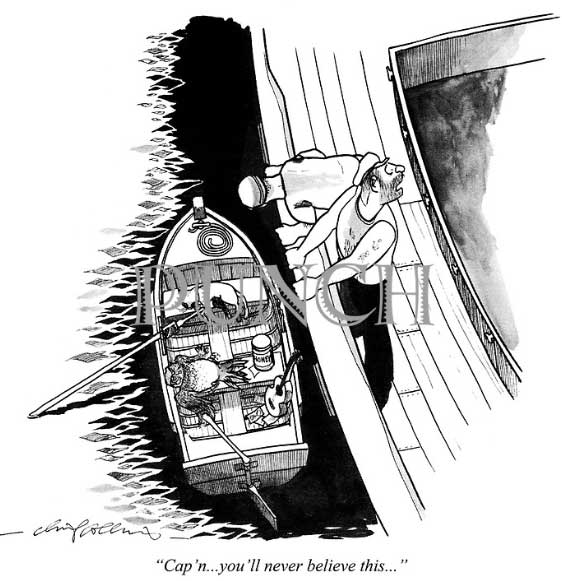
Punch and “The Owl and the Pussy-cat”

Doug Harris reports on the conutinuing interest of Punch for Edward Lear’s most famous poem.


Posted in Edward Lear | Tagged , , | Leave a comment