
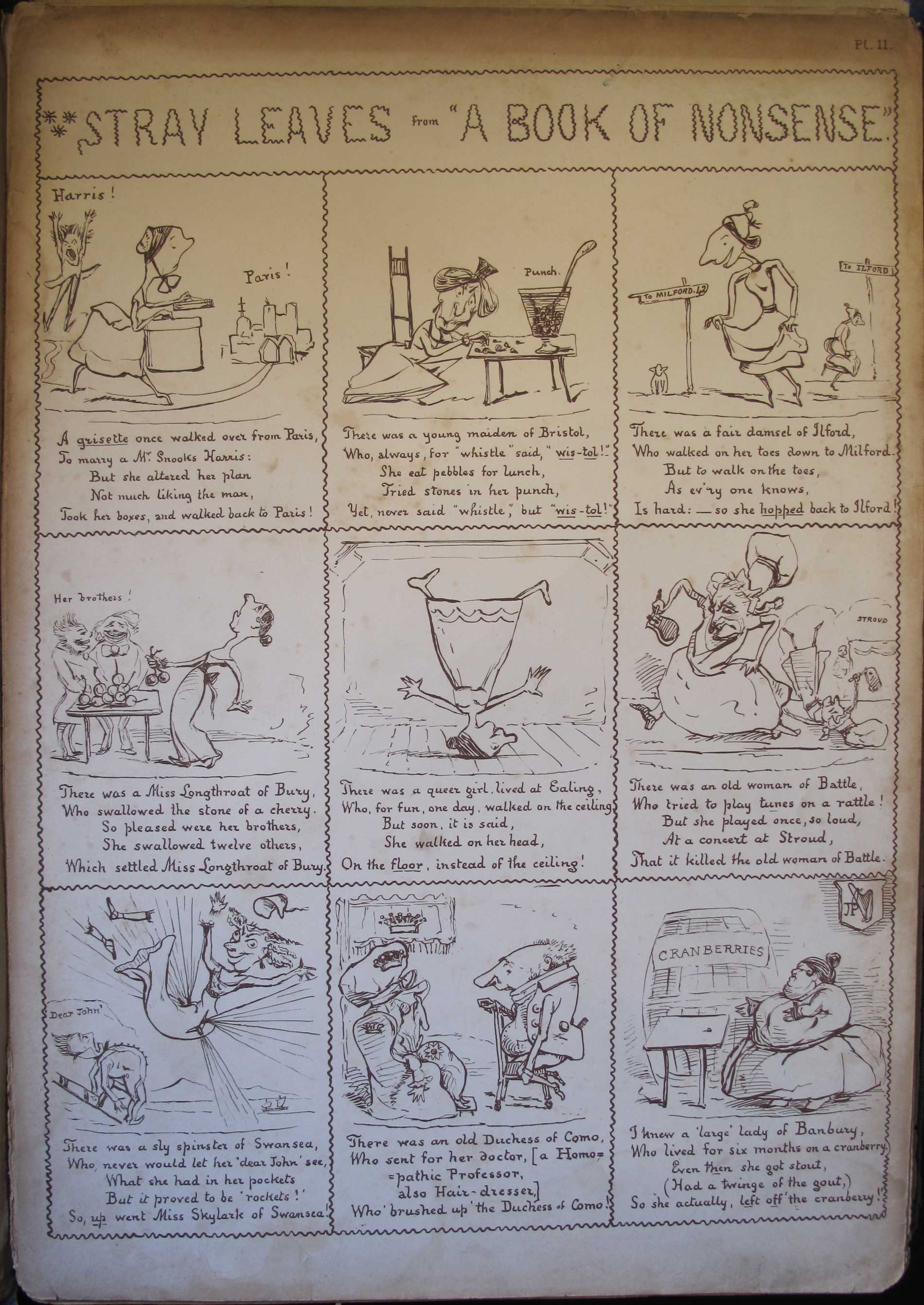
This page containing nine limericks (which was kindly provided by Doug Harris) comes from John Parry’s Ridiculous Things Scraps and Oddities: Some with and Many Without Meaning, London: T. McLean, 1854.
In the November 20, 1869 issue of Once a Week, p. 352, a short piece maintains that “the late Lord Derby was a special lover of children, and he wrote at least one book designed for their special use, It may not be so generally known that some of the designs in Mr. John Perry’s folio guinea book, ‘Ridiculous Things, Scraps and Oddities,’ were originally drawn by him, at Lord Derby’s request, for the amusement of his family.” The late Lord Derby at the time must have been the 14th, who had only recently died , on 23 October 1869. But the whole passage may be due to confusion with Edward Lear’s writing of his early limericks while staying at Knowsley in the early 1830s, when the the Lord of -Derby was the 12th.
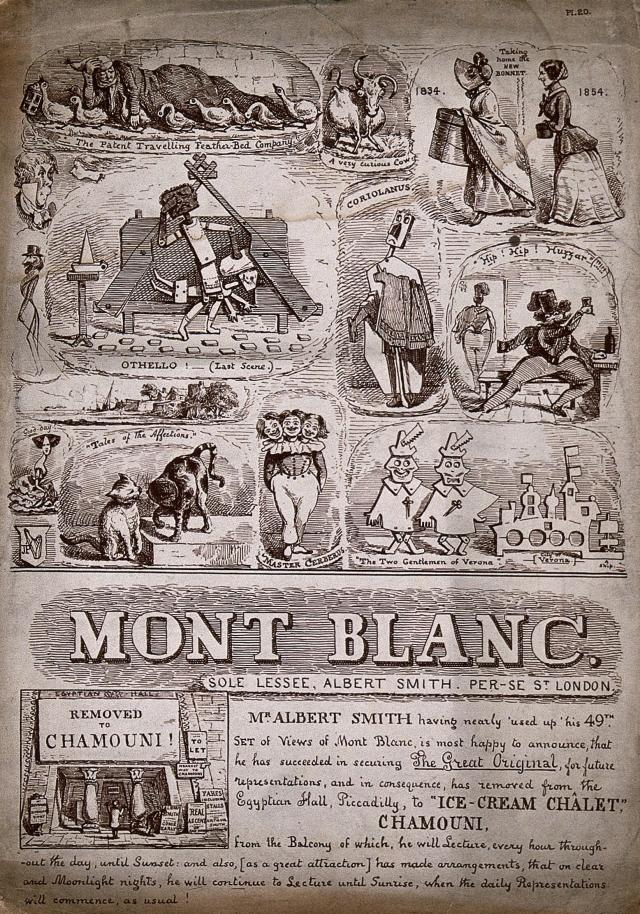
The Stanford Libraries catalogue has the following description, which does not mention limericks in imitation of Edward Lear’s: “Lithographs depict tableaux which reflect Parry’s stage career, including parodies of Albert Smith’s Mont Blanc shows, minstrels, concerts, head-dresses, dolls, pantomimes, silhouettes, ghosts, goblins, music, and wireworks.”
Sara Lodge, in her Inventing Edward Lear, p. 400 n. 79, observes that “It is noticeable that John parry in his ‘Stray Leaves from A Book of Nonsense’, in Ridiculous Things (London: McLean, 1854), plate 11, is also much meaner to his exclusively female eccentrics than Lear is. For example: ‘There was a sly spinster of Swansea, / Who never would let her “dear John” see, / What she had in her pockets / But it proved to be “rockets”! / So, up went Miss Skylark of Swansea!’ This ‘sly’ lady is blown up, losing her legs and hand, in a manner that casts implicit aspersions on spinsters.”
Here is a short biography of Parry from Shakespeariana: A Critical and Contemporary Review of Shakesperian Literature, Volume 3, 1886, pp. 226-227:
Mr. John Parry. John Parry was born in 1810, and was an actor in his childhood ; in 1833 he was favourably known as a baritone singer at various concerts, but not until six years afterwards did he take his stand as a thoroughly original genius and a buffo singer such as England had never previously known. He had a mobile face, with a naturally comic expression, a flexible voice, and a command over the piano which was extraordinary. No fashionable concert at the Hanover Square Rooms of those days was considered complete unless John Parry’s name was to be found on the programme. The first and the last portions were occupied by Grisi, Mario, Albani, Ronconi, Giuglinia, Bosio, and other bygone favorites; but in the interval between them John Parry, blushing, advanced nervously to the grand piano, and sitting down thereat, sang, “Wanted a Governess,” or “Blue Beard,” or “Fair Rosamond,” or “Berlin Wool,” or one of those delightful patter songs, all of which, except the first-named, had been written for him by Albert Smith. Not unadvisedly do I write that he appeared blushing and sat down nervously; for throughout his life John Parry suffered under morbid attacks of shyness, of absolute “stage-fright,” which always rendered his public performances painful to himself, and at last became so distressing that he had temporarily to abandon the profession. As a solo entertainer he had achieved excellent success; his Notes, Musical and Social, his Portfolio for People of all Ages, had crammed the music hall in Store Street with appreciative audiences; but the nervous disorder grew apace on him. He would stand at the side of the platform previous to making his appearance in a perfect agony of fright, his face bathed in perspiration, and it required all the assiduous persuasion of his devoted wife to induce him to face the footlights. In 1853 John Parry broke down entirely, and retired to Southsea. Here he occupied himself as organist of St. Jude’s Church, in giving singing lessons, and in preparing for publication—for he was an adept with his pencil—a book of remarkable caricatures. After an interval of seven years he reappeared, as I have said, as a partner in Mr. and Mrs. German Reed’s entertainment, taking generally the second portion for his own peculiar performance. His dramatic-musical sketch called Mrs. Roseleaf’s Party, was one of the most remarkable combination of vocal and facial mimicry, pianoforte playing, and actual acting, ever witnessed. I have always held that John Parry was never seen to the best advantage by the public; there was always plenty to make them laugh, but his humour was so subtle, his gradations of light and shade were so delicately defined, and a great portion of the effect of his piano playing was so dependent upon the mere touch of a note here and there, as to be only appreciable by those immediately around him. All his notions were odd and whimsical, and with his power of imitation he would reproduce things which scarcely anyone else would think of observing—the strut of a barn-door fowl, the walk of a cat across a wet floor shaking its legs as it went, the distended features and protruding eyes of the gold-fish in a glass bowl, all these I have seen him reproduce to the life, the mobility of his features lending itself to the aspect of the creature imitated. John Parry retired into private life in 1869, took his final farewell of the public at a benefit performance given at the Gaiety Theatre in September, 1877, and died in 1879.
Someone, evidently unaware that the first edition of the Book of Nonsense went back to 1846, thought Lear had imitated Parry; here is an extract from The Spectator, September 23, 1916, p. 342:
[To THE Editor or the “SPECTATOR.”] Sir,—“What Lear did was to adapt the form to a special purpose—to make it the vehicle of sheer, irresponsible, innocent nonsense.” I remember Lear’s first Book of Nonsense, but am under the impression that it came out in the “sixties.” If so, then John Parry, in his exquisite portfolio volume of Ridiculous Things, preceded him in the pure nonsense Limerick, both with pen and pencil. He has a page of specimens, including:— “There was an old woman of Battle, Who tried to play tunes on a rattle! But she daged once, so loud, At a concert at Stroud, That it killed the old woman of Battle.” He calls this page “ Stray Leaves from ‘ A Book of Nonsense.’ ” The whole volume is full of humour and beautiful draughtmanship. It was published by T. McLean, 26 Haymarket, in 1854.—I am, Sir, &c.,
EDWARD HICKS, Pennington, Hants
It was one of the follow-ups to an article that had appeared in the previous issue of the magazine:
THE BOOK OF LIMERICKS.*
Lear did not invent the Limerick. The writer of this notice once came across a perfect example of the form in a miscellany published in the second decade of the nineteenth century, but unfortunately omitted to record the reference, though his memory is positive on the point.
The Limerick, according to Murray [in an 1898 issue of Notes & Queries], was derived “from a custom at convivial parties, according to which each member sang an extemporized ‘nonsense verse,’ which was followed by a chorus containing the words ‘Will you come up to Limerick?’” So when the Protestant Bishop of Limerick was given an Hon. D.C.L. degree at Oxford in the late “seventies” he was greeted by the undergraduates in the Sheldonian with this query. What Lear did was to adapt the form to a special purpose — to make it the vehicle of sheer, irresponsible, innocent nonsense. His Limericks were never allusive or topical, except by accident, as when, for example, he foreshadowed a practice introduced by Mr. Gladstone in the lines: “There was an old man at a station Who made a promiscuous oration.” That primitive humour, on which Mr. Stephen Leacock discourses in his recent volume of essays [I suppose “American Humour” in Essays and Literatry Studies, Toronto: S.B. Gundy, 1916, pp. 97-136], which delights in destruction, is occasionally illustrated in Lear’s verses, but in the main they are genial and kindly. They are not consciously edifying, and would no doubt be condemned by many serious modern educationalists. With Lear pen and pencil went hand in hand. The nonsense of the text was reflected in the nonsense of the drawings, in which the imaginative artist reduced himself technically to the level of a child of genius — say a Marjorie Fleming. The verses, again, though deliberately childish in their irresponsibility, were often redeemed by distinction of style and by melody, and they never come within a thousand miles of vulgarity. As regards form, it may be noted that Lear never, or hardly ever, introduced a fresh rhyme in the last line, and that the repetition, while it rendered the task of composition easier, was often extremely effective. The later development of the Limerick owes little or nothing to Lear. It differs in form by the introduction of the fresh rhyme in the last line, and in spirit it is poles apart. In the book before us, selected from fourteen thousand three hundred and sixty-one contributions sent in to a competition instituted by the Daily Express, while many “old favourites” find a place, Lear’s are excluded, and his influence is observable in very few specimens, The writers aro all “out” to make a point or a pun, or to find an ingenious or far-fetched rhyme. The young lady of Venice who “used hard-boiled eggs to play tennis” has a Lear-like opening, but degenerates into metallic cleverness in her riposte; “‘You don’t know how prolific my hen is.’” The post-Lear Limerick at its best suffers from over-ingenuity. A great number in this collection rely upon misspelt rhymes — e.g., “scremyss” and “Wemyss,” “dolmondeley” and “Cholmondeley.” The effect is undoubtedly amusing, as in the “young lady of Warwick Who lived in a castle histarwick,” and for whom “ the doctor prescribed paregarwick.” But it is essentially a mechanical device and appeals primarily to the eye. To this order belong the variations on the name “Psyche” and the extremely clever legend of “the lethargic reporter Who said that hens’ names might be shorter,” and accordingly “wrote ‘Y & .’; but his effort was not A success for it baffled the sorter.” Here the fatal necessity for the new rhyme has weakened the stanza; for surely the sorter is not the official concerned. Another group of ingenious modern Limericks deals with jingles of which the old lady “who took the 3.3 to Forfar” or the old man “who ran for a train at 2.2” are typical specimens, But the vast majority ring the changes on the stock jokes of the music- halls — on aggressive mothers-in-law and forward minxes, on people who fall down wells, or are too thin or too fat, or come to untimely but unlamented ends. Here is a typical instance:—
“A clever young airman of Leith
Tried to steer the machine with his teeth,
He was anxious to shine,
And a great friend of mine,
So I spent ten-and-six on a wreath.”
The editors expressly state that they have excluded all Limericks which offend by reason of their Rabelaisian tendency, and they have been as good as their word ; but there are a considerable number of a type of which the “maid from Popocatapetl Who dropped her false teeth in the kettle” is a not extreme example, and when taken in large quantities this forced facetiousness is hard to digest. ‘The names of the authors are not given in any case. Perhaps it is as well to allow the perpetrators of such efforts as the above to remain in anonymity; but the famous Limerick in blank verse—
“There was an old man of St. Bees
Who was stung in the arm by a wasp;
When asked, ‘Does it hurt ?’
He replied, ‘No, it doesn’t,
But I thought all the while ‘twas a hornet’”—
is generally assigned to the late W. S. Gilbert. The version here given differs somewhat from that with which we are familiar. The editors include two or three famous University Limericks—notably that on “the fellow of Trinity Who raised xyz to infinity”; but they omit those on the boat captain of Downing and the immortal young man of Sid. Sussex. Their version of the student of Queen’s is, we think, greatly inferior to the one which continues:—
“Who was fond of explosive machines.
He once blew up a door,
But he’ll do it no more,
For it chanced that that door was the Dean’s.”
It can hardly be urged that these academic Limericks are too parochial for such a collection, for the editors include a Latin translation of the young lady of Riga, though unfortunately the printers have played havoc with the text. We are glad to welcome the old Limerick on the technical deficiencies of the young lady of Rio, but was it Mendelssohn’s Trio that she attempted ? There is an echo from the South African War in the lay of the young belle from North Berwick who “followed the guns and distributed buns To the men who were down with enteric”; and another old favourite with a Learian flavour is the mysterious old man of Khartoum,
“Who kept two black sheep in his room;
‘They remind me,’ he said,
‘Of two friends who are dead,’
But he never would tell us of whom.”
We are glad also to recognize another old friend in the “strong man of ‘the Syndicate.” But these gems, few and far between, only serve to emphasize the literary deterioration and vulgarization of the Limerick brought about by journalistic competitions.
We ought to add that the profits from the sale of the present volume, which is profusely illustrated with drawings by Messrs. Dudley Hardy, John Hassall, Heath Robinson, and others, will be devoted to the Daily Express Cheery Fund, which provides football and cricket requisites, games, mouth-organs, &c., to our soldiers and sailors.
* The Book of Limericks. Compiled by Sir William Bull, M.P., and “ Orion” of the Daily Express. With Llustrations by Famous Artists. London: Daily Express Offices, [1s. 6d.]
The Spectator, September 16, 1916, pp. 317-318.
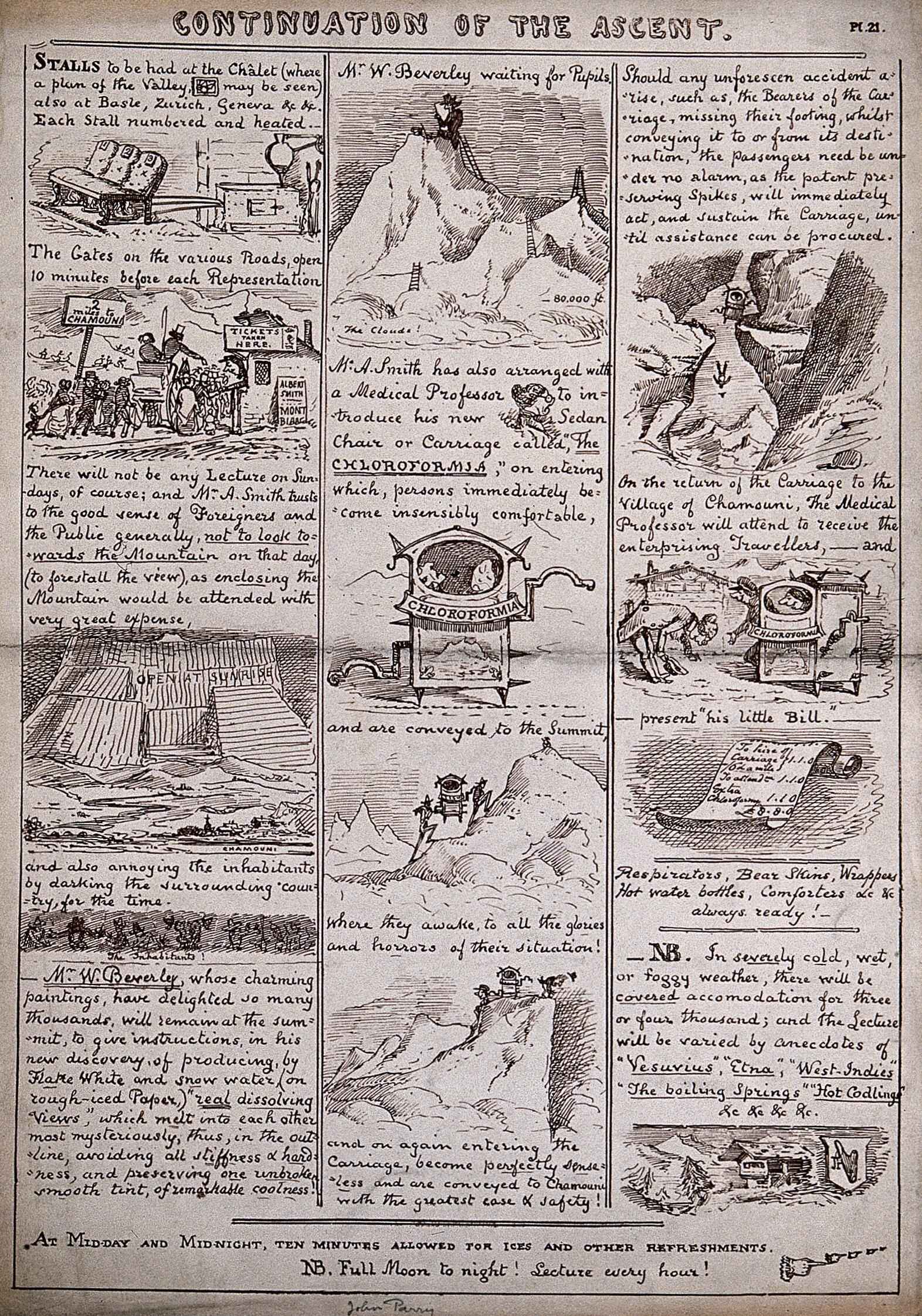
Here are the two pages in Ridiculous Things devoted to a parody of Albert Smith’s famous “Ascent of Mont Blanc”:

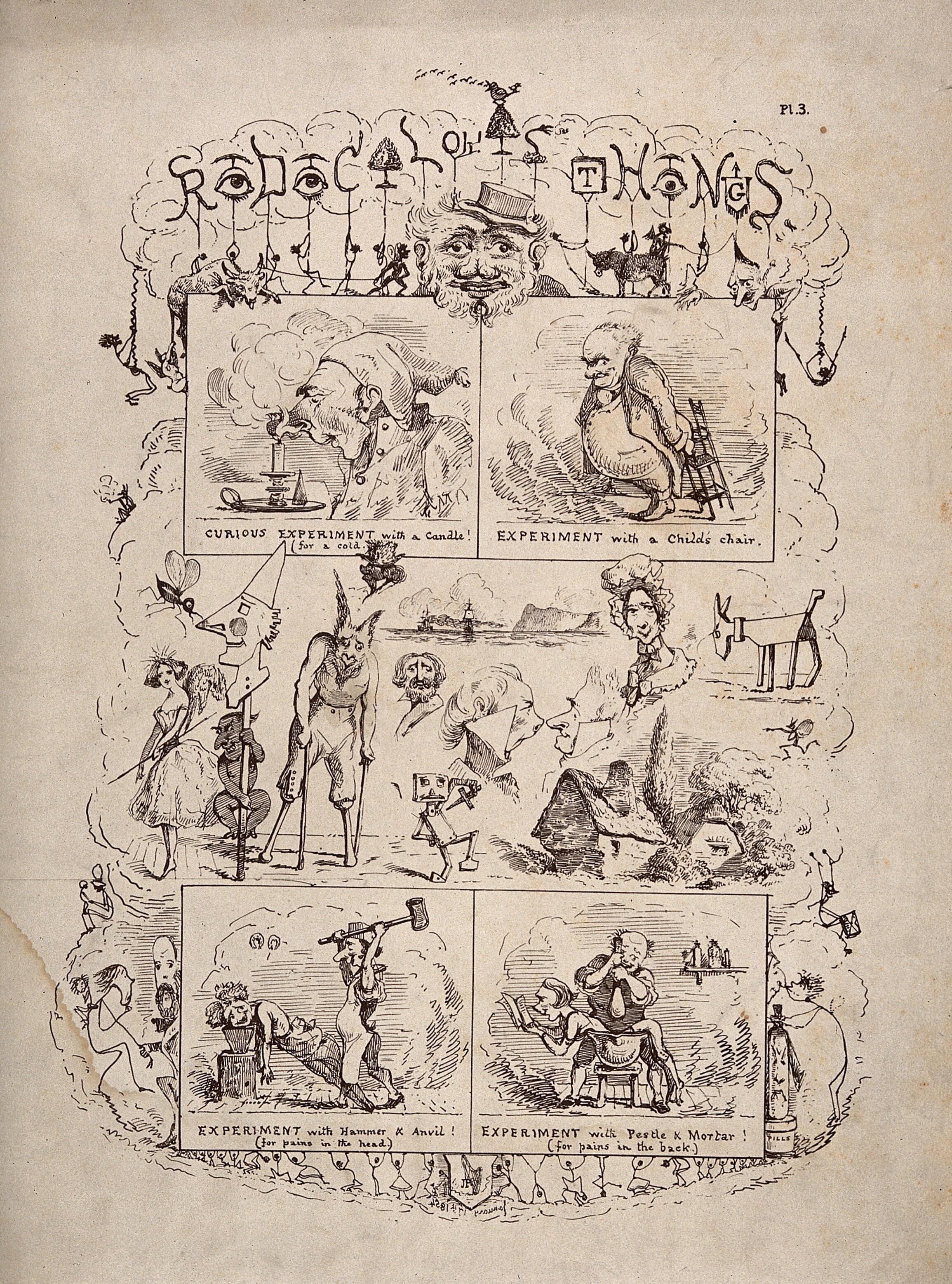
As well as the title page to the book:

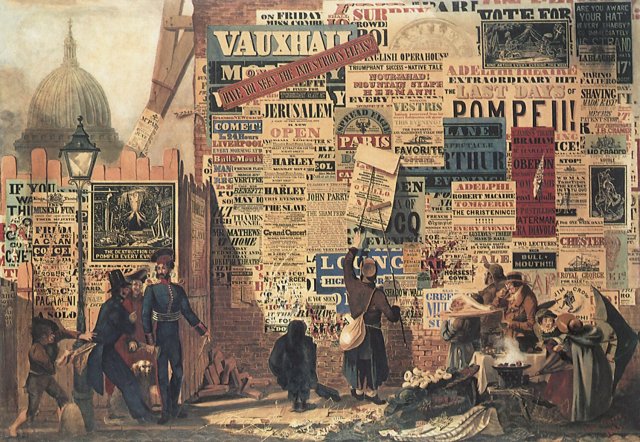
John Parry was also famous for an 1835 watercolour illustrating the invasion of advertisements on London’s walls (see this page on “the comic art of John Orlando Parry” announcing a lecture by Brian Maidment which is not available on the Internet as far as I could find out):













 A Blog of Bosh