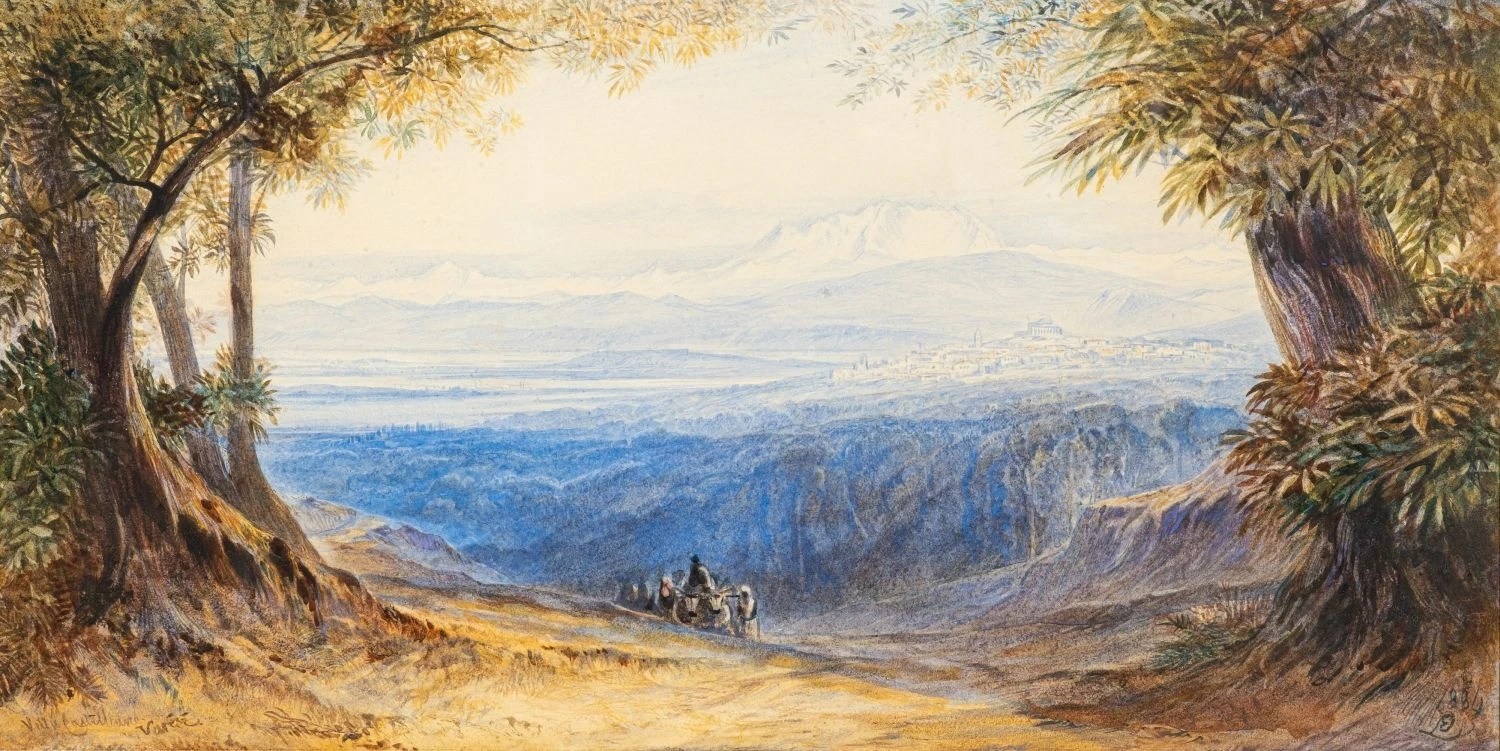
Edward Lear, Villa Castellane, Varese.
Watercolour on paper – 26 x 51.5cm, 42.5 x 68cm framed. Monogrammed and dated 1884 lower right, titled lower left. With Peter Nahum label verso, with Peter Nahum receipt.
Edward Lear, Villa Castellane, Varese.
Watercolour on paper – 26 x 51.5cm, 42.5 x 68cm framed. Monogrammed and dated 1884 lower right, titled lower left. With Peter Nahum label verso, with Peter Nahum receipt.
A few weeks ago Mr Nicholas Grindell contacted me about a chapbook he had published a few years back. It consists of a series of 108 limericks all beginning “There was an Old Man of Berlin” and is intended a tribute both to Edward Lear and the city Mr Grindell has been living in for over thirty years.
Unsurprisingly the title of the book is There Was an Old Man of Berlin and can be purchased from this page.

In the same e-mail Mr Grindell mentions something I had not noticed before: Lear’s own Man of Berlin
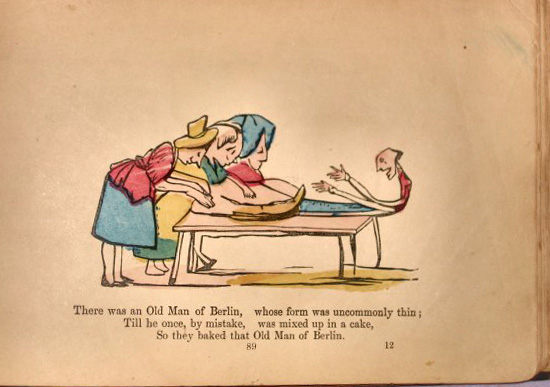
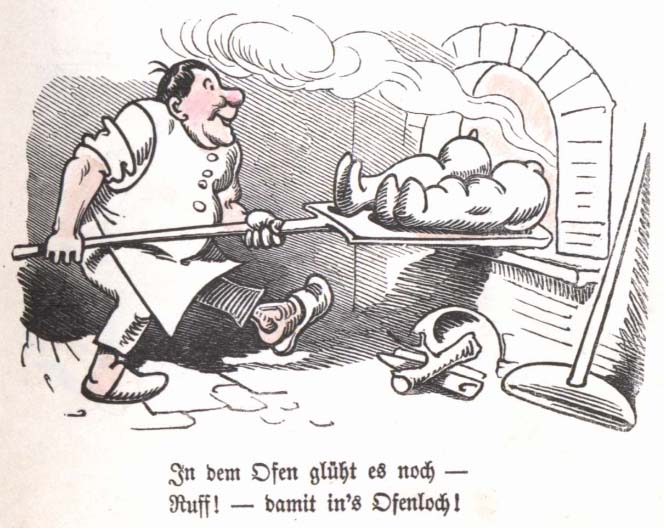
anticipates a scene from Wilhelm Busch’s Max und Moritz (1865), in which the two rascals end up in an oven, though this is not (yet) fatal to them:
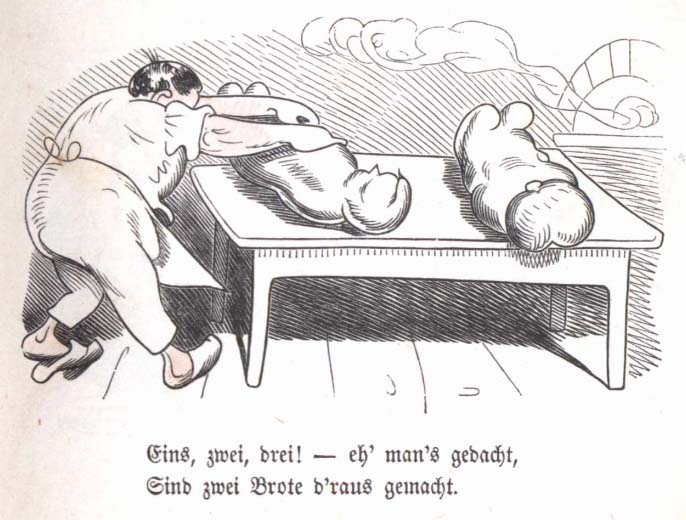
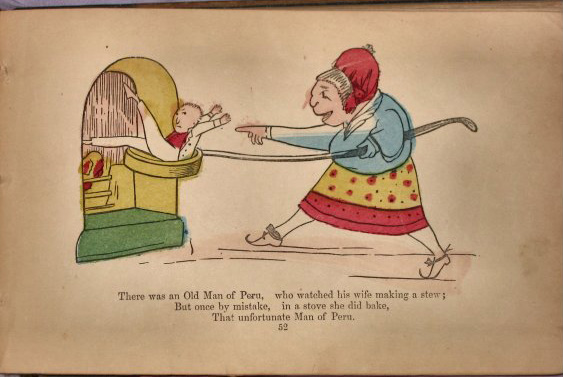
The second picture in Busch’s story corresponds to the fate of Lear’s Old Man of Peru:
My essay on the early editions of Edward Lear’s Book of Nonsense has now been published and is available on Project Muse:
Graziosi, Marco. “The Evolution of Edward Lear’s A Book of Nonsense: The Making of the 1846, 1855, and 1861 Editions.” Book History, vol. 28 no. 2, 2025, p. 282-315. Project MUSE, https://dx.doi.org/10.1353/bh.2025.a976869.

Abstract
Edward Lear’s A Book of Nonsense is a foundational work in modern children’s literature. This essay traces its development from early manuscript limericks to the first two-volume edition of 1846 and then examines the 1855 one-volume edition, identifying four distinct states and reconstructing its complex production history. A census of known variants of this second edition is included in an Appendix. The 1861 edition’s added limericks are discussed, and finally Lear’s evolving approach to book design is compared with Lewis Carroll’s attention to the smallest details of his publications. The evolution of the Book of Nonsense is shown to have provided a model for Carroll’s work and that of the authors of the “golden age of children’s literature.”

Edward Lear, View of Zagori.
Pencil and watercolour, signed lower right, 12 x 18cm.
Provenance
Gallery label verso for Mark Fisher of London SW12 and with original purchase receipt for Mark Fisher Fine Art of SW12, January 1992 for £4,500

Edward Lear, Villa Falconieri, Frascati.
Pencil on paper heightened with white chalk. Inscribed Villa Falconieri from Mondrajon/Frascati (lower left). 7 1/2 x 14 1/4 in.

Edward Lear, The castle at Genazzano, south-east of Tivoli, Italy.
Extensively inscribed with colour annotations; titled and dated ‘Gennazzano. Oct. 09. 1840.’ lower right. Pencil. 21.5 x 42cm.
Provenance
Albany Gallery, London
Although the gallery label verso suggests a date of 1860, the date is more likely to read 1840, when Lear is recorded as being in Italy around Tivoli and Rome.
[On 9 October 1860 Lear was in London.]

Edward Lear, Capo Sant’Angeli, Amalfi.
Pencil with touches of white on paper. 11 x 17.5cm; 4 1/4 x 17 1/2in. 25 x 31.5cm; 9 3/4 x 12 1/2in (framed). Property from a Private Collection, Ravenscourt Park.
Provenance
Thomas Agnew & Sons Ltd, London
Purchased from the above by the present owner in 1991

The present drawing of the dramatic cliffs of Capo Sant’ Angeli on the Amalfi coast was one of a series of works Lear completed to illustrate the poem The Palace of Art by Lord Alfred Tennyson (1809-1892) first published in 1832. Comprising twenty-four quatrains, Tennyson’s verses describe the construction of a vast pleasure palace for the soul.
Lear’s depiction of Capo Sant’ Angeli illustrates verse sixteen: ‘One showed an iron coast and angry waves / you seemed to hear them climb and fall / and roar rock-thwarted under bellowing caves / Beneath the windy wall’. Variations on the drawing are in the collections of the National Gallery, Washington DC, and the Rhode Island School of Design.
Lear lived in Rome, for a decade, from 1837-1847. Tennyson and Lear were friends over many years, frequently exchanging letters and verse. Lear was a frequent visitor to the Tennysons’ house Farringford, in Freshwater on the Isle of Wight, which attracted a host of other Victorian luminories including the photographer Julia Cameron, critic and artist John Ruskin and the painter Danté Gabriel Rossetti.
Invaluable (Olympia Auctions).

Edward Lear, A view of Santa Maura, Levkas, Ionian Islands, April. 1863.
Pencil, pen and brown ink and watercolour on paper. 13 x 20 ¼ in. (33.2 x 51.6 cm.)

Edward Lear, Louvère [Louvière in Swtzerland?].
Watercolour, Underdrawn In Pencil. 9.4 x 19.5 cm (3 3/4 x 7 3/4 ins). J. Leger & Son, 13 Old Bond St., label to frame verso.

Edward Lear, Rocky Valley of Musta, Malta.
Inscribed with title and colour notes, dated 2P.M. April 3, 1866 and numbered 275, pen and ink and watercolour. 23cm x 43.5cm (9in x 17.25in).
Provenance
Mrs Sowerby, February 3rd 1947
The Collection of Gordon & Ursula Bowyer
 A Blog of Bosh