Edward Lear and Alice

One of the most common statements to be found in the frquent comparisons between Edward Lear and Lewis Carroll is that there is no proof that they knew each other’s work; for example John Lehman, in Edward Lear and His Work (1977, p. 50), writes:

One of the most interesting unanswered questions of literary history is whether Edward Lear and Lewis Carroll read one another’s works or were in any way influenced by one another. There is no mention of either in the other’s diaries or letters, as far as we have them.

Many, starting with the anonymous reviewer in the Spectator of 9 April 1887, have identified some sort of Carroll influence in Lear’s later production of songs. Lehman goes on:

Nevertheless it is perhaps not too fanciful to see a certain, possibly distant consanguinity between Lear’s songs and such poems by Carroll as “’Tis the Voice of the Lobster”, “Beautiful Soup” (though both were of course parodies) and “Jabberwocky”.

The mystery, at least in what concerns Lear’s knowledge of Alice’s Adventures in Woderland, is now solved; in the latest edition of her biography, Edward Lear: The Life of a Wanderer (2004, p. 203), Vivien Noakes writes:

At the end of August [1869, the letter is dated 25 Aug.] he received a letter from Fortescue. “Have you read ‘Alice in Wonderland’?” it asked. “It is very pretty nonsense.”

And in the footnote to this passage she laconically states that “Lear’s own copy of Alice in Wonderland is now in the USA” (p. 287, chapter 17 note 23). Nothing is said of this copy (are there any annotations?) and Lear’s reply to Fortescue’s letter has not been published, as far as I know, and it might even be lost. So we do not yet know what Lear thought of his “rival” in the field of Nonsense, but we can be sure that he knew the Oxford don’s most important book and that among his friends it was considered to belong to the same genre he had created more than twenty years before with the Book of Nonsense.
Posted in Edward Lear, Lewis Carroll | 3 Comments

:?

I am late on this, as I read about Hu Wenliang’s “novel without words” only today; but I live in Italy and receive the TLS very late… so others have already discussed it: from the dismissing attitude of CHINAdaily
which concludes the article by “doubting Hu’s novel as hype” to the balanced report of BoingBoing, which notes that Hu “claimed that he spent one year to write the novel”.

Anyway, the whole novel, entitled , reads (?) as follows:

:  ?
:  !
“ ‘……’ ”
(、)·《,》
;——

The TLS, whose text is slightly different from the one above, taken from CHINAdaily, justly observes that this is a translation of the original, so I’m afraid we do not have a chance of winning the US$16,900 that Hu promised as a reward for the first correct interpretation (don’t ask me where he is going to get that money, not from this novel, which has been pirated all over the Internet and will probably not sell much). You want to try anyway and need a hint? It is “a special touching love story.”

After an admittedly superficial analysis I am inclined to exclude from the canon of Nonsense literature, though its five-line structure somehow reminds me of the limerick. It is difficult to gather the details (or I would claim the prize), but it is obvious that it starts with a question/problem, immediately followed by a strong statement, then a hiatus/suspension, a quest and a happy conclusion.

If you prefer a more detailed interpretation Jon @ Rogue Semiotics offers the best one I know, though I’m not sure his reading of “touching” was what the author meant.

Posted in General | Leave a comment

Mr Lear: A Song Tribute

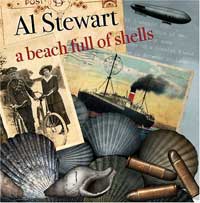
A Beach Full of Shells

Kim Dyer has written to let me know that a new album by Al Stewart, called A Beach Full of Shells (Appleseed Records, 2005), has just been released and it includes a tribute to “Mr Lear”.

You can listen to a passage on Amazon.com; the reviews are very favourable.

Edward Lear has always been a favourite with song writers, as the sadly incomplete Edward Lear and Music page demonstrates, and appeared as a character in the Beatles’ “Paperback Writer”:

Paul wrote “Paperback Writer” as another of his “letter songs.” It is about a novelist who is begging a publisher to publish his thousand page book. In its literal sense, it’s about a paperback writer who has written a novel based on another novel, about a paperback writer. Lennon’s contribution to this song was the phrase “a man named Lear,” and the reference to “The Daily Mail.” The name Lear came from the Victorian painter Edward Lear, who wrote nonsense poems that Lennon loved, and the Daily Mail was the regular newspaper Lennon received. It was recorded on April 13 and 14, 1966.
Oh Look Out! Part 16, 1962-1966 – The Red Album by John T. Marck

BTW, you can listen to two very early recordings of The Owl and the Pussy-cat (Columbia Quartet, 1902, and Haydn Quartet, 1904) in the Sounds section of the site.

Posted in Edward Lear | Leave a comment

Dreaming Alice

Starting on 6 June 2005 BBC Radio 4 will be broadcasting a series of programmes in which contemporary writers give a twist to Alice in Wonderland. You will be able to listen to them on the web for a week from the Programme Info page.

Still available for the next two days the broadcast for Tuesday, 31 May:

Writer and historian Jenny Uglow, author of A Little History of British Gardening, introduces an extract in which Alice encounters The Garden of Live Flowers from Lewis Carroll’s Through the Looking Glass. Read by Patience Tomlinson.

Thanks to A Wasp in a Wig.

Posted in Lewis Carroll | Leave a comment

Let Universe be Books

I have just received Justin G. Schiller Ltd.’s Spring Miscellany catalogue (no. 53) and among the many interesting items listed is an “original ink Manuscript lesson for teaching Logic, conceived in diagram format and dated by Dodgson in the upper right corner ‘5/3/94.'”

Let Universe be Books, a Dodgson MS

On 5 March 1894 Dodgson wrote in his diary:

Gave two Lectures in Logic, one at the High School, to the girls, at 2: the other to Miss Soulsby and four mistresses as well as Edith Lucy and Miss Scott, at 8 p.m.

More from the catalogue entry written with Edward Wakeling’s assistance:

Dodgson here is explaining in a simple way the logic terms “mutually exclusive” and “exhaustive”, as well as their converses. He uses a visual example of books on shelves to get his points across… The term “Universe” in this lesson means every known book that exists…

The MS was once part of the inventory of Blackwells of Oxford, who attended the dispersal auction sale of Dodgson’s library and effects in 1898, and they might have acquired it at this time, perhaps inside one of Dodgson’s books as a page-marker.

Posted in Lewis Carroll | Leave a comment

Lear Alphabet Manuscript and Wasp in a Wig to be Auctioned

Letter P

The Norman and Cynthia Armour Collection of Fine Children’s Books is to be auctioned by Christie’s in New York on 27 April 2005. Among the items there will be the manuscript of a nonsense alphabet. Here is the description for lot 94:

LEAR, Edward (1812-1888). Autograph manuscript for a pictorial nonsense alphabet, ca 1857. 26 separate leaves for each letter of the alphabet, each with large letter in ink at head, a pen-and-ink drawing at center and a quatrain with envoi at foot. Folio, written on blue paper with watermarks “Joynson” or crowned oval with Poseidon at center, each sheet with contemporary linen backing. With added sheets at end to form an album, containing three ink-wash sketches on two leaves of a duck and her young, a rabbit, and a goat and her young; and six hand-colored oval portrait etchings of children, these last sheets watermarked “Smith & Meynier Fiume.” Contemporary half roan, marbled boards (spine mostly perished); modern red quarter morocco folding case. Provenance: Ida Nea Shakespear (signature on flyleaf); sold Sotheby’s London, 20 April 1971, lot 543.

Lear wrote the manuscript during his stay in Corfu and presented it to Ida Nea Shakespear. The drawings and verses are similar to others which have appeared at auction and which Lear published. The most recent appearance at auction for a similar alphabet was at Sotheby’s London, 22 July 1980; this example was prepared for the Tennyson family circa 1855. Two printed examples can be found in Nonsense Songs, Stories, Botany, and Alphabets.

The well-traveled Lear is known to have visited Corfu on numerous occasions, first in 1848, having left Italy when the political situation there became unstable. He next went there in 1855 with Franklin Lushington, whom he’d met in Malta in 1848, though he spent most of this trip there alone and became depressed. His third trip to Corfu was over the winter of 1857. Other trips there were made in 1861, 1862, 1864 and 1877. According to Vivien Noakes, Lear made a number of these delightful alphabets for children up to 1870 (see Noakes, Edward Lear 1812-1888, London, 1985, p. 173).

Other Lear items of interest: William B. Osgood Field’s Edward Lear on My Shelves. Privately Printed [by the Bremer Press, Munich], 1933 (lot 96, $1,500-2,500) and two lots (95 and 97) of Lear or Lear-related books.

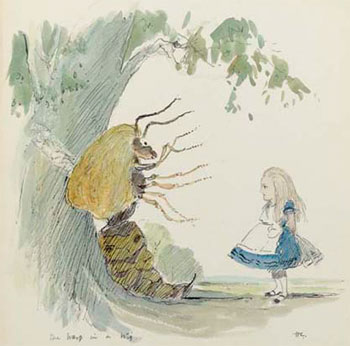
Wasp in a Wig

Also up for sale will be the (still controversial?) galley proofs for the Wasp in a Wig episode:

When they came to light at auction in 1974, after missing for over a century, the “discovery” of the present set of proof sent shock waves throughout the world of Carroll scholars and admirers alike. After fruitless attempts of finding any trace of the suppressed material, the draft was presumed lost, and some Carroll scholars even doubted it ever had ever existed. In 1977, the episode was published, with Mr. Armour’s generous permission, by the Lewis Carroll Society of America. The publication prompted an enormous amount of attention, and numerous articles surrounding the publication of the lost episode appeared in the U.K. and America press at the time…

They are expected to fetch between $50,000 and 70,000.

Posted in Edward Lear, Lewis Carroll | 1 Comment

Kinchinjunga to go under the hammer

Edward Lear's Kinchinjunga

The Telegraph of Calcutta reports that one of Edward Lear’s most famous paintings, “Kinchinjunga” (1873), is to be auctioned by Bonhams and is expected to go for a sum between £400,000 and £600,000:

The painting makes the cover of a Bonham’s catalogue, with an article on “Lear’s Indian Summer” by his biographer, Vivien Noakes, who curated a major exhibition, Edward Lear: 1812-1888, at the Royal Academy in London 20 years ago.

Lear went to India in 1873 at the invitation of his friend, Thomas Baring, the first Earl of Northbrook, who had become Viceroy of India the previous year. The painting was bought by another of Lear’s friends, Henry Bruce, who had become Lord Aberdare in 1873.

Posted in General | Leave a comment

A New Dr Seuss Movie in the Making

Horton Hears a Who - cover

A Wasp in a Wig, a new blog centered on Lewis Carroll, has a post about the projected 20th Century Fox production which will follow on Ice Age 2. As Jerry Beck reports at Cartoon Brew Horton Hears a Who had already been adapted by Chuck Jones in 1970.

For the whole story, see the Hollywood Reporter.

Posted in Dr. Seuss | Leave a comment

Lewis Carroll at the Family Records Centre

From the opening page of Carroll’s section at the Family Records Centre:

Lewis Carroll, the author of the Alice books, is probably Britain’s best known writer of children’s fiction. Less well known is the ‘other’ Lewis Carroll, the mathematician, churchman, photographer and Student of Christ Church College, Oxford, who was more familiar to his friends and colleagues as the Reverend Charles Lutwidge Dodgson.

This exhibition tells the story of his life, from his birth at Daresbury, Cheshire, through his long years at Christ Church to his quite sudden death at his sisters’ house in Guildford.

The story is illustrated using documents from the Family Records Centre, The National Archives and elsewhere.

The site also includes an exhibition on Ellen Terry, a famous actress who was also one of Charles Dodgson’s so-called child friends; also see this short biography of Terry at About.com.

Posted in Lewis Carroll | Leave a comment

Carroll and Money

Lewis Carroll - In His Own AccountLewis Carroll – In His Own Account by Jenny Woolf (Jabberwock Press, 2005) is an annotated transcription of Dodgson’s bank account from 1856 to 1900 (two years after his death) and shows that Carroll was in the red for most of this period, thus contradicting “his reputation for financial sharpness” (Jenny Woolf’s piece on the book in the Times Literary Supplement, “Sounds and Sense”, no. 5315, 11 February 2005, a generous excerpt is available through Blogcritics.org).

The book also shows that, notwithstanding the overdrafts, he was generously helping both individuals and institutions, most notably those concerned with “the plight of the many women and children who were trafficked and abused by the Victorian sex trade” and is therefore relevant to the ongoing war over his sexual preferences (see also): “these donations were not made for show, but were kept entirely private.”

Also see an interview with Jenny Woolf in the Camden New Journal and a short post at A Wasp in a Wig.

Jabberwock now has a page which provides errata, new information and “other useful comments” about the book.

Posted in Lewis Carroll | 1 Comment