Edward Lear and George Grove

One of the most famous of Edward Lear’s self caricatures is certainly the one in which he portrays himself while looking straight into the eyes of a strange “bug,” which is itself gazing at him. I had never cared to check where the image came from, but today, while doing some reasearch for the Diaries project, I found it illustrated a letter Lear sent to George Grove, immortalised in the title of Grove’s Dictionary of Music and Musicians.

remarkable_fungus_(Grove)

Lear was first introduced to Grove by William Holman Hunt on 14 November 1859 and, from the confidential tone of the letter below, a friendship was formed, probably based on the interest in the East the two men shared. The letter also makes clear that the “bug” is actually a toadstool.

Here is the relevant passage, including the nonsense-rich letter, from Graves’s 1903 biography of Grove:

On his return to Sydenham, Grove was at once engaged in the preparations for the Flower Show, held at the Crystal Palace on September 20th {1860}, when he was specially attracted by the Gladiolus exhibit. Next day he remarks in his note-book that “the round hills about Caterham struck me as not unlike Benjamin. For the smooth rocklike flagstones see the East Hill at Hastings half way up,” and the possibility of his paying a second visit to Jerusalem is mentioned in a letter written a month later to his friend, Mr. Bergheim. Entries in his note-books prove him to have already begun to take an interest in the music of Schubert — who afterwards became “his existence” — while a further proof of his Solomon-like versatility is shown by a sudden desire to collect toadstools, evidence of which is forthcoming in the following highly characteristic illustrated letter from Edward Lear, the artist and humorist, to whom he had been attracted by their common interest in the East:

“Oatlands Park Hotel,
“Walton On Temms, Surrey,
“15 Nov. 1860.

“Dear Grove

“I Hasten to inform you that in a wood very near here, there are Toadstools of the loveliest and most surprising colour and form:— orbicular, cubicular and squambingular, and I even thought I perceived the very rare Pongchambinnibophilos Kakokreasopheros among others a few days back. You have therefore nothing better to do than to come with Penrose and hunt up and down St. George’s Hill for the better carrying out of the useful and beastly branch of science you have felt it your duty to follow. Provided also that you bring your own cooking utensils you may dine off your gatherings though I won’t partake of the feast, my stomach being delicate.

“Seriously, however, I should indeed like to see both F. Penrose and yourself here:— couldn’t you send a line first, and come over to luncheon? though it would be far better if you came and dined and slept and then toadstooled all the next day—back to Sydenham or as you pleased. Saturdays and Sundays are my only insecure days, but those are the days also you would be least likely to think of coming. Daddy [i.e. Holman] Hunt writes to me that he is coming soon:— it would be very nice if we could all combine.

“Besides the seedars — you would see 11 other unfinished vorx of art—not to speak of a good many sketches. My life passes daily in a different place, Lebanon, Masada, the Tiber, — the Cervara Quarries, — Philates, Zagori, — Philae, — S. Sabbas, — Damascus, Bethlehem, Beirut, and Interlaken. But I confess that a little more society would sometimes be pleasant — for painting, Greek, music, reading and penning drawings are all used up by the end of the day. Various friends, however, write and come — so I don’t complain.

“If you let me know — shall I send out and gather toadstools in hampers for you? You can sit and pick them in the large hall.

“O ! that I could get back to Jerusalem this spring !

“Goodbye.
“Yours,
” Edward Lear.”

Graves, Charles Larcom. The life & letters of Sir George Grove, Hon. D.C.L. (Durham), Hon. LL.D. (Glasgow), formerly Director of the Royal College of Music. London: Macmillan, 1903, pp. 79-81. (Google Books)

Posted in Edward Lear | Leave a comment

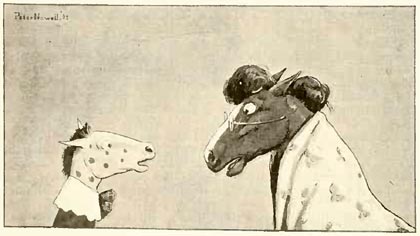
Polly Sleepyhead

My translation of the early episodes of Peter Newell’s Naps of Polly Sleepyhead will be in Italian libraries next week, and the publisher, orecchio acerbo, has a book trailer on YouTube:

This is going to be in the Little Big Books format, which I found suits Polly’s adventures very well.

Posted in Comics, Peter Newell | Leave a comment

Verbeek's Botanies

Sunday Press has announced the availability of their new collection reprinting in full colour the whole run of  Gustave Verbeek’s The Upside-Downs of Lady Lovekins and Old Man Muffaroo, the late Terrors of the Tiny Tads, as well the first complete collection of The Loony Lyrics of Lulu. While writing an introduction for this last strip I collected more material on Verbeek’s connections to Nonsense literature than could fit the pages of the book, so I’ll be posting some of my notes here in the coming weeks.

The Terrors of the Tiny Tads ran in the New York Herald for several years and its style, both graphic and narrative, changed considerably. The more obviously nonsense-influenced strips tend to be the early ones, which are rougher in appearance and tell more violent stories.

The series is famous for its hybrid animals, but several episodes included vegetable beings in the tradition of Edward Lear’s “Botanies.” The June 23, 1907 episode, for instance, presents a series of predator-flowers that are probably at least in part based on Lear’s “Tigerlilia Terribilis” and “Barkia Howlalowdia” (click to read the whole strip):

ttt_1907-06-23_d

tigerliliabarkia

Verbeek’s Dandelioness, which does not really look particularly ferocious, will reappear in the October 3, 1909 strip in a much less violent context:

ttt_1909-10-03_d

Sometimes the vegetable nature of the hybrids is dominant, as in the examples above, sometimes the animal part is the stronger and the creatures can move, and often become dangerous, as in this December 1, 1907 strip:

ttt_1907-12-01_d

Posted in Edward Lear, Gustave Verbeek | Leave a comment

The Grave of Edward Lear

Mr. Eden Phillpotts, […] who lives in Devonshire and spends all his time in the beautiful English country, has written a book called “My Garden,” which will be published by the English Country Life. It is the thoughts of a literary man who is something of a gardener. There is no subject upon which Mr. Phillpotts writes that he does not illuminate, and I hope that some enterprising American publisher will soon issue his garden book.

Mr. Phillpotts has been good enough to send me a sonnet on ” The Grave of Edward Lear” that he published recently in that admirable journal, The Tribune, of London. Here it is:

Amid the silent lodges of the dead,
Beneath the terraced hills of Italy,
He lies, with sunny cypress at his head
And mourning purple of the fleur-de-lys
Upon his marble. Roses white and red
Twine there, and round about the mystery
Of olive groves their twinkling silver spread
Along the sapphire of the Inland Sea.
Sleep, laughter-maker of a vanished day.
What merry jester of them all can vie
With your mad fancies, whimsical and gay?
No sorrow here! We’ll pass this pillow by
In happiness of gracious thoughts, and pay
The tribute of a smile; but not a sigh.

In sending this sonnet to The Tribune, Mr. Phillpotts wrote:

Among the notes and sketches brought home with me from my holiday in France and Italy, I find this little sonnet, written last month. Edward Lear, the famous author of the ‘Nonsense Book’ — perhaps the first real nonsense book ever written — lies at San Remo, and his flowery grave inspired these lines.

It is not all of us who could express our feelings for Edward Lear as gracefully as Mr. Phillpotts has done. We all love him, and have loved him from our childhood to older age. He has left no successor. There are any number of men and women writing nonsense, but it is not the nonsense of Edward Lear.

The Critic, vol. 49, no. 1, July 1906, pp. 11-3.

Eden Phillpotts‘s poem was then published in his Wild Fruit (London: John Lane, 1911, p. 100).

Posted in Edward Lear | Leave a comment

Cassowary vs Missionary

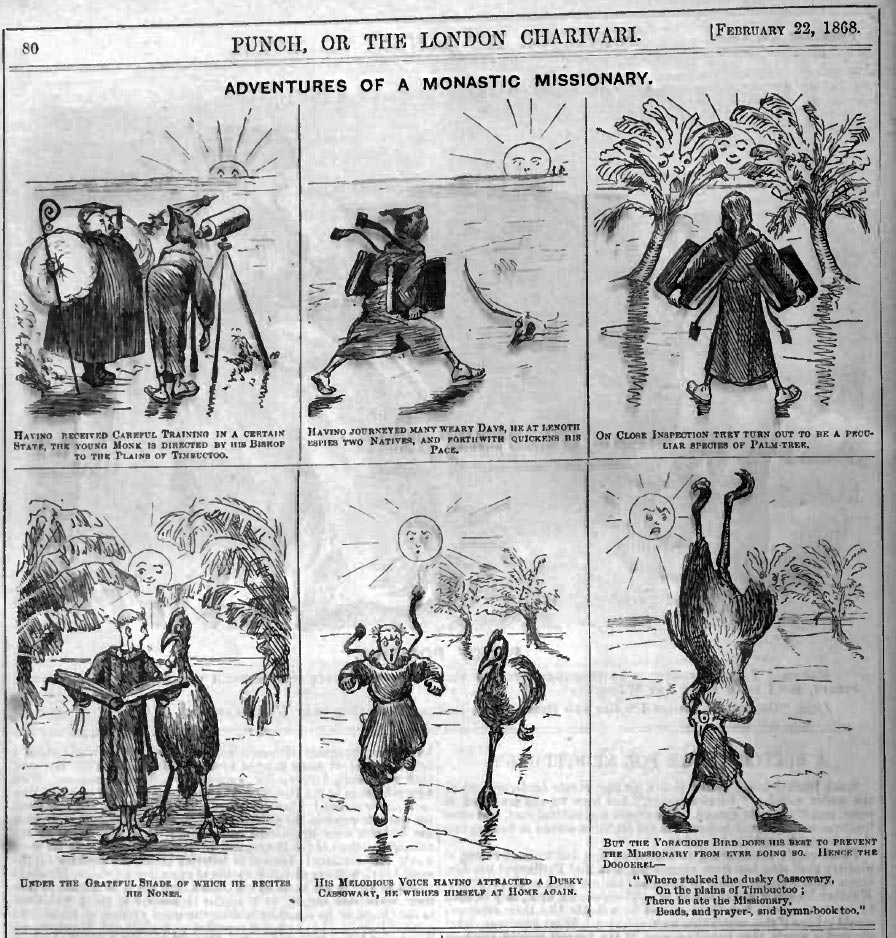
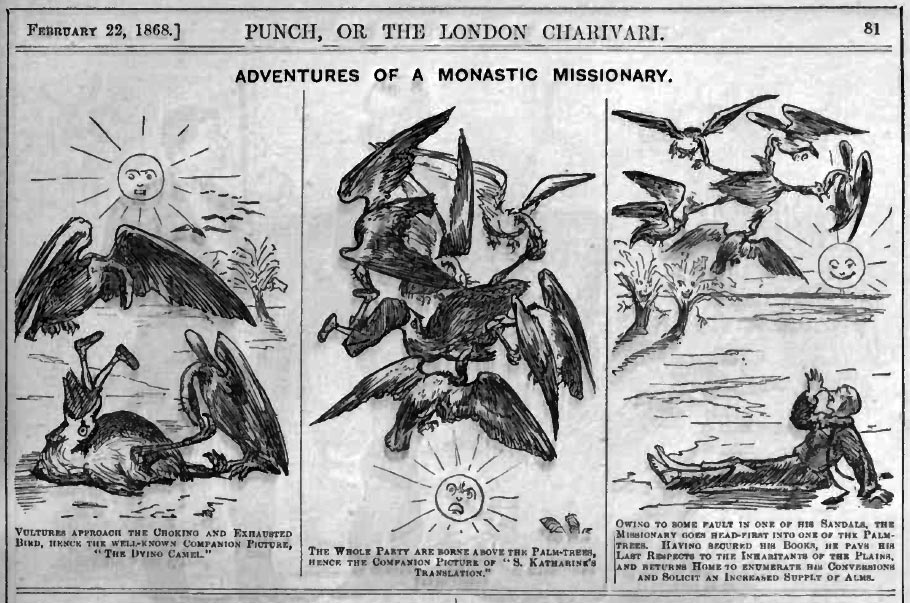
The tragic consequences of being a missionary in Timbuctoo were the subject of one of the infrequent comic strips in Punch (22 February 1868, vol. 54, pp. 80-1).

The little poem around which the story turns is known in several different versions and has been variously attributed, but, as far as I know, no final agreement has been reached; most commentators, however, seem to agree as to the circumstance in which it was composed: the 1829 poetry challenge won by the young Tennyson, whose subject was “Timbuctoo.” You will find some of the versions and hypotheses at the end of this post.

The quatrain is a good illustration of how nonsense is often generated; Lear’s limericks, which almost invariably have a city name at the end of the first line, repeatedly use the same techique. Rhyming with “Timbuctoo” is a challenge, but the phonological sequence |’ɪmbʌktu:| suggested “hymn-book, too” and the hymn-book a missionary, whose sound in turn made “cassowary” a possibility. The notorius undiscerning voracity of the bird sealed the poor preacher’s fate.

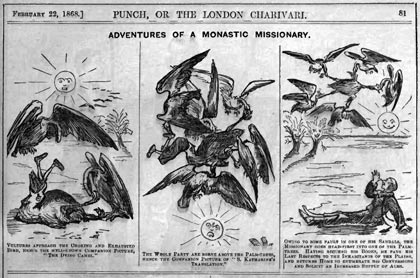
cassowary_s1

cassowary_s2

The Punch artist added a coda to the story which combines a traditional escape from danger with parodies of presumably well-known pictures: “The Dying Camel” of the first panel is a reference to Henry Hope Crealock‘s “Arab and Dying Camel,” even the very small picture I was able to find is enough to show the similarities:
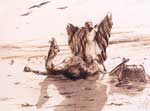
dying_camel

The reference in the second panel is more difficult to identify: Saint Catherine of Alexandria‘s body was carried to Mount Sinai by angels, but the only depiction of the event I have been able to find is a 1612 painting by Jacopo Chimenti which does not really have much in common with Punch‘s picture:
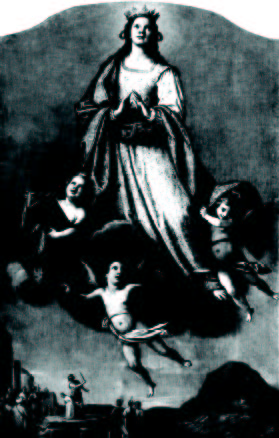
jacopo_chimenti_traslazione_del_corpo_di_sca_(1612)

Notes & Queries, 3rd Series, IV. September 5, 1863, p. 188.

RIDDLE: RHYME TO TIMBUCTOO. What is the answer to the following?

“My first, invisible as air,
Apportions things of earth by line and square.
The soul of pathos, eloquence and wit,
My second shows each passion’s changeful fit.
My whole, though motionless, declares
In many ways how everybody fares.”

While on such a subject, I add that I have heard from at least a dozen quarters that I am the author of a rhyme to Timbuctoo which has amused many. The rhyme is as follows:

I would I were a cassowary,
On the plains of Timbuctoo ;
I’d catch and eat a missionary,
Legs and arms and hymn-book too.

This is not mine ; but I believe I was one of the first dozen who heard it. A. DE MORGAN.

Notes & Queries, 7th Series, I. February 27, 1886, p. 171.

RHYMES ON TIMBUCTOO (7th S. i. 120).— A. F. will find the lines referred to given by PROF. A. De MORGAN in ‘N. & Q.,’ 3rd S. iv. 188. He seems to have known who wrote them. It is a pity he did not say. The version I have always heard differs slightly from that there given, being as follows:—

If I were a cassowary
On the plains of Timbuctoo,
I would eat a missionary,
Blood and bones and hymn-book too;

and I always understood it was an impromptu of Theodore Hook’s in response to a challenge that he could not make a rhyme to Timbuctoo.

A. F. will find the same rhyme with different verses in ‘N. & Q.,’ 3rd S. x. 330 and 4th S. vi. 308. Here is another rhyme, however :—

When Jim and I stalked cassowaries
On the plains of Timbuctoo,
We met three wily adversaries,
I booked one and Jim booked two.
J. B. FLEMING.

I have understood that Bishop Samuel Wilberforce composed this quatrain, being challenged to find a rhyme to the word Timbuctoo. It is as follows:—

If I were a Cassowary
On the plains of Timbuctoo,
I would eat a missionary,
Coat and bands, and hymn-book too.
A. J. M.

[MR. F. C. BIRKBBCK TERRY writes to the same effect as A. J. M., and supplies a slightly different version.]

Ibid., p. 235

RHYMES ON TIMBUCTOO (7th S. i. 120, 170).— Bishop Wilberforce was far too good an ornithologist to place a cassowary in Africa. The first line of the rhymes might be changed to

If I were a lion hairy.

But why should the missionary’s death be made the subject of the lines? The gentle bird, the cassowary, being dismissed as a creature unknown in Africa, the following rhymes might be fitted to “missionary” and “Titnbuctoo,” if that is the feat to be accomplished:—

Riding on a dromedary
O’er the plains of Timbuctoo,
Comes the British missionary,
With his tracts and hymn-book too.
J. DIXON.

Ibid., p. 337

RHYMES ON TlMBUCTOO (7th S. i. 120, 171, 235).- These rhymes possess a literary interest, and imply a definite date, of which your correspondents do not seem to be aware. In 1829 Alfred Tennyson, then an undergraduate at Trinity, gained the Chancellor’s medal for a prize poem, for which the assigned subject was Timbuctoo. Cambridge tradition affirms that when the subject was given out it was said to be impossible to find a rhyme to Timbuctoo, and several university wits tried their hands at a sort of burlesque competition for the prize, with results which your correspondents have chronicled. The orthodox version of the best of those you give is, I believe,—

If I were a cassowary
On the plains of Timbuctoo,
I would eat a missionary,
Prayer Book, Bible, and hymn book too.

Charles P.G. Scott. “The Malayan Words in English. (First Part.)” Journal of the American Oriental Society, XVII, 1896, pp. 93-144.

The bird is mentiond, under a name now current as emu, in the following passage:

In Banda and other Ilands, the bird called Emia or Eme, is admirable. It is foure foot high, somewhat resembling an Ostrich, but hauing three clawes on the feet, and the same exceeding strong: it hath two wings rather to helpe it running, then seruiceable for flight: the legges great and long.
1613 PURCHAS, Pilgrimage, p. 430.

The first English mention of the name cassowary appears to refer to a bird brought to England:

St. James his Ginny Hens, the Cassawarway moreover. (Note by Coryat. An East Indian bird at St. James in the keeping of Mr. Walker, that will carry no coales, but eat them as whot you will.)
1611 PEACHAM, in Paneg. verses on Coryat’s Crudities, sig. 1. 3 r° (1776). (S. D.)

A Cassowaries or Emeus Egg.
1673 J. RAY, Journ. Low Countr., p. 28. (S. D.)

(See other quotations in S. D. and N. E. D.)

The Cassawaris is about the bigness of a large Virginia Turkey. His head is the same as a Turkey’s; and he has a long stiff hairy Beard upon his Breast before, like a Turkey.
1705 FUNNEL, in Dampier’s Voyages, 4:266 (1729). (Y.)

Cassawary, or Emeu, a large Fowl, with Feathers resembling Camels-Hair.
1708 and 1715 KERSEY.

Another large and extraordinary bird is the Cassowary, which inhabits the island of Ceram only. It is a stout and strong bird, standing five or six feet high, and covered with long coarse black hair-like feathers. The head is ornamented with a large horny casque or helmet, and the bare skin of the neck is conspicuous with bright blue and red colours. The wings are quite absent, and are replaced by a group of horny black spines like blunt porcupine quills…. This bird is the helmeted cassowary (Casuarius galeatus) of naturalists, and was for a long time the only species known.
1869 WALLACE, Malay Archipelago (1890) p. 305.

See also 1774 GOLDSMITH, Hist, of the earth (1790), 5:6, p. 67, 73 (Jodrell); 1856 CRAWFURD, Descriptive diet., p. 84; 1869 BICKMORE, Travels in the East Indian Archipelago, p. 150; 1889 WALLACE, Darwinism, p. 115.

The unreflecting voracity of the bird appears in the quotation in which he eats coals “as hot as you will.” In the “experience,” or at least in the travels, of a warlike German, quoted by Yule (1644-1659) he, the cassowary, swallowd 50 bullets, of a size not stated. According to a popular rime, the cassowaries of Timbuctoo, which are ignored by the leading ornithologists, make light of a still heavier diet:

If I were a cassowary,
Far away in Timbuctoo,
I would eat a missionary,
Hat and boots and hymn-book, too.
a. 1880 Auctor incert., loc. non cit.

The New York Times, 25 February 1906

That Poor Missionary!

Was it a Cassowary, a Dromedary, or a “Lion Hairy” That Ate Him?

To the Editor of the New York Times:

How do such perversions of the authentic version occur? Written by Thackeray as a challenge to find a rhyme for Timbuctoo, when Tennyson in 1829 won the Chancellor’s medal at Cambridge with the poem “Timbuctoo,” the final rendering reads:

Riding on a dromedary
O’er the plains to Timbuctoo,
There I met a lion hairy
Eating up a missionary,
Hat, and coat, and hymnbook, too.

Thackeray first wrote “cassowary,” but changed it to “lion hairy,” when informed the habitat of the cassowary was Malaysia, a few thousand miles southeast of the Saharan plains.

EnCycLopedi-CusS.

New York, Feb. 22, 1906.
Posted in Comics, Edward Lear, General | 5 Comments

The Ladies and Scott

Moonshine, a magazine established in 1879, published the following parody of Edward Lear’s “Akond of Swat” on 1 January 1898 (p. 2); it was prompted by the leading dramatic critic of its age Clement Scott’s assertion that “it was practically impossible for any woman to remain on the stage and retain her womanly modesty,” a statement which “aroused great excitement among theatrical people, and great indignation.” (R.A. Torrey, The Power of Prayer and the Prayer of Power, pp. 86-7).

The Ladies and Scott.

(With apologies to the shade of Edward Lear.)

[“Much amusement and some indignation have been excited in theatrical circles by the strictures passed (in an interview) by Mr. Clement Scott on the morals of actresses.” — Daily Paper.]

Where, or which, or whoever, or what
Are the ladies acquainted with Mister Scott?
Are the critic’s friends such a shady lot?
Or where on earth were such thoughts begot?
                Of the ladies, by Scott?

Has he lost his temper for once, or got
A touch of the gout, or an aching “dot,”
                Inclement Scott?

Or whereon does he base his views? and what
Have they done to catch it so passing hot —
                The ladies — from Scott?

Have they dragged him forth from his virtuous cot
At night, and caused him to blush a lot,
                Our virtuous Scott?

Do they ride a bike (as a girl should not)
In the rational dress — or perchance culottes
                The ladies of Scott?

Did they teach him tennis and make him “swot”
When the sun was here, and the pace was hot,
                Unfortunate Scott?

Or cricket, and sai he should field like Trott,
And not stand still like the wife of Lot,
                The ladies and Scott?

Or take him sailing and make him squat
In a sea-sick state on the bows of a yatch —
                Unnautical Scott?

Or is the interview tommy-rot,
And did someone go and invent a lot,
                And traduce our Scott?

We cannot tell, but we fancy not,
And we think it time it was all forgot;
Though it’s odds the ladies won’t care a jot
For the strange opinions of Mr. Scott,
                For they know what’s what!

Posted in Edward Lear, General | 1 Comment

Peter Newell, Independence Day in the Country

newell_independence_day

Old Billy ushers in the day when in the early morn
He winds a merry roundelay upon his crumpled horn.

Peter Newell, from Harper’s Young People, vol. XV, No. 766, 3 July 1894, p. 616.

Posted in General, Peter Newell | Leave a comment

Peter Newell, James and the Hat

newell_hoop_hat_s

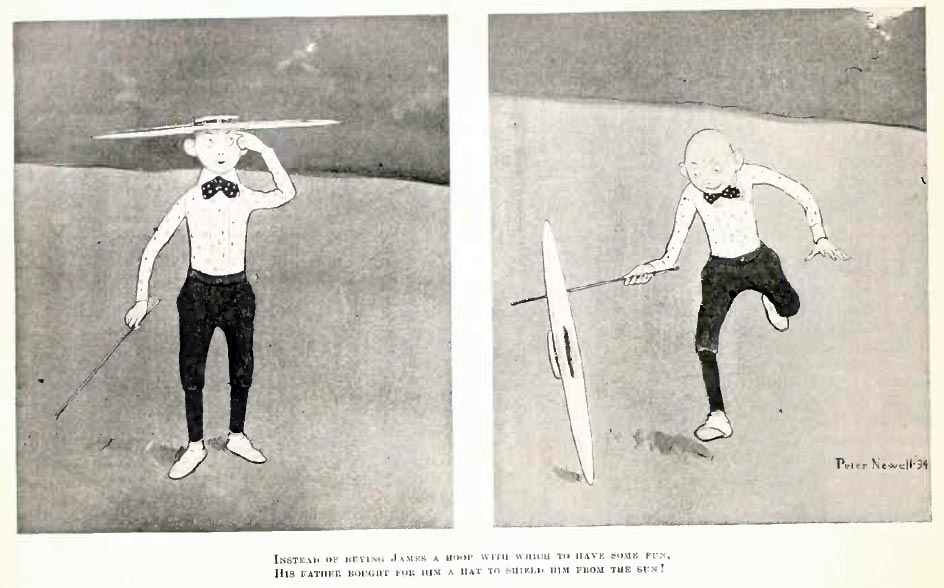
Instead of buying James a hoop with which to have some fun,
His father bought for him a hat to shield him from the sun!

Peter Newell, from Harper’s Young People, vol. XV, No. 767, 10 July 1894, p. 632. (Click for larger image.)

Posted in Peter Newell | Leave a comment

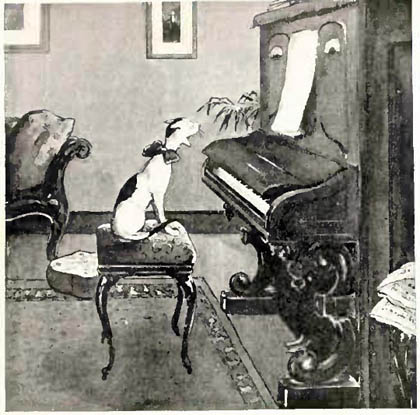
Peter Newell, The Laughing Piano

newell_laughing_piano1

It was impolite, of course, but when Tabby started off with “Oh, promise me,” the piano couldn’t help laughing.

Peter Newell, from Harper’s Young People, vol. XV, No. 769, 24 July 1894, p. 664.

Posted in Peter Newell | Leave a comment

Peter Newell, The Straw Hat

newell_straw_hat

“Oh, what have you done with your little straw hat, with its streamers of ribbons so pretty and gay?”
“Oh, mother, dear mother,quite hungry was I, and I ate my straw hat, I am sorry to say.”

Peter Newell, from Harper’s Young People, vol. XV, No. 774, 28 August 1894, p. 744.

Posted in Peter Newell | Leave a comment