Edward Lear, The Dead Sea, Jordan

El_dead-sea-s


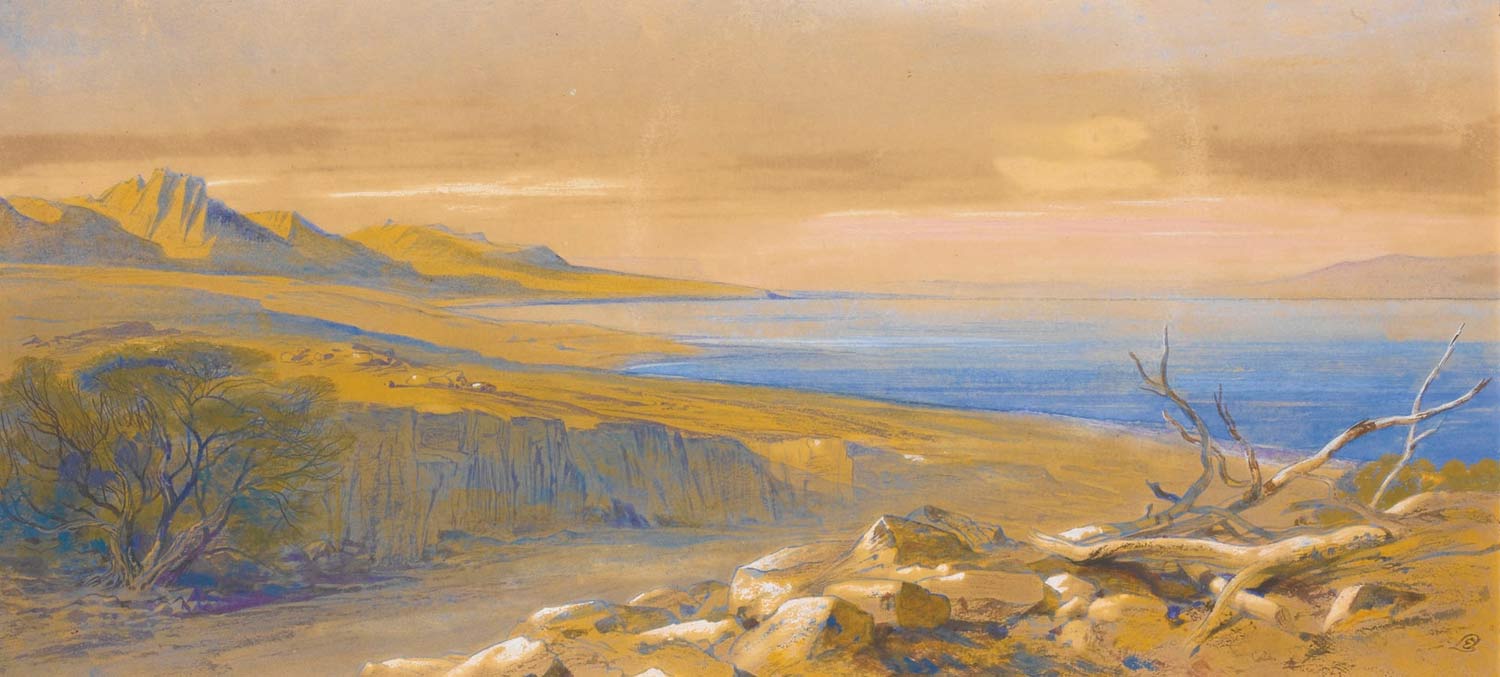
Edward Lear, The Dead Sea, Jordan.
Watercolour and bodycolour, heightened with white; signed with the artist’s monogram lower right. 177 by 375 mm.

Lear arrived in Jerusalem in March 1858, travelling on to Petra and then the Dead Sea, which he considered ‘more like a calm Italian lake than as I have heard it described’.1
1. V. Nokes, Edward Lear 1812-1888, Exhibition Catalogue, Royal Academy of Arts, London 1985, p. 111

Sotheby’s.

Posted in Edward Lear | Tagged , , , , | Leave a comment

Edward Lear, The Amphitheatre, Taormina (1842)

EL_taormina-s


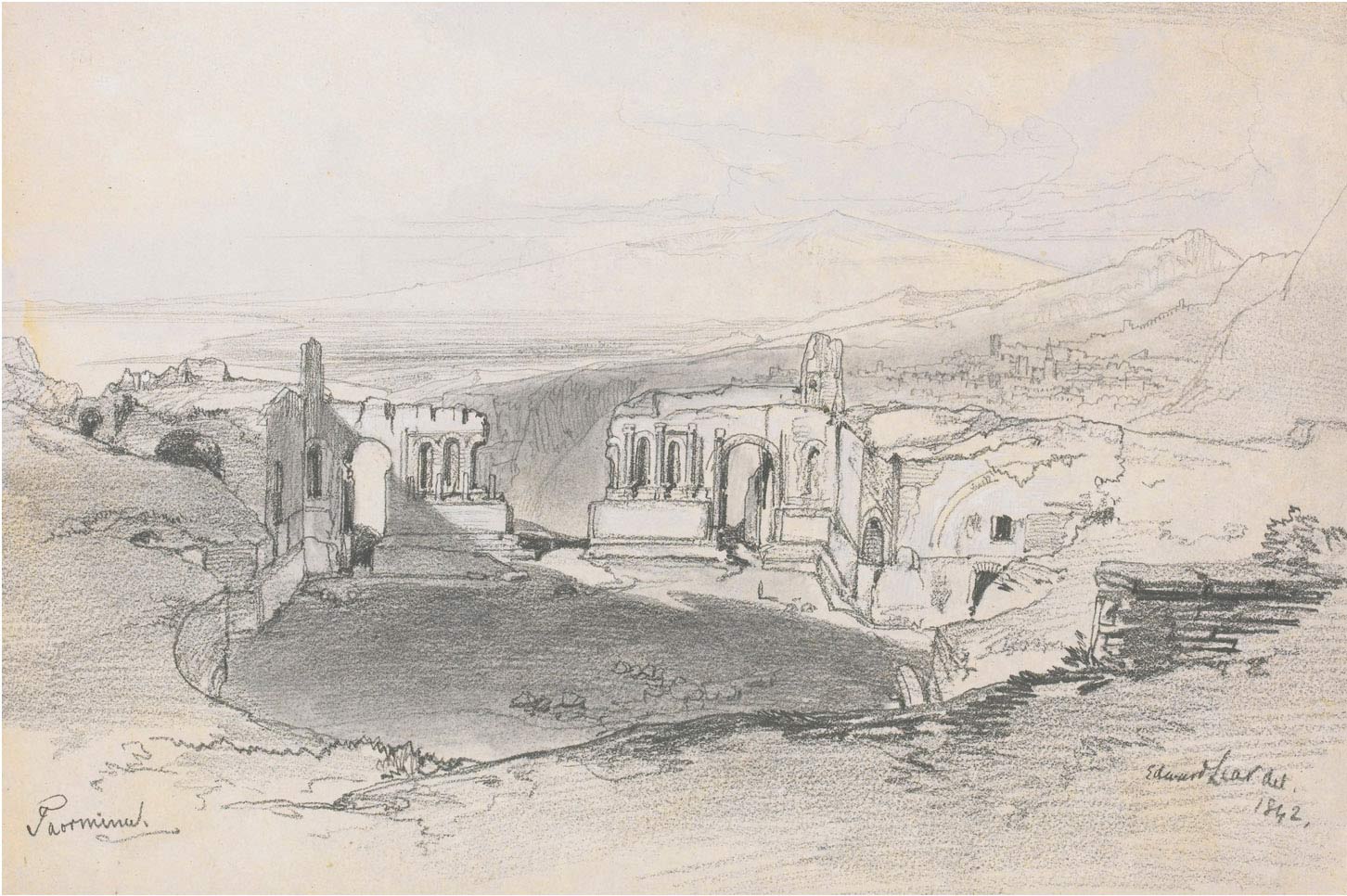
Edward Lear, The Amphitheatre, Taormina, Sicily.
Pencil and grey wash, heightened with white, on grey paper; inscribed lower left: Taormina; signed lower right: Edward Lear del.1842. 165 by 250 mm.

Lear spent ten weeks exploring Sicily in the spring of 1842. On the 5th June he wrote to his patron, Edward, 13th Earl of Derby (1775-1851) that ‘Taormina was our next halting place…This city is very interesting for its containing the most perfect remains of a Greek theatre now extant. It looks towards Etna and the view thence – looking down nearly all the east and S[outh] East coast of Sicily…[It] is truly astonishing.’1
1. V. Noakes, Edward Lear, Selected Letters, 1988, p. 59

Sotheby’s.

Posted in Edward Lear | Tagged , , , , | Leave a comment

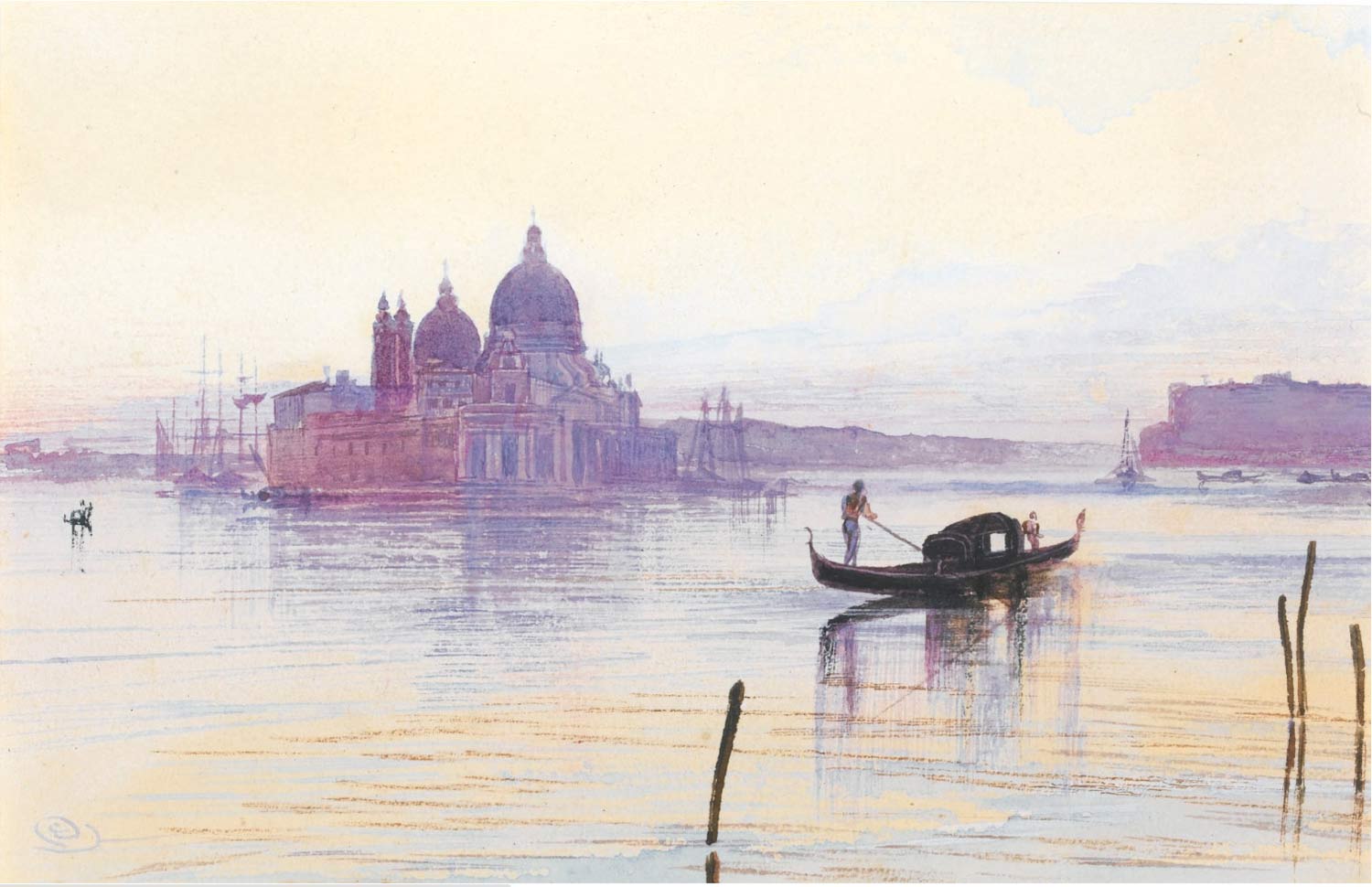
Edward Lear, Santa Maria della Salute, Venice

EL_salute-s


Edward Lear, Santa Maria della Salute from across the Bacino, Venice.
Watercolour over pencil heightened with touches of bodycolour; signed with monogram lower left. 115 by 175 mm.

The present watercolour dates from Lear’s second trip to Venice in November 1865. He first visited the floating city in 1857, but returned on his way to Malta to make studies for an oil painting which had been commissioned by Frances, Lady Waldegrave (1821-1879). Although he had not enjoyed his first visit there, he describes his 1865 trip in a far more favourable light. On the morning of 13th November, he rose early ‘had a cup of café noir in the hotel – and then got a gondola for the day. First drew S(anta) M(aria) de S(alute) by the Doge’s Palace – then from the Iron Bridge…but it was very cold.’1 The cold weather prevented him from completing his drawing and he returned to it on the 16th when he describes ‘the same bright gorgeous – but cold weather. Anything so indescribably [sic] beautiful as the colour of the place I never saw.’2
1. V. Noakes, Edward Lear 1812-1888, London 1985, p.116
2. V. Noakes, op. cit, 1985, p.116

Sotheby’s.

Posted in Edward Lear | Tagged , , , , | Leave a comment

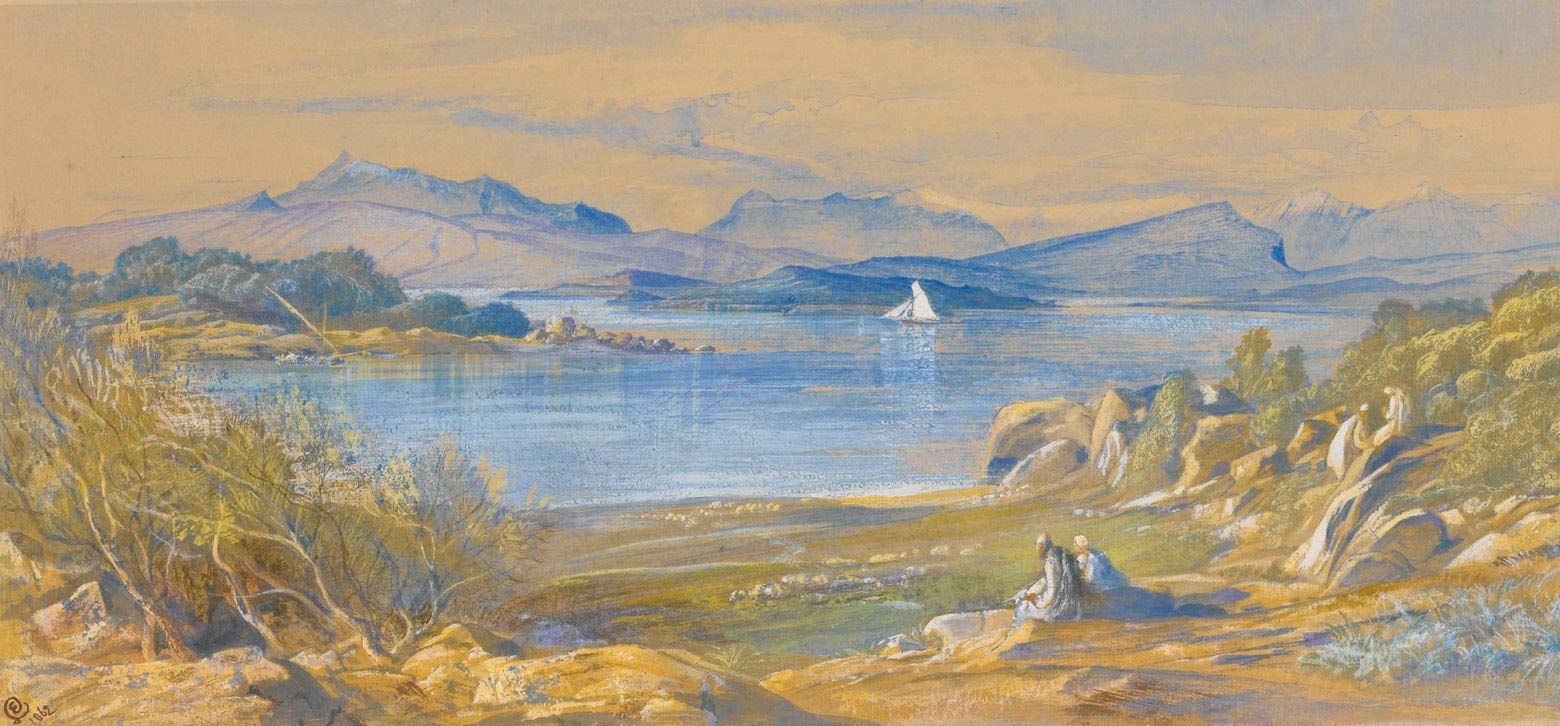
Edward Lear, Porto Tre Scoglie (1862)

EL_tre-scoglie-s

Edward Lear, Porto Tre Scoglie, Albania.
Watercolour over pencil heightened with bodycolour; signed with the artist’s monogram and dated lower left: 1862. 170 by 360 mm.

Few foreigners visited Albania in the mid nineteenth century and Lear, who ventured there in 1848 with only his servant, Giorgio, described it as ‘a new world [which] charmed the eye.’ He was delighted by the wild, dramatic landscape and wrote of ‘a profusion everywhere of the most magnificent foliage recalling the greenness of our own island – clustering plane and chestnut, growth abundant of forest oak and beech, and dark tracts of pine. You have majestic cliff shores; castle-crowned heights, and gloomy fortresses; palaces glittering with gilding and paint; mountain passes such as you encounter in the snowy regions of Switzerland; deep bays and blue seas with bright, calm isles resting on the horizon; meadows and grassy knolls; convents and villages; olive-clothed slopes and snow-capped mountain peaks – and with all this a crowded variety of costume and pictorial incident such as bewilders and delights an artist at each step he takes.’1
1. S. Hayman, Edward Lear in the Levant, Travels in Albania, Greece and Turkey in Europe, 1848-1849, London 1988, p. 72

Sotheby’s.

Posted in Edward Lear | Tagged , , , , | Leave a comment

The Father of Nonsense

Here is an interesting letter that was offered for sale at Bonhams in 2008; as far as I can see it is still available through AbeBooks sellers, which is where I got the small images:

Father of Nonsense r

Father of Nonsense v

The letter reads:

8. Duchess St. Portland Place
25th. June. 1877

Dear Sir,

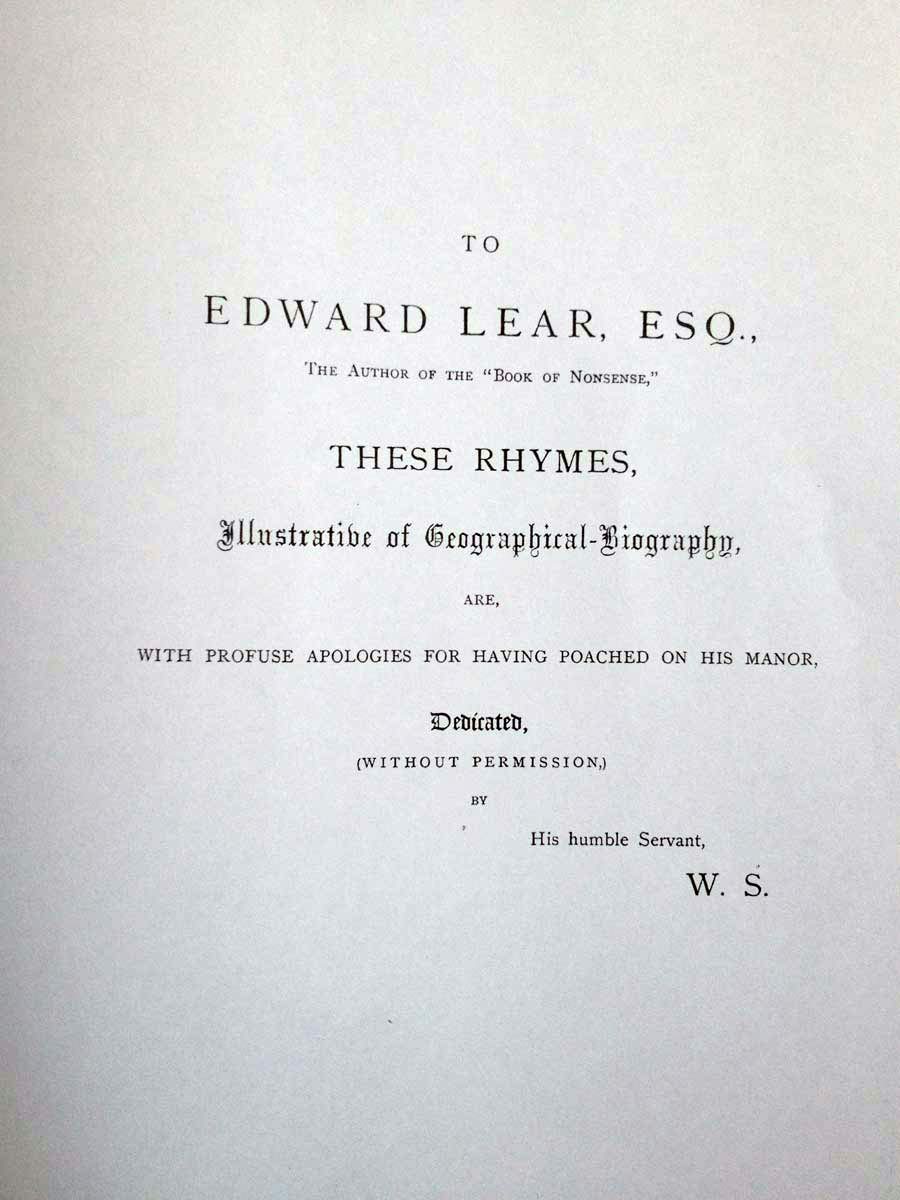
On returning from Surrey just now, I find your Book of Bosh, & hasten to thank you for it , & for your Dedication of it to me the Father of Nonsense.

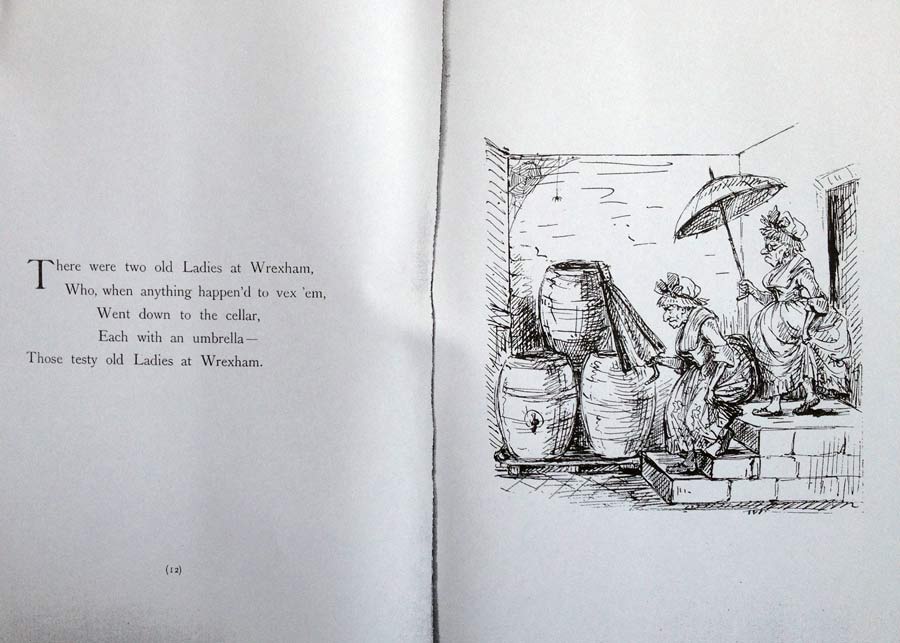
I have not time to look at it much just now, but I thought at a glance, the two Ladies going down into the Cellar very funny.

Believe me,
Dear Sir,
Your’s very truly,
Edward Lear.

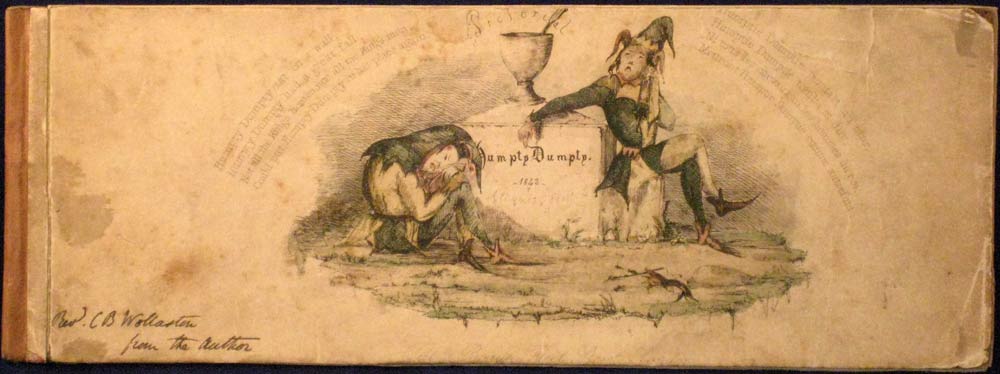
The sellers’ listings unfailingly mention an anonymous The Book of Bosh. With which are incorporated some amusing and instructive nursery stories in rhyme. [With illustrations.] ff. 26. Griffith, Farran & Co.: London, [1889.] 4º (according to the British Library catalogue entry) which was republished in 1890. No earlier editions of the book are mentioned in any catalogue I know of, and the story of “the two Ladies going down into the Cellar” is nowhere to be found in the book, which is available in full online in the Cambridge Digital Library. It is clearly an imitation of “Struwelpeter,” as the description implies:

This brightly illustrated book offers a selection of cautionary tales designed to show children the dangers of bad behaviour. In fact the ‘wrongdoing’ in these stories is very minor: nail-biting, not wiping muddy boots, tearing the pages of books. It is the very ordinary nature of the bad behaviour compared with the outrageous consequences that makes the stories so appealing. Some stories are mere nonsense, others seem too gruesome for children. In particular the case of the girl who bit her nails then proceeded to eat her fingers, which is graphically illustrated!

book-of-bosh-1889

One of the limericks, there are quite a few, actually mentions “Two Young Ladies from Oldham,” but I can’t see any reference to a cellar, though I’ll admit I’m not so sure about the meaning of the text:

bosh-2-wenches

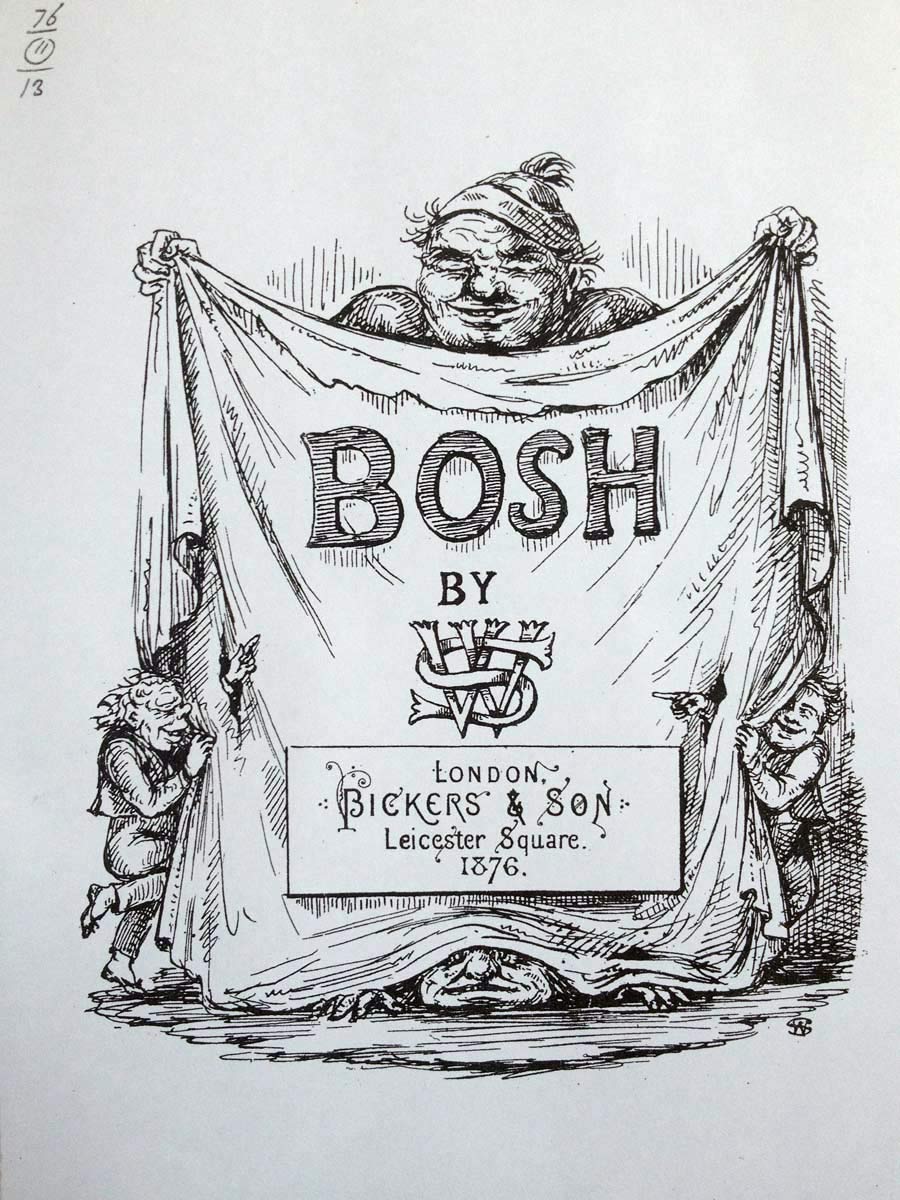
This “book of bosh” is quite amusing and deserves to be seen, but the person Lear is writing to is no doubt one W.S., author of another book of “Bosh,” printed the year before he wrote his thank-you letter, here is the British Library entry: Bosh. (Rhymes.) [With illustrations.] By W. S. London, 1876. As for who this “W.S.” might be I have no idea, but will try to have a look at the book when I next travel to London.

According to The Literary World for 30 June 1876, p. 411, the book had been published that week. Some additional information can be gleaned from a July 1880 advertisement published by Bickers & Son, which states: “BOSH. By W.S. With 21 Illustrations in the manner of Lear’s Nonsense. 4to, boards, 7s. 6d; reduced to 3s. 6d. net.” (Google Books) The price reduction must have been the consequence of slow sales, which also explains the scarcity of the book.

The St. James’s Magazine and United Empire Review mentions it rather favourably in a “Christmas Books” section of its “Christmas Annual” for 1876, p. 117, and gives a few more details, including the dedication to Edward Lear:

“Bosh,” by W. S. (London: Bickers and Son, 1, Leicester Square), is a most amusing imitation of Mr. Edward Lear’s “Book of Nonsense.” The author openly confesses his plagiarism, and apologises for it by a graceful dedication. The rhymes are, however, only the accessories to the drawings, in which the grotesque element prevails. The draughtsman possesses more than ordinary ability for this class of work, while his labour has been produced in the volume before us with every regard to the obtaining of the full effect of his comical genius. Particularly comic is the portrait of the gentleman who is thus described:—

“There is a young Man at Devizes,
Whose feet seem of different sizes :
The fault he imputes
To the make of his boots-
And, perhaps, from that cause it arises.”

And one may fairly notice

“ —— an old Person of Staines,
Who’s accustomed, whenever it rains,
In haste to run out
And stand under a spout,
And there for some time he remains.”

The illustrations to these verses and others are highly amusing. (Google Books)

The Athenaeum, no. 2540, 1 July 1876, p. 25, instead, does not seem to have appreciated it:

Our experience in reviewing rubbish is considerable, but we never encountered more stupid or vulgar rubbish than in ‘Bosh,’ by “W.S.” or “S.W.,” according as we read the cipher on the title-page of a volume sent to us by Messrs. Bickers & Son, an imitation of Mr. Lear’s “Nonsense rhymes.” (Google Books)

See W.S.’s Bosh for more.

Posted in Edward Lear | Tagged , , , | 2 Comments

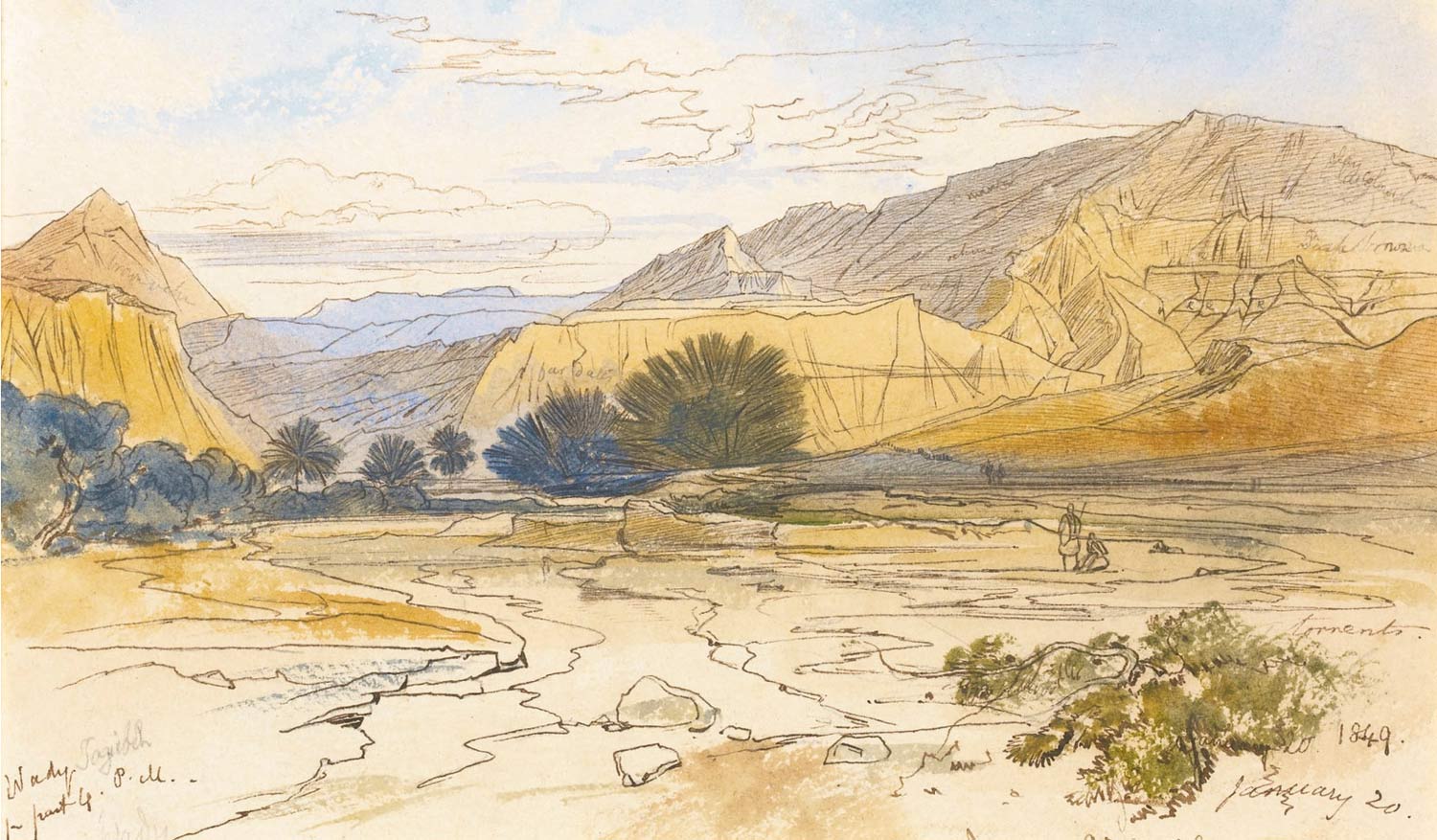
Edward Lear, Junction of Wadis (1849)

EL_junction-s

Edward Lear, Junction of Wadis, Egypt.
Pen and brown ink and watercolour over traces of pencil, on wove paper watermarked: Wick / 18; inscribed lower right: 20. “January”. 1849. 1849 [sic] / Junction of Wadys. [sic],  and further inscribed with artists notes. 150 by 225 mm.

Sotheby’s.

Posted in Edward Lear | Tagged , , , , | Leave a comment

Edward Lear, Ioannina (1856-1857)

EL_ioannina-s


Edward Lear, Ioannina, Greece.
Pen and brown ink with watercolour over traces of pencil; inscribed lower right in pen: Ἰωάννινα / Aug.. 1856 April 1857; and again in pencil: Aug 1856. Apr. 1857. 145 by 228 mm.

Edward Lear travelled extensively throughout Greece in the 1850s and 1860s and his watercolours are an important visual record of a nation in a state of transition from the period of Ottoman rule to that of the country known today. This sketch, which depicts a group of mounted travellers on the plains before the northern city of Ioannina, shows a scene which had all but disappeared by the end of the nineteenth century.

Sotheby’s.

Posted in Edward Lear | Tagged , , , , | Leave a comment

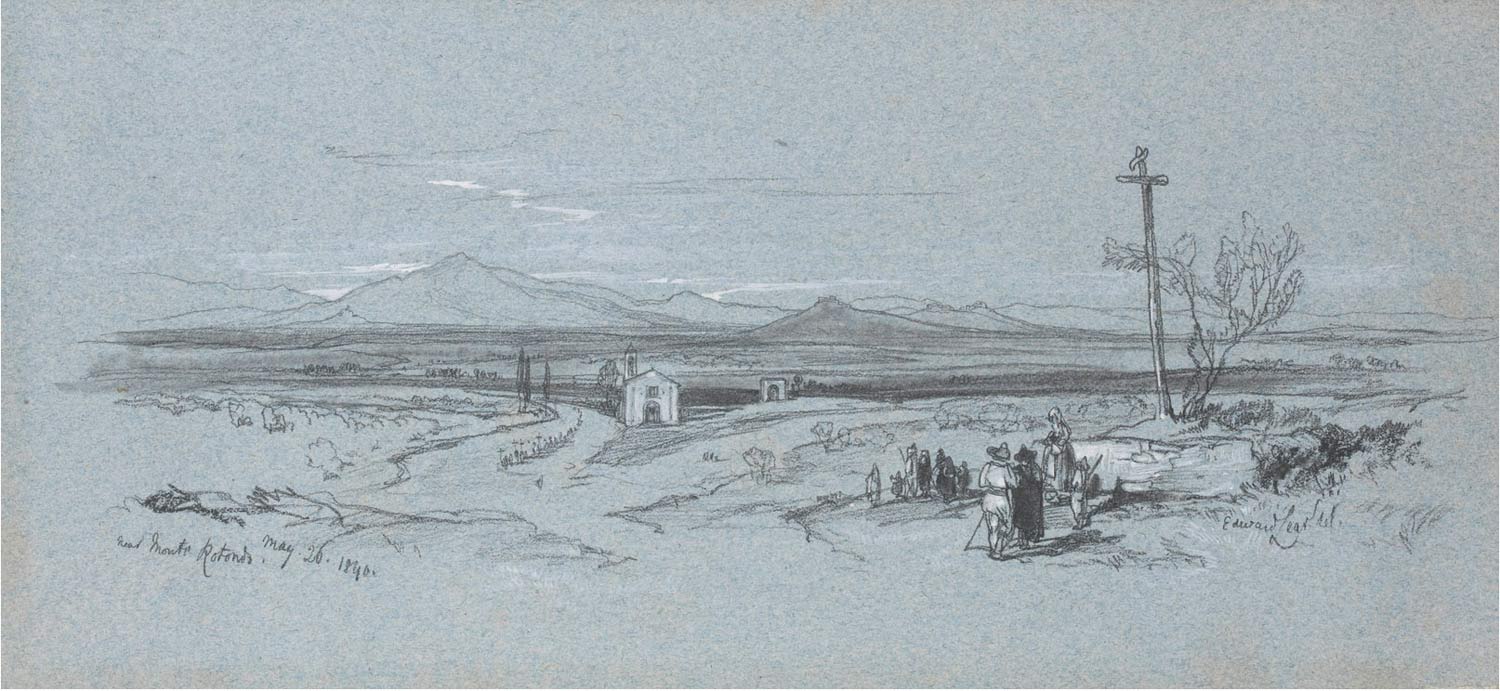
Edward Lear, Figures on Road, Tivoli Beyond (1839)

EL_figures-tivoli-s


Edward Lear, Figures on the Road, Tivoli Beyond.
Pencil, heightened with white and touches of brown wash, on grey paper; signed lower right: Edward Lear / 1839; and inscribed lower left: Tivoli. 240 by 340 mm.

In a letter to his sister Ann, Lear describes the landscape at Tivoli with rapture and reveals ‘all the rich ancients had villas there. You now pass a vast tract of ruins – Cypresses etc., towers etc…Then you commence a long pull up to the town through the most beautiful olive wood! – such trees! – and every now and then you see bits of the ancient villas – all that is left of once vast buildings – now only a few arches with the curious Roman brick-work – covered with large aloes – or roofs of olives.’1
Lear was so enthralled by the beauty of Tivoli that, after his first visit in 1838, he returned there many times and there are two different views of the town in his Views in Rome and its Environs, 1841, plates 23 and 24.
1. V. Noakes, Edward Lear Selected Letters, 1988, p. 42

Sotheby’s.

Also: View of Tivoli, Tivoli (1839), Villa d’Este, Tivoli (1840).

Posted in Edward Lear | Tagged , , , , | Leave a comment

Edward Lear, Falla near Strongoli, Corfu (1862)

EL_falla-s


Edward Lear, Falla near Strongoli, Corfu.
Pen and brown ink over pencil on blue paper; inscribed lower left with the title in Greek and dated: 4 May. 1862, numbered lower right: 49 + 2, and further inscribed with artist’s notes. 215 by 445 mm.

In December 1855, after his friend Franklin Lushington was appointed Judge to the Supreme Court of Justice in the Ionian Islands, Lear decided to settle in Corfu.  He made the island his home until 1863 when Prince William of Denmark accepted the throne and the majority of British residents left the island.

Sotheby’s.

Posted in Edward Lear | Tagged , , , , | Leave a comment

Edward Lear, Distant View of the Citadel, Corfu

EL_citadel-s


Edward Lear, A Distant View of the Citadel, Corfu.
Watercolour over pencil, heightened with touches of bodycolour and gum arabic; signed lower right with the artist’s monogram and inscribed: Corfu. 285 by 450 mm.

Lear was first introduced to Corfu, then under British Protectorate, by Sir George Ferguson Bowen (1821-1899). He arrived by boat from Naples via Malta on 19th April 1848 and was immediately entranced by the beauty of the island, revealing to his sister, Ann, ‘I wish I could give you any idea of the beauty of this island, it really is a Paradise. The extreme gardeny [sic] verdure – the fine olives, cypresses, almonds and oranges, make the landscape so rich – and the Albanian mountains are wonderfully fine. All the villages seem clean & white, with here & there a palm tree overtopping them.’1
During his first trip Lear only spent a few days on Corfu before he left to explore Zante, Cephalonia and Ithaca. However, despite the brevity of his stay, he developed a strong attachment to the island and, in December 1855, after his friend Franklin Lushington (1823-1901) was appointed Judge to the Supreme Court of Justice in the Ionian Islands, he took the opportunity to settle there. He made the island his home until 1863, when Prince William of Denmark accepted the throne and the majority of British residents left the island. He returned there only once more in 1877, but it was a place that never ceased to inspire him, for he believed ‘no other spot on earth can be fuller of beauty & of variety of beauty.’2
1. V. Noakes, Edward Lear: The Life of a Wanderer, London 1968, p. 86
2. V. Noakes, op. cit., 1968, pp.195-6

Sotheby’s.

Also: The Citadel from Ascension.

Posted in Edward Lear | Tagged , , , , | Leave a comment