I wrote the following (with the help of AI) for the friend who bought the picture.
Bought by the present owner at auction: Moore Allen & Innocent, Antique, Vintage & Modern Interiors, 13 August 2026, Lot 445.
Exhibited
J S Maas & Co Ltd, Spring Exhibition 1966, no. 59A, under the present title. A period typed label survives on the backing board of the frame: “SPRING EXHIBITION 1966 / No. 59A / EDWARD LEAR, 1812–1888, / Self-portrait with friends / J S Maas & Co Ltd, dealers in fine art, 15a Clifford Street, New Bond Street W1.” This confirms the title is not a modern saleroom description but goes back at least sixty years, to Maas’s own contemporary cataloguing of the piece.
Provenance
Bought from the Maas Gallery by the vendor’s uncle, Sir Anthony Hooper Bt. (at one point co-owner/sleeping partner of the D’Offay Couper Gallery, 9 Dering Street, New Bond Street, London). On his death, the piece passed to his sister, the vendor’s mother.
Attribution
Not signed, but the handwriting of the colour notes and the pencil style are consistent with Lear’s own working sketches of this type, examined here by the writer.
The drawing
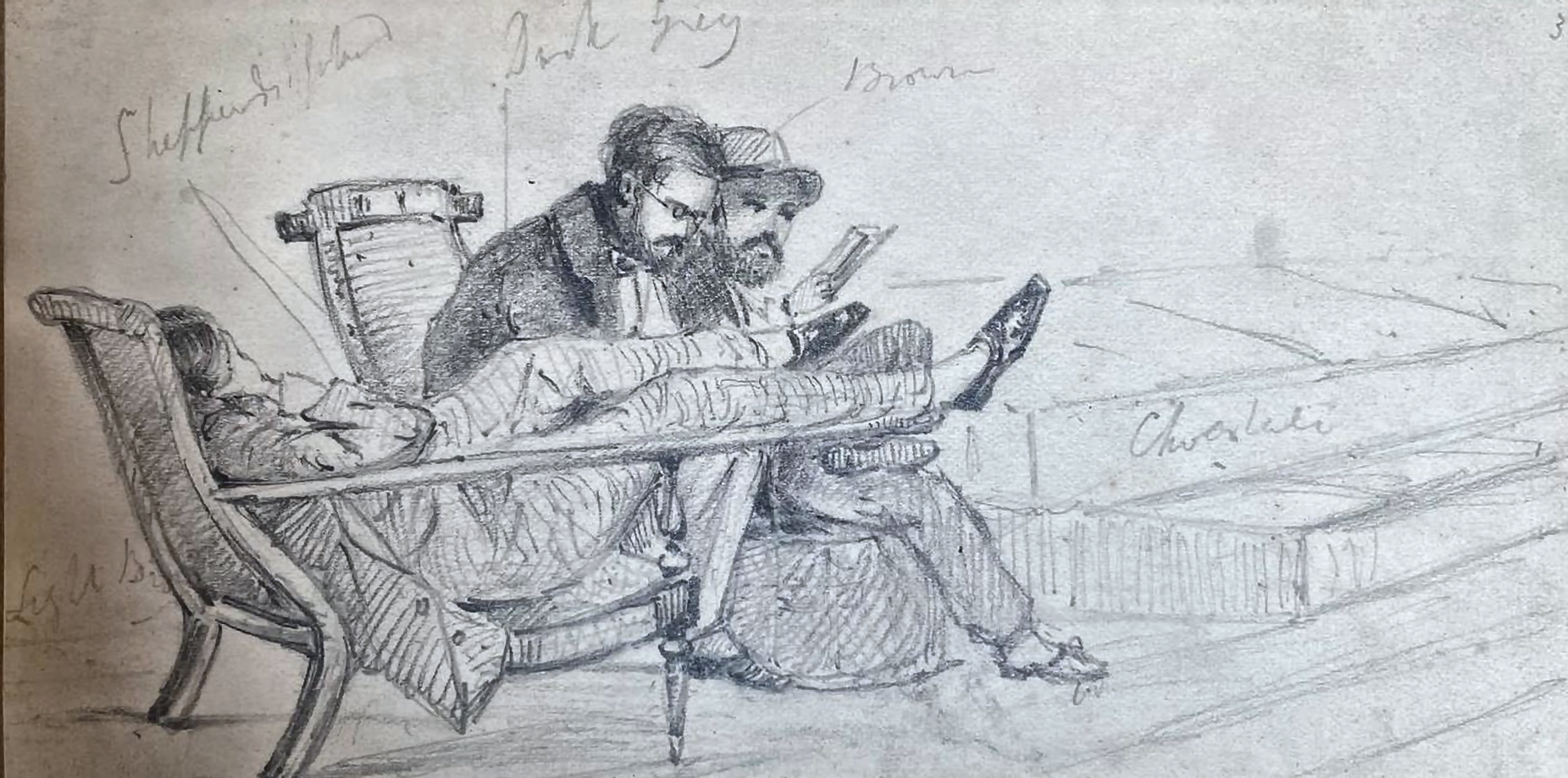
A pencil study, evidently made on the spot, showing three men at leisure on a hotel terrace or veranda: one figure reclines alone in a tall cane recliner on the left, feet extended along a shared footrest; a second, bearded man — Lear himself — sits in a second, shorter reclining chair of slightly different form, one leg only visible, bent down to the floor, foot planted in front of a low round wicker pouffe; a third man, wearing a cap or hat, sits on that pouffe beside him, legs crossed, reading from a book. In the background, a stone parapet or ledge and a paved terrace are indicated in outline, with a hazy horizon beyond.
The sheet carries handwritten colour notes in Lear’s working manner, to guide a watercolour to be worked up later: “Dark Grey,” “Brown,” “Light Br[own],” and “Chocolate,” each with a leader line to the element it describes. A fifth inscription, top left, reads with reasonable probability “Shefferds […]” — the second word is not radable with certainty, it might refer to the peculiar seats — with two leader lines running down toward the two reclining chairs. A small numeral “3” in the top right corner suggests the sheet was once a numbered leaf from a sketchbook or album, rather than a standalone drawing from the outset.
Identification of the hotel
Shepherd’s Hotel, Cairo — so spelt by Lear himself on his own hotel notepaper of December 1853 (“Shepherd’s Hotel, Cairo, Monday, Dec. 19th, 1853,” in a letter to his sister Ann) — was, from the mid-1840s, the leading hotel for English travellers in Cairo. Samuel Shepheard took full control of the earlier “Hôtel des Anglais” in 1845, after which English visitors increasingly referred to it simply as “Shepherd’s,” well before this became its formal or universal name.
Identification of the central figure
The bearded man in round spectacles, with a full moustache and a modest, trimmed beard, can reasonably be identified as Lear himself. Two independent lines of evidence bear on dating this likeness:
- Build: Lear did not begin depicting himself as the corpulent, “spherical” figure of his later comic self-caricatures until July 1860 (Vivien Noakes, in Edward Lear 1812–1888 (Royal Academy of Arts exhibition catalogue, 1985), p. 185). A slim figure therefore excludes only his winter 1866–67 Egyptian trip, and is consistent with any of his earlier visits, including March 1858.
- Beard: This is the more decisive constraint. A small self-caricature Lear sent to Ann during his 1853–54 Nile journey already shows him bald and with a full, bushy beard. Since there is no reason to think his beard grew sparser with time, this fullness likely still held in 1858, and probably beyond. The short, modest beard shown in this drawing therefore points away from both the 1853–54 and 1858 visits, and toward an earlier moment — before the beard was established at all.
Taken together, these point to January 1849, Lear’s first-ever visit to Cairo, when he stayed at “the huge hotel” in the Ezbekieh Square for six days (5–11 January) before setting out for Sinai. Lear’s own account of that later desert crossing — “you would not know me… as I have a beard now as well as moustaches” (letter to Ann started on 16 January 1849, entry for 3 February 1849, Selected Letters, p. 105) — implies a beard newly grown since leaving Cairo, consistent with a short, days-old growth being visible during the hotel stay itself, and with the moustache alone being unremarkable and already long-established (it is already visible in Wilhelm Marstrand’s pencil portrait of Lear, Rome, July 1840; NPG 3055).
The occasion and the companions
Lear travelled to Egypt in 1849 at the invitation of John Edward Cross of Red Scar, Lancashire (1821–1897), whom he had known since his years at Knowsley (1832–37), very probably as one of the young guests there whom Lear entertained with his early limericks — the Cross family’s Hornby connections (John Edward Cross later married Elizabeth, daughter of Admiral Sir Phipps Hornby) placed them within the same closely intermarried Stanley/Hornby circle at Knowsley for whom Lear’s nonsense verses were first composed.
Cross invited Lear to join him in Malta and travel on with him from Cairo to the Holy Land, Syria, and Lebanon over the winter of 1848–49, and offered to pay Lear’s expenses — a fact Lear mentions to his sister: “The matter is a secret,” he told Ann, “and I am supposed to be spending from my own purse” (to Ann, 7 November 1848; quoted in Uglow, Mr Lear, p. 189). Lear mentions receiving Cross’s invitation in a letter to the 13th Earl of Derby from Cairo, 12 January 1849: “came to Janina by the 7th. Novbr. & finding a letter from my friend Cross of Redscar — I set out to meet him at Malta” (Noakes, ed., Selected Letters of Edward Lear, p. 97). The two missed each other in Malta, and Lear finally caught up with Cross in Cairo: “at the huge hotel I found my friend Cross to my extreme delight & his too. His time is very limited, & he had already waited so long that he had given me up” (to Ann, 11 January 1849).
Cross had, only days before, accepted the living of Appleby, Lincolnshire, by a letter written from Cairo on 4 January 1849 (West Yorkshire Archive Service, ref. LC03029/1/1/14/3), and went on to a long career as vicar of Appleby and, eventually, Prebendary of Lincoln — as well as a notable amateur astronomer, building his own observatory at the vicarage (obituary, Monthly Notices of the Royal Astronomical Society, 1898). He is, in all probability, the bearded, hatted figure seated beside Lear, reading from a book.
The third figure, reclining alone in the left-hand chair, is not identifiable from any surviving letter. Lear names no other companion during this Cairo stay beyond Cross, so this man was very likely a fellow guest encountered at the hotel — one of the many transient English travellers passing through Shepherd’s that season — rather than someone previously known to Lear.

