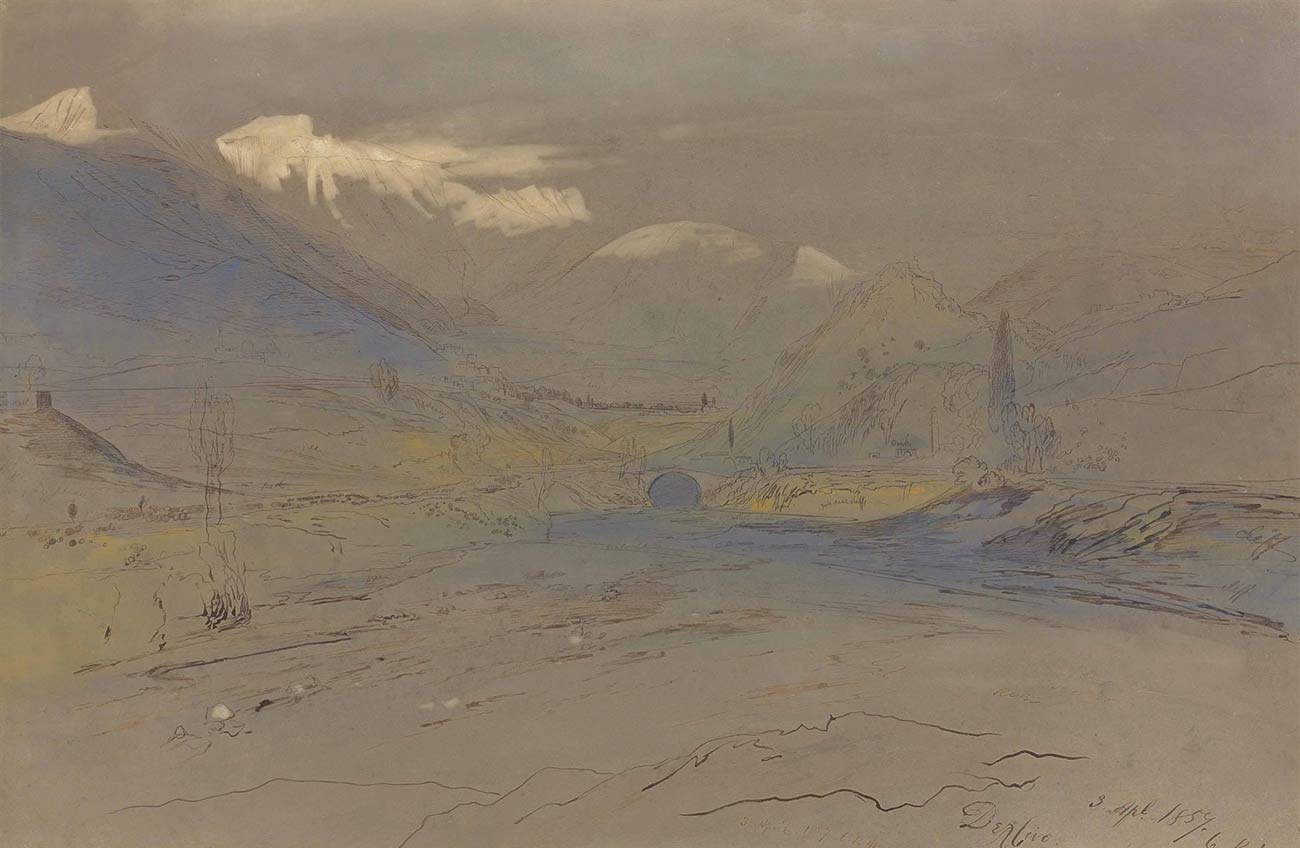
Edward Lear, Delvinë (1857)

EL_delvine-s


Edward Lear, Delvinë or Delvino, Albania.
Dated ‘3 April 1857/ 6. p.m.’ (lower left), and 3 Ap1. 1857. 6 p.m’ (lower left) and inscribed ‘Deilino’ (lower left) and further inscribed with colour notes. Pencil, pen and brown ink and watercolour heightened with bodycolour, on buff-paper.

In 1855 Lear arrived on the island of Corfu, where he based himself on and off for the next three years, although he continued to travel extensively throughout Greece, the Middle East and Albania. In April 1857 he embarked on a three week trip to Albania. In a letter to his sister Ann he wrote ‘On the 1st I go across, with Edwards (Mr Lister Turker’s godson) & George, to Yannin, by Delvino: I can do nothing with that magnificent lake without having seen the mountains with snow on, & so go I must’ (E. Lear, The Corfu Years, Denise Harvey , Greece, 1988, p. 107).

Christie’s.

Posted in Edward Lear | Tagged , , , , , | Leave a comment

Edward Lear, Nayadeh (1854)

EL_nayadeh-s


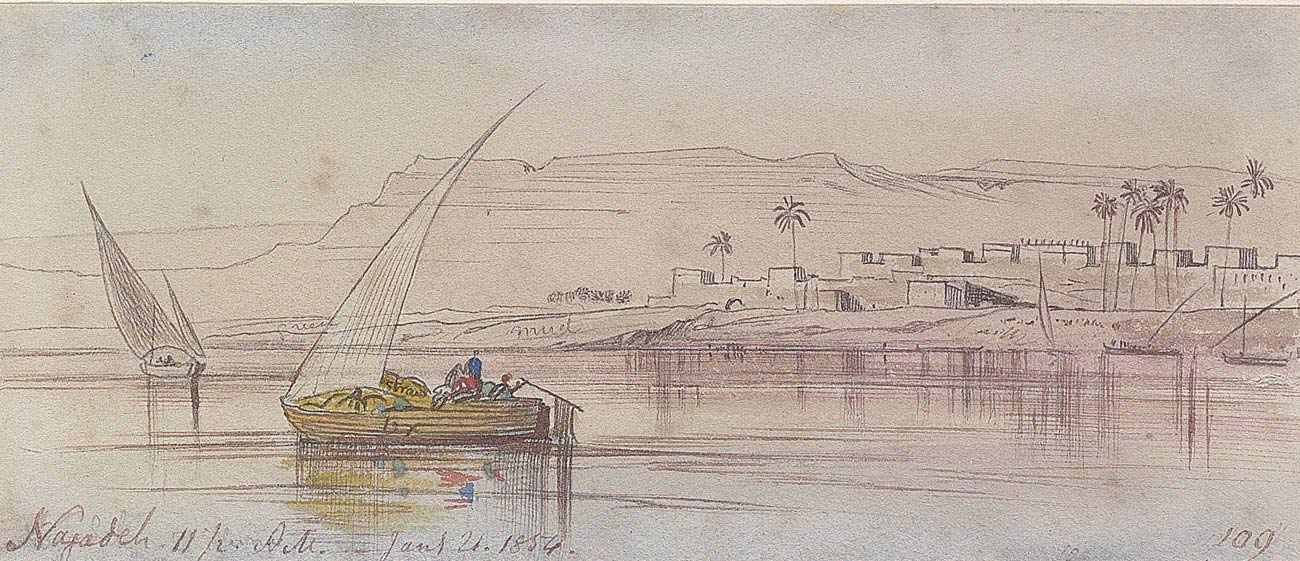
Edward Lear, View on the Nile.
Inscribed and dated ‘Nayadeh 11½ am Jan .. 21. 1854’ (lower left) and numbered ‘109’ (lower right) and inscribed ‘Uppermost’ and numbered ’23’ (verso of the sheet). Pencil and watercolour heightened with bodycolour. 2? x 6? in.; and A scene on the Nile.

Shortly after Christmas 1953, Lear set off up the Nile with a party he had met in Cairo, travelling leisurely by boat as far as Aswan and the first cataract. Lear was clearly captivated by the form of the Egyptian boats; in his letter of 4 January 1854 to his sister Ann he wrote ‘the most beautiful feature is the number of boats, which look like giant moths, -& sometimes there is a fleet of 20 or 30 in sight at once’.

Christie’s.

Posted in Edward Lear | Tagged , , , , | Leave a comment

Edward Lear, Mahatta, Nubia

EL_mahatta-s


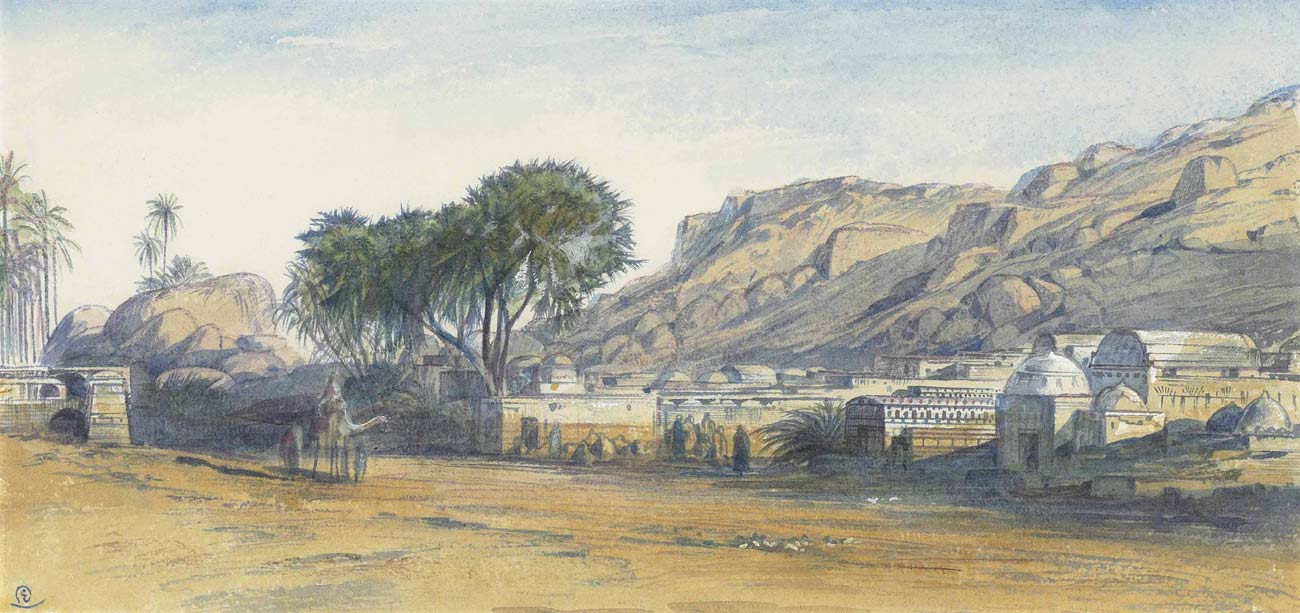
Edward Lear, Mahatta, Nubia.
Signed with monogram (lower left) and with inscription ‘No 2/Mahatta. Nubia’ (on the verso). Pencil and watercolour heightened with touches of white. 7? x 15 in. (18.1 x 38.1 cm.)

The present highly finished watercolour, would have been executed following Lear’s third visit to Egypt in 1866-7 and would have been carefully worked up from the rapid on the spot sketches the artist created.

During this trip he ventured further south than previously, travelling through Nubia (now part of Southern Egypt) as far as the second cataract. The landscape of Nubia fascinated Lear, who wrote to Lady Waldegrave, ‘Nubia delighted me, it isn’t a bit like Egypt except that there’s a river in both. Sad, stern, uncompromising landscape, dark ashy purple lines of hills, piles of granite rocks, fringes of palm, and ever and anon astonishing ruins of oldest temples’ (Lady Strachey, ed., Later Letters of Edward Lear, London, 1911, p. 83).

Christie’s.

Posted in Edward Lear | Tagged , , , , | Leave a comment

Edward Lear, A Market Place (1838)

EL_trier-s


Edward Lear, A view of a market place in a continental town, possibly Trier, Germany.
Signed and dated ‘E. Lear. del 1838.’ (lower right). Watercolour, 6? x 6? in. (12 x 16 cm.); watercolour of a continental village (verso).

The present watercolour was executed while the artist was undertaking his first prolonged overseas trip in the summer of 1837. Apart from two visits to England in 1841 and 1845-6, Lear spent the next decade based in Italy, recording and exploring the continent. The excitement that Lear gained from this early trip and his desire to explore the world was to remain with the artist throughout his life.

Christie’s.

Posted in Edward Lear | Tagged , , , | Leave a comment

Edward Lear, Ceriana (1870)

EL_ceriana-s


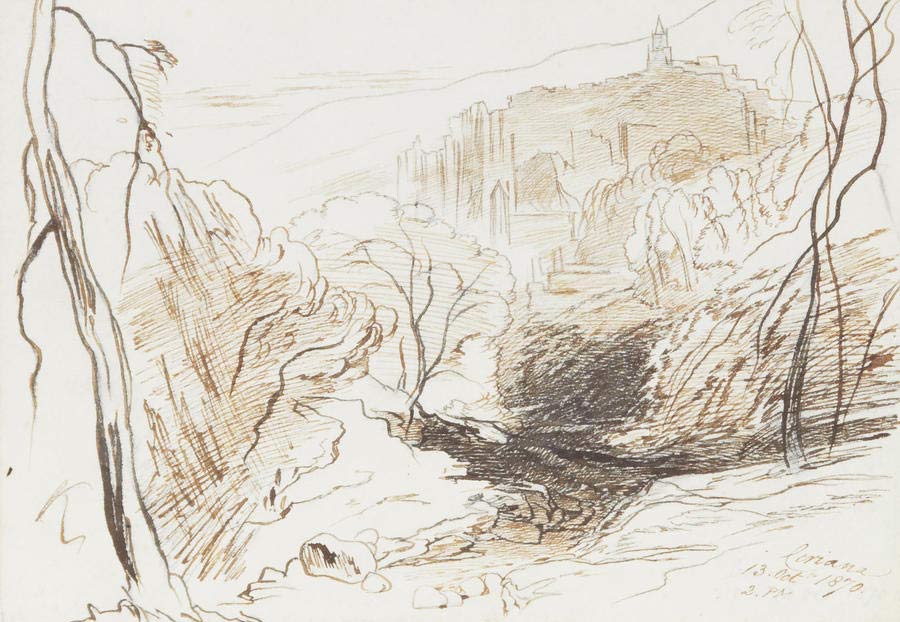
Edward Lear, ‘Ceriana’.
Inscribed with title and dated ’13 Oct 1870 2PM’ (lower right), with collectors stamp (lower left) pen & ink drawing, unframed. 17.5 x 25.5cm (6 7/8 x 10 1/16in).

Bonhams.

Posted in Edward Lear | Tagged , , , | Leave a comment

Edward Lear, Venice after Sunset (1865)

EL_venice-after-sunset-s


Edward Lear, Venice after sunset.
Inscribed ‘Venice’ (lower left), inscribed again and dated ‘after sunset15 Nov 1865′ (lower right), signed, inscribed an dated again’ (Edward Lear/Venice/1865) on a fragment in the same frame. Pen, ink and watercolour. 8 x 13cm (3 x 5in).

Bonhams.

Posted in Edward Lear | Tagged , , , , | Leave a comment

Edward Lear, El Karnak (1854)

EL_karnak-s

Edward Lear, El Karnak.
Inscribed and dated ‘El Karnak/Febr.15.1854/ 5.P.M.’ (lower left) and annotated throughout. Pencil and watercolour. 15.5 x 50cm (6 1/8 x 19 3/4in).

From the private collection of Sir Eric Maclagan, former director of the Victoria and Albert Museum.

Bonhams.

Posted in Edward Lear | Tagged , , , , | Leave a comment

Edward Lear, Nile Study (1858)

EL_nile-study-s


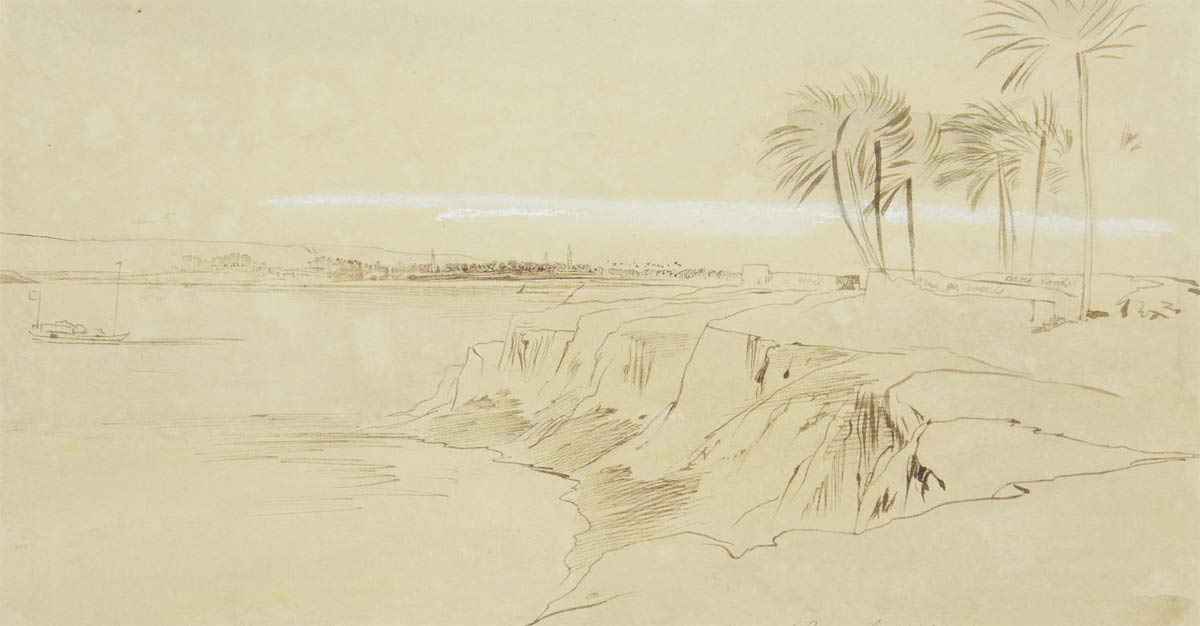
Edward Lear, Nile study.
Dated and inscribed ‘Kmm.4 March 1854/9.A M’ (lower right) and further annotations throughout. Pen and ink, heightened with white and wash, unframed. 15.5 x 25cm (6 1/8 x 9 13/16in).

Bonhams.

Posted in Edward Lear | Tagged , , , | Leave a comment

Edward Lear, Girgente (1847)

EL_girgente-s

Edward Lear, Girgente, Sicily. Inscribed and dated ‘Girgente June 1. 1847’ (lower left) and numbered ‘(82)’ (lower right) and further inscribed with notes. Pencil, pen and brown ink, blue and ochre wash, on buff paper, 24 7/8 x 19¾ in. (32.2 x 50.2 cm.).

Lear first visited Sicily in the spring of 1842 and in the early summer of 1847 he returned. He caught the steamer to Palermo, where he was met by John Proby, heir to the Earl of Carysfort, who wished to learn sketching from Lear. On 11 May they set out together, travelling all round the island, visiting Syracuse and Mount Etna. Of Girgenti Lear wrote to his sister Ann ‘Nothing on earth can be so beautiful as Girgenti with its 6 temples – I speak of the old town and the flowers and birds are beyond imagination lovely.’ (P. Levi, Edward Lear, A Biography, London, 1995, p. 94.). Another view of one of the Temples of Girgenti was drawn by Lear (Christies, London, 7 June 2001, lot 169) the day before the present work on 31st May 1847 and both employ similar ochre tones to capture the warmth of the stones. Lear also used Girgenti as an illustration to the last line of Alfred Tennyson’s poem You ask me, why, though ill at ease, written circa 1833.

Franklin Lushington (1823-1901) and Lear met on the voyage to Malta in the spring of 1849, and Lear wrote ‘My companion is Mr. F. Lushington a very amiable & talented man – to travel with who is a great advantage to me as well as a pleasure’ (Lear to his sister Anne, V. Noakes, Edward Lear, The Life of a Wanderer, London, 1985, p. 76.). They formed a close and life-long friendship and after Lear’s death in 1888 Lushington wrote that ‘he has always been the most charming & delightful of friends to me; & apart from all his various qualities of genius, I have never known a man who deserved more love for his goodness of heart & his determination to do right; & I don’t think any human being knew him better than I did. There never was a more generous or more unselfish soul’ (Lushington to Mrs. Charles Street, exhibition catalogue, V. Noakes ed.,Edward Lear 1812-1888, London, 1985, p. 199). Lushington was the executor of Lear’s estate, Lear left all his papers and paintings to him, and the proceeds from the sale of the Villa Tennyson and its contents to Franklin’s eldest daughter Louisa Gertrude.

Christie’s.

Posted in Edward Lear | Tagged , , , | Leave a comment

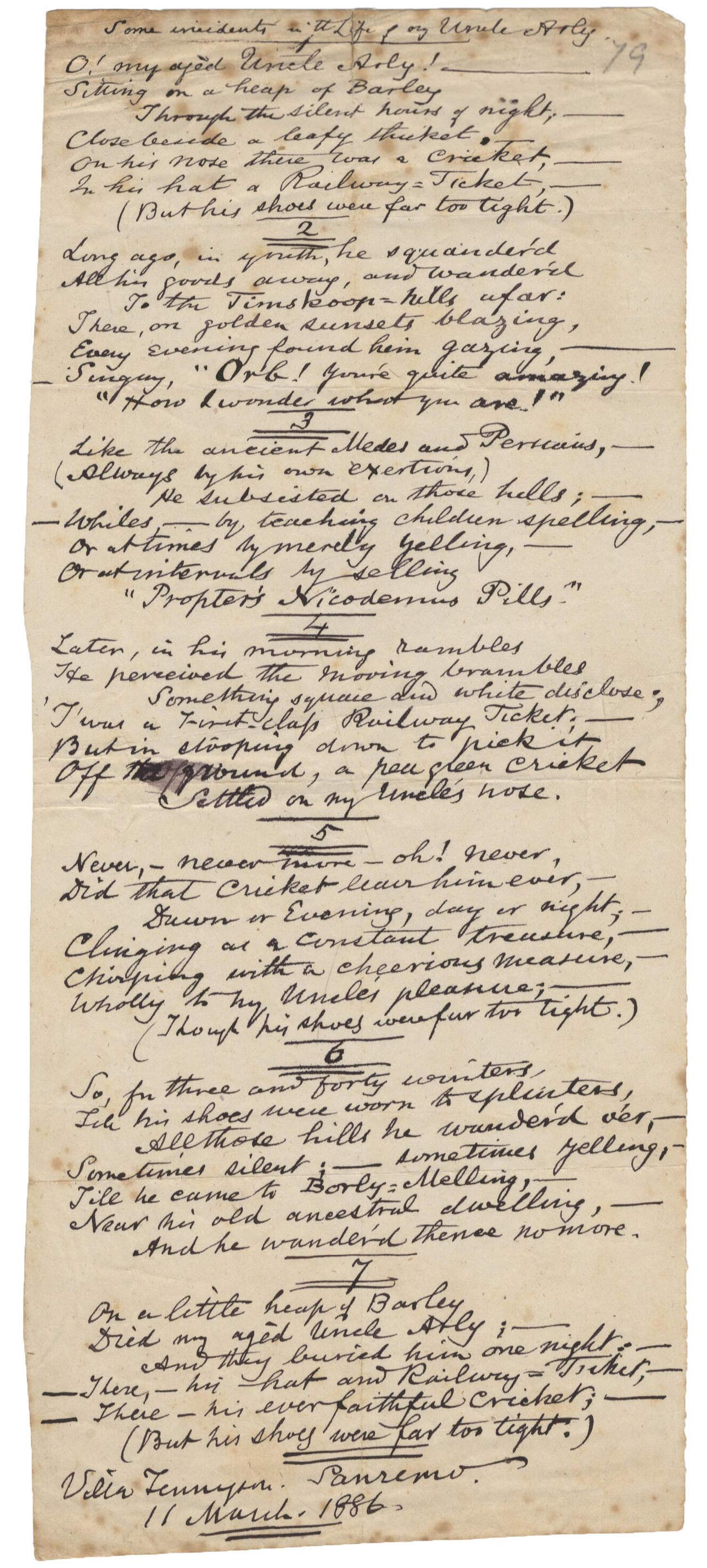
Edward Lear’s Last Poem

Below are a picture and a transcript of Edward Lear’s “Some Incidents in the Life of My Uncle Arly.” The manuscript was sold at Bonhams in May 2013 as part of the Roy Davids Collection. Part III. Poetry: Poetical Manuscripts and Portraits of Poets (auction 20923, lot 279).

EL_arly-s

Some incidents in the Life of my Uncle Arly.

1

O! my agèd Uncle Arly! ―――
Sitting on a heap of Barley
Through the silent hours of night; ――
Close beside a leafy thicket. ――
On his Nose there was a Cricket, ――
In his hat a Railway=Ticket, ――
(But his shoes were far too tight.)

2

Long ago, in youth, he squander’d
All his goods away, and wander’d
To the Timskoop=hills afar:
There, on golden sunsets blazing,
Every morning found him gazing, ―――
― Singing, “Orb! you’re quite amazing!
“How I wonder what you are!”

3

Like the ancient Medes and Persians, ―
(Always by his own exertions,)
He subsisted on those hills; ――
― Whiles, ― by teaching children spelling, ―
Or at times by merely yelling, ―
Or at intervals by selling
“Propter’s Nicodemus Pills.”

4

Later, in his morning rambles
He perceived the moving brambles
Something square and white disclose;
’T’was a First-class Railway Ticket; ――
But in stooping down to pick it
Off the ground, a pea green Cricket
Settled on my Uncle’s nose.

5

Never, ― never more ―- oh! Never,
Did that Cricket leave him ever, ――
Dawn or Evening, day or night; ―
Clinging as a constant treasure, ――
Chirping with a cheerious measure, ―
Wholly to my Uncle’s pleasure; ―――
(Though his shoes were far too tight.)

6

So for three and forty winters,
Till his shoes were worn to splinters,
All those hills he wander’d o’er, ―
Sometimes silent; ― sometimes yelling, ―
Till he came to Borly=Melling, ―
Near his old ancestral dwelling; ―
And he wander’s thence no more.

7

On a little heap of Barley
Died my agèd Uncle Arly; ――
And they buried him one night: ―[1]
― There, ― his hat and Railway=Ticket, ―
― There ― his ever faithful Cricket; ――
(But his shoes were far too tight.)

Villa Tennyson. Sanremo.
11 March. 1886.


[1] Lear omits a line, “Close beside the leafy thicket; ―” which appears in The Complete Nonsense Book, edited by Lady Strachey in 1912.


 Here is the catalogue description including the auction results:

LEAR’S LAST POEM. ‘Some incidents in the Life of My Uncle Arly’, which is in the metre of his friend Lord Tennyson’s ‘The Lady of Shallot’, is full of autobiographical references, most obviously to Lear’s life as an incessant ‘wanderer’. It was also his own obituary. Drafting it over a period of thirteen years, partly on the endpapers of The Letters of Horace Walpole in 1873 and of Addison and Steele’s The Spectator in 1885, he completed it on 1 March 1886 and sent presentation copies to at least thirteen friends. These included Wilkie Collins, whom Lear said he resembled so closely that he was often mistaken for him; Collins considered it Lear’s best poem. Another copy went to John Ruskin (‘Roughskin’), the great art-critic and Utopian, after he had written in the Pall Mall Magazine: ‘I really don’t know any author to whom I am half so grateful, for my idle self, as Edward Lear. I shall put him first of my hundred authors’. In his letter to Ruskin on that occasion Lear esteemed it ‘a thing to be thankful for that I remain as great a fool as ever I was.’

The present manuscript Lear sent to Mary, the wife of Sir Matthew Digby Wyatt (1820-1877), architect, Secretary of the Great Exhibition and first Slade Professor of Fine Arts in Cambridge. It is dated 11 March 1886, ten days after Lear recorded he had finished writing the poem. Lady Wyatt (‘Dear Mrs Digby’) was the recipient of a number of enchanting phonetic letters from Lear, in one of which he sent verses written with a ‘lithp’ (‘O Thuthan Thmith! Thweet Thuthan Thmith…’), explaining that ‘my teeth have thufferred tho mutth, & it theemeth to me that it will produthe a thenthation in the muthical thphereth…’ (see also Roy Davids Collection Part II lot 295).

The notable differences between the present manuscript and the printed version are in the title, line 10 [he is consistent in dotting ‘i’, otherwise the third minim of the ‘m’ in Timskoop might have been assumed to be an ‘i’] the alternative reading for line 42 and the omission in the manuscript of line 46 of the printed version, doubtless just by mistake since there is no reason to assume that the seventh stanza should be the only one without seven lines. Lear began line 27 by writing ‘Off’ indented as if it were the last line of a stanza and, realising his error, immediately smudged it and started the line again correctly aligned. The paper is a little foxed; Lear is writing with something very akin to printers’ ink.

In her life of Edward Lear, Vivien Noakes hints at deeper and darker meanings beneath the benignly whimsical surface of ‘Uncle Arly’.

PROVENANCE: Mary Digby Wyatt.

REFERENCES: The Complete Nonsense of Edward Lear, edited by Holbrook Jackson, 1979; John Lehmann, Edward Lear and his World, 1977; Selected Letters, edited by Vivien Noakes, 1988; Vivien Noakes, Edward Lear the Life of A Wanderer, 1968; Vivien Noakes, Edward Lear 1812-1888, Royal Academy of Arts Catalogue, 1985; Susan Chitty, That Singular Person Called Lear, 1988; Angus Davidson, Edward Lear: Landscape Painter and Nonsense Poet, 1933.
Sold for £10,000 inc. premium
Posted in Edward Lear | Tagged , , , , | 2 Comments