Edward Lear in Malta, Corfu, and Lake Maggiore

varriano-book

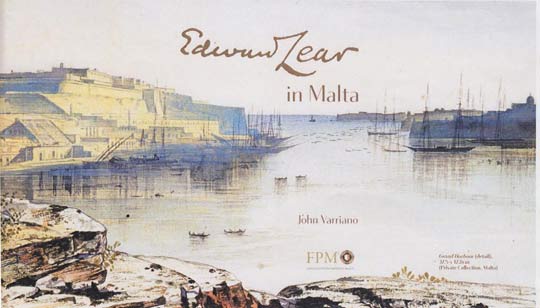
I have received John Varriano’s new book on Edward Lear in Malta, a gorgeous addition to the recent fashion of books and / or exhibitions on Lear’s travels to different parts of the world. This beautiful oblong volume contains a detailed discussion of the painter’s visits to the island and in particular the last one in 1865-1866, lists all known landscape paintings he did of the island — most of those that can still be traced are illustrated — and prints transcripts of the diaries and letters written in the period he stayed there. Highly recommended.

You may remember there was an exhibition in Corfu a couple of years ago on Edward Lear and the Ionian Islands; one of the events connected with this was a lecture on Edward Lear by psychiatrist Anthony Stevens, which I have found is available in its entirety on YouTube: Dr Stevens states that Lear suffered from “a severe body dysmorphic disorder,” i.e. was obsessed with his physical appearance.

Finally, if you read Italian you should not miss Paola Vozza’s long post on Il paesaggio secondo Lear, which also has a gallery with several of the landscapes Lear painted of the Italian alpine lakes.

Isola San Giulio. Lago di Orta. 1842.

Isola San Giulio. Lago di Orta. 1842.

Posted in Edward Lear | Tagged , , , , , | 2 Comments

Edward Lear in Malta

malta-leaflet

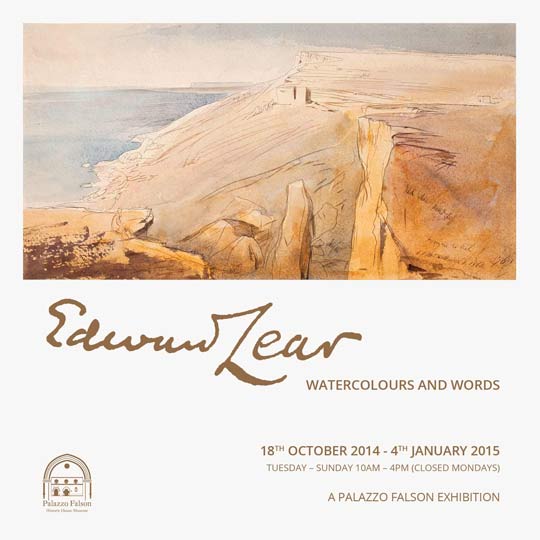
The exhibition curated by John Varriano on Edward Lear’s Malta watercolours, Edward Lear: Watercolours and Words, has opened at Palazzo Falson, Mdina, and will be on until 4 January 2015 (here is an article from The Malta Independent).

varriano-book

Professor Varriano, who also gave a lecture on 18 October, has a new book on Edward Lear in Malta published by Fondazzjoni Patrimonju Malti in Valletta. It can be ordered from the Book Distributors Limited website.

More events  connected with the exhibition include an Artists’ Workshop with John Martin Borg and a Gallery talk by Catherine Galea.

Previously on Lear in Malta.

Posted in Edward Lear | Tagged , , , | 1 Comment

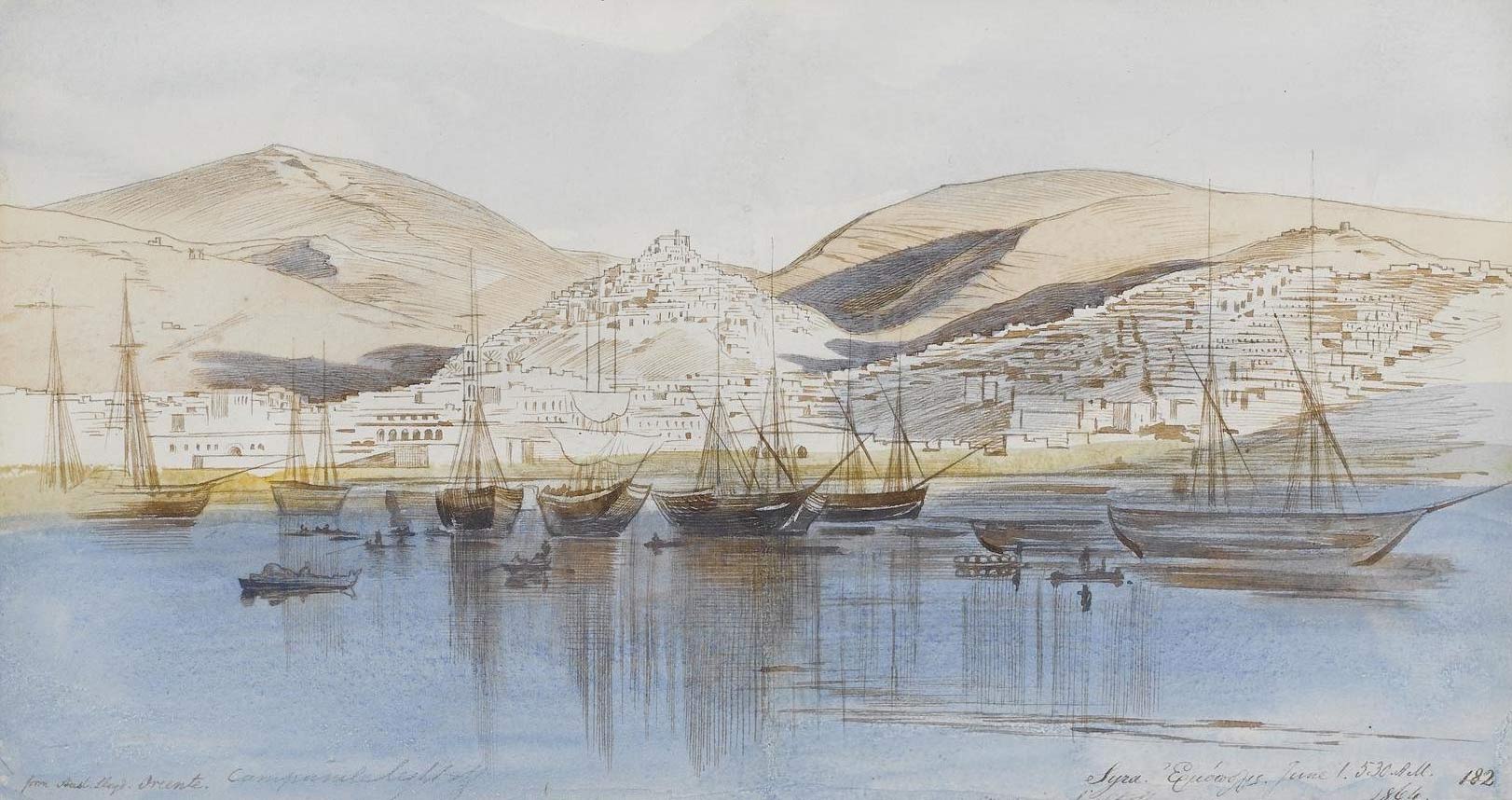
Edward Lear, Syra, Ermoupoli (1864)

EL_Ermoupoli-s

Edward Lear, View of Ermoupoli, Syros.
Inscribed ‘Syra. Ermoupoli. June 1. 5.30 AM/ 182’ and dated ‘1864’ l.r. Watercolour. 17 x 32 cm. (6¾ x 12½ in.)

Lear visited Syra on his way back to Athens at the end of a two month exploration of Crete during which he made nearly two hundred drawings. He had sailed from Khanià early in the morning of 31 May, and sat on deck as the boat sailed north through the Cyclades. “The multitude of ‘Isles of Greece’ is quite uncommon and lovely”, he wrote in his diary, “About eight we reached Syra. A wonderful voyage!”.

Bonhams.

Posted in Edward Lear | Tagged , , , , | Leave a comment

A Day in the Studio with Edward Lear

Another previously unpublished letter Edward Lear sent to William Holman Hunt exactly 150 years ago (see Diary 6.x.64). This one contains a humorous description of a day in Lear’s London studio while he is trying to do some work.

15 Stratford Place. Oxford St. W.
October. 1864

My dear Daddy,

I was glad to hear from you just now, & as you much want some amusement, even if ever so small, I will write a bit, trusting the chance that people won’t call before I have got two or 3 hour’s work at my brambles & bricks & lizards. A heap of callers have been here of late ― & nearly all oldish personal friends, so I am a good deal behind-hand as to work, & believe, after all that I must give up going on Monday to Faringford, ― for ― if I leave this picture very much unfinished, the foreboding of fogs & other interruptions ― keeping me in England ―― would destroy all my fun if I left town. Some good scenes might be drawn out of Studio life ― as for instance.


(4 ladies ― having staid for 2 hours ― rise to go.)

1st Lady “What a treat my dear Mr Lear! but how wrong it is of you to stay so much in doors! You should take more care of your health ― work is all very well but if your health fails you know you will not be able to work at all, & what could [would?] you do then! Now pray go out & only see your friends before 12 or 1. in the morning.
2nd Lady ― But how dreadful these interruptions must be! I cannot think how you ever do anything! ― Why do you allow people to break in on you. So? It quite shocks me to think we have taken up so much time.
3d Lady. Yes, indeed: these are the best hours of the day. You should never see any one after 2 o’clock.
4th Lady. You should walk early, & then you could see your friends all the rest of the day. Interruptions must be so dreadful!

(Enter 4 more ladies. The first 4 rush to them.)

All 8 Ladies ― How charming! how fortunate! dear Mary! Dear Jane! dear Emily! dear Sophia! &c.

5th Lady ― How wrong of you dear Mr. Lear to be indoors this fine day!
6th Lady. ― How you can ever work I cannot think! you really should not admit visitors at all hours!
7th Lady ― But do let us only sit & look at these beautiful sketches!
8th Lady. O how charming! & we will not go to Lady O’s.

The other 4 Ladies. O then we also will all sit down again ― it is so dreadful.

Chorus of 8 Ladies. What a charming life an artist’s is! ―

Artist. ――――― D ―――n!

&c. &c. &c.


I can now understand Mrs. N’s feelings about the Dr.’s picture. I did not take to Mrs. N― it is difficult to do so now a days to most clergy. (The Bishops are getting it right & left from the Times, & justly enough. Gloucester & Lincoln must wish they had said less, for they surely cannot seriously believe their order will gain in the end, by setting the intellectual element of the Community dead against their own.          I find people like the Jánina picture immensely: the brambles &c. ― & a great deal more I owe to you.

I am sorry F. has not bought the Selborne estate: ― the property is in a most delightful part of England ― & he may never again have such a chance. ― Your stay at Burton must have a good many tough drawbacks: ―[some words have been blotted] In the South, where servants

There must have been a second sheet, but I have not been able to find it.

Posted in Edward Lear | Tagged , , , | 1 Comment

Edward Lear, Auribeau (1868)

EL_Auribeau-s

Edward Lear, Auribeau.
Signed with monogram l.r., inscribed ‘Abribeau’ and dated ‘1868’ l.l. Watercolour. 33 x 51.5 cm. (13 x 20 1/4 in.)

Lear was in Cannes until April of 1868. From there he could make expeditions into the hills; he and his servant Giorgio would leave Cannes early in the morning, and he would spend the day drawing.
Lear made several visits to Auribeau- a medieval village between Cannes and Grasse. It is perched on top of a rocky peak above the Siagne gorge and has stunning views of the surrounding mountains.
Lear’s European travels were now coming to an end and with the exception of a few drawings produced in the Italian Alps during the summer months of the 1880s, his depictions of the South of France were the last of his European drawings. Lear, was at the height of his powers as a draughtsman and watercolourist when he painted the present work which is a stunning rendition of this beautiful hilltop town.

Bonhams.

Posted in Edward Lear | Tagged , , , , | Leave a comment

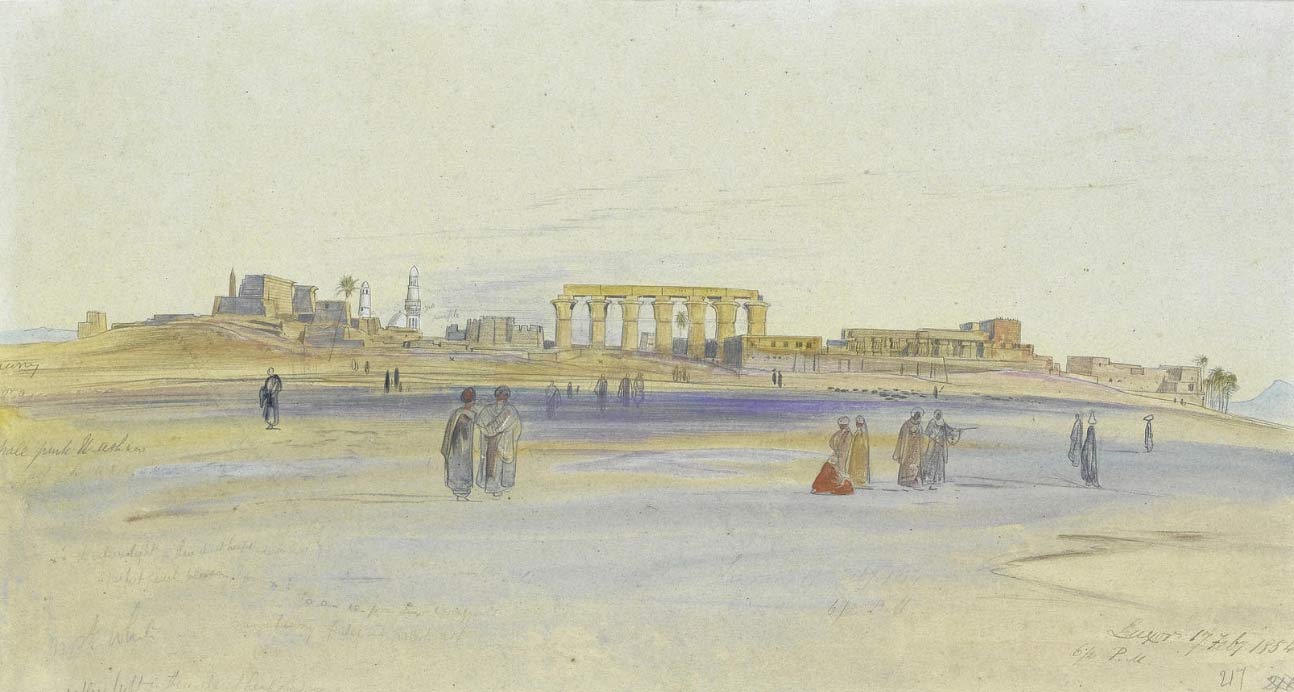
Edward Lear, Luxor (1854)

EL_Luxor-s

Edward Lear, Luxor.
Extensively inscribed throughout; inscribed, dated and numbered ‘Luxor 17 Feby 1854/ 6/2 PM/ 217’ (lower right); inscribed ‘No. 6 single’ (verso). Pencil, watercolour and bodycolour. 24.8 x 45.8cm (9 3/4 x 18 1/16in)

“On February 8th he began on the return journey [from Aswan], and a week later the boat reached Luxor. Here he spent another ten days exploring Karnak and the ruined temples and Thebes and the tombs in the Valley of the Kings: it was all more magnificent than Philae, but not so drawable.” (Noakes 1968, p.124)

Bonhams.

Posted in Edward Lear | Tagged , , , , | Leave a comment

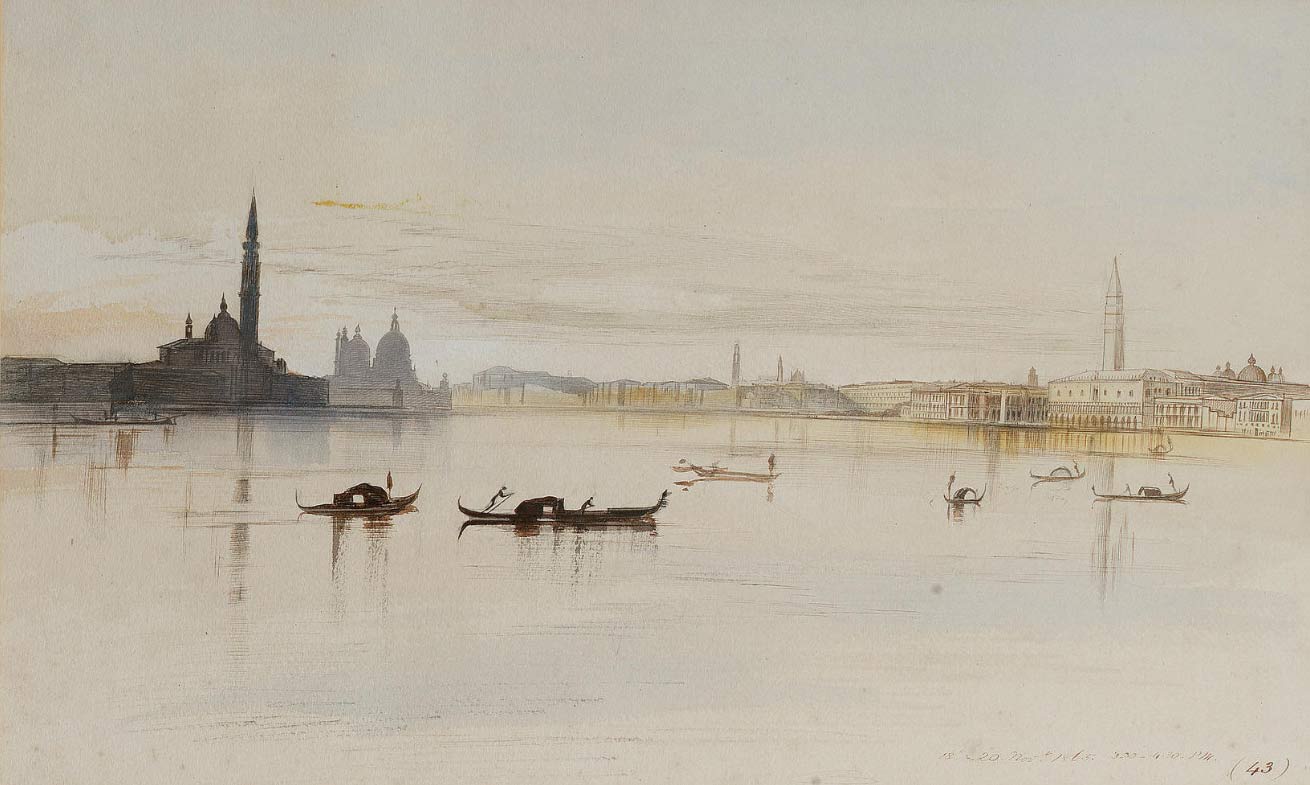
Edward Lear, Venice (1865)

EL_Venice-s

Edward Lear, Venice.
Inscribed ’18th 7 20. Nov. 1865. 3.30′. Watercolour over pencil. 29.5 x 49 cm. (11 3/4 x 19 1/4 in.)

The present watercolour dates from Lear’s second trip to Venice in November 1865. He first visited the city in 1857, but returned eight years later on his way to Malta to make studies for an oil painting which had been commissioned by Lady Waldegrave. Lear went out onto the water, painting the Venetian landscape from a gondola.
‘Anything so indescribably beautiful as the colour of this place I never saw.’
Lear’s diary, 16th November 1865, quoted in Vivien Noakes, Edward Lear-The Life of a Wanderer1985, p.116.

Bonhams.

Posted in Edward Lear | Tagged , , , , | Leave a comment

Edward Lear, Nemertska from Kouzza, Albania (1857)

EL_Nemertska-s

Edward Lear, Nemertska from Kouzza, Albania.
Dated ’15 April 1857′ l.l. and inscribed extensively. Ink and watercolour. 32.4 x 52.1 cm. (12¾ x 20½ in.)

Provenance:
Lady Shaw;
Thence by descent.

Lady Shaw met Lear in Corfu and later acquired this watercolour in London.
Lear first visited Albania in 1848 and recorded his visit in Journals of a Landscape painter in Greece and Albania (1951). He returned in April 1857 to visit the Greek mountain region of Epirus and the villages above the River Vikos, a place he missed on his first trip.

Bonhams.

Posted in Edward Lear | Tagged , , , , | Leave a comment

Edward Lear, Mtahleb, Malta (1866)

EL_Malta-s

Edward Lear, Mtahleb, Malta.
Inscribed ‘Emtachleb, Malta’, dated ’11 am Feby 3 1866′ and numbered 52, further inscribed with extensive colour notes. Watercolour heightened with bodycolour. 36.2 53.3 cm. (14 1/4 x 21 in.)

Provenance:
William Rothenstein.
Sir John Rothenstein.

Lear’s final sojourn to Malta lasted from December 1865 to March 1866, he worked from a house at 9 Strada Torri, Sliema with his servant Giorgio Cocali “my good servant George” as his principle companion.
After a beautiful sunrise on the 3rd February 1866 the day clouded over, with rain, and Lear was doubtful about whether he would be able to do any drawing. However, quite early it began to clear, and he and Giorgio set out in a carriage for Civita Vecchia.
“All the lower part of the island is in gray mist & very beautiful” he wrote. When they reached Civita Vecchi, he persuaded what he called “the woolly pated driver” to go on to Mtahleb. “…a small boy joins to show the way, wh. indeed was difficult. By 9.45, we reach the place – a deep sunk dell – or sort of I. of Wight undercliff”. Having paid off the driver, who responded with “Plenty thank you, Sir”, he settled down to draw Mtahleb which he described as “a delight – & not unlike some spots of Cerigo – also Syracuse: – a great sunken orange garden – between rocks – & with a violet sea beyond. Drew 3 times (incessantly barking dogs did not improve the hour,) till 12.30.” From the timing, it would seem that this drawing is probably the second of these.
The hamlet of Mtahleb is located in the south-west of Malta and near to the Dingli cliffs, it clings to the edge of the Mtahleb gorge and is overlooked by a chapel dedicated to the Nativity of Our Lady. The chapel is one of a number of buildings known as juspatronati chapels; they were built by the Knights and by noblemen on their estates as their own private places of worship. The Mtahleb Chapel was constructed in 1656 by the D’Amico Inguanez family.
Our thanks to Vivien Noakes and to Ian Bouskill for their assistance in the compilation of the above catalogue entry.

Bonhams.

Posted in Edward Lear | Tagged , , , , | Leave a comment

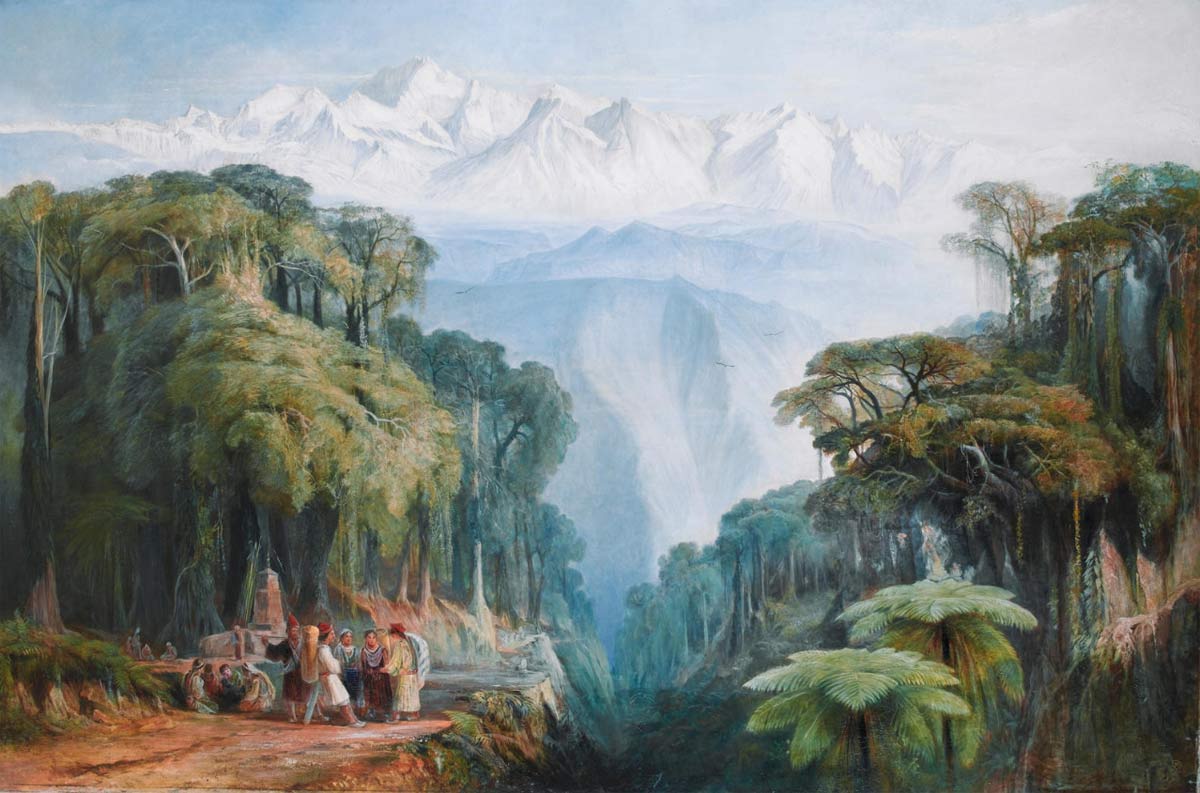
Edward Lear, Kangchenjunga from Darjeeling (1877)

EL_Kangchenjunga-s

Edward Lear, Kangchenjunga from Darjeeling.
Signed with monogram and dated 1877 l.r. Ooil on canvas. 117 x 178 cm. (46 x 70 in.)

Henry Austin Bruce, 1st Baron Aberdare, (1815-1895);
Donated by Lord Aberdare to the Mountain Ash Urban District Council (currently, Cynon Valley Borough Council).

Exhibited: London, The Royal Academy of Arts, ‘Edward Lear:1812-1888‘, 1985, no.63.

In October 1873, Edward Lear left his home in San Remo on the Italian Riviera and embarked on a 15 month tour of India and Ceylon. The previous year his old friend, Thomas Baring, the first Earl of Northbrook, had been appointed Viceroy of India and had invited Lear to visit the subcontinent as his guest.
His decision about whether or not to go depended on finding patrons who would be interested in his Indian paintings. One of those who commisioned him was the statesman Henry Bruce, who became Lord Aberdare in 1873. He left the choice of subject matter to Lear, who wrote to him:
‘Thank you for your good wishes, India wise: and particularly also for your commission- which I will take the greatest pains with. But will you not tell me if you have any special wish for one view more than another? Shall I paint Jingerry Wangerry Bang, or Wizzibizzigollyworryboo?’
Despite these enticing-sounding alternatives, Lear eventually chose Kangchenjunga, one of the highest Himalayan peaks. Lear painted three large oils of this spectacular view: for Louisa, Lady Ashburton (Private Collection, U.S.A.), for Lord Northbrook (Private Collection, U.S.A.) and the present work.
Lear was born in 1812, the 20th of 21 children. His father had been Master of the Fruiterers’ Company and was a Freeman of the City of London, but a few years after Edward’s birth he suffered a sudden financial collapse. The family broke up and Edward was given into the care of his oldest sister, Ann, who was 21 years his senior. It was the beginning of a lifetime of emotional and financial insecurity.
At the age of 15, Lear began to earn his living by decorating screens and fans and by selling drawings to travellers in inn yards. By the time he was 18, Lear was working on what was to become one of the finest works of English ornithological draughtsmanship, ‘Illustrations of the Family of Psittacidae, or Parrots’. By the mid-1830s, he was achieving considerable success as a natural history painter.
In 1837, Lear moved to Rome, where he stayed for eleven years. In 1846, he published both his renowned ‘A Book of Nonsense’ and two volumes of ‘Illustrated Excursions in Italy’, which so impressed Queen Victoria that she invited him to give her a series of 12 lessons. In 1848, Lear left Rome to embark on a twelve month tour of the Mediterranean. He visited, not only established sites, but also wild and remote parts of Italy, Greece, Albania and Palestine. He made hundreds of drawings from which he would work when he returned to London.
Throughout the 1850s, as Lear painted large, dramatic paintings of the places he had visited, his reputation grew steadily. In 1860, he confirmed his success by working on a nine-feet long oil, ‘The Cedars of Lebanon’. However, when he exhibited it in 1861, it was dismissed by ‘The Times’ critic and failed to sell. Lear’s later life was one of constant struggle; largely ignored by the picture-buying public, he depended increasingly on his friends to buy his work.
While working on his painting Kangchenjunga in his studio in San Remo, he wrote to Lord Aberdare,
‘I intend that the ‘Kinchinjunga’ shall be so good a picture that nobody will ever be able,- if it hung in your Dining room- to eat any dinner along of contemplating it- so that the painting will not only be a desirable but a highly economical object.
Lord Aberdare was delighted with the finished work,
‘I am really immensely please that the Venerable the Kinchinjunga is so well placed and so much liked, Lear wrote to him. ‘All I beg of you particularly is this-that if it stands on the ground, you will put up a railing to prevent the children from falling over the edge into the Abyss.’
We are grateful to Dr Vivien Noakes, author of ‘Edward Lear: The Life of a Wanderer’ and curator of ‘Edward Lear: 1812-1888’, Royal Academy of Arts, London, 1985, for her assistance in cataloguing this lot.

Bonhams.
Posted in Edward Lear | Tagged , , , , | Leave a comment