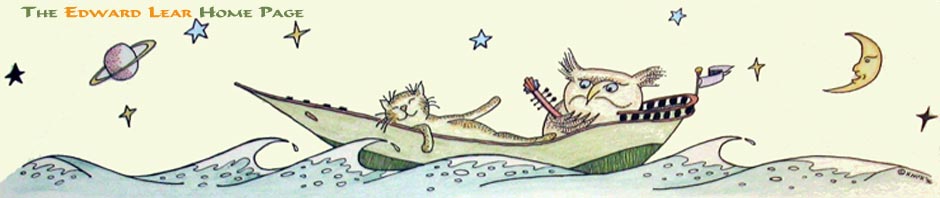

Peter Newell, “The Wolf and the Lamb.” The Metropolitan Magazine, vol. XXII no. 4, July 1905, p. 435.
Peter Newell, “The Wolf and the Lamb.” The Metropolitan Magazine, vol. XXII no. 4, July 1905, p. 435.
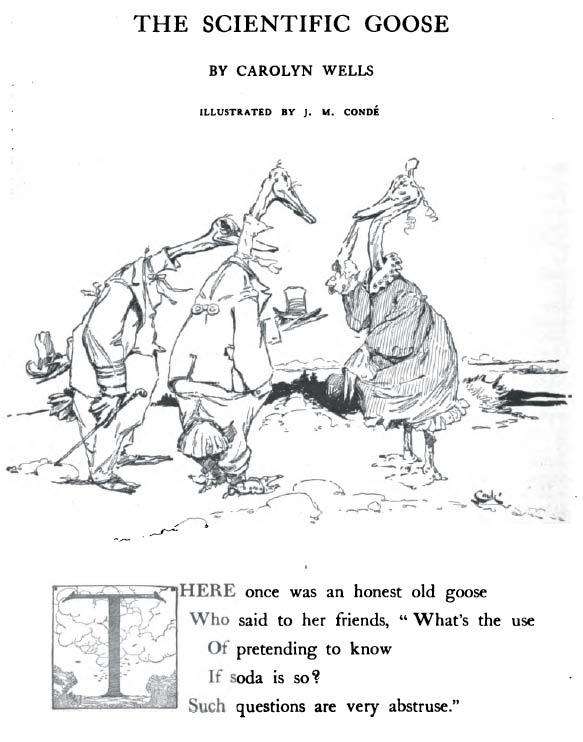
Carolyn Wells, “The Scientific Goose.” Illustrated by J.M. Condé. The Metropolitan Magazine, vol. XXII no. 3, June 1905, p. 3377.
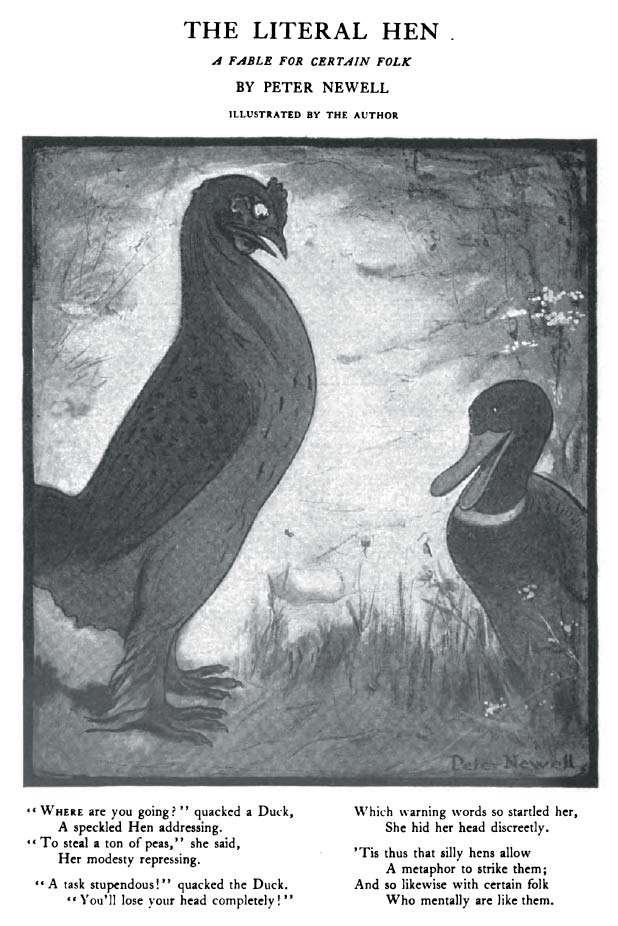
Peter Newell, “The Literal Hen. A Fable for Certain Folk” The Metropolitan Magazine, vol. XXII no. 2, May 1905, p. 194.
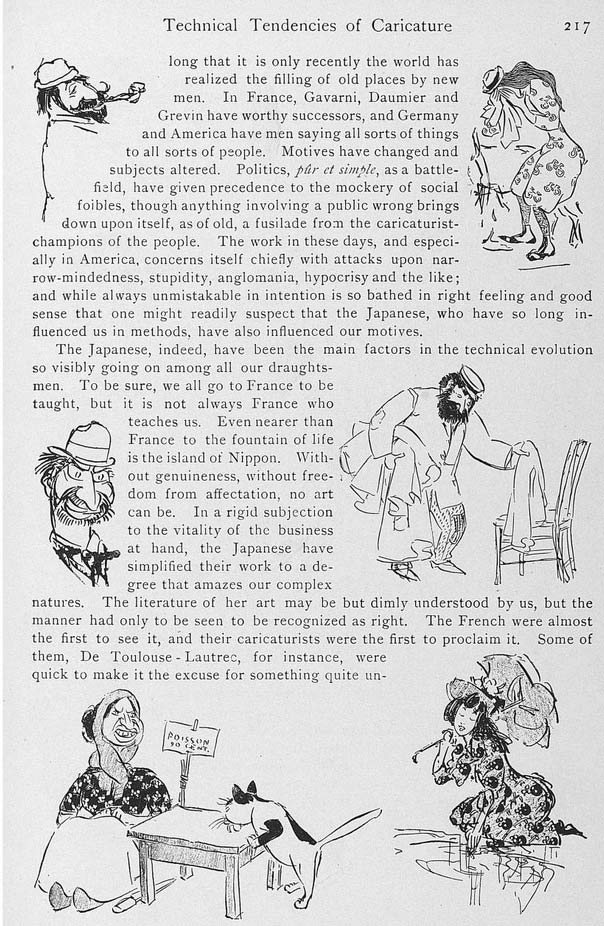
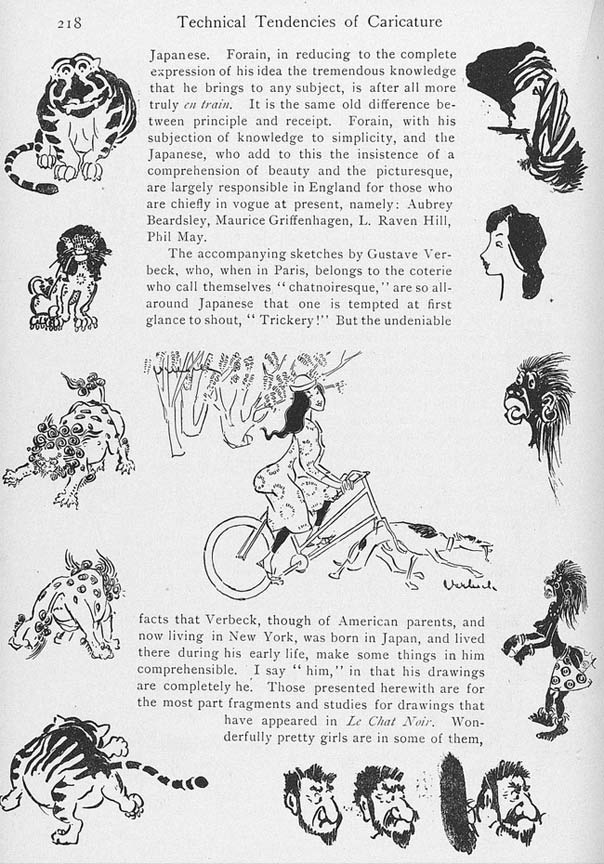
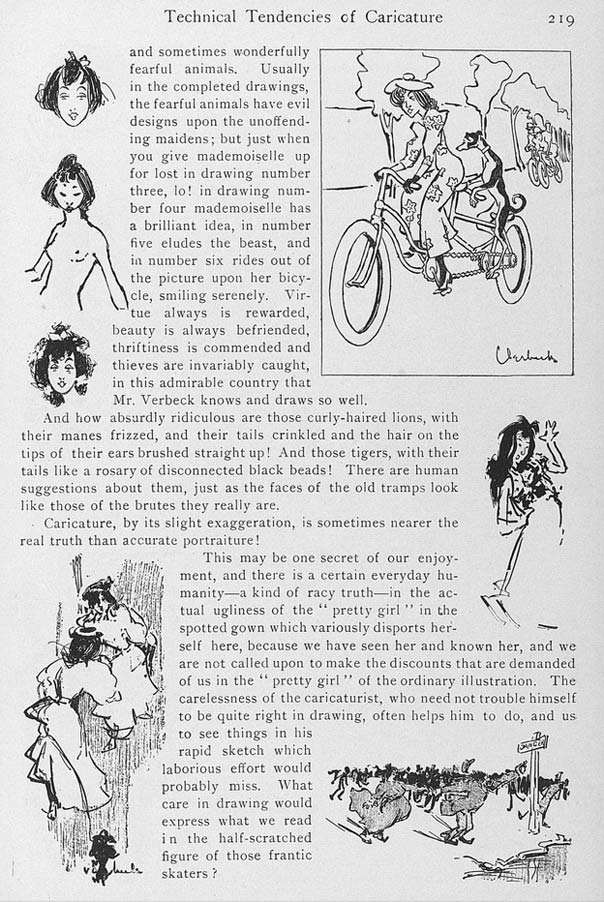
Henry McBride & Gustave Verbeck, “Technical Tendencies of Caricature.” The Monthly Illustrator, Vol. 4, No. 13, May 1895, pp. 215-219.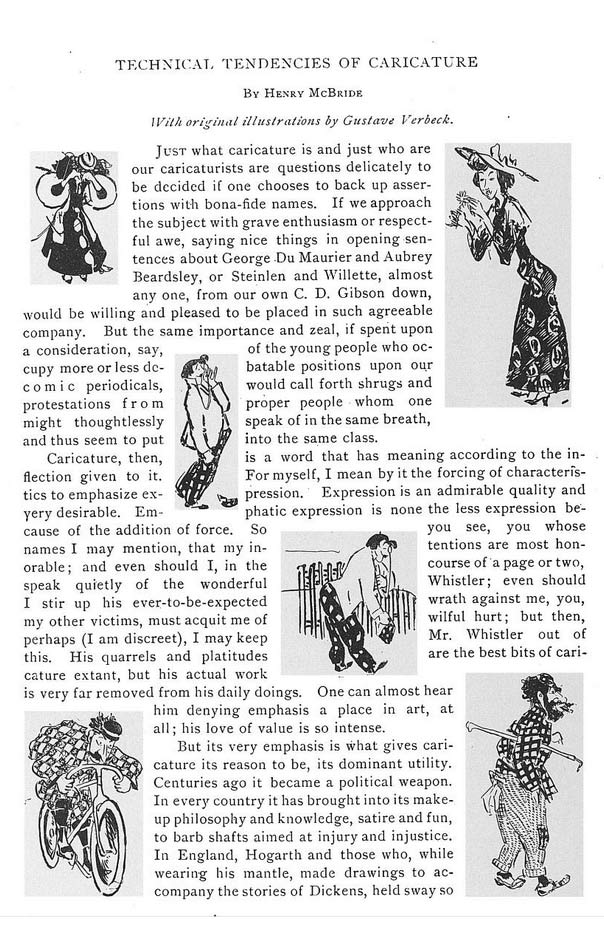
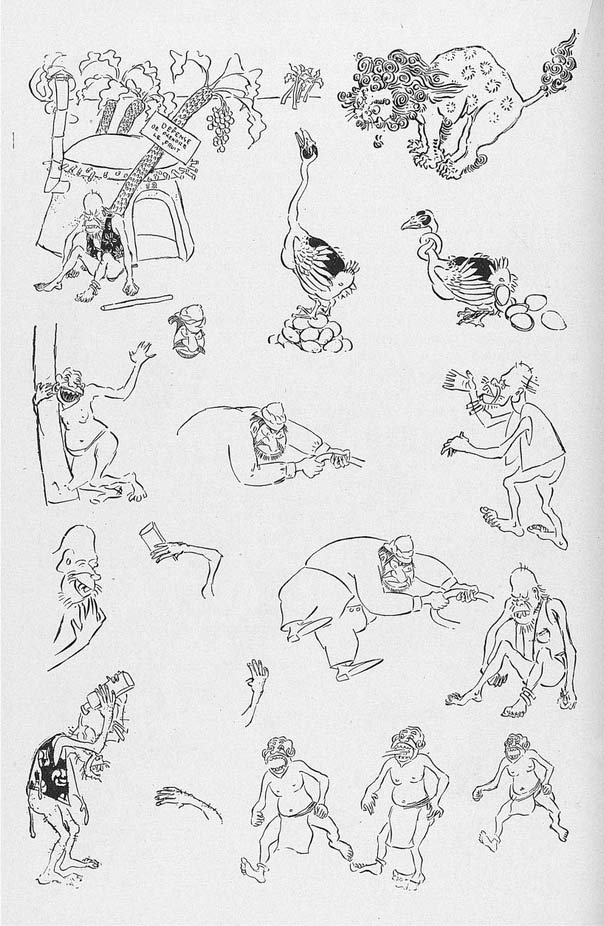
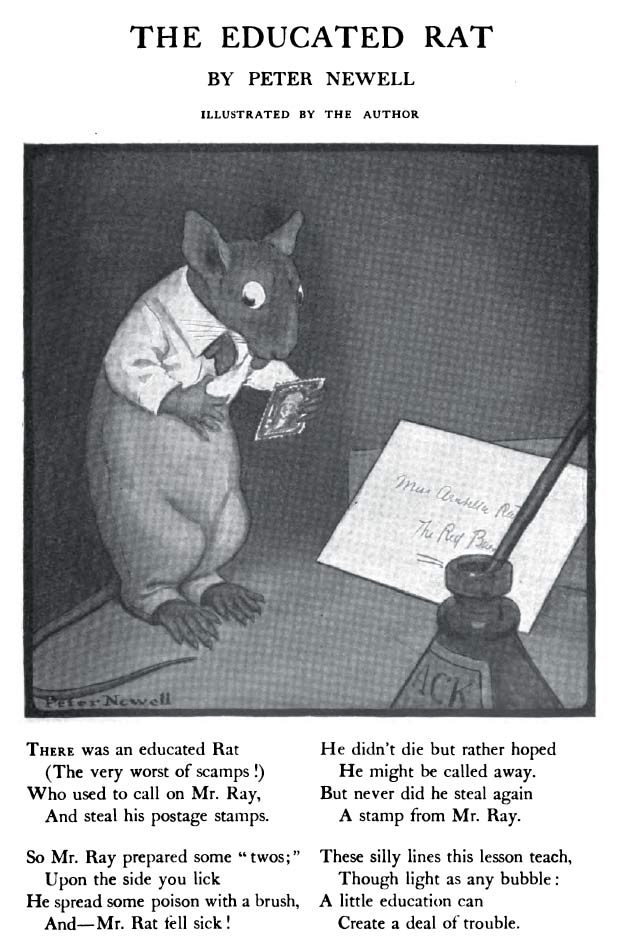
Peter Newell, “The Educated Rat.” The Metropolitan Magazine, vol. XXII no. 1, April 1905, p. 97.
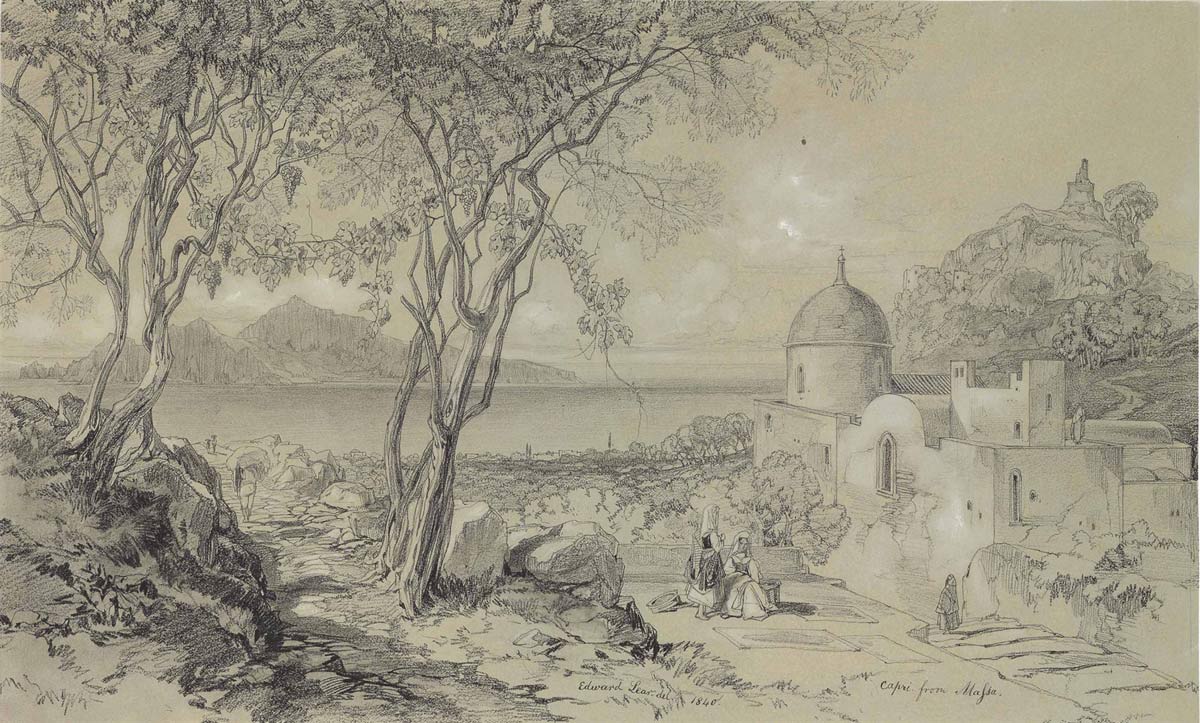
Edward Lear, View of Capri from across the Bay at Massa, Italy.
Signed, inscribed and dated ‘Edward Lear del. 1840/Capri from Massa’ (lower right)
pencil and black chalk heightened with white. 10 x 16 5/8 in. (25.4 x 42.2 cm.)
For a decade from 1837, apart from two visits to England in 1841 and 1845-6, Lear based himself in Italy, spending the winter months in Rome and travelling throughout Italy for the rest of the year. He was inspired by Italy, by Rome and its surrounding landscape. He became part of the artistic community in the city and developed a flourishing practice as a teacher to the English residents as well as finding a ready market for his work.

Edward Lear, View of Sorrento.
Signed and dated ‘Edward Lear del./1839’ (lower right) and inscribed ‘Sorrento’ (lower left)
pencil and black chalk heightened with white. 9 7/8 x 16 ½ in. (25 x 42 cm.)
Lear spent the summer of 1838 travelling through the area around the Bay of Naples with the artist Thomas Uwins (1782-1857). For much of the time they were based in the small village of Capo di Cava and from there made excursions either inland or around the Bay. There is another view of Sorrento and the Bay executed in the same careful technique and on a sheet of similar size, in Boston, Museum of Fine Arts.
Lady Georgiana Peel, née Lady Georgiana Adelaide Russell, (1836-1922) was Archibald Peel’s second wife; he was a friend Edward Lear frequently mentioned in the diaries. A book of her memoirs was published in 1920 by her daughter; unfortunately, the editing is far from perfect, and the “recollections” do not always correspond to what we would expect of Lear, e.g. the “story” she reports does not sound like him at all. Also, when Lear had his adventure in revolutionary Reggio Calabria he ws travelling with John Proby, not Peel.

Recollections of Lady Georgiana Peel. Compiled by Her Daughter Ethel Peel. London: John Lane, The Bodley Head, 1920, pp. 251-253:
Two very interesting men with whom he [Georgiana’s husband Archibal Peel] travelled, in Italy and Corsica, were Mr. Chichester Fortescue, Chief Secretary for Ireland in my father’s administration, and Mr. Edward Lear, the landscape painter, and writer of nonsense stories and verses, also books of travel, which have a charm about them, given by the writer’s very original ideas, coupled with sketches which render to the reader exactly what he wished to describe.
While in company with Edward Lear, they stayed at a small inn, in a town in Italy, which was much agitated by a local revolution, a frequent occurrence in that country. The two visitors, wishing to go out at once to inspect the beauties of the town, gave the keys of their boxes to the waiter, and asked him to unpack, and put out their clothes, as they wished to change at once on coming in. They were somewhat taken aback, when the excited little Italian threw the keys in the air, shouting, “Non c’è roba! Non c’è chiave! Tutto è amora e libertà!” — “There are no clothes, there are no keys, all is love and liberty!” They were quite relieved when the luggage and keys remained in sight, and did not disappear!
A story told A. by Edward Lear always struck him as a lesson in worldly wisdom. Though published afterwards by the well-known landscape painter in one of his books, it may perhaps be repeated. The fable, which though not Aesop’s is worthy of that ancient sage, run [sic] as follows:
“Once upon a time, three poor students, all very near-sighted, and each possessing a single pair of horn-rimmed spectacles, set out to walk to a remote university for the purpose of competing for a professorship. On the way, while sleeping by the wayside, a thief stole their three pairs of spectacles. Waking, their distress was great: they stumbled, they fell, they lost their way, and night was at hand when they met a pedlar.
“‘Have you any spectacles?’ said the three miserable students,
“‘Yes,* said the pedlar,’ exactly three pairs, but they are set in gold, and are of magnificent workmanship; in fact, they were made for the King, and the cost is £15 each pair.’
“‘Such a sum,’ said one student, ‘is absurd; it is surely as much as we possess.’
“‘I cannot,’ the pedlar replied, ‘take less, but here is an ivory-handled frying-pan which I can let you have for a trifling sum, an astonishing bargain; you may never again chance to meet with such a singularly joyful opportunity.’
“Said the eldest of the three students, ‘I will grope my way on as I can. It is ridiculous to buy a pair of this man’s spectacles at such a price.’
“‘And I,’ said the second student, ‘am determined to purchase the ivory-handled frying-pan; it costs little, and may be useful, and I may never again meet with such an extraordinary bargain.’
“But the youngest of the three, in spite of the laughter of his two companions, bought the sumptuous spectacles, and walking quickly on, no longer hindered by his bad sight, soon disappeared in the distance.
“Thereon, No. 1 set off slowly, but falling into a ditch by reason of his blindness, broke his leg, and was carried back by a passing cart to his native town.
“No. 2 wandered on, but lost his way, and after much anxiety and loss of time, was forced to sell his valuable frying-pan at a great loss, to enable him to return home.
“No. 3 reached the university, gained the prize, was made a professor, with a fixed home and a fixed salary, and lived happily ever after.
“Moral. To pay much for what is most useful is wiser than to pay little for what is not!”
Edward Lear, as can be guessed from his books, was the most inspiring of companions, nothing could be uninteresting when viewing it in his company.

Of greater interest are two letters she publishes from John Peel, Archibald’s elder brother, mentioning Lear and his stays in Malta:
Edward Lear has been often here, he has a house the other side of the harbour; I generally dine him and put him up about once a week. Though excellent friends, when talking to him I feel like a bad skater; any minute may bring me to grief. Artists and naval men are so cursedly vain, they are always thinking of their own dignity, and that is why one is perpetually treading on their toes.
(From Malta, February 1865, but must be 1866. Recollections p. 236.)
The other one is of 23 February 1867, ibid. p. 239, and provides a Dickensian portrait of Lear:
Edwin [sic] Lear, when he passed through, dined with me; he was as usual somewhat melancholy, and foretold the death of his remaining relatives, several in number and his own total blindness and impecuniosity like Micawber; however he brightened up, and concealed a good deal of liquor about his person, he is now up the Nile, and I owe him a letter.
Two undated watercolours to be auctioned at Bonhams:
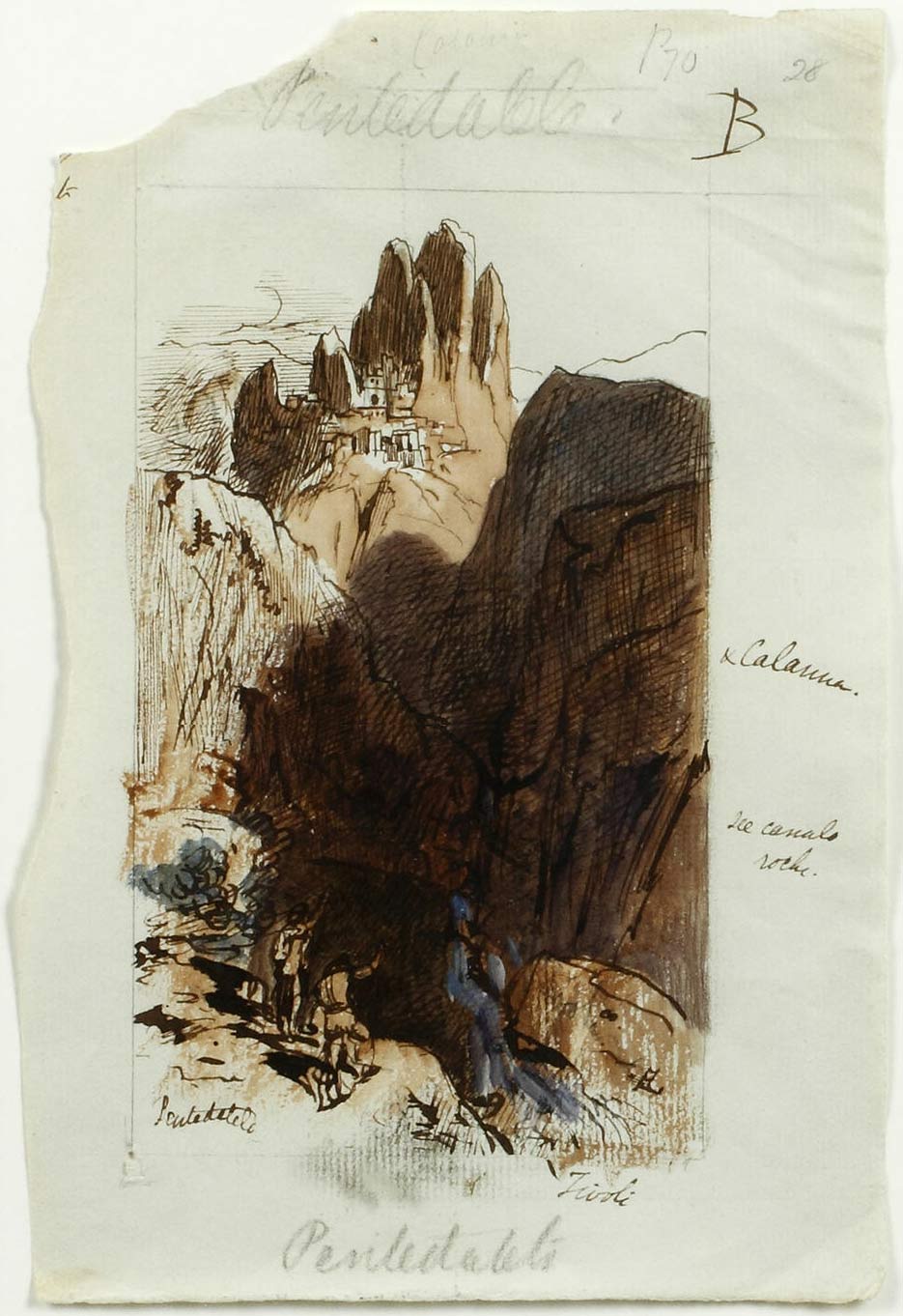
Pentedatelo (Pentedattilo, Calabria, Italy), signed with monogram.
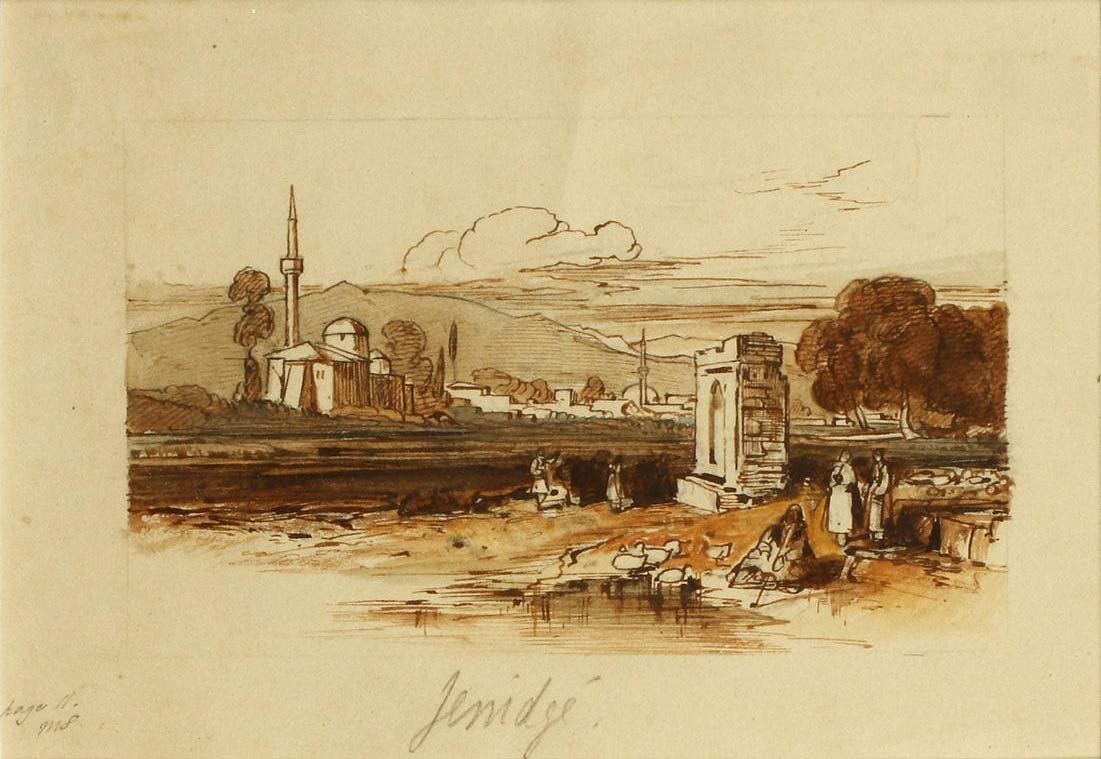
Jenidgé (Macedonia).
[This previously unpublished letter to his elder sister Ann tells of Edward Lear’s leaving Italy because of the 1848 insurrections; he was on his way to Corfu, where he had been invited by G.F. Bowen. It also contains Lear’s first impressions of Malta and, as it is not used by John Varriano in his recent book, may serve to complete the picture of Lear’s attitude to an island he was never able to like.
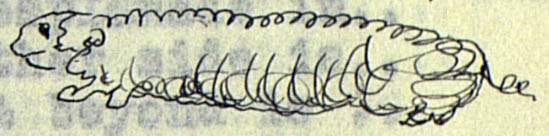
I transcribe the letter from the surviving typescript, so the caricature of the Maltese poodle below was traced from Lear’s original.]
Dumford’s Hotel, Valletta, Malta
April 9th., 1848.
My Dear Ann,
You see by my beginning so high on the paper that I prepare to write you a rather longer letter than of late you have had. I am sure I hope you will not have been uneasy about me ― though the complete stoppage of all posts through Lombardy makes me rather apt to suppose you have not received my last 2 letters. I wrote from Rome, on the 18th. & 28th. of last month, & more than that I could not do. However, I trust you will get this, & learn that I am quite safe & sound & meanwhile I will tell you all I can of my doings since the 28th., & of my journey hither, ― & also of this place itself. Please be so kind as to keep these letters I now write, as they may be useful in after journalising; do not forget to tell me of the dates of all you receive; above all, never fret in the least at not hearing from me, as the last occurrences will have only convinced you how possible it is I should be perfectly well, & yet that you should not hear a word from me for ever so long ― through the stoppage of letters by unexpected events. I was truly glad to leave Rome at the last; every time poor old Giovanina came in to the room she said she was bringing this, or doing that, for the last time, & went out in tears; poor old lady ― she is a kind hearted creature & very sorry to loose [sic] me ― which after 10 years is not wonderful. On the Friday morning (march 31st.) I left very early ― & such a sobbing & crying never was! ― I sold her all my furniture at a mere nominal price, as she had been so good a landlady & did not like to take much money from her. My journey down to Naples by diligence was most extremely pleasant, ― though naturally most unlike any previous one I had ever made. It would be quite impossible to make you understand how a few short months have changed all things & persons in Italy ― for indeed I can hardly believe what passes before my own eyes. Restraint & espionage has given universal place to open speaking & triumphant liberal opinions. One of my fellow passengers was a Neapolitan noble, exiled for 16 years; when he saw Vesuvius first, he sobbed so that I thought he would break his heart. Naples, I found yet more unsettled & excited than I had left Rome. No one could tell what would happen from one hour to the next. The King still reigns, but I cannot think he will long do so. All the English were running away & the resident bankers etc. etc. frightfully harassed & uneasy as to the future. As usual, I found numbers of friends at Naples & had 11 dinner invitations for the 6 days I was o stay. Lord Minto[,] the Miss Tullons, Lord Napier, Lady Carmichael, Baring, Horton, Iggulden, Webbs, Roscoes ^[etc. etc.] The English fleet being there made a deal of gaiety. I was ready to leave by the French steamer on the 5th ― but it did not appear, ― & on the 6th only it came in sight, having been detained by bad weather. We left the harbour at noon on the 6th. & truly glad was I to be out of Italy ― I assure you ― not from any fear of danger, but because the whole tone of the place is worry, worry, worry ― & I am sick of it, having lived in it so long in quieter times. On board we had the Webbs, Ramsays, Sykes etc. etc. ― the Maronite Bishop of Laodicea, 2 of the late Neapolitan ministers, who, secluded for 2 weeks in one of our ships were smuggled on board ― flying for life to Malta etc. etc. The first day was truly delightful, & we were so merry a party that all things were charming ― but in the night an ugly breeze got up, & although we were off Stromboli by 5 a.m. on the 7th, yet we were all day long ― 14 hours namely accomplishing 12 miles ― & only got to Messina by twilight. The sea was very rough, & I confess to being most miserable. However I kept mostly in bed, where also passed all the night of Friday, & all Sat. the 8th on the evening of which we at last reached Malta. It is very unusual to have such bad weather at this time of the year, & you may suppose I was ill enough all the way ― & most heartily glad to land. And now I must tell you something of this place. First ― I have found (as usual) a multitude of friends; having letters to some, & discovering ancient acquaintances in others; so that, as it were, half Malta rushed to receive me with open arms. There is the good ^[natured] Lady Duncan & Mr. & Mrs. Webb who are in the same hotel ― & Col. Sykes & Col. Lockyer, & Mr. Bouchier ―whose family are particularly good natured. Yesterday I went to church twice ― & was much pleased with both the building & the service. You know Queen Adelaide built the church ― & it is a large & handsome one; the bishop resides here ― but his sister is ill, & he was not officiating. Malta itself, is an island all over rock & sand & a little soil, & crammed in every crevice with people & houses. Valetta [sic] is the city ― but somehow one never thinks of any other name than Malta. Such a strange place as Valetta I certainly never did see ― & as a town it is perhaps as beautiful as any existing. The houses all look as if built yesterday ― of a beautiful cream coloured stone, with green or white or painted balconies stuck about in every possible corner. The streets have all capital trottoirs, & there is no dirt to be seen. But the odd part of the character of the place is the mixture of nations; you see all the soldiers English ― English officers driving etc. etc. ― English policemen just as in Cheapside ― but all the bulk of the people are queer, bare footed Maltese ― mingled with blanketed, black faced Africans[,] turbaned Turks, Greeks etc. etc. etc. ― & the bable [sic] of tongues! Most however understand English, though they jabber Maltese which no one but themselves knows anything of. All round the town & two harbours the lines of fortifications are most surprising ― you walk in labyrinths, & when you have got outside, it begins all over & over & over again. ― Zig zag ― zig zag ― up stairs & down stairs ― sharp corners & half moons, moats, drawbridges, bastions & towers till you feel as if built up in Valetta for life. As for the country, there is none; stone walls & stone houses & stone terraces for miles, & villages as far as you can see ― so that you may say that all Malta is a great heap of stone in the Mediterranean with a little ground here & there for cultivation. Food ― pretty cheap fruit abounds. Oranges you know are famous here, & there is good fruit called Japan Medlar which I never before tasted ― Fish not much ― Goats numerous & fine ― milk excellent ― Cows live in cellars. About 18 or 12 trees on all the island I should think [―] yet the varying outline of the angles of forts contrasted with the vast harbours spotted with craft, ― the busy quays, ― & the long lines of public buildings make many an interesting picture. It is impossible to tell you how kind the people are to me; every day I have at least one invitation to dinner, & for some days ― 3 & 4.
April, 12th., Wed.
You see I snatch a bit of every day to fill up this sheet, & indeed ^[it] is no easy matter to find time, though I get up at 5 or 6. Yesterday, I went over early to Sheina, & sketched & walked about till 12 when I had to return here to arrange for money matters. After that, I had several calls to make ― & I drew, & walked round the ramparts till it was time to dress for dinner at the 97th. mess officers ―, a very large & fine dinner. Then came the opera, & a ball at the General’s, ― so I did not get to bed till 2. Of course I should not like this life long, ― but it is impossible not to be pleased with the continual kindness I meet with. I hope to start on Sat. the 15th. for Corfu ― & when there hope to find letters from you ― & I will answer them directly. I look to feeling quite quiet & at home there ― having some intimate friends with whom I hope to stay some time. The weather here is already tremendously hot; it is like India. I never saw such a pretty town as this; it has all the picturesqueness of southern places combined with the cleanness of England. Such beautiful goats are all about the quays & streets; ― I must try to get something Maltese for you. Here comes an invitation to dine with the Governor ―& 2 other dinners! ― which though I can’t eat, I must nevertheless reply to. I cannot read over this letter when written ― so you must excuse all blunders.
April 13th.
I must now wind up & post this today. I hope to send you a pair of lace mittens & something else truly Maltese ― some little ornament if I can find one. Perhaps you would like a Maltese poodle? ― But for fear you should not, I will not send it. I should like to send Eleanor one. They are very like hairy caterpillars to look at ― 2 feet long ― & 3 inches high about.
This morning with an old friend, Kirkpatrick, whom I unexpectedly find here, I walked to the English buying ground ― it is on the ramparts ― but is not so nicely kept as ours in Rome. The weather is most brilliant always. Yesterday the fleet came in from Naples, & no such magnificent naval spectacle did I ever see. They came close to the houses ― all the largest men of war, for the harbour is in the centre of the town. All the part of Valetta where I am reminds me of Brighton ― only it is so perfectly white & gay. But it will not do to look beyond the town ― as the “country” is too ugly. A whole crew of Arabs in blankets & scarlet turbans are just going by the window; one of them with a very long beard & leading a little blanketed boy ― might be Abraham with Isaac. I have a very nice little bedroom with a balcony ― paying 2 [] a night, which, with my breakfast is all the expense I am at. At Corfu I hope to stay with Bowen. I long to see Corfu & the mountains of Albania. The Webbs, who brought me letters in Rome, & who live over me are most kind; indeed I have too many friends, & wish I were more thankful for them. Pray name dates of all the letters you get, & write c/o G.F. Bowen Esq., University. Corfu, & believe me dear Ann,
Ever affect. yours,
Edward Lear
 A Blog of Bosh