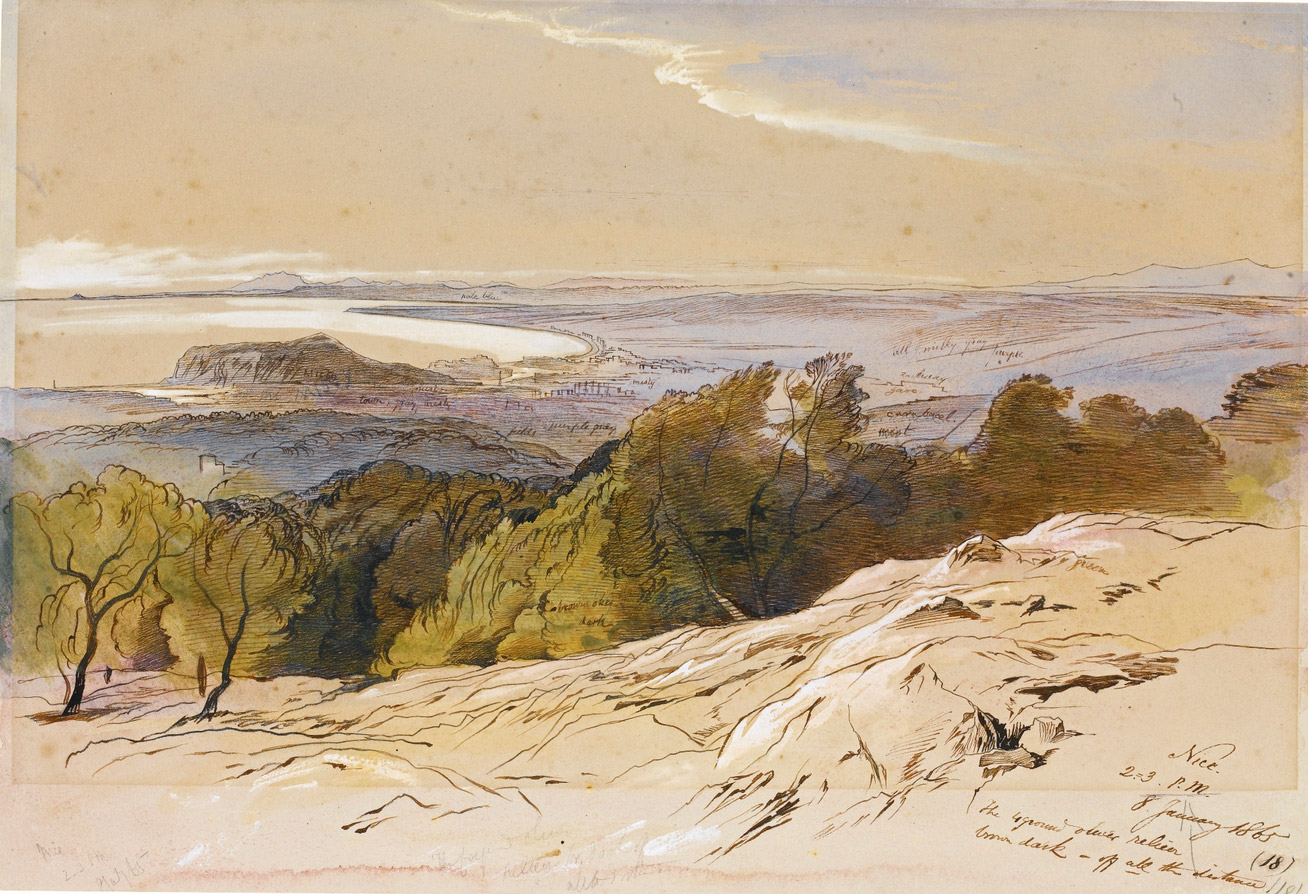
Edward Lear, Nice (1865)

el_nice-s

Edward Lear, Nice, France.
Pen and brown ink and watercolour over pencil heightened with white;
inscribed in ink lower right: Nice. / 2.= 3. P.M. / 8 January 1865 / (18) the 4ground olive section / brown dark – off all the distance; further inscribed with the artist’s colour notes
370 by 543 mm.

Lear drew this landscape from life in the early afternoon of 8th January 1865. He had arrived in the French Riviera in November of the previous year and had decided to spend the winter there, before returning to London in April.

This drawing belongs to Lady Evans, in whose family it has been since the early 20th Century. Lady Evans was married to the late Sir Charles Evans (1918-1995), who was the deputy-leader of the triumphant Everest expedition of 1953.

Sotheby’s.

Posted in Edward Lear | Tagged , , , , | Leave a comment

Mrs Jayfer, Millais, Dicky Doyle and Wilkie Collins in an Edward Lear Letter

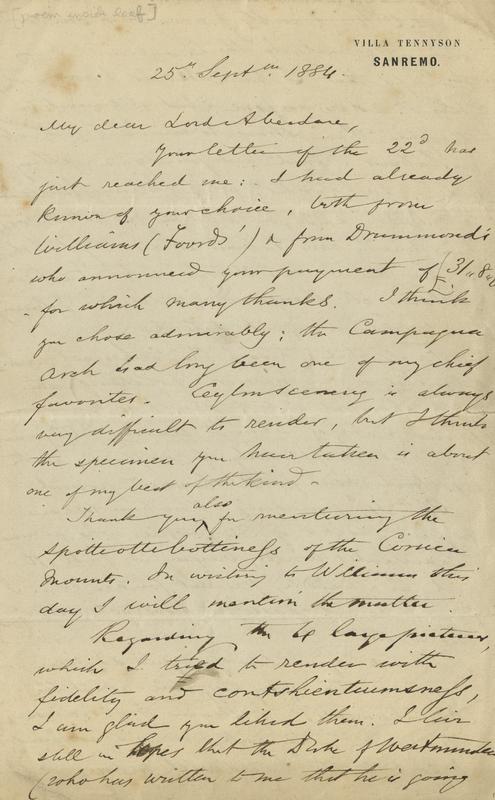
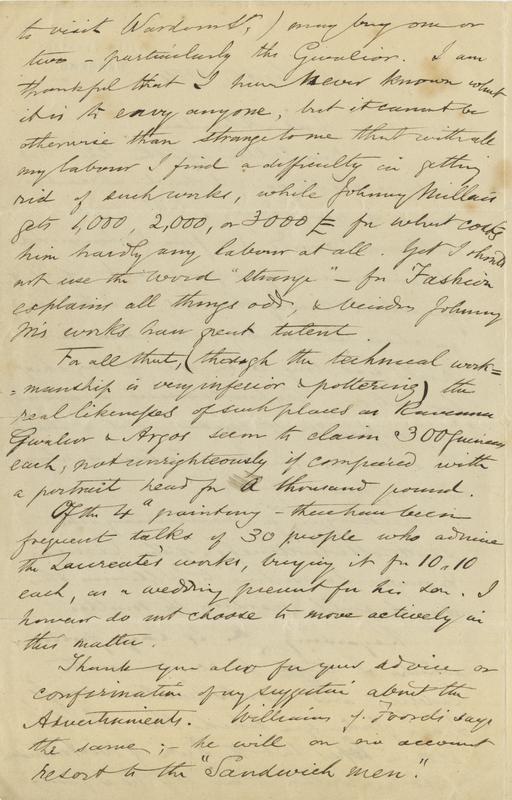
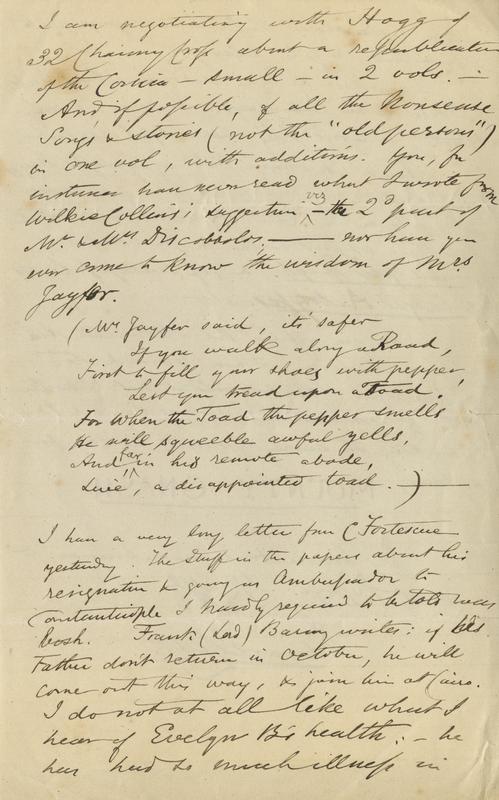
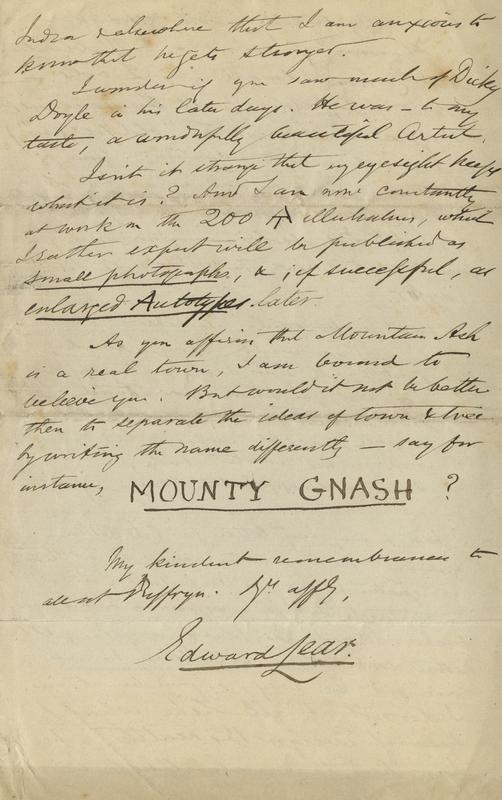
Among the many subjects touched in the letter to Henry Bruce, Lord Aberdare transcribed below from the scans available on the Florida State University website, is Edward Lear’s statement that the second part of “Mr and Mrs Discobbolos” was suggested by Wilkie Collins (see previous post), and that he was thinking of publishing a new collection of his nonsense songs with additions; he also mentions Richard Doyle as a “wonderfully beautiful artist,” and complains of the difficulty he has in “getting rid” of some of his paintings:

Villa Tennyson
Sanremo

25th. Septer. 1884.

My dear Lord Aberdare,

Your letter of the 22nd has just reached me: I had already known of your choice, both from Williams (Foord’s) & from Drummond’s who announced your payment of £31.8.0 ― for which many thanks. I think you chose admirably; the Campagna Arch had long been one of my chief favorites. Ceylon scenery is always very difficult to render, but I think the specimen you have taken is about one of my best of the kind.

Thank you ^[also] for mentioning the spottiottibottiness of the Corsica Mounts. In writing to Williams this day I will mention the matter.

Regarding the 4 large pictures, which I tried to render with fidelity and contshientiumsness, I am glad you like them. I live still in hopes that the Duke of Westminster (who has written to me that he is going to visit Wardour St.,) may buy one or two ― particularly the Gwalior. I am thankful that I have never known what it is to envy anyone, but it cannot be otherwise than strange to me that with all my labour I find a difficulty in getting rid of such works, while Johnny Millais gets 1,000, 2,000, or 3,000£ for what costs him hardly any labour at all. Yet I should not use the word “strange” ― for Fashion explains all things odd, & besides Johnny M.’s works have great talent.

For all that, (though the technical workmanship is very inferior & pottering) the real likenesses of such places as Ravenna Gwalior & Argos seem to claim 300 guineas each, not unrighteaously if compared with a portrait head for a thousand pound.

Of the 4th painting ― there have been frequent talks of 30 people who admire the Laureate’s works, buying it for 10.10 each, as a wedding present for his son. I however do not choose to move actively in this matter.

Thank you also for your advice or confirmation of my suggestion about the Advertisements. Williams of Foord’s says the same; ― he will on no account resort to the “Sandwich men.”

I am negotiating with Hogg of 32 Charing Cross about a republication of the Corsica ― small ― in 2 vols. ― And, if possible, of all the Nonsense Songs & stories (not the “old persons”) in one vol., with additions. You, for instance have never read what I wrote from Wilkie Collins’s suggestion ^[viz.] ― the 2nd part of Mr. & Mrs. Discobbolos. ――― nor have you ever come to know the wisdom of Mrs. Jayfer.

(Mrs. Jayfer said, it’s safer
If you walk along a Road,
First to fill your shoes with pepper,
Lest you tread upon a toad.
For when the Toad the pepper smells
He will squeeble awful yells,
And ^[far] in his remote abode,
Live, a disappointed toad.) ――

I have a very long letter from C. Fortescue yesterday [sic]. The stuff in the papers about his resignation & going as Ambassador to Constantinople I hardly required to be told was bosh. Frank (Lord) Baring writes: if his Father don’t return in October, he will come out this way, & join him at Cairo. I do not at all like what I hear of Evelyn B.’s health: ― he has had so much illness in India & elsewhere that I am anxious to know that he gets stronger.

I wonder if you saw much of Dicky Doyle in his later days. He was ― to my taste, a wonderfully beautiful Artist.

Isn’t it strange that my eyesight keeps what it is? And I am now constantly at work on the 200 AT illustrations, which I rather expect will be published as small photographs, &, if successful, as enlarged Autotypes later.

As you affirm that Mountain Ash is a real town, I am bound to believe you. But would it not be better then to separate the ideas of town & tree by writing the name differently ― say for instance, MOUNTY GNASH?

My kindest remembrances to all at Duffryn. Yrs affly,

Edward Lear.

MS letter HAB 1884-09-25 1

MS letter HAB 1884-09-25 2

MS letter HAB 1884-09-25 3

MS letter HAB 1884-09-25 4

Posted in Edward Lear | Tagged , , , , | Leave a comment

An Edward Lear Letter to Wilkie Collins

The friendship between Edward Lear, the Victorian poet of nonsense verses, and Wilkie Collins, the novelist, has long been well-known. Yet, strangely enough, it was a friendship of which, as Collins’ biographer tells us, “hardly a trace remains.”{1} We know that Lear, ill and depressed, wrote at the end of 1881 to Hubert Congreve that he would continue to correspond in the future only with those “I have been in the habit of writing to since 1850 ― 32 years.” Among those he named was Wilkie Collins.{2} That Collins had written at least once to Lear is seen in a single reference in a letter written by Lear to Lord Carlingford on January 7, 1884, in which he said he had received a “long and very nice letter from Wilkie Collins. . . .”{3} We are told that Lear sent to Collins a copy of John Ruskin’s letter to the Pall Mall Gazette praising the nonsense poet,{4} and that Lear sent to Collins a manuscript copy of his last nonsense-poem ” Uncle Arly.”{5} In view of all this, it is extremely odd that in the two volumes of Lear’s published letters not one to Collins appears. In the J. Pierpont Morgan Library there has been for some years an autograph letter from Lear to Collins; so far as I can ascertain this letter has never been published. For some unaccountable reason those who have written on Lear and on Collins have seemingly been unaware of its existence. If it is, as seems very probable, the only letter from Lear to Collins in existence, it should be of interest not only to students of both Lear and Collins but also, because of a reference in it, to those of Ruskin. This letter of two and one-half pages may very well be the one in which Lear enclosed the copy of ” Uncle Arly,” for that poem may be the “absurdity ” which he mentions in the first paragraph. An exact transcription of the letter follows:

7. March 1886
Villa Tennyson
Sanremo.
My dear Wilkie,
“Ee’n in our ashes live” &c &c ― so, ― though I have been in bed some 14 weeks, I have nonetheless written an absurdity which I fancy you may like ― whereby I send it.
The acute Bronchitis which I began with, Dr Hassall I am grateful to say has pretty well abolished. Not so the congestion, which with its dreadful cough ― is trying enough. Yet many thousands suffer more, & I may be very thankful that only increasing weakness is my greatest drawback.
One of my oldest friends, Fortescue, (now Ld Carlingford) was here for two months & with me almost all day daily. And other friends come & are coming from Cannes, Hyères ― &c. & I have lots of books, (many by one Wilkie Collins,) & most attentive & able servants ― to feed me or lift me in or out of bed. Of what is called the “Colony” here I know ― I am happy to say nothing. Neither perpetual church services ― (high or low ― candlestix or cursings ―) are to my taste, nor are balls & Lawn Tennis among my weaknesses.
Mr Ruskin (vide Pall Mall Gazette Febr 15 ―) has of late greatly exalted me, & he is now taking much interest, he writes most kind letters, ― about yeverlasting & never terminated AT or Alfred Tennyson illustrations ― still let us hope ― to come out in Autotype ― about the year 4810. Meanwhile, if I go off in one of these terrible phitz of coughing, this may be the last note you will ever be bothered by from, Your’s affly,
Edward Lear{6}

David Shusterman
University of Kansas
{1} Kenneth Robinson, Wilkie Collins (New York, 1952), p. 93.
{2} Later Letters of Edward Lear, ed. Lady Strachey (London, 1911), p. 34.
{3} Ibid., pp. 296-297.
{4} Angus Davidson, Edward Lear Landscape Painter and Nonsense Poet (London, 1938), p. 265.
{5} Robinson, p. 93. [See a MS of the poem]
{6} Quoted by permission of the J. Pierpont Morgan Library

Modern Language Notes 71.4, April 1956, pp. 262-264.

Catalogue entry for this letter at the Pierpont Morgan Library. They have another Lear letter to Collins, of 25 May 1887 “concerning his poor health, and the sale of his large ‘Argos picture’ to Trinity college, Cambridge― ‘a matter of high honour & pleasure to me’.”

Posted in Edward Lear | Tagged , , , | 1 Comment

The First English Limerick?

The text set as No. XXII in Michael East’s Second Set of Madrigals 1606 is an almost perfect limerick (East, xii and 115-20; Fellowes, 91{1}); a fact which I believe has not been noted before.

The piece runs:

O metaphysical tobacco,
Fetched as far as from Morocco,
Thy searching fume
Exhales the rheum,
O metaphysical tobacco.

and it can be seen that it conforms in every respect to the ‘rules’ of the limerick, except that it changes to an iambic rhythm for lines 3 and 4, Like Edward Lear’s limericks, but unlike most modern examples, it uses the first line as the concluding line.

The tone and diction of the piece are at odds with the other, more courtly lyrics used in East’s collection and this, taken in consideration with the more homophonic and chordal music to which it is set, seems to anticipate the fashions of the late seventeenth and early eighteenth centuries, the era of ‘Wit and Drollery’. Indeed it is surprising that a precurson to the limerick-form has not already been discovered amongst the glees, catches, and ‘Pills to Purge Melancholy’ of that period. Now with this example of the form in front of us the absence of any proto-limericks from the eighteenth century is even more unaccountable.

John Leonard
University of Queensland.

Notes and Queries, n.s. 40.2 [Volume 238], June 1993, pp. 207-208.

As you may have realised, I’m throwing away tons of paper and scanning and ocr-ing my Lear-related photocopies: publishing some of this material here is a good way to make the material easy to find. Bonus: you can listen to Michael East’s ‘limerick’ here, or get a glimpse of the score and listen to a MIDI version here.

Posted in Edward Lear, Limerick | Tagged , , , | Leave a comment

Edward Lear and Charles Kingsley

From Notes and Queries, n.s. 16.6 (Vol. 214), June 1969, pp. 216-217:

An Edward Lear Letter to Charles Kingsley

Apparently, Edward Lear and Charles Kingsley never became personally acquainted. No records are presently known to attest sucha relationship.

However, after the successful appearance in 1871 of Lear’s Nonsense Songs, Stories, Botany and Alphabets, Kingsley (as did others) requested permission from the author to use quotations from the book. In response Lear wrote the following letter explaining the procedure for obtaining such approval, expressing praise for the works of Kingsley, and referring to a previous inability to take advantage of an opportunity for meeting the rector of Eversley.

Villa Emily.
San Remo, Italy.{1}
8 Novbr 1871

Dear Sir,

I have only this morning received your note, — though dated some time back, — and hasten to answer it. I am sorry I cannot do so exactly as I like. For, owing to a vast number of requests such as that you have sent me. I have been obliged to leave the arrangements of permissions &c entirely in my publisher’s hands, — and as he has already communicated three [sic for “these”?] to several persons, I may not even interfere with what has been settled. I have by this post written to Mr. Bush,{2} begging him to release this to you together with anotice of what he has written to others on the same subject.

Your kind remarks as to the pleasure my little book has given you delight me; I have often thought I should like to thank you for so much satisfaction given me by your many works — (perhaps above all — “Water Babies,” which I firmly believe to be all true,) and I ought to have done so at the Grenfells of Taplow{3} long ago — but I was not able to go there when asked to have the pleasure of meeting you. And I half feel that I am somewhat churlish in thus officially as it were turning you over to my publisher; only that (after a larger number of similar requests than you can imagine,) — I have declared I would abide sic his decisions.

Believe me,
Dear Sir,
Yours obliged and truly,
Edward Lear{4}

To the Rev. Charles Kingsley
Eversley

Fred L. Standley.
Florida State University

{1} Lear’s newly constructed home; for details see Angus Davidson, Edward Lear: Landscape Painter and Nonsense Poet (New York, 1939), pp. 209-210.

{2} Robert John Bush, publisher of Nonsense Songs, Stories, Botany and Alphabets (London, 1871).

{3} The family of Pascoe Grenfell, M.P., of Taplow Court, relatives of KIngsley’s wife, Francis Eliza.

{4} This autograph letter is in the Childhood in Poetry Collection of Robert Manning Strozier Library of Florida State University and is reprinted by permission of the Curator, John Mackay Shaw.


Posted in Edward Lear | Tagged , , , , | Leave a comment

Edward Lear, Ravenna

el_ravenna-s

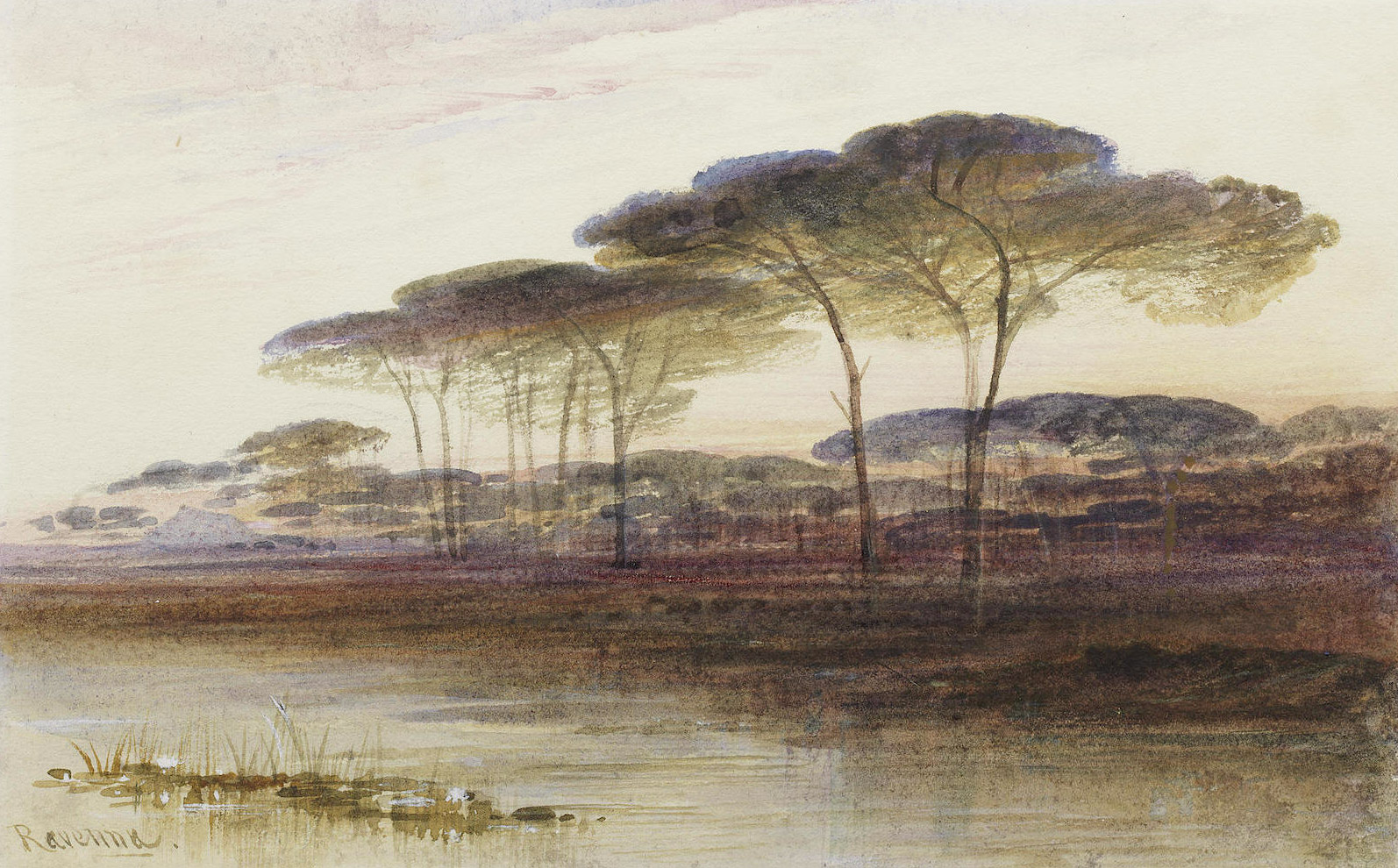
Edward Lear, Ravenna.
Inscribed ‘Ravenna.’ (lower left). Wwatercolour and gum arabic. 16.5 x 26.3cm (6 1/2 x 10 3/8in).

Bonhams.

Posted in Edward Lear | Tagged , , , , | Leave a comment

Edward Lear, View of Abu Simbel (1867)

el_abu-simbel-s

Edward Lear, View of Abu Simbel.
Signed with monogram and dated 1884 (lower right), inscribed ‘The Temples of Ipsambl. Feby 8. 1867′ (lower left), further inscribed ’14. Temples of Ipsambl.’ on the reverse. Watercolour. 9 x 17.5cm (3 9/16 x 6 7/8in).

Provenance: Private collection, UK.

Edward Lear visited southern Egypt in early 1867, executing the present lot on 8 February. In a letter to Lady Waldegrave, dated 9 March of the same year, he describes ‘Aboo Simbel which took my breath away'[1]. Painted from the opposite bank of the Nile, the present watercolour depicts both temples at Abu Simbel, built over 3,200 years ago by Ramesses II as monuments to himself and his queen, Nefertari. For centuries the temples were seemingly forgotten and covered with sand until their rediscovery by Swiss explorer Johann Ludwig Burckhardt (1784-1817) in 1813. It is said that ‘Abu Simbel’ was the name of the local boy who guided the first re-discoverers to the site, and later this was the name given to the complex.

When the construction of the Aswan Dam began in 1960, it became apparent that the ancient temples would soon be submerged and destroyed by the rising waters of the newly created Lake Nasser. An international fund-raising campaign by UNESCO led to their relocation to higher ground – a highly complex and costly process that was finally completed in 1968. Thus, the present lot shows the original location of the Abu Simbel temples.

[1] Vivien Noakes, Edward Lear: Selected Letters, London, 1988, pp. 208-209.

Bonhams.

Posted in Edward Lear | Tagged , , , , | Leave a comment

Edward Lear, Malacca Parakeet

el_malacca-p-s

Edward Lear, A Malacca Parakeet, Palaeornis Malaccensis, an illustration for Prideaux J. Selby’s Natural History of Parrots, Edinburgh,W. H. Lizars; 1836.

Signed and inscribed ‘E. Lear fct.’ (vertically from branch), inscribed ‘Plate 3d’ (upper left), and ‘Palaeornis Malaccensis/Plate’ (lower centre), indistinctly inscribed along lower framing edge. Watercolour and pencil. 18.5 x 11cm (7 5/16 x 4 5/16in).

Provenance: with Thos. Agnew & Sons Ltd., London. Private collection, UK.

The modern term for the Malacca Parakeet is the Long-tailed Parakeet (Psittacula longicauda). The breed was discovered by the Dutch physician and naturalist Pieter Boddaert (1730-1795).

Bonhams.

Posted in Edward Lear | Tagged , , , | Leave a comment

Edward Lear, Ravenna (1867)

el_ravenna-67-s

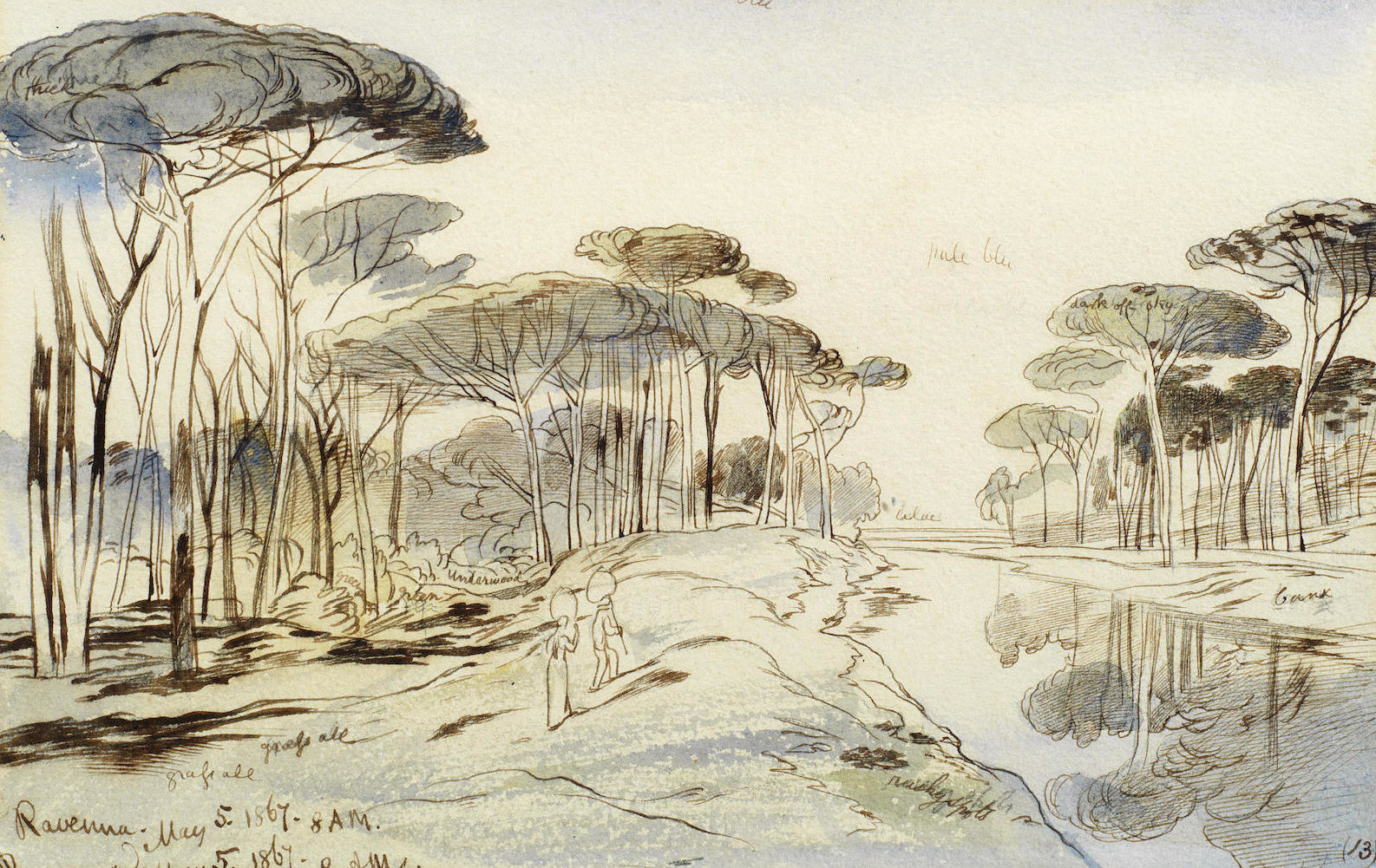
Edward Lear, ‘Ravenna.’
Inscribed and dated ‘Ravenna.May 5.1867.8AM.’ (lower left), numbered ‘(13)’ (lower right) and inscribed with various colour notes. Pen and watercolour. 15.4 x 25cm (6 1/16 x 9 13/16in).

Bonhams.

Posted in Edward Lear | Tagged , , , , | Leave a comment

Lewis Carroll, the Limerick, and the Meeting That Failed

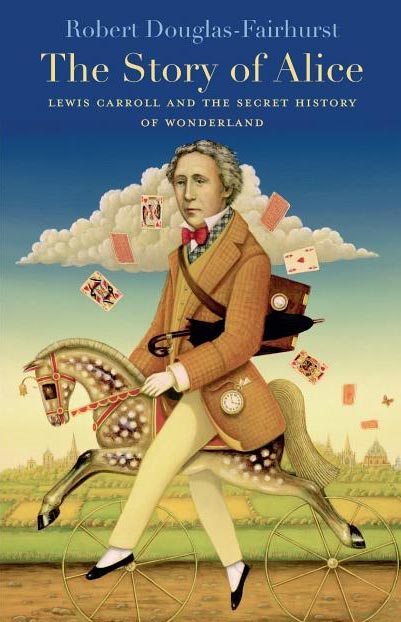
Douglas-Fairhurst, Robert. The Story of Alice: Lewis Carroll and the Secret History of Wonderland. Cambridge (Mass): Harvard University Press, 2015.
douglas-fairhurst

pp. 39-40:

What makes Useful and Instructive Poetry espefcially useful and instructive in terms of Carroll’s later literary career is that it contains his only experiments in what would become one of the most popular forms of nonsense writing: limericks. Take the final two examples:

There was once a young man of Oporta,
Who daily got shorter and shorter,
The reason he said
Was the hod on his head,
Which was filled with the _heaviest_ mortar.

His sister named Lucy O’Finner,
Grew constantly thinner and thinner;
The reason was plain,
She slept in the rain,
And was never allowed any dinner.

Edward Lear’s earliest limericks were published in 1846, a year after Carroll’s experiments, so they cannot have been an influence unless Carroll saw them in manuscript, although similar poems had been published before (as lear acknowledged) in collections such as The History of Sixteen Wonderful Old Women (1820) and Anecdotes and Adventures of Fifteen Gentlemen (1821). A More significant question is why Carroll was drawn to the form at all. The likeliest answer is that it was another example of what could happen when imaginative freedom encountered formal restraint. Limericks seem to work through irresistible logic, because each one is a small but perfectly shaped world in which everything happens for a reason. Such forms are inevitabgly appealing to writers, who spend most of their lives trying to make artificial constractions look as natural as the air they breath, but on closer inspection both stories reveal themselves to be mere parodies of cause and effect. The ‘reason’ Carroll’s young man frows ‘shorter’ is because he is from a place called ‘Oporta’: the ‘reason’ Lucy grows ‘thinner and thinner’ is because her surname is ‘O’Finner’. What at first sight looks like logic turns out to be nothing more than an accident of language. If the man had been from Walway, he might have got stuck in the hallway; i fLucy had been the Hatter, she would probably {41} have grown fatter. Put another way, Carroll’s limericks show that if poems are a kind of game that depends upon sticking to the rules, a writer’s words are not simply counter he can shuffle around on the page like draughts. They are playthings with a life of their own.

pp. 167-169:

In Carroll’s case, the literary meeting that failed to happen were sometimes even more disappointing. It appears that he never met Edward Lear, for example, although they had friends such as Tennyson in common. However, one place they did keep bumping into each other was on the page, and critics of both writers have spent many fruitless hours trying to establish whether the number of common features in their work is the result of influence or accident: a ‘treacle-well’ (Carroll) and ‘deep pits of Mulberry Jam’ (Lear); ‘cats in the coffee and mice in the read’ (Carroll) and the Old Person of Ewell who made his gruel nice by ‘insert[ing] some mice’ (Lear); ‘the Owl and the Panther’ (CArroll) and ‘the Owl and the Pussy-cat’ (Lear); creatures that re ‘something like corkscrews’ (Carroll) and ‘the Fimble Fowl, with a corkscrew leg’ (Lear). Their uses of literary form were also intriguingly aligned. Many of Lear’s limericks, in particular, repeatedly open up little windows of escape before slamming them shut again:

There was an old man who screamed out
Whenever they knocked hi about:
So they took off his boots, and fed him with fruits,
And continued to knock him about.

This is funny, in the same way that a clown being repeatedly smacked on the head by a ladder is funny, but the impression that it is unavoidable is largely generated by lear’s chosen form. The Italian word stanza literally means a stopping place or a room, but here Lear has transformed it into something more like a prison cell, in which the alarmingly faceless ‘they’ have confined their victim. The rhymes hint at an alternative outcome, but this is denied by Lear’s self-imposed requirement that a limerick should always return to its starting point. So ‘screamed out’ leads to ‘knocked him about’, and ‘knocked him about’ produces ‘knock him about’, like a miniature version of the idea that violence breed more violence. But there is no way out.

If Lear’s limericks allowed him to channel his fears of stagnation, his longer nonsense poems opened up more liberating alternatives. From the Jumblies to a Daddy Long-Legs, many of the creatures in his poems travel impossible distances and end up in destinations that exist only in the world of books. They go to sea in a sieve, or search for somewhere to play for evermore at battlecock and shuttledore — any place that will give odd couples and eccentric groups the opportunity to live happily ever after. To some extent they are all discuised versions of Lear himself, who spent his adult life wandering across Europe and the Middle East, pen and sketchbook in hand, and when he pictured himself as an animal usually chose a bird — a creature evolved for flight. Rearranged in alphabetical order, the full list of his destinations read more like the index to an atlas: Albania, Belgium, Corfu, Dardanelles, Egypt, France, Greece, Holland, Italy, Jerusalem…

By contrast, until the publication of Alice’s Adventures in Wonderland Carroll had never ventured further than the Isle of Wight. In 1856 he had composed a fifteen-page speech about th elife of Richard Hakluyt, the great Elizabethan travel writer and former Student of Christ Church, to be delivered at a college dinner. That set the tone for the next decade of his life, during which he was usually happier mapping out long hourneys in writing than taking them on in person. And then, in the summer of 1867, he agreed to undertake a two-month trip overland to Russia. It would only have been slightly more surprising if he had announced that he was to lead an expedition in search of the source of the Nile.

[Google Books]

On the Edward Lear – Lewis Carroll connection, see these previous posts:

Edward Lear and Alice
Lewis Carroll on Edward Lear
Posted in Uncategorized | 3 Comments