Edward Lear’s Diaries Blog News

Edward-Lear

Tomorrow I will resume posting Edward Lear’s diaries from the date I stopped over a year ago.

I will try to publish two-three entries a day until I reach the end of 1865, at which point Lear will be in Malta: the journal for that period is available in John Varriano’s book, so I will skip it. I expect to be able to begin posting day by day at a 150-year interval again by the summer.

In the next few days Lear will be going on a tour of the French and Italian Riviera and as some of the watercolours for the trip are available on the Houghton Library website, the posts will also be “illustrated.”

I hope you will enjoy the blog and look forward to reading your comments.

Posted in Edward Lear | Tagged , , | 2 Comments

Edward Lear in Malta

I wrote the review below exactly one year ago for a newsletter of the Edward Lear Society that never appeared. Even though it is too late to visit the exhibition, you may still be able to order the book: it contains the full text (but not the dinner-table maps) of Edward Lear’s diary during his 1865-1866 stay in Malta.

I take this opportunity to announce that I will be resuming posting the Diaries in the next two or three days: since they are available in Varriano’s book until the end of March 1866, I’ll try to cover the missing months, from November 1864 (when I had to stop) to December 1865, and hopefully will resume the 150-year delayed publishing at the beginning of next April.

varriano-book

Since the success of the 2009 exhibition on Edward Lear’s tours of Ireland and the Lakes in 1835 and 1836, held in the Wordsworth Museum in Grasmere, The Lake District, in north-west England, studies on Lear as an artist have tended to focus on his visits to specific locations. Sometimes Lear’s name has been used as a basis for a discussion of the history of an area and the conditions of its inhabitants around the time of the painter’s tour, as for instance in Giuseppe Macrì’s recent Il tempo, il viaggio e lo spirito negli inediti di Edward Lear in Calabria (Reggio Calabria: Laruffa, 2012).

This is not the case with John Varriano’s  excellent volume on Edward Lear in Malta, whose publication by the Fondazzjoni Patrimonju Malti was timed to coincide with the opening of an exhibition of Lear’s Maltese watercolours at Palazzo Falson from 18 October 2014 to 4 January 2015: Edward Lear: Watercolours and Words. The book provides a list of all known pictures painted by Lear while on the island, with well-printed, though generally rather small reproductions of those the author was able to locate. The catalogue is organized around extensive transcriptions of relevant passages from Lear’s letters and diaries, although it seems Varriano did not have access to Lear’s unpublished letters to his sister Ann and so missed some relating to Malta. The checklist at the end of the book, which follows Lear’s own numbering, includes over 300 items, many of which cannot be located or identified at present.

Varriano’s “Introduction” is especially skilful in the formal analysis of Lear’s plein air drawings. The watercolours are discussed in the context of the production of other painters working in Malta at the same time ― Michele Bellanti and Giovanni Schranz ― as well as in relation to the tradition of Samuel Prout’s and David Roberts’s “tinted drawings,” in which “the line typically defines formal boundaries with the colour washes remaining secondary.”  More questionable is perhaps Varriano’s definition of James Duffield Harding as a painter who “followed in his [Lear’s] steps,” when Lear is known to have been deeply influenced by Duffield’s manual, Elementary Art; or, the Use of the Lead Pencil Advocated and Explained (1834). However, it would certainly be hard to take issue with the author’s conclusion that Lear’s watercolours “remain a unique hybrid of the Romantic sensibility that attracted him to the poetics of Tennyson, and the earlier, more clear-headed English documentary tradition.”

The introduction also provides an overview of Lear’s visits to Malta, listing a total of seven, most of them just for a few days while sailing to other destinations. Varriano misses the eighth, on 14 December 1866: while he was on his way to Egypt, Lear only stayed an afternoon, but it was quite busy according to the diary entry:

 […] 10. walk deck, Lovely morning. 11. Gozo in full sight. Odd indeed to see places, formerly so uninteresting, now so accurately known, Nadur, Rabats [sic] &c. (Short parenthetical  lunch ― Captn. Guning ― Mrs. G. Sutton’s nephew.) ― & lo! the Sliéma House! ― At 1.30 in harbour, & shortly in a boat & up to palace with one box & hat box. Weather ever lovely. Paolo. Peel ― fat & well. Legh, Major Deedes. At 3, with Peel to Genl. Ridleys ― “same one good soul.” Then P. & I walked out, & I called on H.T. Williams ― (out) ― Lady Houlton (Mrs. Xtian there ― all piny whiny ―) Mrs. Legh ― & Mrs. Goodeve, & Goff. Back at Palace by 6. Mrs. Williams amiably came. As I returned, it rained but I trust, no change of wind. Bowden came, a plenum. At 7. Peel. 7.30 ― Legh & Deedes ― dinner ― which the dinner & champagne ― O! Deedes is a nice kindly sort of man, but poor dear Leghs arguments! At 11 ― John Peel the good & kindly would see me to the boat, & Giuseppe the seal with a big coat ― into the ship. J. Peel is one of a 1000 ― & I grieve to see him only for a moment & no more. Yet, ἒτζι εἶναι [so it is]. ― Now that I am in this vast silent ship at midnight, how strange does this short Parenthesis of Malta life seem!

We also have John Peel’s version of this visit in a letter of 23 February 1867 to his younger brother Archibald, a good friend of Lear’s; the painter is presented in one of his dark moods, though ready to appreciate that champagne:

 Edwin [sic] Lear, when he passed through, dined with me; he was as usual somewhat melancholy, and foretold the death of his remaining relatives, several in number and his own total blindness and impecuniosity like Micawber; however he brightened up, and concealed a good deal of liquor about his person, he is now up the Nile, and I owe him a letter. (Recollections of Lady Georgiana Peel; Compiled by Her Daughter Ethel Peel. London: John Lane, The Bodley Head, 1920. 239)

Peel had been Assistant Military Secretary to Sir Henry Storks, Governor of Malta since November 1864 and the real reason ― together with his A.D.C. Evelyn Baring ― behind Lear’s decision to spend the 1865-66 winter there. Unfortunately, “Sir Storky” and Baring had sailed to Jamaica to investigate the conduct of the Governor, John Eyre, two days before Lear’s arrival on 9 December 1865: “No greater bore could have occurred,” he wrote in his diary.

Lear had never really liked Malta, even though this was where, in February 1849, he first met Franklin Lushington ― to whom he would be deeply attached all his life ― and the 1865-66 stay only confirmed his first impression, as it had been expressed in a long unpublished letter to his sister Ann:

 Dumford’s Hotel, Valletta, Malta
April 9th., 1848.
My Dear Ann,
[…] Malta itself, is an island all over rock & sand & a little soil, & crammed in every crevice with people & houses. Valetta [sic] is the city ― but somehow one never thinks of any other name than Malta. Such a strange place as Valetta I certainly never did see ― & as a town it is perhaps as beautiful as any existing. The houses all look as if built yesterday ― of a beautiful cream coloured stone, with green or white or painted balconies stuck about in every possible corner. The streets have all capital trottoirs, & there is no dirt to be seen. […] All round the town & two harbours the lines of fortifications are most surprising ― you walk in labyrinths, & when you have got outside, it begins all over & over & over again. ― Zig zag ― zig zag ― up stairs & down stairs ― sharp corners & half moons, moats, drawbridges, bastions & towers till you feel as if built up in Valetta for life. As for the country, there is none; stone walls & stone houses & stone terraces for miles, & villages as far as you can see ― so that you may say that all Malta is a great heap of stone in the Mediterranean with a little ground here & there for cultivation. […] (Full letter.)

His next letter to Ann, of 19 April ― from which Varriano quotes ― is probably the best expression of Lear’s contradictory feelings on Malta: “I cannot remember to have left any place with so much regret after so short a stay in it … But I could not live at Malta ― there is hardly a bit of green in the whole island ― a hot sandstone, wall, & bright white houses are all you can see from the highest places…”

John Varriano’s book is a welcome addition to a growing body of literature dealing with Edward Lear’s travels and, notwithstanding some omissions, will no doubt remain the standard treatment of his connection to Malta for several years.

On Lear and Malta here at the Blog of Bosh, and recently: Edward Lear in Gozo.

Posted in Edward Lear | Tagged , , , , , | 2 Comments

The Beatles and Edward Lear

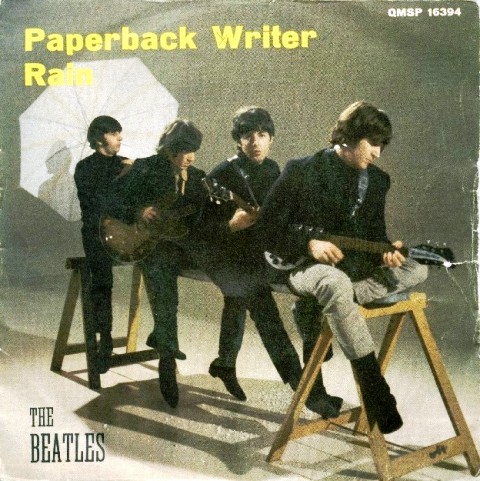
Paperback writer

The first sign of the metamorphosis that was under way in the Beatles’ music came on the group’s first single of 1966, “Paperback Writer” b/w “Rain,” a record that recalled “Can’t Buy Me Love” b/w “You Can’t Do That” in its pairing of songs that matched sharp distinctions of style with close similarities of form. Paul McCartney’s “Paperback Writer” was a satire of pop ambition in the style of “Drive My Car,” set like its predecessor in a musical context of relentless simplicity. Instead of a melody that clamors on one note, the song has a harmony that clamors on one chord, confining itself to long stretches on the tonic relieved by brief forays to the subdominant. This going-nowhere chord progression suggests a harmonic metaphor for unfulfillment that jibes with the lyrics of the song.

Like its budding author-narrator, “Paperback Writer” tries to make the most of its meager resources by heaping an elaborate arrangement on its simple harmonic frame. In the introduction, the song title is triplicated in an a cappella chorale that has Paul, John, and George staggering their entrances like children singing rounds. Their voices invert in a cascade of “writer, writer, writer” as the singers complete their lines, whereupon Ringo comes bolting out of the gate with a beat of almost comic intensity behind a driving, harshly distorted figure on guitar. “Son of Day Tripper” was how Lennon described the song, but the lyric is much wittier than that of the earlier single. There’s a wealth of satiric nuance in the formality of the author’s query on behalf of his “dirty story” with its thinly fictionalized plot and its obsessive dimensions (“a thousand pages give or take a few”). The mangled reference to “a novel by a man named Lear” sounds like a dig at Lennon, whose own paperback writings had drawn comparisons with Edward Lear. But the butt of the joke rests firmly with McCartney himself. He, after all, was the one who wrote the query letters back in the days of the Quarry Men and the Silver Beatles, soliciting work for the band in his most affected grammar-school prose. And the tight fit between the singer and his character helps to drain the condescension from the song. When Paul exclaims the words “Paperback Writer” at the end of every verse, he brings a starry-eyed reverence to this dubious occupational title that almost stands up to the punning counterpoint of “Pay-per-back-er” (sung to the tune of “Frère Jacques”) that John and George provide.

If the words and music of “Paperback Writer” could be said to capture some of the spirit of London in 1966, enlivened by people from all stations of society on the move and on the make, then John Lennon’s “Rain” on the flip side of the single captured the dreamy private languor that formed the flip side of the city’s “swinging” scene. The two tracks are similar in the simplicity of their chord progressions and the fullness of their sound, but the rhythm of “Rain” feels enervated, and the accompaniment eschews the clipped, Mod-like precision of “Paperback Writer” for a more impressionistic wash. Where the one track is a line drawing, the other is a blurry pastel.

In keeping with the allusion to Edward Lear on McCartney’s side of the single, the they who run and hide from the weather in Lennon’s song, the they who “might as well be dead,” resemble the they of Lear’s limericks: “the realists, the practical men, the sober citizens in bowler hats who are always anxious to stop you doing anything worth doing,” as George Orwell once described Them. “Rain” is a postcard from Weybridge, a subversive salutation from the heart of the stockbroker belt. The lyric is more overtly imagistic than in any previous Beatles song, with “rain” and “shine” juxtaposed as mere “states of mind” in a meteorological yin and yang. The accompaniment is more imagistic as well, dominated by droning guitars, long rolls from the drums that rattle through the verses, and lush choral singing in the bridge that fills the air with melismatic sheets of sound: “Ra-a-a-a-a-a-a-a-a-ain—I don’t mind! Shi-i-i-i-i-i-i-i-ine—the weather’s fine!” Another novel element is the treatment of Lennon’s voice, lispy with treble and thickly double-tracked, which seems to be strained through the soup of drums and guitars. “Can you hear me?” John asks in the song’s last intelligible line, introducing a coda in which the drumrolls and the choral voices mingle with an audio hallucination created by rerecording the vocal track backwards. The result is a stream of apparent gibberish that retains the form of speech but reverses the shape of its acoustic “envelope” in a way that suggests another dimension in which time and meaning have turned around.

[Gould, Jonathan. Can’t Buy Me Love: The Beatles, Britain, and America. New York: Harmony Books, 2007. 325-327.]

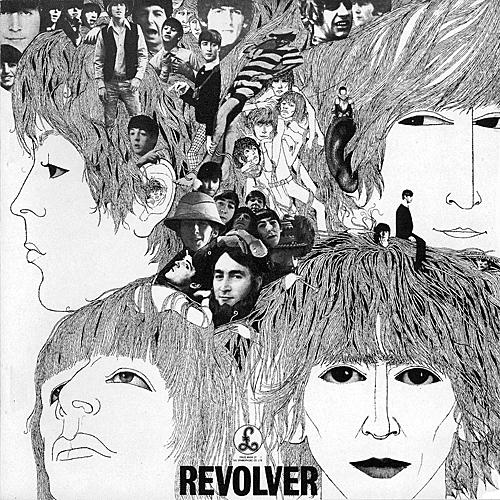
beatles-revolver

From its height of romantic rapture, Revolver next descends to the allegorical depths of the sea. Written by Paul, with help from John, expressly for Ringo to sing, “Yellow Submarine” is by all rights a children’s song, with simple words, simple chords, and a numbingly simple refrain. It is performed in a sing-along manner removed from the context of contemporary pop, sounding more like a throwback to an earlier era of participatory music-making that atrophied—among adults, at any rate—in the era of records and radio. Yet its simplicity and childishness are deceptive, for nothing the Beatles had recorded to date was more dependent on technological sleight-of-hand. “Yellow Submarine” is a simple song transformed by the wonders of multitrack technology into a sophisticated sonic pastiche. In 1966 it stood as a cockeyed monument to the whole self-sufficient and self-absorbed existence the Beatles were creating for themselves at Abbey Road. Sung by anyone else above the age of thirteen, it would have smacked of deliberate camp. But Ringo lacked the vocal resources to be anything but guileless, and he brought to the song the same deadpan quality he brought to the Beatles’ films. In his hands the Yellow Submarine became a satirically updated version of the improbable craft in which Edward Lear put his characters to sea—the Owl and the Pussycat’s pea-green boat, the Jumblies’ unsinkable sieve.

Like “Norwegian Wood,” the song begins by subverting the narrative cliché. “In the town where I was born, lived a man who sailed to sea,” Ringo drones over the strum of an acoustic guitar, “And he told us of his life, in the land of submarines.” Like all good nonsense, the lyrics to the world’s first undersea shanty are based on a single incongruity, taken to its logical extreme: men have been sailing to sea in songs like this for centuries, but not in submarines. The second verse is accompanied by the frothing of the ocean, closing in overhead, while the third competes with a hubbub of conversation, clinking glassware, and jovial bonhomie: “And our friends are all aboard, many more of them live next door / And the band begins to play….” Whereupon a full brass band does just that, shattering the calm of this polite gathering with two bars of booming oompah, which is just enough to conjure the image of tubas in a submarine. Between verses, Ringo stands at the head of a sailors’ chorus, chanting the refrain. There’s also a solo, of sorts, composed entirely of sound effects drawn from the collective unconscious of a generation of schoolboys raised on films about the War Beneath the Seas. Valves squeak, pipes hiss, bells sound, hatches slam, and crisply garbled voices relay terse commands, until the song’s last verse is discharged from this Goonish concerto with the whoosh of a torpedo exiting its tube. Here Ringo is joined by John, who echoes each line in the strained, sardonic voice of an old vaudevillian with the crowd in the palm of his hand. John signs off with a maniacal laugh and the ship’s company falls in for the final refrain, which has taken on an aura of daffy sincerity like some old patriotic number, sung to the tramp-tramp-tramp of marching feet.

[Ibid. 355-356.]

Posted in Edward Lear, Podcasts | Tagged , , , | Leave a comment

“A Master of the Faux Demotic”

Would you believe this is a characterization of Edward Lear?

Miller, Sam. A Strange Kind of Paradise: India Through Foreign Eyes. London: Vintage Books, 2014. 184:

Edward Lear, the English illustrator and poet, a master of the faux demotic and best known for writing nonsense, said after a trip to Agra in 1874, that the world could be divided into two groups of people ― ‘them as has seen the Taj Mahal; and them as hasn’t’. The Taj was firmly on the tourist trail by then, and when, a year after Lear, the future Edward VII popped by, he pointed out, rather wisely, I think that it was commonplace fro every writer ‘to set out with the admissione that [the Taj Mahal] is indescribable, and then proceed to give some idea of it’.

[Note in the same page] Lear’s limericks include Kashmir (‘scroobious and queer’), Madras (‘cream-coloured ass’), Calcutta (‘bread and butter’) but no Delhi ― surely a gift to rhymesters ― or Agra. Lear also wrote a nonsense verse called The Cummerbund: An Indian Poem in which he deliberately misuses every Anglo-Indian word he comes across. It ends “Beware, ye Fair! Ye Fair, beware! / Nor sit out late at night, ― / Less horrid Cummerbunds should come / And swallw you outright.’ A cummerbund is in fact a sash worn around one’s middle, similar in some ways to the Virgin Mary’s girdle.

[Note on pp. 104-105] The Virgin’s girdle was not the corset-like undergarment of moden English innuendo, but a belt or sash, sometimes known as a cincture, or zone in Greek, and said in Mary’s case to have been made of camel hair. As well as the tradition that Thomas received the girdle because he was late getting there [to Palestine to attend the death and assumption to heaven of the Virgin Mary] from India, it’s also said that, as with the resurrection, Thomas doubted what his eyes were seeing ― and that the possession of the Virgin’s girdle convinced him that he wasn’t imagining things. A piece of mary’s cincture is among the relics held at the Monastery of Vatopedi on Mount Athos.

Posted in Edward Lear | Tagged , , | Leave a comment

2015 in review

The WordPress.com stats helper monkeys prepared a 2015 annual report for this blog.

Here’s an excerpt:

The concert hall at the Sydney Opera House holds 2,700 people. This blog was viewed about 29,000 times in 2015. If it were a concert at Sydney Opera House, it would take about 11 sold-out performances for that many people to see it.

Click here to see the complete report.

Posted in Uncategorized | Leave a comment

Edward Lear in Gozo

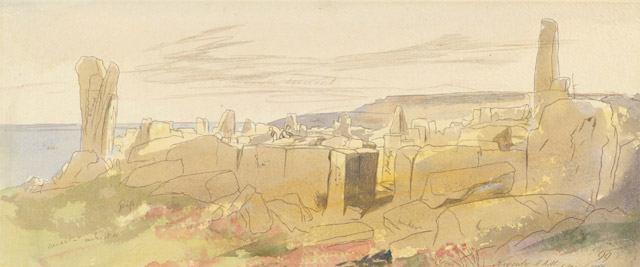
Edward Lear, Below Rabato, Gozo. 20 March 1866, 9.00am n. 193

Edward Lear, Below Rabato, Gozo. 20 March 1866, 9.00am n. 193

A new essay on Edward Lear has been added to the bibliography:

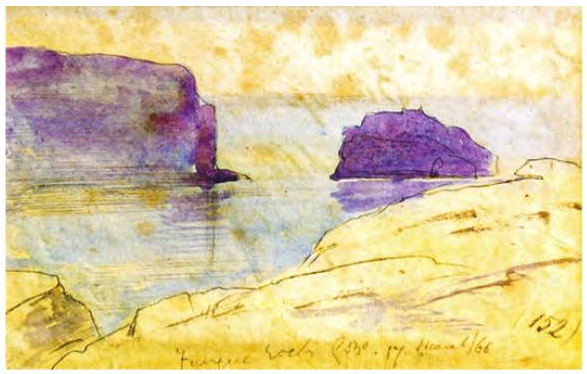
Edward Lear, Fungus Rock, Gozo. 17 March 1866 n. 152.

Edward Lear, Fungus Rock, Gozo. 17 March 1866 n. 152.

Tabone, Joseph Attard. “Edward Lear in Gozo, March 1866.” Every Traveller Needs a Compass: Travel and Collecting in Egypt and the Near East. Eds. Cooke, Neil and Vanessa Daubney. Oxford: Oxbow Books, 2015. 15-21.

Edward Lear, Scklendi, Gozo. 20 March 1866, 11.30 am n. 200.

Edward Lear, Scklendi, Gozo. 20 March 1866, 11.30 am n. 200.

It can be read in full on Google Books (at least here in Italy). Also relevant to Lear and available in full is

Anderson, Sonia P. “Sir John Young, High Commissioner for the Ionian Islands, and His Private Letter Book, 1856–571.” Every Traveller Needs a Compass: Travel and Collecting in Egypt and the Near East. Eds. Cooke, Neil and Vanessa Daubney. Oxford: Oxbow Books, 2015. 1-13.

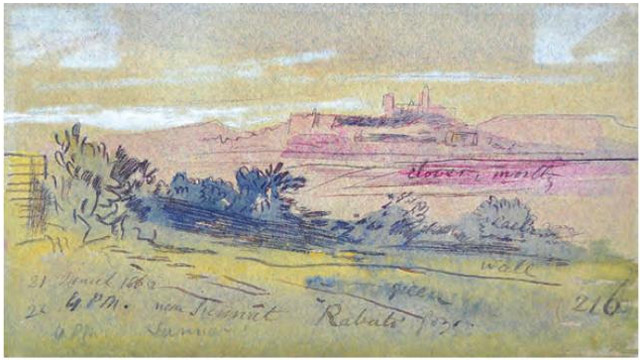
Edward Lear, Near Sannat (Rabato), Gozo. 21 March 1866, 4.00 pm n. 216.

Edward Lear, Near Sannat (Rabato), Gozo. 21 March 1866, 4.00 pm n. 216.

Edward Lear, Near Nadu, Gozo. 23 March 1866, 2.30 pm n. 233.

Edward Lear, Near Nadu, Gozo. 23 March 1866, 2.30 pm n. 233.

Meanwhile, the National Gallery of Victoria has launched its digital collection, which includes six paintings by Edward Lear, one of Krendy, Gozo (n. 99):

EL-Krendi

Posted in Edward Lear | Tagged , , , , | 1 Comment

Syd Barrett and Edward Lear

syd-barrett-ABC

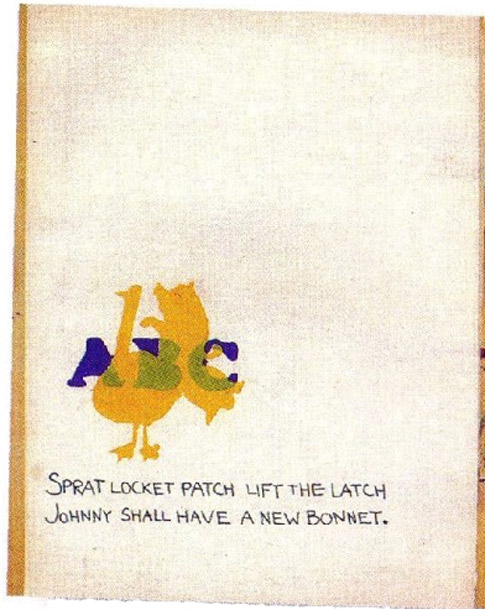
[Syd Barrett’s Fart Enjoy contains] two pages of cut-up nursery rhymes. One reads:

Sprat Locket Patch Lift The Latch.
Johnny Shall Have A New Bonnet

The other reads:

Hark! Jack Was Diddlty Dumpty
All Jolly
To Market To Buy A Plum Cake

The former is accompanied by a drawing of a three-headed creature (turkey, pig and cockerel?) which mimics the style of Edward Lear’s animal grotesques. The letters ABC are stencilled across it – a reference to Cobbing’s recently published ‘ABC In Sound’. The latter is accompanied by a drawing of a rouge-cheeked boy wearing green cap, shorts, sandals and a blue T-shirt.

syd-barrett-J

These cut-ups are composites of eight rhymes: ‘Hark! Hark! The Dogs Do Bark’, ‘Little Jack Horner’, ‘Diddlty Diddlty Dumpty’, ‘We’re All Jolly Boys’, ‘To Market to Market to Buy a Plum Cake’, ‘Lucy Locket Lost her Pocket’, ‘Cross Patch Draw the Latch’ and ‘Johnny Shall Have a New Bonnet’. Syd took these rhymes from Kate Greenaway’s illustrated Mother Goose anthology, where they comprise eight of the first twelve rhymes in the book.

The first edition of Greenaway’s pocket book was published in 1881 and contained fifty-four pages of colour chromolithograph illustrations and rhymes. It ran into numerous reprints. Many households of Syd’s generation would have had one of the many Mother Goose anthologies that had been in circulation since folklorists began collecting nursery rhymes during the Victorian era. These rhymes, frequently dark and macabre in tone, and the lavish illustrations that accompanied them, burned their way into many a young child’s imagination. Nursery rhymes in general, and the Mother Goose rhymes in particular, were integral to Syd’s development as a songwriter. His use of them in the Fart Enjoy booklet gives us the first indication of the centrality of childhood motifs to his work, and they would become a common thematic thread in his lyrics for Pink Floyd. The way they are utilised in Fart Enjoy suggests that Syd, transforming whatever materials he had at his disposal and working, as Andrew Rawlinson put it, ‘in the immediate context’, was now beginning to develop a highly inventive approach to language to match the sophisticated touch and technique of his painting. There was nothing rigorous or methodical about it. Syd simply used whatever was available, in this instance a pocket book of nursery rhymes, and deconstructed it.

[Chapman, Rob. A Very Irregular Head: The Life of Syd Barrett. Cambridge, MA: Da Capo Press, 2010. 63-65. Google Books.]

‘You’ve gotta look at Cambridge really; you’ve gotta look at Lewis Carroll and Edward Lear, more than the lifestyle thing,’ says Pete Brown of Syd’s influences. ‘Maybe it’s inspired by people like Rimbaud and Verlaine and people like that, but I think the English fringe thing is more to do with it, always has been. Language, lateral thinking, looking at the weirdness of British existence, looking at rural or semi-rural peculiarities.’

No account of Syd Barrett’s creative blossoming can take place without examining these earliest and most enduring influences. The lives and works of Edward Lear (1812-88), Charles Dodgson, aka Lewis Carroll (1832-98), Kenneth Grahame (1859-1932) and Hilaire Belloc (1870-1953) form a thematic framework within which Syd’s initial flowering as a songwriter can be contextualized and understood. The songs that were overtly influenced by Belloc, Grahame et al. only constitute a very small body of his oeuvre but these are the songs for which he is best known and on which his reputation as a songwriter largely rests.

‘The English Robin and Puck and Goodfellow thing. The slightly whimsical faery quality that he had,’ notes Emily Young. ‘It’s from the English folk tradition, but not the English workingman one. You’re not quite sure if he will appear or disappear. More of the Irish and Celtic and less of the Germanic. Something of “the trees have secrets”. I think he was absolutely in touch with that.’

As Emily Young suggests, Syd was very precise in his absorption of childhood literature. There is nothing of the Germanic or Norse tradition, no Hans Christian Andersen, no Aesop, no Brothers Grimm and, despite what some have suggested, little or no Tolkien either. He draws very directly upon Belloc, Grahame, Lear and Carroll, and little else but the merest hint of C.S. Lewis and the found material he plundered from a few nursery rhyme pocket-books.

[Ibid. 143-144.]

Edward Lear created a fascinating nonsensical cosmogony of human, animal and plant life, populated by such creatures as the Jumblies, the Quangle Wangle, the Pelican Chorus, the Akond of Swat and, perhaps most famously, the Dong with the Luminous Nose. He wrote nonsense botany, nonsense recipes, nonsense limericks and nonsense songs and constructed an entire nonsense alphabet.

John Lennon was clearly the pop world’s most obvious descendant of Lear. The characters that populate his books John Lennon in His Own Write (1964) and A Spaniard in the Works (1965), such as Eric Hearble, Treasure Ivan, the Wumberlog and Mr Boris Morris, as well as the language that describes them and the sketches that accompany them, are highly reminiscent of Lear. Although the influence was never as overt in Syd’s work (his influences rarely were), he exhibited the same sense of playful absurdity.

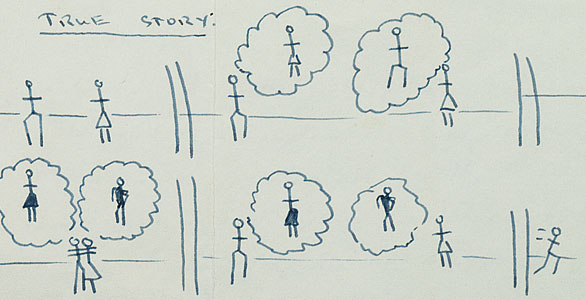
Syd’s letters to Libby crackle with the same kind of offbeat wit and invention that characterised much of Lear’s own correspondence. Often Syd is undeniably juvenile ― e.g. a drawing of a limbless man sunbathing is accompanied with the caption ‘Don’t disturb him, he’s quite armless’ ― but then so is much of Lear’s work. Documenting his travels through the Scottish Highlands with his friend Phipps Hornby in 1841 Lear drew a series of bizarre illustrations depicting the two men cramming huge game birds into their knee-high boots (‘P & L being hurried insert the remains of their lunch in their boots’) and Lear being comically poked in the eye by a brush-wielding child (‘L ― on ascending the cabin stairs ― nearly loses his eye by the abrupt and injudicious promission of a new broom in the hands of a misguided infant’). Syd sent Libby illustrations depicting, among other things, a stick man carrying a huge sausage above his head (‘sausage thief running’) being pursued by another stick man (‘copper ― whistle note (G#)’). Another drawing, captioned ‘ A retch [sic] goes to school with his paints in a box while all sleep and are not bothered’, is pure modern-day Lear in its lyrical inventiveness.

I could not find a decent image of the stickman running away with a sausage, so here's another "sticky" picture story, cf. here.

I could not find a decent image of the stickman running away with a sausage, so here’s another “sticky” picture story, cf. here.

Syd even walked like a Lear illustration. As biographer Vivien Noakes noted, many of Lear’s drawings were suffused with ‘a sense of movement ―the arms are flung spontaneously back like bird’s in flight and the legs stride out or stand poised expectantly on tip-toe as if they are going to be spun round like a child’s top’.

Like Lear, Syd would populate his lyrics with imagery drawn from botany, zoology and nature. Lear and Carroll influenced the clarity of his lyrics too, and, of course, a key chapter in Kenneth Grahame’s Wind in the Willows, ‘The Piper at the Gates of Dawn’, where Rate and Mole embark upon a mystic odyssey downriver and encounter the great god Pan, provided the title of the first Pink Floyd LP. Interestingly enough, Grahame only wrote the ‘Piper’ and ‘Wayfarers All’ chapters in the book almost as an afterthought, in order to give the book its mystic dimension. Coincidentally Syd only named Pink Floyd’s debut LP at the last minute. The album’s working title right up until July 1967 was Projection.

[Ibid. 147-149.]

Posted in Edward Lear, Nonsense Lyrics | Tagged , , , | 1 Comment

Nonsense Programmes

As usual for the Christmas period, the BBC has a few Nonsense-related programmes you can listen to while still available on iPlayer Radio:

Drama of the Week, which you can download as a podcast, is Jeremy Iron’s reading of T.S. Eliot’s Old Possum’s Book of Practical Cats (this was first broadcast on 25 December in two parts).

Lewis Carroll’s The Hunting of the Snark was the Drama for Chrismas Day at 14:15, narrated by Tony Robinson with music by Katie Chatburn, Dorry Macaulay, Kathryn Williams, Stephen Cordiner and Jasper Wilkinson.

On the same day, Words and Music has “Sheila Hancock and Scott Handy read poems and prose on the festive theme of giving and receiving gifts. Through the words of writers from Robert Herrick to O. Henry, and from Edward Lear to Walt Whitman.” Actually, only one Lear limerick (There was an Old Man in a Pew, around 37:00) is read by Scott Handy with a nice music box accompaniment (Angel Polka).


The Finest Nonsense (Lear read by Jacobi)

If you want a decent amount of Lear, Naxos has just published Sir Derek Jacobi’s reading of The Finest Nonsense by Edward Lear (listing of poems from Naxos’s website): you can get it for free with an Audible trial.

Posted in Edward Lear, Lewis Carroll, Podcasts | Tagged , , , | 2 Comments

Benjamin Rabier’s Bullets

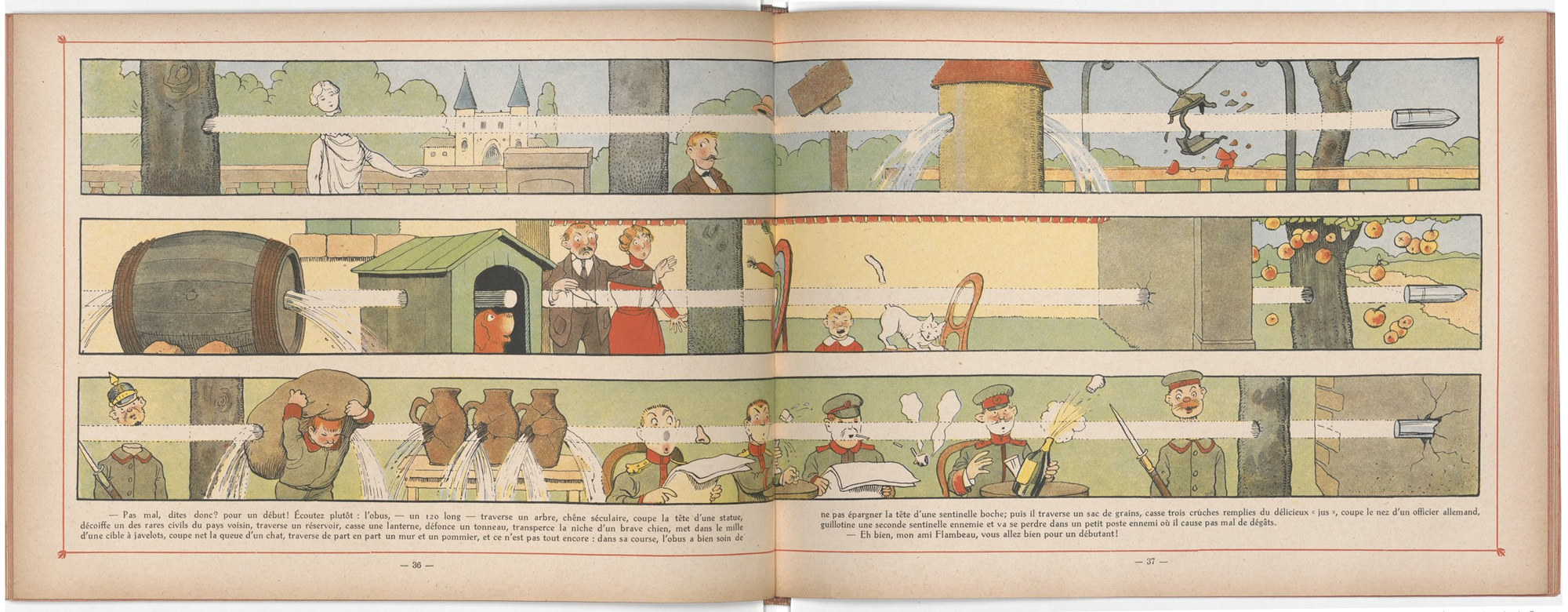
Antoine Sausverd of Töpfferiana has a very interesting post on a pair of strips by Benjamin Rabier which appear to have been influenced by Peter Newell: “Trajectoire,” a single-page story from La Jeunesse illustrée (no. 700, 11 February 1917) follows the route of a bullet through twelve panels.

Even more interesting, and much more stylish, is the use of the same idea in two facing pages (36-37) of the previous year’s album Flambeau Chien de guerre (Tallandier, 1916):

rabier2

There can be little doubt that these were influence by Peter Newell’s Hole Book (1908) and Rocket Book (1912); and how could Rabier have come to know of these books? Probably through Alfred Z. Baker who, after eloping with Newell’s daughter to France, contributed to the same children’s magazine Rabier was working for, La jeunesse illustrée, a series of “Images à renversement” in 1906-07.

Another essential post on Rabier’s use of formal constraints in his strips (his “expériences oubapiennes” as Sausverd calls them).

To celebrate this finding I have added a gallery to nonsenselit.org reproducing the whole Torn Book, another toy book published by Baker in 1913. In this one, part of each page is torn, showing a portion of the image on the next page, which completes the picture

tornbook

Rabier’s Flambeau, chien de guerre is available in full at Gallica.

Posted in Comics, Peter Newell | Tagged , , , , | Leave a comment

John Ashbery, Tuesday Evening (1995)

In case after reading yesterday’s “The Dong with the Luminous Nose” you were wondering, like me, what “a long nonsense poem” by John Ashbery looked / sounded / felt like, here is

Tuesday Evening

She plundered the fun in his hair.
The others were let go.
There was a wet star on the stair.
Upstairs it had decided to snow.

Not everyone gets off at this stop
the turtlelike conductor said.
If you’d like to hear those beans hop
it could be arranged in your head.

Now from every side, cheerleaders
and their disc-eyed boyfriends come.
The latter put up bird feeders.
Birds alight on them and are dumb

with anticipation of the meal.
The punishment is not due
in our time said the wise old eel.
Its overture is still distant in the blue

sign of a vacant factory. You’ll know
when it starts up. Darn! That’s what I thought
it would be, I said. Isn’t there a hoe
somewhere to root these weeds out?

Or a chair on a blanket
of a manor house in time
and shouldn’t we somehow thank it
for the perfection of the climb?

Straight over roads, in culottes
the marching women go. Why besmirch
that casket, choose fleshpots
over a stand of young birch?

The veranda failed to make an impression,
ditto the lavaliere.
Potted ferns have become my obsession,
waltzing under the chandelier.

No one weeps to me anymore.
Then up and spake greengrocer Fred:
“Time and love are a whore
and after the news there is bed

to take to. Don’t you agree?
It’s lonely to believe, but it’s half
the fun. Here, take a pee
on me, but over there by that calf.”

The things we thought of naming
are crystals now. You can see from the porte cochere
now a small business flaming,
now the besotted rind of some pear.

It all seems ages ago—that time
of not being able to choose
or think of a rhyme
for “so many books to peruse

until the body is done.” A chicken
might pass by and never notice
us standing pale as a mannequin,
clutching a fistful of myositis

as though this would matter some day to some lover
when the time was ripe and our mooring
had been sliced. Then it would be time to rediscover
a plashing that would seem more alluring

for being ancient. You see, the past
never happened. Nothing can survive long in its heady
embrace. Our memories are a simulcast
of lost conventions, already

drowning in their sleep. In some such
wise we outgrew ourselves, lianas
over lichen. Forasmuch
as sweetness comes to the nicotianas

only at evening, your arrangement is overbred,
threadbare. You may want to think about this
a little. Down in their pavilion, whose overfed
airs waft lightly, naughtily, Dad and Sis

are waving, calling your name, over
and over again. But it’s like a wall of veil
tipped in. We can dance only alone. Rover
senses an advantage—it’s the Airedale

from the next block again. To keep even the peace
sounds extraneous, now. How many senses
do we need? Our motives predecease our
cashing them in. Fences

will be happy to relieve you of that icon
for a small consideration. And you,
what about you? Slowly unraveling, the chaconne
sizes us up: right pew,

wrong church. O if ever the devil
comes to claim his due, let it be after
the touching ceremony, yet before the revel
becomes frenzied, and ambitions turn to laughter.

Resist, friends, that last day’s dying.
The melodious mode obtains. Always
remember that. At trying
moments, practice the art of paraphrase.

Just because someone hands you something of value
don’t imagine you’re in it for the money.
You can always tell a gal-pal you
prefer the snakeroot’s scented hegemony.

Or go for a walk. It counts too.
In my charming madness I dress plainer
than when they used to mispronounce you,
but what’s correct streetwear in N’Djamena

clashes in the old upstate classroom.
Come, we’re weak enough to share a posset,
divide with the boys another hecatomb.
All other rodomontades are strictly bullshit.

Such are the passwords that tired Aeneas
wept for outside the potting shed,
when, face pressed to the pane, he sought Linnaeus’
sage advice. And the farm turned over a new leaf instead.

We can’t resist; we’re all thumbs, it seems,
when it comes to grasping mantras.
The oxen are waiting for us downstream; academe’s
no place for botanizing; the tantra’s

closed to us. Song and voice, piano and flowers,
abduct us to their plateau.
Look—becalmed, a horse devours
buttercups in the ruts by an old château.

If this is about being regal, it must be Japan
has assented. Let’s take the vaporetto
to where it goes. A sea cucumber of marzipan
promises decorum. The boatman quaffs Amaretto.

Well, and this is the way I’ve always done it. A fricative
voice from this valley wants to think so. Those jars of ointment
are still untouched. Were patients always so uncommunicative?
Even Jeremy? He’s late for his appointment,

and I must go down an inclined plane
to the city’s anthill, with only dissolved rage
for company. And should some perdurable chatelaine
gain control over the police, must we summon the archimage

to bandage the hurt? Only a little moisture
remains at the tip of the tongue, a pro forma
signal of engagement. Before the great rupture,
still a duo, we sang the “Casta Diva” from Norma

on Sunday morning. Now all’s retrograde;
the new openness cloys. Pencils are to sharpen,
yet I keep mine dull. My cockade
is tarnished, my dress puny, my shoes of cordovan

behind the bed. Sometimes I like to ride in a carriage,
over dales and downs. My fiancée is a lacrosse player.
When the moon is full one’s in the mood for marriage,
amiable for a while. But the village soothsayer

warned us against it, of dreary days to come
unless we interacted on a vast scale. And who can predict
furtive new developments? Because we’d swum
the Hellespont long ago, in our youth, we assumed the verdict

would be sealed by now. And you know, only anonymous
lovers seem to make it to the altar. The rest are branded
with a time and place, and rarely know each other. The eponymous
host of the Bridge and Barrel, a moralist, was openhanded,

yet nothing could bar the tear from one blue eye. He’d chattered
vainly till now. So I assumed the aggressor’s fate.
Behind the door crockery clattered
mysteriously, the beadle was stunned, the boilerplate

contract wilted in the intense heat
of the deluged afternoon. Even when the tumbrel
arrived, it seemed it would have to wait
for the century to catch up. Meanwhile, in the adumbral

hall not a whistle could be heard, no screams, no catcalls,
unless you counted the willows’ sobbing.
Evening came on boisterous. Pirouettes and pratfalls
were executed before an admiring crowd. Demons were hobnobbing

with whatever entered on skis. To have proffered
only this was sublimely sufficient. But what of cattails
loosing seeds on the air like milkweed? A scoffer’d
not turn away, just this once, for what prevails

is most certainly what will be current
years from now: celadon pods with opal juices
oozing from them. Fruits of the sand, blackcurrant
and bayberry, and a crowd of mild smiles, a burnoose’s

wandering cord. When needed to combat flatulence,
the correct pills turn up in pairs. I mistook embroidery
in the stair carpet for something else, the doll’s petulance
for a sign from the heavens. The whole darn menagerie

is after me now; I have strength for but one curtain call,
and that a swift one. But will the critics
recite my reasons? Luckily a landfall
materialized in the nick of time. Luckily my desire wasn’t great. Politics

overwhelms us all. In seasons of strife we compose palinodes
against the breakers, retracting what was lithe
in our believing. By evening, its heresy implodes
under an August moon; repercussions writhe

in a context of mangroves. Perfervid scroungers
invade the Catalog Fulfillment Center, diverting the sick energy
in our wake into easeful light, and day. A few loungers
on the mezzanine are puzzled, but most are not. The ambient lethargy

incises its monogram on the walls of bathhouses, in wooden
tunnels: To wit, man plays a role in his conspiracy,
ergo, he cannot be a victim. After a sudden
denouement, the climate again turns bland; its apostasy

was too minute to register on God’s barometer.
Only an occasional letter to the Times
hinted that a change might have occurred.
Otherwise it was beau fixe on the speedometer

as it raced toward clayey lands with windmills
and similar giddy appurtenances. From far,
from night and morning, innovations arrive in schools, whippoorwills
are calling. The Circolo Italiano welcomes new adherents, a streetcar

bearing members of the Supreme Court floats in the sky like a zeppelin.
It was all over in a trance. Now it’s the fiction
weighs us down, an iron corset. Adrenaline
is channeled into new, virtuoso ways, wherein constriction

is viewed as normal, soothing as an antimacassar.
Better to live in a fictive aura, I say, than putter
in one’s garden forever, praying to NASA
at dusk, as in Millet’s Angelus, closing a shutter

on substantive dreaming. That, after all, is where we’re
at. It is time for the rebuilding of melody
on a grand scale. Reread Shakespeare; a fakir here
and there won’t sabotage the kernel of parody

baked into the airiest ontological mille feuilles, nor change that gold
back into straw. The medicine men knew what they were doing when
they lanced boils with direct imaging. Charm gained a foothold,
then exploded into bronze deities. No matter, the regimen

practiced by the ancients, i.e., inhaling
dust and air near a body of water, is still around to restore
lost fossils of wit to their living, vibrant selves, unveiling
a menu both familiar and alluring. Before

quitting this backdrop of a Renaissance piazza, open
your body and mind to all comers. They are both factory and garden
to the happy few, thunderstorms to some, a dull weapon
though fierce, to others. And as attitudes harden,

the lost light stares as a man in pajamas
crosses the ravaged street. All this decision-making entails
sophomoric stunts and impatience. From the Bahamas
to Torquay stretches the dun pilgrimage. Cocktails

infiltrate it, but the man knows he must go
just so far and stop, that his beloved will have forgotten
him by then. He must choose the stars or the snow,
a naked stick figure. All the rotten

things that can befall a man with a comb and toothbrush
already happened to him, leagues ago. And there is no ending
it. Yet the past is profitless slush,
same as the present. Tomorrow is on hold, pending,

and great lizards infiltrate the Dalmatian-spotted
sky. Was it for this you gave yourself up
to some cause or other, that has now trickled away, dotted
with colored pom-poms? Only a final hiccup

sits on the step, awaiting orders. You were wrong about language,
see. Its arrows are raining down like ejected porcupine
quills. An archer (Robin Hood, for instance) could gauge
the correct distance between identical hummocks. Which is fine

with me, except I don’t think anybody’s going to notice
the directive that brought you here. Best to marshal the
secondary promptings and forget the awful journey before rigor mortis
sets in. You mean it hasn’t? Right. Then I’m still in the Marshalsea,

my dependency shall never cease! And there’s a kind of happiness,
though a bitter one, in that. I’m going to cash in my chips
and quit while I’m winning. The loveliness
of statues of statesmen survives, a barcarole drips

from their sagging jaws, graphic as springtime.
In twos and threes, peasants
vanish behind yon ridge. The celestial pantomime
engulfs them slowly. The pheasants

of our kingdom aren’t as plump as yours. No matter.
I’ll wager a microclimate’s responsible. And did your sister
ever loan you those three bucks? No, the regatta
closed down while we were still ogling its pinnaces, and a twister

slashed through at that precise moment, there was nowhere
to hide, in the confusion we got separated.
Now I must arise and go where
the flying fishes play, and poppies perplex the cultivated

plain. Go ahead, I’ll keep an eye on things, you can breathe
easy. It’s what I had in mind: a sail printed all over
with musical staves. I would unsheathe
love’s whippet and embrace us all, even if Rover

never growled again. “Springs, when they happen, happen elsewhere.
A certain sexiness …” ventured the prince. But where, oh where, is the nectar
that makes babes of us? Our printout’s in disrepair,
the parterres are fading, and the projector

is spinning out of control. Half a hundred youths
could sustain us, swimming in the moat
with reeds to breathe through. The emptied booths
by the front gate are cheerless indeed. A stoat

swept by me on the waters, halfway to refurbished oblivion,
but my antennae suggest nothing apposite
to formalize his trajectory. A safe-conduct from the Bolivian
chargé d’affaires flutters in the breeze of my room. In the windows opposite,

a massacre is reflected. Is it meant as codicil,
or mere free-form tangling? Anyway, night is serendipitous
again; swallows clutter my windowsill;
bats are executing stately arabesques. A precipitous

slide into belief must have occurred recently, but left no earnest
of its passing. A videotape of sports bloopers
keeps unreeling, determined to rescue its syllabus from the furnace
of eternity; airheads are treated roughly. One of those Victorian peasoupers

is equalizing everything, titmouse and pterodactyl
alike. When it will be the fashion again we’ll have trochees
galore. Even the bellicose double-dactyl
will flourish for a time, in Okefenokees

of subjectivity. Lakes will overflow, bargain
counters shrivel to nothing, the Great Bear look away, brittle
talismans explode at dormer windows. The degradation Ruskin
warned against is back, a heap of frozen spittle.

We see one thing next to another. In time they get superimposed
and then who looks silly? Not us, as you might think, but the curve
we are plotted on, head to head, a parabola in the throes
of vomiting its formula, piqued by the sullen verve

of day, while night is siphoned off again. And as wolverines
prefer Michigan, so this civil branch of holly is nailed to your door, lest you
fear my coming, or any uncivil declaiming, or submarines
in the bay that spreads out before us, or any gumshoe.

We’ll party when the millennium gets closer. Meanwhile
I wanted to mention your feet. A dowser
could locate your contentedness zone. But where have you been while
folk dancing broke out, and colorful piñatas, waking Bowser

in his kennel, rendering the last victuals in
the larder unappetizing? Yet those feet shall impose the glory
of my slogans on the unsuspecting world that belittles
them now, but shall whistle them con amore

anon. That doesn’t mean “peace at any price,”
but a shaking-down of old, purblind principles
that were always getting in the way. Self-sacrifice
will be on the agenda, a lowering of expectations, a ban on municipal

iron fences and picnics. Man must return to his earth,
experience its seasons, frosts, its labyrinthine
processes, the spectacle of continual rebirth
in one’s own time. Only then will the sunshine

each weekday lodges in its quiver expand till the vernal
equinox rounds it off, then subtracts a little more each day,
though always leaving a little, even in hyperboreal climes where eternal
ice floes fringe the latitudes. On a beautiful day in May

you might forget this, but there it is, always creeping up on you.
Permit me then for the umpteenth time to reiterate
that basking in the sun like an otter or curlew
isn’t the whole story. Tomorrow may obliterate

your projects and belongings, casting a shadow longer than the equator
into your private sector, to wit, your plan to take a Hovercraft
across the lagoon and have lunch there, leaving the waiter
a handsome tip. For though your garrison be fully staffed,

the near future, like an overcrowded howdah,
trumpets its imminent arrival, opens the floodgate
of a thousand teeming minor ills, spoiling the chowder
and marching society’s annual gymkhana, letting in smog to asphyxiate

palms and eucalpytuses. One paddles in the backwash of the present,
laughing at its doodles, unpinning its robes,
smoothing its ribbons, and lo and behold an unpleasant
emu is blocking the path; its one good eye probes

your premises and tacit understandings, and the outing
is postponed till another day. Or you could be reclining
on a rock, like Fra Diavolo, and have it sneak up on you, spouting
praise for the way the city looks after a shower, divining

its outer shallows from the number of storm windows
taken down and stashed away, for it has the shape of a sonata—
bent, unyielding. And, once it’s laid out in windrows,
open to the difficult past, that of a fish on a platter.

Expect no malice from it and freshets
will foam, gathering strength as they leapfrog the mountain.
But a quieter realism plumbs the essence of ponds, as nitwits
worship the machine-tooled elegies of the fountain,

that wets its basin and the nearby grass. In a moment the dustmen
will be here, and in the time remaining it behooves
me to insist again on the lust men
invent, then cherish. But since my mistress disapproves,

I’ll toe the line. And should you ask me why, sir,
I’ll say it’s because one’s sex drives are like compulsive handwashing:
better early on in life than late. Yet I’m still spry, sir,
though perhaps no longer as dashing

as in times gone by, and can wolf down the elemental
in one gulp—its “How different one feels after doing something:
calm, and in a calm way almost tragic; in any case far from the unwholesome
figure we cut in the reveries of others, a rum thing

not fit to be seen in public with.” Yet it is this ominous bedouin
whose contours blur us when someone glimpses
us, and is what we are remembered as, for no one can see our genuine
side falling to pieces all down our declamatory gestures. They treat pimps as

equals, ignoring all shortcomings save ours. And of course, no commerce
is possible between these two noncommunicating vessels of our being. As urushiol
is to poison ivy, so is our own positive self-image the obverse
of all that will ever be said and thought about us, the vitriol

we gargle with in the morning, just as others do. This impasse
does, however, have an escape clause written into it: planned
enhancements, they call it. So that if one is knocked flat on his ass
by vile opprobrium, he need only consult his pocket mirror: The sand

will seem to flow upward through the hourglass; one is pickled
in one’s own humors, yet the dismantled ideal
rescued from youth is still pulsing, viable, having trickled
from the retort of self-consciousness into the frosted vial

of everyone’s individual consciousness noting it’s the same
as all the others, with one vital difference: It belongs to no one.
Thus a few may climb several steps above the crowd, achieve fame
and personal fulfillment in a flaring instant, sing songs to one

more beloved than the rest, yet still cherish the charm and quirkiness
that entangle all individuals in the racemes
of an ever-expanding Sargasso Sea whose murkiness
comes at last to seem exemplary. So, between two extremes

hidden in blue distance, the dimensionless
regions of the self do have their day. We like this, that,
and the other; have our doubts about certain things; enjoy pretension less
than we did when we were young; are not above throwing out a caveat

or two; and in a word are comfortable in the saddle
reality offers to each of her children, simultaneously
convincing each of us we’re superior, that no one else could straddle
her mount as elegantly as we. And when, all extraneously,

the truth erupts, and we find we are but one of an army of supernumeraries
raising spears to salute the final duet
between our ego and the endlessly branching itineraries
of our semblables, a robed celebrant is already lifting the cruet

of salve to anoint the whole syndrome. And it’s their proper
perspective that finally gets clamped onto things and us, including
our attitudes, hopes, half-baked ambitions, psychoses: everything an eavesdropper
already knows about us, along with the clothes we wear and the brooding

interiors we inhabit. It’s getting late; the pageant
oozes forward, act four is yet to come, and so is dusk.
Still, ripeness must soon be intuited; a coolant
freeze the tragic act under construction. Let’s husk

the ear of its plenitude, forget additional worries,
let Mom and apple pie go down the tubes, if indeed
that’s their resolve. For, satisfying as it is to fling a pot, once the slurry’s
reached the proper consistency, better still is it to join the stampede

away from it once it’s finished. Which, as of now,
it is. Wait a minute! You told us eternal flux
was the ordering principle here, and in the next breath you disavow
open-endedness. What kind of clucks

do you take us for, anyway? Everyone knows that once something’s finished,
decay sets in. But we were going to outwit all that. So
where’s your panacea now? The snake oil? Smoke and mirrors? Diminished
expectations can never supplant the still-moist, half-hesitant tableau

we thought to be included in, and to pursue
our private interests and destinies in, till doomsday. Well, I
never said my system was foolproof. You did too! I did not. Did too!
Did not. Did too. Did not. Did too. Hell, I

only said let’s wait awhile and see what happens, maybe
something will, and if it doesn’t, well, our personal
investment in the thing hasn’t been that enormous, you crybaby;
we can still emerge unscathed. These are exceptional

times, after all. And all along I thought I was pointed
in the right direction, that if I just kept my seat
I’d get to a destination. I knew the instructions were disjointed,
garbled, but imagined we’d eventually make up the lost time. Yet one deadbeat

can pollute a whole universe. The sensuous green mounds
I’d been anticipating are nowhere to be seen. Instead, a dull
urban waste reveals itself, vistas of broken masonry, out of bounds
to the ordinary time traveler. How, then, did he lull

us, me and the others, into signing on for the trip?
By exposing himself, and pretending
not to see. Solar wind sandpapers the airstrip,
while only a few hundred yards away, bending

hostesses coddle stranded voyagers with canapés
and rum punch. To have had this in the early stage,
not the earliest, but the one right after the days
began to shorten imperceptibly! And one’s rage

was a good thing, good for oneself and even
for others, at that critical juncture. Dryness
of the mouth was seldom a problem. Winking asides would leaven
the dullest textbook. Your highness

knows all this, yet if she will but indulge
my wobbling fancies a bit longer, I’ll … Where was I? Oh, and then
a great hurricane came, and took away the leaves. The bulge
in the calceolaria bush was gone. By all the gods, when

next I saw him, he was gay, gay as any jackanapes. Is
this really what you had in mind, I asked.
But he merely smiled and replied, “None of your biz,”
and walked out onto the little peninsula and basked

as though he meant it. And in a funny kind of way, the nifty
feeling of those years has returned. I can’t explain it,
but perhaps it means that once you’re over fifty
you’re rid of a lot of decibels. You’ve got a tiger; so unchain it

and then see what explanations they give. Walk through
your foot to the place behind it, the air
will frizz your whiskers. You’re still young enough to talk through
the night, among friends, the way you used to do somewhere.

An alphabet is forming words. We who watch them
never imagine pronouncing them, and another opportunity
is missed. You must be awake to snatch them—
them, and the scent they give off with impunity.

We all tagged along, and in the end there was nothing
to see—nothing and a lot. A lot in terms of contour, texture,
world. That sort of thing. The real fun and its clothing.
You can forget that. Next, you’re

planning a brief trip. Perhaps a visit to Paul Bunyan
and Babe, the blue ox. There’s time now. Piranhas
dream, at peace with themselves and with the floating world. A grunion
slips nervously past. The heat, the stillness are oppressive. Iguanas …

From Can You Hear, Bird (1995).
Posted in Nonsense Lyrics | Tagged , | 2 Comments