Edward Lear, Albe (1844)

el_albe-s

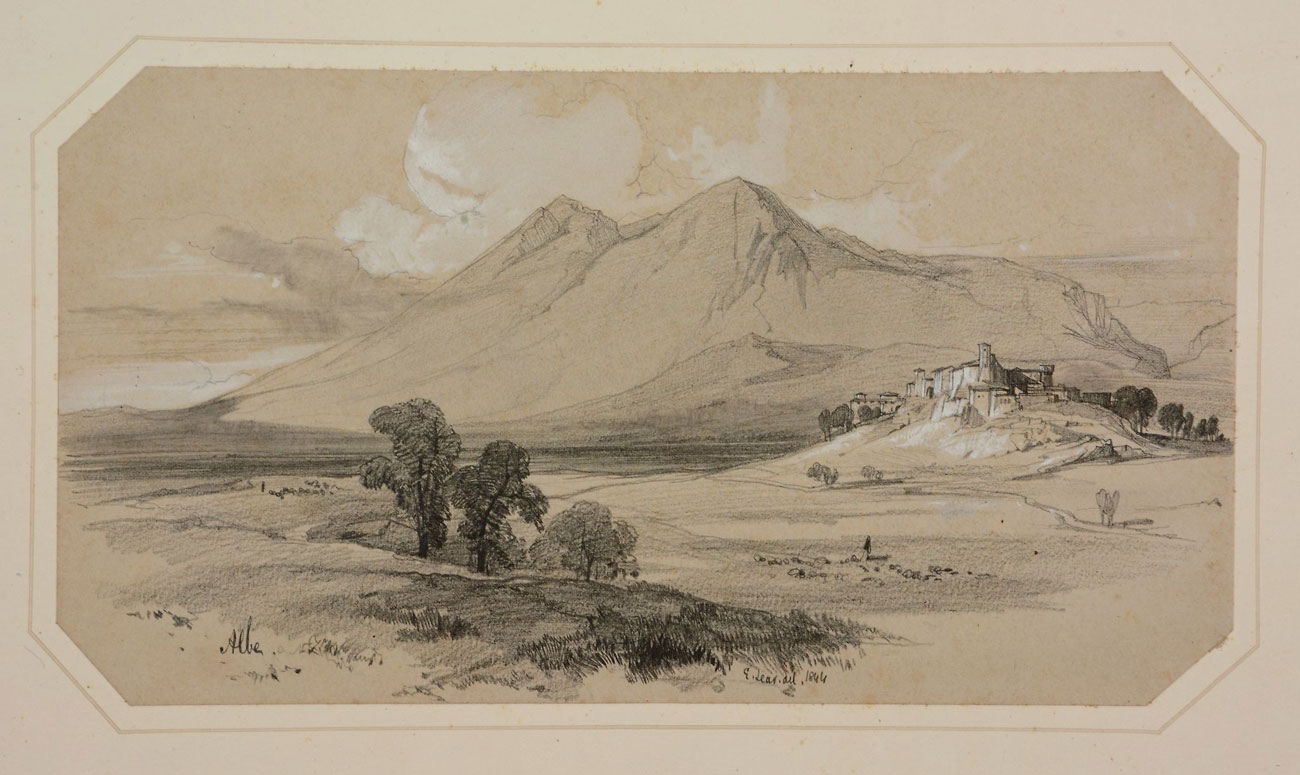
Edward Lear, Albe, 1844.

Black chalk, pencil, grey wash, heightened with white, on light buff paper. Signed and dated 1844 lower right, inscribed Albe lower left. 14 x 26 cm. (5 1/2 x 10 1/4 in), corners trimmed.

Provenance:
John Scandrett Harford (1787-1866); thence by descent to the present owner.

Engraved:
Edward Lear, Illustrated Excursions in Italy, 1846, plate 17

“Two afternoons I devoted to visiting Alba, the ancient Alba Fucinensia, which stands on a double hill, about two miles only from Magliano, though the walk thither across the plain, covered with stones, is as fatiguing as treble the distance on a decent road”. [op.cit., 1846, p. 70]

Bloomsbury.

Posted in Edward Lear | Tagged , , , , | Leave a comment

Edward Lear, Antrodoco (1844)

el_antrodoco-s

Edward Lear, Antrodoco, 1844.

Black chalk, pencil, heightened with white, on light blue paper. Signed and dated 1844 lower left, inscribed Antrodoco lower right. 13 x 18 cm. (5 1/8 x 7 in).

Provenance:
John Scandrett Harford (1787-1866); thence by descent to the present owner.

Bloomsbury.

Posted in Edward Lear | Tagged , , , , | Leave a comment

Edward Lear, Santa Maria di Luco (1844)

el_luco-s

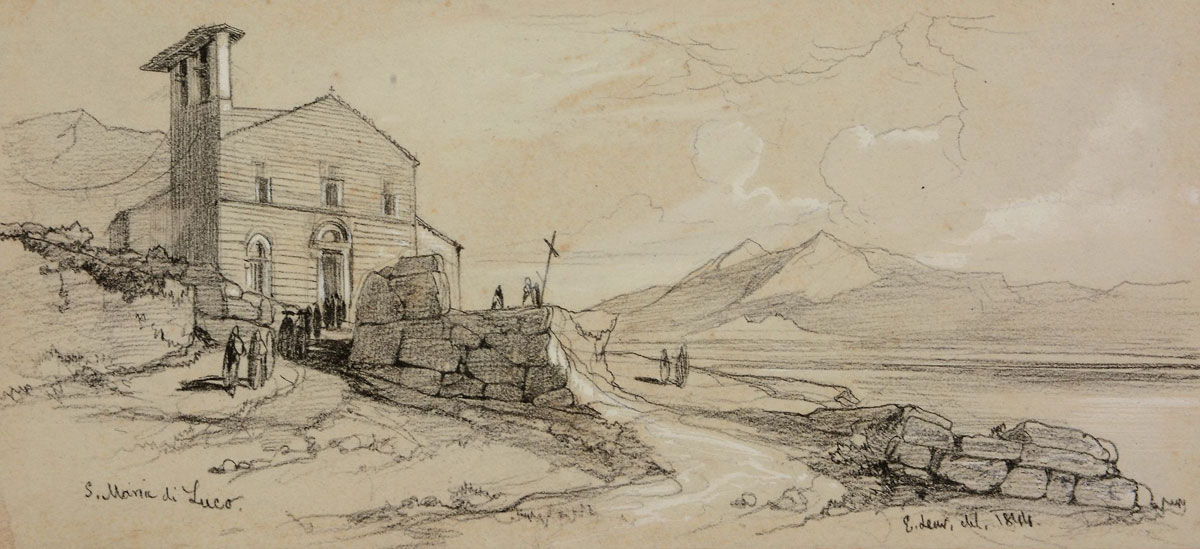
Edward Lear, Santa Maria di Luco, 1844.

Black chalk, pencil, heightened with white, on light grey paper. Signed and dated 1844 lower right, inscribed S. Maria di Luco lower left. 9.5 x 20 cm. (3 3/4 x 7 7/8 in).

Provenance:
John Scandrett Harford (1787-1866); thence by descent to the present owner.

Engraved:
Edward Lear, Illustrated Excursions in Italy, 1846, pl. 5

” … we were well pleased with the beautiful view of the Lake, and the group of Alba and Velino, now diminished by distance, yet forming a fine back-ground to the picturesque church and walls.” [op. cit., Lear, 1846, p. 21].

Bloomsbury.

Posted in Edward Lear | Tagged , , , , | Leave a comment

Edward Lear, Buon Ricovero & Villa Cesia (1843)

el_buon-ricovero-s

el_villa-cesia-s

Edward Lear, Buon Ricovero, 1843; Villa Caesia, 184[?]3.

A pair, watercolour, heightened with white, on light blue paper. Both signed lower right, inscribed and dated Buon Ricovers, 1843, and Villa Caesia, 184 [?]3 , respectively. 8 x 14 cm. (3 1/8 x 5 1/2 in), and 7.5 x 17.5 cm. (3 x 6 7/8 in ).

Provenance:
John Scandrett Harford (1787-1866); thence by descent to the present owner.

Bloomsbury.

Posted in Edward Lear, Uncategorized | Tagged , , , , | Leave a comment

Edward Lear, Santa Maura (1863)

el_lanta-maura-s

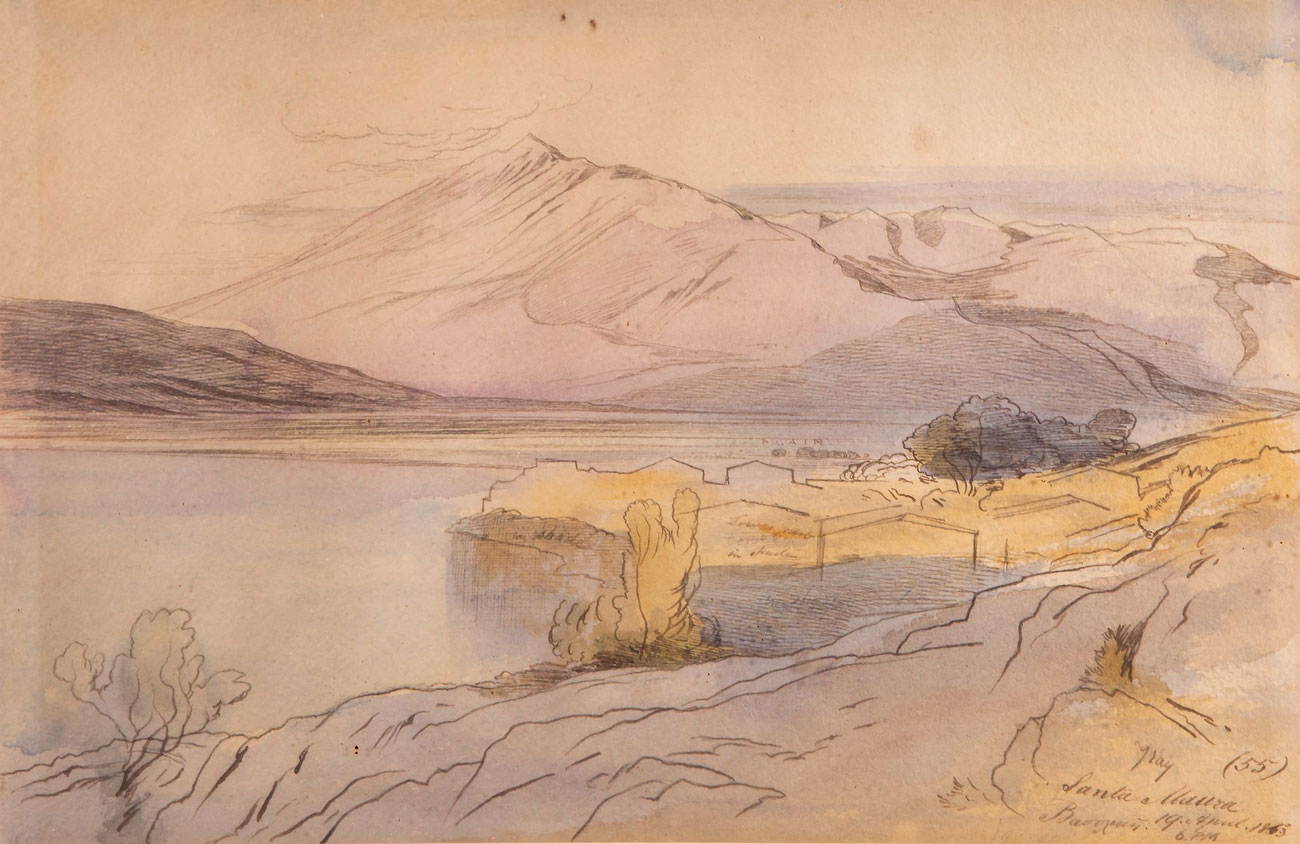
Edward Lear, Santa Maura.

Brush and ink, watercolour, traces of graphite, on wove paper. Inscribed and dated ’19 April 1863 6PM’ lower right. 20.5 x 32 cm. (8 1/4 x 12 1/2 in).

Provenance:
Thomas Agnew & Sons, London (label on reverse, no. 25998);
Spink, London (label on reverse, no. K3/4392)

Bloomsbury.

Posted in Edward Lear | Tagged , , , , | Leave a comment

Edward Lear, A Venetian Sail Barge (1865)

el_venice-s

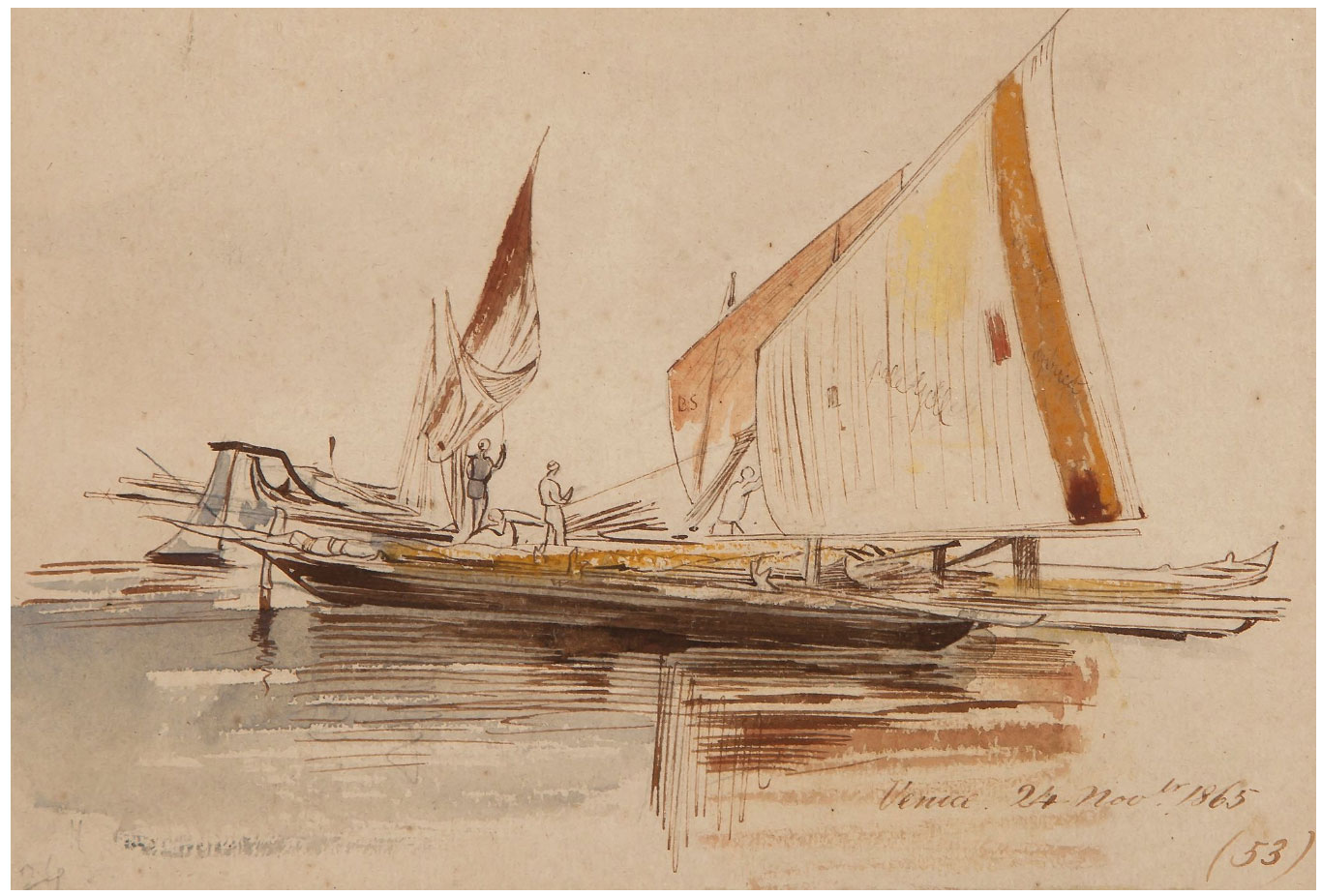
Edward Lear, A Venetian sail barge.

Brush and red ink, watercolour, touches of body colour, traces of graphite. Inscribed ‘Venice 24 Nov, b’r 1865 (53)’ lower right. 11.5 x 17 cm. (4 1/2 x 6 3/4 in)

Provenance:
Thomas Agnew & Sons, London (label on reverse, no. 29064)

Bloomsbury.

Posted in Edward Lear | Tagged , , , | Leave a comment

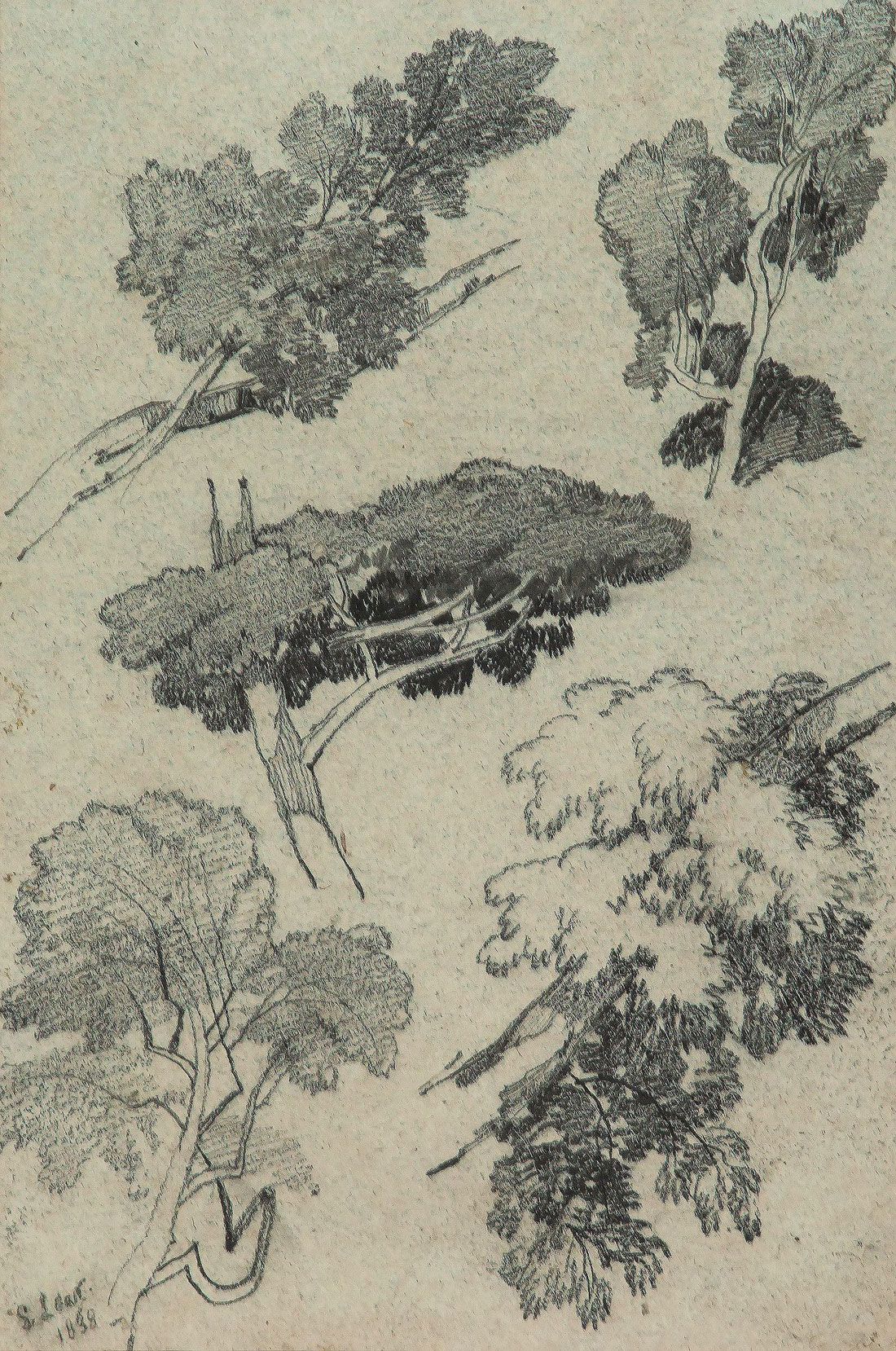
Edward Lear, Sketches of Trees (1838)

el_trees-s

Edward Lear, Sketches of trees.

Graphite on blue wove paper. Signed and dated 1838 lower left. 26 x 18 cm.(10 1/4 x 7 1/8 in).

Provenance:
Spink, London (label on reverse, no. K3/4388);
Thomas Agnew & Sons, London, 1970s.

Bloomsbury.

Posted in Edward Lear | Tagged , , | Leave a comment

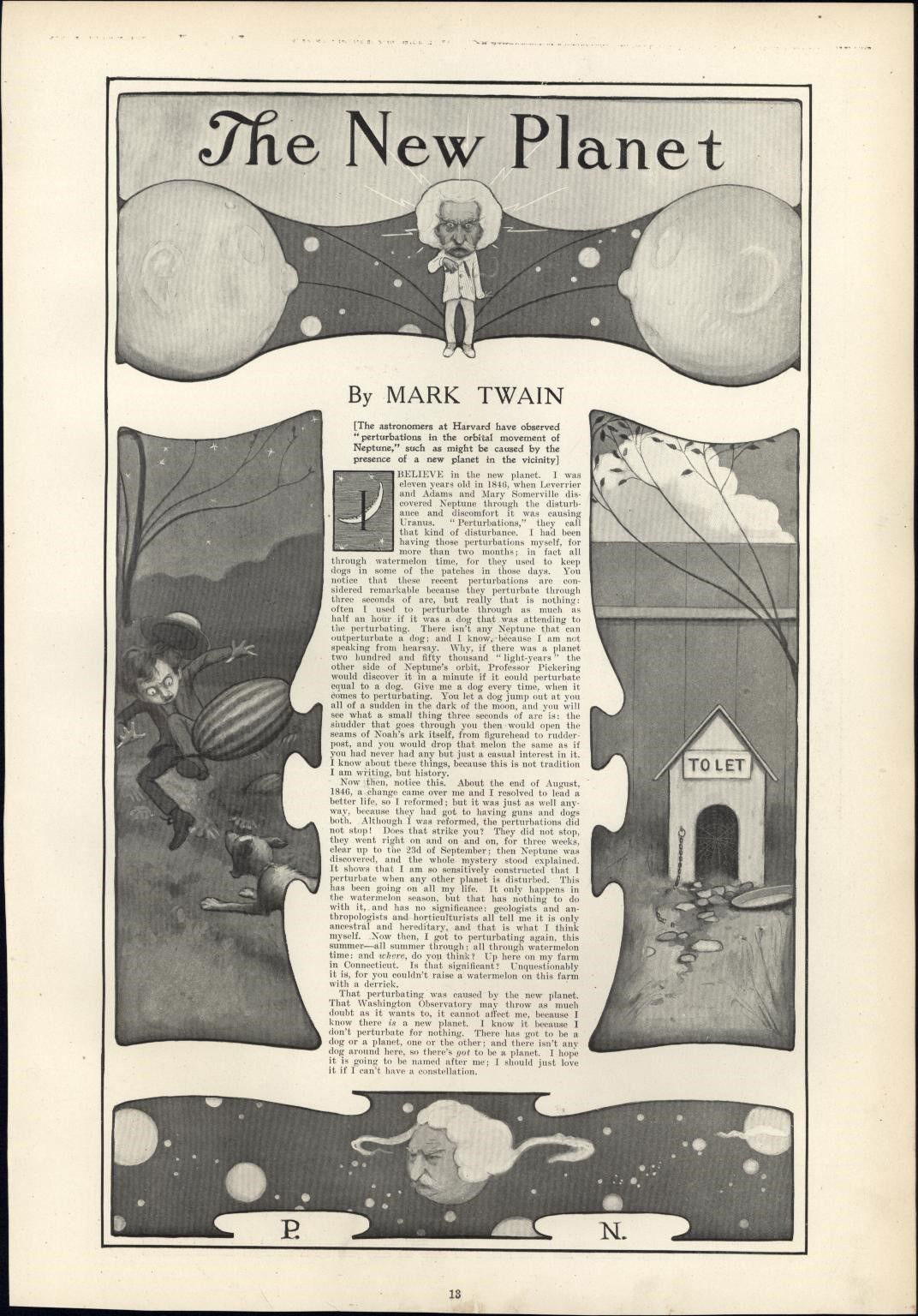
Mark Twain, The New Planet, Illustrated by Peter Newell

pn_new-planet-s

THE NEW PLANET

(The astronomers at Hanard have observed “perturbations In the orbital movement of Neptune,” such as might be caused by the presence of a new planet in the vicinity.)

I BELIEVE in the new planet. I was eleven years old in 1846, when Leverrier and Adams and Mary Somerville discovered Neptune through the disturbance and discomfort it was causing Uranus. “Perturbations,” they call that kind of disturbance. I had been having those perturbations myself, for more than two months; in fact, all through watermelon time, for they used to keep dogs in some of the patches in those days. You notice that these recent perturbations are considered remarkable because they perturbate through three seconds of arc, but really that is nothing: often I used to perturbate through as much as half an hour if it was a dog that was attending to the pertur-bating. There isn’t any Neptune that can outper-turbate a dog; and I know, because I am not speak-ing from hearsay. Why, if there was a planet two hundred and fifty thousand “Hght-years” the other side of Neptune’s orbit. Professor Pickering would discover it in a minute if it could perturbate equal to a dog. Give me a dog every time, when it comes to perturbating. You let a dog jump out at you all of a sudden in the dark of the moon, and you will see what a small thing three seconds of arc is : the shudder that goes through you then would open the seams of Noah’s Ark itself, from figurehead to rudder post, and you would drop that melon the same as if you had never had any but just a casual interest in it. I know about these things, because this is not tradition I am writing, but history.

Now then, notice this. About the end of August, 1846, a change came over me and I resolved to lead a better life, so I reformed; but it was just as well, anyway, because they had got to having guns and dogs both. Although I was reformed, the pertur-bations did not stop! Does that strike you? They did not stop, they went right on and on and on, for three weeks, clear up to the 23d of September; then Neptune was discovered and the whole myster>’ stood explained. It shows that I am so sensitively constructed that I perturbate when any other planet is disturbed. This has been going on all my life. It only happens in the watermelon season, but that has nothing to do with it, and has no significance: geologists and anthropologists and horticulturists all tell me it is only ancestral and hereditary, and that is what I think myself. Now then, I got to p)ertur-bating again, this summer — all summer through; all through watermelon time : and where, do you think ? Up here on my farm in Connecticut. Is that signifi-cant? Unquestionably it is, for you couldn’t raise a watermelon on this farm with a derrick.

That perturbating was caused by the new planet. That Washington Observatory may throw as much doubt as it wants to, it cannot affect me, because I know there is a new planet. I know it because I don’t perturbate for nothing. There has got to be a dog or a planet, one or the other; and there isn’t any dog around here, so there’s got to be a planet. I hope it is going to be named after me; I should just love it if I can’t have a constellation.

Text from The Complete Works of Mark Twain. Authorized Edition. New York: Harper and Brothers, 1923. 355-357.

Illustrated page from Harper’s Weekly, 30 January 1909.
Posted in Peter Newell | Tagged , , | Leave a comment

Edward Lear, Hajar Kim, Malta (1866)

el_hajar-kim-s

Edward Lear, Hajar Kim, Krendy, Malta, 4 March 1866.
Annotated sketch at the archaeoligical site of the prehistorical temple complex at Hagar Qim, near Qrendi in southern Malta, pen and sepia ink over pencil on buff paper, 360 x 525mm., annotated in the lower half with location and colour references in the same ink, evenly browned, 1866.

This is a companion drawing in respect of exact date, subject location, paper type and annotation, to no. 973 in the catalogue of the collection of Edward Lear landscape drawings in the Houghton Library of Harvard University. Edward Lear (1812-1888) visited Malta for the penultimate time between December, 1865, and April, 1866, the longest of eight spells on the island, stopping there again only very briefly in December 1866, on his way to Egypt. Despite these numerous returns to Malta, Lear was ambivalent towards the place, as expressed in a letter to his sister, in 1848, “I cannot remember to have left any place with so much regret after so short a stay in it. But I could not live at Malta ― there is hardly a bit of green in the whole island ― a hot sandstone, wall, & bright white houses are all you can see from the highest places”.

The megalithic temple complex of Hagar Qim, in the south of the island, dates from 3600-3200 BC, and is considered to be one of the oldest religious sites on Earth. It was first excavated in 1839, and is now a World Heritage Site.

Provenance: with Antoine Xuereb, London.

Bloomsbury.

Posted in Edward Lear | Tagged , , , | Leave a comment

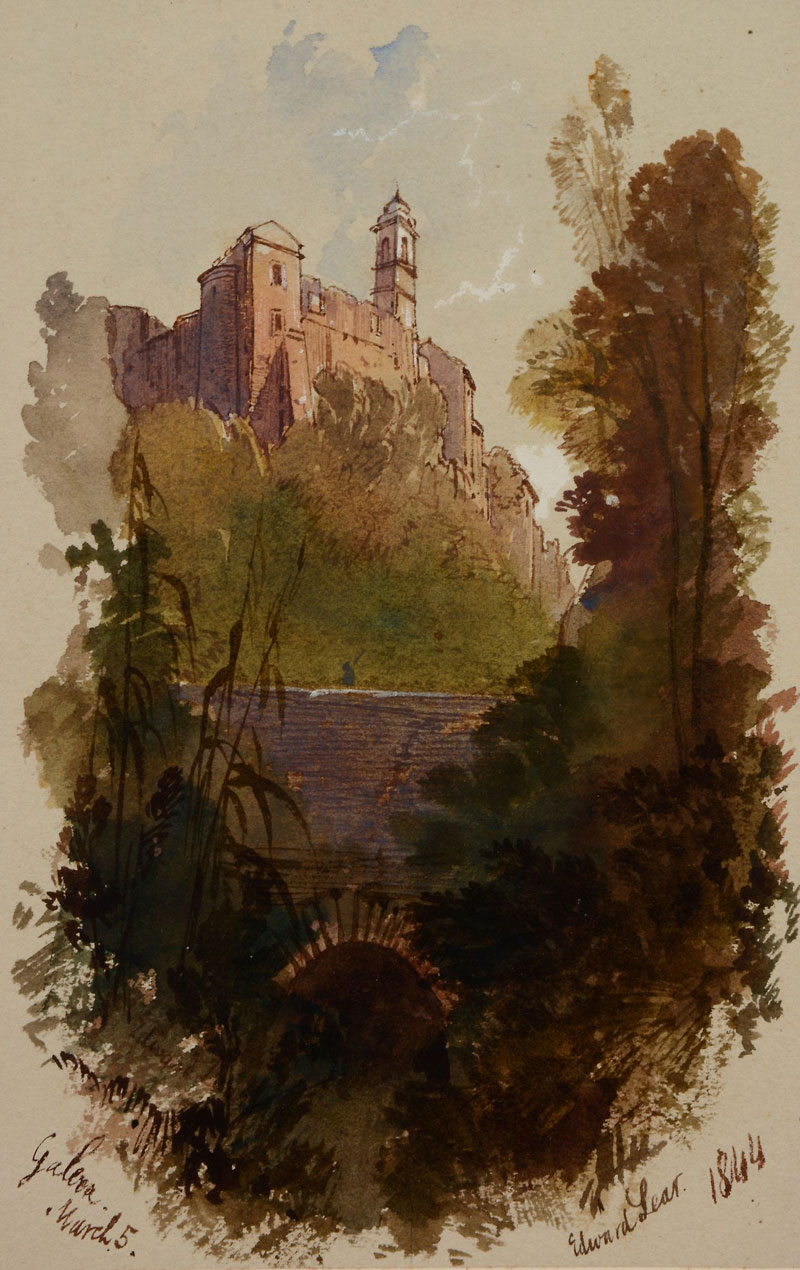
Edward Lear, Galera (1844)

el_falera-s

Edward Lear, Galera, 1844.

Watercolour, heightened with white, on light grey paper. Signed and dated 1844 lower right, inscribed Galera , March 5 lower left. 17.5 x 11 cm. (6 7/8 x 4 1/4 in).

Provenance:
John Scandrett Harford (1787-1866); thence by descent to the present owner

For a similar watercolour of Galera by Lear, executed two years earlier than the present work, see Tate, London (ref.: N02749).

Bloomsbury.

Posted in Edward Lear | Tagged , , , , | Leave a comment