New to Read

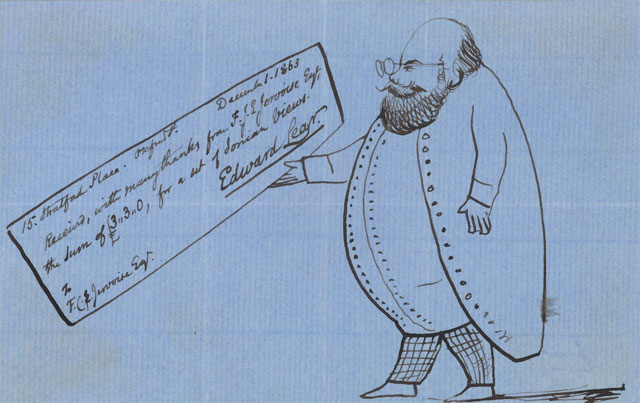
Harvard University, Houghton Library, pga typdr 805 L513 63i METS.

I have added a number of items to the bibliographies:

Zirker, Angelika. “Don’t Play with Your Food? – Edward Lear’s Nonsense Cookery and Limericks.” The Pleasures and Horrors of Eating: The Cultural History of Eating in Anglophone Literature. Eds. Gymnich, Marion and Norbert Lennartz. Göttingen: Bonn University Press, 2010. 237-53. (here)

Boyce, Charlotte. “Onions and Honey, Roast Spiders and Chutney: Unusual Appetites and Disorderly Consumption in Edward Lear’s Nonsense Verse.” Food, Drink, and the Written Word in Britain, 1820–1945. Eds. Addyman, Mary, Laura Wood and Christopher Yiannitsaros. Abingdon: Routledge, 2017. 38-64. (Google Books)

Ponterotto, Diane. “Rule-Breaking and Meaning-Making in Edward Lear.” Revista Alicanta de Estudios Ingleses 6 (1993): 153-61. (here)

Morini, Massimiliano. “‘How Pleasant to Know Mr. Lear!’: Edward Lear and the Sympathetic Reader.” Rivista di Studi Vittoriani 4.8 (1999): 93-109.

Finlay, Nancy. “A Gift of Nonsense: An Edward Lear Manuscript.” Biblion: the Bulletin of the New York Public Library 7.1 (1998): 5– 19.

Lecercle, Jean-Jacques. “‘The Boy Stood on the Burning Deck’: Poétique du nonsense.” Études anglaises 57.1 (2004): 92-102. (here)

Weiss Adamson, Melitta. “The Games Cooks Play: Non-Sense Recipes and Practical Jokes in Medieval Literature.” Food in the Middle Ages: A Book of Essays. Ed. Weiss Adamson, Melitta. New York and London: Garland, 1995. 177-95.

Posted in Edward Lear | Tagged , , | Leave a comment

Edward Lear’s Canadian Cousins

[The following is from Steve Uglow’s research on Edward Lear’s family: I posted the first part, on Frederick Harding, a couple of months ago as part of  a discussion of some family portraits.]

The references to cousin Caroline Jones in Canada and to Henry ‘Chesner’ need some digging into Lear’s father’s background.

Jeremiah was the son of Henry Lear [1709-1763] who married Margaret Lester [1710-1795] on 6th May 1744 at All Hallows London Wall. Little is known of Jeremiah’s siblings but there is the will of Margaret who died in 1795. She was living in Hoxton in the parish of St Leonard, Shoreditch and had clearly taken on the sugar business of husband Henry after his death. Is this Margaret Jeremiah’s mother?  The will is proved on 27th January 1795 by the sole executrix, daughter Catherine but only after Catherine and Jeremiah Lear, both of Pentonville, had sworn an oath that this was their mother’s handwriting and their mother’s true will.

The children mentioned in the will includes:

  1. Catherine – she is unmarried at the time of her mother’s death in 1795. Her mother made her the sole executrix which suggests that she is the eldest and close to her mother.
  2. Mary – she is unmarried at the time of her mother’s death in 1795. She is a witness at her sister, Sarah’s, marriage in 1773. This suggests that she was at least 21 and thus born between 1744 and 1752.  There is a record of Mary Lear buried on 6th November 1797 at St Dunstans, Stepney.
  3. John – he is a witness at Sarah’s marriage in 1773. This suggests that he was at least 21 and thus born between 1744 and 1752.
  4. Sarah – she was baptised 9th January 1755 in Liverpool, the daughter of Henry, a sugar boiler, living in Castle St, Liverpool.
  5. Jeremiah (1757-1833)
  6. Henry

Margaret bequeaths  £5 to Mary and John and to Sarah’s children, Thomas and Charles. Henry gets her watch. The real wealth is in the sugarhouse and dwelling house in Wentworth St, Whitechapel and she directs that these be sold. Catherine received half the proceeds as well as her clothes and furniture while the other half was divided between Sarah, Henry and Jeremiah.

In her will, Margaret refers to daughter, Sarah, as Sarah Chesmer (although this is not conclusively legible) and here is the link to the Canadian cousins. On 18th May 1773 a Vicar General Marriage Licence is issued for Chesmer/Lear and on the following day, 19th May, at St Mary’s, Whitechapel, Thomas Chesmer of Whitechapel, bachelor, and Sarah Lear of Whitechapel, spinster and minor, were married. The witnesses are John Lear and Mary Lear, presumably Sarah’s siblings.

Who the Chesmers were is uncertain – one branch of Chesmers/ Chasmers were to be found south of Cranbrook and Sissinghurst in Kent Weald in villages such as  Rolvenden, Benenden. Whether Thomas came from that stock is moot.

By 1795, Sarah and Thomas have at least two children – Thomas and Charles – but Lear refers to cousin Henry ‘Chesner’ and presumably there must be a third son, Henry.  Possibly he is born around 1785 – in May 1821 Henry Chismer, aged 35, sailed on the SS Martha from Liverpool to New York. Described as a merchant, his destination was Canada. [There is a 25/5/1785 baptism on 25th May 1785 in Benenden, Kent, for Henry son of Charles and Elizabeth Chasmar  but this is unlikely to be our Henry as the record has “poor’ for his parents and there is the death of Henry Chasmar, engineer aged 54 in New York in 1839]

By 1809, Henry is an active merchant: the Public Ledger and Daily Advertiser, 26th  January,  advertises the fact that four or five hundred tons of goods may be conveyed to Liverpool on moderate terms if ready for immediate shipment – those interested should  apply to Smith and Chesmer, 3 Copthall  Chambers.

But Henry is either an unlucky, incompetent or downright dishonest businessman – in 1810 a man called Tupper was in business in Valencia and in touch with Horatio Smith, Henry Chesmer and John Down were merchants in London. In April 1810, Chesmer was in Valencia agreeing to buy Spanish wool with Tupper, ship it to England, sell it and divide the proceeds 50/50. Tupper bought £30,000 of wool and shipped it to Bristol. Chesmer arranged for Haythorne and Co in Bristol to sell the wool, not indicating that Tupper had interest in the sale.  In January 1811, Chesmer’s company received advance of £5000 from Haythorne. On 28th February 1811, the company was declared bankrupt [1811: London Gazette,  28th February, the Bankruptcy Commissioners announced a meeting to make a dividend of the estate and effects of bankrupts Horatio Smith, Henry Chesmer and John Down of Great Winchester St.] The impact of this bankruptcy rumbled on throughout the decade – Tupper sued Haythorne in 1815, dividends were announced against Smith, Chesmer and Down, Great Winchester St, merchants [Birmingham Chronicle 14 December 1820] and in 1822, the case of Fisher v Miller [Times 12/11/1822] referred to Chesmer, a bankrupt, who has assigned his property to the plaintiff, Fisher.

His private life also seemed tempestuous – in 1814, in  Rogers v Chesmer [Sheriff’s Court, Bedford Row] Chesmer is sued for assault by a neighbour and for pouring urine over his child. Both live in Sloane St., Knightsbridge [Public Ledger and Daily Advertiser – 2nd June 1814].  Later that year on 27th July, Emily Indiana Chesmer was born and baptised on 1st September at St Lukes, Old St. She was the daughter of Henry and Sarah. The baptismal record said that the couple lived in City Rd and that Henry was a merchant. Emily Chesmer was probably buried at Holy Trinity, Brompton on 4th December 1851.

We have to assume that wife, Sarah, dies  and that his business dealings in England were such as to make the colonies a more attractive place. On 2nd November 1818 in Sorel, Montreal, Canada, Henry Chesmer Esq of Essex in England and Miss Caroline Jones, daughter of Major Robert Jones, of Sorel, were married. The record is signed by contracting parties, father of bride and Maria, sister of bride.

They relocate to the West Indies where Frances Catherine Caroline Chesmer was born on 28th August 1819 in Kingston, Jamaica – the father was recorded as Henry, the mother as Caroline Jones.

But Henry clearly came back and forth to England – in 1820, he was bankrupted again, this time as Henry Chesmer, late of Broad St Buildings but now of Brompton, merchant, trading under the name of Henry Chesmer and Co: Birmingham Chronicle, 9th  March 1820.

In 1820, Henry and Caroline have another child, Jessy, daughter of Henry and Caroline of Brompton Crescent born on 30th September and baptised on 9th March 1821 at St Mary Abbots Church, Kensington.  Two months later, Henry was on the SS Martha from Liverpool to New York

Henry died in 1826 and was buried on 2nd August in Sorel, Montreal, Canada. He was described as a native of England but last from the West Indies and at the time of his death at father in law’s house, Lieutenant-Colonel Jones of the Militia. Two years later, Caroline Jones, daughter of John Jones, widow of Henry Chesmer, merchant of London, married again, to Robert Jones of Stanbridge, gentleman and Quebec politician.

Lear stayed in touch with the Jones family, although they were not related – George Archibald, son of honourable Colonel Jones of Stanbridge and Caroline Chesmer, his wife was baptised in Philipsburg on 1st September  1838. George Archibald, Archie, is not on the Quebec censuses in 1851 or 1861 but accompanies Lear in Egypt in 1867.

Henry’s daughter, Jessy, is a cousin of Lear. She marries Edward Foy. He is a major in the 71st Foot when they marry – on 12th December 1847, The London Gazette reported that  Brevet Major Edward Foy was to be major by purchase, vice Sir Hew Dalrymple. But by 1851, Edward had left the army and was lodging with a silk printer at Woodbine Cottage, Bexley – he was described as a fundholder.

The census was 30th March 1851 – on 21st July, Edward Foy  and Jessie Chesmer married in Iberville, Quebec. They returned to England and by 1871 and were living at Park Gate, Leckhampton. Edward Foy died in 1878 with Jessy as sole executrix of an estate under £60,000. Jessy herself stayed in Leckhampton and died in 1895, leaving £57,772 6s and probate, tantilisingly, to Henry Chesmer Boomer Esq .
Posted in Edward Lear | Tagged , , | Leave a comment

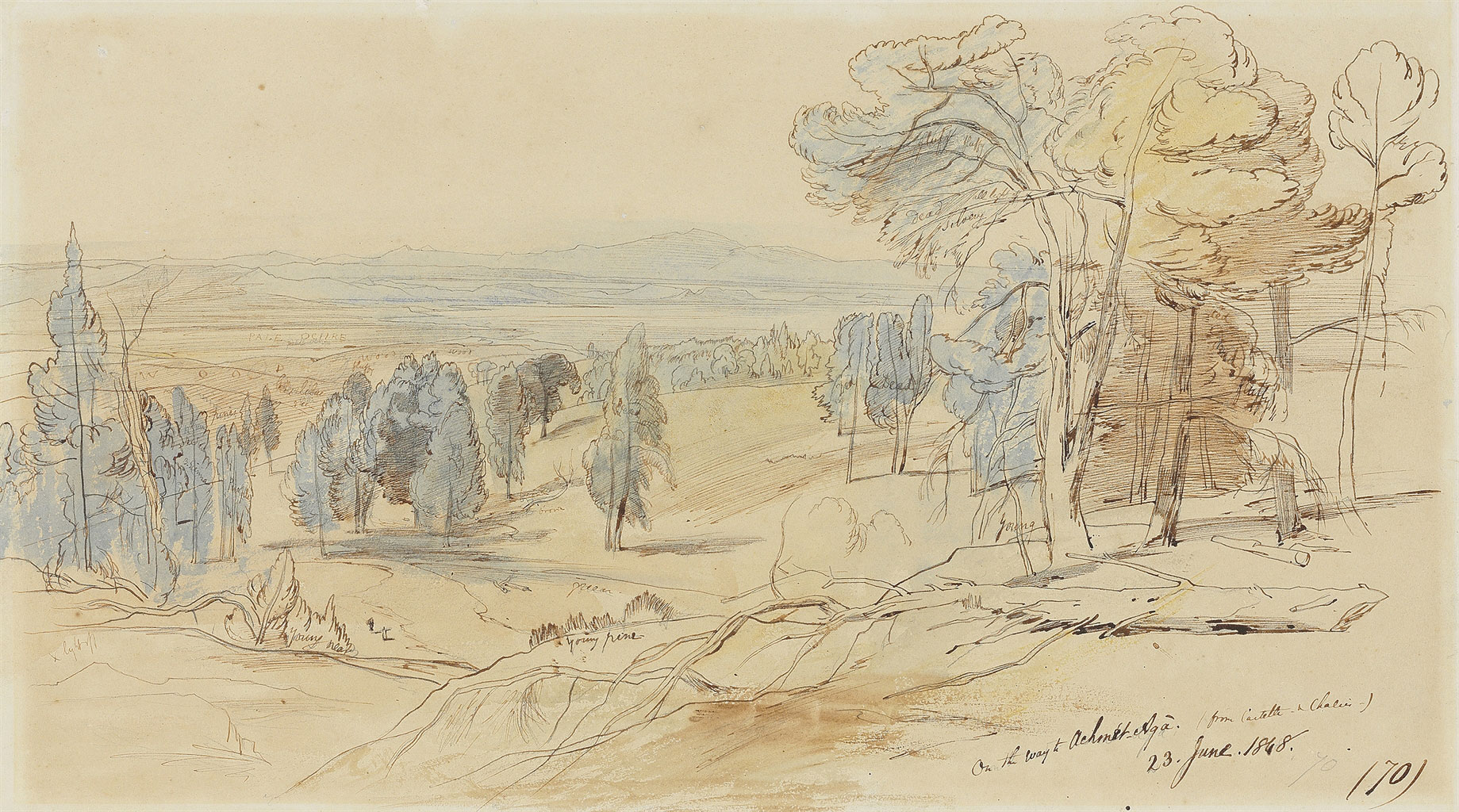
Edward Lear, On the way to Achmet Aga from Castella and Chalcis, Greece

Edward Lear, On the way to Achmet Aga from Castella and Chalcis, Greece.
Inscribed, dated and numbered ‘On the way to Achmet Aga. (from Cactella & Chalis)/ 23. June. 1848./ (70)’ (lower right) and further inscribed with notes. Pencil, pen and brown ink, brown, blue and green wash. 11 ½ x 20 ½ in. (29.2 x 52.1 cm.).

Lear arrived in Greece on 1 June 1848 and the following day reached Athens. He had originally thought to travel overland from Corfu and make a tour of Albania, but was invited by Sir Stratford and Lady Canning to accompany them to Turkey, via Athens. It was during this visit that Lear first met his lifelong friend and patron Charles Church, the owner of this drawing, as well as lot 120. Charles was in Athens with his uncle Sir Richard Church, who had been commander-in-chief of the Greek forces in the war of independence against the Ottoman Empire.

Whilst waiting to travel to Turkey, Lear and Church decided to undertake a tour of central Greece together, travelling as far as Thebes. The trip was highly eventful with Lear being thrown from his horse on the first day and damaging his shoulder, being bitten by an insect which made his leg swell and getting heat stroke. By the time they had reached Thebes, Lear was dangerously ill and had to be carried back to Athens ‘by 4 horses on an Indiarubber bed’ (Lady Strachey, ed., Letters of Edward Lear, London, 1907, p. 11).

On the day that he executed the present drawing, 23 June, he described in his diary the landscape he passed through. ‘Long descent by beautiful Ilex woods, a perfect garden shrubbery. Then deep vales of pine …The pass below is one of the most beautiful I ever saw — so stuffed with vegetation. First, the running river, then Oleander endless; above, huge planes, hung with clematis or creepers, or oaks, or taller abeles. … On the right of the pass were vast red rocks, here and there crowned with pines of great size, or more generally fringed all over with dwarf or young pine and arbutus… At the end of this valley is the little village of Achmèt Agà.’

Provenance

Charles Church, a gift from the artist.
H.M.N. Hollis; Sotheby’s, London, 13 March 1969, lot 140 (£750 to Agnew’s).
with Agnew’s, London.

Exhibited

Sheffield, Graves Art Gallery, Edward Lear, July 1964.

Christie’s.

Posted in Edward Lear | Tagged , , , , | Leave a comment

Edward Lear, A view of the Valley of the Nera, near Rome

Edward Lear, A view of the Valley of the Nera, near Rome.
Signed with monogram, inscribed and indistinctly dated ‘River’ (lower centre) and ‘Valley of the Nera/ EL 18[..].’ (lower right). Pencil heightened with white on buff paper. 10 ¼ x 13 ¾ in. (26 x 35 cm.).

The present drawing dates from the period 1838-9, when Lear was living in Rome and made frequent expeditions into the surrounding Campagna.

Provenance

with Hazlitt, Gooden & Fox, London, where acquired by Christian Peper, 1976.
Christian Peper; Christie’s, New York, 26 January 2012, lot 23.

Christie’s.

Posted in Edward Lear | Tagged , , , , | Leave a comment

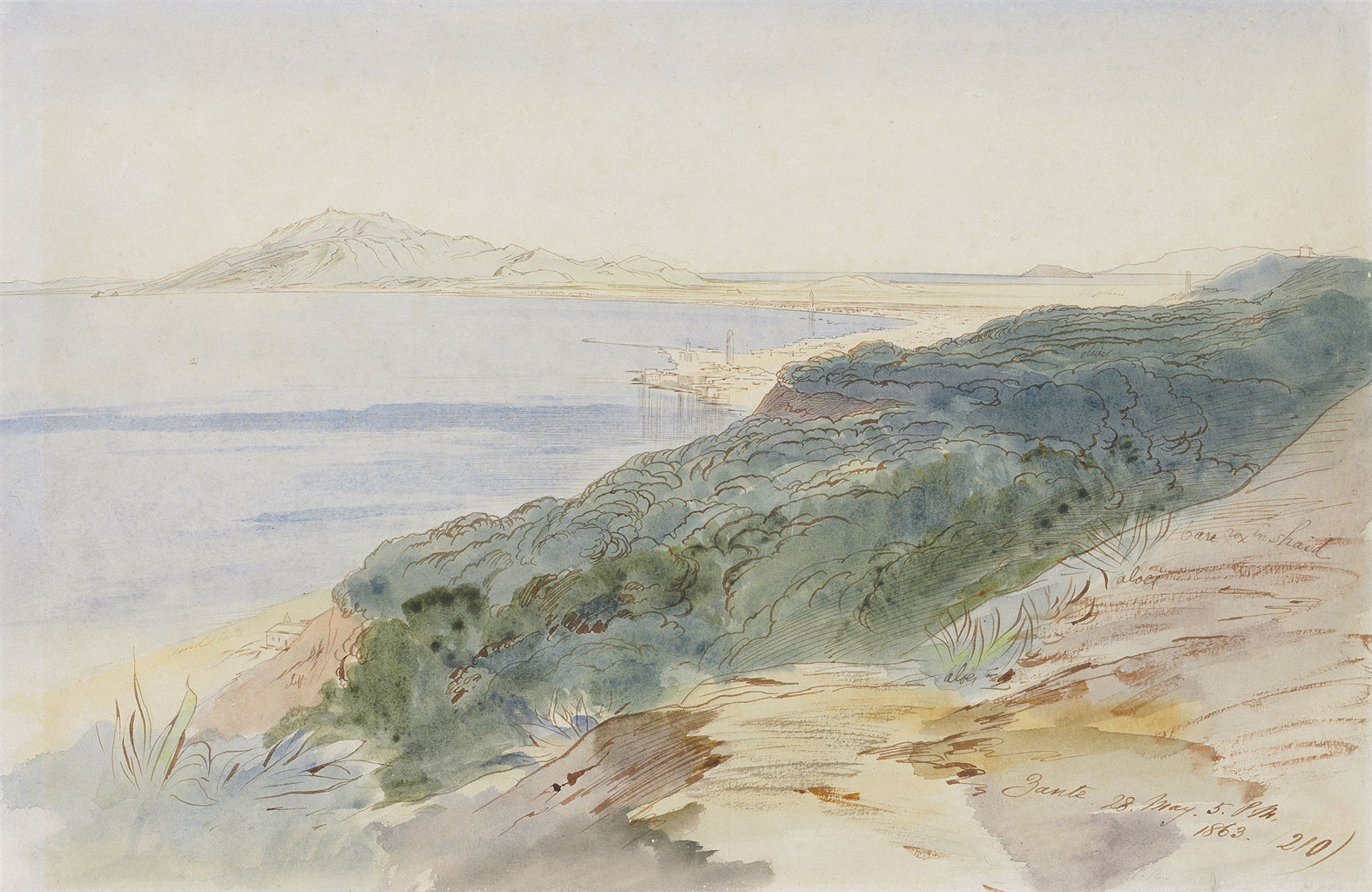
Edward Lear, Zante, with a view over the town to Monte Scopo

Edward Lear, Zante, with a view over the town to Monte Scopo.
Inscribed, dated and numbered ‘Zante. 28. May. 5. P.M./ 1863/ (210)’ (lower right). Pencil, pen and brown ink and watercolour. 13 x 20 in. (33 x 50.8 cm.).

During April and May 1863, Lear undertook a second tour of the Ionian Islands, the results of which were published in Views of the Seven Ionian Islands in December 1863. The publication contained twenty lithographic plates, with short descriptive text. Lear realising that British rule was coming to an end (the King of Denmark had been offered the throne of Greece), undertook his two month tour specifically to produce a series of drawings for publication. He also had in mind a more personal publication of his journals recording his travels around the islands, but this was never fulfilled. Lots 123 and 124 date from this tour.

Lear had first visited the region in April 1848 and fell in love with the beauty of the islands, particularly Corfu, which he made his base between December 1855 and early 1864.

Christie’s.

Posted in Edward Lear | Tagged , , , , , | Leave a comment

Edward Lear, The Monastery of Agios Pavlos, Mount Athos

Edward Lear, The Monastery of Agios Pavlos, Mount Athos.
Inscribed in Greek ‘Saint Paul’, and dated ‘9.10. Sept./ 1856’ (lower right) and extensively inscribed with colour notes throughout. Pencil, pen and brown ink and watercolour, on buff paper. 21 ¼ x 14 7/8 in. (54 x 37.8 cm.).

First documented in 972 AD and dedicated to Christ the Saviour, the monastery of St Paul was founded on the western side of Mount Athos. It is ranked 14th in the hierarchy of Mont Athos.

Provenance

Charles Church, a gift from the artist; and by descent to
Mary Church, given by her to
Canon John McLeod Campbell Crum and by descent to
Miss Margaret Crum; Sotheby’s, London, 12 March, 1987, lot 93.
with Agnew’s, London, where purchased by the present owner.

Description

Property from a Private European Collection (lots 120-125)

Between 1853 and 1868, Lear spent the years travelling throughout the Mediterranean. He had attempted to visit Mount Athos, in 1848 and 1849 with Charles Church, but without success. He eventually arrived there in September 1856, when he spent three weeks travelling throughout the peninsular and managed to visit all twenty principal monasteries and most of their dependencies. The location provided him with the perfect subject matter; mediaeval architecture perched on the rocks of the Holy Mountain, on stark promontories overlooking the Aegean or sometimes almost hidden among secluded cypress groves and lush vegetation.

Lear produced numerous drawings which he intended to publish on his return to England and although this was never fulfilled, he did adapt several of his drawings for his series of illustrations to Tennyson’s poems in the 1880s. He also painted at least 10 oils of the area, based on his drawings, the most famous being his painting of Mount Athos with the Monastery of Stavroniketes, (Yale Center for British Art, New Haven).

His record of all of the monasteries on Mount Athos, must have been unique and he described them in a letter to Emily Tennyson as ‘very valuable’ (V. Noakes, Edward Lear, selected letters, Oxford, 1988, p.138). That he did not pursue this project may have been in part due to his ambivalence to the monastic life, which he expressed in a letter to Chichester Fortescue, ‘However wondrous and picturesque the exterior & interior of the monasteries, & however abundantly & exquisitely glorious & stupendous the scenery of the mountain, I would not go again to Ayios Oros for any money, so gloomy, so shockingly unnatural, so lying, so unatonably odious seems to me the atmosphere of such monkery’ (Lady Strachey (ed.), Letters of Edward Lear, London, 1907, p. 41).

Despite his feelings about monastic life and the isolation of the inhabitants of the ‘Holy Mountain’, Lear was received warmly wherever he went and found the landscape and architecture beautiful. He captured the approach to Mount Athos in a letter to his sister Ann, ‘one crosses a ridge of hills, whence Mount Athos is first discovered – a blue peak on a bluer sea – seen above the most wondrous forests of beech I ever beheld. Nothing did I ever behold more lovely than those views’. As he crossed to the isthmus, the path became ‘most toilsome through the wildest and grandest forest scenery – from which every now and then you looked out on such screens and depths of green wood as would astonish those who talk of England as having more trees than other countries’.

Exhibited

London, Fine Art Society, Edward Lear, A Centenary Exhibition, June 1988.
Oxford, Ashmolean Museum, Happy Birthday Mr Lear. 200 Years of Nature and Nonsense, September 2012 – January 2013, unnumbered.

Christie’s.

Posted in Edward Lear | Tagged , , , , | Leave a comment

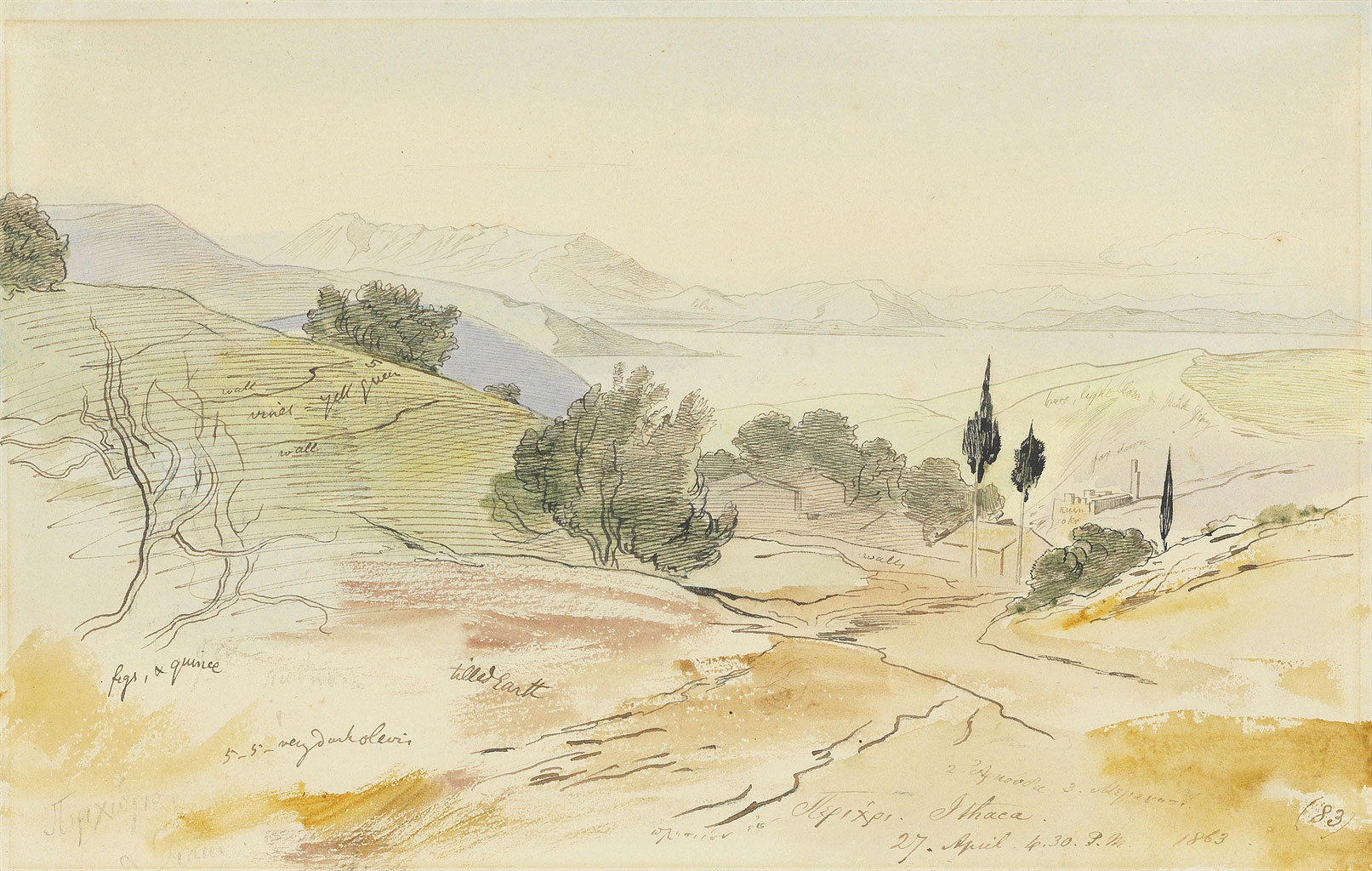
Edward Lear, View of Ithaca

Edward Lear, View of Ithaca.
Inscribed, dated and numbered ‘Ithaca./ 27.April. 4.30.P.M. 1863. (83)’ (lower right) and further annotated in Greek with key of names of the other Ionian Islands. Pencil, pen and brown and grey ink and watercolour. 9 1/8 x 14 ¼ in. (23.2 x 36.2 cm.).

Provenance

with Spink, London, where purchased by the present owner.

Christie’s.

Posted in Edward Lear | Tagged , , , , , | Leave a comment

Edward Lear, The Monastery of Konstatmonitou, Mount Athos

Edward Lear, The Monastery of Konstatmonitou, Mount Athos.
inscribed in English and Greek and dated ’16.Sept.1856′ and further inscribed in Greek (lower left) and with colour notes throughout. Pencil, pen and brown ink and watercolour. 13 5/8 x 19 ¼ in. (34.6 x 48.9 cm.).

he monastery was built in the 10th Century, in a forest about 50 minutes from the coast on the south east side of Mount Athos. It is ranked 20th in the hierarchy of Mount Athos.

Provenance

with Agnew’s, London, 1974, where purchased by the present owner.

Exhibited

Oxford, Ashmolean Museum, Happy Birthday Mr Lear, 200 Years of Nature and Nonsense, September 2012 – January 2013, unnumbered.

Christie’s.

Posted in Edward Lear | Tagged , , , , | Leave a comment

Edward Lear, The Monastery of Koutloumousiou, Mount Athos

Edward Lear, The Monastery of Koutloumousiou, Mount Athos.
signed with monogram, indistinctly inscribed in Greek and dated ‘Sept.1.1856.’ (lower right) and dated again ‘1.Sept’ (lower left, in pencil). Pencil, pen and brown ink and watercolour. 9 1/8 x 12 ½ in. (23.1 x 31.7 cm.).

The monastery was built on the north east side of Mount Athos and was first documented in 1169. It ranks 6th in the hierarchy of Mount Athos.

Provenance

Anonymous sale; Sotheby’s, London, 12 March 1987, lot 116.
with Agnew’s, London, where purchased by the present owner.

Christie’s.

Posted in Edward Lear | Tagged , , , , | Leave a comment

Gromboolia: Nonsense Art and Literature

Michael Heyman, one of the leading experts on world nonsense literature, has created a new website: Gromboolia: The Nonsense Art and Literature Site. It includes an anthology linking to several examples of nonsense literature, music, comics and so on, as well as a new blog and information on Michael’s creative and academic publications.

Posted in General | Tagged , , | Leave a comment