
Edward Lear, River landscape, Naqadeh (Iran)
Inscribed ‘Naqadeh 11AM 21 Jans 1854’ and numbered 108, watercolour, 6 x 15.5cm.
Provenance
with Ryman & Co Ltd, Oxford
Edward Lear, River landscape, Naqadeh (Iran)
Inscribed ‘Naqadeh 11AM 21 Jans 1854’ and numbered 108, watercolour, 6 x 15.5cm.
Provenance
with Ryman & Co Ltd, Oxford
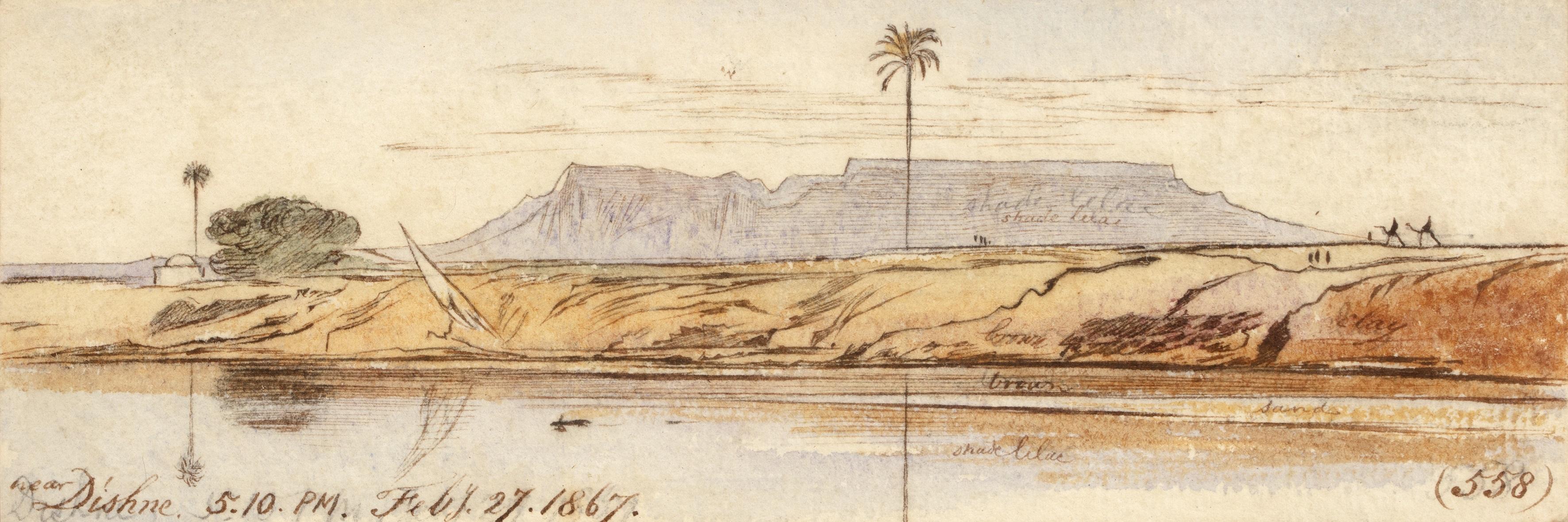
Edward Lear, View on the Nile, Dishne.
Inscribed ‘Near Dishne, 5.10PM Feby 27.1867’, and numbered 558, watercolour, 6 x 17cm.
Provenance
with Ryman & Co Ltd, Oxford.

Edward Lear, Jerusalem from near the Mount of Olives, 1858.
Pen and brown ink and watercolour. Works on Paper. 214 by 320 mm

Edward Lear, View of Cairo, with the Pyramids of Giza and the Sphinx in the distance.
Inscribed and dated ‘Cairo / 9. Jany . 1849.’ (lower left), further inscribed, dated and numbered ‘Cairo. Jany 9. 1849. 2’ (lower right), and further variously inscribed with the artist’s notes throughout. Pencil, pen and brown ink and watercolour, heightened with touches of bodycolour, on paper. 6 ¾ x 20 in. (17.2 x 50.9 cm.)
Lear first visited Egypt in January 1849, writing to Fortescue ‘I strongly long to go to Egypt for the next winter as ever is, if so be as I can find a sufficiency of tin to allow of my passing 4 or 5 months there. I am quite crazy about Memphis & On & Isis & crocodiles and ophthalmia & nubians, and simooms & sorcerers & sphingidoe. Seriously the contemplation of Egypt must fill the mind, the artistic mind I mean, with great food for the rumination of long years.’ (Lady Strachey, The Letters of Edward Lear, London, 1907, pp. 8-9.)
His first visit was brief and he saw only Cairo and the Pyramids, before travelling on in early February to Sinai and Palestine by camel, with his friend John Cross.

Edward Lear, Mont Blanc.
Signed with monogram and dated ‘1863’ (lower right). Ppencil, watercolour and bodycolour on blue paper. 6 ½ x 10 1⁄8 in. (16.5 x 25.9 cm.)
Provenance
Anonymous sale; Christie’s, London, 15 November 1983, lot 261.
with Agnew’s, London, where purchased by the uncle of the present owner.
Exhibited
London, Agnew’s, 11th Annual Exhibition of Watercolours and Drawings, January-February 1984, no. 184.

Edward Lear, Olive trees, Corfu.
Signed with monogram and inscribed and dated ‘Corfu / December / 17 / 1857’ (lower left); signed inscribed and dated ‘E Lear Corfu December 17 1857’ (lower right). Oil on board. 17 3⁄4 x 21 3⁄4 in. (45.5 x 55.5 cm.)
Provenance
Anonymous sale; Sotheby’s, London, 15 July 1992, lot 77, where acquired by the present owner.

Edward Lear, An Olive Grove, Corfu, a sailing boat to the right.
Inscribed and dated ‘Corfu / December 22 / 1857’ (lower left); Inscribed and dated ‘Corfu December 22 1857’ (lower right); and further inscribed and dated ‘1857 / H. M. N. H.’ (on a label attached to the reverse). Oil on board. 18 1⁄2 x 24 in. (47 x 61 cm.)
Prevenance
Anonymous sale; Sotheby’s, London, 15 July 1992, lot 76, where acquired by the present owner.
Lear first visited Corfu in 1848, and then stayed for a longer visit from December 1855 until May 1857 staying with his friend Franklin Lushington. He returned from Trieste on 1 December 1857 and these two sketches were made shortly thereafter. In an early letter to is sister Anne dated 14 May 1848 he wrote: `I wish I could give you any idea of the beauty of this island – it really is a Paradise … The chief charm is the great variety of the scenery, and the extreme greenness of every place. Such magnificent groves of olives I never saw – they are gigantic’. On Christmas Eve 1857 he again wrote `Perfect calm has been the order of every hour since I came. I finished a drawing of Zante and have sent it off; besides this the 2 paintings for Mrs Empson are all that I have completed, and those 2 not quite’. This and the subsequent lot are in all likelihood the paintings referred to.
Doesn’t much lokk like a Lear to me; for sure the writing for the dating is not his.

Edward Lear, A scarlet-throated tanager in a tree.
Signed ‘E. Lear’ l.c., pencil, watercolour and bodycolour. 18 x 16cm
Provenance
The collection of Mr and Mrs Nigell D’Oyly.

Edward Lear, A black-spotted barbet, c.1830
Signed ‘E. Lear’ l.l., pencil, watercolour and bodycolour. 16 x 14cm, framed oval.
Provenance
The collection of Mr and Mrs Nigell D’Oyly.
Literature
Viven Noakes, ‘Edward Lear 1812-1888 at the Royal Academy of Arts’, 20 April-14 July 1985, illustrated p.80, plate 6a.
This watercolour study was from a group of bird drawings which Lear gave to Mrs Godfrey Wentworth as a token of gratitude in 1830. It is believed that she introduced him to the naturalist Prideaux Selby at the start of his career. It is likely that Lear undertook an informal apprenticeship with Selby, and the bold and lively approach demonstrated in Selby’s ornithological works has been skilfully developed in Lear’s later bird drawings.

Edward Lear, A thick-billed euphonia on a branch.
Signed ‘E. Lear’ l.r., pencil, watercolour and bodycolour. 20 x 15cm
Provenance
The collection of Mr and Mrs Nigell D’Oyly
 A Blog of Bosh