Edward Lear, Honister Crag, Lake District (1836)

Edward Lear, Honister Crag, Lake District.
Signed and inscribed ‘E./ Honister. Cu’ (lower right). Pencil heightened with white on grey paper. 4 ¼ x 6 7/8 in. (10.8 x 17.5 cm.), corners cut.

Literature
C. Nugent, Edward Lear The Landscape Artist: Tours of Ireland and the English Lakes, 1835 & 1836, Grasmere, 2009, p. 158, fig. 43.

Lear made a walking tour of the Lake District in 1836, from which this drawing dates. Lear loved the landscape and wrote enthusiastically to John Gould (31 October 1836) ‘I left Knowsley…on the 12th August for a sketching tour, & really it is impossible to tell you how, and how enormously I have enjoyed the whole Autumn. The counties of Cumberland & Westmorland are superb indeed, & tho the weather has been miserable, yet I have contrived to walk pretty well over the whole ground & to sketch a good deal besides’. Many years later in 1884, Lear recalled of his trip ‘…I know every corner of Westmorland; Scawfell Pikes is my cousin, and Skiddaw is my mother in law’. Honister Crag is on the road which cuts between Buttermere and Borrowdale, and Lear dated another drawing from the same viewpoint 10 October.
A group of drawings from this tour was sold in these Rooms, 20 November 2003, lot 77, and are now at Dove Cottage, Grasmere.

Christie’s.

This Sale, Old Master and British Drawings and Watercolours Including Works from the Collection of Jean Bonna (London, 2 July 2019), has several Lears worth seeing. If you can’t wait for me to post them here you should download the PDF catalogue, that contains more pictures than those that appear online.
Posted in Edward Lear | Tagged , , , , , | 1 Comment

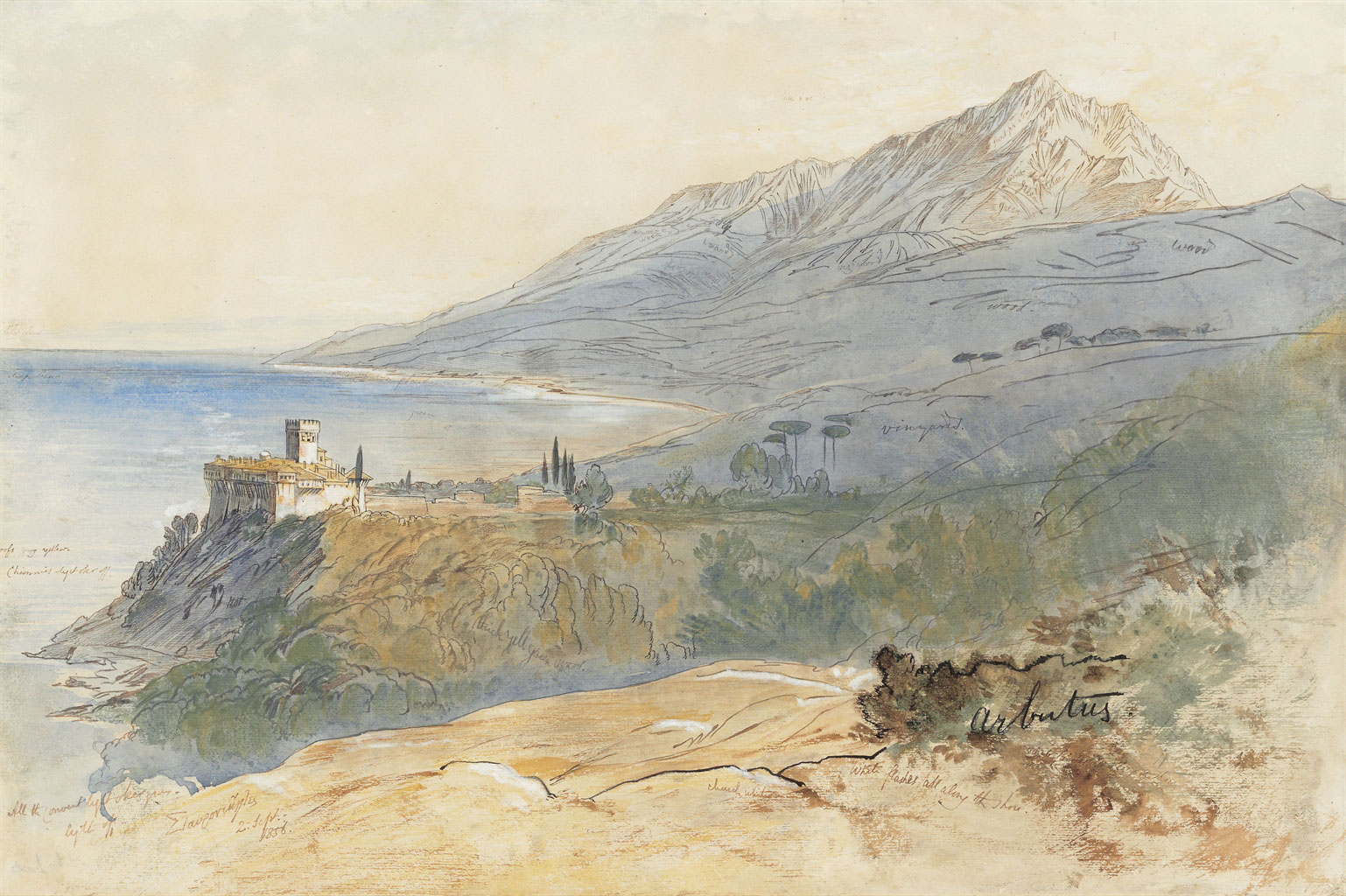
Edward Lear, The Monastery of Stavronikita, Mount Athos (1856)

Of the picture below, Stephen Duckworth, who kindly informed me of this sale of several Lear paintings, writes:

This fine view of Stavroniketes monastery on the Mount Athos peninsula was drawn by Lear early on his journey round the twenty main monasteries on the peninsula in September 1856.  It has been known that this drawing was held by Sir Roger and Lady Hollis by descent from Charles Church who received it probably as a gift from Lear himself.  It was exhibited at an exhibition in Sheffield in 1964 and at the Fine Art Society in London in 1988, but no image of the drawing has been available until now.  Lear used his drawing as a basis for the oil painting of Stavroniketes held by the Yale Center for British Art – Mount Athos and the Monastery of Stavronikétes.

There are further details of this and the other Mount Athos monasteries on Edward Lear and Mount Athos His visit in 1856.

Edward Lear, The Monastery of Stavronikita, Mount Athos.
Inscribed and dated ‘Stavroniketas (in Greek)/ 2. Sept./ 1856’ (lower left), and extensively inscribed with artist’s notes throughout. Pencil, pen and brown ink and watercolour. 13 3/8 x 20 1/8 in. (34 x 51.1 cm.)

Provenance
Charles Church, a gift from the artist, and by descent to the present owners.

Exhibited
Sheffield, Graves Art Gallery, Edward Lear, Drawings from a Greek Tour, July 1964, no. 44.
London, Fine Art Society, Edward Lear, A Centenary Exhibition, June 1988, no number.

This drawing is a study for Lear’s most famous Mount Athos painting, Mount Athos and the Monastery of Stavronikétes, now at the Yale Center for British Art, New Haven.
Lear attempted to visit Mount Athos in 1848 with Church, but was unsuccessful. He eventually returned in September 1856, visiting all twenty principal monasteries and many of their dependencies. He produced a series of fifty drawings of the monasteries and landscapes, of which the present drawing is part. He apparently intended to publish a volume of his tour of Mount Athos but this was never fulfilled, although he did adapt several of his drawings for his series of illustrations to Tennyson’s poems.

Christie’s.

Posted in Edward Lear | Tagged , , , , | Leave a comment

Readings (and a request for help)

Jusat a few short pieces and a thesis:

Sara Lodge, The Limerick Man: Edward Lear in Iraland, The Irish Times, 22 June 2019.

Matthew Bevis, On Rationality and Nonsense, iainews.com, 19 June 2019.

Relative Clauses in EDward Lear’s Complete Nonsense Limericks: A Stylistic Analysis. An undergraduate thesis by Clara Clarissa Poppy Mahendra.

Can anyone help determine the year for this? It is Norba from near Ninfa.

Posted in Uncategorized | Leave a comment

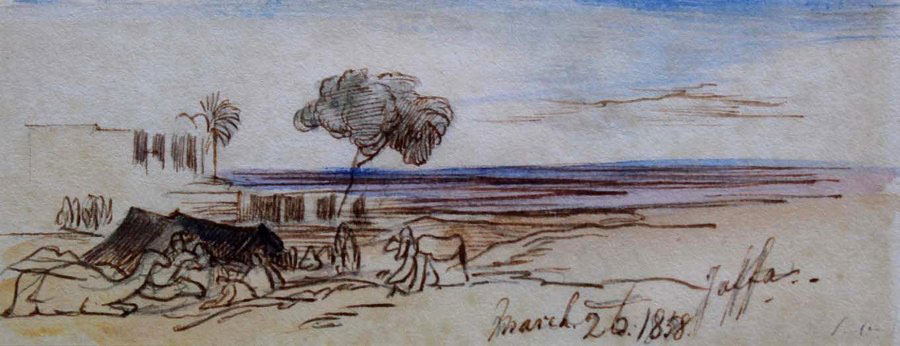
Edward Lear, Jaffa (1858)

Edward Lear, Jaffa.
Inscribed l.r.: Jaffa and dated March 26 1858. Watercolour over pen and ink and pencil, 4.5 by 12.5 cm.

Provenance
Sotheby’s, London, 16 July 1992, lot 165

Lear’s trip to the Middle East in the Spring of 1858 resulted in several impressive views of Jerusalem, two of which are now in the Tate (inv.2753 and 2792). He wrote in his diary on the day the present drawing was executed:

“Rose at 6 having slept very decently. Sea Calm, hardly in any wind. Jaffa…”
(diary entry for Friday 26 March 1858)

Harry Moore-Gwyn.

Posted in Edward Lear | Tagged , , , , | Leave a comment

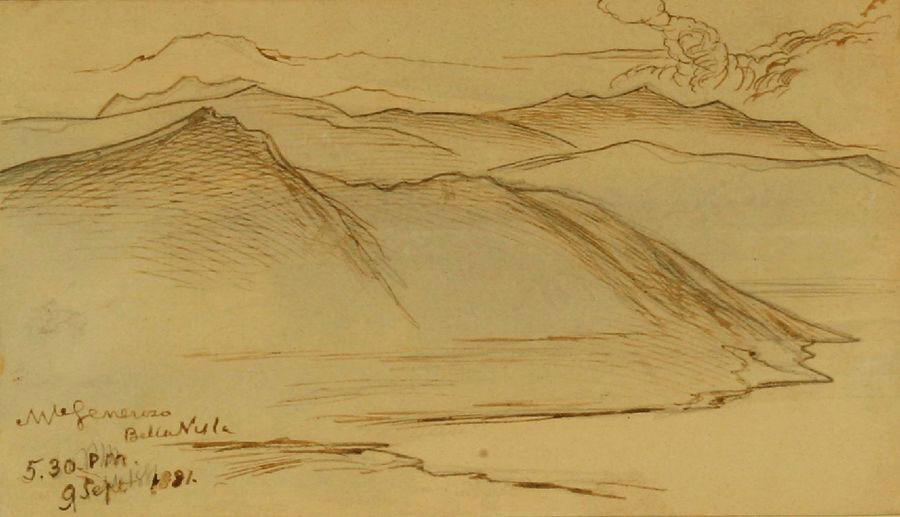
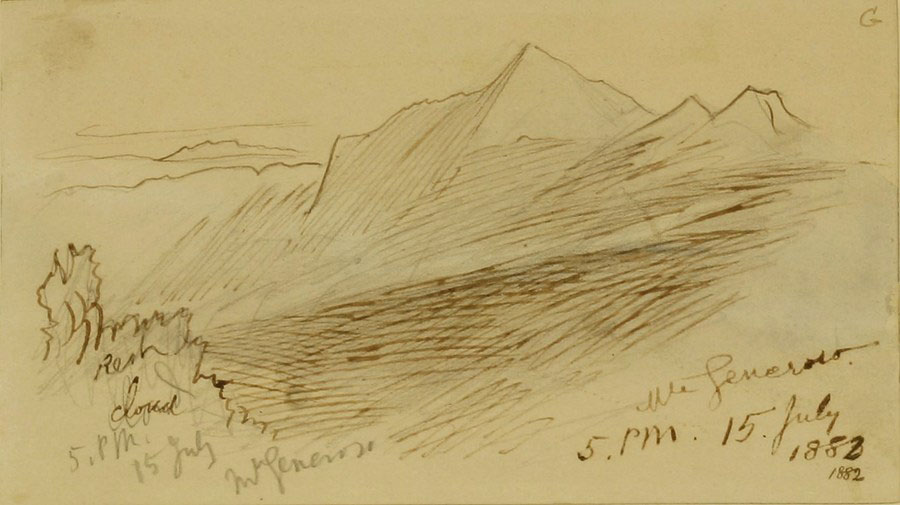
Edward Lear, Two Pictures of Monte Generoso (1881-82)

Edward Lear, Mount Generoso – a “Bella Vista.”
Inscribed with title and dated l.l.: 5.30 pm/9 Sept 1881. Pen and sepia ink, 10 by 17 cm.

Harry Moore-Gwyn.

Edward Lear, Monte Generoso.
Inscribed and dated in ink l.r.: M.Generoso/5 pm/15 July 1882and similarly in pencil (l.l.) Pen and sepia ink over traces of pencil, 10 by 17 cm.

Harry Moore-Gwyn.

Posted in Edward Lear | Tagged , , , , | Leave a comment

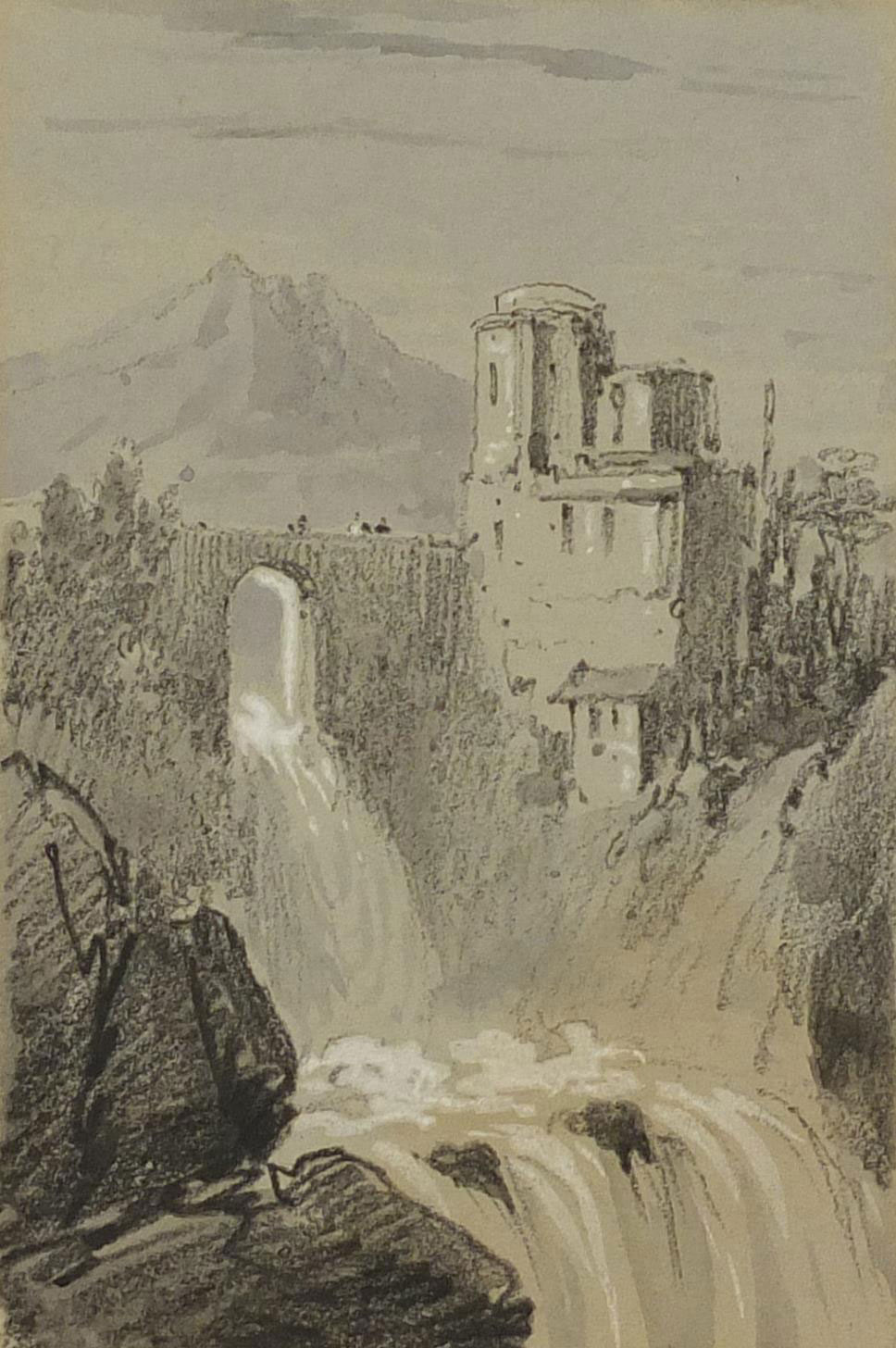
Edward Lear, Castle with a Waterfall

Edward Lear, Castle by a waterfall with a mountain beyond.
Heightened watercolour and black chalk, mounted unframed, 11.5cm x 7.5cm.

Provenance
Christie’s 6/12/2008 lot 181.

The Saleroom.

Posted in Edward Lear | Tagged , , , , | Leave a comment

Edward Lear and Frederic Church

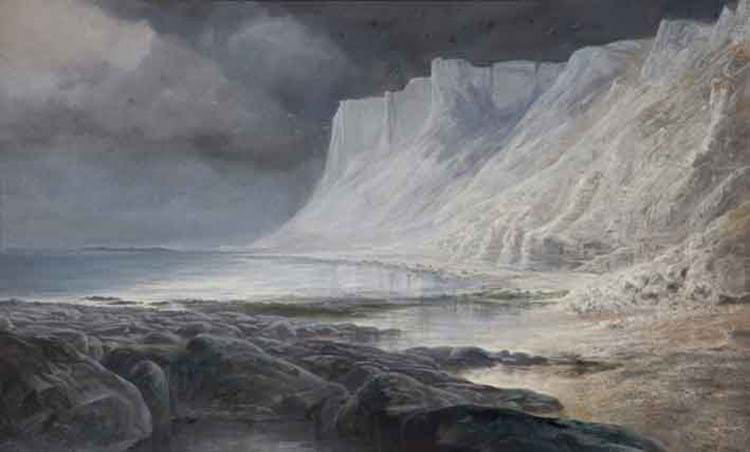
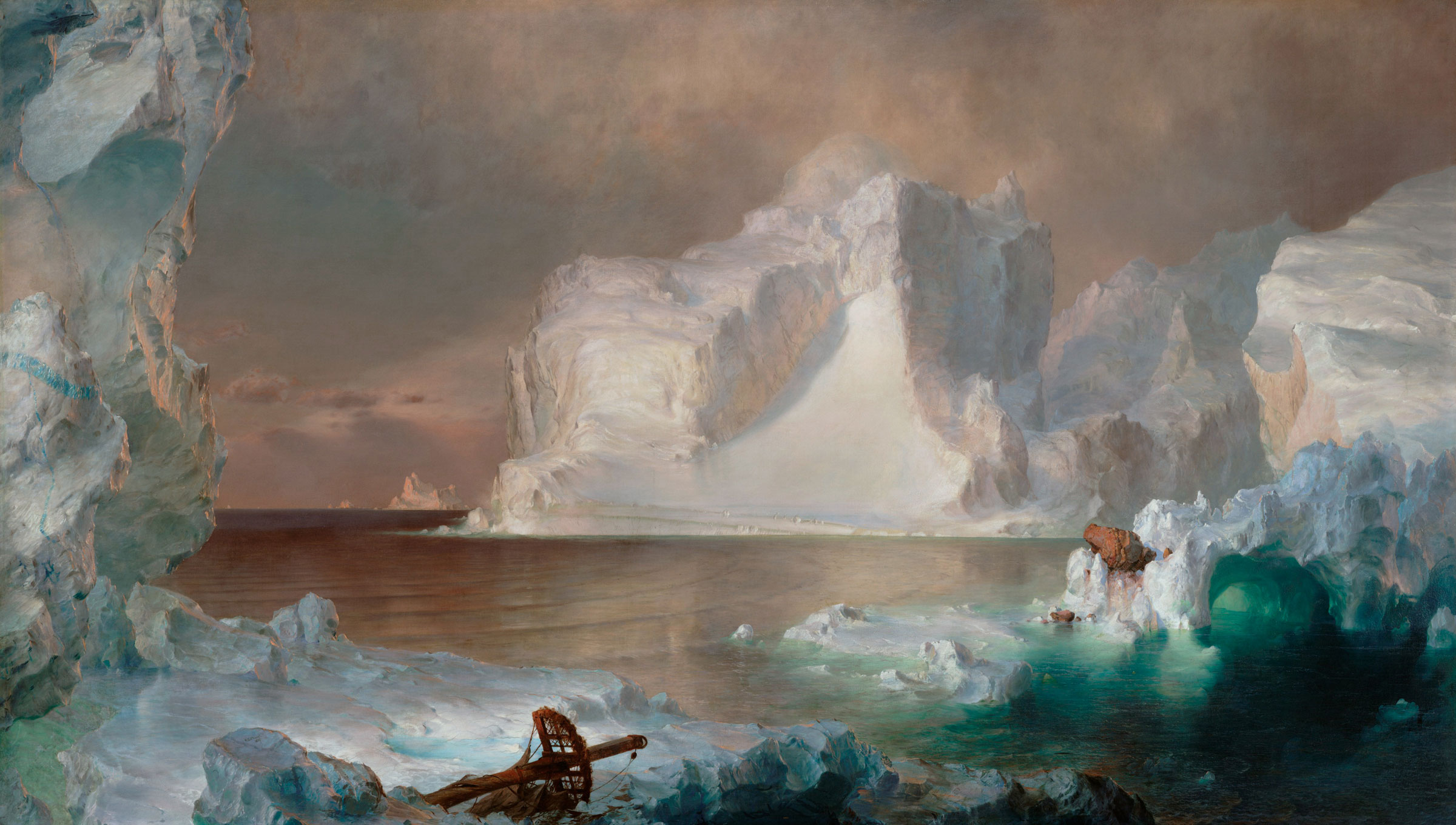
Commenting on Edward Lear’s impressive painting of Beachy Head, in her recent Inventing Edward Lear, Sara Lodge writes, among much more:

In Beachy Head, Lear directly recalls the dramatic composition of [Frederic] Church’s The Icebergs in a way that is immediately apparent when one sees the two images side by side. The left foreground is a dark and cold foreshore; the sea occupies the middle distance, flowing into a curved bay. But the focus of both paintings is the luminous white expanse of rock / ice that rises sheer in the upper right of the picture, suggesting both the beauty and the harshness of ‘the North’, a title Lear also entertained for his work. It is fascinating that Lear chose to portray the south coast of England as if it were an Arctic landscape. One could see this as a domestication of the Romantic wilderness. However, the opposite is also true. Lear dramatically alienates England in this picture, representing it at its extremity as a strange, cold place whose  eroded cliffs are as forbidding as they are impressive.

On Lear and Beachy Head also see: Edward Lear Visits Beachy Head with His Sister Sarah.

Posted in Edward Lear | Tagged , , , | Leave a comment

Harriet Lear’s Copy of Journals of a Landscape Painter in Southern Calabria

Edward Lear, Journals of a Landscape Painter in Southern Calabria. London: Bentley 1852.
Large 8vo, with presentation inscription ‘Harriet Lear from her brother Edward, Nov. 29 1853’, plates as required (one with partial tear without loss), in worn half binding.

The Saleroom.

Posted in Edward Lear | Tagged , , , | Leave a comment

Edward Lear, Valletta, Malta

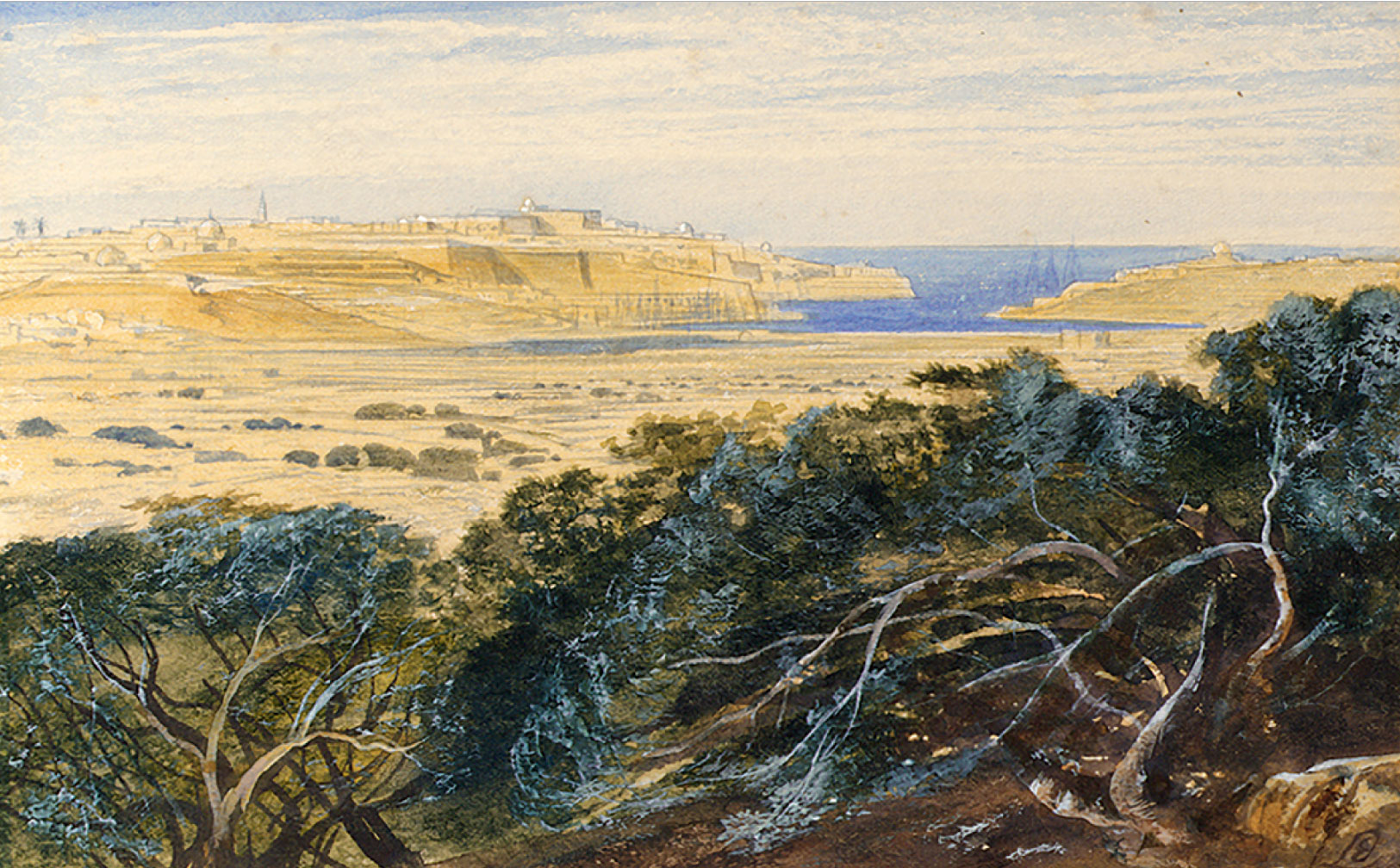
Edward Lear, Valletta, Malta.
Signed with monogram l.r. Watercolour over pencil heightened with bodycolour. 11.3 by 18.3cm.; 4½ by 7¼in.

Lear’s first trip to Malta, which he described as ‘that much beloved place’ (see Lady Strachey, ed., The Letters of Edward Lear, 1907, pp.243-44), was in 1848 on his way from Italy to Greece, but on that occasion he had little time for drawing. Finding himself in Malta again in 1862, on his way from Corfu back to England, he took the opportunity to make a few drawings of the island. He also spent a lonely winter there from December 1865 to April 1866. Malta has since the sixteenth century been the headquarters of the Knights of St. John, now known as the Knights of Malta.  Its position in the central Mediterranean with access to central and Eastern Europe as well as Africa, means it has always been of vital naval strategic importance. Charles V gave the islands to the Knights of Malta in 1530, on a perpetual lease, following their expulsion from their previous headquarters in Rhodes by the Ottoman Empire. Ottoman aggression continued and gained an air of invincibility when half the Christian Alliance Fleet were destroyed at the Battle of Djerba in 1560. An attack on Malta was inevitable and had the Turks pressed forward immediately it is impossible to see how they would have been repelled. As it was their delay allowed Alliance forces to rebuild. A vast fleet set sail from Constantinople and arrived off Malta in May. The following siege, which lasted until September, was one of the bloodiest in history and the eventual Maltese victory was received with a mixture of relief and jubilation by the courts of Europe. The city of Valetta was constructed following the victory and named after Jean Parisot de la Valette, the Grand Master, who had commanded the defence of the island. It fortified the Xiberras peninsula and reinforced the knights command of the island. They retained control until 1798 when Malta was taken by Napoleon en route to his invasion of Egypt. Nelson’s great victory at The Battle of the Nile in August of that year was the beginning of the end of French dominance in the Mediterranean. Malta fell to the British in 1800 and was a vital port from which the Royal Navy could disrupt French supply routes, intercept intelligence and maintain the operational fleet. The island was formally handed over to Great Britain in the Treaty of Paris of 1814. During the remainder of the nineteenth century it was ruled by a British Military Governor.

Provenance
Admiral Sir Charles Thomas Scott and thence by descent to his son Sir David Scott in 1911.

Sotheby’s.

Posted in Edward Lear | Tagged , , , , | 1 Comment

Edward Lear, Jerusalem from the Mount of Olives

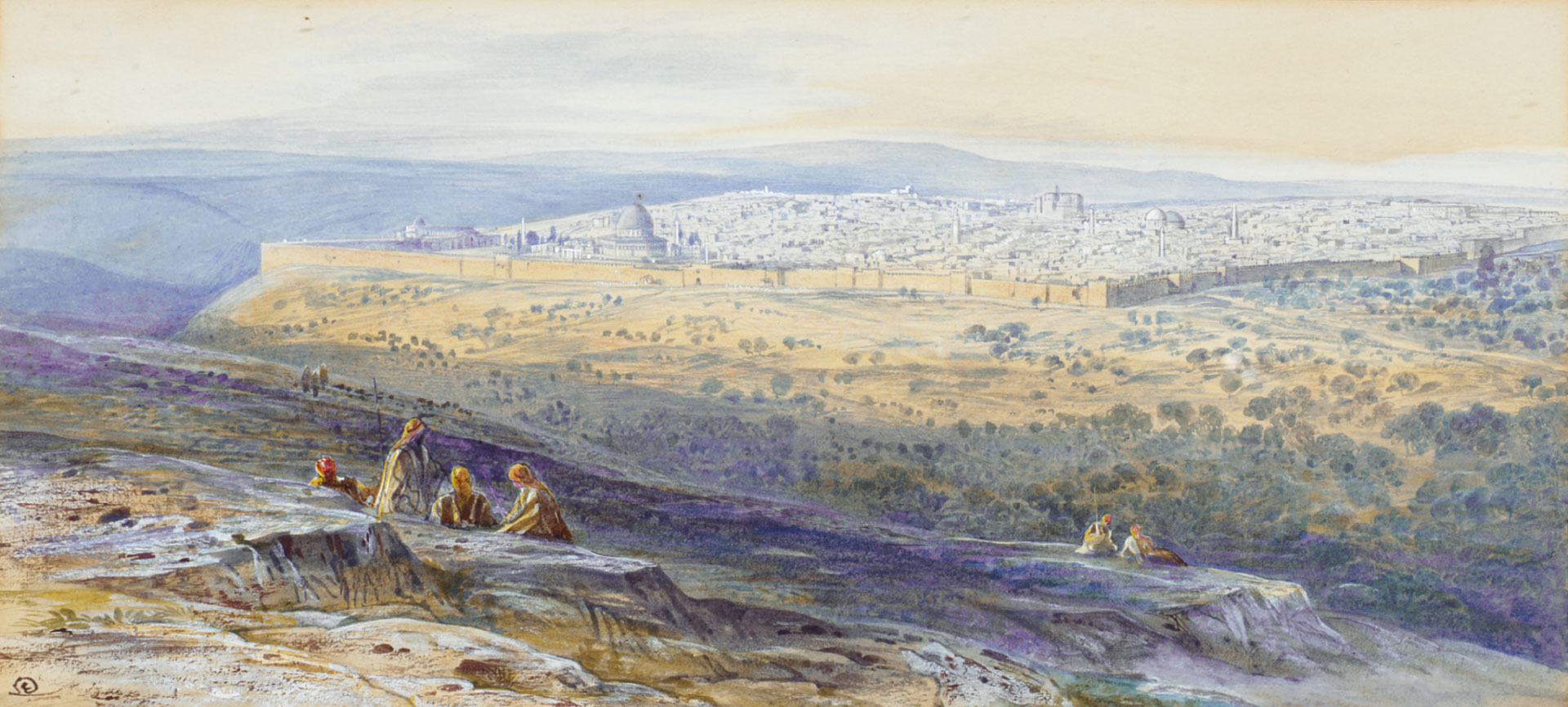
Edward Lear, Jerusalem from the Mount of Olives.
Signed with monogram l.l. Pencil and watercolour heightened with white. 17 by 37cm., 6¾ by 14½in.

After leaving Corfu by the spring of 1858, Lear visited Jerusalem. He arrived during Holy Week and immediately began exploring the countryside outside the city walls: ‘We crossed the Kidron & went up the Mount of Olives – every step bringing fresh beauty to the city uprising behind. At the top, by the Church of Ascension the view is wonderfully beautiful indeed’ (see Vivien Noakes, Edward Lear 1812-1888, 1985, p.149). He was, however, reluctant to stay for long because of the Easter crowds, and soon left for Petra. He returned to the city on 20 April, and began working on a painting of Jerusalem at sunset from the Mount of Olives which Lady Waldegrave had commissioned. He also painted an oil of an almost identical viewpoint, but at sunrise. Lear spent almost a fortnight studying the view from the Mount of Olives and making a number of drawings which he used as the basis for later watercolours such as the present work. From his vantage point could be seen ‘the site of the temple & the 2 domes – and it shows the ravine of the valley of Jahosaphat, over which the city looks: -and Absalom’s pillar – (if so be it is his pillar – ), the village of Silouam, part of Aceldama, & Gethsemane are all included in the landscape. And besides this the sun, at sunset, catches the sides of the larger Eastern buildings, while all the upper part of the city is in shadow; – added to all which there is an unlimited foreground of figs, olives, & pomegranates, not to speak of goats, sheep, & human beings’ (see Lady Waldegrave, 27.V.58, manuscript, Somerset Record Office, Taunton). In 1865 Lear painted one of his most accomplished landscapes of the Holy Land, an oil of Jerusalem (Ashmolean Museum, Oxford) depicting a similar vista from the north-east side of the Mount of Olives, with shepherds and their flock in the foreground.

The first owner of this watercolour was Alfred Manners Drummond (1829-1921), son of Andrew Robert Drummond and brother of the banker Edgar Atheling Drummond (1825-1893). Edgar Drummond and Lear became friends after they met in Rome in the winter of 1858. Lear often mentioned Edgar’s younger brother Captain Alfred Manners Drummond, in his correspondence, and as he was an adventurous traveller and art collector, he also became one of Lear’s patrons. The picture remained in his collection until his death when it passed to his niece Dorothy, the first wife of Sir David Scott. For more information on Lear’s friendship with the Drummonds, see Maldwin Drummond’s book After You, My Lear – In the Wake of Edward Lear in Italy.

Provenance
Given by the artist to Alfred Manners Drummond (1829-1921) and thence by descent to his niece Dorothy Scott (née Drummond), first wife of Sir David Scott.

Sotheby’s.

Posted in Edward Lear | Tagged , , , , | Leave a comment