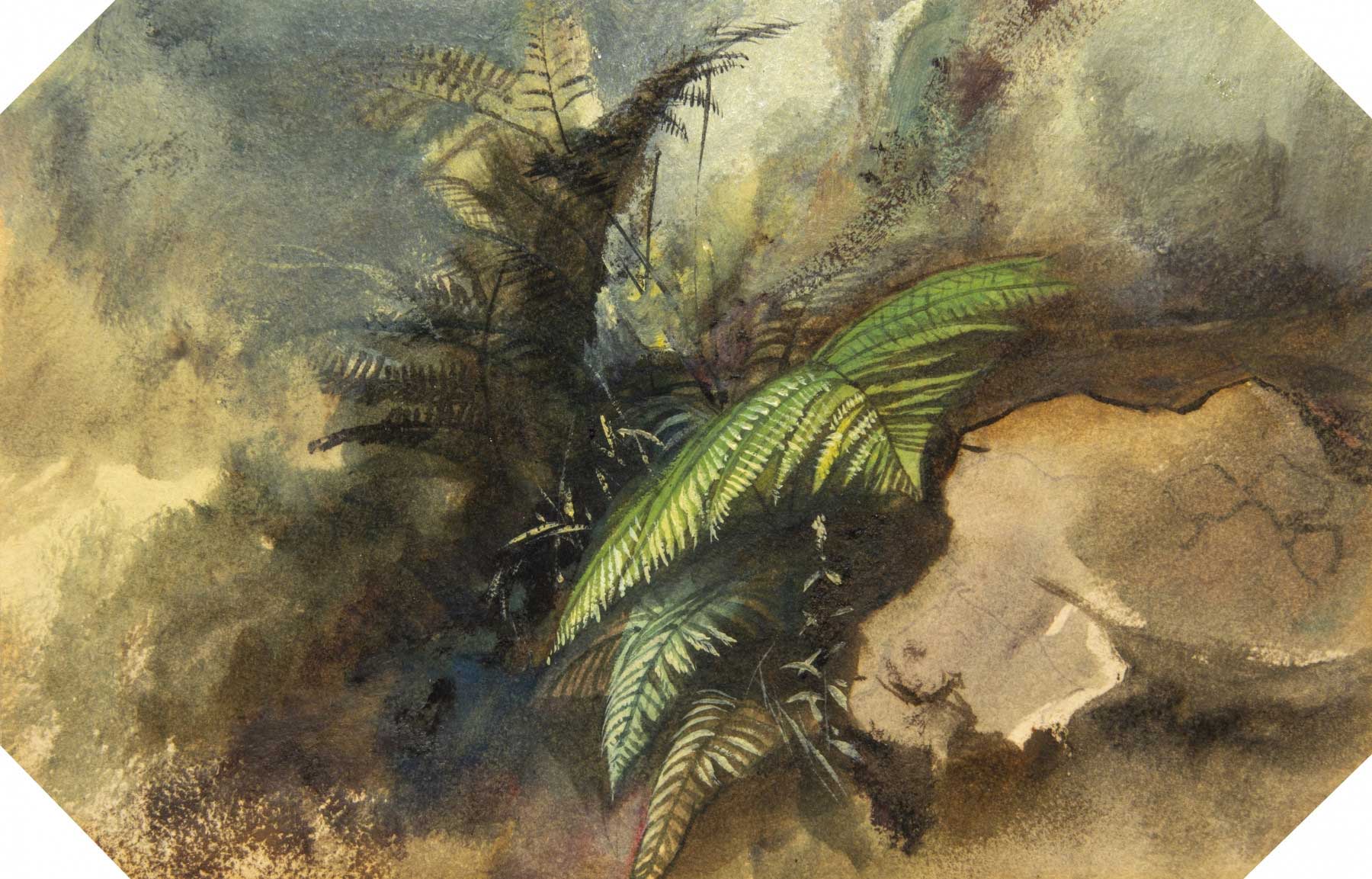
Edward Lear, Ferns.
Watercolour with oil and pencil. 5 x 7 ¾ inches.
Edward Lear, Ferns.
Watercolour with oil and pencil. 5 x 7 ¾ inches.
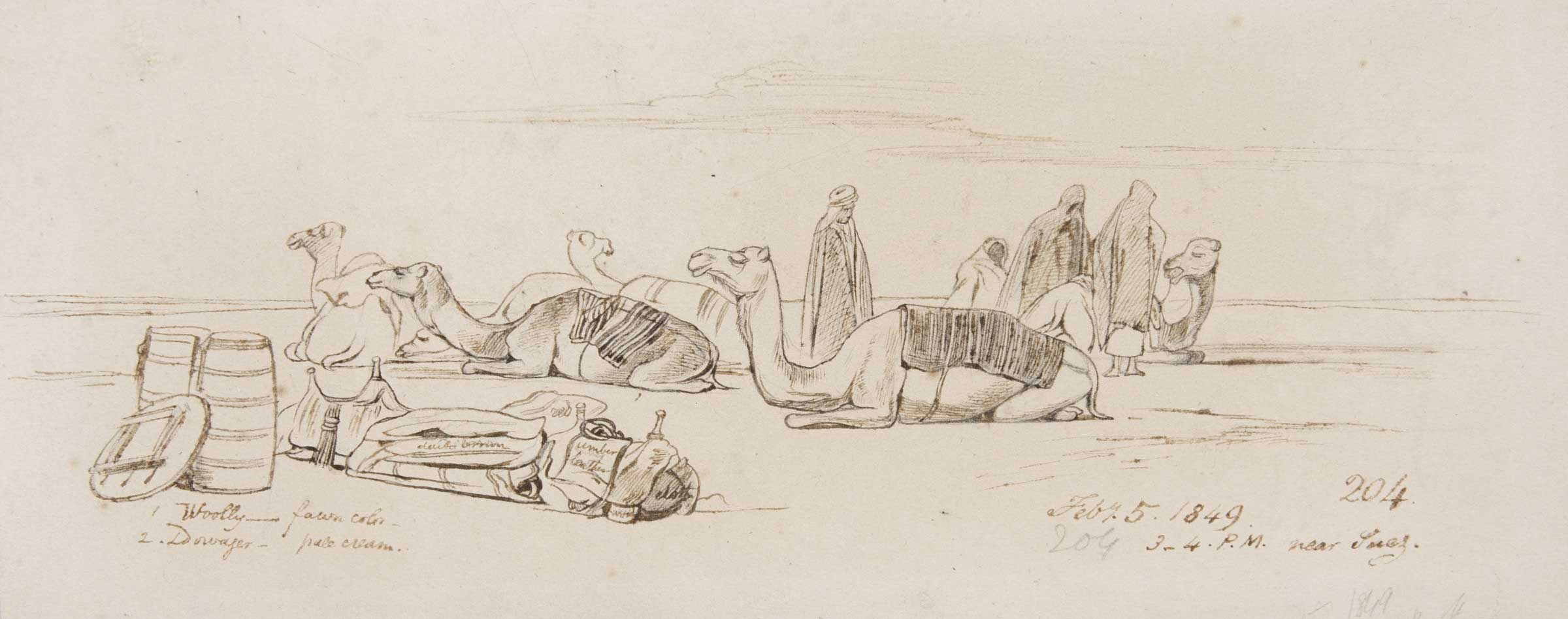
Edward Lear, Camels Resting near Suez.
Inscribed ‘204’, ‘near Suez’, ‘1. Woolly – fawn colour’ and ‘2. Dowager – pale cream’, and dated ‘Feby 5 1849. 3-4 pm’. Pen and ink. 4 x 10 inches.
Provenance
Andrew McIntosh Patrick;
Luke Gertler
Having been thinking about a trip to Egypt from early in 1848, Edward Lear arrived in Cairo in January 1849. There he met his old friend, the Reverend John Cross, who had offered to finance an expedition to Sinai and Palestine. They set out by camel on 13 January, and travelled along a route that can be charted through the many drawings that Lear made on the way, including those around Suez (15-17 January), of the wadis around Abu Zenima (20 January) and of Wadi Ferran (23 January).
Lear and Cross arrived at St Catherine’s Monastery, Mount Sinai, on 27 January 1849, and stayed there for three nights. However, during that time, Lear caught a cold, so they decided to turn back to Suez, and on their arrival, Lear was exhibiting signs of fever. They had ‘hoped to make Gaza, quarantine, and the Holy Land but, having stayed there for eight days … the weather turned bad and Lear suddenly became miserable and gave up. From Alexandria, he took ship for Malta’ (Peter Levi, Edward Lear: A Life, London: Tauris Parke paperbacks, 2013 (revised ed), page 121). He would eventually visit Palestine in spring 1858.
The present drawing was made outside Suez on 5 February 1849, near the end of the trip. It is likely to be at least one of five studies of camels produced on that day. Two others are in the collection of the Houghton Library, Harvard University. The first, numbered ‘200’ and drawn at 10 am, focusses on a single camel which has been tethered by its front leg. The second, numbered ‘201’ and drawn at noon, comprises studies of six dead camels in various states of decomposition, one of which is being picked over by vultures. As
the present – far more charming – drawing was numbered ‘204’ and drawn between 3 and 4 pm, Lear must have made two further studies in the time in between noon and 3 pm, probably also of camels.
In a letter to his sister, Ann, written between 16 January and 3 February, Lear described his experience of the beasts of burden. He compared the enjoyable sensation of riding one to sitting ‘on a rocking chair’, but found them to be easily irritated, so that ‘If you try to make them go faster – they grown’, as he expressed in his punning spelling, and ‘if you stop them or try to go slower – they growl also’.
We missed these nice pictures, early experiments in oil on paper by Lear, when preparing the Amalfi catalogue.
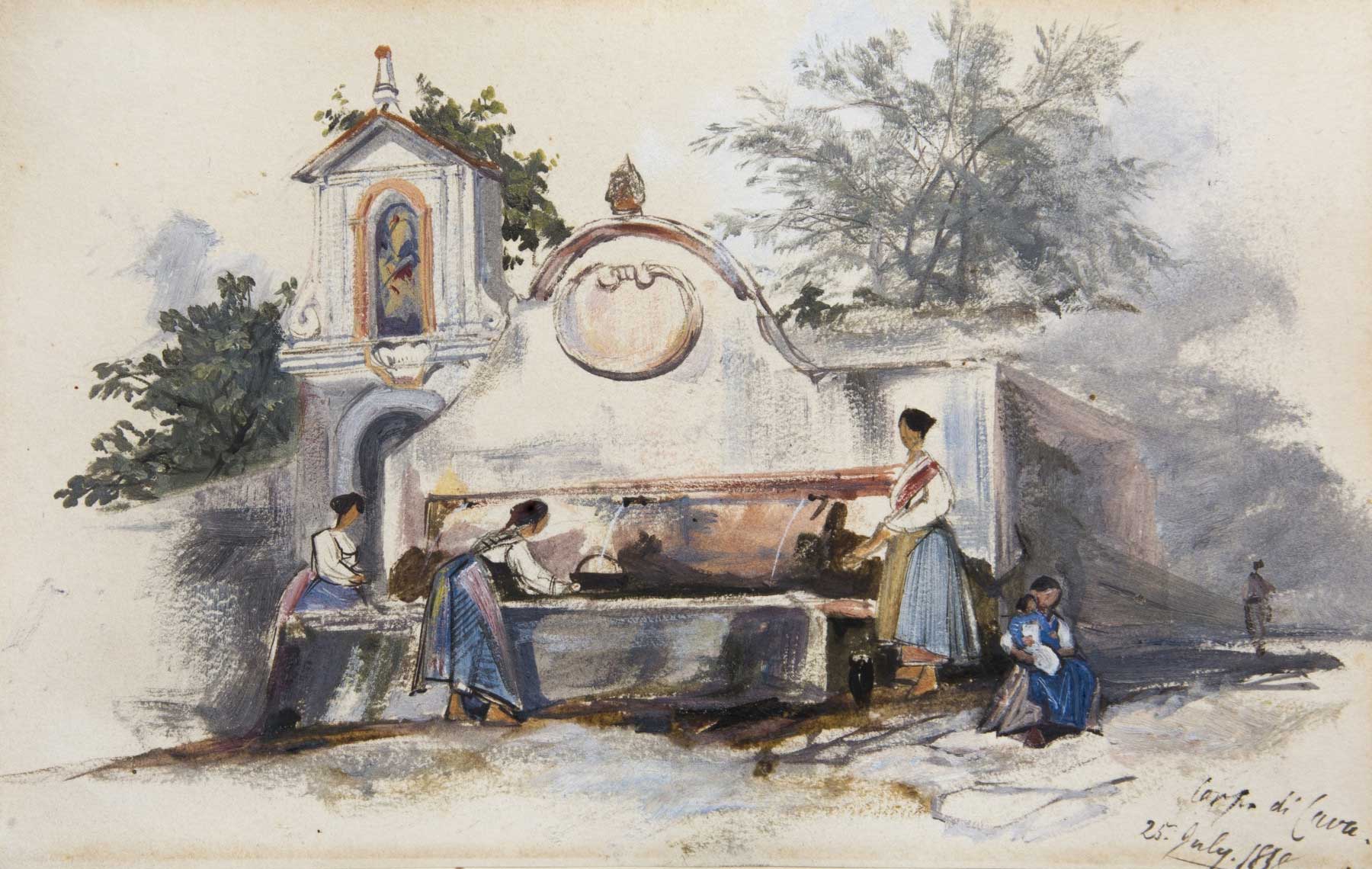
Edward Lear, Corpo di Cava.
Inscribed ‘Corpo di Cava’ and dated ’25 July 1838′. Pencil drawing of mother and child on reverse. Oil on paper. 5 ½ x 8 ¾ inches.
Early in 1837, a group of subscribers, led by the Earl of Derby and his cousin, Robert Hornby, commissioned Edward Lear to go to Rome to produce drawings (and, at the same time, to improve the state of his health). It would be his third trip to the Continent, but his first to Italy. He left England in July that year, and arrived in Rome in the December. Apart from two visits to England in 1841 and 1845-46, he then remained in Italy for a decade.
Each summer of that decade, Lear would travel to a different part of the country. In May 1838, he made a slow journey to Naples in the company of fellow artist, James Uwins. On their arrival, they found that they were staying in the same hotel – the Hotel de La Ville de Rome – as Samuel Palmer and his wife, Hannah, who were in the middle of their Italian honeymoon. However, Lear found Naples ‘all noise, horror – dirt, heat – & abomination’ (as he expressed in a letter to John Gould in the following year, on 17 October 1839). So, after a few days, he and Uwins moved on.
Travelling in a south-easterly direction, they settled at Corpo di Cava, a village situated at the head of a high wooded valley looking down to the Bay of Salerno. It had been the haunt of artists since the time
of Poussin and Rosa, and James Uwins’ uncle, Thomas Uwins RA, had painted there 10 years before, which may have prompted his and Lear’s visit. There they established a daily pattern of walking and sketching, punctuated by some longer expeditions, including that, in the middle of June, to the classical ruins of Paestum, which dominate the coastline about 30 miles south of Salerno.
Late in June, Lear and Uwins moved from Corpo di Cava to Amalfi, on the coast west of Salerno, and stayed for three weeks at the Albergo Cappucini, until 18 July. The visitors’ book reveals that they overlapped with Achille Vianelli and Ercole Gigante, two landscape painters of the School of Posillipo. It was following their return to Corpo di Cava in late July that Lear produced Collecting Water, Corpo di Cava. This shows Lear experimenting with oil – on paper – for the first time, sometimes purely and sometimes in conjunction with other, water-based media. His decade in Italy is defined in part by his decision to take seriously to oils. He and Uwins finally left Corpo di Cava at the beginning of August, in order to stay in Sorrento, on the southern extreme of the Bay of Naples. At the end of the month, they began their slow return to Rome.
‘Chris Beetles Summer Show’, 2020, No 29.

Edward Lear, Vietri sul mare.
Oil with watercolour and bodycolour.

Edward Lear, On the Road to Vietri sul mare.
Signed, inscribed “Vietra” and “13”, and dated “July 1838”. Pencil with bodycolour.
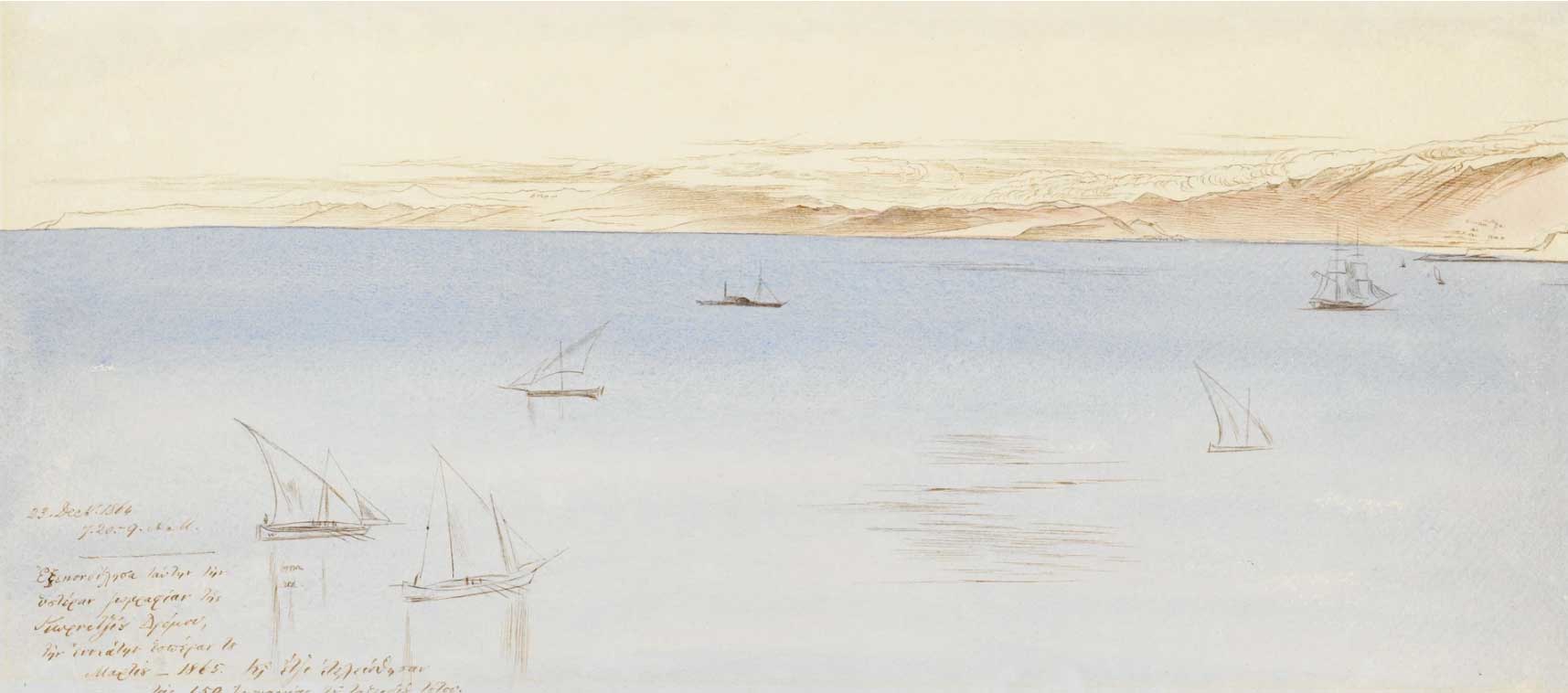
Edward Lear, View of Genoa.
Pen and brown ink and brown, pink and blue wash.
23 Decenmber 1864.
The Delineator, February 1918, p. 33.
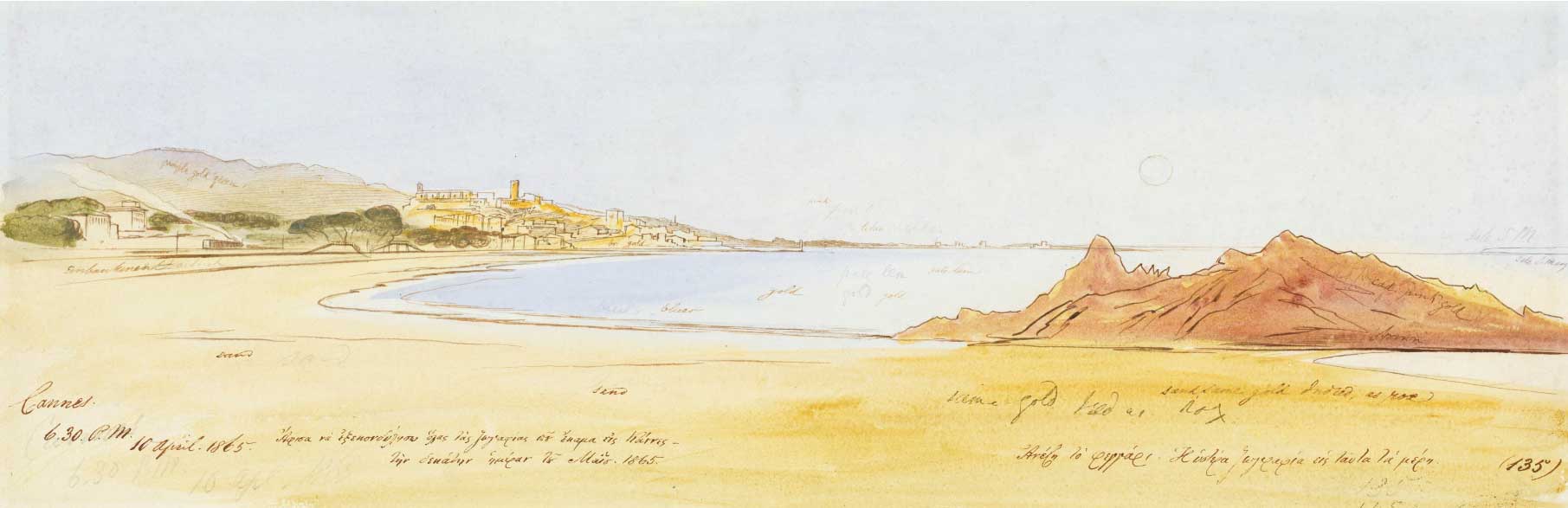
Edward Lear, Cannes.
Inscribed and dated ‘Cannes./ 3.30. P.M./ 10 April. 1865.’ (lower left) and numbered ‘135’ (lower right, and further inscribed in Greek and with colour notes). Pencil, pen and brown ink and watercolour. 6 7/8 x 21 ¼ in. (17.5 x 54 cm.)
Provenance
With Agnew’s, London, where purchased for the present collection (NINA R. AND ARTHUR A. HOUGHTON, JR.).
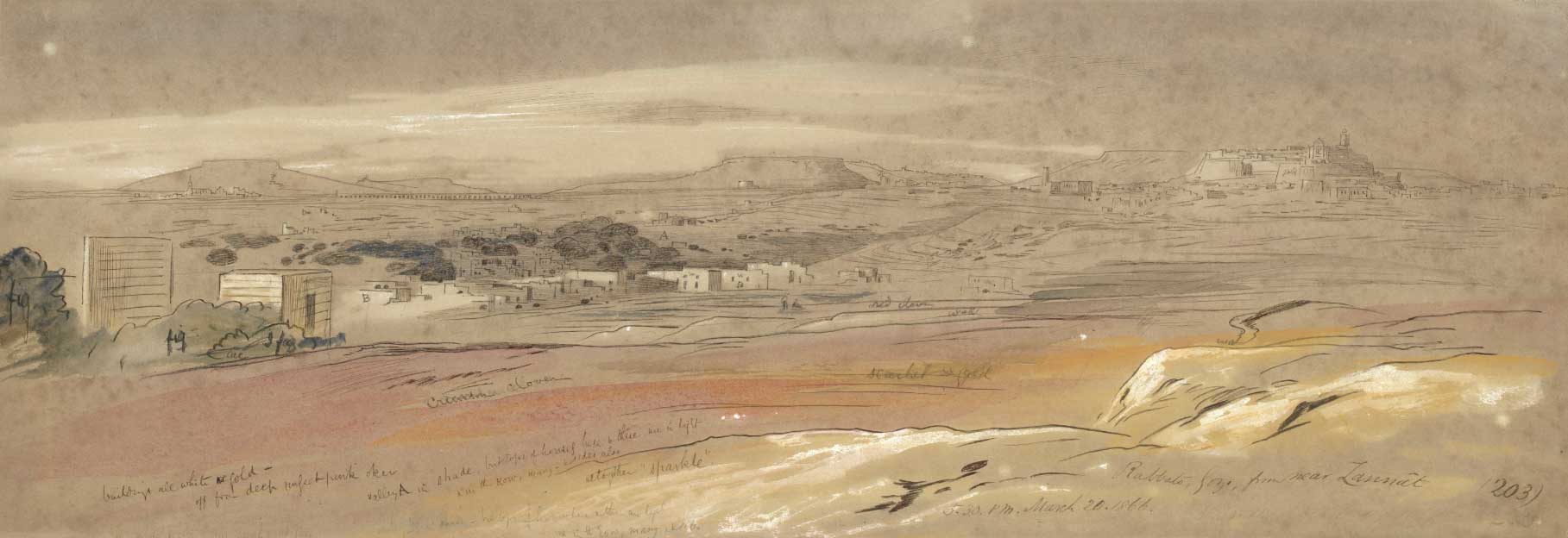
Edward Lear, Rabbato, Gozo, Malta.
Dated ‘5.30 P.M. March 20. 1866.’ and numbered ‘203’ (lower right) and extensively . Inscribed with colour notes throughout. Pen and brown ink and pink, green and ochre wash heightened with white on grey paper. 7 1/8 x 20 ¾ in. (18 x 52.8 cm.)

Edward Lear, Cannes.
Inscribed and dated ‘Cannes./5.4.5 PM. 8 April 1865 Isle Ste. Marguerite’ (lower left) and numbered (‘115’) (lower right), and further inscribed with the artist’s colour notes. Pen and brown ink and watercolour, heightened with white on blue paper. 6 1/8 x 19 5/8 in. (15.6 x 50 cm.)

Edward Lear, Argostoli and the Black Mountain, Cephalonia.
Inscribed, numbered and dated ‘Argostoli [in Greek]. (129)/May 5. 1863.’ (lower right) and extensively inscribed with colour notes. Pencil, pen and brown ink and watercolour. 12 7/8 x 19 ¾ in. (32.8 x 50.3 cm.)
Provenance
Gilbert Davis (L. 757a).
William Cavendish Bentinck, 9th Duke of Portland and by descent to
Anonymous sale; Christie’s, New York, 30 January 2014, lot 72.