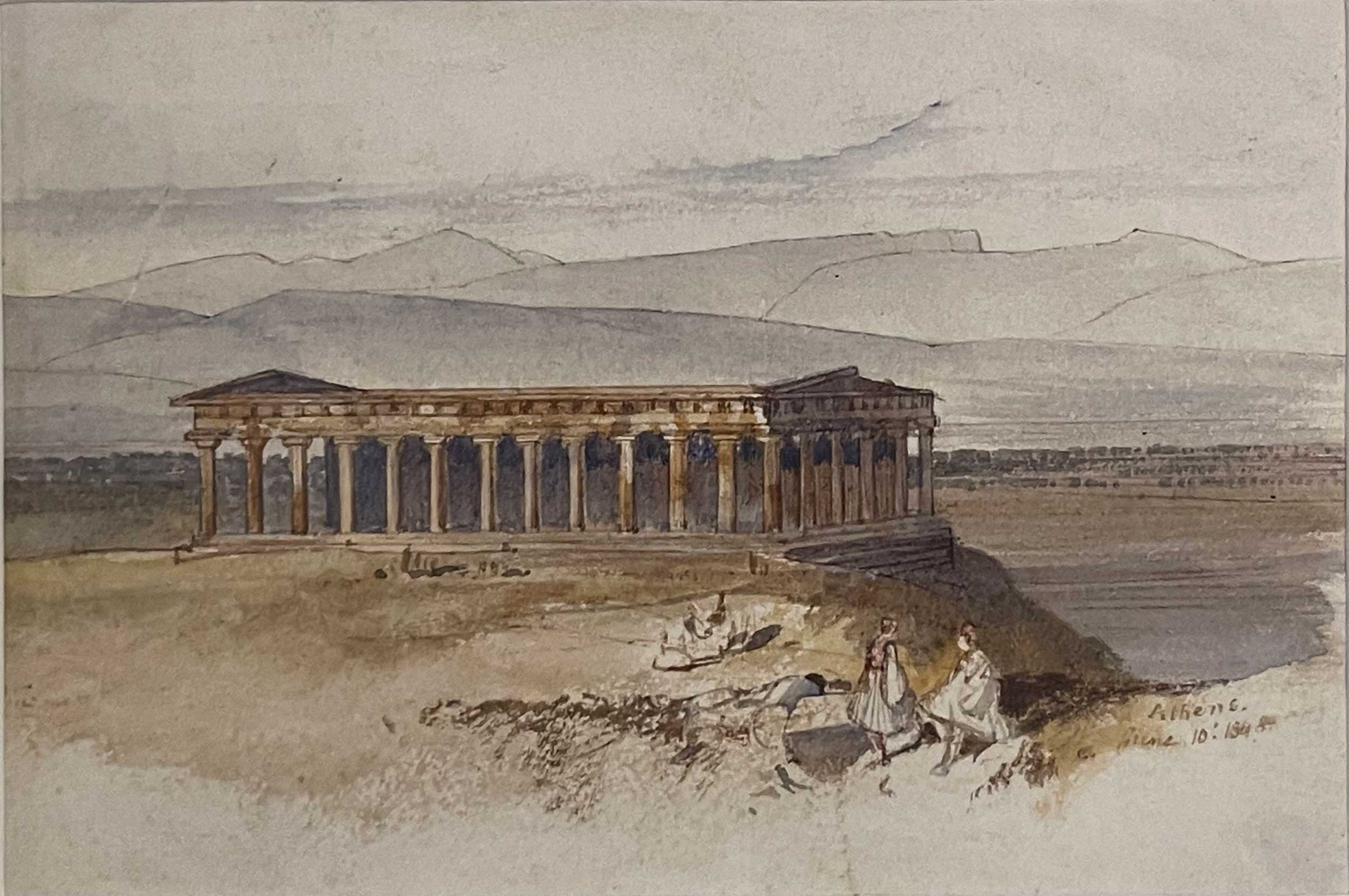
Edward Lear, Hephaistion (1848)

Edward Lear, Hephaistion (incorrectly described as “The Acropolis” in the Auction web page).
With seated figures in the foreground. On paper. Signed and dated. Inscribed: “Athens / June 10th 1848”. (reverse) Thomas Agnew & Sons label: “no 36717”; “no 75 E. Lear Athens”. 3.75 in x 5.75 in.

Provenance
Condylis Collection

The Saleroom.

With thanks to Rowena Fowler for correcting the description.


Posted in Edward Lear | Tagged , , , , | Leave a comment

The Limerick Man: Lear in Ireland

This Sunday, at 6 pm and free thereafter to listen to online, on the Lyric Feature on RTÉ lyric fm, Sara Lodge, author of the recent Inventing Edward Lear, presents The Limerick Man – the story of Edward Lear, and the influence of his visits to Ireland on his life and work.

Here is a short presentation.

You can now download the programme from this page. Or download it here.

Posted in Edward Lear | Tagged , , , | Leave a comment

Edward Lear, View of the Acropolis and the temple of Hephaistos, Athens (1848)

Edward Lear, View of the Acropolis and the temple of Hephaistos, Athens.

Pen and brown ink and watercolor over pencil, heightened with white; inscribed lower right: Athens – from the West / June 5-6-7- 1848 / 5; further inscribed with extensive color  notes. 319 by 495 mm; 12¾ by 19½ in.

Literature
R. Fowler and E. Well, Edward Lear’s Grecian Travels, on-line edition, unnumbered.

Lear made this on-the-spot drawing over three successive days (between 5 and 7 July 1848) shortly after arriving in Athens on his inaugural tour of Greece. The previous month, in Corfu, he had met Sir Stratford and Lady Canning who had asked him to accompany them to Constantinople, where Sir Stratford had recently been appointed British Ambassador to the Ottoman Empire.
In Athens, the Cannings organized for Lear to stay at the British embassy and Lear also met up with his friend, Charles Church (1825-1915), with whom he explored the city and traveled more widely in northern Greece.
Understandably, Lear could not wait to begin exploring and he wrote to his sister Ann the following day: ‘I have risen as early as I could this morning, & surely never was anything so magnificent as Athens!…. The beauty of the temples I know well from endless drawings – but the immense sweep of plain with exquisitely formed mountains down to the sea – & the manner in which that high mass of rock – the Acropolis – stands above the modern town with its glistening white marble ruins against the deep blue sky is quite beyond expectations.’1
A comparable drawing by Lear, showing this scene from a slightly different viewpoint, was sold at Christie’s in 2008.2

1. V. Noakes, Edward Lear: Selected Letters, Oxford 1988, p. 76*
2. Sale, London, Christie’s, 4 June 2008, lot 30 ($77,790)

Posted in Edward Lear | Tagged , , , , | Leave a comment

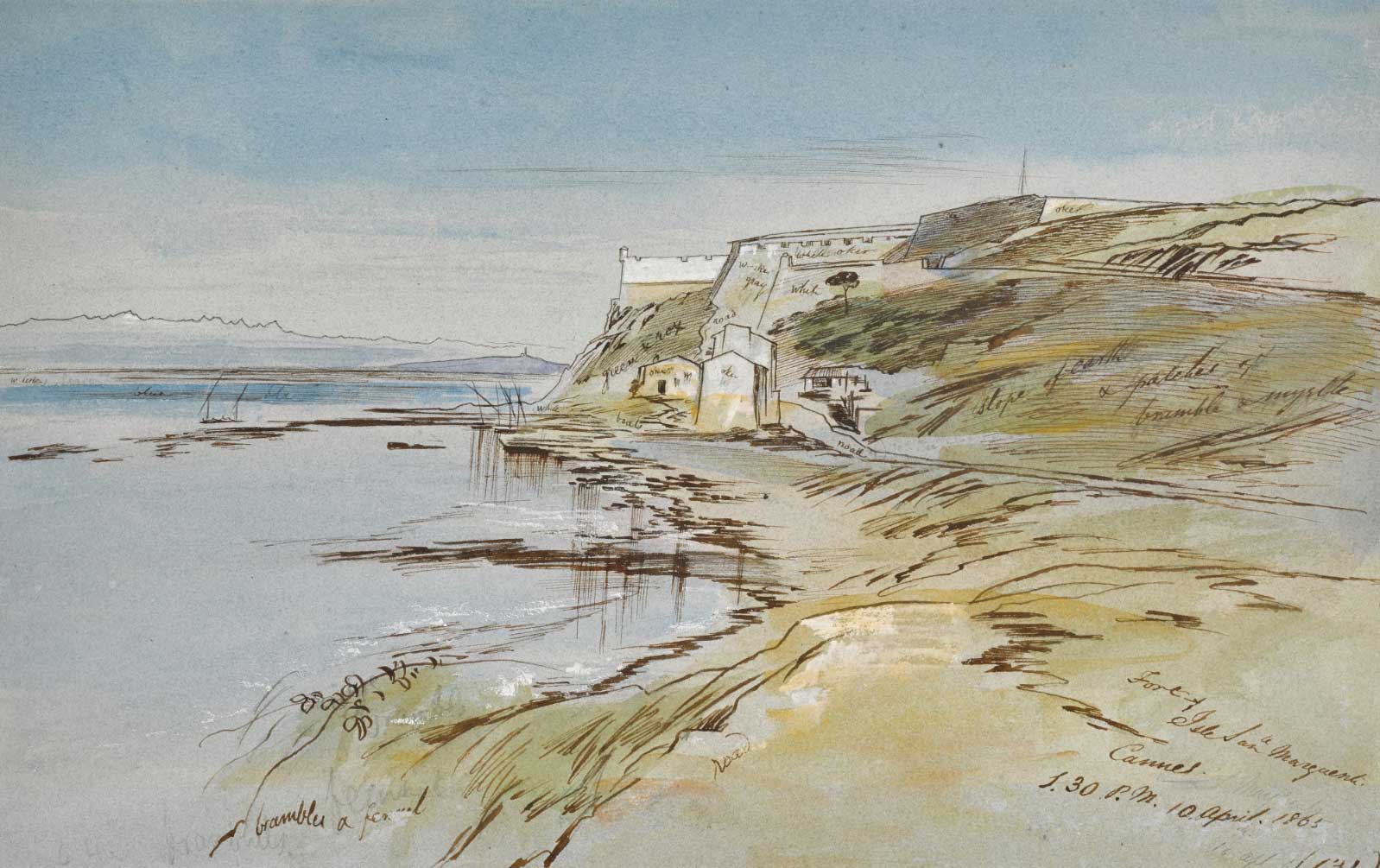
Edward Lear, Fort of Ile Sainte Marguerite, Cannes (1865)

Edward Lear, Fort of Ile Sainte Marguerite, Cannes.
Pen and brown ink and watercolor, heightened with white; inscribed and dated lower  right: Fort of Isle Sante Marguerite / Cannes. 1.30 P.M. 10 april. 1865 / (131), and  elsewhere with extensive color notes. 315 by 505 mm; 12½ by 12⅜ in.

Provenance
With Agnew’s, London;
with Chris Beetles Gallery, London

Exhibited
London, Chris Beetles Gallery, Summer Show, 2018, no. 21

Between November 1864 and April 1865, Edward Lear stayed on the French Riviera, in order to produce work for an exhibition that he planned to hold later in the year. Basing himself in Nice, he visited towns along the coast, including Antibes and Cannes. At the end of his sojourn, he spent a week in Cannes and, on his return to London, wrote to his friend Chichester Fortescue, Lord Carlingford, that he was ‘absolutely delighted’ with the town, finding it ‘different’ and preferable to Nice. In a postscript to the letter, he added, that he had produced 125 sketches ‘at Nice, Antibes and Cannes’.1
Thanks to Lear’s habit of dating and numbering his drawings, the pattern and prolificacy of his work can be charted in some detail. On 10 April 1865, he spent the day on the Lérin Islands, just off the coast of Cannes, first visiting Saint-Honorat, where he made at least nine drawings, and then Sainte-Marguerite, where he made the present one, and probably others.
Ile Sainte-Marguerite is the largest of the Lérin Islands, and is home to the Fort Royal, which was built in the early seventeenth century, and became a barracks and state prison a few decades later. The fort is most famous for holding the unidentified prisoner known as ‘Man in the Iron Mask’, who died there in 1703.

1. Ed. Lady Strachey, Later Letters of Edward Lear, (21 April 1865), London 1911, p. 61

Sotheby’s.

Posted in Edward Lear | Tagged , , , , | Leave a comment

The Edinburgh Companion to Nonsense Literature

Barton, Anna, and James Williams, eds. The Edinburgh Companion to Nonsense. Edinburgh: Edinburgh University Press, 2022.

Introduction: Companionable Nonsense – Anna Barton and James Williams

Part I: Notes towards a History of English Nonsense

1. Buba, Blictrix, Bufbaf: Medieval Theory and Practice of Nonsense – Jordan Kirk
2. ‘The Best Fooling’:
Every Man Out of His Humour, Twelfth Night, and Early Modern English Nonsense Games – Rebecca Fall
3. Nonsense in the Age of Reason – Freya Johnston
4. ‘The Light of Sense | Goes Out’:
Romantic Poetry and Victorian Nonsense Poetry – Peter Swaab
5. Victorian Nonsense and Its Kinships – Martin Dubois
6. Shady Pleasures: Modernist Nonsense – Noreen Masud
7. Mid-Century Nonsense and Destructive Mockery – Adam Piette

Part II: Global Nonsenses

8. In Search of Ancient Greek Nonsense – Sara Chiarini
9. Traditional Moorings, Modern Practices: Indian Literary Nonsense – Sumanyu Satpathy
10. Signs and Wonders: Two Approaches to Nonsense in Russia – Jamie Rann
11. ‘What’s the French for fiddle-de-dee?’: Nonsense in French – Alexandra Lukes
12. Italian Nonsense: Tradition, Translation, Translocation, Transcodification (and a Trinity) – Alessandro Giammei

Part III: Contexts and Connections

13. English ‘hibber-gibber’ and the ‘jargon of France’: Rabelaisian Nonsense in Translation – Hugh Roberts
14. Musical Foundations of Nonsense – Michael Heyman
15. Doubtful Girls and Silly Women: Nonsense and Gender – Anna Barton
16. Queer Nonsense: Query? – Hugh Haughton
17. Humans, and Other Nonsense Animals – Cassie Westwood
18. Nonsense Among the Philosophers – Michael Potter
19. ‘Word beyond Speech’: Nonsense and the Sacred – James Williams

The Edinburgh Companion to Nonsense presents several interesting and informative articles on the subject, the great majority of which, including the one on the Victorian period, largely avoid the two recognised masters of the genre: a welcome decision as the literature on them is by now quite abundant. The essays, as you can see from the table of contents above, are divided into three main sections, the first of which  provides a sketch of the history of nonsense in English, the second takes a look at some of the traditions in other countries (in many of which the authors candidly admit that there is nothing comparable to English nonsense), and the last contains less easily classifiable material concerning particular critical approaches to nonsense or its relationship to other disciplines.

While all the essays present stimulating discussions of the nonsensical practices of a number of authors or of particular periods, what is missing is any attempt at a definition of nonsense: none, not even the introduction, confront the issue of what nonsense is, which is perhaps not strange given how differently each author confronts the peculiar traditions of distant times and places. This is a conscious choice of the editors, who write: “we have made no attempt as editors to police the views or positions of our individual contributors.”

They also write that they “are receptive to the thought that there might be modes of nonsense that move outside of language (the proper domain of ‘sense’) altogether, that other art forms might generate their own form of ‘nonsense'” but, apart from Hayman’s essay on music and nonsense, there is very little about nonsense in different media, in particular the visual mode, which is certainly relevant to Lear and Carroll, as well as to many other kinds of nonsense.

The book is certainly an important addition to the criticism of a number of literary nonsense practices and to several authors who have used nonsensical techniques in their works, though a less eclectic variety of subjects might have made it of greater interest to non academic readers.
Posted in Edward Lear, General, Lewis Carroll, Nonsense Lyrics | Tagged , , , | 1 Comment

“Nonsense!” – Words from Edward Lear, music by Mel Orriss

Festive Flutes and Mel Orriss perform six of Lear’s limericks set to music.

Posted in Edward Lear, Limerick | Tagged , , | 1 Comment

Southampton University’s Christmas Concert (with Lear-related Music & Lecture)

Southampton University Chamber Choir gives its Christmas Concert on Friday December 10th in Turner Sims at 8pm, conducted by Simon Pettite.

Beautiful Christmas choral music by Josquin (who died 500 years ago) and Sweelinck, plus the first performance of David Owen Norris’s new piece Letters from Lear: a musical portrait, with the tenor Mark Wilde and Helen Sanderson, guitar.

Niki Demetriou, Martha Raban and Hope Felts-King are taking part too, along with Mark’s daughter, Heather.

By a happy coincidence, the grandfather of Professor Francesco Izzo translated Edward Lear’s Nonsense Rhymes into Italian, and Francesco will be reading some of them at the concert, in Italian. We can guess which famous limerick each might be!

And there’ll be a few Christmas surprises too. I hope you might be able to come. Student tickets are £5.

More information at Turner Sims’s “Christmas with Edward Lear”

Here is a preview of David Owen Norris’s Letters from Lear: a musical portrait:

Music students and staff are very welcome to a 45’ talk by Dr. Sara Lodge on Thursday 9th December at 4pm on Avenue Campus, in Lecture Theatre C:

‘Bongs, Dongs and Nonsense Songs: Edward Lear’s Music’

Edward Lear (1812-1888) is well known as a writer and illustrator of nonsense verse for children, such as ‘The Owl and the Pussy-cat’. But few know that Lear was also a gifted musician and composer, who wrote and published twelve song-settings of his friend Tennyson’s poems . He was also an entertainer, who delighted in setting fresh words to old tunes for comic effect. Indeed, his nonsense poems were all originally songs. This talk will explore Lear’s love of music, his musical compositions, and what an understanding of his musical milieu can tell us about his poetry.

Sara suggests that before her talk, we might have a look at ‘The Owl and the Pussy-cat‘, ‘The Jumblies‘, ‘The Dong with a Luminous Nose‘, and ‘The Courtship of the Yonghy-Bonghy-Bo‘. All of these can be found online at nonsenselit.org which also has a number of useful links to other resources on Lear:

Sara Lodge is a Senior Lecturer in English at the University of St Andrews, specialising in nineteenth-century literature and culture. She has broadcast on Edward Lear on Radio 3 and RTE Lyric FM and is the author of an interdisciplinary study Inventing Edward Lear (Harvard UP, 2018), which was a Choice Outstanding Academic Title for 2019. She has recorded all of Lear’s music, making it available to the public for the first time, with the help of pianist David Owen Norris and various singers. Her research has also revived many lively contemporary settings of Lear’s songs by Victorian female composers, showing how Lear’s nonsense was interpreted musically in his lifetime and how he responded positively to these creative interpretations.

Posted in Edward Lear | Tagged , , | Leave a comment

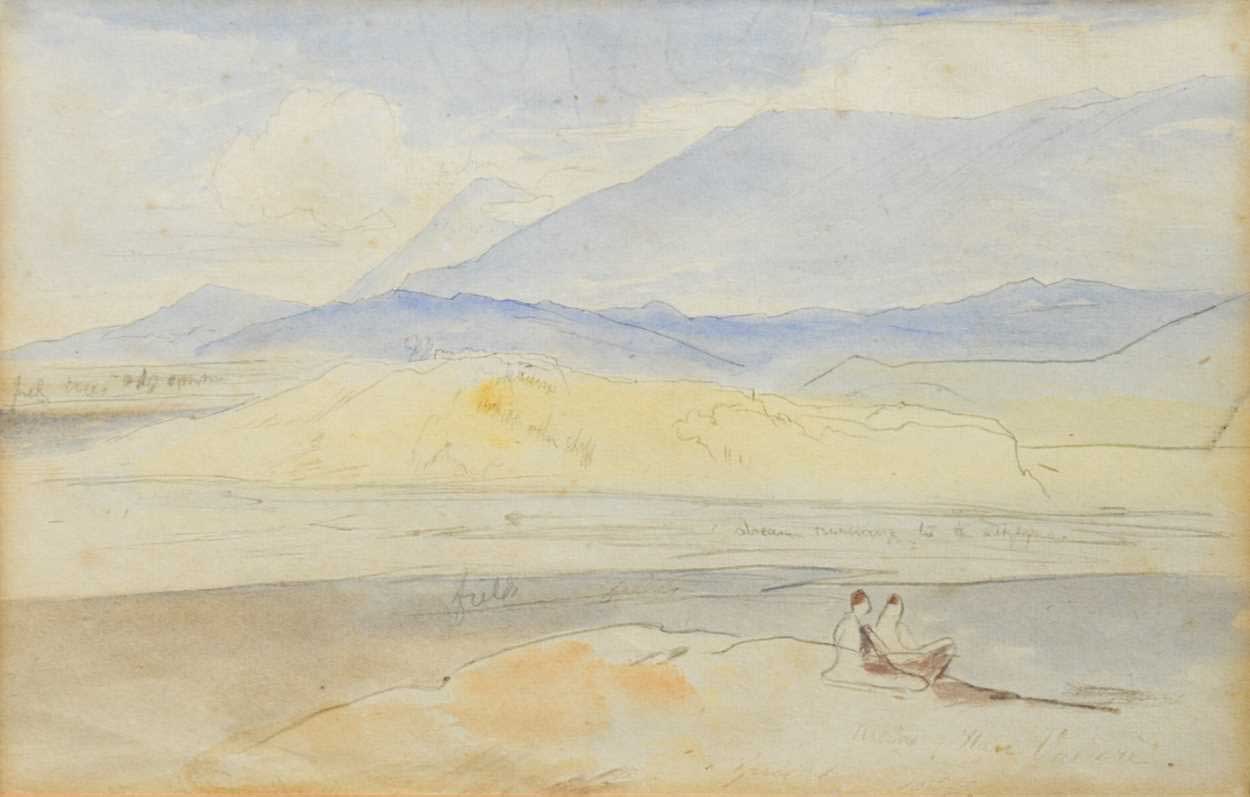
Edward Lear, Khan of Valaré (1857)

Edward Lear, A landscape study with figures wearing fez hats, from a sketchbook,  depicting the site of the former khan of Valaré (Albanian Valarë).
Inscribed and dated ‘Ruins of Han [sic] Valarè / April (1?) 1857’ (lower right) and with artist’s annotations. Pencil and watercolour on paper. 12 x 19cm.

On 2nd April 1857, Lear set out from Corfu on a three-week tour of Albania and Greece, arriving at the harbour of Tre Scoglie (today’s Ksamil). Lear’s diary for 1857 is no longer extant and the account of his journey is only known from a letter to his sister Ann, dated 23rd April 1857, the day he returned to Corfu. According to the letter, Lear had made 98 drawings on his travels, of which only about a third have been located.

The present study depicts the site of the former khan of Valaré (Albanian Valarë), which Lear visited on 19th April 1857.
The watercolour is loosely attached to card that is inscribed in later hand ‘Ruins of Hase Valiere [sic] Albania’.

The Saleroom.

Posted in Edward Lear | Tagged , , , , | Leave a comment

Edward Lear, Landscape near Tivoli (1840)

Edward Lear, Landscape near Tivoli (Lunghezza).
Pencil, inscribed and dated 8th of May 1840, 8.5″ x 16″, Provenance: Agnew’s Exhibition and Abbot and Holder.

The Saleroom.

Posted in Edward Lear | Tagged , , , , | Leave a comment

Edward Lear, Bab el Kalabshe on the Nile (1871)

Edward Lear, Bab el Kalabshe on the Nile.
Signed with initials lower left; inscribed Bab el Kalabshe on the Nile on the overlap; inscribed, signed and dated Bab el Kalabshe. on the Nile / Edward Lear / 1871 on a label on the stretcher and signed and dated Edward Lear 1871 on a label on the stretcher.
Oil on canvas. 24.5 by 47.5cm., 9½ by 18¾in.

This recently rediscovered oil, painted in 1871, is appearing for the first time at auction having remained in private hands for three generations. The painting provides a fascinating record of old Kalabsha, situated on the Nile about 50km south of Aswan and now submerged under Lake Nasser. A lone dhow graces the water in the distance, while figures amble to the edge of the river on the right. The rocks glow in the desert heat and a tinge of pink bathes the left edge of the river bank that curves out of sight. The clear and brilliant colour of Egypt and in particular the Nile, both challenged and astonished Lear, and the present work is a culmination of this admiration.

Lear had previously sketched Kalabsha on his third visit to Egypt in 1867. Early in the year he painted areas around Dendour and Philae and notably at 5.10pm on the 16 February painted at ‘Bab el Kalabshe’ according to an inscribed watercolour now in the collection of the Yale Centre for British Art. Two days later he was ‘between Daboad & Phila’ and produced a watercolour of a large boat on the river’s bank, and subsequently two other watercolours executed in February 1867 feature the same vessel. This might have been the ship he was travelling on and the same as that he chose to depict in this oil, painted four years later.

After extensive travelling through Europe and the Middle East, in March 1871 Edward Lear settled in San Remo, where he built a house he called Villa Emily after his friend and wife of poet Alfred Tennyson. He published Nonsense Songs, Stories, Botany and Alphabets which included his famous nonsense song, The Owl and the Pussycat. He also executed a number of oils re-visiting his sketches, studies and notes from Egypt, producing the present work, and paintings titled Nile boats near Deir el kadige, Sunset on the Nile, above Aswan and Negadeh, on the Nile near Thebes.

Sotheby’s.

Posted in Edward Lear | Tagged , , , , | Leave a comment