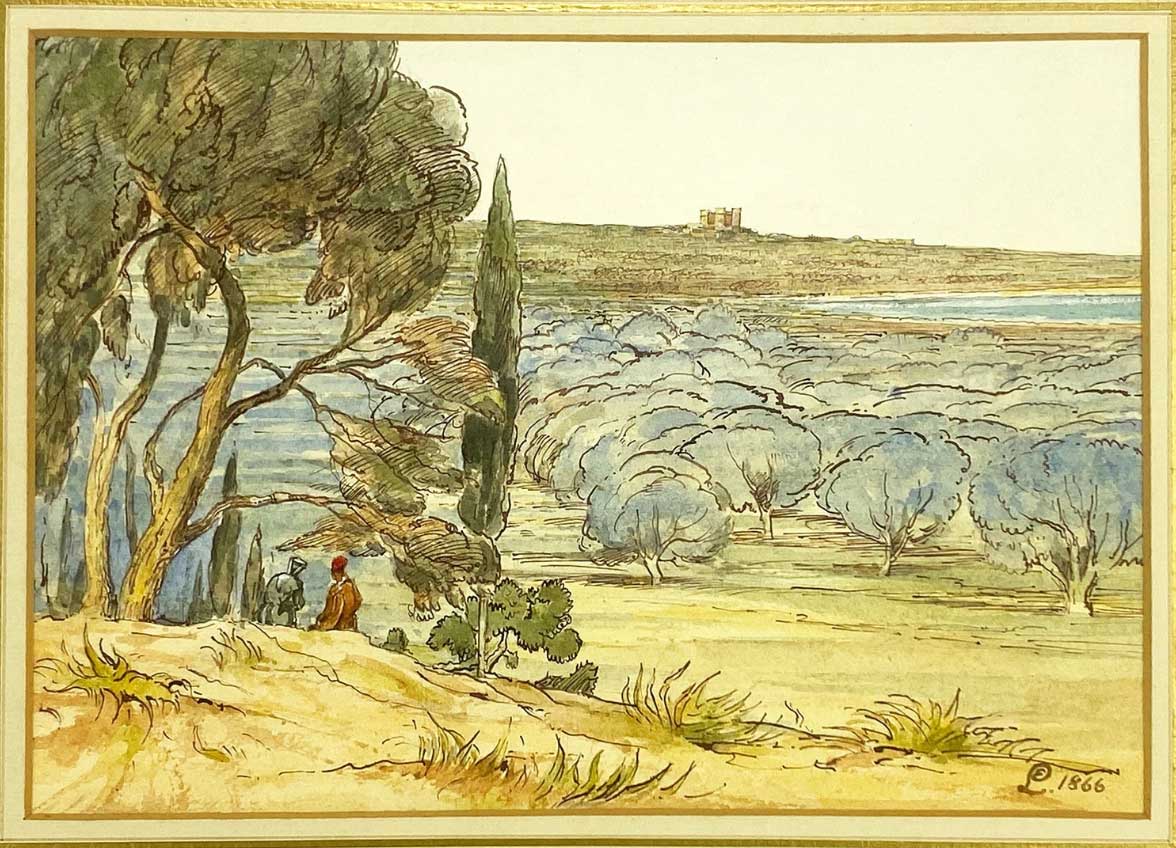
Edward Lear, The Red Tower or St. Agatha’s Tower, Malta.
1866. Watercolor and ink on paper. 7.5 by 10.75.
Edward Lear, The Red Tower or St. Agatha’s Tower, Malta.
1866. Watercolor and ink on paper. 7.5 by 10.75.

‘There was an old person of Skye,/ Who was nearly a hundred feet high;/ He seemed to the people/ As tall as a steeple,/ And served as a lighthouse on Skye.’ (upper left)
pen and brown ink, partial watermark ’18…’
4 7/8 x 7 7/8 in. (12.5 x 20 cm.)
NONSENSE DRAWINGS BY EDWARD LEAR, FROM THE COLLECTION OF NINA R. AND ARTHUR A. HOUGHTON, JR. (LOTS 121-129)Although rarely seen on the market, Lear’s Nonsense poems and limericks, with their accompanying drawings, are perhaps his best known works, familiar across the world. They come from the time Lear spent at Knowsley between 1831 and 1837, when he was commissioned to produce drawings of the menagerie of Lord Stanley, later the 13th Earl of Derby. Lear entertained the many children who visited Knowsley with poem and songs, and with a series of illustrated limericks. These were not gathered together and published until 1846, when they were published anonymously by Thomas McLean as Book of Nonsense. Several drawings exist for each published limerick, as he often gave them as gifts to children, and 48 Nonsense drawings remain in an album at Knowsley. He continued to produce Nonsense drawings and limericks throughout his life, and A Book of Nonsense was republished several times, alongside 3 further books of Nonsense drawings and limericks. Lear wrote to Norah Bruce in 1870, ‘Nonsense is the breath of my nostrils’, and his joy in the absurd and ridiculous is immediately obvious in these drawings. The present group of drawings relate to a variety of his Nonsense books, and indeed some were never published in Lear’s lifetime and are fairly recent discoveries.

‘There was an old person of Calais/ Who lived in a blue marble palace./ But in coming downstairs,/ He encountered some bears/ Who devoured that old person of Calais.’ (upper left)
pen and brown ink
4 7/8 x 7 7/8 in. (12.5 x 20 cm.)

‘There was an old man of the Rhine, who thought it was going to be fine,/ So he walked for six hours through wind and through showers/ that resolute man of the Rhine.’ (upper centre)
pen and brown ink, partial watermark ‘…37’
4 7/8 x 7 7/8 in. (12.5 x 20 cm.)

‘There was an old person whose wish/ Was to swallow a very large fish -/ So he asked his 7 daughters/ To cut it in quarters,/ And boil it for tea in a dish.’ (lower left)
pen and brown ink, partial watermark ‘…37’
4 7/8 x 7 7/8 in. (12.5 x 20 cm.)
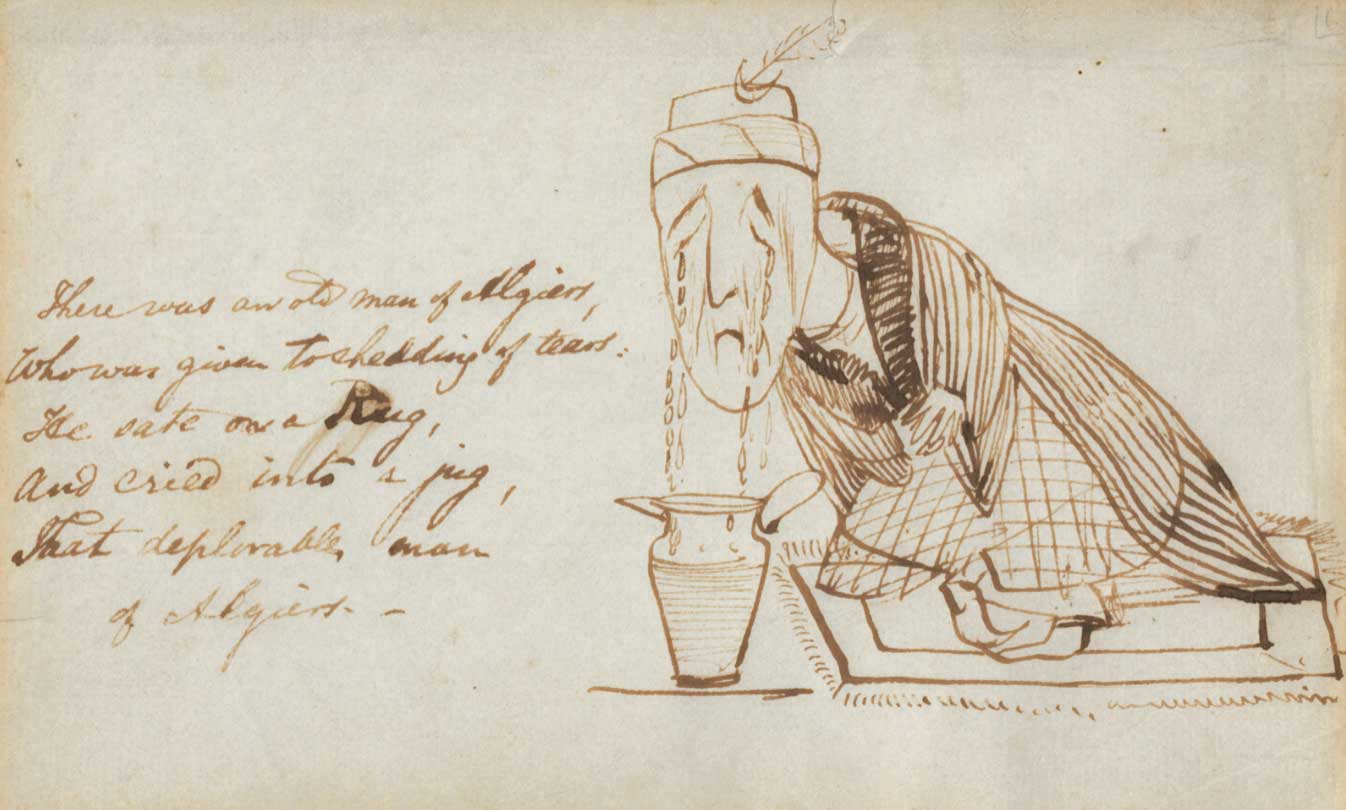
‘There was an old man of Algiers,/ Who was given to shedding of tears./ He sat on a Rug,/ And cried into a jug,/ That deplorable man/ of Algiers’ (centre left)
pen and brown ink
4 7/8 x 7 7/8 in. (12.4 x 20 cm.)

‘There was an old man of Toulouse/ who purchased a new pair of shoes;/ When they asked, “Are they pleasant?” He said, “Not at present.”/ That turbid old man of Toulouse.’ (lower centre)
pen and brown ink
5 ½ x 6 1/8 in. (14 x 15.6 cm.)
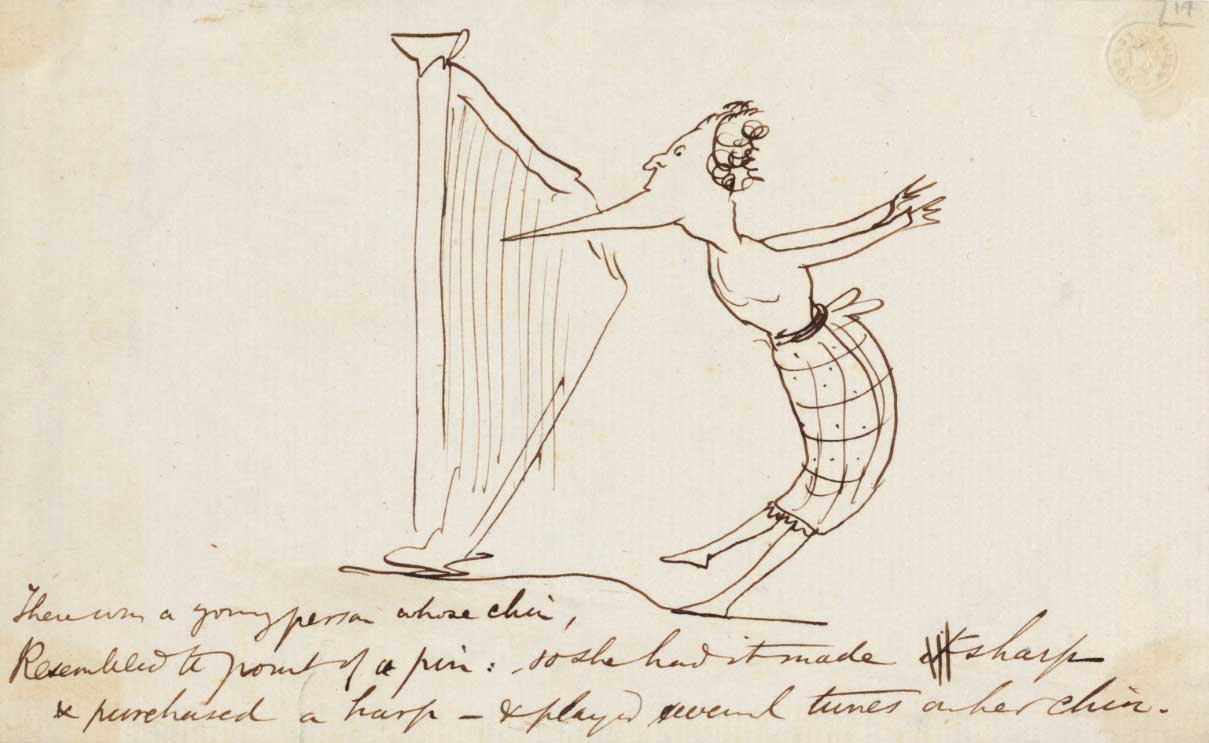
‘There was a young person whose chin,/ Resembled the point of a pin: so she had it made sharp/ & purchased a harp – & played several tunes on her chin’ (lower centre)
pen and brown ink on paper blindstamped ‘SUPER LONDON’
4 3/8 x 7 1/8 in. (11.1 x 18.1 cm.)

‘There was an old person of Oude/ Who fled when was he was not pursued,/ When called back by his mother/ He answered “Oh! bother!”/ That naughty old person of Oude.’ (lower centre)
pen and brown ink, blindstamped ‘… LONDON’ (lower left)
4 7/8 x 7 7/8 in. (12.5 x 20 cm.)

‘There was an old man with an Owl/ Who continued to bother & howl:/ He sat on a rail & imbibed bitter ale/ Which appeased that old man and his owl.’ (lower left)
pen and brown ink
4 3/8 x 7 in. (11.1 x 17.8 cm.)
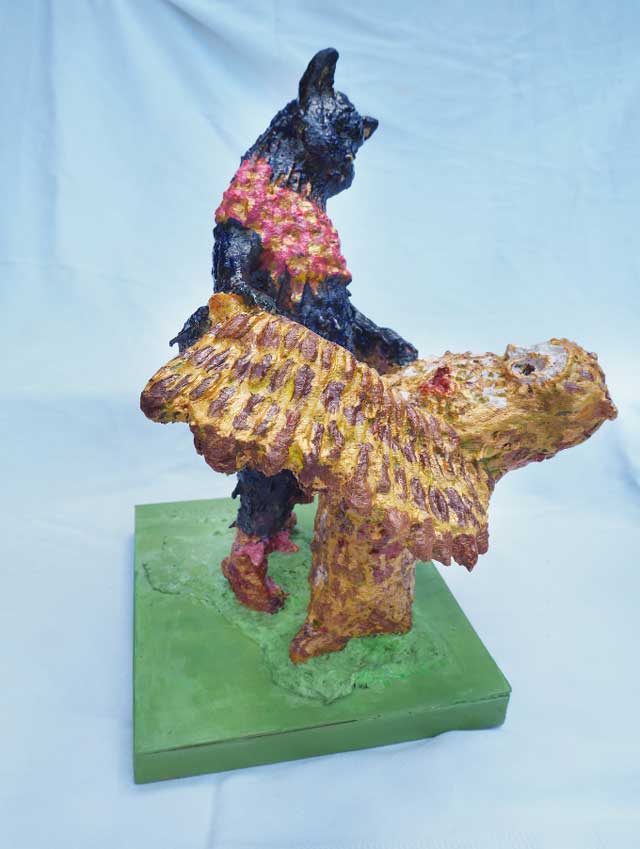

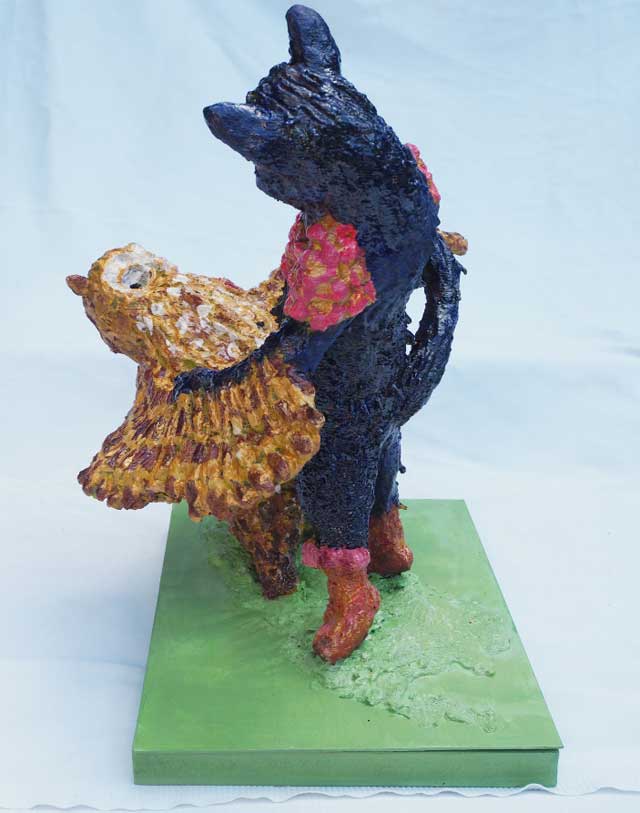
Lydia Karpinska, The Owl and the Pussy-cat.
Capturing joy and movement from every angle, this charming intrepretation entitled They danced by the light of the moon, is of course the unmistakable owl and pussy cat of Edward Lear. This piece is the work of sculptor Lydia Karpinska BA, M.R.B.S. This study in mixed media resin, patinated and hand finished by the artist, is 20cm x 37cm x 27cm A wonderful addition to an existing collection, or equally as a charming accent stand alone piece. Lydia is an artist whose public sculptures include Windsor Lady (HM Queen Elizabeth ll) complete with Corgis at Batchelors Acre Park, Windsor, Sir Nicholas Winton whose seated figure partially occupies a bench at Maidenhead Station. Vintage Boys and The Boy & Boat, Maidenhead. Green Man, Woburn Square, London. Swing, Skate, Star, Elms Park, Bracknell and Water Babies, Wokingham.

Edward Lear, Kandy.
Dec 2. 1894 [but actually 1874], 7.45AM,:- pencil, watercolour, pen and brown ink drawing inscribed as titled, further annotated, ‘bamboo’, ‘green for misty’, ‘cabbidge palm’, ’12ft high’ …. 16 x 34.5cm.
Provenance
With Thos. Agnew & Sons Ltd.
Exhibition label
‘2. E.Lear. Kandy, Ceylon’.

Edward Lear, Garf Hoseyn.
Inscribed Garf Hoseyn/ 2.15. PM. 1867./ Feby.15.1867 in ink (over a similar inscription in pencil), numbered (483) lower right, with artist’s colour notes, pen and brown ink with coloured washes, heightened with white. 30.5 x 53cm.
A slightly earlier drawing of the same subject (near Lake Nasser, Nubia, Egypt), timed at 12.30pm on the same day (and numbered 480) is in the collection of The Yale Center for British Art (Gift of Donald C. Gallup), New Haven, Connecticut
The latest TLS (no. 6169 of 25 June 2021) contains three new Nonsense compositions by Edward Lear, found by Amy Wilcockson and Edmund Downey among the papers in the Charnwood Autograph Collection, British Library Add MS 70949, f. 239, f. 243 and ff. 244-5.
One is a never before seen limerick:

Another poem, “Lays of the Octopods (The Last of the Octopods),” the editors had already published in Notes & Queries last year.
The third item is a letter, with a self caricature which is not reproduced in the paper, unfortunately. The issue of the TLS also contains an article by Thomas Dilworth on a “viral” limerick.
After the series devoted to the Johnson’s Family visit to the World’s Columbian Exposition of 1893 (now completed with the missing eighth number), Peter Newell was sent to the Exposition Universelle Internationale in Paris in 1900 and produced another picture story, whose protagonist was “Uncle Jeff Pettingill.”
Nichol Allen was so kind to send me the whole series, which appeared in Harper’s Weekly from 2 June to 15 September 1900, so here it is:
2 June
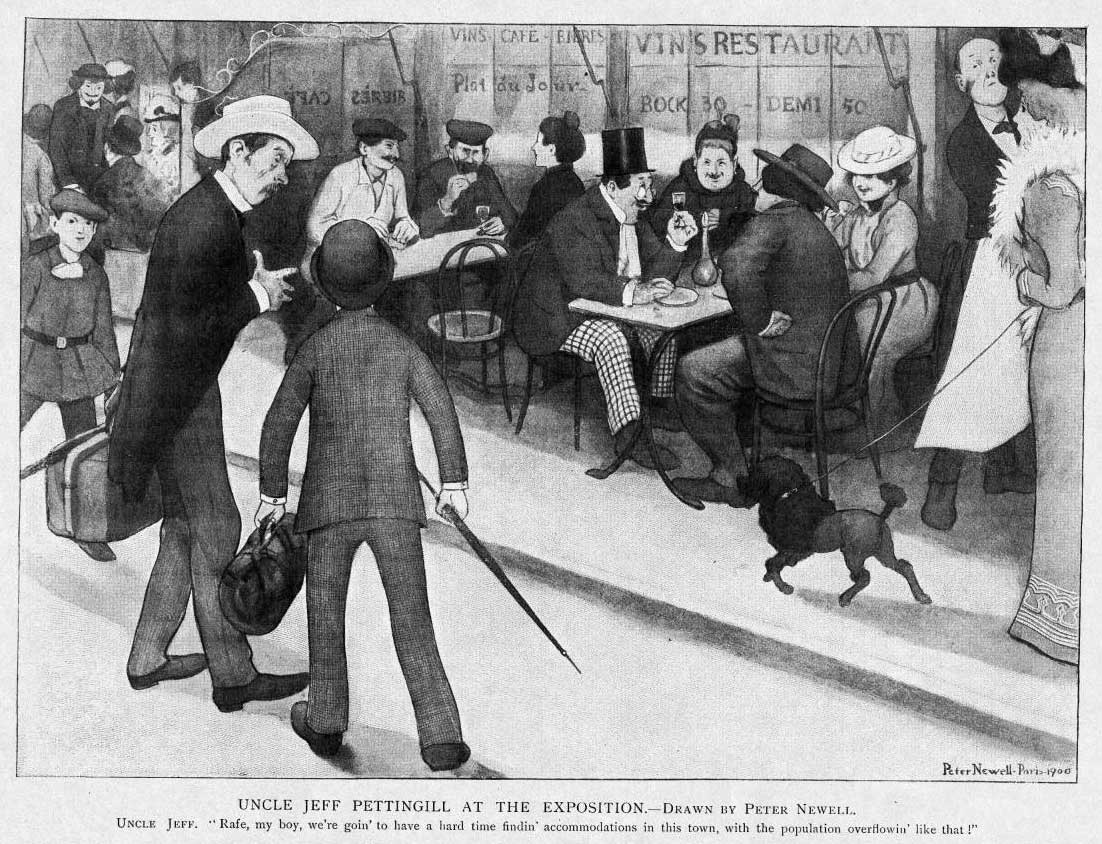
16 June

23 June

14 July

21 July
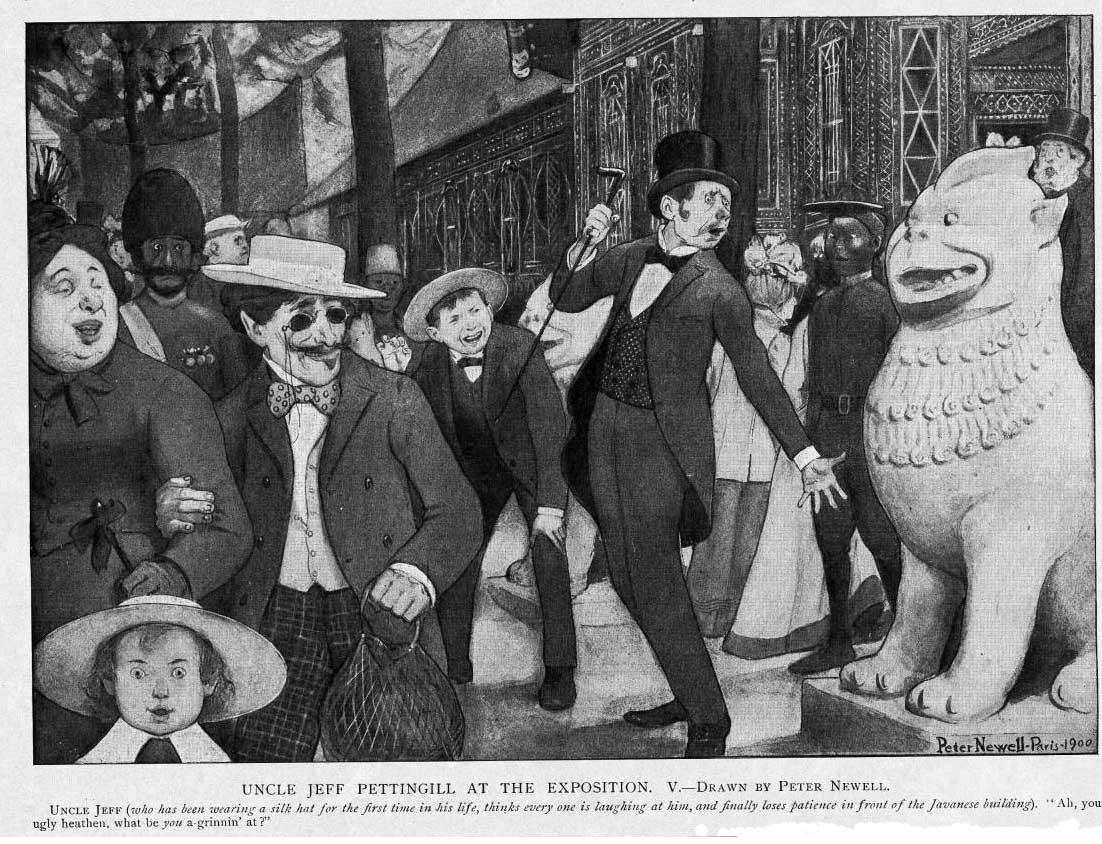
4 August

11 August (2 pictures)


18 August
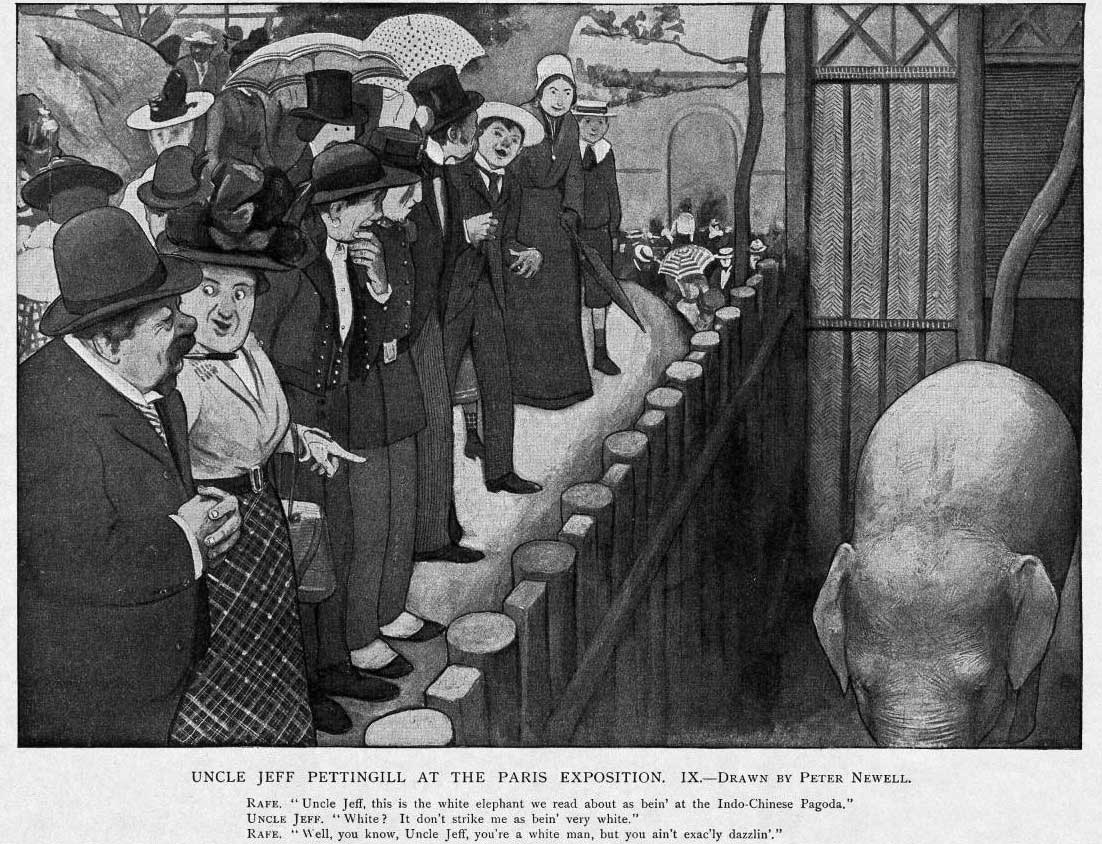
25 August

1 September

15 September

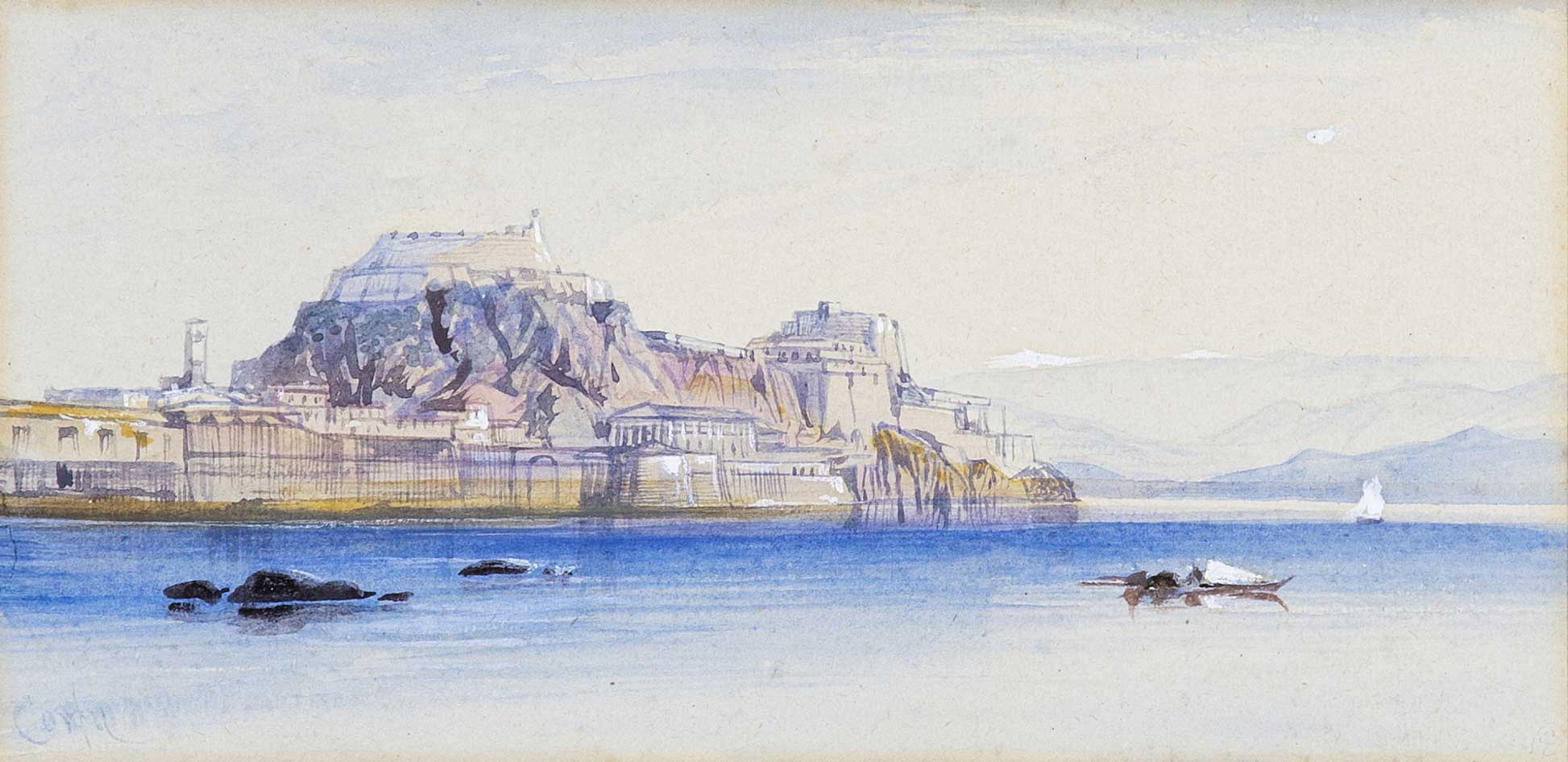
Edward Lear, Corfu.
inscribed ‘Corfu’ (lower left). Watercolour on paper. 12 x 20.5cm (4 3/4 x 8 1/16in)
Provenance
The Parker Gallery, London.
Acquired from the above gallery by the present owner, c. 1971-75.

Matthew Bevis will be giving an online lecture on “Edward Lear in Transit” tomorrow, 12 May 2021:
This talk considers two questions: What—if anything—do Lear’s paintings and poems see in one another? And what sense (or nonsense) can be made from thinking about landscapes alongside limericks?
The event is organized by Inventions of the Text, and you can get a free ticket to follow it at Eventbrite.

India does have its own legacy of nonsense literature. The origins of nonsense can be traced back to the great mystical texts of India, such as the Vedas, the Upanishads, and the medieval poet-saints like Kabir and Sant Namdev. Furthermore, the folk tradition had a strong influence on the formation of Indian nonsense in its oral forms. India abounds in nonsense-like folk material: lullabies, nursery rhymes, folk drama, folk tale, never-ending stories, chain verses, and so on, some being for children, some for grown-ups, others for both. Still, as a literary form, nonsense is not very popular beyond the English-influenced areas of India, namely West Bengal, Orissa, and the Maharashtra. Let us add after Heyman xxxiv) that, since the mid-nineteenth century, and perhaps even earlier English literary nonsense has found its way into these regions, especially West Bengal, the language of which has, according to Sampurna Chatterji [Sukumar Ray’s brilliant translator from Bengali into English.], a riotous caboodle of effects that can be used to create a vivid nonsense literature. Sukumar Ray and Rabindranath Tagore [Heyman states that Tagore was the first to recognize that children’s chhoda represented a separate rasa — the tenth one (in Bengali the word means “taste,” “essence” of something, an emotional effect art has on the audience). He adds that in his preface to a collection of nonsense, _Abol Tabol_ (1923), Sukumar Ray names this rasa kheyaal rasa, “the spirit of whimsy” (xl-xli). It is worth noting that kheyaal also means “play.”], the main representatives of the genre in the Indian context, grew up reading Edward Lear, who incidentally, stayed in India from 1873 to 1874, and Lewis Carroll. As Heyman says, the influence of the English on the Indian nonsense is undeniable” (xxxiv). However, Indian nonsense does have its distinct differences from English nonsense. In his introduction to The Select Nonsense of Sukumar Ray, the filmmaker Satyajit Ray, Sukumar’s son, observes that Indian nonsense places its characters much closer to real life than English nonsense, the characters of which are kept to a certain distance from the familiar world. He goes on to list the obsession with exotic food, indigenous fauna and flora, or extended families (as in Tagore’s poem “The Old Woman’s Grandma-in-Law’s Five Sisters”), among other specific themes. As Heyman suggests, Bengali nonsense was born out of the sheer delight of upturning the imposed rules, such as respect for elders or class/caste issues, and mocking the rigidity of folklore and sacred texts in order to create something that helps “live with such apparent opposing dualities, even to enjoy them” (Heyman xxxii).
Bee Formentelli, “Rabindranath Tagore’s Shey as a Playful Encounter Between a Poet and His Granddaughter.” In Justyna Deszcz-Tryhubczak (ed.), Children’s Literature and Intergenerational Relationships. Cham: Palgrave Macmillan, 2021. 95-113. 100-101.
 A Blog of Bosh