Edward Lear, A rest on the way to Pisa.
Signed with monogram and dated 1861 and 1863. Watercolour with bodycolour. 6 ¼ x 10 ¼ inches.
Literature
Vivien Noakes, Edward Lear 1812-1888, London: Royal Academy of Arts, 1985, pages 126-127, catalogue number 39.
Jenny Uglow, Mr Lear. A Life of Art and Nonsense, London, Faber & Faber, 2017, pages 316-318.
This painting of Pisa is probably one of a series of drawings that Lear referred to as his ‘Tyrants’. Jenny Uglow mentions in her biography, Mr Lear. A Life of Art and Nonsense, that by the early 1860s and distressed by the lack of sales of his large paintings, he embarked on a series of smaller ones. ‘Taking sixty sketches from his many travels, he made thirty small mounts and thirty larger. He stuck his paper onto these and for the next two days he made thirty outlines a day, giving each one a number: within a fortnight he was calling these his “Tyrants”‘. In a sketch planning how he hung the finished paintings, this Pisa drawing is clearly identifiable as number 33 which he hung on the Southside wall of his gallery.
Edward Lear, Parnassus.
Pen, ink, pencil and wash – “Parnassus, 12 April 1849, 11 A.M.”
Mount Parnassus from Near Thebes – a study of an extensive landscape, with figures, some on horseback, inscribed, dated and numbered 159, 11.25ins x 19ins, in modern gilt frame and glazed.
In 1849 Lear decided to return to Greece in order to produce a book. He and his companion Lushington arrived in Patras on 9th March 1849. From there they moved on to the Morea Coranth, Athens,Thebes, Parnassus and Delphi finishing their tour in Patras once again following six weeks of walking and sketching.
Provenance
Dover College, Dover, Kent.
With handwritten note, which reads: “List of old Argonauts and Hellenic travellers who have joined in this gift to Canon Compton, the “Father” of the “Schoolmaster Crusades”, and a two column list of fifty-three names.
Dover College was founded in 1871 by a group of local businessmen. In 1892, the Reverend William Cookworthy Compton succeeded Canon William Bell as Headmaster. Ahead of his time, Compton helped organise schoolmasters’ and student tours in Greece alongside Henry Lunn, later of Lunn Poly fame. It led to the establishment of ‘Hellenic Travellers’ Club’ which had an associated camera club calling themselves the Argonauts.
Edward Lear, Falla, near Strongili, Corfu.
Inscribed lower left with the title in Greek and dated 4th May 1862 and numbered lower right: 49+2. Pen and brown ink over pencil on blue paper 21.5 by 44.5 cm., 8 ½ by 17 ½ in.
Provenance
With Spink and Son, London;
John, Lord D’Ayton (1922-2003);
By descent until sold, Sotheby’s, 3rd July 2003, lot 187;
Private Collection UK
Lear first visited Corfu in 1848, where he was astonished by the beauty of the island, its flora and fauna and especially the flowers that carpeted the island in spring. He wrote to his sister, Ann, ‘I wish I could give you an idea of the beauty of this island, it really is a paradise. The splendour of olive groves, the blue of sky and ivory of church and chapel, the violet of mountain can hardly be imagined’. (Letter to Ann, 14th May 1848, quoted in, Edward Lear & The Ionian Islands, 2012, p. 47). He returned towards the end of 1855, in the company of his friend Franklin Lushington (1823-1901), who had been appointed Judge to the Supreme Court of Justice in the Ionian Islands and decided to settle on the island. Corfu remained Lear’s base until the islands were ceded to Greece in 1863 and the majority of British residents left the island.
His diary entry for Sunday 4th May, the day that the present drawing was executed records, ‘Particularly lovely, all day… the olives are wonderful, the interminable perspective of the silver light catching trunks contrasting with the deep shades on the green & fern below. Soon at Stavros [where a villager] showed us to the topos where [all the English] were wont to go & no lovelier view can be seen, – so much so that I rank it first of all the distant Corfu views, – as regards the seeing all & everything… I sat down to draw… 6 hours of it’. (Lear, Edward, 1812-1888. Diary: autograph manuscript, 1862., MS Eng 797.3, (5). Houghton Library, Harvard College Library).
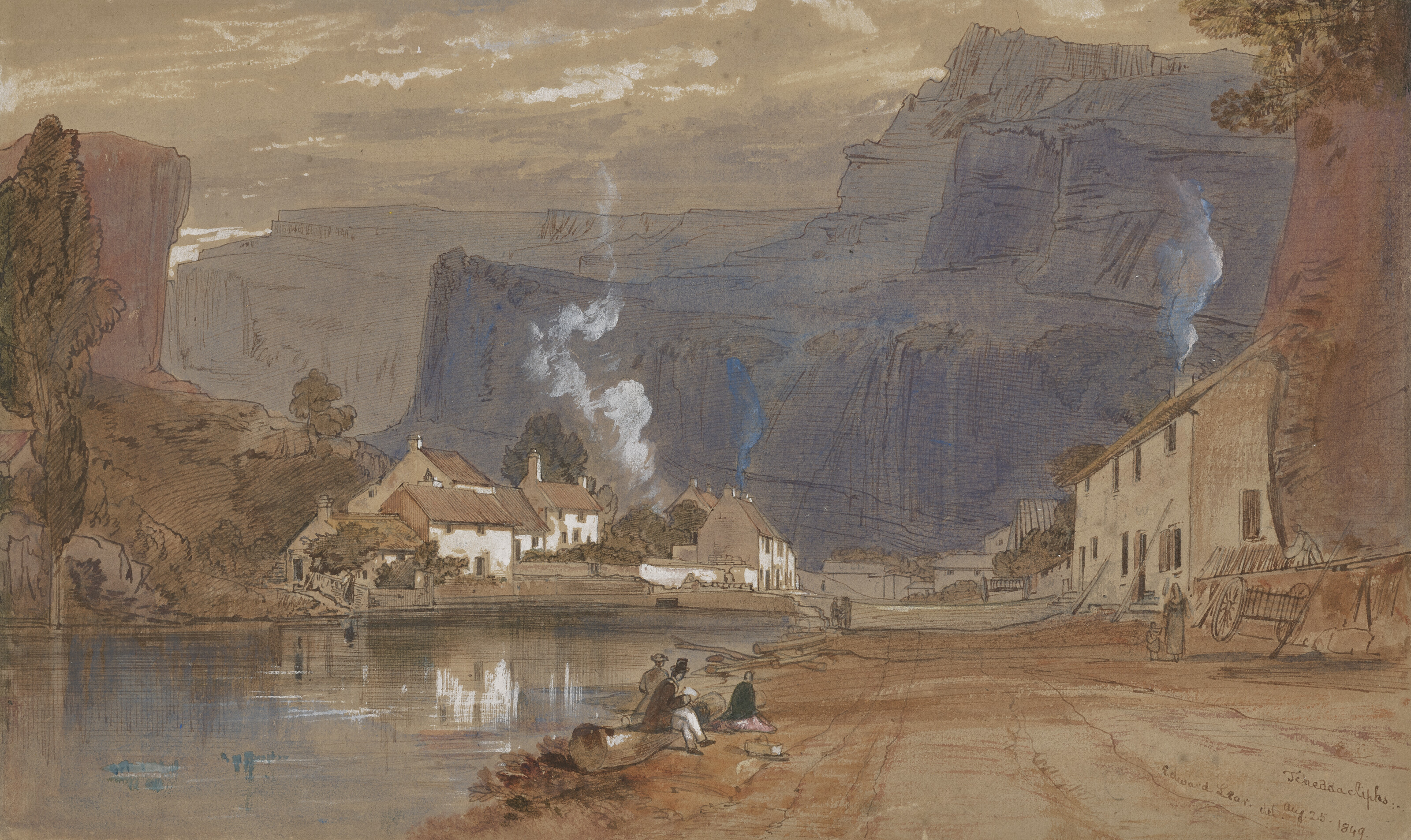
Edward Lear, Cheddar Cliffs, Somerset.
Signed, inscribed and dated ‘Tcheddacliphs [sic] / Edward Lear. del. Aug. 25.1849.’ (lower right). Pencil, pen and brown ink and watercolour heightened with white on buff paper
6 7/8 x 11 3/8 in. (17.5 x 28.9 cm.)
Provenance
Mrs. D.M. Edwards.
with Hazlitt, Gooden & Fox Ltd, London, where purchased, August 1976.
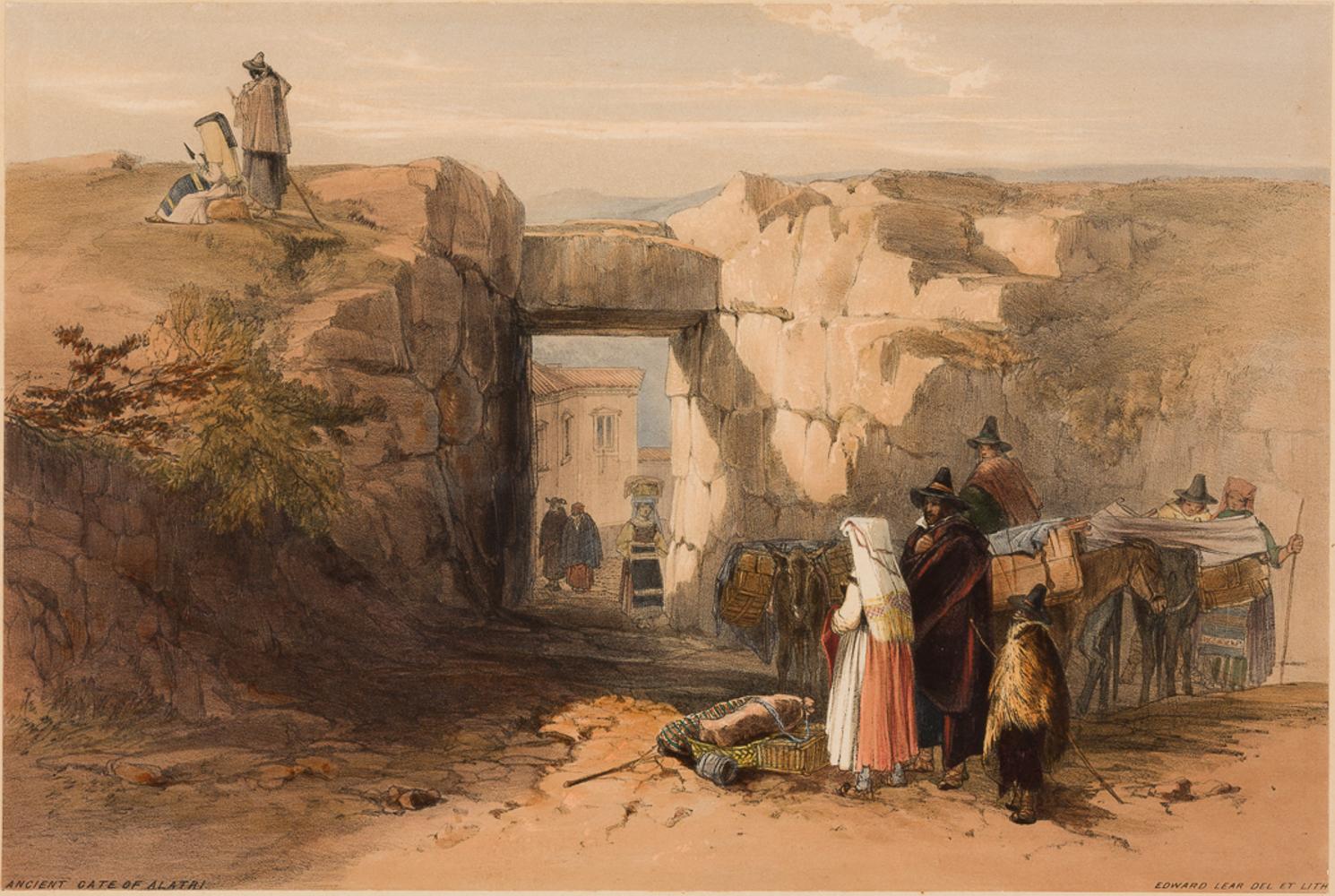
Edward Lear’s lithograph of the Ancient Gate of Alatri from Views in Rome and Its Environs. In a coloured version, under Lear’s supervision? I’m finding more and more of these lithographs in colour, so perhaps the book was sold in different versions.
For sale, with a watercolour by Samuel Prout through Invaluable. If I lived in the US I’d be sure to bid on this, the starting bid is quite interesting.
In a previous post, like this one inspired by Doug Harris, I showed a page of “Irish Literary Learics” from Idyls of Killowen: A Soggarth’s Secular Verses (London: James Bowden, 1899), by Matthew Russell, S.J.
The same limericks, however had already been published in 1898 in The Irish Monthly, vol. 26, pp. 87-89, so the use of the term “learic” was even earlier than I thought.
Here is a transcript of the text:
A BATCH OF IRISH LEARICS.
FIRST of all, what is a Learic? A Learic is not a lyric as pronounced by one of that nation who joke with deefficulty; but it is the name we have invented for a single-stanza poem modelled on tho form of “The Book of Nonsense” for which Mr. Edward Lear has got perhaps more fame than he deserved. His funny pictures helped his funny rhymes very cleverly. We have not seen it noticed that these nonsense-verses copy the metre of Lady Morgan’s “Kate Kearney.” It is a very amphibrachian metre, to coin an epithet for the occasion; namely, the “foot” that predominates is an amphibrach, consisting of a long syllable between two short ones, like eternal. The whole stanza is made up, first, of two lines consisting of three amphibrachs, then two short lines consisting each of an amphibrach and an iambus, ending with a fifth line the same as the first two. Mr. Lear’s verses are largely geographical. Here is his nonsense-verse about almost the only Irish town that he has thus honoured:—
There was an Old Person of Newry,
Whose manners were tinctured with fury:
He tore all the rugs
And broke all the jugs
Within twenty miles’ distance of Newry.
The following will fix on the youthful mind that the spot which determines our first meridian is pronounced Grinnttch.
There was a Young Lady of Greenwich
Whose garments were bordered with spinach;
But a large spotty calf
Bit her shawl quite in half,
Which alarmed that Young Lady of Greenwich.
It will be perceived that Mr. Lear uses one rhyme twice. It seems a more skilful feat to find three distinct rhymes; and the more ‘difficult the rhyme the better, if the difficulty be fairly overcome. “Winchelsea” is hard enough; but we see no special force in the concluding line.
There was an Old Lady of Winchelsea,
Who said, “If you needle or pin shall see
On the floor of my room,
Sweep it up with a broom,”
That exhaustive Old Lady of Winchelsea.
With this explanation we venture to print an original batch of Learics on Irish men, and women of letters. The reader is supposed to know that Mrs. Cowden Clarke wrote a Concordance of Shakspere, and that Mrs. Gaskell’s “Cranford” is the closest parallel for Miss Barlow’s Lisconnell.
I. The Author of “The History of Dublin.”
Thy marvellous lore, Sir John Gilbert,
Can crack the most obdurate filbert,
And many a mystery
In Erin’s dark history
Has been by thy critical skill bared.
II. The Author of “Vagrant Verses.”
Lady Gilbert, once Rosa Mulholland,
Weaves stories most deftly of all, and
Her “Verses,” though “Vagrant,”
Are pure, fresh, and fragrant—
Oft drawn from the Acta of Bolland.*
III. The Author of “Irish Idylls.”
The Gaskell of Erin, Jane Barlow,
Dwells nearer to Dublin than Carlow.
Irish life with its side ills
Shines out in her “Idylls”
With much of the pathos of Marlowe.
IV. The Author of “A Fairy Changeling and Other Poems.”
Thy name, Dora Sigerson Shorter,
(Not always pronounced as it ort ter, +
Matrimonially rounded,
Can now be compounded
In this amphibrachian mortar,
V
The “Author of “The Art of Conversation.”
A Greek (not a Turk) is Mahaffy;
Of his Hellenist lore more than half he
Has amassed on the plan
Of that muscular man
In Cymric song famous as Taffy.
VI. The Author of “Hurrish.”
I wish that Miss Emily Lawless
In her studies of Ireland saw less
Of dark ugly shade—
The sketch she has made
Is surely not truthful or flawless.
VII. The Author of “A Cluster of Nuts.”
Katherine Tynan is now Mrs, Hinkson,
But her maiden name pleasantly links on
To that wonderful throng
Of story and song
Which amazes the more that one thinks on,
VIII. The Author of “The Mystery of Killard.”
I knew you a boy, Richard Dowling,
And, though there’s a good deal of howling
In your thrilling romances,
Most gentle your glance is,
And your face always smiling, not scowling.
IX. The Author of “Shakspeare, his Mind and Art.”
In matters Shakespearian Dowden
Is a glorified Mrs. Clarke (Cowden).
He has mixed in the melée
That rages around Shelley,
But he cares not for Lingard or Plowden.
X. The Author of “Maime o’ the Corner.”
Mrs. Blundell, self-called “ M. E. Francis,”
As bright and as keen as a lance is.
Her plots are well knit,
And a delicate wit
The charm of her stories enhances.
* St. Barbara, St. Brigid, etc , in the Acta Sanctorum of the Bollandists
+ The g “ought to’’ have its hard sound.
The introductory note mentions “the metre of Lady Morgan’s “Kate Kearney” as the inspiration for the form. Of course Doug dug out the song on YouTube:
Doug adds: “it is interesting to note that it does indeed fit the limerick lilt rather neatly. It’s also interesting that the ballad of Kate Kearney, first heard as the tune “The Beardless Boy” by Edward Bunting in 1796 and perhaps then first seen in print as Kate Kearney in 1807 as shown here … is in limerick form:”
… and in 1810 in both ‘The Shamrock’ and ‘The Hibernian Songster and ‘The Emperor’s Wedding’) … although laid out in print quite differently:
Oh did you not hear of Kate Kearney?
She lives on the banks of Killarney;
From the glance of her eye,
Shun danger and fly,
For fatal’s the glance of Kate Kearney. etc etc.”
Here is the score of the song, published in 1829 in The New-York Mirror, and Ladies’ Literary Gazette.
British / French Commemorative Medal, bronze d.80mm: Edward Lear 1812-1888 Père du Non-Sens (medal) by Ronald Searle – famous satirist and illustrator, from his series The Fathers of Caricatures, 1970s, struck by the Monnaie de Paris (Paris Mint). A heavy high-relief art medal, GEF, with box.
For a couple of semesters in college I worked at the on-campus student coffee house, The Bandersnatch, named after the creature in Lewis Carroll’s famous nonsensical poem, Jabberwocky. When you work inside a Lewis Carroll nonsense poem, you start to take nonsense seriously. While toasting bagels and brewing coffee, and listening to the songs playing on the house stereo, I created what I classified as a nonsense hierarchy.
Understandable Nonsense.“Colorless green ideas sleep furiously,” is a Frankenstein monster of a sentence composed by the MIT Professor of Linguistics, Noam Chomsky to test his theories of language and the best example I can think of as nonsense where the words are all understandable but whose meaning is nonsensical. This category is not a lot of fun, mostly because it seems to be the playground for academics to make linguistic arguments.
The pop songs I heard were much more entertaining nonsense. John Lennon, a life-long lover of nonsense words, filled some of The Beatles most memorable songs with Understandable Nonsense like Come Together:
He wear no shoeshine
He got toe jam football
He’s got monkey finger
He shoot Coca-Cola
Mixed-Up Nonsense. Second level of nonsense is a mix of the understandable and made up. Carroll’s 1855 poem Jabberwocky is what I think of — writing that is grammatically correct and partially understandable but filled with lots of made-up, fun words.
’Twas brillig, and the slithy toves
Did gyre and gimble in the wabe:
All mimsy were the borogoves,
And the mome raths outgrabe.
I don’t know what a slithy tove is but the sound of the words along send me in a direction where I conjure up an image of something amphibian-like.
Carroll’s contemporary, Edward Lear, wrote a whole book of nonsense including poems, short stories, songs, drawings, alphabets, and even botanical drawings.
Over a century later, this was fertile ground for writers of pop-songs. The 1960’s vocal group, The Crystals, had a Top Ten Billboard it with The Da Doo Ron Ron:
I knew what he was doing when he caught my eye
Da do ron-ron-ron, da do ron-ron
He looked so quiet but my oh my
Da do ron-ron-ron, da do ron-ron
In 1967, John Lennon was working with three different song ideas when the result turned out to be one of the most memorable songs from The Magical Mystery Tour album with Mixed-Up Nonsense of I am the Walrus
They are the egg men
I am the walrus
Goo goo g’joob, goo goo goo g’joob
Goo goo g’joob, goo goo goo g’joob, goo goo
The torch of mixed-up nonsense was picked up in the late 1970s by The Police with their Billboard Top Ten hit, De Do Do Do, De Da Da Da. The lyrics are credited to Sting who said he was interested in the success of the Crystals Da Ron Ron and Do Wah Diddy by Manfred Man. He was self-aware enough to expressly call out the nonsense of the words:
De do do do, de da da da
Is all I want to say to you
De do do do, de da da da
They’re meaningless and all that’s true
As early as The Police’s first album, Sting had been playing with mixed nonsense in the track Masako Tango, from their first album:
Key wo wa di com la day wa da
Co wa da zu ma pu wa all day
See po wa ta na po ba ba
Zoe ka mo wa I’ve been sleepin’ all day
Total Nonsense.This is the top of the nonsense pyramid where there are no recognizable words and, while it might feel grammatically correct, it’s not like a foreign language where you can find a translation because there are no translations. A prime example is the Dada poet, Hugo Ball, who in 1916 wrote a poem, Karawane, consisting of nonsensical words. Some commentators called it a “sound poem.” Here’s the opening verse:
Gadji beri bimba clandridi
Lauli lonni cadori gadjam
A bim beri glassala glandride
E glassala tuffm I zimbra
The Talking Heads revived the poem in their 1979 song I Zimbra, from their album Fear of Music. Ball received a writing credit for the song on the track listing. And if you want to say you have seen everything on the internet, you can watch a YouTube video of Marie Osmond reciting Karawane.
On the final Beatles album to be recorded, Abbey Road, John Lennon took his fondness for wordplay into pure nonsense with the song Sun King and the lyrics:
Quando para mucho mi amore de felice corazón
Mundo paparazzi mi amore chicka ferdy parasol
Cuesto obrigado tanta mucho que canite carousel
The lyrics sound like a romance language just out of reach but were in fact totally made-up. Leaving John Lennon at the top of the nonsense hierarchy would likely please him.
There’s a lot more nonsense out there for another day but for now I’ve got to Gimble in the wabe.
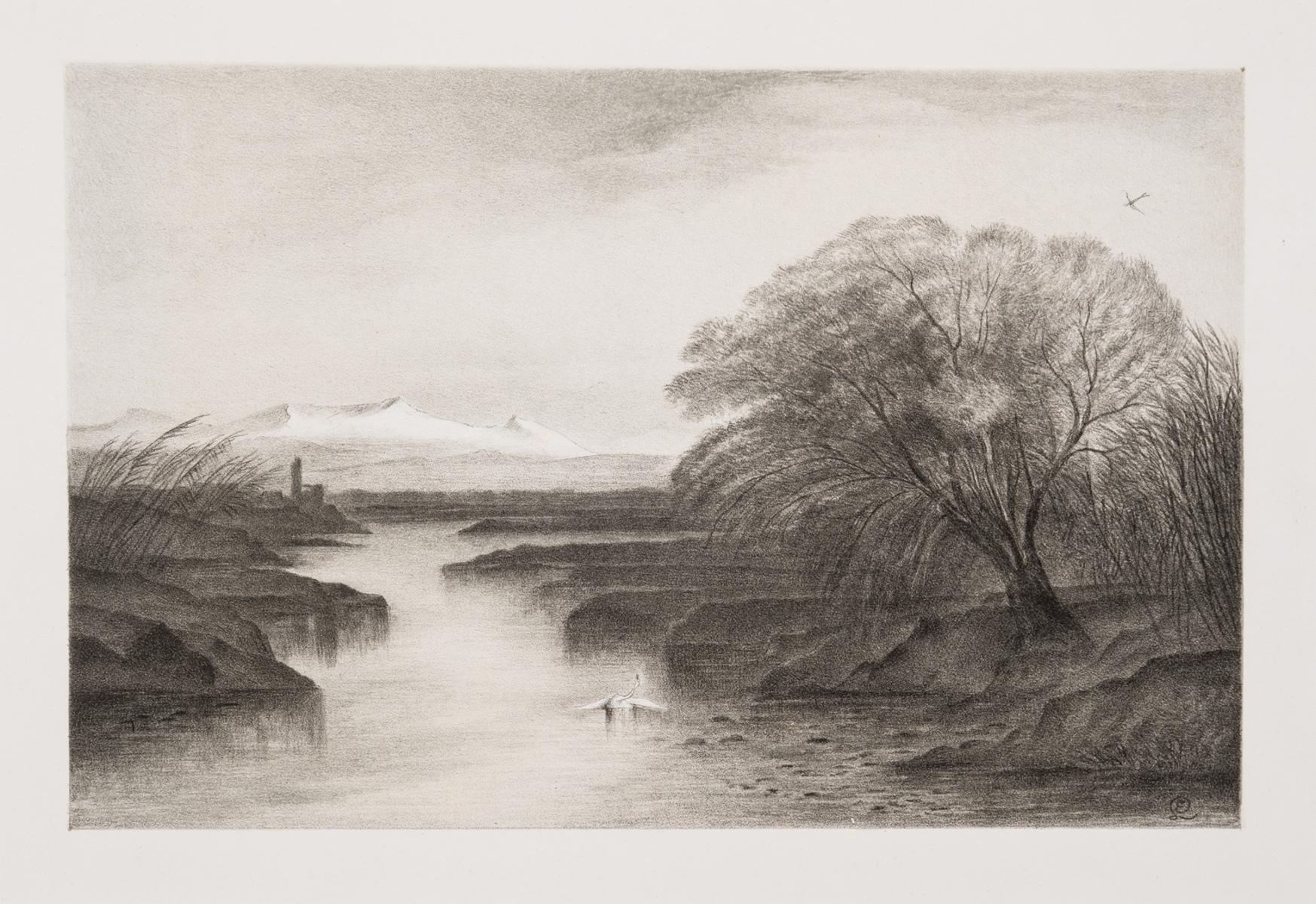
Tennyson (Alfred, Lord).- Lear (Edward) “One willow over the river hung… River Anio, Campagna di Roma”, lithograph on fine wove paper, image 165 x 255 mm (6 1/2 x 10 in), sheet 280 x 335 mm (11 x 13 1/4 in), hinged into mount, some minor pin holes carefully restored, unframed, [circa 1885]
Provenance
Sotheran’s, London;
Private collection, London
Rare working proof of an apparently unpublished lithograph illustrating Tennyson’s poem The Dying Swan. Houghton Library hold the original drawing for the print in their collection ‘Edward Lear drawings for illustrations to the poems of Tennyson’ [see item 17].





 A Blog of Bosh