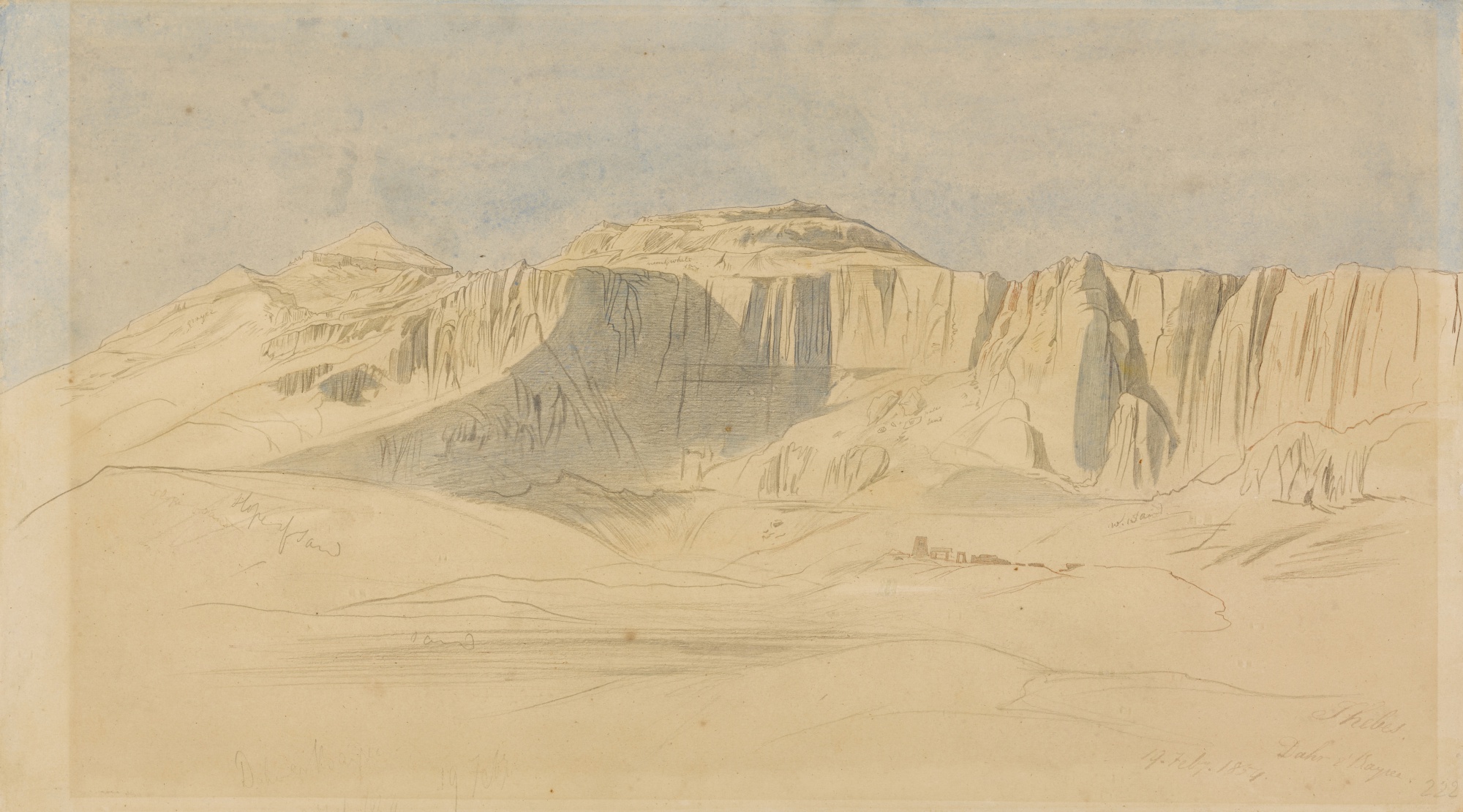
Edward Lear, Dahr el Bayree, Thebes (1854)

Edward Lear, Dahr el Bayree, Thebes.
Inscribed Thebes. Dahr el Bayree. 19 Feby. 1854. lower right; further inscribed with extensive artist’s notes, inscribed No. 12 single verso. Pen and brown and pencil and watercolour. Unframed: 28.9 by 51.1cm., 11¼ by 20in. Framed: 52.8 by 74cm., 20⅝ by 29⅛in.

Provenance
Spink, London
The Fine Art Society, London, by 1988
Acquired from the above by the late owner

Exhibited
London, The Fine Art Society, A Centenary Exhibition, 1988

Lear visited Thebes in February 1854, spending ten days sketching the temples, ruins and landscape, as part of his journey along the Nile. In the present drawing Lear has his back to the river and looks west towards the Thebian Hills. His inscription Dabr El Bayree, would seem to refer to ‘Dayr al-Baḥrīa’, a nearby 7th century monastery.

Sotheby’s.

Posted in Edward Lear | Tagged , , , , | Leave a comment

Edward Lear, “And I will See, Before I Die, The Palms and Temples of the South”

Edward Lear, “And I will See, Before I Die, The Palms and Temples of the South.”
Signed with initials EL lower right. Oil on canvas. Unframed: 48.5 by 75.5cm., 19 by 29¾in. Framed: 63 by 89.8cm., 24¾ by 35¼in.

Provenance
Commissioned in 1856 by Chichester Fortesque and thence by descent to Charles  Towneley Strachey, Lord O’Hagan M.E.P. (his sale: Sotheby’s, London, 3 November 1993, lot 21)
Purchased from the above by Martin R. Davies, Bristol

Literature
Lady Strachey (ed.), Letters of Edward Lear, London, 1907, p. 35

According to Lady Strachey, this painting is a replica of a work of the same title, painted for Sir John Simeon in 1856 (possibly the smaller Philae on the Nile, Christie’s, London, 15 December 2011, lot 57). It was completed in the same year for Chichester Fortesque and both pictures were probably based on a watercolour dated 1854 (Christie’s, London, 15 December 2010, lot 72). Lear was accustomed to reuse this title from Tennyson for his views of Philae.
This picture was commissioned by Chichester Fortesque (1823-1898) who Lear first met in Rome in 1848 when Fortesque described the artist as; ‘a delightful companion, full of nonsense, puns, riddles, everything in the shape of fun, and brimming with an intense appreciation of nature as well as history… I don’t know when I have met any one to whom I took so great a liking.’ (Lady Strachey, The Letters of Edward Lear, London, 1907, p. xxv) (Fig.1). Fortesque was Member of Parliament for Louth and later became Chief Secretary for Ireland, President of the Board of Trade and Lord Privy Seal. He was given a barony in 1874, taking the title Lord Carlingford. In 1871 he married Lady Waldegrave whose niece, Constance, Lady Stachey (Strachie) published Lear’s correspondence with Lord Carlingford and Countess Waldegrave.

Sotheby’s.
Posted in Edward Lear | Tagged , , , | Leave a comment

Edward Lear, The Island of Philae, above the First Cataract on the Nile, from the South, Afternoon (1855)

Edward Lear, The Island of Philae, above the First Cataract on the Nile, from the South, Afternoon.
Signed and dated E. Lear 1855 lower right; inscribed, signed and dated Philae/ Edward Lear 1855/ I will see before I die/ The Palms and Temples of the south on a label on the reverse. Oil on canvas. Unframed: 90.5 by 148.5cm., 35¾ by 58½in. Framed: 106 by 163.5cm., 41¾ by 64¼in.

Provenance
Purchased from the artist by William Neville Esq. of Highbury, with whom it remained until his death in 1874 when it was bequeathed to the artist in memory of their friendship
Sale: Spink & Son, London, 29 November 1976
Purchased from the above by Martin R. Davies, Bristol

Literature
Lady Strachey, The Letters of Edward Lear, London, 1907, p. 314, no. 116
Amelia Edwards, A Thousand Miles up the Nile, London, 1974, illustrated in reverse on the cover
Vivien Noakes, Edward Lear 1812-1888, London, 1985, pp. 146-147, illustrated p. 38

Exhibited
London, Royal Academy, 1856, no. 625
Royal Academy, London, Edward Lear 1812-1888, no. 52

Sotheby’s.

Posted in Edward Lear | Tagged , , , | Leave a comment

Edward Lear, The Pyramids near Cairo (1849)

Edward Lear, The Pyramids near Cairo.
Inscribed and dated near Cairo. Jany. 9. 1849 lower left; inscribed a mother of Mud. lower centre; numbered 7 lower right. Pen and brown ink and watercolour over traces of pencil. Unframed: 17.1 by 50.7cm., 6¾ by 20in. Framed: 41.5 by 73.2cm., 16¼ by 28¾in.

Provenance
Private collection, USA
Sale: London, Sotheby’s, 29 November 1973, lot 178
Leger Galleries, London, by 1975
Acquired from the above by Martin R. Davies, Bristol, April 1975

Exhibited
Sheffield, Graves Art Gallery, Edward Lear. Watercolours, Oils and Drawings, 1988
London, The Fine Art Society, A Centenary Exhibition, 1988

This drawing was created on the 9 January 1849, three days after Lear’s arrival in Cairo. He had just spent nine months travelling in the eastern Mediterranean and he had long wanted to experience Egypt. In Cairo he met his friend John Cross and together they set out by camel on the route from Cairo to Suez. Lear fell ill in Suez and this curtailed his plans, ultimately forcing him to abandon his travels in the region. He was, however, hugely inspired by the landscapes and people of Egypt and he would return on three further occasions.

Sotheby’s.

Posted in Edward Lear | Tagged , , , , | Leave a comment

Edward Lear, View of Janina

Edward Lear, View of Janina.
Watercolour and pastel. 29 x 45.5cm (11 7/16 x 17 15/16in).

Provenance
With J. Leger & Son, London, 1959 (as Janina, Turkey).
Private collection, UK.

Ioannina (or Janina) which lies on Lake Pamvotis is part of modern day Greece, the major city of the province of Epirus. When Lear visited in 1848 it formed part of Albania but the area had been surrendered to the Ottomans in 1430 and remained under their rule until the early 20th century. One of the most recognisable landmarks of the town is the minaret and dome of the Fethiye Mosque which houses the tomb of Ali Pasha (1740-1822), ruler of the Pashlik of Ioannina. When in his 80s, his views and actions brought growing disapproval from the Ottomans who arrested him in 1822 at the St Panteleimon monastery on Lake Pamvotis, and killed him (see lot 11 for a portrait of Ali Pasha). The mosque and minaret, silhouetted on a promontory that extends into the lake, are at the very centre of Lear’s composition in this watercolour.

In 1848 Lear embarked on an impromptu sketching tour of Albania and Greece which took him from Salonica in the north, westwards to Corfu and down to Mount Olympus. He travelled very much off the beaten track with his manservant Giorgio, staying mostly at simple roadside khans where he regularly shared his quarters with farm animals. In luckier moments he enjoyed the hospitality of Turkish pashas or Greek dragomen. In his diary for 5 November 1848 he describes his dramatic approach to Ioannina: ‘..amid rolling thunder and flashing lightning did I gallop on, across the treeless level, till the sky cleared suddenly, and … I saw from a slight eminence the lake of Yannina [sic] unexpectedly spread below me……There lay the peninsula stretching far into the dark grey water, with its mosque, its cypress tufts, and fortress walls; there was the city stretching far and wide along the water’s edge; there was the fatal island, the closing scene of the history of the once all-powerful Ali.’ He stayed in unaccustomed luxury at the British Consulate, remarking ‘After the khans and horrors of upper Albania, the spacious and clean rooms at the Vice-Consulate were delightful to repose in; and newspapers, letters, joined with all kinds of comfort, suddenly and amply atoned for all by-gone toils and disagreeables.’

A similar view by Lear, taken from a point closer to the town, is in the Derby Collection at Knowsley.

Bonhams.

Posted in Edward Lear | Tagged , , , , | 1 Comment

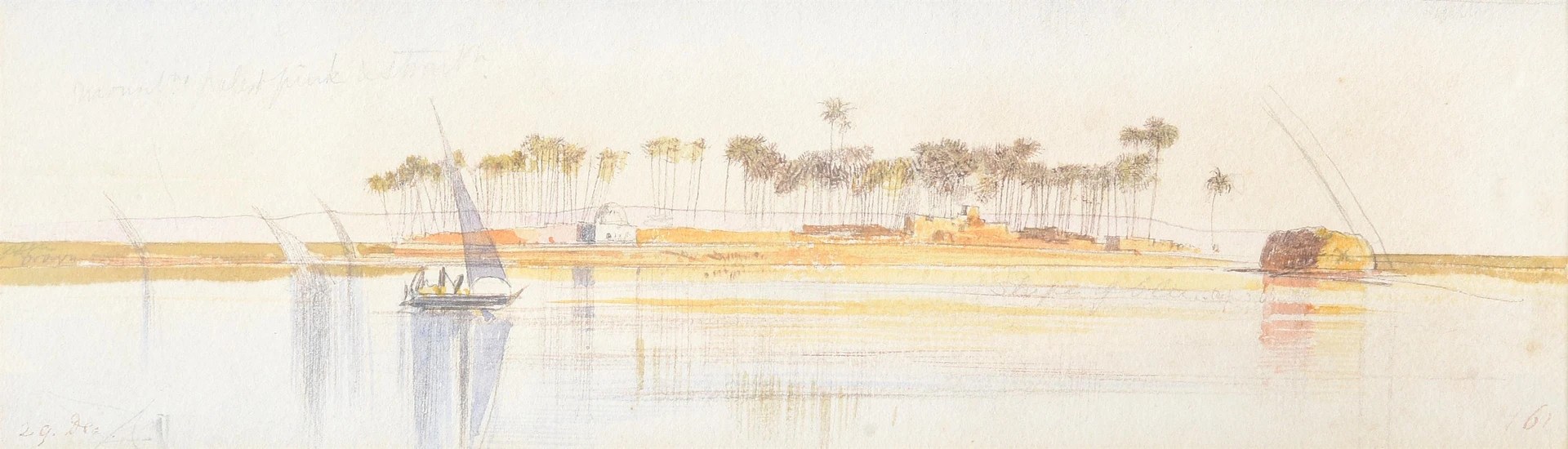
Edward Lear, Dhows on the Nile

Edward Lear, Dhows on the Nile.
Pencil and watercolour Dated ’29 Dec’ (lower left), numbered ‘161’ (lower right), colour notes throughout 6.5 x 22.5cm (2½ x 8¾ in.)

Provenance
The Ruskin Gallery, Stratford-upon-Avon. The gallery label affixed verso dates the work to 1867, however a later inscription to the label notes there had later been a suggestion by Vivien Noakes that the work is earlier and dates to 1853, which would make it one of Lear’s first Nile trip pictures.

Dreweatts.

Posted in Edward Lear | Tagged , , , , | Leave a comment

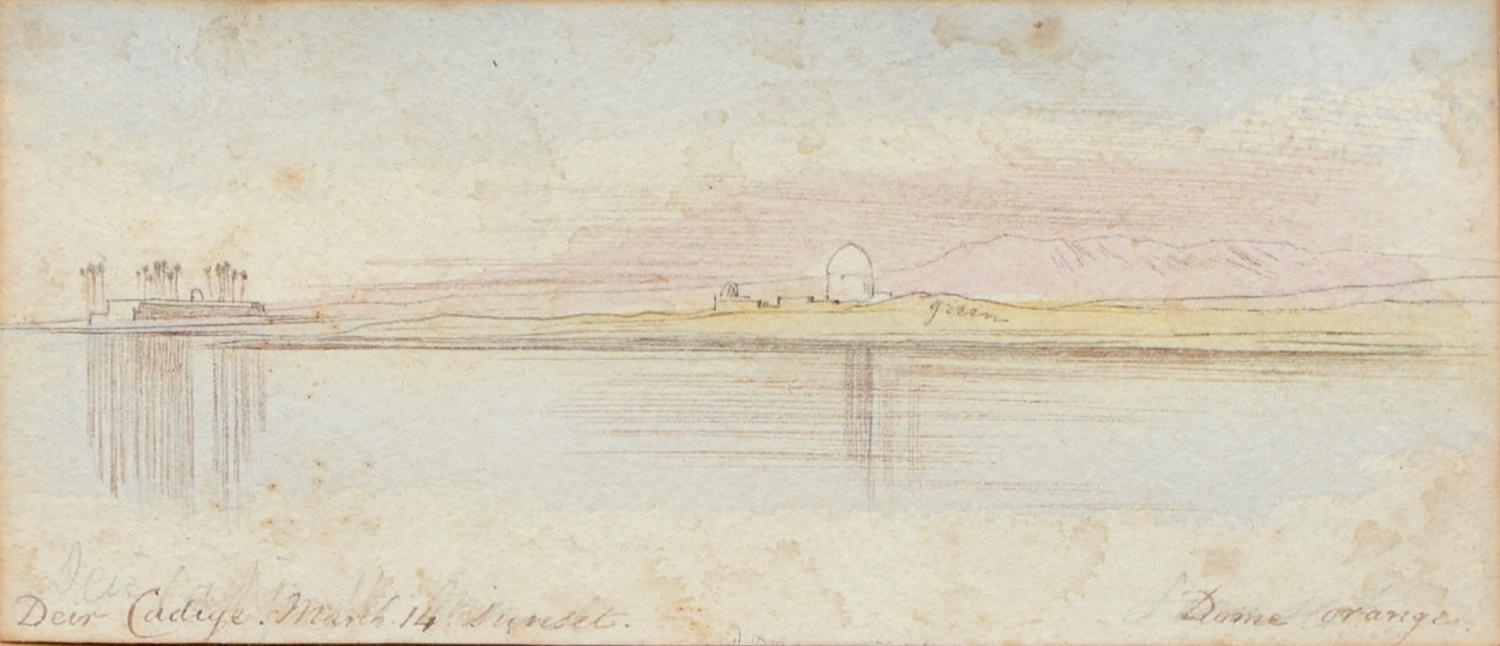
Edward Lear, Deir Kadige on the River Nile

Edward Lear, Deir Kadige on the River Nile, Egypt.
Inscribed Deir Cadige March 14 sunset Dome orange, 66 x 151mm. Loosely laid down on an old mount, slight sporadic stains, undisturbed in old ebonised frame with, on the reverse, the trade label of H Isaacs Burton on Trent.

The Saleroom.

Posted in Edward Lear | Tagged , , , , | Leave a comment

A Letter by Edward Lear

Edward Lear, letter to unknown recipient from Barzanò, Monza, of 28 July 1886:

The Post brings me a letter from the Tennyson Poet folk – about the “Break break” — & the “Lines to E.L.” And I think it would interest you to know what is written on the subject…

The other letter shown in the lot listing seems to be unrelated.

Invaluable.

Posted in Edward Lear | Tagged , , , | 4 Comments

Edward Lear, San Buci (1840)

Edward Lear, San Buci, near Rome (Sambuci?).
Pencil on grey-brown paper, laid onto card, title and date ‘9 July 1840’ to lower right in pencil, pencil note to lower left ‘Ivy’, small loss at left lower corner, slight overall toning, sheet size 27.2 x 40 cm (10 6/8 x 15 3/4 ins), framed and glazed (45 x 56 cm).

Provenance
Collection of Michael and Megan Dawson. Having first established Greater London Arts in 1967, funded to promote culture in the London boroughs, Michael Dawson (1932-2022) became director in 1969 of the Yorkshire Arts Association. While running the YAA under the auspices of the Arts Council, Michael also founded the Ilkley Literature Festival, where he succeeded over the ensuing years in drawing in writers of international reputation, including W. H. Auden, Ted Hughes, Phyllis Bentley, Philip Larkin, , Ian McEwan, and Alan Bennett.

Edward Lear travelled throughout Italy, staying primarily in Rome, for a period of over four years between 1837 and 1841. During this time he built up a collection of landscape sketches which he used in the first and largest of his published travel books, Views of Rome and its Environs published in 1841 by Thomas M’Lean.

Invaluable.

Posted in Edward Lear | Tagged , , , | Leave a comment

Edward Lear, View of Nuneham Elms, Stratton, Hampshire (1877)

Edward Lear, View of Nuneham Elms, Stratton, Hampshire.

Posted in Edward Lear | Tagged , , , , | Leave a comment