
Edward Lear, “Sermione” [Sirmione], Lago di Garda.
Watercolour, signed with monogram and titled recto, labels verso, 12cm x 18cm, within a gilt frame.
Provenance
Marc and Ismini Fitch, thence by descent; Hallam, Lord Tennyson.
Edward Lear, “Sermione” [Sirmione], Lago di Garda.
Watercolour, signed with monogram and titled recto, labels verso, 12cm x 18cm, within a gilt frame.
Provenance
Marc and Ismini Fitch, thence by descent; Hallam, Lord Tennyson.
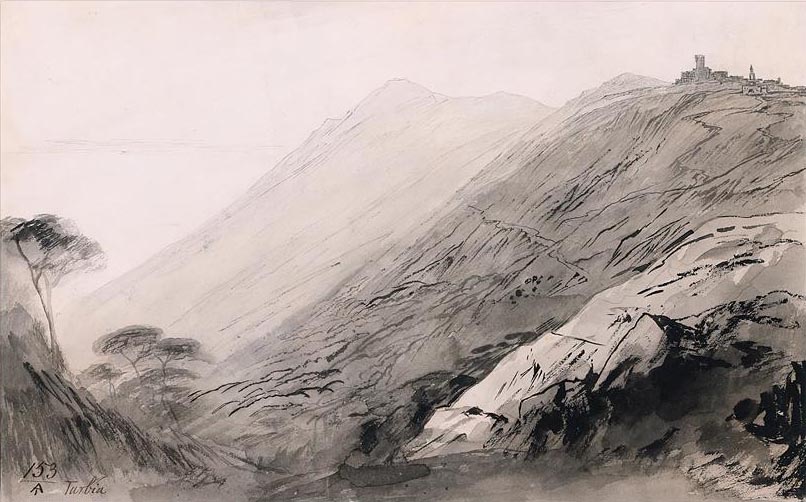
Edward Lear, Turbia.
Pen and grey wash. Numbered and inscribed as titled ‘153 AT’ (lower left). 31.5 x 51cm (12¼ x 20 in.)
Provenance
Thomas Agnew and Sons Ltd., London, 1982, no 212
Edward Lear travelled to Southern France in the winter of 1864/5 and at the end of his journey along the Corniche wrote to his patron Lord Carlingford that he `brought back 144 drawings great and small’. The present work was derived from these sketches and depicts Turbia (La Turbie) which lies in the hills above Monaco on the highest point of the Via Aurelia. He used the work to illustrate Alfred, Lord Tennyson’s poem, The Daisy, a project that he originally conceived in 1852 that envisaged illustrating many of his poems with 200 works of `poetical topography’. The Daisy featured in 28 works and the inscription `153 AT’ refers to line five in the poem `What Roman strength Turbia showed’ and the poets initials. The project was never completed, but after Lear’s death Tennyson published a slim volume of three poems including The Daisy. The present lot was not illustrated but other works were, including a view of Monaco from Turbia.

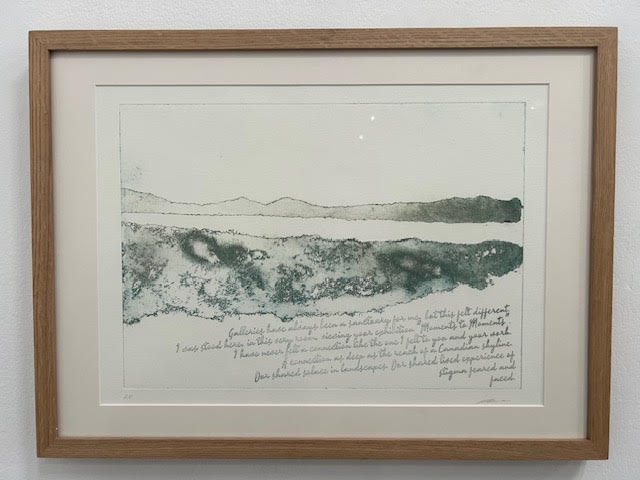
Fae Kilburn made these on an antique printing press, which was brought to Ikon as the centrepiece of the exhibition Start the Press! Ikon invited eight regional printmakers to create new work on the press in front of a live audience. Funded by the Jerwood Foundation, the prints were added to the exhibition alongside work by David Hockney, Lubaina Himid and Yinka Shonibare.

The press was manufactured in Germany in the early 1800s and was originally used by the British Admiralty to print maps, so very much an instrument of empire. It was acquired by Wolverhampton School of Art in 1970 and has been used by staff and students ever since. Unfortunately the school is being slowly closed down, so we’re not sure what the future holds for the press.

Fae chose to create new work in response to Lear:
A Letter to Lear is a triptych I created for Start the Press! @ikongallery, inspired by the deep connection I felt when viewing the Ikon exhibition Edward Lear: Moment to Moment (2022). The text reflects my lived experience of epilepsy, 100 years after Edward Lear, and the stigma I have encountered. Like Lear, I also find solace in my artistic practice and the landscape. The works by Lear have stayed with me, highlighting the significance and power art can have. Each piece is a different segment of this letter. I created soft muted colours that reflect Lear’s landscapes, and suggest a 19thC aesthetic, linking to the time of Lear. I often connect different personal elements in my work, such as the use of the antique printing press, dated to 1810, an instrument that would have been used during Lear’s lifetime.
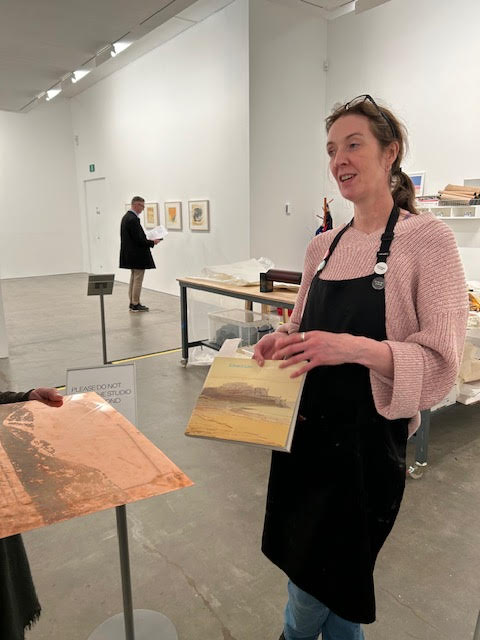
Fae has limited vision and chose to exhibit the etched copper plates, for audiences to touch, alongside the final prints. She spent her four days in residence in the gallery operating the press and talking to audiences about Moment to Moment.

Stephen Duckworth is at it again: he has created a new, very nice site, about Edward Lear and His Studio Practice, which covers all aspects of Lear’s painting activity: sketches, studio work.
A very useful resource for anyone interested in Lear as a painter.

Edward Lear, Abetone.
Ink, pencil and watercolour – Passo di Abetone, Italy, annotated and dated ‘7.30. pm, August 28, 1883’, titled verso on gallery label, 9.5 x 17cms.
Provenance
With Colnaghi & Co. Ltd., no. 146, English Exhibition, 1973; private collection north Wales.

Edward Lear, Ponte Rotto, Rome.
Watercolour, Indistinctly inscribed, and inscribed verso (now framed) 5.5″ x 9″ (14 x 22.8cm).
I already posted this image, but it looks better here.
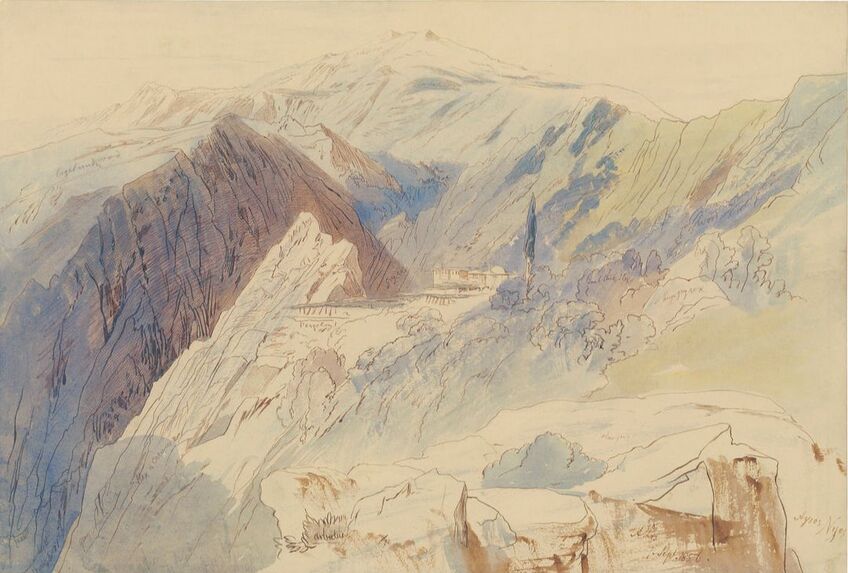
Around St Nilus monastery, Mount Athos, Greece.
Stephen Duckworth has posted a new website with lots of information on Edward Lear’s tours and drawings / watercolours. It presents a lor of previously-unavailable information, so don’t miss it!
Previous posts by Stephen:

Edward Lear, The Abbey of Santo Spirito at Sulmona.
Signed lower right ‘E. Lear del. 1844’ and inscribed lower left ‘Abbadia di S. Spirito.’ Black chalk, pencil and stump heightened with white on buff paper 8.5 x 15cm
Provenance
John Scandrett Harford (1787-1866), Thence by descent until 2015
Literature
Edward Lear’s Illustrated Excursions in Italy, 1846, engraved by J. Whimper, as vignette, p.30.
The Abbey of Santo Spirito stands about five kilometres outside the town of Sulmona at the base of Monte Morrone. The present monastery was built in the early 18th century, after an earthquake all but destroyed the original 13th century building. `Below the solitary hermitage is the Monastery of S. Spirito, founded by Pope Celestino V, but now used as a poor-house for the three Abruzzi. It is a picturesque edifice, some distance from the high-road; and its tall campanile is seen all over the Pianura of Solmona’ (see Literature, pp.30-31)
The following is the beginning of a letter by Saint-John Perse to Joseph Conrad, from St.-Perse, Letters. Translated and edited by Arthur J. Knodel. Princeton, NJ: Princeton University Press, 1979. Letter 181, pp. 364-365.
To Mr. Joseph Conrad
“Oswalds,” Bishopsbourne,
via Canterbury
EnglandFrench Legation in China
Peking, February 26, 1921Dear friend,
I have received your message through Agnes Tobin.[1] Our friend is still in California, and her health will not permit her to come all the way out here; but from California, thanks to her, I have more than once had news of you in England.1 I am replying to you by way of the same intermediary.
I am very touched by your recalling my first visit to Ashford in Kent, in the company of Agnes, before the war — as I am by all your reminders of the friendly conversations we had in those days. Nor have I forgotten anything that I carried away from visits with you; many a scrap of those first informal chats we had in the evening, in the little downstairs apartment where a terrible attack of gout confined you, recurs to me in the most unexpected way.
I am still with you, poring over the old family album that contains all of your Polish childhood. I still hear you reciting the first stanzas of Edward Lear’s “Jumblies,” and assuring me that you found in them far more of “the spirit of great adventures” than in the best sea-authors, such as Melville. I still hear you becoming irritated at my passion for Dostoievsky and my distaste for Turgenieff. And you surprise me again in confiding to me that the French authors you know best are Molière and Zola. And finally, you still show your annoyance when I repeat that for me you are the only real poet of the sea, whereas you claim that it is only the ship itself that you wanted to exalt — man’s work against the sea like the bow bent against destiny or the fiddle rigged against the night.
I don’t think you ever took my obsession with the sea seriously; it struck you as a literary affectation when, in fact, because of my birth, childhood, and ancient insular atavism on a small Caribbean island, the sea is to me something absolutely basic, mingled with my very blood; and without my noticing, it has spread to every part of my being.
There is nothing metaphysical in all this. When I was still very young, I heard a grown-up peremptorily state that woman was the fifth element. I countered bluntly, saying that it was the sea, which, in my mind, was quite distinct from water and air.
Dear, great, friend, to me you will always be the most humane man of letters I have ever met. Do you know what I admire most about you? Your abiding inability to pass judgment on those whom fate places in your path as friends.
…[1] Agnes Tobin (1864-1939), an American lady from a well-known Californian family, was a frequent resident in England, where she became an intimate of the literary group that gathered around Alice and Wilfred Meynell. Through Francis famines, she came to know Gide and Larbaud, and then AL [Alexis Léger, st-John Perse real name]. It was through Agnes Tobin that AL came to know Joseph Conrad.
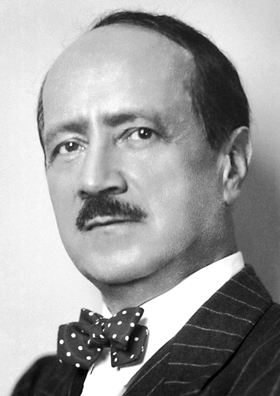
Saint-John Perse, Nobel Prize for Literature 1960.
St.-John Perse also mentioned Edward Lear in a letter to André Gide (Letter 114, pp. 214):
To Monsieur Andre Gide
ParisParis, December 7. 1912
Dear friend,
Unfortunately I won’t be in London when you pass through.
I haven’t been able to get hold of the book here that you want to read. But drop me a line telling me whether you are in Paris, and I’ll at least send you, even though it happens to be my own, a copy that I’ll look for here in one of my trunks.
Great as my “critical” admiration for Tagore’s work may be, the thought never crossed my mind of actually “recommending” a book. If I ever did take the liberty of citing what is to my liking or taste, I would recommend no one but Edward Lear, the only poet of a breed that seems to me the poetic breed par excellence.
As for Rabindranath Tagore, whom a very great fame awaits in England, before we go any farther, I’ll bring him around to visit you this summer, or take the liberty of sending him to you — this great, aged pilgrim of such delicate charm and unerring distinction.
…
Finally, there is a letter to Mrs. Henry Tomlinson Curtiss (Letter 345, pp. 642-643):
To Mrs. Henry T. Curtiss[2]
Chapelbrook
Ashfield Road,
Williamsburg, Mass.Les Vigneaux,
Presqu’ile de Giens (Var)
September 9, 1958Dear Mina,
…
Other friends in this region: a master ironsmith who forged my grillwork and fence posts and who tells me tales of his youth when he was a “Companion of the Tour de France.” There is also an old master beekeeper, the dean of French apiculturists. I especially like it that he treats his rheumatism by having his own bees sting him. Otherwise this coast is today quite devoid of artisans — coopers and wheelwrights or others of the band who wear leather aprons and used to talk under the jutting roof. (One just cannot find here any point along the coast, as you can on the Atlantic shore of France, where seaman and farmer meet on the same threshold and around the same forge fire to have some chainlink or other mended.) As for literary folk, there are none, thank God! that I know of, but the ghosts are legion: Stevenson, and Conrad, and beloved Edward Lear; Vogüé, Edith Wharton; Lamartine and Michelet — even Tolstoy, would you believe it? and finally Valery,[3] whom I wish I could still tease by reminding him that Mediterranean light blinds us and shuts the door on our metaphysical threshold.
…[2] Mrs. Henry Tomlinson Curtiss, nee Mina Kirstein, sister of Lincoln Kirstein, the editor of Hound and Horn (i 927-1934), a noncommercial literary review somewhat analagous to Commerce in Europe, and subsequently one of the founders of the New York City Ballet. Mrs. Curtiss was not only a great admirer of Marcel Proust’s works; she had actually translated a copious selection of Proust’s letters into English (Letters of Marcel Proust, 1948).
[3] The nearby town of Hyères was a wintering spot frequented by Queen Victoria and by any number of English writers including Robert Louis Stevenson, Joseph Conrad, and Edward Lear, as well as such Anglophile American writers as Edith Wharton and her friend Henry James.

From Edward Lear’s Diary, 29 February 1872.
 A Blog of Bosh