James T. Fields on Edward Lear

James Thomas Fields was the publisher of Our Young Folks Find in Worldcat, an American children’s magazine, which in 1870 first published three poems by Edward Lear, including “The Owl and the Pussy-Cat” (see the previous post: Lear Illustrated in America).

James Thomas Fields

In 1877, after retiring from the publishing business he wrote Underbrush (Boston: James R. Osgood and Company, 1877 Find in Worldcat), whose first chapter includes a long passage on Lear:

Voyages and Travels abound in my friend’s library, and among them Edward Lear’s beautifully illustrated works are conspicuously represented. Everybody knows the “Nonsense Book” of this tricksy spirit, but his books of travel have been neglected in America. Perhaps, however, his fun has produced greater effects everywhere than his learning.

When a prominent English statesman, some years ago, completely disabled by the cares and fatigues of his great office, consulted Sir Henry Holland, the Court Physician, as to what course he should adopt to regain his health and vigor, Sir Henry, with profound wisdom, told the Chancellor to go down to Brighton for a month, and take only one book with him. “Shall it be Homer?” asked the scholar and statesman of the physician. “By no means,” said the doctor. “The volume I recommend is Edward Lear’s ‘Book of Nonsense,’ one of the healthiest works ever written in the kingdom.” “And who is Edward Lear?” inquired the man of state affairs. “Sir,” said the physician, “I am amazed at your question! Edward Lear, sir, is the biographer of ‘that globular person of Hurst,’ of ‘that uneasy old man of the West,’ of ‘that courageous young lady of Norway,’ or ‘that morbid old man of Vesuvius,’ and others of the like distinction.” The statesman retired with his one book to the seacoast, and came back to Downing Street at the end of his vacation a wiser and a healthier man, it is said.

I happen to know Edward Lear very well, and am glad to have the opportunity of commending this gentleman’s comic books everywhere. He is a great, broad-shouldered, healthy Englishman, who spends a large portion of his valuable time in making children, especially, happy. He is the classmate and much-loved friend of Alfred Tennyson (whose beautiful poem to E.L. means Edward Lear); and if you chanced, a few years back, to go to Farringford about Christmas-time, you would have been likely to find a tall, elderly man, in enormous goggles, down on all-fours on the carpet, and reciting, in the character of a lively and classical hippopotamus, new nonsense-verses to a dozen children, amid roars of laughter,–a very undignified position, certainly, for one of the best Greek scholars of Europe, for a landscape-painter unrivalled anywhere, and the author of half a dozen learned quartos of travels in Albania, Illyria, Calabria, and other interesting countries! But what a delight he is personally to the juniority of England wherever he is known! A few years ago he was obliged to build a cottage in Ravenna, in Italy, and live there a portion of the year, in order to get time for painting and study; for when he is in London the little people, whom he passionately loves and cannot live without, run after him, as they did after the Pied Piper of Hamelin, to that extent he has no leisure for his profession. When it is known that the delightful old fellow is on his way back to England for the holidays, many of the castles and other great residences are on the alert with invitations to secure him for as much time as he can give them. Generation of children have clustered about him in different Christmas seasons. He dedicates his first “Book of Nonsense” “To the great-grandchildren, gran-nephews, and grand-nieces of the thirteenth Earl of Derby, the greater part of the book having been originally composed for their parents.” Prime favourite as he is among the Argyles and the Devonshires, he has an immense clientèle among the poor and overworked peasantry of various countries. Having been a traveller so many years, and so conversant with the languages of the Continent, he is just as much at home with his fun and his wide goggles in the mountain-passes of Switzerland and Spain as he is in the great houses of England. Long life to Edward Lear, and continued success to his ministry of good-nature about the world! He promised, not long ago, he would come to America before he got too old to see our country; and I hope, some day not far distant, to see him, so full of genial wit and drollery, cutting up his harmless and healthful antics for the amusement of the boys and girls of America. One of his sayings, at least, deserves immortality: “This world will never grow old,” he said, “so long as it has little children and flowers in it.” (pp. 52-6.)

Fields had published another book of essays, Yesterdays with Authors (New York: Houghton, Mifflin, 1871 Find in Worldcat) with chapters on Wordsworth, Dickens and Thackeray, but nothing on Lear.

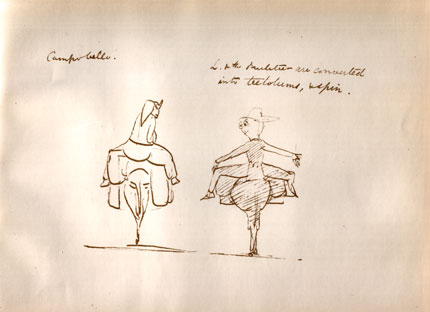
In 1879-1880 Lear and Fields were still writing to each other quite regularly; a letter of 15 October 1879, in which Lear enclosed “Mr and Mrs Discobbolos”, also contained a semi-serious complaint about “a serious misfortune” (the building of a hotel in front of his house) that “has happened to the well known Artist & Author, Edward Lear,” which, having been published in some American newspapers, cost him John Addington Symonds‘s friendship (see Vivien Noakes, Edward Lear, 2004, pp. 243-4 Find in Worldcat). Noakes does not say, but it seems obvious that Fields, clearly an enthusiastic admirer, was responsible for divulging it; a fact which did not put an end to their correspondence, as testified by a letter of 18 January 1880 in which Lear again discusses his plan to build a new villa (Noakes, p. 244 note 2).

Posted in Edward Lear | 1 Comment

Lear Vamping

Tennyson was always very satisfied with Lear’s arrangements of his poems and did not refrain from praising them in public though, as Angus Davidson notes in his 1938 biography, Edward Lear: Landscape Painter and Nonsense Poet (1812-1888) (London: John Murray), p. 87 Find in worldcat, “severer critics did not quite approve.” He then reports an episode which took place at a musical party at the painter John Everett Millais’s house in Cromwell Place; his uncited source is the painter’s son, John Guille Millais (The Life and Letters of Sir John Everett Millais, President of the Royal Academy. 2 vols. Vol. 2. New York: Frederick A. Stokes Company, 1899, pp. 141-2 Find in worldcat) in a chapter devoted to his father’s relationship with Tennyson:

But to Millais Tennyson was always somewhat of an enigma. For at least forty years he was so short-sighted that any book he wished to read must be held almost close to his eye, and yet the scenery of his poems and all natural objects he refers to are so exquisitely and so minutely depicted that one could hardly believe that he had never seen tem. His taste for music was most varied. Though, as we know, he delighted in the works of the great composers, he would now and then seemingly enjoy music that was scarcely classical. An instance of this occurred at a musical party one evening in Cromwell Place. Edward Lear, a charming man and author of the well-known Book of Nonsense, could hardly be called a musician, but being good at “vamping” he sat down to the piano and hummed rather than sang two of Tennyson’s songs to tunes of his own composing. It was a clever performance; but the really musical people there were quite surprised at the eulogistic terms in which tennyson spoke of the compositions. I cannot help thinking, however, that it was regard for the man rather than the music which caused this unexpected outburst of praise.

As to the effects of Lear’s performances on the less musically sophisticated, the following episode, also in Davidson, pp. 95-6, provides a humorous instance:

Before leaving England he [Lear] and Lushington went for a few days to the Tennysons’ at Farringford. Everyone was in good spirits and the visit a great success: at a small party one evening Lear sang his Tennyson songs with all his usual verve, so that his hearers were delighted and deeply moved, and Mrs. Tennyson wrote to him afterwards: ‘I am afraid you will not believe me when I tell you what a hero of romance you are at Afton. How Miss Cotton was found all pale after a sleepless night, how her companion came and poured into my ear a mighty river of thanks and praises and admiration of all sorts.’

The episode is dated October 1855 by Vivien Noakes, Edward Lear: The Life of a Wanderer. Rev. and enl. ed. Stroud: Sutton, 2004, p. 112 Find in worldcat.

Lear himself, however, was not immune from the effects of his own musical exploits, as the Earl of Cromer (Evelyn Baring) writes in the “Introduction” to Queery Leary Nonsense Find in worldcat:

His laughter was, indeed, akin to tears. I have known him. sit down to the piano and sob whilst he played and sang: “Tears, Idle Tears,” which he had himself set to music, and the next morning send me the subjoined sketch;

Lear at the Piano

accompanied by the following literary production, in which he poked fun at his favourite poet and devoted friend:

“Nluv, fluv bluv, ffluv biours,
Faith nunfaith kneer beekwl powers
Unfaith naught zwant a faith in all.”

Listen to Robert Tear’s performance of Edward Lear’s arrangement of Tennyson’s Tears, Idle Tears.

Previous post on Lear’s music.
Subscribe to the podcast only rss feed.

Posted in Edward Lear, Podcasts | Leave a comment

The Book of Nonsense as a Colouring Book

Now and then you can see listed on eBay copies of Edward Lear’s Book of Nonsense in which some or all of the pictures have been coloured. Lear’s childish drawing style, with its large spaces waiting to be filled with bright colours, though unusual at the time, was probably as attractive to people with a fancy for the brush as the accompanying limericks.

In most cases the colouring is probably only the result of a bored child’s lack of anything better to do, but sometimes the artist has done an excellent job, as in the case of some sheets listed some time ago (see the set). According to the seller, these were taken from an 1862 Routledge edition, printed by the Dalziel Brothers, Camden Press.

It is quite obvious that the person who put the colour had a project and a personal view of the limericks: the characters’ faces are painted white and so enhance the impression that the limericks are not really about people, but rather puppets or clowns:

Old Man of Cape Horn

Notice, by the way, how the colours bring out the Old Man’s resemblance to Humpty Dumpty.

Posted in Edward Lear | 1 Comment

A Geography of the Early Limerick

A Peep at the Geography of Europe

Ever since I heard of Google Earth I realised it would be very useful for limerick lovers, but I was too lazy to try and find out how to create interactive maps until I found this post at the Stoa Consortium blog; so here come kmz files for each of the four limerick books published in the early 1820s, with links to the limericks themselves. To use these you’ll have to download and install Google Earth.

You can also download a file containing maps for all four books.

Posted in General, Limerick | Leave a comment

Changing again

I’ve started changing the page layout again, so some parts of the site might not work correctly for some time. Be patient.

Posted in General | Leave a comment

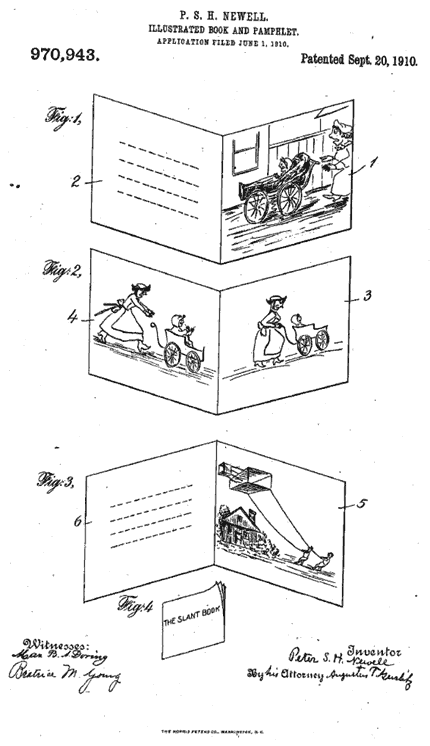
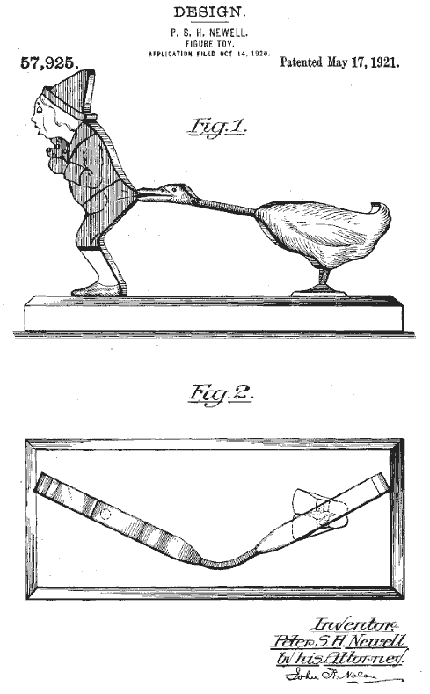
More on Peter Newell

You can now read Philip Hofer’s article on “Peter Newell’s Pictures and Rhymes”, which was published in Colophon. A Book Collectors’ Quarterly in 1934.

Posted in Peter Newell | Leave a comment

Jungle-Jangle

The Peter Newell section of nonsenselit.org now has a full-size, perfect copy of Peter Newell’s Jungle-Jangle.

Peter Newell, Jungle-Jangle (1909)

Thanks to Bob & Ellen Watters, who kindly contacted me and scanned the book.

Posted in General, Peter Newell | Leave a comment

Meta: Site Update

I am going to try and upgrade the blog from WordPress 1.5 to 2.0.2 later today, so there might be problems.

Posted in General | Leave a comment

Where did Nonsense go?

One of the questions which are often asked about Nonsense is, Why did it disappear almost completely from literature after the great season of Edward Lear and Lewis Carroll? As M.B. Heyman writes in his thesis (Isles of Boshen: Edward Lear’s literary nonsense in context, University of Glasgow, Faculty of Arts, Department of English Literature, 2005):

If we skip Lear, Carroll, and the rest of the nineteenth century momentarily, we find a curious twist to the course of nonsense. Although literary nonsense drastically changed the face of children’s literature, as a more “pure” form for children it seems to have died away toward the turn of the century. Instead of remaining a children’s genre, nonsense returned to its old adult audience in various forms (p. 3).

After listing a few examples (Edward Gorey, Mervyn Peake, Dr. Seuss and Roald Dahl) he concludes that “the genre has never returned to the kind of success and popularity it had with Lear and Carroll” (p. 4).

I don’t know as to why it disappeared from children’s literature but have an idea about where it went: first it moved to the pages of the Comic Supplements in American newspapers and, when it vanished from them too, around 1910, it became the basic component of cartoons and was at the core of the medium at least until the 1960s when, with the sad demise of the theatre shorts and the advent of the TV cartoon, it was replaced by elementary adventure plots.

ASIFA-Hollywood Animation Archive

ASIFA-Hollywood Animation Archive are getting ready to celebrate Animation’s 100th Birthday on April 6th: the site has a Biopedia (an Alphabetical Biographical Index) and the frequent posts often include wonderful illustrations from animation-related books and sometimes even whole shorts that can be downloaded.

É Cohl, Fantasmagorie, 1908

As an experiment in vodcasting, I’m posting a cartoon which perfectly exemplifies the pervasiveness of Nonsense even in the earliest animated films: Émile Cohl‘s Fantasmagorie (1908). You may need to download iTunes to watch it.

Posted in Comics, General, Podcasts | Leave a comment

Self-Reference in Lear s Limericks

The documents section of nonsenselit.org now contains a recent essay on Edward Lear:

Winfried Nöth. “The Art of Self-Reference in Edward Lear’s Limericks.” Interdisciplinary Journal for Germanic Linguistics and Semiotic Analysis 10.1, 2005, pp. 47-66.

Many thanks to professor Nöth and the journal editors for permission to reproduce it.

Posted in Edward Lear, General | Leave a comment