Alice Illustrators at the Hornseys

A major contemporary art exhibition inspired by Lewis Carroll’s ‘Alice’ books entitled ‘Alice’s Wonderland’ is opening at “the gallery — Hornseys” on 14 April. Also on display “fine printers proofs from the original Sir John Tenniel wood blocks, as well as heliogravures by Salvador Dali.”
Posted in Lewis Carroll | Leave a comment

Lewis Carroll and His Telescoping Determinants

If you are interested in C.L. Dodgson’s mathematical works, you can read this article on the website of the Mathematical Association of America, which lists and links to several other essays on Carroll’s method for evaluating determinants.

Posted in Lewis Carroll | Leave a comment

Alice in Russia

The Moscow Times has an interesting story of the coming of Lewis Carroll’s Alice in Wonderland to Russia: it seems the book had a very negative reception from the time of the first 1879 translation until 1967, when Soviet bureaucrats commissioned a translation after mistaking it for a Bulgarian book.

Posted in Lewis Carroll | Leave a comment

The 1903 Alice Movie

The whole of Lewis Carroll’s Alice in Wonderland (well, almost) in just 9 spectacular minutes, the original probably ran a bit longer as some scenes seem to be incomplete. On YouTube, in very low quality, but then I had never managed to see it:

For more information on the film and a some good comments see the IMDb entry.

From Fuse #8 through Educating Alice, where some more Alice movies are discussed.

Posted in Lewis Carroll, Podcasts | Leave a comment

Peter Newell's Patents

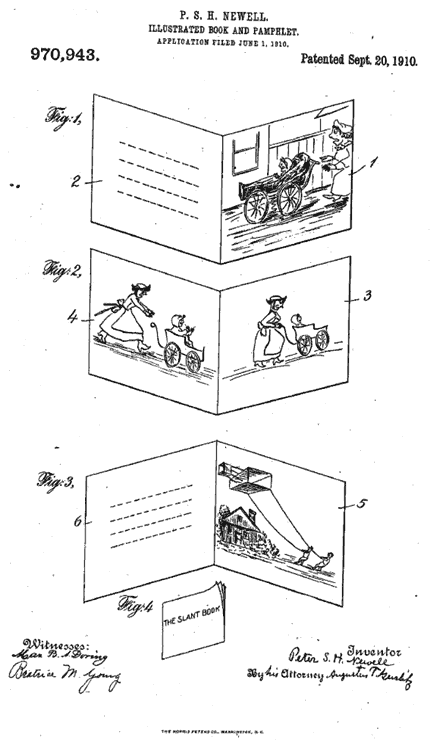
Peter Newell’s innovations in book technology, while mostly not very radical, induced him to patent the designs he created, below is the first page of his patent for the Slant Book:

patents_newell_slant_1.gif

In the specification he writes:

… I, Peter S. Newell of Leonia, in the State of New Jersey, have invented certain new and useful Improvements in Illustrated Books and Pamphlets …
As such books have been heretofore made it has been usual to form or shape them in rectangular configuration, with the result that no, or but little, variety in the form of the books could be obtained, and the constant uniformity of such books in such forms, fails to meet the desire for change and variety which is strong in many persons, especially in children and young people. In addition to that, such monotonous form of book does not lend itself to impart any suggestion of action or motion to the design or pictorial representations which may be shown therein, so that whether the pictures represent flying or climbing upward, or sliding down hill, it is always the same rectangular form of book and page on which such motion is to be suggested or delineated.
In books made according to my invention the shape of the book itself and of the pages therein suggests the action or motion which is intended to characterize the illustration contained therein.

The pictures above show that Newell was thinking of using the peculiar shape for more varied effects, though in the end he exploited only the downhill rush in the Slant Book.

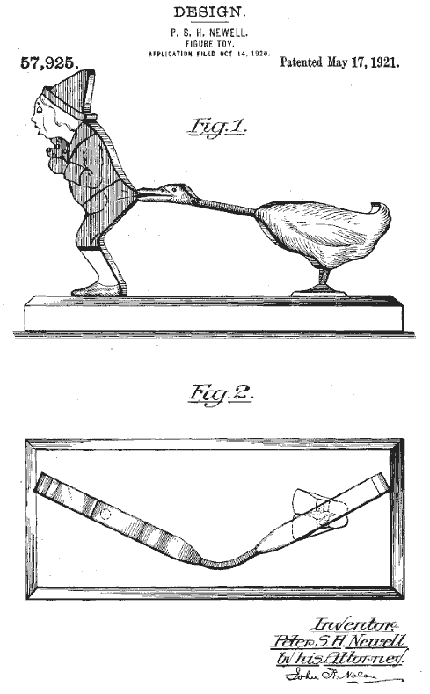
Peter Newell, Figure Toy patent, 1920

The patent for the Slant Book, along with those for a couple of 1920 figure toys (1, 2), one of which is reproduced above, is available thanks to Google Patent Search, where the full description can be read.

Posted in Peter Newell | 3 Comments

Fictional Edward Lear

Interest in Edward Lear must be on the rise, at least among writers: he has been making appearances in a number of novels, short stories and even as the central character in Clive Barker’s play Subtle Bodies (in Forms of Heaven: Three Plays by Clive Barker. London: HarperCollins, 1997).

A few stories have been made available online, the classic Donald Barthelme’s “The Death of Edward Lear,” from Overnight to Many Distant Cities (New York: Penguin, 1983), as well as two recent web originals: “Lear on Limbo: Journal of a Landscape Painter on the Island of Limbo” by Dennis List, and “The Old Man of Corfu” by Peter Byrne (at swans.com).

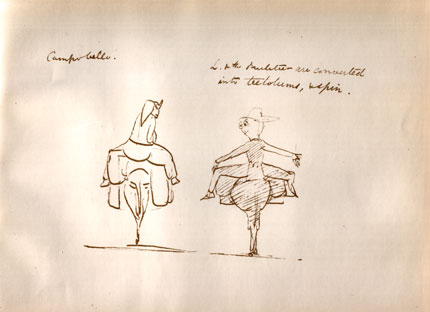
Lear in Campobello

If the fictional Lear does not satisfy you, you can follow the adventures of a British family following in his (and Michael Montgomery‘s) footsteps across Sicily in last Saturday’s Telegraph Magazine: To Gromboolia and Back.

Posted in Edward Lear | 1 Comment

Two Kinds of Paradox

Chris Gosling has kindly sent me a copy of G.K. Chesterton’s 1911 article “Two Kinds of Paradox,” first published in the Illustrated London News. See previous post on Chesterton.

Posted in General | Leave a comment

Chesterton on Nonsense

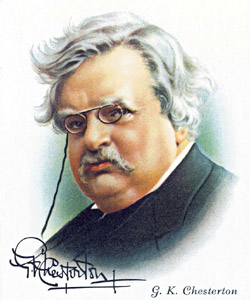
G.K. ChestertonA post at the Blog of the American Chesterton Association about G.K. Chesterton’s frequent references to Edward Lear gives me an opportunity to mention that three nonsense related articles of his are on the Bookshelf of nonsenselit.org:

Another essay which promises to be very interesting is “The Two Kinds of Paradox,” London News 11 March 1911 (reprinted in vol. XXIX of the Collected Works. San Francisco: Ignatius Press, 1988). I have not been able to find a copy, but a discussion is available here.

Posted in General | 1 Comment

A-Courting with the Yonghy-Bonghy-Bò

In my previous post on the sources of Edward Lear’s “The Courtship of the Yonghy-Bonghy-Bò” I forgot to mention William Wordsworth’s “The Blind Highland Boy,” noted by Michael Heyman in his Isles of Boshen; in the poem the boy escapes in a turtle-shell, but is ovetaken and saved by his good neighbours.

I have now found the Great Wolford text I mentioned online, and it is dated 1913 to 1916, a bit late to have had an influence on Lear, though I have not seen the printed text and cannot say for sure: it might well be that the Yonghy Bonghy-Bò is Fidler Wit’s predecessor.

The study of the sources of “The Courtship of the Yonghy-Bonghy-Bò,” in any case, must include some mention of popular courting songs, often consisting of long lists of the lover’s properties, which often provide the comic element; e.g. see “The Clown’s Courtship” (Dixon, James Henry. Ballads and Songs of the Peasantry of England: Taken Down from Oral Recitation and Transcribed from Private Manuscripts, Rare Broadsides and Scarce Publications. Ed. Robert Bell. London: Charles Griffin and Co., 1864: 155):

Quoth John to Joan, wilt thou have me?
I prythee now, wilt? and I’ze marry with thee,
My cow, my calf, my house, my rents,
And all my lands and tenements:
            Oh, say, my Joan will not that do?
            I cannot come every day to woo.

I’ve corn and hay in the barn hard by,
And three fat hogs pent up in the sty:
I have a mare, and she is coal black,
I ride on her tail to save my back.
            Then say, &c.

I have a cheese upon the shelf,
And I cannot eat it all myself ;
I’ve three good marks that lie in a rag,
In the nook of the chimney, instead of a bag.
            Then say, &c.

To marry I would have thy consent,
But faith I never could compliment;
I can say nought but ‘hoy, gee, ho,’
Words that belong to the cart and the plow.
            Then say, &c.

The same anthology, which you can download from the recently released Live Book Search, includes more courting songs. For a more explicitly comic example, see “Harry’s Courtship” (pp. 155-6), which presents the same story, but as “modest Mary” protests that she is not going to “sit at my wheel a-spinning, / or rise in the morn to wash your linen; / I’ll lie in bed till the clock strikes eleven,” Harry is forced to reply: “Why then thou must marry some red-nosed squire.”

Posted in Edward Lear | Leave a comment

On the Coast of Coromandel

Vivien Noakes, in her edition of Edward Lear’s Complete Verse and Other Nonsense (London: Penguin, 2001; pp.517-8), mentions as a source for “The Courtship of the Yonghy-Bonghy-Bò” a Great Wolford, Worcestershire, mummers’ play, in which the Fool says:

In comes I fidler Wit
My head’s so large, me wits so small
I’ve brought me fidler to please you all.
Toll-de-roll the tinder box
Father died the other night
And left me all his riches,
A wooden leg, a feather bed,
And a pair of leather breeches,
A coffee pot without a spout,
A jug without a handle,
A guinea pig without a wig,
And half a farthing candle.

Were it not for the fact that Tennyson’s “Frater Ave atque Vale” was written in June 1880 while Lear’s poem was finished by 11 December 1871 and first published in Laughable Lyrics (1877), Davidson’s suggestion of an influence would be attractive; as it is, we must think that the poet laureate’s poem was influenced by Lear’s song.

The setting and tone for “The Coutship of the Yonghy-Bonghy-Bò” might rather have been suggested by Benjamin Penhallow Shillaber’s “The Coromandel Lament”, which appeared in his 1853 collection Rhymes, With Reason and Without (Boston: A. Tompkins and B. B. Mussey Co.). The poem, “supposed to represent the feelings of a Coromandel chief in captivity, was written for music. The incident is mainly true.”

In the Coromandel country I was born,
    Far away, far away;
And happy was I at night and morn,
    In the Coromandel country, far away:
        Where the birds sang free
        In the banyan tree,
    In the Coromandel country, all the day.

Ah, fearful was the fight where my father was slain,
    Far away, far away;
When first I felt the captor’s chain,
    In the Coromandel country, far away:
        Where the breeze blows free
        Over land and over sea
    In the Coromandel country, far away.

The cruel men bore me the waters o’er,
    Far away, far away,
From kindred and home I may never see more,
    In the Coromandel country, far away:
        From the green palm tree
        That overshadowed me,
    In the Coromandel country, far away.

But tyrants never can bind our dreams,
    Far away, far away;
Again in my sleep the warm sun gleams,
    In the Coromandel country, far away;
        Again on the tree
        Sings the bird for me,
    In the Coromandel country, far away.

O, welcome the hour when friendly Death,
    Far away, far away,
Shall waft my spirit with his breath
    To the Coromandel country, far away;
        Ever there to rest,
        In freedom blest,
    In the Coromandel country, far away.

The melancholy atmosphere of the lyric perfectly fits the mood of Lear’s Nonsense Songs (1871) and Laughable Lyrics and not a few phrases recall Lear’s much more memorable ones from “The Jumblies” (“Far and few, far and few”) and “The Dong with a Luminous Nose” (the “Bong tree”, “The Dong was happy and gay, / Till…), as well as “The Duck and the Kangaroo” (“over the land and over the sea”).

Shillaber’s Rhymes, With Reason and Without was only published in the USA, at least so it seems from the WorldCat record, but Lear also had American correspondents (see previous posts: 1, 2) and he might have obtained a copy. The book is now available online thanks to the Making of America repository and can be downloaded from Live Search Books.

Posted in Edward Lear | 1 Comment