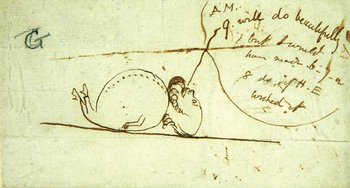
Uncle Arly Told by Dudley Moore

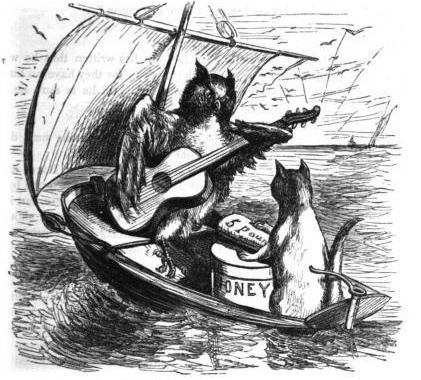
A suitably obscure rendition of an Edward Lear poem (“Incidents in the Life of My Uncle Arly“) by Dudley Moore from the needlessly destroyed archives of “Not Only… But Also“.

Posted in Edward Lear, Podcasts | Leave a comment

The Pobble Who Has No Toes: a Marionette Show

This is clearly an amateurish home production of Edward Lear’s “The Pobble Who Has No Toes;” the image is quite dark and at times this makes it difficult to understand what’s going on.

Posted in Edward Lear, Podcasts | Leave a comment

The Akond of Swat Video by Ken Nordine

The music for this video was first published in Ken Nordine‘s CD A Transparent Mask (Asphodel ASP 2004, 2001): “The Akond of Swat” is one of Edward Lear’s Indian poems.

More Nordine on YouTube.

Posted in Edward Lear, Podcasts | 1 Comment

Two Old Bachelors: the Cartoon

From YouTube, a short animated film by Doug Wilson, illustrating Edward Lear’s poem “The Two Old Bachelors.” This traditional animation movie was produced at the University Of Central Lancashire for his 3rd year degree and it was shown at the Flip Animation Festival in Wolverhamptin in October 2006.

A quick search revealed several other clips I’ll be posting after this one.

Posted in Edward Lear, Podcasts | Leave a comment

Another Peter Newell Patent

In 1909 Peter Newell filed an application for a patent on books with leaves “having designs thereon, and having corresponding portions of said designs cut away to provide sight openings.” The drawings used to illustrate it are sketches of the pictures published that same year under the title of Jungle-Jangle, a mild satire of Theodore Roosevelt’s hunting expedition to Africa.

Newell, Jungle-Jangle patent image

While the patent for the Slant Book was granted within months of the filing, this one took until 1911 to receive approval, perhaps because instances of “peep shows” or “tunnels” had already appeared at least since the 1850s, according to the Popup Lady’s “History of Movable Books” (also see “Exploring Tunnel Books” at artistbooks.org and Patrizia Ghirardelli’s “Glossario“). Peter Newell’s slim volume, however, differs from the traditional tunnel book for its use of the cut-out shapes as a narrative device which prepares the final revelation; the old peep shows aimed at showing a surprising but static scene.

F.U. Wagner Picture-Book patent

Interestingly, an incredibly similar design had been filed in 1908 by one Frank U. Wagner but it did not receive approval until 1912: in this case the lady’s face showing through the hole was to be in relief, a variation on S. and J. Fuller’s early-19th century doll-books such as The history of little Fanny, exemplified in a series of figures and Frank Feignwell’s attempts to amuse his friends on Twelfth Night. Exhibited in a series of characters.

Posted in Peter Newell | 1 Comment

Alice Illustrators at the Hornseys

A major contemporary art exhibition inspired by Lewis Carroll’s ‘Alice’ books entitled ‘Alice’s Wonderland’ is opening at “the gallery — Hornseys” on 14 April. Also on display “fine printers proofs from the original Sir John Tenniel wood blocks, as well as heliogravures by Salvador Dali.”

Posted in Lewis Carroll | Leave a comment

Lewis Carroll and His Telescoping Determinants

If you are interested in C.L. Dodgson’s mathematical works, you can read this article on the website of the Mathematical Association of America, which lists and links to several other essays on Carroll’s method for evaluating determinants.

Posted in Lewis Carroll | Leave a comment

Alice in Russia

The Moscow Times has an interesting story of the coming of Lewis Carroll’s Alice in Wonderland to Russia: it seems the book had a very negative reception from the time of the first 1879 translation until 1967, when Soviet bureaucrats commissioned a translation after mistaking it for a Bulgarian book.

Posted in Lewis Carroll | Leave a comment

The 1903 Alice Movie

The whole of Lewis Carroll’s Alice in Wonderland (well, almost) in just 9 spectacular minutes, the original probably ran a bit longer as some scenes seem to be incomplete. On YouTube, in very low quality, but then I had never managed to see it:

For more information on the film and a some good comments see the IMDb entry.

From Fuse #8 through Educating Alice, where some more Alice movies are discussed.

Posted in Lewis Carroll, Podcasts | Leave a comment

Peter Newell's Patents

Peter Newell’s innovations in book technology, while mostly not very radical, induced him to patent the designs he created, below is the first page of his patent for the Slant Book:

patents_newell_slant_1.gif

In the specification he writes:

… I, Peter S. Newell of Leonia, in the State of New Jersey, have invented certain new and useful Improvements in Illustrated Books and Pamphlets …
As such books have been heretofore made it has been usual to form or shape them in rectangular configuration, with the result that no, or but little, variety in the form of the books could be obtained, and the constant uniformity of such books in such forms, fails to meet the desire for change and variety which is strong in many persons, especially in children and young people. In addition to that, such monotonous form of book does not lend itself to impart any suggestion of action or motion to the design or pictorial representations which may be shown therein, so that whether the pictures represent flying or climbing upward, or sliding down hill, it is always the same rectangular form of book and page on which such motion is to be suggested or delineated.
In books made according to my invention the shape of the book itself and of the pages therein suggests the action or motion which is intended to characterize the illustration contained therein.

The pictures above show that Newell was thinking of using the peculiar shape for more varied effects, though in the end he exploited only the downhill rush in the Slant Book.

Peter Newell, Figure Toy patent, 1920

The patent for the Slant Book, along with those for a couple of 1920 figure toys (1, 2), one of which is reproduced above, is available thanks to Google Patent Search, where the full description can be read.

Posted in Peter Newell | 3 Comments