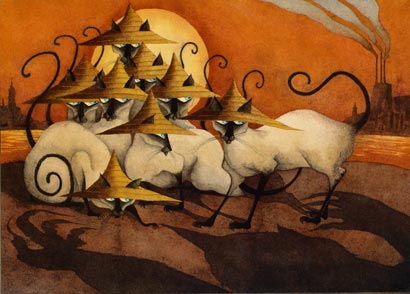
Lord Purrpurr Performs Owl and Pussy-Cat

Lord Purrpurr of the Fuzzberrys gives his rendition of Edward Lear’s “Owl and the Pussycat:”

Posted in Edward Lear | Leave a comment

More on Alice by Unsuk Chin

The International Herald Tribune has a review of Unsuk Chin’s adaptation of Lewis Carroll’s Alice which reveals problems with Achim Freyer’s staging:

One might have deemed the book universally known, but it apparently escaped Freyer’s upbringing in East Germany. He reportedly read it only after agreeing to the project based on his esteem for Chin’s earlier music. But in an interview in the German magazine Rondo he criticized Carroll’s treatment of Alice as obscene and the work’s surrealism as outdated.

Sally Matthews (Alice) and Stefan Schneider (Caterpillar) in “Alice in Wonderland”

And:

A frosty relationship is said to have developed in rehearsals between Freyer and Chin, who in the Süddeutsche Zeitung took a swipe at his staging, calling it constrained.

All reviewers, at least so far, seem to agree on the “fascinating” nature of Chin’s score. From the little I have been able to see in the clips on the Staatsoper site I must say the staging looks fine to me, but it is not difficult to see how it may get boring in a show lasting over two hours.

Posted in Lewis Carroll | Leave a comment

Alice in Wonderland by Unsuk Chin

Korean composer Unsuk Chin‘s opera based on Lewis Carroll’s Alice in Wonderland was premiered on 30 June at the Munich festival and has been favourably reviewed in the Guardian and the Los Angeles Times.

The Mad Tea Party

More information, including a photogallery and a video, is available at the Bayerische Staatsoper site.

Parts of the opera were previewed during the 2005 Proms under the title snagS and Snarls and broadcast by BBC Radio 4.

Here is Chin’s own program note:

1 Alice Acrostic
2 Who in the world am I?
3 The Tale-Tail of the Mouse
4 Twinkle, twinkle, little star
5 Speak roughly to your little boy

snagS & Snarls was commissioned by the Los Angeles Opera and is a kind of sketch for the opera Alice in Wonderland, also for the Los Angeles Opera. With the exception of the first piece, its movements are based on scenes from Lewis Carroll’s Alice’s Adventures in Wonderland.

1 Alice Acrostic
Lewis Carroll wrote this poem as a conclusion for his two Alice stories. It is an acrostic in which, reading down, the first letters of each line spell out the name Alice Pleasance Liddell, the girl who inspired the Alice stories. In this poem Carroll recalls, nine years after the event, the boating trip on the River Thames on 4 July 1862, during which he made up and first told some of the Alice adventures to the three Liddell sisters. In the last line of this acrostic, ‘Life, what is it but a dream?’, Carroll was probably making reference to the anonymous canon that even then was popular in England:

Row, row, row your boat
Gently down the stream –
Merrily, merrily, merrily, merrily
Life is but a dream.

2 Who in the world am I?
The text is taken from the chapter ‘The Pool of Tears’, in which Alice has an existential crisis arising from finding herself in a world in which another kind of logic appears to rule. It contains the poem ‘How doth the little crocodile’, which is a parody of a well-known English pious poem of the 18th century.

3 The Tale-Tail of the Mouse
A picture-poem from the chapter ‘A Caucus-Race and a Long Tale’

‘Mine is a long and sad tale,’ said the Mouse, turning to Alice; and sighing. ‘It is a long tail, certainly,’ said Alice, looking down with wonder at the Mouse’s tail … And she kept on puzzling about it while the Mouse was speaking, so that her idea of the tale was something like this …

The music reflects the picture-poem. The phrases begin loudly and become softer and softer; the instruments move upwards quickly: the notes on the pages thereby take on the appearance of a mouse’s tail.

4 Twinkle, twinkle, little star
The punning text is a series of variations upon the Mad Hatter’s song ‘Twinkle, twinkle, little bat’, from the chapter ‘A Mad Tea-Party’. This text is in turn a parody of the poem ‘Twinkle, twinkle, little star’ by Ann and Jane Taylor. (The Carroll expert Martin Gardner has noted that Carroll was probably making another joke since ‘bat’ was what one well-known mathematics professor of Carroll’s acquaintance was called by his students.) The people and animals alluded to in the text, including Bill, Pat, and Ed, appear elsewhere in Alice’s Adventures in Wonderland.

5 Speak roughly to your little boy
This scene is based on the chapter ‘Pig and Pepper’ and takes place in the Duchess’s kitchen, where the Duchess sings a grotesque lullaby to a baby who is later transformed into a pig. In the midst of it, the cook throws cooking pots and other kitchen utensils at the Duchess and others present, which is represented musically by an expanded percussion section that includes wineglasses, cutlery and cooking pots.

According to the author Martin Gardner, the text ‘Speak roughly to your little boy’ parodies a nowforgotten English religious instructional poem, ‘Speak gently!’, that was written by one of Carroll’s contemporaries. In addition I have inserted texts from Carroll’s stage version of Alice, which give the scene a ritualistic quality.

Posted in Lewis Carroll, Podcasts | 1 Comment

The Bong Tree – Again

Over at the Language Log Bill Poser has a post, prompted by the recent Supreme Court decision on “Bong hits 4 Jesus,” on the different meanings of “bong”.

In a previous post I connected the “bong tree” to the Buddha’s “bo tree,” or Indian fig tree. The etymology provided for “bong” as a smoking implement in Wikipedia — from Thai baung meaning (1) marijuana pipe, a bong, and (2) a section of hollow bamboo stalk (see the dictionary entry at thai-language.com) — also refers to some kind of tree, though I think the meanings listed by Poser have little or no relevance for Edward Lear’s “The Owl and the Pussy-Cat.”

Among the many posts Language Log has devoted to the case, you should also read The Supreme Court Fails Semantics, which discusses “utterances that have no semantic interpretation,” i.e. nonsense.

Posted in Edward Lear | Leave a comment

Another Owl and Pussy-Cat Reading

Edward Lear’s most famous poem is performed by the “amazing” Kazzy, with limited animation:

Posted in Edward Lear, Podcasts | Leave a comment

The Dong with a Luminous Nose: A Theatrical Adaptation

The Dong with a Luminous Nose: poster

From an e-mail from Shipra Ogra, Administrator of the London Bubble Theatre Company:

London Bubble Theatre company is showing Edward Lear’s “The Dong with a Luminous Nose” as part of theatre in the parks we do every summer. We will take Edward Lear’s much-loved nonsense poem and inject a touch of reality to create an open-air production full of humour. The concept of touring in the parks is a part of our mission of making theatre accessible to people who do not usually engage with the medium. We are one of the first theatre companies in London to show theatre in non-theatre spaces and have been doing so successfully for over 30 years.

The show will open on July 4 at Sydenham Wells Park and then move to several different parks in London. For a full schedule and further details visit the company’s web site.

Posted in Edward Lear | Leave a comment

Nonsense Drolleries

Some time ago I placed William Foster’s illustrations from Nonsense Drolleries. The Owl & the Pussy-cat. The Duck & the Kangaroo. London: Frederick Warne, 1889 in the nonsenselit.org’s picture gallery: their most striking feature, in my opinion, is the fact that the illustrator is unique in choosing to represent the Owl as the bride and the Pussy-cat as the the bridegroom.

The Owl as bride

The British Library has a page on William Foster which gives some information about this heretic.

The book has since been placed online by the Internet Archive in the usual formats.

Posted in Edward Lear | Leave a comment

Lewis Carroll on Edward Lear

I mentioned in a previous post that Edward Lear’s copy of Alice in Wonderland is now in the USA, that he discussed the book with Fortescue (though we do not know what he thought of it), and that his circle considered Carroll’s tales as belonging to the same genre of literary Nonsense which Lear had created, or recreated, for the Victorian age.

It now seems that evidence that Carroll knew and appreciated Lear’s books has been around for a long time, at least since Florence Becker Lennon’s The Life of Lewis Carroll. New York: Collier Books, 1962, pp. 171-2:

The strangest hiatus between Carroll and his contemporraries reaches to Edward Lear, in whose biography Angus Davidson says: “There occurred during the autumn of that year [1865], in the world which, until now, Lear had been indisputed king — the world of Nonsense — an event of the utmost importance, the publication of Lewis Carroll’s Alice in Wonderland. From Lear’s complete silenceon the matter it might be thought that he never heard either of the book or of … its author; yet this is hardly possible. He was in London when it came out.” Lear and Dodgson both knew most of the pre-Raphaelites and moved in overlapping circles; if they never met, they could hardly have escaped hearing each other’s bon mots. But Carroll never mentions Lear either, and Mr. Madan [in a letter to Lennon] said there seemed to be “no trace” of Lear in his library. Nevertheless it is unthinkable that Carroll had not read the Book of Nonsense, which came out when he was fourteen. Carroll at least eventually appreciated Lear, for Miss [Menella] Dodgson writes in a letter that he gave her and her sisters one of the Lear books. Perhaps the two lions were mutually carnivorous, like Eugene Field’s fierce toy animals, and circled round at a respectful distance to keep from eating each other up.

In this case, too, we do not know what Carroll thought of Lear’s Nonsense, but his opinion must have been positive if he gave a copy of one of his books to his nieces.

More recently, while reviewing Charlie Lovett’s Lewis Carroll Among His Books (Jefferson, NC and London, McFarland & Company, 2005) in the latest Lewis Carroll Review (Issue 35, May 2007, p. 3), August A. Imholtz Jr. writes:

There is [in Lovett’s catalogue, purporting to include books that Carroll read even if there is no trace in the existing lists] … no work by Edward Lear, and yet the late Iona Opie more than twenty years ago told me she had acquired Carroll’s own, unfortunately unannotated, copy of Lear’s Book of Nonsense, which is now in the Opie collection of Children’s Literature at the Bodleian.

Lennon’s idea that Carroll could hardly have ignored Lear’s 1846 Book of Nonsense might be confirmed by the fact that the young Dodgson actually wrote a few limericks, all of them composed in that same year.

Posted in Edward Lear, Lewis Carroll | 3 Comments

More UPA: Christopher Crumpet

There are a lot of UPA cartoons on YouTube; I had never seen Christopher Crumpet (1953), another story drawn in a pseudo-simple style reminiscent of Edward Lear with a largely nonsensical tale by T. Hee and Robert Cannon. The cartoon also reminds me of the earliest animation sequences, which very often started with a hand drawing the characters (in this case the hand is also animated, though in a very different style).

Posted in Comics, Podcasts | Leave a comment

The Unicorn in the Garden

James Thurber‘s drawings, once extremely popular, place him firmly in the tradition of Edward Lear’s apparently childish illustration, while his stories tend to be mildly satiric or parodistic.

One of the most famous of these, The Unicorn in the Garden, was adapted for one of UPA‘s most acclaimed cartoons. After watching the short, don’t miss Michael Sporn’s post, which also includes the text and illustration of the story, and the ensuing discussion.

Directed by Bill Hurtz
Story by James Thurber
Animation by Phil Monroe, Rudy Larriva, Tom McDonald
Design & Color by Robert Dranko
Music by David Raksin
Production Manager Herb Klynn
Produced by Stephen Bosustow

Posted in Comics, James Thurber, Podcasts | Leave a comment