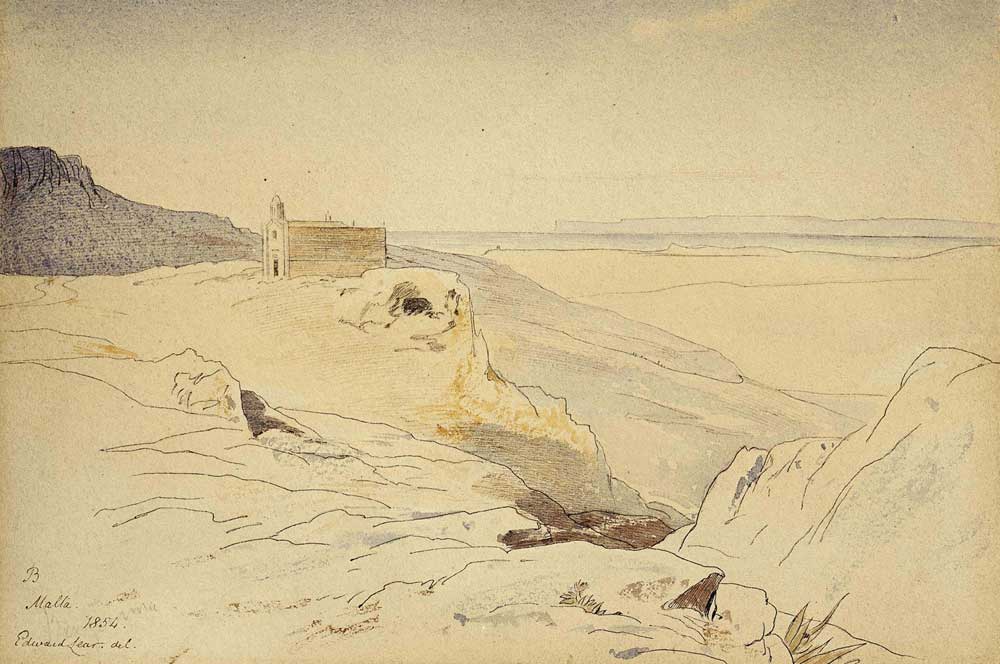
Study of a mountain church, Malta (1854)
Stephen Duckworth has sent me a list of paintings, watercolours and drawings by Edward Lear (pdf) in UK public collections. We will try to keep you updated on which are going to be displayed during 2012.
Study of a mountain church, Malta (1854)
Stephen Duckworth has sent me a list of paintings, watercolours and drawings by Edward Lear (pdf) in UK public collections. We will try to keep you updated on which are going to be displayed during 2012.
MR. LEAR has followed up his delightful “Book of Nonsense” by a new one, called “Nonsense Songs, Stories, Botany, and Alphabets,” [R.J. Bush, Charing Cross.] which contains many great triumphs of the scientific feeling for nonsense, and we are disposed to say,—though this is somewhat rash, without the co-operation of a jury of children,—some decided failures also. The old “Book of Nonsense” contained no failures. The present writer has seen an eminent statesman, great in finance, unequalled on the Bank Act, laugh over it the whole of a summer morning (when out of office). It is true that if the delightful legend which attributes its origin to the intense desire of the late Lord Derby to betray the present Lord Derby in his boyhood into a nonsensical mood, has any foundation in fact, the book most likely failed in its immediate purpose, for no one could be so exceeding sober as that usually prudent statesman who had ever had a hearty laugh over one of Mr. Lear’s nonsense rhymes. But it is not the first time that great unintended fruits have been reaped from an enterprise which had apparently ignominiously failed. The whimsical has probably no charms for Lord Derby, to whom the following nonsense verse would be quite appropriate:—
“There was a young man of Coblence
Who had such confounded good sense!
When they dared him to fight
He said, ‘Have I the might,
Can I spare the pounds shillings and pence!'”
But the rest of the world, old and young, have really enjoyed in their leisure hours Mr. Lear’s capital nonsense. Who has not been struck by that remarkable prophecy of the grotesque medicinal alternative presented (more than once since Solferino) to the Austrians?—
“There was an old man of Vienna
Who lived upon tincture of Senna,
When that didn’t agree
He took Camomile tea,
That nasty old man of Vienna.”
And who has not moralized over that pathetic parable of the results of a rash or ill-assorted marriage, in demoralizing even the sincerity of the sufferer?—
“There was a young person of Gretna
Who jumped down the crater of Etna,
When they asked ‘Is it hot?’
He replied ‘It is not!’
That mendacious young person of Gretna.”
In the “Book of Nonsense” Mr. Lear never went beyond the limits of true nonsense. His delightful rhymes and delightful pictures defied sense,—which is just what nonsense ought to do,—but the defiance was in itself at once acknowledgment and rebellion. What we want from Nonsense is exactly this,—a gay rebellion against sense. But there is no relief to the mind unless there be enough sense in the nonsense to make the nonsense visible, just as,
“Glowing embers through the room
Teach light to counterfeit a gloom.”
Thus nothing can be more admirable than Mr. Lear’s Nonsense Botany. His picture of “the Bottleforkia Spoonifolia” is one which would make Dr. Hooker roar; the thing looks so like a new botanical genus, with its bottle-shaped calyx, and fork-shaped stamens, and spoon-shaped leaves, and sounds so like a true genus as well. So again, the “Manypeeplia Upsidownia” is so delicious a caricature of the fuchsia that we are not sure it would not engender a new sense of humour in that pendulous plant, and make its petals quiver with suppressed mirth. The “Piggiwiggia Pyrarnidalis ” might at a little distance betray a Campanula into something like recognition of kindred; and as for the “Plumbunnia Nutritiosa,” it is a sort of gigantic strawberry with a mottled and darker colour, and the same sort of leafy calyx. The nonsense botany is genuine nonsense,—extravagant enough to make the most prosaic man laugh; but yet nonsensical precisely because it recognizes the laws of sense, and directly traverses them. But is there any real science of nonsense in nonsense cookery of the following kind ?—though we feel pretty sure that Mr. Lear would not let it appear in public if it had not already proved its power to amuse:—
“To Make An Amblongus Pie.
“Take 4 pounds (say 41/2 pounds) of fresh Amblongusses and put them in a small pipkin.
“Cover them with water and boil them for 8 hours incessantly, after which add 2 pints of new milk and proceed to boil for 4 hours more.
“When you have ascertained that the Amblongusses are quite soft, take them out and place them in a wide pan, taking care to shake them well previously.
“Grate some nutmeg over the surface, and cover them carefully with powdered gingerbread, curry-powder, and a sufficient quantity of Cayenne pepper.
“Remove tho pan into the next room, and place it on the floor. Bring it back again, and let it simmer for three-quarters of an hour. Shake the pan violently till all the Amblongusses are become of a pale purple colour.
“Then having prepared the paste, insert the whole carefully, adding at the same time a small pigeon, 2 slices of beef, 4 cauliflowers, and any number of oysters.
“Watch patiently till the crust begins to rise, and add a pinch of salt from time to time.
“Serve up in a clean dish, and throw the whole out of window as fast as possible.”
That seems to us a trifle nearer to the grave talk of an idiot asylum, than to the nonsense of sane people. Yet we are far from denying that children would laugh over it. There is such a fund of animal spirits in children, that they will laugh almost for the sake of laughing on the slightest excuse, and the mystification about the Amblongus, the careful directions, “remove the pan into the next room, place it on the floor, bring it back again,” and finally, “throw the whole out of window as fast as possible,” might tickle the very easily tickleable childish fancy. There is something in a child’s mind which exactly corresponds to the sensitiveness of the soles of its feet or the armpits to gentle tickling. If you suddenly substitute a flat no-meaning where the law of association led them to expect meaning, children will laugh, often almost hysterically. But the question is not so much ‘Will a child laugh at this?’ as ‘Is it the sort of nonsense at which it ought to laugh?’ And we can’t think it is. There is not the trace of that gaiety and elasticity of feeling in the author which is the sine qua non of all good nonsense. Only compare it with this delightful ballad from the same book, which is of the very essence of first-rate nonsense!—
Said the Duck to the Kangaroo,
‘Good gracious! how you hop!
Over the fields and the water too,
As if you never would stop!
My life is a bore in this nasty pond,
And I long to go out in the world beyond!
I wish I could hop like you!’
Said the duck to the Kangaroo.‘Please give me a ride on your back!’
Said the Duck to the Kangaroo.
‘I would sit quite still, and say nothing but “Quack,”
The whole of the long day through!
And we’d go to the Dee, and the Jelly Bo Lee,
Over the land and over the sea;–
Please take me a ride! O do!’
Said the Duck to the Kangaroo.Said the Kangaroo to the Duck,
‘This requires some little reflection;
Perhaps on the whole it might bring me luck,
And there seems but one objection,
Which is, if you’ll let me speak so bold,
Your feet are unpleasantly wet and cold,
And would probably give me the roo-
Matiz!’ said the Kangaroo.Said the Duck ,’As I sate on the rocks,
I have thought over that completely,
And I bought four pairs of worsted socks
Which fit my web-feet neatly.
And to keep out the cold I’ve bought a cloak,
And every day a cigar I’ll smoke,
All to follow my own dear true
Love of a Kangaroo!’Said the Kangaroo,’I’m ready!
All in the moonlight pale;
But to balance me well, dear Duck, sit steady!
And quite at the end of my tail!’
So away they went with a hop and a bound,
And they hopped the whole world three times round;
And who so happy, — O who,
As the duck and the Kangaroo?
The four pictures which illustrate this delightful ballad are as good as the ballad itself. First, there is the Kangaroo towering up in lofty, prim reserve above the suppliant Duck in its nasty pond, which looks the very picture of urgent humility,—of passionate plebeian yearning; while the Kangaroo’s small elegant head reared at a vast height above the Duck, and her dropped paws, indicate respectively aristocratic breeding and a certain indifference to the Duck and her humble sphere. In the second picture, where the Duck’s wheedling is evidently taking effect, the condescension with which the Kangaroo stoops from her immense height to listen to the Duck’s pleadings, and the lackadaisical expression with which she takes pity on the poor waddling thing,—who is drawn in an attitude inexpressibly vulgar, cook-maidy, and self-humiliated, as she approaches the Kangaroo,—are quite irresistible. Mr. Lear has never drawn anything more humorous. In the third drawing, the Duck is well in the saddle at the tip of the Kangaroo’s tail, while the Kangaroo, who is jumping along, looks affectionately and anxiously back to see that the Duck is comfortable in its new and somewhat hazardous position, while the Duck, who has entirely lost its crestfallen and dispirited air, looks the very picture of cosy satisfaction. In the last drawing something of the élan of adventure has come upon the Kangaroo, who leaps away with the full enthusiasm of travel, and eager forward glance into the new world; while the Duck, who has got all its desires fulfilled, is the image of petted and luxurious happiness. It is quite impossible to conceive happier illustrations of the true science of nonsense than this ballad, or that of “The Owl and the Pussy Cat,” who go to sea together, the owl playing love ditties on the guitar to his love, to which the pussy, in the true spirit of woman’s lights, replies by pressing an immediate marriage on the “elegant fowl,” —or that of “the Jumblies,” who go to sea in a sieve, afford us.
All nonsense should be audacious and capricious defiance of sense, but never go far enough from sense to lose the feeling of the delightful freedom which is implied in the rebellion. Mr. Lear is a little too fond of inventing absurd words or using existing words in an absurd sense. The discovery of “The Co-operative Cauliflower” by the four little children who explore the world, is not a bad idea, and perhaps there is enough ghost of suggestion to be nonsensical about the statement that the Co-operative Cauliflower arose and hurried off “in a somewhat plumdomphious manner towards the setting sun;” but when the children promise a testimonial to Lionel “as an earnest token of their sincere and grateful infection,” the Malapropism has no particular fun as being out of character with the story; and so, too, of the statement that “they cooked their provisions in the most translucent and satisfactory manner and that after stuffing their rhinoceros, they placed it outside their father’s door as a “Diaphanous Doorscraper.” We can’t laugh at this, and we doubt if children could. Anything that gives to nonsense the air of far-fetchedness destroys its exhilarating character. It must bubble up from a real spirit of extravagance and joyous rebellion against sense, or it is not true nonsense. The sense of effort destroys its true character. Nonsense written for the sake of nonsense is not good, and has a tendency to become gibberish; nonsense written for the sake of defying sense, is one of the most delightful of the many forms in which human liberty asserts itself. The lower animals are capable of plenty of sense, but only just touch the verge of nonsense. A retriever who runs off with your boot to express her delight that you are going to put it on, reaches indeed the very verge, but hardly passes it. An animal capable of true nonsense, as distinguished from mere high spirits, would be the equal of man. And in spite of little failures here and there, the ideal of nonsenseis attained by Mr. Lear, who, in this respect, may be said to stand at the very summit of the human race.
The Spectator. Volume 43, no. 2216, 17 December 1870, pp. 1505-1506.
Sing-Song: a Nursery-rhyme Book. By Christina G. Rossetti. With 120 Illustrations by Arthur Hughes. Routledge.
The Princess and the Goblin. By George Macdonald. Strahan.
Through the Looking-glass, and what Alice saw there. By the Author of Alice’s Adventure in Wonderland. Macmillan.
More Nonsense; Pictures, Rhymes, Botany, &c. By Edward Lear. Bush.
It is pleasant to see children’s literature get better as it does year by year in England. This season in particular has produced a crop of books that are delightful for them— for the children—but more delightful still, perhaps, for some among their elders; since no child, in the most enchanted eagerness of its single-minded attention and fancy, knows so full or so subtly mingled a pleasure in the best of these things as the properly constituted grown-up reader. The adult spirit here finds the reward of its affliction of self-consciousness. While the attention, the fancy, can let themselves go, and be as those of a child, following the fun or movement of the tale with all the old mirth, the old breathlessness, there lingers, beneath such abeyance of criticism, a more complex self looking on somewhere in the background, aware of the revival of ancient spells, and pleased to feel them work:—you have your own enjoyment to enjoy as well as its object, you have a hundred causes of pathetic entertainment side by side with the old absorption.
The volume written by Miss Rossetti, and illustrated by Mr. Hughes (not, by the way, a matter of story-telling but of song-singing), is one of the most exquisite of its class ever seen, in which the poet and artist have continually had parallel felicities of inspiration—each little rhyme having its separate and carefully engraved head-piece. In the form of the poetry the book answers literally to its title, and consists of nothing but short rhymes as simple in sound as those immemorially sung in nurseries—one only, of exceptional length, containing as many as nine verses—and having always a music suited to baby ears, though sometimes a depth of pathos or suggestion far enough transcending baby apprehension. But both in pictures and poetry, provided they have the simple turn, and the appeal to everyday experience and curiosity, which makes them attractive to children at first sight and hearing, the ulterior, intenser quality of many of these must in an unrealised way constitute added value, we should say, even for children. The pieces range, indeed, as to matter, from the extreme of infant punning and catchy triviality to the extreme, in an imaginative sense, of delicate penetration and pregnancy, with an almost equal grace of manner in either case; here is an example of the latter:—
“What are heavy? sea-sand and sorrow:
What are brief? to-day and tomorrow:
What are frail? spring blossoms and youth:
What are deep? the ocean and truth.”
And this is illustrated with one of the best of Mr. Hughes’ landscape cuts—a still, flat sea flooded with moonlight, under a black sky, with a child’s sand-castle going to pieces at its edge. There are some dealing with death—a motherless baby, a ring of three dancers from which one is caught away—in just the right mood of tender thought and plaintive wonder, striking the mere note of loss, unexplained disappearance, the falling of an unknown shadow, with the loveliest feeling; and many about out-door things, birds and flowers, animated with an intimate fanciful charity, or having sometimes a little ethical conclusion, of which the lesson cannot fail to find its way home. In tuning the simplest fancies or hints of fragmentary idea, Miss Rossetti cannot lose the habit or instinct of an artist; and the style and cadence of these tiny verses are as finished and individual, sometimes as beautiful in regard of their theme, as they can be, and not much recalling any precedent, except in a few cases that of Blake. We would direct the reader to pp. 6, 13, 21, 38, 40, 120, for perfect scraps of art in their way. Mr. Hughes’ illustrations, many of them lovely and full of imagination as we have said, and always seconding the suggestion of the verse, are not quite equal, and the sentiment is sometimes in advance of the design: but what can be more delightful than the child feeding birds at the winter window on p. 8, or its vis-à-vis supping porridge in the ingle, or the lambs and ducklings of pp. 27 and 29, or the landscapes of pp. 35 and 79, or the pathetic dance of p. 73, or the pancake-making (79), or, indeed, a full half of them all.
Mr. George Macdonald is a poet also, and in his Light Princess had already achieved a humorous and imaginative success in that most difficult of all tasks, the invention of contemporary mythology for children. We should say that with this writer, more than most, it was hit or miss; other pieces in the volume containing The Light Princess we should count misses. Here, again, and on a larger scale than before, the hit is palpable and delightful. The Princess and the Goblin does not perhaps contain any invention so felicitous as that of the child to whom an evil fairy had denied the physical property of gravity; but it is a thoroughly beautiful and enjoyable story, and its machinery of princess and nurse, heroic miner-boy, evil subterranean goblins, and beneficent supernatural grandmother in her tower, thoroughly calculated to take hold of the imagination of readers of all ages. The suppressed personage within our grown-up reader will be knowing enough to observe, from his background, that there is allegory in all this; aware of the religious and ethical pre-occupations of the writer’s genius, he will guess what the beneficent grandmother is meant more or less explicitly to stand for—will, if he chooses, be able to note how it is even the moral and religious foundation that has stimulated the writer’s invention and developed the turns and incidents of the story. But all this really does not at all spoil this charming fable, as it has so many others; the narrative and scenic parts of it are conceived with a vividness of their own, alongside of the ethical part of the conception; the characters are delightfully dramatic, and there is nothing strained in the tone of purity and elevation which is given to them. Against unction, when unction passes into such bright imaginative devices as these, and only gives a peculiar ring and fervour to their pathos or their humour, the most uncompromising opponent of moral story-writing can have nothing to protest. Mr. Macdonald in this story is long, detailed; but he has the art of having been there (so to speak); and the attention never flags during all the adventures of the little Irene with her mystic friend in the tower, and the brave Curdie with his goblin enemies in the mine. The sympathetic talent of Mr. Hughes in this volume again has been employed in furtherance of the writer’s fancy,and his designs (though not so fully in his choicest manner, perhaps, as those we last spoke of) are very delicate and ingenious.
We pass from poetical enchantment to prose fun in passing from the work of Mr. Macdonald to that of Mr. “Lewis Carroll”—from the transformation scene to the harlequinade, if one may venture that imperfect parallel. Through the Looking-glass is a sequel to Alice in Wonderland, and has the misfortune of all sequels—that it is not a commencement. An author who continues himself loses the effect, although not the merit, of his originality; and in its originality lay half the charm of the old “Alice.” No reader will have the sense of freshness and the unforeseen, amid the burlesque combinations which the little lady encounters in her new dreamland, which he had amid those of the old; hence the inevitable injustice of a comparison. But, making allowance for the sense of repetition, we think the invention here shows no falling-off in ingenuity or in the peculiar humour, which mixes up untransformed fragments of familiar experience with the bewilderment of the polite child amid people of irregular manners and a topsy-turvy order of existence. There is perhaps a little too much complication in the machinery of chess-board geography prevailing in Looking-glass Land, and a somewhat meaningless eccentricity in some of the transformations; but the ingenuity which traces out the remotest consequences of its data cannot be too much praised,—as the property of space in Looking-glass Land by which to walk towards a thing is to move away from it, and the inverse disposition of the letters in the amazing nonsense-poem of “Jabberwocky.” The introduction and conclusion of the adventure are particularly well devised and written. Every reader will be charmed to meet his old friends the Hare and the Hatter (still engaged upon his tea and bread and butter) dignified with the Anglo-Saxon orthography Haigha and Hatta (Alice has evidently been having lessons in English history); and amused at the forms under which the child’s matter-of-fact dream realises the ideas of Tweedle-dum and Tweedle-dee, Humpty Dumpty, and all the provoking brotherhood of mythic personages who insist on taking all words literally, and regarding every question as a riddle. If this prose extravaganza, this matter-of-fact absurdity, has a certain ugliness at times which seems to run near the edge of the vulgar, that is its only weak point. The clever and mannered humour of Mr. Tenniel’s designs illustrates their theme to perfection.
A stout, jovial book of More Nonsense, by Mr. Edward Lear, transcends criticism as usual. We may just indicate the interest of the preface, in which the author explains the genesis of this class of composition; we may point out the great felicity of some of the new botanical figures and names — “Nastycreechia Krorluppia,” “Stunnia Dinnerbellia,” and the rest; we may protest, with deference, against the absence of the charms of rhyme in the alliterative pieces at the end of the volume; and then leave the reader to his unmolested entertainment.
Sidney Colvin.
The Academy. A Record of Literature, Learning, Science, and Art. Volume III, no. 40, 15 January 1872, pp. 23-24.
[The idea of “correcting” Edward Lear’s nonsense, which I discussed while reviewing John Crombie’s nice booklet, is as old as Lear’s books. Here is a review from 1871.]
Mr. Lear commences his new book of nonsense with an amusing account of the obstinacy of a fellow-traveller some few years ago on the line between London and Guildford, who had taken it into his head that there was no such artist in existence as Edward Lear, and that the real author of the Book of Nonsense was the late Earl of Derby, which he proved (after a fashion) by pointing out to his fellow-travellers that ‘Lear’ was only an anagram on ‘Earl,’ and as the late Earl’s Christian name was Edward, ‘Edward Lear’ was a mere tacit confession by the noble author of his responsibility for all this fun. A lady in the carriage objected that some friends of hers told her they knew Mr. Lear. ” ‘Quite a mistake! Completely a mistake,’ said the old gentleman, turning rather angry at the contradiction. ‘I am well aware of what I am saying. I can inform you no such a person as Edward Lear exists.’ Hitherto I had kept silence, but as my hat was, as well as my handkerchief and stick, largely marked inside with my name, and as I happened to have in my pocket several letters addressed to me, the temptation was too great to resist, so flashing all these articles at once on my would-be extinguisher’s attention, I speedily reduced him to silence.” Let us add that Mr. Lear has taken his revenge on the old gentleman by drawing him, in caricature, on the cover and above the introduction, as engaged in peering into the inside of Mr. Lear’s hat and lifting up his hands in foolish surprise at the confutation he reads there. The two ladies (rather young and pretty) are looking on with a certain feminine hero-worship at the victorious artist’s performance; but the boys whose ‘Book of Nonsense’ led to this éclaircissement, and who must heartily have enjoyed the scene, are unfortunately not included in the sketch. The old gentleman, however, will go down to posterity as the very type of thick-headed credulity and self-opinionated tenacity,—the kind of man who builds so firm a structure of belief on a petty coincidence that one is quite aghast to consider the materials of which unswerving British faith is made. Certainly, there was far more sense in Mr. Lear’s nonsense than in that old gentleman’s dogged sense; and again, there was more nonsense in his sense than in Mr. Lear’s nonsense. Indeed, he is in every respect so instructive an old gentleman that we almost feel disposed to think of him as created for the purpose of standing in a kind of “pre-established harmony” with Mr. Lear’s book,— as a sort of embodied proof of the danger of making nonsense out of sense by laying too much emphasis upon it, and, comparatively at least, of the wisdom of turning sense into nonsense.
And this, Mr. Lear, in his ‘Nonsense Botany’ at least, has done most efficiently. Nonsense is a result of the elasticity of the mind, a rebound from sense. If the old gentleman had had any elasticity of mind, instead of dwelling so morbidly on the fact that ‘Lear’ is an anagram on ‘Earl,’ he might have observed that Lear is also an anagram on Real, and that in that manner it could just as well be proved that Lear was the ‘real’ author, as that the author was Edward an Earl. Mr. Lear has this elasticity of mind. He cannot see the grand Latin names attached to all the delicate little plants, such as, for instance, Potentilla frigida, Campanula excisa, Azalea procumbens, and the rest,—without at once being carried away by the impulse to make our rather artificial and grandiloquent science see the absurd side of its own pedantry, and accordingly in his Nonsense Botany he draws us the most delightful pictures of plants, only a little more artificial than the real, and gives us the most exquisite scientific names for them. Thus we have the Stunnia Dinnerbellia, a hanging Campanula of gigantic size, with the tongue ready to give out a tremendous peal; the Sophtsluggia glutinosa, a flabby Arum ; the Arthbroomia rigida, a very stiff Goat’s-beard, with a perfect besom at the top; the Enkoopia Chickabiddia, a kind of monster double anemone, with a coop of hen and chickens in its calyx; the Jinglia Tinkettlia, a species of river-flag flowering in a bunch of kettle-shaped blossoms; and best of all, perhaps, the Nastycreechia Krorluppia, a vegetable Mercury’s wand, precisely resembling a thoroughly stripped branch of a shrub all covered with caterpillars. It is impossible to give any conception of the infinite fun in these ‘Nonsense Botany’ pictures,—we have mentioned but a few,—without seeing them; but certainly they, with their admirably chosen names, are delightful specimens of the purest nonsense, such nonsense as Mrs. Elliot had in view when she said:—
“Sense may be all true and right,
But Nonsense, thou art exquisite!”
It takes only sense to appreciate sense, but it takes sense, and something more, a power of joyous rebellion against sense,—of vital rebound from it,—to appreciate true nonsense. The power of nonsense is given only to those who, having sufficient fundamental sense to feel the extremely narrow limits of all sensible thinking, have enough quicksilver in the heels of their mind to feel also the charm of a free gallop into the impossible. Humour and wit deal also with the incongruous, but keep mostly within the bounds of the possible, dwelling on the paradoxes of feeling and thought and speech which actually present themselves in real life. But the very charm of Nonsense consists in the joyous defiance of possibility,—and of children’s nonsense in the defiance of possibility in modes easily intelligible to children. No one has ever succeeded better in such nonsense than Mr. Lear, and we regard his ‘Nonsense Botany’ as the climax of even his efforts. There is a touch of subtlety about it which, without rendering it in the least degree obscure to childish apprehension, will give a freshness of flavour to their enjoyment.
The new Rhymes and their illustrations are also, for the most part, very good, though we fancy there is a certain decline in the perorations of these rhymes, as compared with those of our old friend the first Book of Nonsense. It is difficult to find anything here quite as good as,—
“There was a young person of Norway,
Who casually sat in a door-way;
When the door squeezed her flat,
She cried out, ‘What of that?’
That courageous young person of Norway;”
—or as,
“There was a young person of Sweden,
Who went by a slow train to Weedon;
When they cried out ‘Weedon Station!’
She made no observation,
But thought she would go back to Sweden.”
Perhaps the following is as good as any in the new volume:—
“There was a young person whose history
Was always considered a mystery;
She sat in a ditch, although no one knew which,
And composed a small treatise on history.”
The third line, and the picture of this very self-complacent femme savante composing by the light of a very gorgeous setting sun in a ditch,—whereof it is quite certain that nobody could possibly tell which it is,—are quite up to the high level of Mr. Lear’s best nonsense. But as we said, there is too much tendency to negligence about the winds-up, which is a very critical point in these rhymes. Take this, for instance, which opens remarkably well:—
“There was an old person in grey,
Whose feelings were tinged with dismay;
She purchased two parrots, and fed them with carrots,
Which pleased that old person in grey.”
The last line is very feeble, and there is a want of consecutiveness between the tinge of dismay and the action taken thereon, which is not the sort of want of consecutiveness that the higher Nonsense demands. The true line of direction in which Mr. Lear’s excellent nonsense-opening produces itself, is more nearly, we take it, this,—
“She said, ‘Surely this gloom is a shadow of doom!’
And rent her apparel of grey.”
Again, Mr. Lear is a little too much disposed to verbal nonsense, which is, we admit, not unfrequently a success with children, but depends for its success entirely on the private intelligence between the inventor and the children to whom it is confided. This nonsense therefore is not a sufficiently generalized kind of nonsense for public use, and should be kept in the secret department of the nonsense-producer. Take this, for instance:—
“There was an old person of Ware,
Who rode on the back of a bear:
When they asked, ‘Does it trot?’ he said, ‘Certainly not!
He’s a Moppsikon Floppsikon bear!'”
We don’t say that Mr. Lear was wrong in revealing this rhyme to his young friends, with great show of mysterious intelligence as to the import of the terms, but we do say it is not public nonsense,—it is merely not sense, which is very different. So, again, with this rhyme:—
“There was an old man of Cashmere,
Whose movements were scroobious and queer;
Being slender and tall, he looked over a wall,
And perceived two fat ducks of Cashmere.”
We couldn’t laugh at that without a previous initiation, even if it did not contain the manufactured word ‘scroobious.’ It may have taken very well with children whose minds were prepared by mysterious hints to receive it, but in relation to the public opinion of children it is too near the mere negative of sense to do Mr. Lear credit. We should say the same of a good many of the descriptions of the alphabetic pictures, such as,—
“The Rural Runcible Raven,
Who wore a white wig and flew away
With the carpet-broom;”
—or,
“The Fizzgiggious Fish,
Who always walked about upon stilts,
Because he had no legs.”
Verbal nonsense is dangerous ground, and at all events requires the aid of living humour of manner, and a good mutual understanding between the teller and those to whom it is confided, to carry it off at all.
On the whole, however, this book is a delightful addition to the capital nonsense Mr. Lear has furnished for us in such abundance, and the “Nonsense Botany” is nonsense and something more, true humour as well. If sufficient attention were devoted to the editing of the rhymes, we submit that several of them might be greatly improved in a new edition. Good nonsense requires either inspiration or a good deal of musing to produce it.
The Spectator, volume 44, no. 2269, 23 December 1871, pp. 1570-1571.
No feature of Edward Lear’s limericks has attracted greater criticism than the repetitive last lines; sooner or later someone was bound to try to ‘improve’ them by providing a more satisfying ending to Lear’s “nonsenses,” as he generally refferred to his limericks. Over the years I have been sent several rewritings of the Book of Nonsense, usually steering Lear’s compositions towards the bawdy form approved by Legman and his modern followers.
One thing distinguishes the latest attempt, John Crombie’s The Old Man of Corfu, Who Fancied a Loo with a View. Putting the Limerick Back into Lear’s Nonsense Rhymes.With incidental drawings by Sheila Bourne (Kickshaws, 2011; only 26 copies lettered A-Z printed): the awareness, emphasized by the subtitle, that Lear’s micro-epics are being transformed into something different, they are being translated from “pure” nonsense into conventional humorous narratives. Compare for example the following
There was a young lady in blue,
Who said, ‘Is it you, Is it you?’
When they said, ‘Yes, it is,’ —
She replied only, ‘Whizz!’
So they rented her out to the Zoo.
with Lear’s original
There was a young lady in blue,
Who said, ‘Is it you, Is it you?’
When they said, ‘Yes, it is,’ —
She replied only, ‘Whizz!’
That ungracious young lady in blue.
The point of both is that the young lady is not behaving according to expectations, but while Lear simply comments on this with a slightly euphemistic adjective and avoids closing the situation, Mr. Crombie feels compelled to provide narrative closure; in this particular case, by the way, it is not without its merits and has the advantage of avoiding the obvious; the lady is not locked away in the rhyme-necessitated zoo, but rather “rented out.”
Mr. Crombie seems to feel a peculiar hate for Lear’s adjectives, sometimes obvious, sometimes totally unexpected, and sometimes only a little out of register, but this does not prevent him from trying to obtain the same effect by different means. With the help of a nice illustration, the rewritten ending makes the story funny within the narrative convention which requires the characters’ actions to have consequences.
Lear did write limericks of this sort, witness the unfortunate fate of the old man with a gong, who was smashed for disturbing the neighbourhood (the nonsense effect in this particular case is mainly provided by the illustration), but in his “nonsenses” he was not interested in telling stories: avoiding making sense for most of the time was more than enough for him, and a superfluous adjective, as in the case of the lady in blue, or a totally inappropriate one in other cases, was clearly a good way to stop our innate ability to bring everything within the confines of the already-seen.
Mr. Crombie is perfectly aware of this and in his well-documented introduction writes:
Despite prosodic affinities, the limerick and the nonsense rhyme do of course operate at opposite ends of the moral spectrum. The former teases optimally ingenious — and, ideally, bawdy — tales from any available set of rhymes; nonsense on the other hand uses their chance affinities precisely to subvert all logical connections, to set at naught their narrative or sense-making capacity.
Some copies may still be available from jmcdc at mail dot com, so if you are interested in this nice booklet hurry, my copy was marked “G.”
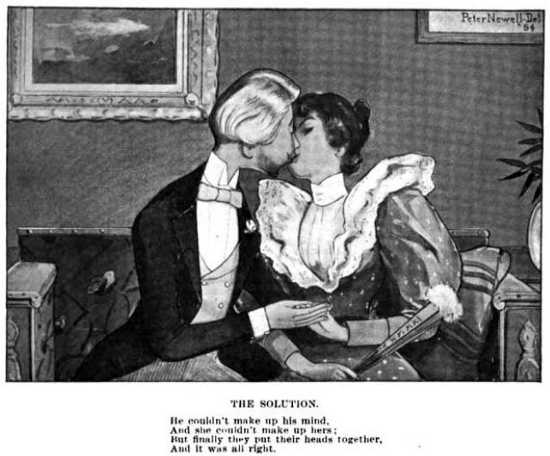
Peter Newell in Harper’s New Magazine, vol. 97, June 1898, p. 159.
A Woolly little terrier pup
Gave vent to yelps distressing,
Whereat his mistress took him up,
And soothed him with caressing:—
And yet he was not in the least
What one would call a handsome beast.
He might have been a Javanese,
He might have been a Jap dog,
And also neither one of these,
But just a common lapdog:—
(The kind that people send, you know,
Done up in cotton, to the Show).
At all events, whate’er his race,
The pretty girl who owned him
Caressed his unattractive face
And petted and cologned him,
While, watching her with pensive eye,
A patient ass stood silent by.
“If thus,” he mused, “the feminine
And fascinating gender
Is led to love, I too can win
Her protestations tender.”
No sooner said than done! And he
Sat down upon the lady’s knee.
Then, while her head with terror swam,
“This method seems to suit you,”
Observed the ass. “so here I am.”
Said she, “Get up, you brute, you!”
And promptly screamed aloud for aid:—
No ass was ever more dismayed.

They tied him up within the yard,
And there with whip and truncheon
They beat him, and they beat him hard,
From breakfast-time till luncheon.
He only gave a tearful gulp,
Though almost pounded to a pulp.
THE MORAL is (or seems, at least,
To be): In etiquette you
Will find that, while enough’s a feast,
A surplus will upset you:—
Toujours, toujours la politesse, if
If the quantity is not excessive!
Guy Wetmore Carryl, illust. Peter Newell, in Harper’s New Magazine, vol. 97, July 1898, pp. 320-1.

Peter Newell, from Harper’s Bazaar, I don’t know the date or issue no.
Houghton Library has published several more manuscript facsimiles of Edward Lear material, mostly early zoological and botanical drawings:

Houghton Library, MS Typ 55.27
Edward Lear album of drawings, [ca. 1830]. MS Typ 55.27 contains a large number of early animal and plant drawings and a few landscapes. Some might actually be by his sister Ann.

Houghton Library, MS Typ 55.12
A number of the animal watercolours Lear did while at Knowsley in the early 1830s can be seen in Edward Lear drawings of animals and birds. MS Typ 55.12.

Houghton Library, MS Typ 55.8
Sketches of the psittacidae,1832. MS Typ 55.8 offers nine drawings that were published in Lear’s parrots book as well as two unpublished ones.

Houghton Library, MS Typ 55.4
Depictions of birds, plants, and insects. 1828-1836. MS Typ 55.4 is a scrapbook containing 80 drawings and watercolours by Edward Lear and his sister Ann.
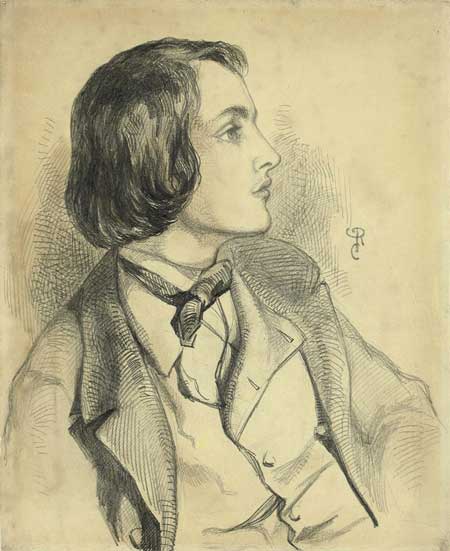
W.M. Rossetti portrait by Dante Gabriel Rossetti
Edward Lear, besides being a universal benefactor as author of The Book of Nonsense (dear to Dante Rossetti), was a very agreeable and efficient landscape designer who had been rather far afield in his quest of the picturesque — Albania, Calabria, Syria, etc. He was moreover an entertaining and judicious writer of travelling adventure, as evidenced in his book A Landscape-painter in Calabria. There is in this volume a deal of genuine Italian character-sketching: Christina was very fond of it. I met Lear in 1852 in company with Holman Hunt, and passed a week or so in their society. They were at Fairlight, near Hastings ; Hunt painting his admirable sheep-picture Our English Coasts, and Lear, who had resolved to put himself under severe discipline as a quasi-Praeraphaelite executant, producing one of his larger oil-paintings, The Quarries of Syracuse. This was quite a new start on his part, as hitherto he had aimed chiefly at telling composition and facile handling. Lear was a rather tall man, spectacled, with a rounded nose and ordinary features. He was a sprightly, easy, unpretentious talker, having knocked about in the world more than sufficiently to acquire aplomb and suppress affectation, and being accustomed to move in “good society.” At Fairlight we had vile spring weather of recurring rain varied with sea mists; and Lear was much given to declaiming against the English climate, which, as he said (and I more than once noticed it to be true), even if tolerably fine before and after his sojourns in his native land, was constantly detestable during those intervals. Another object of his denunciation—but this was in a later year—was the oriental camel, in his view an unmannerly and unmanageable beast, affording material for little save human exasperation. His verdict on the “ship of the desert” anticipated that which has been versified in Rudyard Kipling’s stanzas on The Oont. Lear, in his later years, settled in San Remo. His sight had never been strong, and he became blind. At the beginning of 1887 I was at San Remo with my wife and two children, and I noticed the Villa Tennyson, at which Lear resided. I blameably neglected to call at once; and then an earthquake (much talked of all over Europe) occurred, and my family decamped from the place, and I along with them. Thus, to my permanent regret, I failed to see good old Lear in his darkened retirement. He lies buried in the San Remo cemetery.
Rossetti, William Michael. Some Reminiscences of William Michael Rossetti. New York: Charles Scribner’s Sons, 1906, 156-7.
 A Blog of Bosh